
Sue puts some more detail on the Cadbury Hill experience.
Share this:

Like the best of ideas, it begins with a partly-seen ghost, the glimmer of an edge of something that will work…. Ideas are great, but, unless something is practical and consistent on the day, its value is limited to fuelling a ‘greater’ idea that will be.
And then the right idea expands, filling out, not linearly, but with emotions that billow like a spinnaker on a sailing ship, catching a wind that is not of the individual creator’s making. If the goal is a spiritual one, then that catching of an inner wind has the taste of something that will have a shared effect on a group of people who have come to experience transformation.
The setting for the September 2018 weekend workshop ‘Castles of the Mind’ is the beautiful coastline of historic Northumberland, the border county between England and Scotland, the home of the terrible land-pirates known as the Reivers; and, before that, the place of skirmish, battle and blood between the Scots and the English.
Small wonder, then, that this beautiful coastline has more than its fair share of castles, whose use dates back over a thousand years. They provide the basis of a wonderful chain of historic visits, but their use in this coming Silent Eye weekend (14-16 September) is based on far more than their strong and ancient stone.
Castles of the Mind is based on how we think, feel, act and behave now...
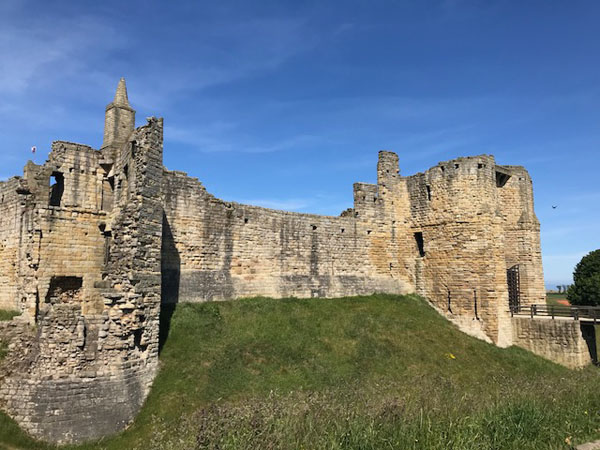
The weekend of 14-16 September will be a mixture of companionship, adventure and fun. We will begin on the afternoon of Friday 14th, assembling for an Italian coffee or English tea, in the lovely town of Warkworth, fifteen miles south of Bamburgh. This classic Northumbrian market town provides a pleasant venue for us to gather and discuss the structure of the weekend.
From there it is short walk (or drive) up the nearby hill to the car park of Warkworth Castle, our first site, and the basis for the rest. Warkworth castle is a unique medieval building. The castle was the favourite residence of the well-known Percy family – the Earls and Dukes of Northumberland. It was occupied by their family from the 14th to the 17th centuries.
Below, on the banks of the river Coquet, and often missed by those visiting, are the ruins of a hermitage, which was carved directly out of the rock.
As a group, we will consider the impact that this imposing castle has on our combined consciousness. We will look at the sheer mass of its presence, and consider the nature of authority and achievement… We may also reflect that, though the purpose of its design is still visible, it is a ruin…
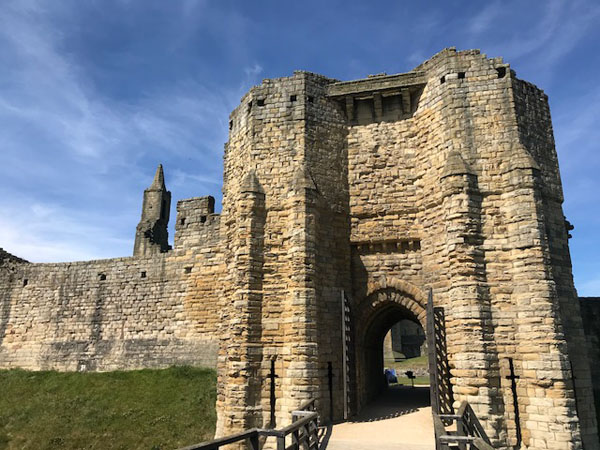
The functions of this mighty power were focussed on the gateway. Though the building’s primary purpose was defence, its real use – the exercise of the authority that security brought – came only when that structure allowed people in… or out.
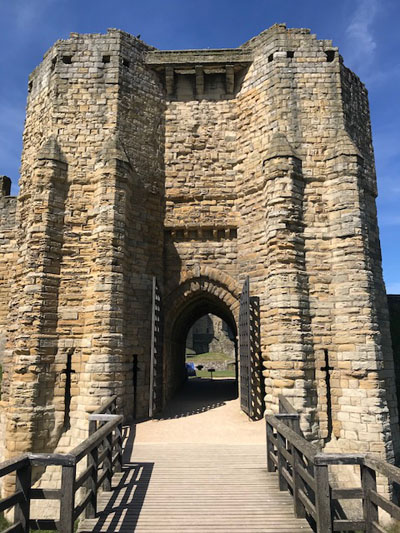
In this, the castle mirrors the basic building-block of organic life: the cell. A cell’s function is to isolate its organic mechanisms from the ‘soup’ of the world around it. Only through this isolation can the processes of individual life take place. It is ironic that, here, in a world where the castle was one of the largest ‘things’ in the world, its function mirrored that of the smallest structure of life.
One of the ‘shocks’ on the path of mystical study is to discover how closely the physical processes of life are mirrored on a higher level within the structures of consciousness. We will discuss this as we peer through the ‘tunnel’ of the castle’s portcullis and gatehouse, beginning to perceive that, beyond the ‘wall that excludes’ there are internal stone structures that hint at a more sophisticated life in the interior – though only able to operate while the protection of the walls continue to operate.
Here, we will consider where fear fits into all this? Is it primal in its power; so deeply rooted that we cannot afford to go near it? Or have we forgotten that, once, it was layered over the foundational mechanisms of our lives… and is therefore a ‘man-made’ reaction?
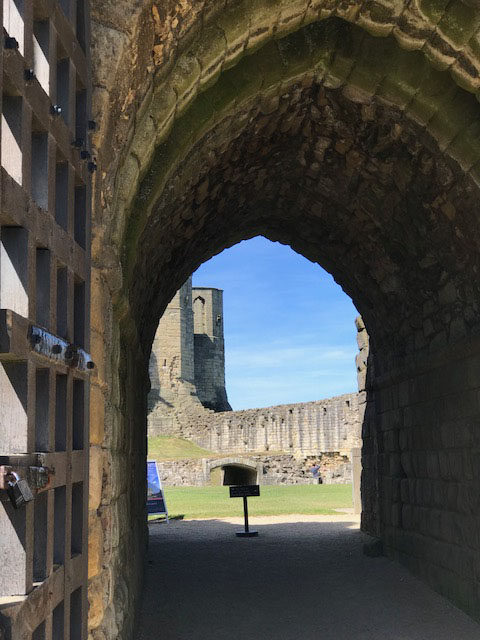
And then something remarkable will happen. We say this with confidence, since it always does. When a group intends to raise its ‘level’ of consciousness by working together, there occurs a moment – early in the event – when everything comes to a point of harmony and productive endeavour.
In the tunnel of the gatehouse, the constricted space that will lead to the essential nature of the weekend, we will ask each person to imagine they are being born into a vision of their own interior nature…
To be continued…
Castles of the Mind is the September 2018 workshop of the Silent Eye School of Consciousness, a not-for-profit teaching organisation that promotes and enables the investigation of our true self, using a combination of modern consciousness methods and traditional magical symbolism. The workshop is open to all, not just Companions of the Silent Eye School.
The Silent Eye holds four workshops per year – in April, June, September and December, mirroring the major events of the solar cycle. The April event is the main one, and is always held in Derbyshire. The other three are ‘walk and talk’ events such as that described above, and are held in different locations each year. The administrative cost is £50.00 per person which does not include accommodation and meals. Meals are usually taken in local pubs and the costs shared.
For more details email us at:
rivingtide@gmail.com.
©Stephen Tanham
Share this:

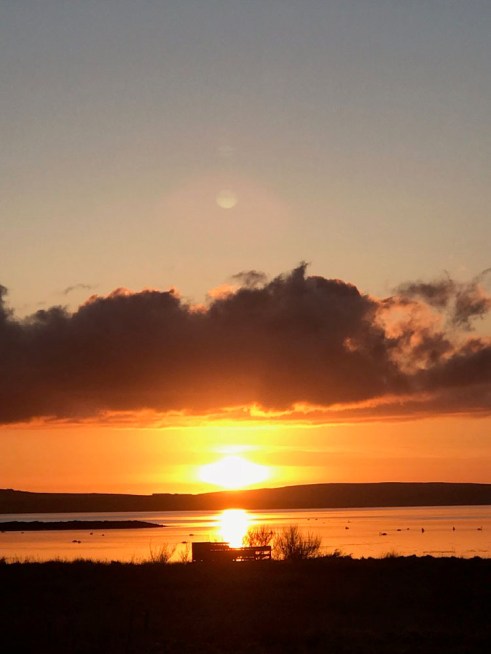
Against the heat, I have to climb
To drink the air so soft and fine
That my sore feet and too hot dog
Seek, daily in these fleeting months
For she who hides the winter in the wine
___
In heady breaths of fragrant fire
My lungs draw deep the hotter bliss
Now fading like the summer’s arc
Will shortly start to downward curve
And ask me did you drink my summer kiss?
—
Where this is known alone endure
The keepers of the summer kind
As, stolen, held, orgasmic joy
Is folded over in-breath’s heart
To lie, concealed, in winter mind
—
©Stephen Tanham
Share this:

From Sue: A deep and thoughtful introduction to Knights Templar spiritual thought….
Share this:

An extract from one of the readings during the Dorset weekend, created by Stuart and Sue.

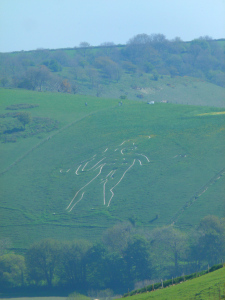
Giant Hill, Cerne-Abbas
*
…We stop, looking out across the processional way… as the torchlight approaches.
The sky is clear, and the Hunter’s Moon illuminates the white outline of the giant.
From the Trendle comes the sound of drum beats… soft and insistent, an echoed heartbeat of earth… the truncated scream of a stag pierces the night as the drumbeats increase their rhythm…pounding like blood through the temples…then dying down to a soft thrumming which waits….
She watches from the hilltop.
There will be blood tomorrow too… for vengeance, for betrayal… for a kingdom…many will fight for her… many will die…but she holds the power.
They will come, over the hilltop, through the valley… and they will be caught.
She has the high ground and those who serve her know its ways…But tonight she watches and waits… there is another service… she watches the dark forms approach from the enclosure…The…
View original post 181 more words
Share this:

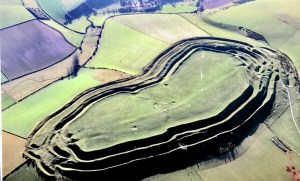
(Visitor board image of the entire Maiden Castle site, regarded as Britain’s finest example of an Iron Age hill fort. ©English Heritage)
He did not know how many were up there…
Centurion Calogerus stared at the edge of the plateau above him. The vast hill-fort rose from the chalk lands below in what appeared to be a series of grassy layers. There were no walls that he could see. This would be quick…
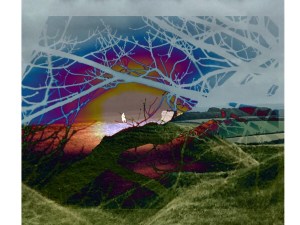
As the dawning sun of the year’s longest day crested the edge of the hill, he smiled in remembrance of his youth. This would have been his birthday; not the day he had come into the world but a new one given by those gentle people who raised him in that far-off province, before the strong and swift youth was snatched from the sea of death and forged into a fearsome Roman soldier.
Calogerus stared into the distance, again. There was a figure up there… A figure so distant that he should not have been able to make out any details, yet he could. It was a priest, he knew. How he knew, he didn’t know…
Below him, huddled in the strange and twisting entrance road, crouched eighty of his best men. Bisected by machines of death on wheels. They were not elite soldiers. They were auxiliaries, trained by their centurion in the arts of war and tactics. Tough and more loyal than he had any right to expect… Give them to Calogerus, they would say, extracting from battles and conquered tribes the best, the strongest, the ones with the bright eyes. He will turn them into Roman soldiers.
And he did… He took the dregs and made them into the best that the Legions of Aulus Plautius contained. The hero of Camulodunum commands us, they whispered, looking at their centurion. Our new master is no coward, hiding behind Roman finery.
And so, when the mighty Legion that was sweeping southern Britain grouped to move on, they used him and his dregs to create the opening, to breach the defences, to probe the weaknesses, and sometimes, to die… A foreigner and not high-born, he had risen slowly through the ranks. For a centurion, he was old.
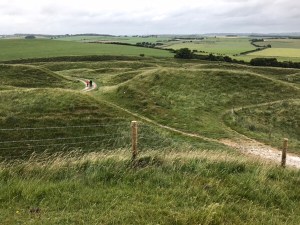
Calogerus looked down at his men, waiting in readiness, and shifted his right hand to his sword’s pommel. Below, in the winding trench – deeper than six men and hollowed to a near-point, like a ‘V’ – the silence became something you could taste… Like iron on the tongue.
He looked up at the distant figure on the hill. For a moment he imagined he was that priest, looking down; then drew back from the act as an image flashed before his inner eye – the one he dared not talk about, when the soldiers drank and feasted and bled. In the image he was a figure in white, seen, not by the priest, but by the hill, itself. He shook himself out of the daydream and found he had been fingering the scar in the middle of his forehead. Too many echoes of his youth followed that thought and he blinked his eyes clear of visions, drawing his sword so that it sang in the morning air.
“Let the memories be gone, forever,” he hissed to the line of liquid green-gold forming on the curved horizon. “Let the light of this longest day wash it away…”
His sword was the signal, and the line moved forward. He followed on the top of the trench, probing the place’s secrets. He was sure there were many. The scholars spoke in hushed tones about this place. There were rumours that it was thousands of years old, but he didn’t believe that. It was just a big hill, and Roman soldiers were adept in the capture of such places. The Durotriges tribesmen – and women – up there were doomed.
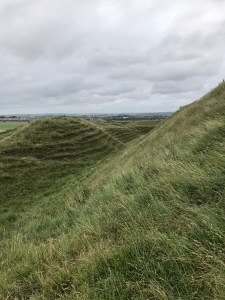
The first shock came when he heard the laboured moaning from below. He stopped to survey the men in the still-dark trench. He could see the sheen of sweat on their bare shoulders, but the noise was not theirs. He peered into the gloom and drew a breath when he saw the bowed wheel of the cart. The angle of the hill, and lack of a flat path at the bottom, was placing strain on the bearing and axle; the heavy weapons on board were doing the rest.
No fools the builders of this hill, he thought. But, no sooner had the admiration registered than there came the crack of breaking timber and one of the carts toppled sideways, pinning screaming soldiers beneath it. In seconds, their comrades came to the rescue, but several were injured.
The centurion uttered a curse before shouting, “Leave it! Ensure the rest of the wagons are forced level. Forward with weapons drawn!”
The loss of one-third of their armaments would weaken their strength, but the biggest cart remained – and it carried the largest punch. But progress was slow, and bore a weariness he did not understand…
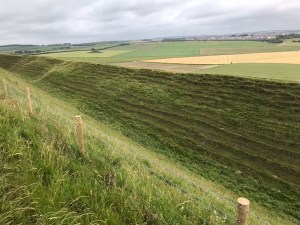
The scouts had said that the gate with the twin towers lay dead ahead, but the centurion had to curse again as the path his men were following – with their heavy loads – turned abruptly left. There was a light path over the top, but the weapon carts would never get up its steep bank. His stomach turned over as he realised the complexity of these defences. Primitive tribes? Calogerus shook his head.
He had no choice but to carry on. They had not been challenged so far. For all they knew the tribe above them were unaware of this dawn attack.
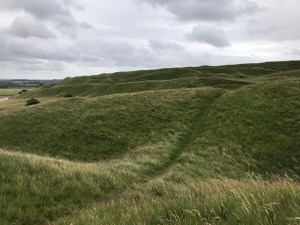
They marched for far too long before the trench turned, again, seeming to snake back on itself toward the point on the hillside where they had entered the site. Here, the walls of the trench were even higher. The wailing noise stung his ears like the feeling of severe pain – as with a deep wound, where the flow of blood is not immediately seen. The centurion spun round, trying to locate the source. His men, far below, were also turning in panic – and he could see that they were becoming more faint in the trench’s gloom.
Calogerus stared at the madness. As far as he could see, his men were not being attacked, and yet they had begun to stagger around, as though injured – or drunk…
The baleful wailing had hidden the other, more subtle invader. The burning grass – the dreaming grass – the clouds of mist were clouds of smoke, washing over the men at the bottom of the trench… And then came a sound like the strike of a hawk and the ground began to shift under the centurion and he fell, rolling down the slopes as the trench walls came alive with snakes. A rough blow with a blunt weapon robbed him of vision and sense…
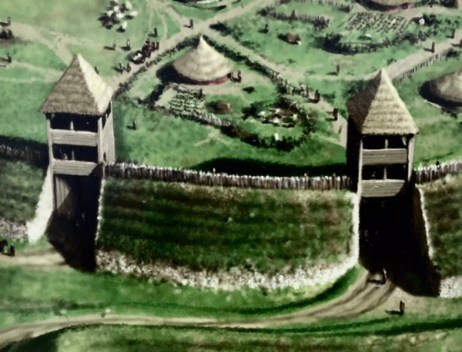
(©English Heritage: photograph of the visitor information board)
He woke to the sight of the gates – a prisoner on their own munitions cart approaching the thick wooden door as it cranked open on its chains. He could see, straight away, that the scouts had been wrong; that the twin towers, separated by the earthen bank, would be much harder to attack. Even here, the paths were curved… Such clever defences.
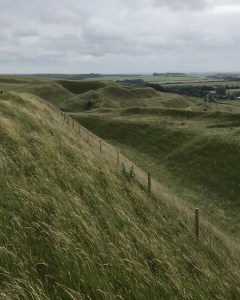
The voice walking behind him was gentle. “Only three of your men are dead,” the priestess said, holding a cup of soaked herbs to his parched lips. We only killed those we had to… the rest were encouraged to flee.”
He tried to sit up, but leather bonds held him fast. “Don’t struggle,” she said. “Your choices are few, but you are alive.”
“Better dead, than this disgrace…” His parched throat rasped the words. She gave him more to drink.
“In a military world, yes,” she said. “But the mark on your head tells the story of another world that once claimed you. She pulled him around and he beheld great beauty and calm eyes that spoke more deeply than he knew how.
“We are both doomed,” the priestess said. “I am not foolish enough to believe otherwise. In days…months at the most, the legion will return and its vengeance will be bloody and swift – and our tricks with paths that curve and the dream smoke will not prevail.”
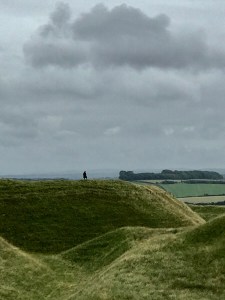
He struggled to rise, again, and this time she helped him, slicing her knife through the bindings at his wrists, but leaving those around his ankles. “For now,” she said.
“They will kill me, anyway,” he said, knowing that his life had reached its end.
As the sun set on the day of the rebirth of his spirit, they held hands on the top of the plateau and faced the west, bathing in the red gold of the longest day’s passing. For now, and briefly, they could be timeless.
The armies of Aulus Plautius were not before them… but they would come, soon enough, as one civilisation died and another – younger, hungrier and more deadly, drank its blood.
Other parts of the Dorset series:
Stuart France’s “Church Crawl” posts which are related description of the Dorset workshop.
This work of fiction is set in the real landscape of Maiden Castle, an Iron Age fort near Dorchester, Dorset. The details of the fort’s defences are real, as can be seen from the photographs. The Durotriges are known to have used psychotropic substances to enhance their rituals, and may well have employed all manner of attack in their complex defences – which are as described.
The visit to Maiden Castle was the last part of the Silent Eye’s pre-solstice weekend, June 2018. For details of the work of the Silent Eye School of Consciousness, and other ‘in the landscape’ workshops, click the link below.
Stephen Tanham is a director of the Silent Eye School of Consciousness, a not-for-profit organisation that helps people find the reality and essence of their existence via home-based, practical courses which are low-cost and personally supervised by email.
His personal blog, Sun in Gemini, is at stevetanham.wordpress.com.
Within, you’ll find friends, practical mysticism, poetry, literature and photography…and some great guest posts on related topics.
©Stephen Tanham
Share this:

From Stuart…
Share this:

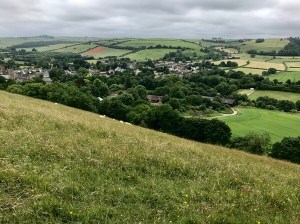
It is said that a chapel dedicated to St Catherine once stood on this hill, looking down at the little town of Cerne Abbas, below.
The original St Catherine was a pre-Christian figure about whom very little is known. She was associated with the symbol of an eight-armed wheel – the famous ‘Catherine wheel’, remembered now in the name of a firework….
Those visiting hadn’t known of the site’s link to St Catherine when the plans for the Silent Eye’s pre-solstice weekend were created by Stuart and Sue. But the presence of symbols related to St Catherine only added to the power of what would unfold in a hidden enclave, below.
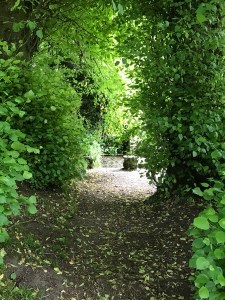
Above: the hidden path down to The Silver Well
——-
Two women wait in the green-kissed shadows of a path leading down to a holy well. They are both recent graduates of the Silent Eye’s three-year course in Self-knowledge. One had her graduation celebrated at the April ‘Jewel in the Claw” workshop; the other has travelled far, from another continent, to be with us on this weekend. In return, we wanted to mark her graduation in a very special way….
——-
The story of St Catherine, like so many of the ancient legends, was absorbed into early Christian mythology. There are many references to her in these parts of the south-west of England, and many are likely to be ‘Pagan’ in origin. The term ‘pagan’ was created to diminish anything that came before Christianity; but the discovery of our own rich spiritual past has given a different tint to this word, in much the same way that the word ‘Quaker’ was originally an insult to those of their persecuted and noble faith.
——-
The woman who has already passed through the rite holds the hand of the other, who is blindfold. The beauty of the place of the flowing water is to be revealed in stages. From the site of the Silver Well, below, the chime is heard. Together: one in knowledge, the other in trust, they descend the path….
——-
In the Christianised version, Catherine was the talented daughter of a noble Alexandrian family. She converted to Christianity as a child, after a vision of the Virgin and Christ Child. After speaking out against a corrupt emperor, she was ordered to be ‘broken’ on an eight-armed wheel. But the wheel broke, rather than its tortured occupant, and the eighteen year old girl was beheaded, instead.
——-
The guiding hand stops the other at the very edge of the flowing water. She can only hear the beauty of what lies ahead. From across the water she senses before her, she hears the first of three voices. A question is asked: she must state what she understands has happened to her in the course of her inner work of three years. There are no right or wrong answers, but the consolidation of the achievement is an important blessing on the soul at this threshold….
——-
The original eight-spoked wheel associated with St Catherine is likely to have been a symbol of the eight agricultural ‘festival’ dates of equinoxes, solstices and the cross-quarter days. Such a finely-tuned calendar would link the subtle changes in the human consciousness to the revolutions of the solar year.
——-
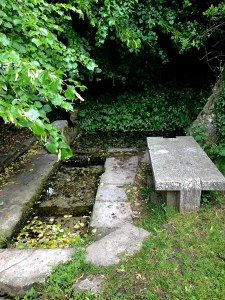
Intense minutes have passed. The three voices beyond the water have ended their friendly questioning. The answers have been recorded and delivered, as a scroll, to the graduate. The blindfold is removed by the guiding companion. The beauty of the Silver Well and its mystical altar are revealed. Ahead of her lies a choice of paths across the stream. There is no wrong path, only what the soul chooses….
——-
When the original St Catherine’s chapel had long gone from its hillside, the monastery of St Augustine stood at the edge of the town; and in its gardens there was a secret place, marked by a well. The well was loved and tended by the townsfolk. It provided much of their drinking water, being at its purest in the spring months when the flow from the hills was plentiful.
The monastery was, eventually, ‘dissolved’ on the orders of the King, whose name was Henry. Only a stone tower (now a private dwelling) and the well, which was likely to have been incorporated into the monastery buildings – as ancient holy wells often were – survive.
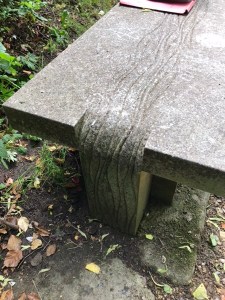
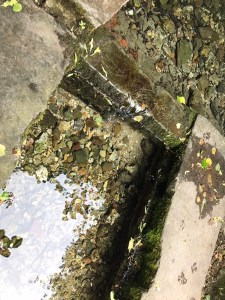
(Below: The pure and flowing water is also carved into the top stone of the altar)
——-
She is shown the choice of paths, and chooses the stone bridge, over which the waters of the stream gently wash. Her shoes are removed and, entering the shallow waters, she crosses to the place of the graduates…
——-
Although the monastery is gone, there remains an altar in this holy place. On its front edge are the Christian words ‘Whoever believes in me’. The full quotation from St John is continued around two of the edges of the altar stone:
‘Whoever believes in me, though he die, yet shall he live.”
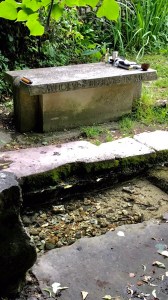
——-
She stands on the bare earth before the altar. With water and with words her hands and feet are washed, and the way forward is revealed. She takes her place and is embraced by all.
The simple rite is finished… The water flows.
——-
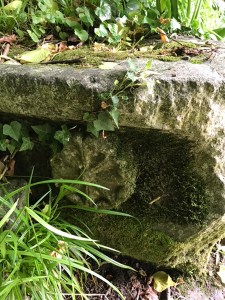
Above: Catherine of the wheel is still here….
The Silver Well remains. The almost-hidden St Catherine’s wheel by the Silver Well maintains its silent presence by the waters.
The Benedictine monastery is long dissolved. The older chapel on the hillside is gone. The ancient saviour-warrior figure carved into the hillside endures, together with the legend of St Catherine. The town celebrates them all, together with the work of its fine church.
There is harmony in Cerne Abbas… and the waters flow.
Stephen Tanham is a director of the Silent Eye School of Consciousness, a not-for-profit organisation that helps people find the reality and essence of their existence via home-based, practical courses which are low-cost and personally supervised by email.
His personal blog, Sun in Gemini, is at stevetanham.wordpress.com.
Within, you’ll find friends, practical mysticism, poetry, literature and photography…and some great guest posts on related topics.
©Stephen Tanham
Share this:

The lovely little town of Cerne Abbas holds a secret that is easily missed.
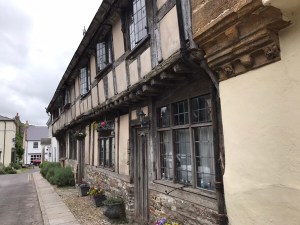
The idyllic streets, some with intact architecture from hundreds of years ago, are a delight. Although well-visited, it feels relaxed. The local people are friendly – something we have found throughout this gentle county of Dorset, filled with villages nestling into green and flowing hillsides.
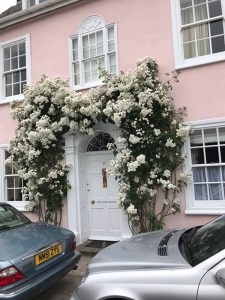
It’s the morning of day two of the Silent Eye’s June weekend, a period of reflection of the coming Summer Solstice, the longest day, the Feast of St John, the time when the ‘fullness’ of the light begins its decline.
Cerne Abbas has an ancient link to the idea of ‘fullness’. It is expressed in a well known icon of the town – the Cerne Abbas Giant. A mere ten minute walk from the main square you come to a viewing point from which this smiling mystery is revealed:
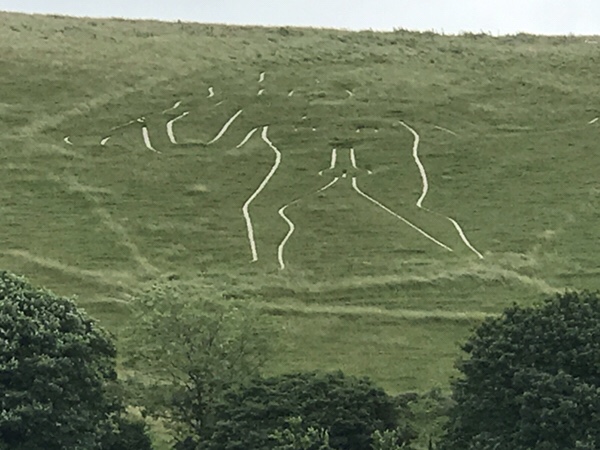
The giant’s main attribute is obvious. Proud and long, he struts his stuff with a warrior’s club in the right hand and a less certain set of objects in the left. What is he? No-one knows for sure. Even the date of his origin is disputed. An ancient tribal leader, perhaps, a figure very much like the original ‘warrior-saviour’ gods from Celtic times, such as Cernunnos, who ruled over the hidden treasures of the Underworld.
Whatever his meaning, the little town of Cerne Abbas loves him. The humour is shared, but the figure, and his link with a legendary past, has a serious connection with the psyche of this beautiful part of England, that goes far beyond the merely commercial.
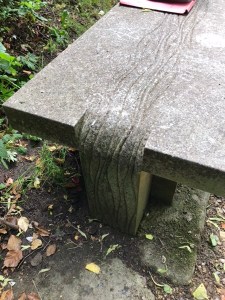
Cern Abbas has another secret; one you would miss if you weren’t shown it. Beside the church is an almost hidden path that leads down to a place of great beauty and significance, and we were planning to us this for a very special ceremony.
To be continued…
©Stephen Tanham
Share this:

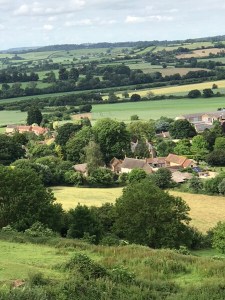
I’ll leave the detail to they who planned this : Stuart and Sue. But, some real-time photos and narration will give a flavour of the Silent Eye’s 2018 pre-solstice weekend, here in beautiful Dorset.

Dorset-based, yet our first journey was 18 miles north into Somerset, to the legendary South Cadbury site of the ‘Arthurian Castle, the site of an an ancient fortified settlement, and a place of great ‘earth-power’. We began at the lovely church of St Thomas à Becket. Not shown on the maps, and with a mysterious past…
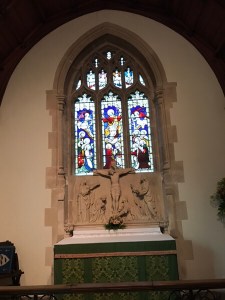
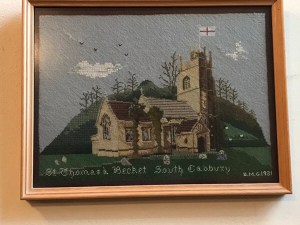
The locally painted picture, above, says it all… by the time this church was built they had learned the folly of imposing new building on places of ancient power, despite the traditional advice of St Augustine.
This one was built just below the hill; to coexist. And, what a hill…
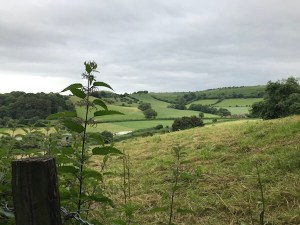
We climbed up Cadbury ‘castle’
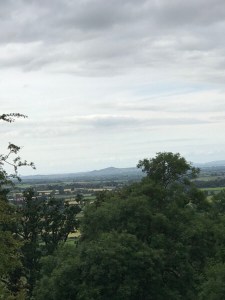
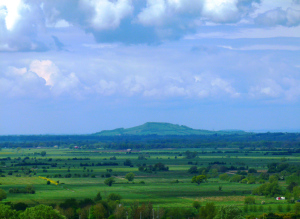
To find the distant north contained the Tor at Glastonbury – day’s walk away. A very special distance, that – the key to much of what would follow, as patterns on the land began to speak.

©Stephen Tanham
Share this:

From Stuart, as we gather for day two of the Dorset weekend
*
…”The why, is always the same.”
“In order to connect, or to make whole?”
“And in order to then participate in that wholeness.”
“Which is connection.”
“They call Glastonbury England’s ‘holiest erthe’.”
“Perhaps that is why?”
“Today, we look up to the night sky, and wonder, and dream of perfection.”
“Or, at least, some of us do.”
“Perhaps, there was a time when, at certain junctures in the sacred year, to participate in that perfection was just a days walk away?”
Share this:

+ #SE18Characters, #Silenti, Jewel in the Claw, Mystery Play, Mystery Schools, Spirituality, The Jewel in the Claw
Jewels in the Claw (viii)
by Steve Tanham

Continued from Part Seven.
He – the man with the packing cases – picks up his empty tea cup and begins to walk towards the small table near the entrance door of the large room in which the mystery play ran its course. It’s important that everything is cleared, he thinks; restored to how it was, pristine…
Laughing to himself, he realises that he is walking the edges of the square of what was the royal court floor, though nothing of it remains outside of his imagination…and the memories of nineteen other people who helped bring it to life.
This was her space, he whispers to the silent air, still reverential, still listening for her commands to those within the square of black and white, the world of polarity. That, moment…that moment when enough had been seeded by clever language and innocent moves within the squares. That moment when the Sovereign stepped forward, intellectually, to declare her intentions. His memory of that second is acute. He relives it, but as what? Is he the playwright, above the creation, but guiding it as director? No, his involvement is still too acute. Is he, then, William Shakespeare, a character that thinks he is a creator? Perhaps… Or, is he each of the characters, permitted to play alongside the actors, if in memory only?
Putting the cup down on a table top full of other used cups, he realises he is all these things, because he is alive, and graced with the evolving stories of life – both his and the life of the world in which he lives and writes. And, most importantly, that the lives of the other players came together with his, and his with theirs, and the result was beautiful.
Realising this, with a clarity that is shocking, he shifts from writer to playwright character, to Queen…
Robert Cecil, horrified and incredulous has just spoken.
“Your Majesty, the Jesuit is still in our presence!”
The Queen holds back the smile out of deference to her First Minister, and scolds the man with the folded hands, sitting, quietly, in the West of the court… with whom she is secretly delighted, though she would have let Frances Walsingham kill him, had Dr Dee not been so… upright. Few understand what being a Queen entails… the embodiment of purpose.
“Priest! I gave you leave–are you so eager to forfeit your life?”
The Jesuit stands. His quiet voice belies the fear he has generated in her world – but not in her. “Your Majesty, I mean no offence,” he says. “I have no home as such… My life is spent in the shelter of others’ homes, often locked away in dirty holes in the ground where I must wait out Lord Cecil’s men… And all this for the giving of the Mass to those that need it! Never have I plotted against the Crown, never have I sought to cause distress or fomented uprising against your government or your reign.”
The priest looks down at his own feet, shaking his head in disbelief that he is still here, mere yards from two of the Queen’s closest guardians who would run him through in a second, if permitted. But the small voice continues:
“A man I do not know has just saved my life – an honest man, in my opinion – and the image of Christ within me says: ‘Stay and risk what little is yours to help defend him.’ You did promise me safety if I became part of this gathering. I beg you to let me stay a while longer and see if I can earn a deeper contribution, here”.
The Queen watches through narrowed eyes as Dr Dee looks at the Lady Rab’ya, who looks at the priest. The Saracen woman knows what Dr Dee knows: that the essence of the whole chamber has changed… And The Queen knows it, too.
Robert Cecil is still standing, glaring at the Jesuit. His words are fully the equivalent of Frances’s dagger.
“Your Grace! I can take no more of this!”
The Queen puts as much gentleness into her voice as she deems proper. “Robert, you are a good man. Stay with me… my plans are only partly unveiled and I seek, before God, to do no harm to you or your causes.”
She watches as the twin forces within him wrestle for his soul: his desire to better his father in service to his Sovereign; and his need to kill the long-hunted priest. He breathes deeply but is not calm.
“I am a good man, Your Majesty; I would follow in my father’s footsteps. For years he hunted that man, who was protected by some of the richest families in your Kingdom! Now, I have him in my grasp and you want me to let him go!”
The Queen gathers the material of her royal dress, allowing a few more seconds to pass.
“Robert, I, too, fight with the legacy of my father – King Henry. They were dark times… When I was halfway to my third year, my mother was taken from me, to walk, mere days later, to her execution. Later, still young, along with my dear Dudley, I was thrown into the tower by my half-sister, Queen Mary… Just Dudley, me.. and the ravens, the three ravens…”
The ravens, the three ravens that will come to mean so much more in this chamber… She continues:
“Your father, Baron Burghley, and Frances’s father, Francis Walsingham, swore to protect and guide my young life… and they did… A debt I could never repay.”
She must tell it from the heart, now. Must bare some of the most hideous detail to help this young, gifted and determined man raise his eyes and see beyond vengeance.
“Your father once told me that he had calculated that the Tudor dynasty had taken the lives of more than fifty thousand people. He left me to draw my own conclusions. Must we forever feed this cycle of blood and terror? The mighty Armada is vanquished. Even Imperial Spain does not have the wealth to rebuild it.” Then, softly. “Robert, could we not, now, build on the peace, in matters religious as well as military?
Robert Cecil says nothing. He holds his head in his hands for a moment, then rises, still full of rage. He strides down the Outer Court’s passageway, stopping to glare at the Jesuit, then wrenches aside the heavy door of the court chamber, letting it slam closed as he leaves.
There is silence in the royal court. For a while, not even the Queen dares to speak.
Other parts in this series:
Part One, Part Two, Part Three
Part Four, Part Five , Part Six
Stephen Tanham is a director of the Silent Eye School of Consciousness, a not-for-profit organisation that helps people find the reality and essence of their existence via home-based, practical courses which are low-cost and personally supervised by email.
His personal blog, Sun in Gemini, is at stevetanham.wordpress.com.
You’ll find friends, poetry, literature and photography there…and some great guest posts on related topics.
©Stephen Tanham


 Sun in Gemini
You must be logged in to post a comment.