+ #Silent Eye, #Silenti, Child of Light, Consciousness, esoteric psychology, Higher Mind, Incarnation, meditation, Mindfulness, Mystery Schools
Age and the Inner Life
by Steve Tanham

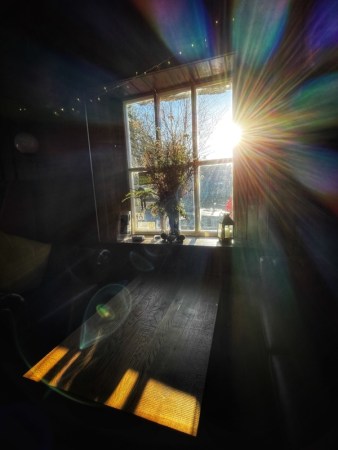
How old are we?
It’s often a cruel question and we wrestle with the answer, knowing full well how many years downstream we are … but feeling, not too deep inside, that our inner state bears no relation to that set of two digits…
Traditionally, this has been dismissed as just part of our psychology. We don’t want to feel old, so we learn to feel young inside. Personally, I find this a thin explanation, and one that does not fit the facts.
Much of this is related to health. If we are fortunate to be well – regardless of our age – then we naturally feel young. That ‘youthfulness’ is actually part of being well, not of the numerals attached to us by officialdom.
Having spent most of my life in the mystical tradition, this mismatch between age and ‘felt age’ intrigued me, and I began to look at fitting it into a broader and much kinder explanation.
Our bodies gradually wear out. Genetically we are programmed to have a finite life. I read that, from the age of about thirty, we are getting old, rather than older. The decline takes a long time, and allows us to mature, become parents and even active grandparents.
We are not helpless in the face of this. We can take responsibility for our own health – in particular, for the state of the primary systems of our body. Smoking is obviously a route to a shorter life, and one in which the end may be deeply unpleasant.
Exercise is its own reward, but it takes effort to get to a mental and emotional place where we look forward to it. The quality of food we eat matters. What really makes a difference to how we live our lives is our mobility and flexibility – the elastic within our muscles and joints. The growth of Yoga and Pilates groups demonstrates the effectiveness of these ancient systems (Pilates is a modern derivative of Yoga). I can say from four years of personal experience of the latter that it has literally changed my life and that of my wife. We not only feel twenty years younger, but we have far more energy than we can remember having at say, forty.
As children, we are like rubber bands. Everything is fun and everything is bodily flexible. We exercise all the time, and our cardio systems are fully functioning. It is natural to simply feel the power of youth in our organic selves.
But these things are of the body. They are not about the invisible attributes that are so much the centre of the idea of ‘me’ – the sense of self.
The planet can be said to feed the body. We inherit from great Nature the patterns of healthy cellular life. The body, via the senses, feeds the mind: the self ‘inside’ the body, though we can’t really allocate the mind a ‘home’, just as we can’t physically point at the future, the past and the present.
Yet the present is all we have, and even in that we have what seems to be precious little. If we try to pin-point the present, it’s gone… And yet we know, somehow, that the present is at a level of ‘here and me’ occupied by no other presence in our shifting landscape of matter.
The present has an existence like nothing else… second only to the awareness that knows both the present and itself. The present is continuously passing and only our reactions try to cling to it.
That non-static awareness is our Being, whose properties are itself, and not built on or borrowed from anything that we would find familiar in the world of matter.
Put simply, the Being that we truly are – reflected in the mind and the body – has no age, and like the idea of Russian Dolls, nested one inside the other, it has always been there, prior to the mind and prior to the body.
The body will leave us at so-called death, its molecules returning to the good Earth from which it came – itself an eternal world of matter-as-energy and energy-as-matter.
The mind has spent the lifetime facing the body, but its nature is not the world that is the body’s home. At the end of the body’s life, it must ‘turn’ to see of what it is the product, and in that homecoming, it will find the answer to its final questions.
How old will it be? It will be as ageless as it was at the birth of its world.
At our transition, the mind loses its bodily senses, and turns to what was always the source of its world and even its own life. In that mystery is the answer to what does not age, and a suggestion that the golden trail to that state is what lends our personal inner it’s signature of agelessness.
©Stephen Tanham 2023
Stephen Tanham is a Director of the Silent Eye, a journey through the forest of personality to the dawn of Being.
http://www.thesilenteye.co.uk and http://www.suningemini.blog
Share this:

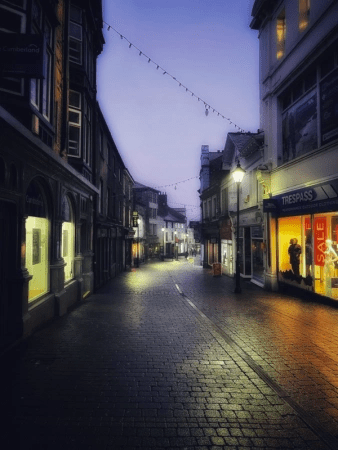
Kendal, midweek… the retail day was drawing to a close. A thin fog had covered the town and its surrounding hills for most of the day, and the encroaching darkness at the end of the afternoon made the gloom seem even more dense.
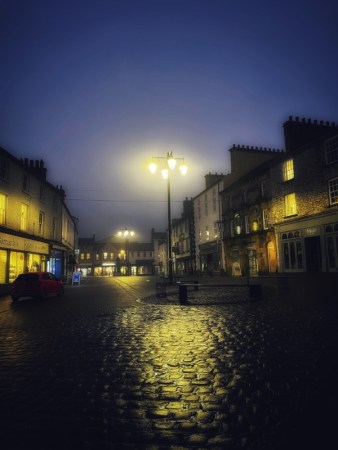
I have always been drawn by urban photos of streets where the lights have that ‘just turned on’ look. Collie in hand, I decided to criss-cross the town centre and look for a few examples of my own…
Kendal is full of very old alleys that connect various streets, revealing its old design in the process. Using these as shortcuts, you can plot an interesting figure of eight through the town.
As I approached the car park, two of the best shots emerged, though had I not been energised by the previous few, I might have missed them.
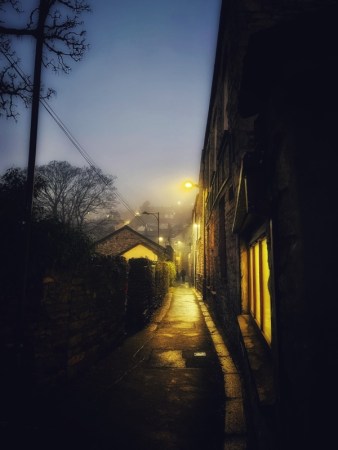
Neither were in locations that would have been considered attractive. The long and narrow alley to the foot of the steep Fellside district (above) would have looked dull and grey without the lights.
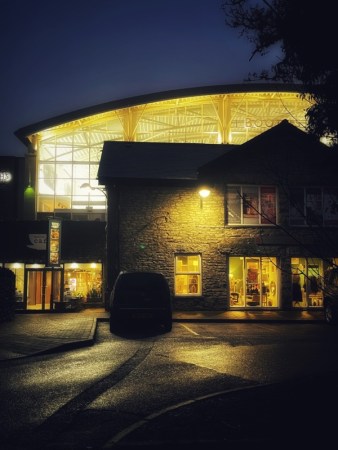
Setting off on the walk, I had no idea if the iPhone camera would cope – but it did. Using the edit tools over a coffee before leaving the town centre, I was able to isolate the light by making it more moody and yellow, and set it against a complementary sky by marginally upping the blue in the fog.
All of that on the iPhone… We are fortunate to live in an age where we can carry such creative potential in our pockets…
©Stephen Tanham 2023
Stephen Tanham is a Director of the Silent Eye, a journey through the forest of personality to the dawn of Being.
http://www.thesilenteye.co.uk and http://www.suningemini.blog
Share this:


One of the ‘easy wins’ in photography is to vary the shooting height of the camera by either getting higher… or, as in this case, lower.
The large-screen camera phones have made this easy to do, since once you have placed the device on or close to the ground – often thanking your last Pilates class – it’s still possible to see the shot framed in the screen.
A final trick is to tun the phone upside down, bringing the lens close to the … mud, in this case. Normally, this corrects itself when you look at the image, but if not you can easily rotate the photo using the device’s inbuilt tools.
The Stone Jetty, Morecambe, in the bitter cold of last Monday. I’ve upped the blues to emphasise this, but not by much… And good luck with the mud!
©Stephen Tanham 2023
Stephen Tanham is a Director of the Silent Eye, a journey through the forest of personality to the dawn of Being.
http://www.thesilenteye.co.uk and http://www.suningemini.blog
Share this:

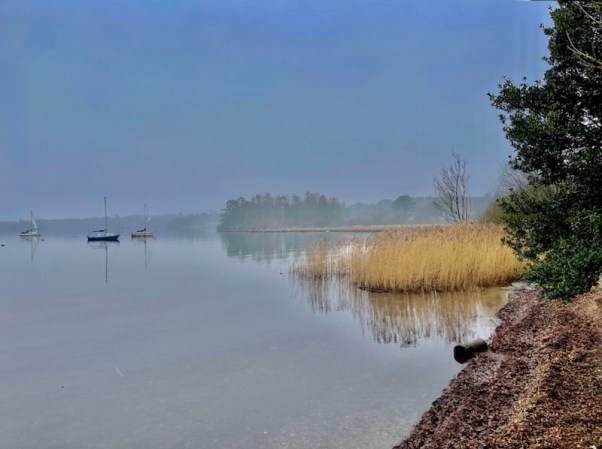
There are many symmetries in life but one of the least remarked on is the complementary states of early and later life relative to where we place our attention.
When young, despite ‘trailing clouds of glory’, as Wordsworth elegantly wrote, we are completely in-volved with the physical world ‘out-there’. From the wonder and adoration of our baby state, through the realisation that we can interact with what is around us, into the fumbling competence of our teens when we sense that mastery of certain aspects of life might serve us well for what follows.
Our lives then follow a familiar pattern: the responsibility of parenthood, perhaps? Most certainly the looking after of ageing parents of our own. Perhaps we take on voluntary work of some sort, eager that our developed skills should serve some other purpose than our survival and prosperity.
These things are the beginning of the ‘invested’ foundations of old age; a time in which we need the grace of acceptance, but also the ability to discern and use the great curve of outer then inner on which our life has travelled.
Any contact with meditation in its many forms will show us the immediate value and astonishing peacefulness of time spent ‘lowering the volume’ of the world and increasing our presence in our inner world that belongs, delightfully, to us alone.
The first steps might simply be to lessen the habitual power that the ‘out-there’ world has over us. We may benefit from self-study of our reactions, in particular – coming to see how much of our behaviour is automatic and even robotic.
Mindfulness is a much-abused term, but a combination of mind-state awareness plus an identity with what slowly emerges as an ‘has always been there’ self will propel us into a profound lessening of our attachment to the things of the world.
Other things take its place: that love of, say, poetry returns. We may finally take the time to learn to draw, speak French, or join a local choir. In short, the world of things is being replaced with a world of not-things; a world where the self of habit simply crumbles beneath the warm and glowing presence of a ‘higher Self’.
This higher Self owes nothing to the routine development of personality, which is long-established, but it can change the personality to suit its more gentle and refined intent. Older people can assume a ‘wisdom of the elders’ – a state deeply valued in ages gone by, but little noted in this one, where the main focus seems to be the primacy of the 30 second piece of media fame.
When the body passes beyond fatigue and begins to fail, this new Self can look with great power back at the lifetime and know that it was strengthened by its further encounter with matter. As Professor Brian Cox (who holds no spiritual beliefs) has said:
Your very atoms were once the stuff of vastly powerful suns and they have been assembled to give awareness of time and space in an age when our technology allows us to physically see the process of the ‘birth’ of the universe. What more could you ask?”
Having grace in old age – internal Self focus- is the compensation for the far away youth where we were wholly in-volved with the world; where our bodies radiated health and we drank the stuff of life from dawn to dusk.
But this final stage of life need not be without purpose other than reflection. There is a trail of the wise to be had, one that, having cast off the attraction of materialism, wants to know where this sense of higher Self and presence radiates from. The answer will lie on the trail of what ‘awareness’ actually is, and on that journey more and more of the world will fall away… leaving more and more of the Self.. smiling.
We could say that the fascination with the ‘world’ is the sign of an earlier age that wraps us in its energy. Perhaps the development of peace, acceptance and presence is the embrace of the inner age of our lives.
©Stephen Tanham 2023
Stephen Tanham is a Director of the Silent Eye, a journey through the forest of personality to the dawn of Being.
http://www.thesilenteye.co.uk and http://www.suningemini.blog
Share this:

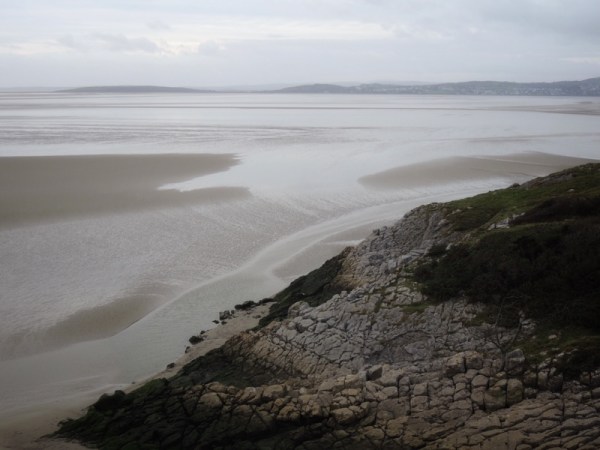
I was talking with a friend about life – not a generalised view of life, such as we might do in an introductory talk to mysticism, but in the sense of what life actually is…
The topic of life led us to consider health… and how we might picture health and it’s inevitable effect on the final stages of our lives.
And then I remembered a kind of moving image I had many years ago in a partial dream-state.
In this vision, life was revealed as a beautiful flowing ocean over which our ordinary waking consciousness navigated, as would the captain of a ship.
Beneath the level of the waves, the ocean depths were festooned with all forms of life, possibly representing the evolution of our bodies.
But the sea was anything but level. Far beneath the waves were giant mountains; countless in number.
The aging process was one in which the water gradually lowered its level, eventually revealing the sharp peaks beneath. The captain of the ship had to start being careful about the course – being prepared to change direction to avoid the emerging dangers.
The undersea mountains were the hazards of life – including injury and illness. When young (the full ocean) they were of no concern.
Eventually, as the water level fell further, great skill was required to navigate the vessel at all. There came a sense of inevitably that our fitness for organic life was diminishing and that we would find ourselves surrendering to the fact that our ship was no longer sufficient to continue our journey.
The undersea mountains had always been there, and always would. But the ocean lifts us above them…
Although this sounds depressing, the sense that accompanied it was not negative; rather a recognition that all life was linked and really one, but that our time as individuals in that gift of nature that is our bodies was limited: what has a beginning must have an end.
I hadn’t thought about this for many years, but our conversation brought it back, and I thought I’d share it here…
©Stephen Tanham 2023
Stephen Tanham is a Director of the Silent Eye, a journey through the forest of personality to the dawn of Being.
http://www.thesilenteye.co.uk and http://www.suningemini.blog
Share this:

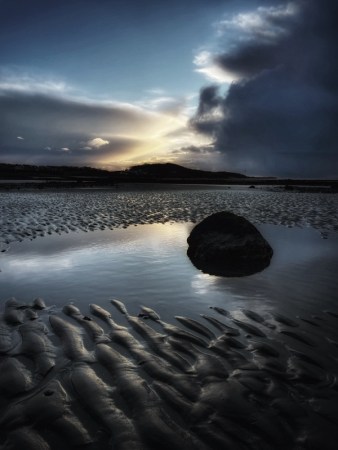
Late afternoon and a final run on Heysham Beach for Tess the collie.
And then strange things began to happen in the sky. Bright sun on a collision course with a front of hailstones.
Not the place to be! So I grabbed a final shot and we ran for the car…
Only later did this joyful result reveal itself!
©Stephen Tanham 2023
Stephen Tanham is a Director of the Silent Eye, a journey through the forest of personality to the dawn of Being.
http://www.thesilenteye.co.uk and http://www.suningemini.blog
Share this:

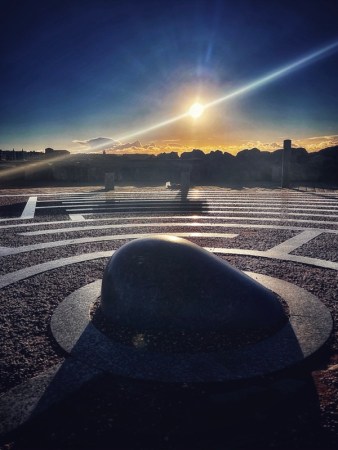
In an attitude that most of us would find chilling, Francis Crick, the Noble Laureate who co-discovered the structure of DNA, referred to it as ‘the astonishing hypothesis’.
He wasn’t talking about genes, but the proposal that all human feelings, actions and thoughts – right down to the level of consciousness, itself, are the products of neural activity in the brain. In truth, science continues to struggle to explain consciousness, which seems to precede matter in any serious consideration.
The results of such thinking expose the human to some of the most pervasive and well-funded exploitation in our species’ history; and this at a time when individual human rights are being eroded and, often, erased altogether.
Vast sums of money are spent influencing our consumer behaviour. One of the best examples, and known world-wide, is the annual American Super Bowl whose 30 second giant adverts have been a frontline battleground over the years for such clashes as Apple vs IBM personal computers and, more recently, the ‘cola wars’, in the form of Coke vs Pepsi.
Vast sums of money are to be made selling us flavoured, fizzy water, and the average costs of having a 30 second advert at the world’s most viewed sporting event have risen from $37,500 for the first one in 1967 to an eye-watering $7 million in 2022. We will return to the ‘cola wars’, later, as they now feature as a case study in large-scale doubts being aimed at this emerging pseudo-science…
The field of neuromarketing purports to offer a method of applying the science of Neurobiology to test and quantify our consumer preferences. Apparently, we are not always rational creatures… Who knew?
Technology that extracts, and possibly changes, the mind’s layers of preference and choice is expensive and very specialised. The idea of the ‘wired brain’ has long been the domain of sci-fi.
Neuromarketing or ‘consumer neuroscience’, studies physical and electronic changes in the brain to predict and manipulate our decision making. In decades gone by, it was considered a frontier science, but claimed successes over the past few years have bolstered its reputation and seen vast investment from companies who have most to gain.
But the most recent findings from ordinary human-based consumer research – which is fighting back – have confounded this. We live in interesting times in the battle for the dwindling money in our pockets.
“Neuromarketing” loosely refers to the measurement of physiological and neural signals to gain insight into our motivations, preferences, and decisions, which can help to fine-tune marketing programmes for advertising, product development and associated pricing.
The two primary tools for scanning the brain’s electrical activity are Magnetic Resonance Imaging (fMRI) and EEG. Magnetic resonance imaging uses strong magnetic fields to track changes in blood flow across the brain, and is administered while a person lies inside a machine that scans them over a small period of time – a bit like a photocopier scanning its target piece of paper but a bit more intimidating. It’s a familiar device in images of advanced tech in medicine.
An EEG (electroencephalogram) reads brain-cell activity using sensors placed on the subject’s scalp; it can handle large volumes of data in a short time, but is less effective at pinpointing exactly where the activity occurs or measuring it in the deep, subcortical regions of the brain, where the more interesting activity takes place.
An fMRI machine can look deep into the brain but is cumbersome, and it tracks activity over the course of only several seconds, which may miss key data. One of the deciding factors is that fMRI machines are many times more expensive than EEG equipment, typically costing millions versus about £20,000 for the alternatives.
Tools for measuring other physical indicators that ‘track’ brain activity – called ‘proxies’ – tend to be more affordable and are easier to use. Eye tracking uses our focus ‘fixation points’ to measure attention and can even indicate ‘arousal’ using pupil dilation.
Facial-expression coding which reads the minute movement of muscles in the face can measure emotional responses; and also heart rate, respiration rate, and, again – via skin conductivity – arousal. We may surmise that arousal is related to craving and many companies could love to link it to their products.
Some of the neuromarketing approaches claim to, effectively, ‘reverse the process of evolution’; drilling into our motivation from the outer brain layers that control our rational behaviour, down through the powerful emotional regions and, even lower, to the ‘reptile’ layers of the inherited instincts – the latter have changed little in the recent development of mankind. At that level, we appear to be ‘hard-wired’ lizards and intent on staying so.
It’s sobering to relate modern politics to such a model. Instructive, too…
“I got ma beer…”
Lizard cartoon
It is fascinating that from the perspective of the law, neuro ‘science’ can operate freely within what even psychology regards as ‘moral territory’. For example the ‘lizard’ brain would equate with the powerful but unruly ‘id’ in Freud’s model of human behaviour – something even the most experienced psychologists approach with caution. The unchallenged nature of such intrusion by marketeers into what and who we are should worry us all…
The attraction of this market-led descent of consciousness into the primaeval, is that companies sponsoring such work can readily relate to it. If I’m a purveyor of a new fizzy drink, and have risen to the top of my management pyramid, I might easily understand why removing evolution’s constraints at the personal and social levels of consciousness – so that I could get my product to be not only acceptable but craved – would be a good idea.
Interest in consumer neuroscience took off in the mid-2000s, when business school researchers started to demonstrate that advertising, branding, and other marketing tactics can have measurable impacts on the brain. It’s currently on a high, but the exciting claims are not always being backed up by scientific results. Perhaps the big lizards in big marketing aren’t getting all their own way. Our human complexity may be our saviour, yet.
Pepsi is famous for funding a massive marketing campaign to knock Coke off the world’s top spot.
In 2004 researchers at Emory University served Coca-Cola and Pepsi to subjects in an fMRI machine. When the drinks weren’t identified, the researchers noted a consistent neural response, apparently in favour of Pepsi. But when subjects could see the brand, their limbic structures (brain areas associated with emotions, memories, and unconscious processing) showed enhanced activity, demonstrating that knowledge of the brand altered how the brain perceived the beverage. In simple terms, people in the test related more to the better-known Coke.
This reversed the prevailing ‘drill down to the lizard’ focus, and shows that our higher ‘selves’ could ‘reach down’ and correct the world of ‘craving’. This continues to be a hot topic…
Four years later a team led by INSEAD’s Hilke Plassmann scanned the brains of test subjects as they tasted three wines with different prices; their brains registered the wines differently, with neural signatures indicating a preference for the most expensive wine. In fact, all three wines were the same.
We can’t expect the newly graduated high-flyer to take a moral stance when she begins that hi-tech marketing job. Protecting the human should be the work of government, who need to be more on our side than ever before.
Sadly, the trends are the other way. Britain’s exit from the EU – one of the few institutions that has formulated punitive policies for corporate violators – is currently being celebrated by our right-wing government’s planning a bonfire of former European regulations protecting the individual’s rights and employment protections; exactly at a time when they need to be strengthened.
The fundamental crisis in all of this is the voting public’s lack of understanding of the heart of these complex issues. As long as that prevails, there is little hope that democracy will function as it is supposed to: to protect the people.
Power knows how to manipulate. When you’re hungry and your children are cold, you don’t have time to learn that.
©Stephen Tanham 2023
Stephen Tanham is a Director of the Silent Eye, a journey through the forest of personality to the dawn of Being.
http://www.thesilenteye.co.uk and http://www.suningemini.blog
Share this:

+ #Silenti, English Lake District, Lake District, landscapes, nature, Photographic techniques, Photography, Places and Prose
Some days define…
by Steve Tanham
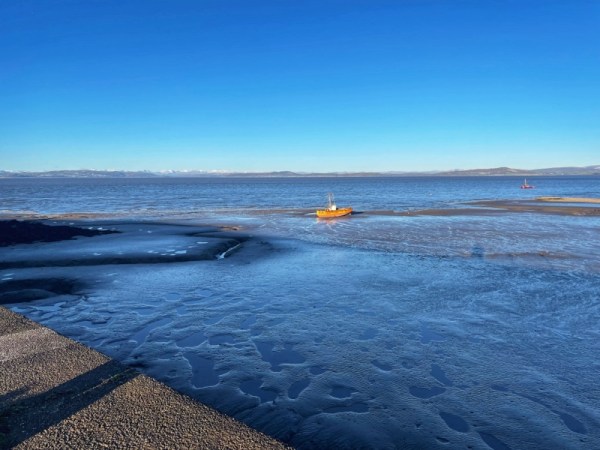
Some days define…
In this case the cold. The vastness of Morecambe Bay is sometimes defined by its light. In this case the deep blue of an early afternoon with icy winds to match.
Ice on the foreshore by the lifeboat’s hovercraft station, clustered into tiny pools on the dark mud.
Two small fishing boats – most of Morecambe’s shrimping fleet – provide the only colour break to the endless electric blue; striking in their fragility.
From the jetty – unseen, left – falls a shadow so subtle, it looks alive, providing more dimension to the wet, black sand where none dare tread.
Blue, cold, vast.
©Stephen Tanham 2023
Stephen Tanham is a Director of the Silent Eye, a journey through the forest of personality to the dawn of Being.
http://www.thesilenteye.co.uk and http://www.suningemini.blog
Share this:


The entire one-mile promenade at Grange-over- Sands is decorated with a series of rock gardens.
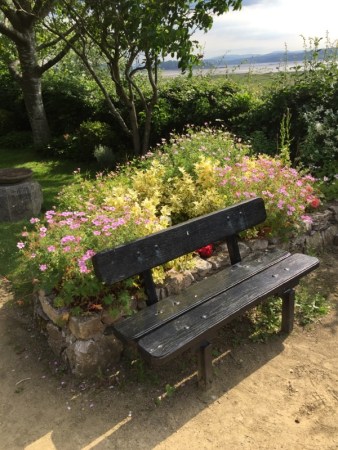
These are looked after entirely by volunteers whose work is most active in the summer, but continues, in terms of maintenance, during the colder months, when there is little else to be seen.
But that is not always the case…
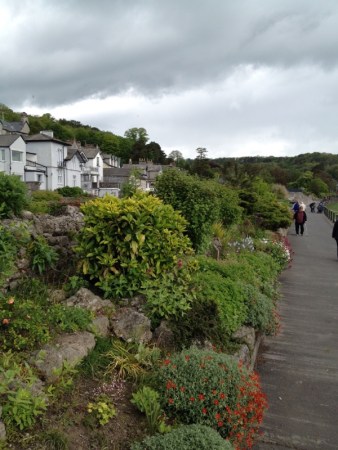
Grange town centre is a few hundred metres behind the promenade and its gardens. The railway line is closer than you would imagine!


Each volunteer is assigned to a team which looks after a garden within the overall set. The quality of work and presentation are outstanding.
From time to time, a new section is created – often following a bequest.
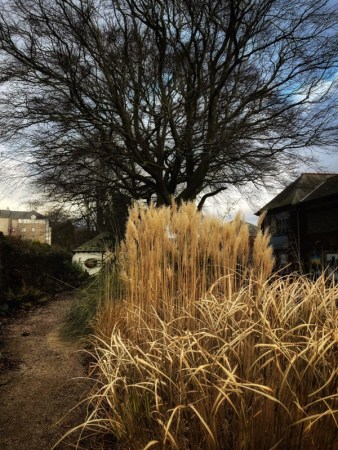
The Stumpery is a recent example. Designed to provide both winter and summer interest, this simple ‘hidden park’ is small oval, only some of which is designed to be seen when walking by. The interior, seen above and in the opening photo, is an example of how grasses have a continuing presence when almost all of their companions have shrunk to an herbaceous mound.
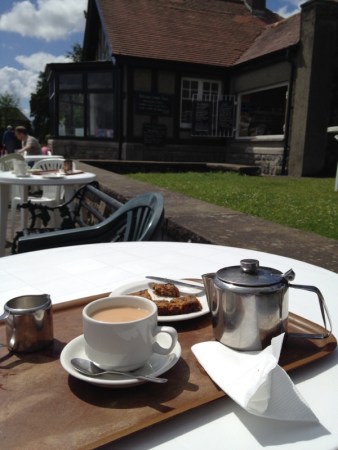
All the other photos were taken in July…
©Stephen Tanham 2023
http://www.thesilenteye.co.uk and http://www.suningemini.blog
Stephen Tanham is a Director of the Silent Eye, a journey through the forest of personality to the dawn of Being.
Share this:

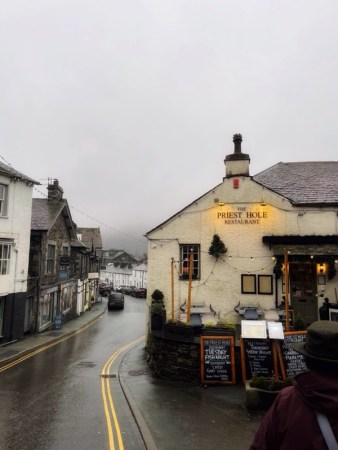
We were walking through a very rainy Ambleside a few days ago. What I smilingly call my ‘camera mind’ spotted how well the lines and colours of the Priest Hole pub contrasted with the wet and uniform grey of the January light.
I also loved how the bright ‘double yellows’ led the eye away into the misty gloom…
The ‘lead-line’ of the road on the left was attractive, but my attention was fixed on the roof angle of the pub … and I didn’t know why…
I considered my options with the image. One colour stood out. I needed to conserve the paleness and the hint of yellow – I knew that was important but I had little idea why.
Studying the shot again at home, I remembered I’d saved a screenshot from Instagram of a beautiful image by a photographer I follow: bnwshot_world.
I dug it out and, sure enough, the angle of the woman’s hat, which partly obscures her face, was ‘sympathetic’ to the sloping roofline of the pub. I’m constantly amazed at what the mind can remember in symbolic form. I’m sure I’d have forgotten her birthday…
I was not planning to use the B+W image in anything other than an illustrative fashion, and at lo-resolution. Using the trusty iPad’s own image tools cropped it down to this:

One of my favourite techniques – and a pastime anyone can try – is to digitally ‘overlay’ two images that look like they belong together. I had my two images – one borrowed – and began to play with how they might look.
Immediately, I could see that ‘wedge of light’ of the model’s skin under the hat and above her society-event dress was a lucky fit for the slanting angle of the pub’s roof.
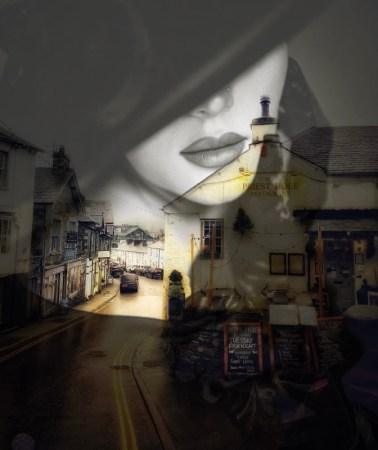
So, what’s the story, here?
A mysterious and rich woman moves into a rather grey Lakeland town. Perhaps in her mind, she is re-living something romantic from her past? Then again, she is dressed all in black. Perhaps there are darker motives?
Maybe we can make a contest of it. Bottles of favourite plonk (as before just images to keep the postage costs down) for the back-story that fits the crime… Sorry facts… Mmm.
I’ll do my best to publish any that are sent in. Just one short paragraph, please! Like you’d find on the cover of a new book.
If you’re an Instagram user, please take a look at bnwshot_world. I find them a constant source of classy inspiration.
©Stephen Tanham 2023
Stephen Tanham is a Director of the Silent Eye, a journey through the forest of personality to the dawn of Being.
http://www.thesilenteye.co.uk and http://www.suningemini.blog
Share this:


There are photos that epitomise some particular quality of the natural world.
January has a dearth of such moments. Its light is so thin that composition – outside of the contrasts of monochrome – is practically a matter of pot luck.
But I was lucky. This part of the promenade at Grange is one of the coldest places you can be at this time of year. The expanse of Morecambe Bay deposits it’s breezes in summer – and gales in the winter – on wary joggers and dog walkers. Almost no-one else is out there…
But, for a few moments, the sun shone. Then disappeared for the rest of the day. And I happened to be on top of the railway bridge when it did so.
©Stephen Tanham 2023
Stephen Tanham is a Director of the Silent Eye, a journey through the forest of personality to the dawn of Being.
http://www.thesilenteye.co.uk and http://www.suningemini.blog
Share this:


We were driving back from Ilkley with a clip full of ‘winter Wharfedale’ photos, many of which were destined be spoiled by the falling light along the riverbank or too ambitious in the first place.
In decades gone by, the pain wouldn’t only have been the attempt and failure, but the cost of paying to have them developed and copied to photo paper, only to consign most of them to the bin … with expensive regret.
Prior to the development of Manchester’s city centre tram service, which crosses forty miles in each direction: north-south and east-west, we would set off from our offices on Salford Quays to take our rolls of actual ‘negative’ film to one of a number of specialist high-street shops, only to repeat the journey for the collection of the finished prints a few days later.
It was a tiresome process. But when the results were good there was a great sense of elation as you held up that physical print that would, without doubt, be good enough to win a prize.
“Nonsense!”
It’s the competition judge in the back of your mind – even if you choose to ignore him…
Back then, when you looked at the pile of rejects on your desk, next to a much smaller pile of possibly worthy shots, you had an instant visual indicator of how well you’d performed with that roll of film and your expensive SLR (single lens reflex) camera.
None of this was remotely digital, of course … well, the metering might have been.
It was common for expert photographers to urge us amateurs to take lots of shots so that we could learn by doing: both well and badly. And also learn by bending the rules – like occasionally shooting into the sun, rather than the conventional wisdom of following the brightest light rays to the subject.
All photographers have this rosy picture that their children and close friends will want to leaf though their photos when they’ve gone…
They won’t. The best thing you can do for them is to take out 90% and consign them to the actual or digital bin – or persuade the local history museum to take them. If you do this, then you have a chance that one or more of your descendants or close friends might enjoy looking at your structured memories…
Most of photography is very much of the now…and we need to be prepared to pass out of other people’s now in a clean and orderly way.
But back to our return journey to Kendal…
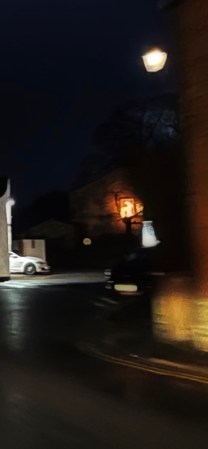
Crossing through the pretty village of Gargrave on the outskirts of Skipton – one of the anchors points of the Yorkshire Dales, we tuned into a Radio 4 programme about the gradual handover of the stonemason’s craft to the architect.
Cosy in the car’s warm cabin, we listened as the quiet and intense ‘radio time’ passed in the company of Andrew Ziminski, the author of the book in the opening paragraph.
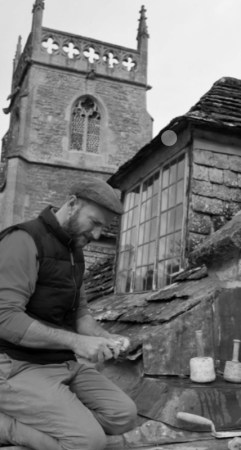
Ziminski is an authority on the history and significance of building in stone. His knowledge is respected internationally, and he lectures across Europe. His uniqueness is that he still works as a stonemason, and his special skills have been employed on many critical repair projects in stone.
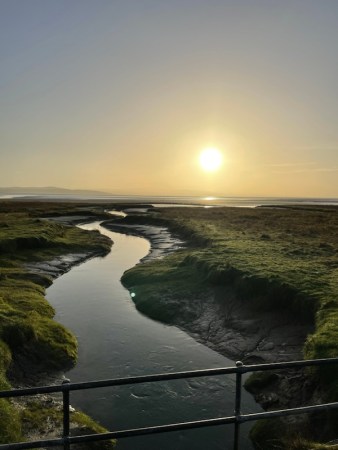
Given that the master craftsmen in particular were often accomplished designers, architects and artists as much as they were artisans. He points out that, regardless of the fame of what they worked on, they were all engineers who spent years learning the technical skills needed for their craft.
One of his favourite tricks to immerse us in the world of the stonemason is to conduct a journey through time, and references two of his ‘perspective journeys’, the first of which examined the year through its festival holidays, ending on the Celtic festival of Samhain and the feast of All Saints – on 1st November.
Ziminski, who has a good eye for nature, can expressively describe the changing seasons in vivid detail.
House martins twitter as they close in on a condensing insect swarm, spiders spin webs around me as I sleep on site, and I am often to be found among bat roosts under bridges.
The second ‘time journey’ is one through the history of building with stone in the British Isles. It begins in a Neolithic chambered tomb and ends with the modern use of concrete.
In this way, Ziminski fills our imagination with the struggles and progress over a thousand years.
I’ll close this post with the two most dramatic perspectives that he gleaned from these time journeys:
In the first, he speaks of how, within a family of stonemasons, the father would begin the creation of the building. The son would continue the work but not see it completed. The grandson would be present at the grand opening and nurse it through the infancy of its use.
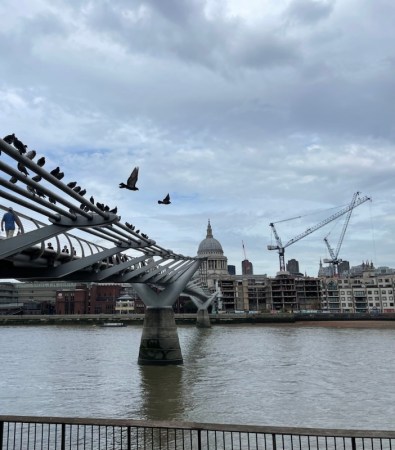
He contrasted this with the modern techniques of modular building and said that, by comparison in the world of the architects of today:
in the age of the modern architect, the building would be delivered by the architect; the ‘son’ would witness its decline, and the ‘grandson’ would see it demolished.
Two very different worlds… Perhaps it is no mystery that we return, time and again, to our favourite stone masterpieces in an increasingly transient world.
Photography is the most transient art. Can we photograph the future? On the face of it, no. But the future is an interweaving of the strongest currents of today. We can with some accuracy predict things. A very accurate example is the movement of the planets; vast but regular.
God does play dice, but usually at the level of the very very small. And she does it for variation and not amusement.
We could go back to the bank of the River Wharfe and say that this particular 100 metre mass of water travelling at 3 km per hour – will be very much the same mass that passes another observer, 3 km downstream, in an hour’s time. We could even throw in a rubber duck to test it… But that’s just my sense of humour rather than ‘sense’ of scientist…
Now, where’s that picture clean-up routine?
©Stephen Tanham 2023
Stephen Tanham is a Director of the Silent Eye, a journey through the forest of personality to the dawn of Being.
http://www.thesilenteye.co.uk and http://www.suningemini.blog


 Sun in Gemini
You must be logged in to post a comment.