
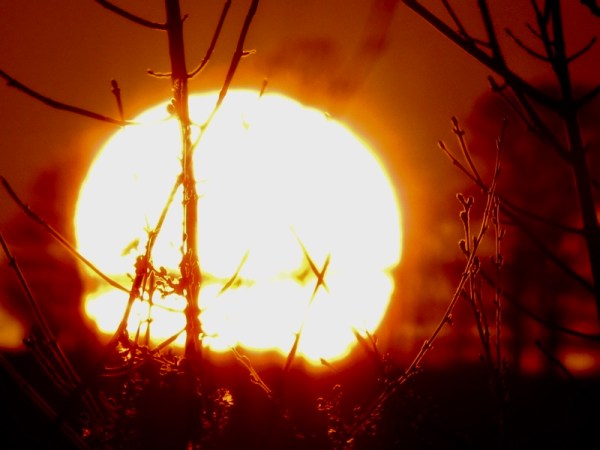
In Part One, we looked at how most of our daytime consciousness is made up of actual words that are spoken within. This can be quite a revelation if we have become used to them but never really observed the fact. This flow of internal language is busy narrating the events of our existence, our opinions and our reactions, as though we carried it as a kind of ‘robot’ in our heads.
This robot forms part of our self, but it is a lower part compared to what is available to us. Studying this robot can teach us a lot about how we live our lives; and particularly about how we react.
But our true ‘selves’ are not far away. The robot has created its reactive maze over our lives, but beneath this domain, in a place it cannot reach, is the realm of the Real.
The Real is our realm of Awareness, which we do not realise is a separate place from the spinning wheel of noisy and intrusive thoughts.
Awareness exists in many forms. We can say the most primitive cellular life-forms have awareness of their physical or chemical environment. There is a hierarchy of knowing above this base level comprising: Information; knowledge, wisdom and eventually something that the ancients knew as gnosis – an intimacy with the truth of a situation that is self-evident and powerful.
The world of gnosis, or self-evident and self-powerful knowing, lives beneath our world of thoughts and personality. When we are able to stop the flow of verbal thoughts, we immediately sense its presence. The quiet sweetness of this place is like a summer breeze. There is no hurry or need to do anything. We have entered a state of simply ‘being’.
The mind has always bothered itself with the stuff of our lives, and primarily, the product of the senses – the most important of which is the concept of the whole body. In that ‘sense’ the body is ‘me’.
And for many people that is enough. They accept that the body will one day die and ‘take with it’ the psychological personality that has sustained a sense of self through that lifetime. We may choose to believe in a religious form of death in which that personality – refined to its soul essence – enters another Kingdom, after a suitable period of review of the life lived.
For others, there comes a strong sense that what might survive death is already here; already part of our daily life – but not the personality. Many who have been raised in conventional religious backgrounds struggle to grasp what the non-Abrahamic ‘religions’, such as Buddhism, are proposing as the deeper truth about life. The essence of this alternative approach to consciousness-development is to get ‘beneath’ thought; to find that quiet place where the chatter stops.
We can compare ‘being’ not to the letter three, but to the zero. Zero, becomes the final part of our One-Two-Zero sequence. We are not used to thinking about nothing: literally no-thing. Our minds are used to a flow of subject-object relationships: I make the tea. ‘I’ is the subject; ‘tea’ is the object. It’s the way we use language and is deeply useful for the level of thought needed in everyday life.
But I can’t say ‘I make nothing’. I might get away with it if I mean it humorously. But apart from that, ‘nothing’ is not an object the mind understands. It cannot fashion or describe no-thing. Mind is the organ of experience, and none of its body-facing experience has been about ‘nothing’. As Jung said, only deep sleep has brought it into contact with the infinite.
And now some blog-writer wants your mind to think about nothing; no-thing. And it can’t. But the value of attempting to think about no-thing – or zero – is that it trips up the normal processing of the mind and makes it think about what might underpin the world it constantly describes in worm-word chatter.
I can’t have zero carrots. But if I had seven carrots and someone took all of them from me, then the accuracy of now having zero carrots – in view of the fact that I did have seven, is useful. Someone might now owe me for seven carrots, for example…
The mind is capable of interacting with far more than just the body. But the finer realms in which it can fly freely are not those those of daily life and its habitual thought processes.
Which is what we have been doing in these three posts…
The deeper and largely unseen secret nature of awareness will be the subject of another series of posts.
The ‘One’ exercise in Part One is aimed at showing us the truth of this realm that lies just below our regular consciousness. All we have to do is to suspend the regular flow of thought (and keep doing so) to enter its beautiful space.
You may think access to ‘being’ is a lifetimes’s work, but it’s not. It is right there, right now. The seeing that looks out on the world through the lenses of the personality is at the heart of both our body and spirit. All we have to do is to shift habit with enough force to get the beautiful mind to drink the zero.
To paraphrase the Sufi mystic Rumi; All you need to do to get to love (the joy of reality) is to remove the barriers you have carefully erected against it…
Other posts in this series:
This is Part Three, the concluding post.
——————
©Stephen Tanham 2022
Stephen Tanham is a Director of the Silent Eye, a journey through the forest of personality to the dawn of Being.
http://www.thesilenteye.co.uk and http://www.suningemini.blog
Share this:


We had gone to bed early – exhausted by the journey from Poolewe to Uig.
What felt like a full night later, I woke, refreshed, to find the sun streaming through the bedroom curtains… Not a sight we were used to on this trip.
I smiled. It’s always nice when something really special ‘just happens’ on your birthday. Ahead of me was a day of gentle celebration and good food… However, for the next hour at least – since my travelling companions were all good sleepers – I had the world to myself.
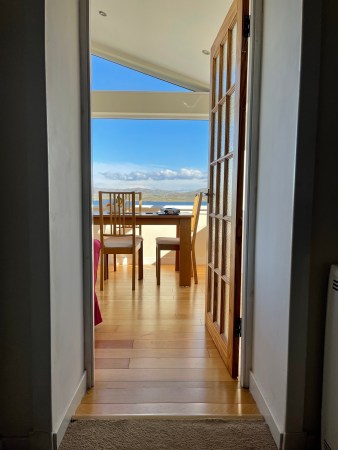
Leaving my wife, Bernie, peacefully sleeping, I eased myself out of bed, put on a T-shirt, shorts and sandals and quietly ventured out into the lounge, then into the kitchen of the holiday cottage, smiling at how much better this place was than our rather basic accommodation at Poolewe.
I made a pot of tea – a cup is never enough – and grabbed a handful of cashew nuts; my usual start of day. Following the glow of the intense sun, I turned to go out onto the patio. As I slid the patio door open, I caught sight of the wall-clock. It was 05:30 in the morning…
As with the previous evening, the extent of the summer light was startling. The outside deck was flooded with the dawn, and it seemed to spill over into the rest of the garden. Clutching my tea, I sat down to commune with a dawn that had just broken over the nearby hill…
I could try to describe the beauty of that moment, but with this photo we can share it…

A birthday dawn of extreme beauty. I sat and gazed for a long time…
After two more cups of tea, I reluctantly left the natural splendour of the loch-facing garden and ventured back into the cottage. The ever-present midges were starting to feast on me and it was time to get the day started.

A leisurely two hours later, we were enjoying an egg and bacon breakfast surrounded by sunshine in the dining room. But as the meal progressed, the skies began to darken, and a chillier wind could be felt entering the open door. My main present brought a smile: my longed for coat… I would finally be not only warm, but weather proof…

No-one apart from Paul, whose people-carrier we were travelling in, realised that I had left my walking coat back in Cumbria, and had been relying on a windproof top plus three layers for survival…
Not any more! I slid the new coat on and ate my final slice of toast and marmalade wearing it. The darkening skies were beckoning… I was ready for the challenge.
We had a few simple things planned. After the tiring previous day, we wanted a gentle pace. We had heard that there was a local cooperative store a few miles away. The plan was to top up the car with fuel and see if they had any fresh produce. The following day would be Sunday and all the island’s shops would be closed.
But first, the two dogs needed some serious exercise; and a beach was called for. The frisky Collie and the blind but happy black Labrador had been wonderfully patient throughout yesterday’s journey. Now they would need a good run on another of Lewis’ famous beaches.

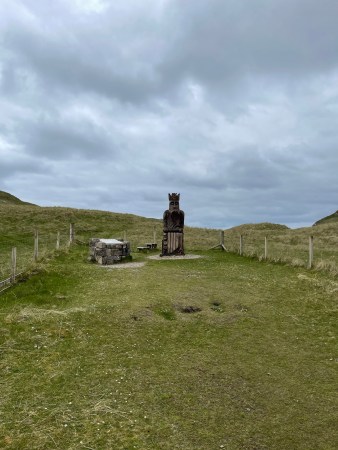
We consulted our detailed map and located a long beach – Uig Sands – not far from the cooperative store. A two-in-one approach would suit us well. We drove straight to the beach without stopping, but noticed a mysterious sculpted figure set back off the road. The dogs were too desperate, so we didn’t investigate. There would be time on the way back.
The Collie and the Labrador howled their way out of the people-carrier and we watched them chase off along the sands. My new coat – on since breakfast, was perfectly warm against the increasingly cold winds on the open expanse of beach. It was a warm and happy moment!
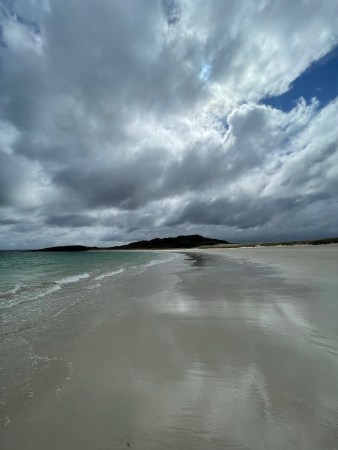
We walked for over a mile along the beautiful beach, stopping only when the incoming tide made the sand too wet to continue. An hour later, we were back in the car and intent on a coffee at the community co-op. But first we wanted to investigate the mysterious figure by the main road.
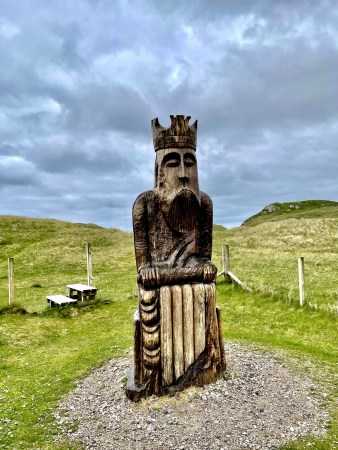
We had heard of the Lewis Chessmen, but didn’t know on what part of the island the famous Viking figures had been discovered. It turned out that the mysterious figure marked the most likely spot, though the exact location is not known.

The figure above, carved in oak by Stephen Havard, was commissioned in 2006 by Uig Community Council and erected with the co-operation of Ardroil Grazings Committee. It is based on one of the kings in the famous collection of walrus ivory chess pieces which were discovered near here in 1831.
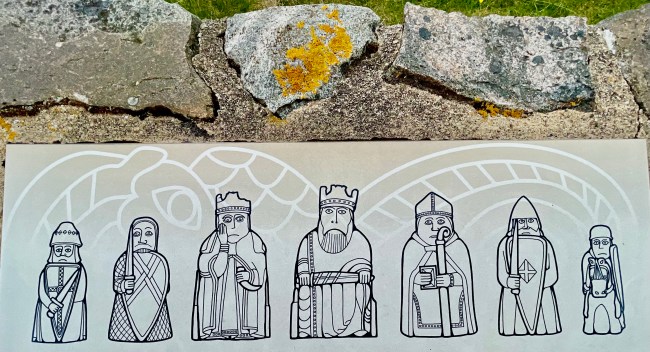
They were found by Malcolm Macleod of Pennydonald, hidden inside a small stone structure in a nearby sand dune. Eleven of the exquisitely carved figures are in the National Museum of Scotland in Edinburgh and 82 in the British Museum in London. They were probably made in Norway in the twelfth century during the 450-year period when the Norse ruled the Western Isles.
Back at the holiday cottage, the two ladies and I were treated to several rounds of gin and tonic. Paul had nobly offered to drive that evening to the local ‘fish and chip’ shop to get our tea, since nothing else was open. We were to eat them in the car overlooking Uig sands…
At least that’s what they told me… You can imagine my surprise when we pulled up at the most modern looking building on the island – the Uig Sands Restaurant

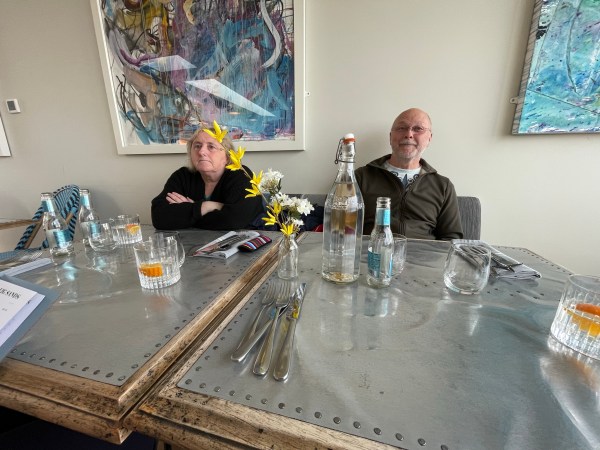
We had a delicious seafood dinner. The restaurant – one of the best on Lewis, is run by a local fishing family who have successfully diversified.
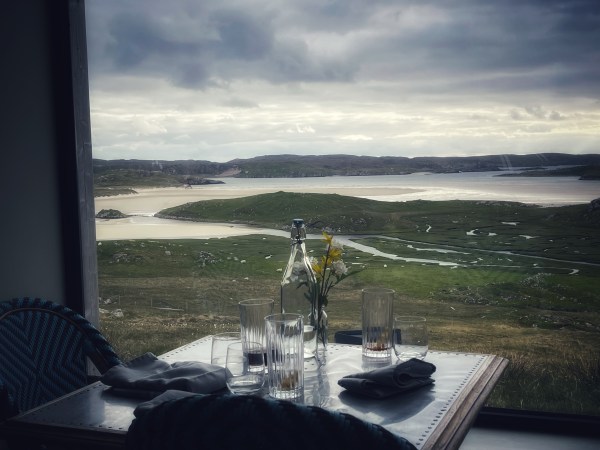
Soon, we were back at the cottage, being warmed for bed with a dram or two of single malt. It had been the most wonderful day… and I hadn’t been cold, once.
Part One: https://suningemini.blog/2022/05/24/a-poolewe-diary-1/
Part Two, https://suningemini.blog/2022/05/31/a-poolewe-diary-2/
Part Three, https://suningemini.blog/2022/06/06/a-poolewe-diary-3-the-loch-on-the-back-of-the-oats-box/
Part Four, https://suningemini.blog/2022/06/14/a-poolewe-diary-4-once-upon-a-time-in-the-far-north-west/
Part Five: https://suningemini.blog/2022/06/21/a-poolewe-diary-5-over-the-minch-to-lewis/
Continuation onto the the Hebridean Island of Lewis:
A Hebridean Diary: Part One – Impressions of Lewis
A Hebridean Diary: Part Two – Long Road to Uig
A Hebridean Diary: Part Three – Of Coats and Kings (this post)
©Stephen Tanham 2022
Stephen Tanham is a Director of the Silent Eye, a journey through the forest of personality to the dawn of Being.
http://www.thesilenteye.co.uk and http://www.suningemini.blog
Share this:


The tree on the right marks the farthest point the setting sun reaches on its solstice progression across the ridge beyond the garden.
From the dark wood lattice of winter, through the joyous green spring, to the fullness of summer, I never tire of standing outside the house and attempting to capture a little of its evening splendour…
Falling away, now, as it nears the first tree – the marker that tells me I must leave behind this year’s zenith; though there is still much the garden will bring to profusion and song.
But summer is brief and we need to hold its glory in our hearts to remind us of ‘what can be’.
It’s a little like a nature-prayer, perhaps? Reminding us that the inner light that fires the emotions to action is never far away…
©Stephen Tanham 2022
Stephen Tanham is a Director of the Silent Eye, a journey through the forest of personality to the dawn of Being.
http://www.thesilenteye.co.uk and http://www.suningemini.blog
Share this:

In part one, we looked at a simple but effective technique to remove us from the ‘head chatter’ of the flow of verbalised thoughts in our mind. Use of the deep word ‘ONE’, although another word, itself, can act like a ‘bullet’ to stop the stream of often unconscious words that cloud our attention, affect our emotions and drain our energy.
If you’re tried this over the past week, you’ll know it not only works, but starts to reconnect us with peaceful and purposeful level of ‘belonging’ – a place and state with which we have a deep sense of identity. In other words, it feel like home.
It’s worth spending some time noting the qualities of this inner state: Alive, fresh, resilient and happy… and often described as ‘sweet’, in a literal sense.
A friend said of his experience: “It feels like the me I’ve always wanted to be”.
Do any of these things have ‘value’ in the normal, egoic-self world? They can’t be counted or have any other value placed on them; only an approximate description of how they are. But how things are can never be truly described. It exits only in your consciousness. To be more accurate, since consciousness is a much-abused term – how things are can only be the subject of your ‘awareness’. When we use this, we are doing so in a quite different way from it’s common usage. More will be said about this next week.
Mystical writers don’t mean to complicate things; they usually seek to be accurate, but in my experience, when dealing with things of the soul, we need to be direct… almost to shock…
Let’s greet it for what it is. This is the YOU. Its vibrant, sweet and resistance-less nature accompanied you to birth as an infant. It has always been you. If this is you, then what is the other, external you – the personality?
The personality is a machine of protective responses, a shell, an electronic suit of armour that you have grown around every aspect of your sense of self to protect its own preeminence from the attacks of the world.
But the real YOU is this new, inner being that has always been there. It’s not fragile. It’s just covered up and largely ignored because of the sophistication of your ‘day-self in the world’. It busies itself keeping you alive and healthy – when we let it, and waits for the time when you’ll want to meet.
To help us move further into awareness. Let’s add another Deep Word: TWO.
We can go into our ONE state in any set of conditions of the outer life. It doesn’t matter if we’re active or passive. Sitting in our favourite chair or driving the car through the horrible morning traffic, sitting on the bus or the Tube… Or meditating. let the ONE Word seize and silence the chattering Worm-Words, and, as soon as you feel that sense of sweet connection, say (mentally or physically) the word TWO.
As you do so, see the golden circle of calmed awareness created by the ONE word and visualise that it is just in front of you. Mentally reach out your hands and clasp the left and right sides; at the same time rotating this linked ‘you and it’ as though you are being spun around.
You are now on the inside… Looking out – not through the eyes of the personality – but through the eyes of this Inner YOU that contains everything you could need or want.
If thoughts persist in describing this as it’s happening, shoot them down with the ONE world spoken by the TWO consciousness.
The TWO place came before the personality – the ‘daytime you’. That is why the personality is wary of it. The personality – the egoic self – has no powers to affect it; only cloud it over with habitual patterns of what’s important.
The TWO self lives in the world of Being; a place whose nature and laws are different to the outer, material realm.
Nothing is more important than this TWO state, and the more we surrender to its loving embrace, the more we will see the outer ‘world’ in its true, non-reactive presence… and all its glorious beauty.
In the final post in this series, next Thursday, we’ll add another number to complete the series of ‘inner moves’, and come to better understand the nature of Being…
Other parts in this series:
——————
©Stephen Tanham 2022
Stephen Tanham is a Director of the Silent Eye, a journey through the forest of personality to the dawn of Being.
http://www.thesilenteye.co.uk and http://www.suningemini.blog
Share this:


The day was already old by the time the ferry from Ullapool had docked at Stornaway. We had been warned that shops were few and far between on the Hebridean island of Lewis and advised to take advantage of the supermarkets in the capital.
The no-sunday trading laws imposed by the ‘Wee Free’ Presbyterian church were in force across the island, and we were unlikely to find exceptions, so stocking up the provisions was a really good idea – tired though we all were.

Finally equipped with a large box of groceries, we set off, somewhat weary, for the Uig peninsula, all the way across the width of the island. The route seemed straightforward, and didn’t look that far on the map. What we didn’t know was that most of the island’s roads were single-track, with passing places.

Fortunately, the main route east to west was a normal, two-lane highway, but it turned out this only took us half-way to our destination. Coming to the end of the major road, we were faced with single-track and having to use the stopping places to let oncoming cars pass us. The locals are used to this kind of driving, and are well able to judge the road, ahead. They were also very fair with ‘who was there first’. It took a few days for us to get the hang of it. Once you do, you can make much faster progress using this ‘protocol’ from the past.
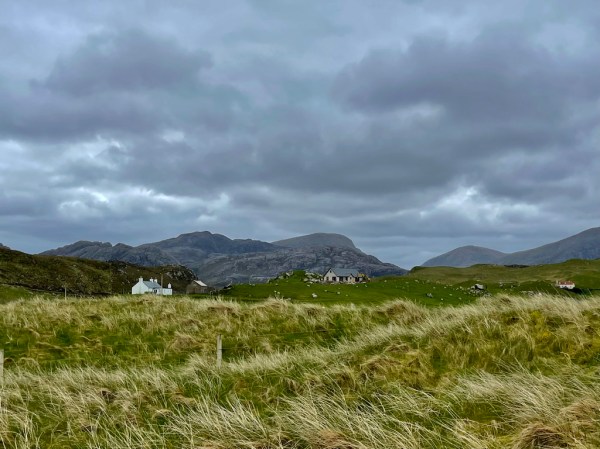
The sheer ’emptiness’ of the island makes an immediate impact. The landscape is unchanging and composed of low hills, winding lochs and innumerable outcrops of white rock. The view across to the west showed a line of large mountains – presumable the last land before America. It was to take us several days before we had any sense of geography – or even orientation. There is no such thing as a straight line, here. The land is marked out by the need to follow the lochs, most of which end in the open sea, but take a convoluted route there.
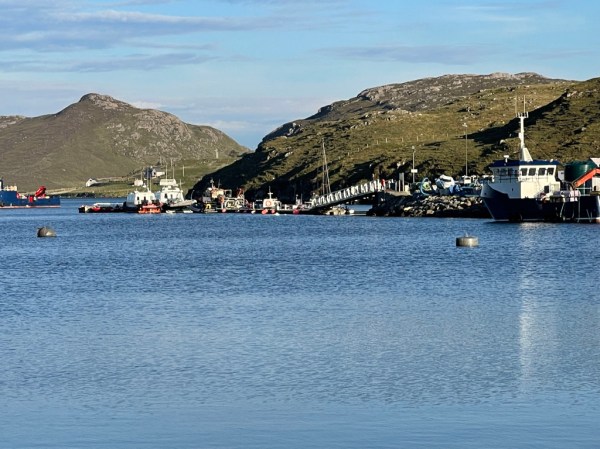
Eventually, we arrived in Uig – a peninsula on the north-western shore of Lewis famed for its beaches. It had been a long journey from Poolewe, via Ullapool and the ferry, and we were ready to make a quick supper and turn in.
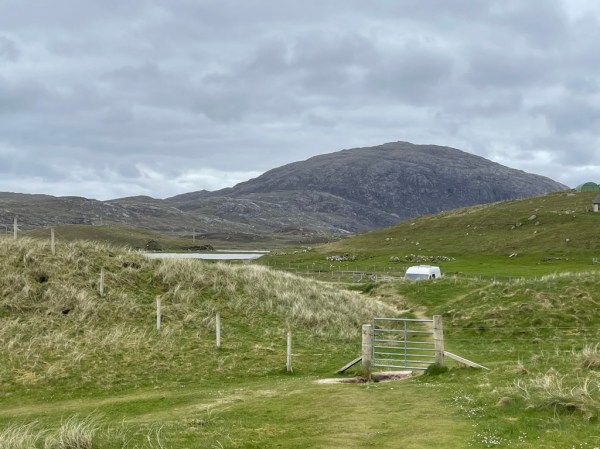
It was then we noticed how light it was. Despite being nearly ten at night, the sky looked as bright as an afternoon. The two dogs needed walking, so we decided to put off dinner for an hour and seek out one of the local beaches.

A ten minute drive from the holiday cottage and we found the small road that led down to our nearest beach. In the back of the people carrier, the dogs were going mad; being able to smell the sea after being cooped up in the car for most of the day…
But the next half-hour restored the wonder of the whole journey – and one of the primary reasons for coming this far. On either side of us, the near-white beach stretched out for what looked like miles.

It was scenic but – despite the summery sky – still cold. Lewis was a strange place, but we were warming to it… And tomorrow was my birthday… That long-awaited new coat would finally be providing me with real warmth!
Part One: https://suningemini.blog/2022/05/24/a-poolewe-diary-1/
Part Two, https://suningemini.blog/2022/05/31/a-poolewe-diary-2/
Part Three, https://suningemini.blog/2022/06/06/a-poolewe-diary-3-the-loch-on-the-back-of-the-oats-box/
Part Four, https://suningemini.blog/2022/06/14/a-poolewe-diary-4-once-upon-a-time-in-the-far-north-west/
Part Five: https://suningemini.blog/2022/06/21/a-poolewe-diary-5-over-the-minch-to-lewis/
Continuation onto the the Hebridean Island of Lewis:
This is Part Two
©Stephen Tanham 2022
Stephen Tanham is a Director of the Silent Eye, a journey through the forest of personality to the dawn of Being.
http://www.thesilenteye.co.uk and http://www.suningemini.blog
Share this:

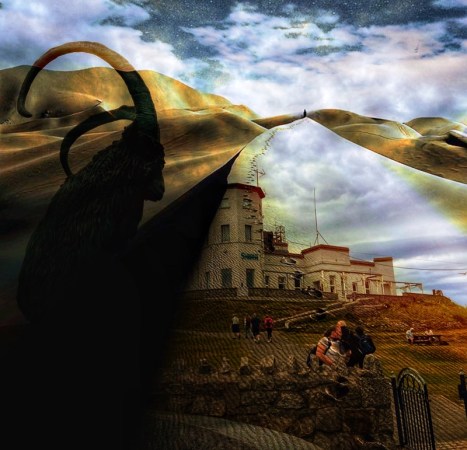
A rocky height of towering truth
A hundred years of blood and sacrifice
Laid waste in haste to crown a naked lie
Where courtiers smile like truth and gloat
Up among the goat-men at the throat
Once taken, that first step reflects
The once-fine earth, which now collects
Within the wheels of grasping greed
Old boys, less good, embrace the skin
Beneath the hooves of goats and men
©Stephen Tanham 2022
Stephen Tanham is a Director of the Silent Eye, a journey through the forest of personality to the dawn of Being.
http://www.thesilenteye.co.uk and http://www.suningemini.blog
Share this:

Close your eyes for a second and listen to your own mind. You don’t need to be anywhere quiet. It can simply be where you are. There are two schools of thought involving meditative practices: the first says you need to be somewhere detached from the world; the second states that the world – our world – is specially configured to give us deeply personal responses on all levels.
You may be surprised to find your mind is full of words. Even worse, the chances are it’s chattering away to itself. We don’t expect to find words inside us like this. It’s not how we ‘think’ of ourselves.
But we’re full of words; most of them useless. Word-worms…
Usually, that chattering is actually narrating your present moment: you mustn’t forget to pick up the milk from the supermarket; your active dislike of that couple you had round for dinner; that stiffness in your thigh after the long walk on Sunday. Did you fall on it, or is it just age…
They’re all shouting for attention, these word-worms. All of them want your whole attention for their second in the spotlight while your body gets tense and you have to invoke an even more powerful script of words to calm yourself down.
Let’s not…
Let’s not play their game of words. Instead, let’s trip them up in the middle of their usual writhing in our minds. Let’s create a ‘word master’, using their own technology, to deploy back at them.
The word ‘ONE’ : say it as though someone just opened the door to that garden in full bloom; or the park in midsummer, happy with the laughing of children.
Let it look like a circle of golden, fiery light in the blue sky, having the power to consume any worm word still writhing in your mind.
One of your more perceptive worms shouts in protest, ‘But it’s another word!’
And it is… but it’s a tool of the deep mind, not the superficial thought layer that thrives off eating your energy with tension, daydream and longing.
‘ONE’ – say it mentally (or even physically if you wish) watch how it stops every other word in your mind. Whenever another worm arises, say it to yourself, again. Keep doing it. Don’t let anything arise that isn’t ONE.
I first discovered the power of this driving the car while heading for a confrontational business meeting. I found over the next ten minutes that it didn’t do anything for my driving but enhance it. I arrived at my meeting clear-headed and full of creative ‘power’. That’s when I discovered for myself that there were two layers to my mind: Words and Awareness. The awareness had already absorbed how to drive. Once the worms were taken away, it carried on driving with calmness and equanimity.
Discover this for yourself. Start with something simple, then move on to the more critical activities. Assure yourself at each stage.
You may be walking, working or wondering. That’s okay. You don’t need to stop anything apart from the chatter of irrelevant worms. A few minutes of this and you may be eyebrow-raisingly shocked at how well your tasks are going. For some reason, you don’t need all those worms that regard themselves as irreplaceable.
After a while of this One-focussed silence, you’ll begin to feel a kind of peaceful golden glow… The image of the golden ‘One circle’ may take on a shine, one that radiates a gentle, peaceful feeling.
At this point your cleverer worm-words may begin, very quietly, telling you how remarkable this is, and, in, particular, how WELL you’re doing!
Have none of it. Whack it with ONE!
So what’s going on? Why is this working?
Next week, we’ll look at where all these word-worms come from, and why they have such power. By then, you might have experienced some answers of your own…
©Stephen Tanham 2022
Stephen Tanham is a Director of the Silent Eye, a journey through the forest of personality to the dawn of Being.
http://www.thesilenteye.co.uk and http://www.suningemini.blog
Share this:

Close your eyes for a second and listen to your own mind. You don’t need to be anywhere quiet. It can simply be where you are. There are two schools of thought involving meditative practices: the first says you need to be somewhere detached from the world; the second states that the world – our world – is specially configured to give us deeply personal responses on all levels.
You may be surprised to find your mind is full of words. Even worse, the chances are it’s chattering away to itself. We don’t expect to find words inside us like this. It’s not how we ‘think’ of ourselves.
But we’re full of words; most of them useless. Word-worms…
Usually, that chattering is actually narrating your present moment: you mustn’t forget to pick up the milk from the supermarket; your active dislike of that couple you had round for dinner; that stiffness in your thigh after the long walk on Sunday. Did you fall on it, or is it just age…
They’re all shouting for attention, these word-worms. All of them want your whole attention for their second in the spotlight while your body gets tense and you have to invoke an even more powerful script of words to calm yourself down.
Let’s not…
Let’s not play their game of words. Instead, let’s trip them up in the middle of their usual writhing in our minds. Let’s create a ‘word master’, using their own technology, to deploy back at them.
The word ‘ONE’ : say it as though someone just opened the door to that garden in full bloom; or the park in midsummer, happy with the laughing of children.
Let it look like a circle of golden, fiery light in the blue sky, having the power to consume any worm word still writhing in your mind.
One of your more perceptive worms shouts in protest, ‘But it’s another word!’
And it is… but it’s a tool of the deep mind, not the superficial thought layer that thrives off eating your energy with tension, daydream and longing.
‘ONE’ – say it mentally (or even physically if you wish) watch how it stops every other word in your mind. Whenever another worm arises, say it to yourself, again. Keep doing it. Don’t let anything arise that isn’t ONE.
I first discovered the power of this driving the car while heading for a confrontational business meeting. I found over the next ten minutes that it didn’t do anything for my driving but enhance it. I arrived at my meeting clear-headed and full of creative ‘power’. That’s when I discovered for myself that there were two layers to my mind: Words and Awareness. The awareness had already absorbed how to drive. Once the worms were taken away, it carried on driving with calmness and equanimity.
Discover this for yourself. Start with something simple, then move on to the more critical activities. Assure yourself at each stage.
You may be walking, working or wondering. That’s okay. You don’t need to stop anything apart from the chatter of irrelevant worms. A few minutes of this and you may be eyebrow-raisingly shocked at how well your tasks are going. For some reason, you don’t need all those worms that regard themselves as irreplaceable.
After a while of this One-focussed silence, you’ll begin to feel a kind of peaceful golden glow… The image of the golden ‘One circle’ may take on a shine, one that radiates a gentle, peaceful feeling.
At this point your cleverer worm-words may begin, very quietly, telling you how remarkable this is, and, in, particular, how WELL you’re doing!
Have none of it. Whack it with ONE!
So what’s going on? Why is this working?
Next week, we’ll look at where all these word-worms come from, and why they have such power. By then, you might have experienced some answers of your own…
©Stephen Tanham 2022
Stephen Tanham is a Director of the Silent Eye, a journey through the forest of personality to the dawn of Being.
http://www.thesilenteye.co.uk and http://www.suningemini.blog
Share this:

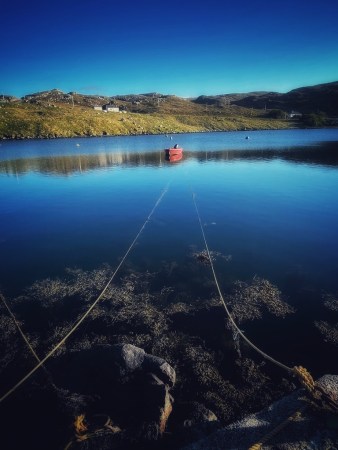
Although it was a continuation of the same trip, it would be misleading to continue with the ‘Poolewe Diaries’ as a title. The sailing from Ullapool to the Hebridean main island of Lewis marked the second week of the Scottish adventure, so a change of title is appropriate…
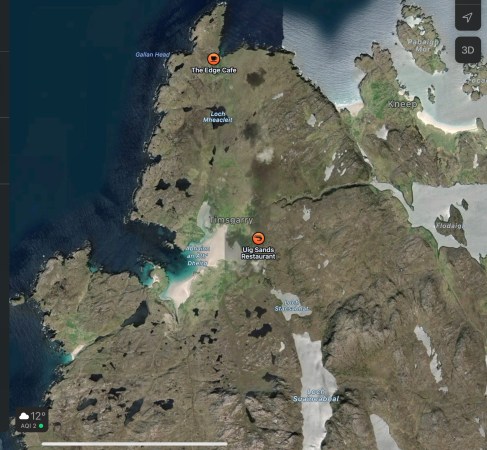
Arriving on the island of Lewis, you get a strong sense of the remoteness of the place. Our departure port of Ullapool was remote enough, but then adding a three-hour ferry crossing just emphasised how separated this community is from the main population areas of Scotland.
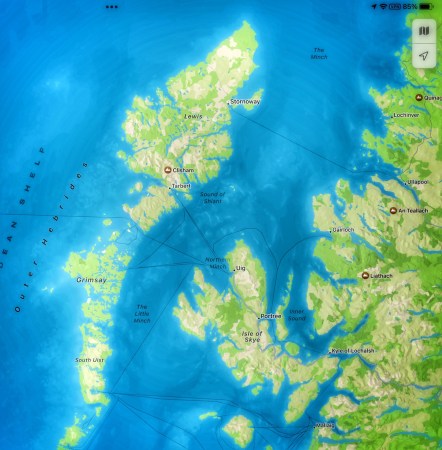
Image from Apple Maps, post processed by the author)
The largest town on Lewis is the port of Stornoway, famous for its appearance as the second item in the BBC’s maritime ‘shipping forecast’. The Shipping Forecast is a BBC Radio broadcast of weather reports and forecasts for the seas around the far coasts of the British Isles. It is produced by the Met Office and broadcast by BBC Radio 4 on behalf of the Maritime and Coastguard Agency.
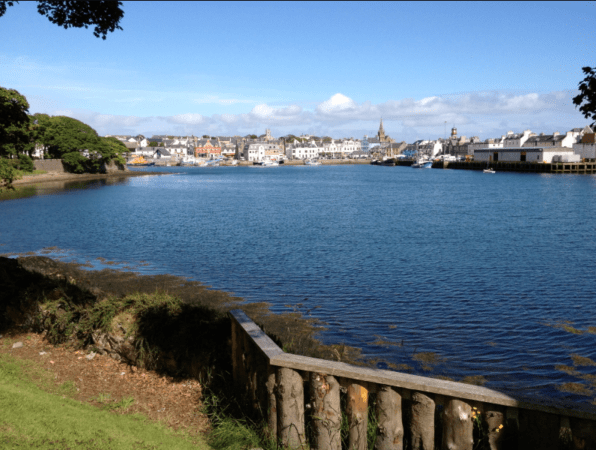
Stornoway is the main town of the Western Islands (the local name for the Outer Hebrides). It was founded by Vikings in the early 9th century, with the old Norse name Stjórnavágr. The settlement grew up around a sheltered natural harbour and became a trading hub for people from all over the island. Local travel to Stornoway was either by family boat, or (more slowly), by horse-drawn coach. The town of Stjórnavágr was the main base for trade with the rest of Scotland and further afield.
In the 15th century the local castle, the ancestral base of the MacLeod clan, was breached by the cannons of the Duke of Argyle, and local taxes were imposed on trade. This was hated by the islanders, who rebelled against such shipping rights being imposed. Continued resistance succeeded against King James VI, who, in 1598, tried to establish his own trading company, the ‘Fife Adventurers’.

It failed. Declaring it ‘ungovernable’, James transferred Lewis to the MacKenzies of Seaforth in 1610. Stornoway Castle was later demolished to expand the harbour. A few remnants of the old stonework are to be found beneath the sea, alongside the pier foundations.
I have a personal connection with the island of Lewis – cultural rather than genetic…
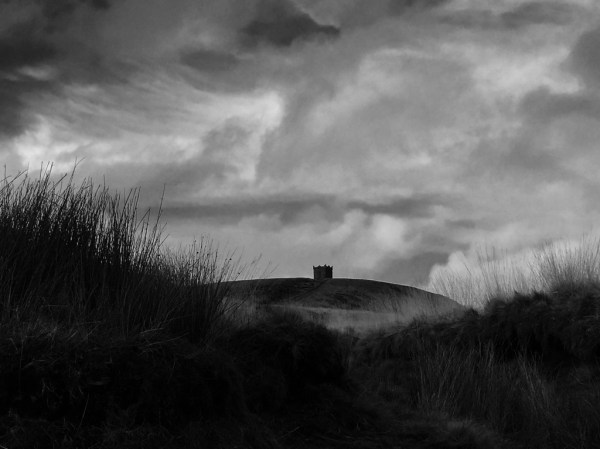
I was born in Bolton, Lancashire. As a boy I used to walk the moors above the town of Horwich, marvelling at the ‘lost city’ nature of the ruins of the old ornamental gardens – long abandoned after the house that used to be there was burned down by the Suffragettes.
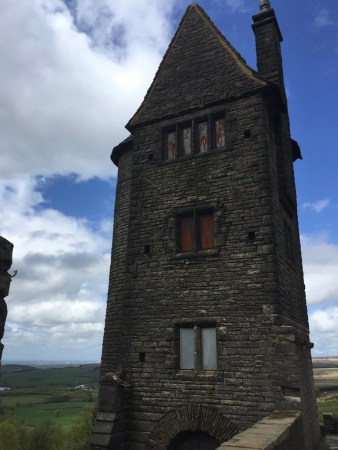
Later, I found out the mysterious gardens were the creation of William Hesketh Lever and built as a summer retreat on the site of where he and his wife did their courting. For many years, I looked into his life and built up a collection of facts and images. In a sense, his personal industry and success inspired me.
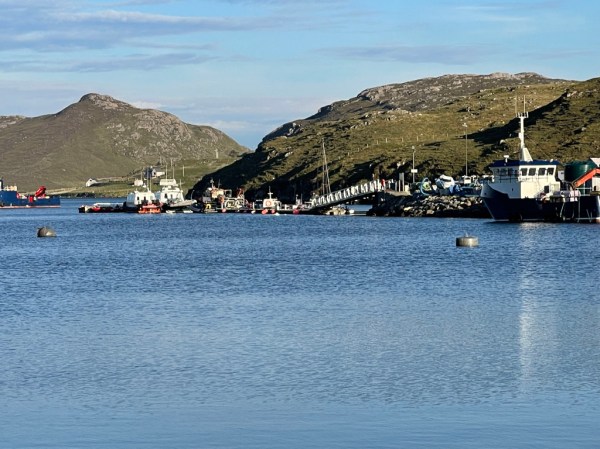
William Hesketh Lever, a man born to a working-class family in the centre of Bolton, built up a local soap business and became increasingly successful and prosperous, eventually creating Port Sunlight on the Wirral Peninsula, an entire ‘model town’ where the workers in his vast factories were guaranteed quality homes in the pleasant village. Until this trip, I had not realised that there was a link between William Lever and the island of Lewis.
In 1918, Matheson sold the island of Lewis to the soap millionaire – who had now become William Lever, 1st Viscount Leverhulme. Lord Leverhulme owned the island for only a short time. His economic plans for the Island of Lewis (together with various business setbacks) overstretched his finances. Faced with failure in Lewis, and unlike his predecessors, he gave Stornoway parish to the people of the town. The Stornoway Trust was formed and continues to administer the town for the people.

The Lever Brothers soap empire eventually became part of Unilever, the modern multi-national corporation whose cleaning products grace most supermarkets.
It was the Friday afternoon. We needed to stock up on essential supplies from a local supermarket, as Stornoway had the only sizable shops. The following day was Saturday, which would allow us to get our bearings in the Uist Region of the island – before the almost total closure that is Sunday on Lewis.
We had been warned that there was a strong and specific religious presence on Harris; one that pervades many aspects of life on the island. In Lewis’ case, it was the ‘Wee-Frees’. The entry in Wikipedia refers:
The Wee Free in modern usage is used, usually in a pejorative way, of any small group who because of their, arguably obscure, religious principles choose to remain outside or separate from a larger body. A Wee Free attitude might show as a preference for being part of a smaller but ideologically sound group rather than a larger compromised one.
The term ‘Wee Free’ was an epithet commonly used to distinguish between two Scottish Presbyterian Churches after the union of 1900: The Free Kirk and The United Free Kirk – the latter being some 25 times larger in its congregation. The rhyming Scottish diminutive became the adopted familiar name of the smaller entity.

The Island of Lewis is dominated by the Wee Free Presbyterian Church. It has its presence in every aspect of the island’s life. The church is energetically anti-Catholic and regards the Pope as having been artificially ‘inserted’ by dogma between mankind and God. One of the tenets of the Wee Free community is that you protect the Sabbath.
Holidaymakers are welcome to attend the churches or simply enjoy their time on the island. But nothing is open on Sunday… well, almost nothing, as we were to discover.
First, we had to cross the island to the Uist area and find our holiday cottage…
Part One: https://suningemini.blog/2022/05/24/a-poolewe-diary-1/
Part Two, https://suningemini.blog/2022/05/31/a-poolewe-diary-2/
Part Three, https://suningemini.blog/2022/06/06/a-poolewe-diary-3-the-loch-on-the-back-of-the-oats-box/
Part Four, https://suningemini.blog/2022/06/14/a-poolewe-diary-4-once-upon-a-time-in-the-far-north-west/
Part Five: https://suningemini.blog/2022/06/21/a-poolewe-diary-5-over-the-minch-to-lewis/
This is the continuation of our adventure, now on the Hebridean Island of Lewis, and is Part One of ‘A Hebridean Diary’.
©Stephen Tanham 2022
Stephen Tanham is a Director of the Silent Eye, a journey through the forest of personality to the dawn of Being.
http://www.thesilenteye.co.uk and http://www.suningemini.blog
Share this:


I’ve always loved piers…
Most partly grown-up small boys do. It’s that sheer expanse of linear possibility…
Breathtaking.
Piers are usually associated with railway towns. In many ways the railway town was the forerunner of modern urban development. The ‘seaside’ was invented by railway companies who provided the means to get there – in three graduations of ‘wealth: third class; second class and first.
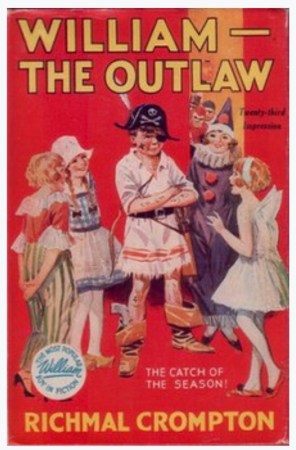
The scruffy small boys – all looking like they were from one of Richmal Crompton’s ‘Just William’ books – didn’t seem to mind being bottom of the heap. ‘Wakes Week’ had arrived and dad could come, too…

Seaside towns didn’t always have long piers, but it was a badge of honour if they did.
This one’s in Llandudno, North Wales. It’s privately owned. There are numerous small businesses along its impressive length and a rejuvenated cocktails and drinks bar at the end.
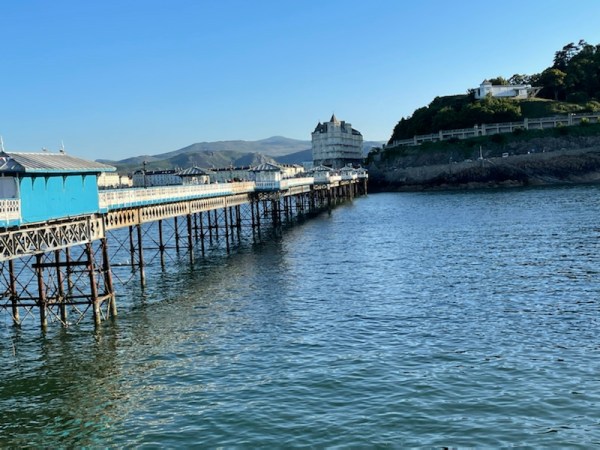
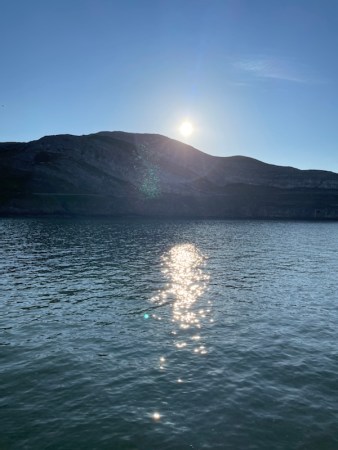
Pint of Guinness with the sunset, anyone?
©Stephen Tanham 2022
Stephen Tanham is a Director of the Silent Eye, a journey through the forest of personality to the dawn of Being.
http://www.thesilenteye.co.uk and http://www.suningemini.blog
Share this:

+ #Silenti, Ancient Landscapes, Ancient Sacred Sites, Consciousness, Lake District, myths and spirituality, Photographic techniques, Photography
Heroes in a Landscape (7) End of the Quest
by Steve Tanham
Continued from Part Six…
The final day of a weekend like ‘The Journey of the Hero’ has to serve many purposes. It has to reinforce what has been shared; it has to send people on their homeward journeys with a smile… and a desire to do it, again. In short, it needs to embrace the companions with a warm hug!
It also needs to bring closure to the ‘plot’ of the story. All workshops need a good story – a thread of purpose and often mystery that defines the sequence of experience. Those attending should feel they were the ‘players’ and not simply the participants. Most will embrace this…
As with the other stages of the weekend, timing would be vital for our final day. To make sure we had workable planes, we had taken a day out, in April 2022, to dry-run the sequence for the final half-day, ending where we began at Castlerigg Stone Circle… hopefully with kinder weather.
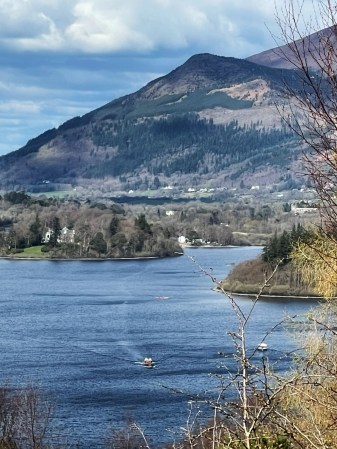
We met at the usual Cricket Club car park in Keswick, from which the two peaks of Latrigg and the much larger Skiddaw are prominent.
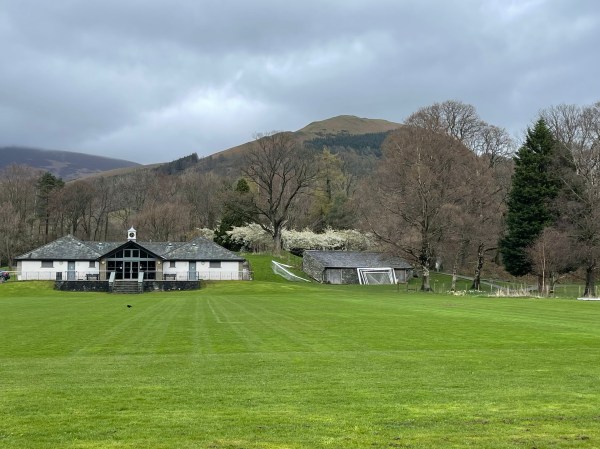
Even from the car park, Latrigg appears to be anything but simple. The footpath rises from the river valley and becomes a small road that dramatically crosses the ravine carrying the main A66 carriageway. It then merges with a number of small lanes, eventually snaking up the side of Latrigg, to end in a shambolic and muddy car park not far from the summit.
There was mischief afoot – but well-humoured mischief. Gazing up at Latrigg from the Cricket Club, it looked a challenging climb, and one that wouldn’t fit well with a relaxed and reflective morning. In reality, the companions would soon find themselves whisked up to within a level half-mile of the summit by car.
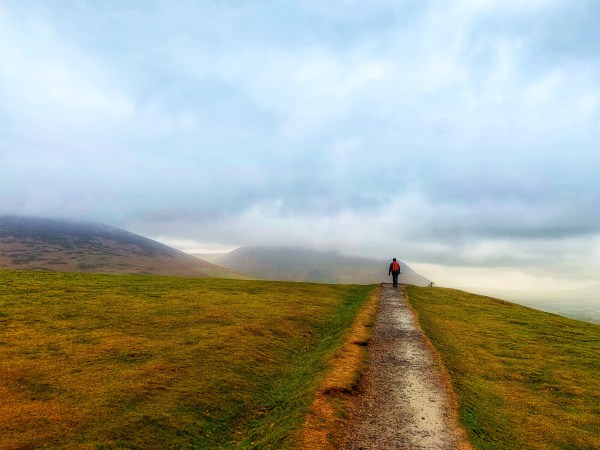
At least, that was the plan. The photos, below, taken during the recce day in April show how wonderful the views are from the path edge facing Keswick and its two lakes.
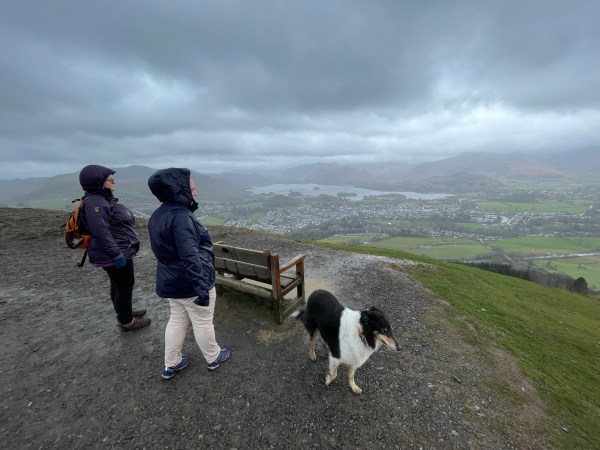
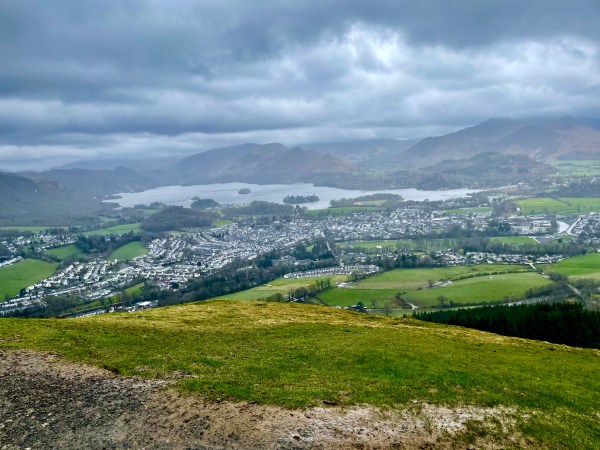
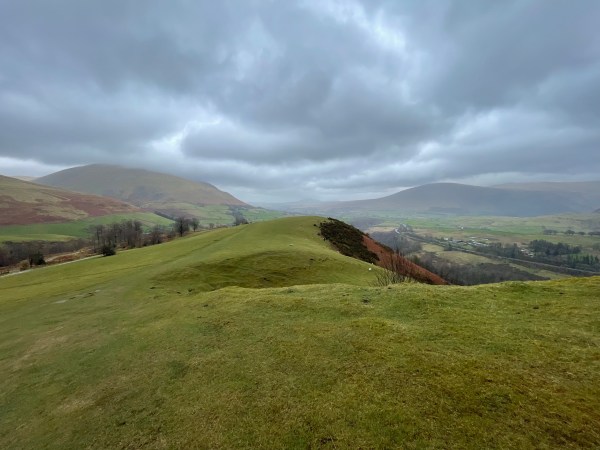
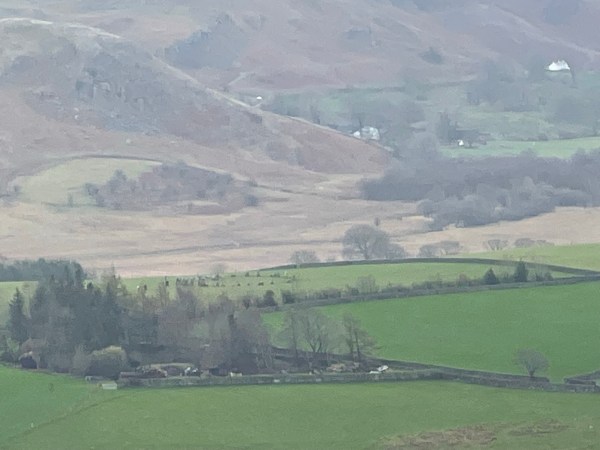
At what you think is the summit – as in the first two photos, above, you turn round to see that the path continues climbing gently for another half-mile to reach a point where you can see the Borrowdale Valley, the A66 main road….and Castlerigg Stone Circle.
The symbolic idea was that, nearing the end of the quest, the hero would be granted a final view of the destination. But first they would have to find it!
That was the plan. Sadly, something else was in store for us. On the recce day in March, we had little difficulty in getting up the twisty, tiny road to the car park. I remarked at the time that I wouldn’t want to turn around in that tight place if there was much traffic…
Sunday morning, 8th May 2022, offered beautiful skies and a warm day. Everyone seemed to be converging on Keswick. Those that know the access points to Skiddaw also use the top of the Latrigg road as their start-point. The place was rammed.
But the time I’d crawled the car up the busy hill, there were only one or two very tight parking places available, and other cars were frantically trying to escape the mayhem and get back onto the broader roads below.
We had to abandon the idea of parking at the top. I offered the alternative of leaving the cars just off a lower section of the road a short distance below us, but tension had set in – along with the spectre of not being able to retrieve the vehicles in a timely fashion, later.
We managed to reverse everyone out and cut our losses – heading directly for Castlerigg, and noting, for future trips, the lower points on the hill from which a short additional climb would have made the whole plan feasible.
One of the companions, a lady who lives locally, suggested that we take a break at the new Climbing Centre just down the road from the stone circle. It proved to be good choice. A coffee and cake later, we agreed that, over the three days, very little of fundamental importance had gone wrong… and we could swallow this one hit…
After all, Castlerigg could now be explored at our leisure and in sunshine. It had plenty of its own magic to offer.
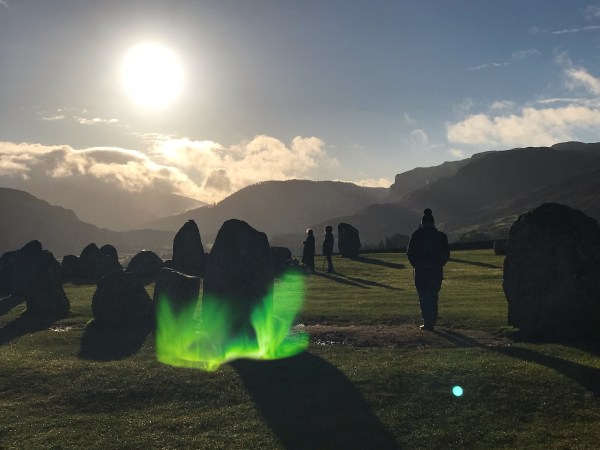
Back at Castlerigg, I pointed at the nearby hills and the secondary edge where we would have stood to look down on where we were, now. You can just imagine our ghostly presences waving…
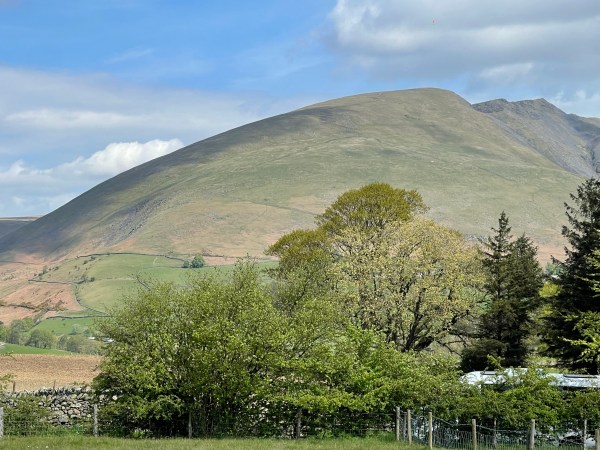
The revised agenda allowed us to spend more personal time within the Castlerigg stones, before calling everyone together into a quieter place to the side of the main site to complete the Hero’s Quest and confer on all present our customary bag of coloured ‘raw gemstones’, for ‘placing or planting’ at other specials locations in each person’s future travels.
To those that were leaving straight from here, we said our goodbyes by the cars. Then, one final journey back into Keswick to reunite the main body of the group with their vehicles and we were done. Everyone had enjoyed it. A few even looked wistfully back up at Latrigg as we were leaving to envisage how the full morning could have gone.
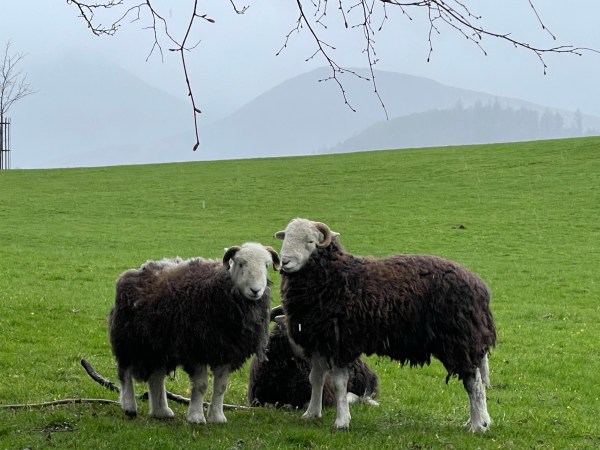
The workshop had proved resilient. Everyone said they felt that a meaningful journey – including a degree of needed ‘hardship’ – had been achieved. A landscape had been ‘absorbed’, a quest fulfilled, and a deeper understanding of a few key Tarot images had been not only gained, but also used in a way that none had seen before. The Heroes had returned to their start point, to – as T.S. Eliot wrote, and known it for the first time. And with that knowledge, able to go forth empowered…
It was still a beautiful day. Stuart and I ambled back along the A66 and joined the M6 motorway southbound. I took us off at the junction prior to the usual one and surprised my co-Director by emerging from a small lane next to the Station Pub – the place we hold our monthly management meetings close to Oxenholme Station – the only West Coast mainline station in a village!
Sadly, time did not allow the usual pint of Guinness, and soon he was being whisked south to Preston by the Glasgow-London train…and I was driving the short distance to home.
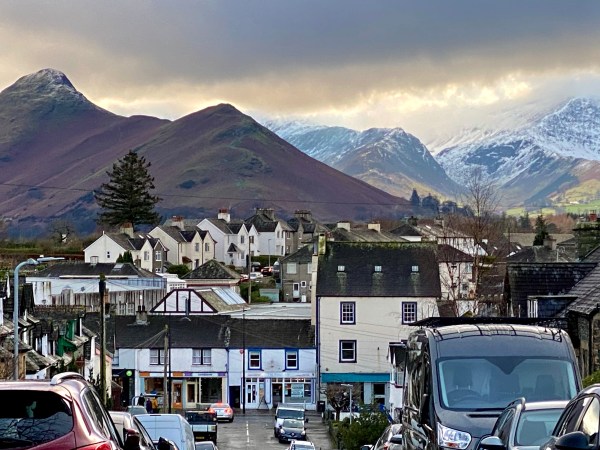
Keswick had served us well, but it was good to be back in Kendal. We hope you’ve enjoyed the journey…
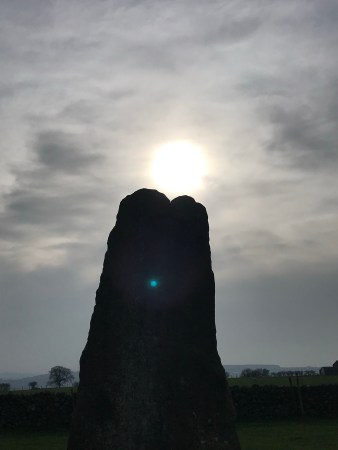
September 2022 Workshop
There will be another workshop of this kind, but with a different theme, in the first half of September 2022. All are welcome. The admin fee is £75.00 per person.
You can register your interest in the comments section or via an email to Rivingtide@gmail.com
Other parts in this series:
Part One, Part Two, Part Three,
Part Four, Part Five, Part Six.
This is Part Seven… the final part.
©Stephen Tanham 2022
Stephen Tanham is a Director of the Silent Eye, a journey through the forest of personality to the dawn of Being.
http://www.thesilenteye.co.uk and http://www.suningemini.blog
Share this:


Midsummer from the Pike My thanks to fellow blogger Ashley, for his evocative Haiku this morning, and from which I stole the title of this blog. My …
On the hill of summer
Michael from the Rivendale Review ‘took me home for the Solstice’ with this blog. I used to mountain bike ‘up the Pike’ on the Solstice evening.
Surrounded by lakes and mountains, now, I cannot complain! Yet they are all a car ride away. My own Solstice evening now consists of a local dog walk to see my favourite oak tree. Yesterday evening it was radiant with midsummer energy.
Here’s the photo, with a little bit of editing to fully capture the ‘feel’
I hope you had a reflective Solstice…

©Stephen Tanham 2022
Stephen Tanham is a Director of the Silent Eye, a journey through the forest of personality to the dawn of Being.
http://www.thesilenteye.co.uk and http://www.suningemini.blog


 Sun in Gemini
You must be logged in to post a comment.