+ #Silenti, Ancient Landscapes, Ancient Sacred Sites, Astrology, Consciousness, guided mystical walks, mystical travel, Neolithic, Photography
The City and the Stars (1)
by Steve Tanham

With the Pictish Trail weekend a long car journey and a boat ride behind us, we had awakened in Stromness to the early morning of an overcast Orkney day – The excavated and intact Neolithic village of Skara Brae was a few short miles away…
(1300 words, a ten-minute read)
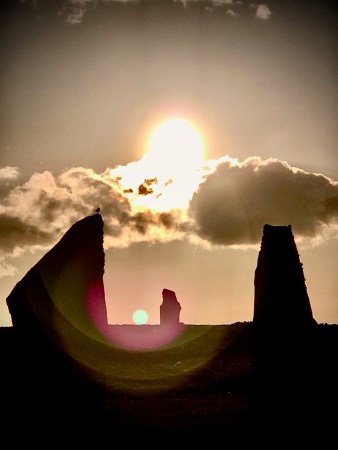
We had not expected to be here at all. Visiting Orkney for the second part of our Pictish Trail journey had seemed impossible because of Covid restrictions. But there were signs that things were relaxing and even re-opening. Our potential companions for the extended weekend had urged us to keep trying, so we’d put ourselves on every visitor ‘notification list’ possible.
In the end, we couldn’t call it with any certainty, and simply contacted everyone who was interested and asked if they’d be prepared to risk it… Everyone said yes; that it was worth it just to go to Orkney, regardless of what was open or not… In the largest sense, there was an act of faith, here…
Our ferry tickets and accommodations in Stromness were booked. There was no going back; we’d just have to make do with what we could achieve on each day. Stromness and Kirkwall, the capital of Orkney, were worth at least a day each, and we only had three. Then we got a message saying the Neolithic village of Skara Brae had opened for a limited number of bookings which were to be strictly time-controlled. Within minutes, Bernie had responded and we had our visit: 10.00 am on the morning after our arrival. Getting off the ferry, with our hotel just at the end of the quay, one of our party was so excited, she was literally hopping from foot to foot…
We had only a few days to give our group a taste of this wonderful archipelago, situated just a few miles off the coast of north-east Scotland. It’s a world of its own – especially in terms of its ancient history. We’d been here once before and couldn’t wait to share it. In addition, since I was here last, work done on the Neolithic civilisation on Orkney was being revolutionised by the new findings at the Ness of Brodgar. I had my own views on some of it…
Now, we were at Skara Brae, just a few miles from Brodgar, on the Orkney Mainland. There was a queue to get into the visitor centre of this 5000 year old ‘village’. We’ll come on to why I’ve put that in quotes, later…

We were awaiting our timed entry to access the walkway down to the actual village when I read the graphic above. It puts everything into perspective. I’ve reproduced it here:
‘You have come to a village which started life around 3100 years BC. Before Stonehenge, the Great Wall of China, and the Pyramids of Egypt were built. This is the oldest village in Europe where you can still see the houses with their original stone furniture intact.’
For reasons I’ll go into later in these posts, I’m not sure it was an ordinary village. I think it was something far more exciting.
Then the hour turned and we were socially-spaced and walking through the descriptive graphics, towards the sophisticated reconstruction of one of the eight houses beyond. The visitor is not allowed to descend into the real dwellings, but a landscaped walkway around the entire village has been constructed to allow close visibility – from above, in most cases.
To compensate for this, the reconstructed house at the entrance of the site is an exact reproduction that you can enter to immerse yourself in Neolithic life. I had been fascinated by it on our visit in 2018 and couldn’t wait to see its effect on our companions.
But, sadly, it wasn’t open…too small an enclosed environment to accommodate the restrictions on social distancing. However, I do have photos from our first trip, so here’s a visual journey through what would normally be available.

(Above: The replica house at Scara Brae is modelled on House 7 (see map) and gives the essential feeling of height not apparent from looking down at the real houses from the walkway. House 7 was excavated by Professor Gordon Childe in 1928 (below). When he found it, it had no roof. He dug down through the sand to find the layers where people had lived)

(Above: Gordon Child, the principle archaeologist who excavated Skara Brae in the years 1928 to 1931)

(Above: The real House 7 is shown on the site map: bottom row, middle. We would be visiting that next)

(Above: the reconstructed ‘sail-cloth’ and timber roof)

(Above: the central hearth contained ashes and red clay)

(Above: there are two box beds, The fireside slab of one of the beds had carvings on it, worn away in the middle, as if by people climbing in and out of the pen. A decorated pot was also found in the bed. Above the beds are cupboards set into the wall. Intriguingly, skeletons of two women were discovered buried partly under the house wall behind one of the beds…)

(Above: the ‘dresser’ – my italics – The top shelf of the dresser was found to be bare, but on its lower shelf were pieces of pottery and burnt bones. There was a storage cell in the room, but it may have been linked to drains found under some of the other storage cells in the village. The astonishing possibility that they may have served as indoor toilets cannot be ruled out)
Near to the ‘model house’ is an information board that sets the scene for the actual village, which lies a few hundred metres away, on the edge of the sea. Here are two useful excerpts.

(Above: a more detailed scale map of Scara Brae)

‘5000 years ago the villagers who decided to settle at Skara Brae did so for good reasons.
This was a land of plenty, with rich fertile soil for grazing cattle. The temperature then was a few degrees warmer than it is now, making it easier to grow crops. In the uncultivated land wild deer and boar roamed.
Birch Hazel and willow trees formed sparse scrubland. Wild berries and herbs grew. The lochs and sea were stocked with fish. Driftwood from the virgin forests of America was regularly cast up on the beach.
The cliffs supported colonies of sea birds important for their meat and eggs. Seaweed provided a plentiful supply of fuel. The abundant stones, clay and pebbles were useful building materials.
Today the landscape differs in one important respect: 5000 years ago the sea was much further away from the village. Land once covered the area which now forms the adjacent Bay of Skaill. This area of land held a loch or lochans which gave the people a vital supply of freshwater. Over hundreds of years the cliffs were gradually eaten away by the sea and sand dunes formed. This process of erosion was already beginning in the early life of the village…’

(Above: the elevated walkway snakes around the Skara Brae village, allowing a thorough visual exploration without actually entering the 5000 year old dwellings)
The reproduced House 7 and the information boards had served us well. Everyone had taken what little time the visitor centre would allow to study what was coming. Now we had a few hundred metres to walk to get to the real Skara Brae. As we walked, there was a palpable but delighted feeling of disbelief that this was actually happening…
To be continued next Tuesday.

To be continued…
This is Part One of the City and the Stars – a continuing mystical trip through north-east Scotland and Orkney on the trail of the Picts.
The Pictish Trail weekend blog posts:
Part One, Part Two, Part Three, Part Four, Part Five, Part Six, Part Seven, Part Eight, Part Nine
©Stephen Tanham, 2020.
Stephen Tanham is a Director of the Silent Eye, which offers a distance-learning program to deepen the personality and align it with the soul.
Share this:


You might think they had little to smile about. Covid-19 was inflicting its worst levels of disease and death since the epidemic began. The most powerful economy in the world was, in the words of several media commentators, ‘tanking’.
And yet, when Joe Biden stood up and finally acknowledged he was to be the next President of the United States, backed by his family and the active and able Vice-President, Kamala Harris, I felt a pride quite disproportionate to my status as a British citizen and therefore outside the US election, looking in.
I, and many of my friends felt a closeness to the recent American political process in a way that had not happened before. Something tangible and dark was trying to end a world, and the thinking people of America had rallied.
I have always been interested in the politics of the USA – my uncle lives in California and I have been a frequent visitor to its shores. My happiest memories there include my wife and I travelling the entire length of Highway One up the Pacific coast from San Diego to Seattle. We didn’t do this in one trip, rather over a series of visits that we would tack on the back of the computer trade shows at which we exhibited on a twice-yearly basis.
My mother was a passionate socialist. I absorbed this growing up. But then, after my computer science degree, I began a series of jobs with American computer firms… and found them exciting and productive places to be. Decades later, I established my own software company in Manchester, and there followed twenty-three years of learning to survive and eventually prosper in business. I feel I can have a reasonably dispassionate view of what works, one that combines the ‘social’ and ‘business’ worlds.
The efficiency and motivation of a thriving ‘American’ style’ environment is second to none. But it’s not the whole story…
I believe that we need equal focus on both entrepreneurial and social actions. I no longer subscribe to the ethic that ‘private is always best’. It isn’t. Anyone who travelled on the wretched urban railways of the north-west of England over the past thirty years will tell you that. Our NHS delivers amazing and free care on an unimaginable scale, and could not possibly be replaced by a combination of private enterprises – something President Obama was trying to replicate, to some degree in the USA, before being thwarted by Congress.
My uncle is Republican; his daughter and my cousin and her partner are Democrats. Over the years of business and social travel, I have listened to their various views, trying to discern the essential ‘signature’ of political thought on each side. John McCain was one of of the Republicans I most listened to. The inherent ‘nobility’ of the man was indisputable. He had never traded on his many years as a prisoner in Vietnam, though others had not forgotten his selfless stance.
He bore its physical and political scars quietly. I remember him facing up to Mitch McConnell – who was standing in front of him to psychologically ‘block’ his way while the Senate voted on yet another of the President’s steps in destroying President Obama’s Affordable Health Act. McCain voted against the Republican bill and ended up having Trump’s hate and the spite of his lackeys heaped upon him, shortly before he died.
The President called him a ‘looser’, this from a man who didn’t serve his military time because of a ‘bone-spur’. I remember an interview with a Republican from Arizona who said that they would remember this comment about one of their favourite sons… The recent vote suggests they did.
McCain had a ‘light in his eyes’. The people dancing in the streets of New York when it was announced that Joe Biden was now President Elect had a light in their eyes, too. I view that light as a very real thing. It is a reflection from within. All people of whatever political persuasion who do their best to live by the truth have this shining in their eyes, however subtly.
In my opinion, Joe Biden has it, too. When he and Kamala Harris stood up to acknowledge their victory, you could see and feel that truth. There is nothing easy about what they are inheriting. America will continue to face challenges, no less than we do in the UK. Sadly, we will face a singular future, having been torn from our ‘United States’ of Europe by the same forces that have just lost the presidential race in the USA and now find themselves hopelessly floundering in the face of a renewed America’s pro-EU stance.
Perhaps the light of that truth will one day shine again in our eyes… I certainly hope so. It was beautiful to watch on those bright American faces.
©Stephen Tanham, 2020.
Stephen Tanham is a Director of the Silent Eye, which offers a distance-learning program to deepen the personality and align it with the needs and goals of the soul.
Share this:

If you’re a canoeist, the half-mile of the River Kent that descends, thunderously, through the limestone levels of this part of Cumbria is well known as an extreme test of skill… but there are other reasons to visit…
(400 words; a five minute read)
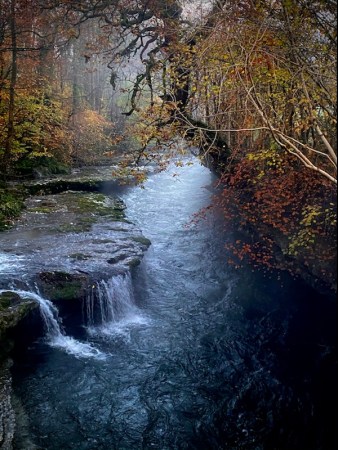
Our village, Sedgwick, owes its existence to the River Kent, which rises in the southern Lakeland mountains around Kentmere and flows out into the northern end of Morecambe Bay. The name derives from the ancient Viking language, meaning ‘Place of the River’. The Kent has many faces; some deadly, some beautiful.
For me, the river is at its most beautiful in the autumn. The gradual fading of colour is nearly complete by the early days of November; but the mists have just begun.
I was lucky with this shot, which wasn’t planned beforehand. I had taken Tess, our collie, for an early morning walk before I had to leave to visit my mother, sixty miles south in Lancashire. I didn’t really have the time to take a photographic diversion, especially with the dog in tow, but the sight of mist over the river drew me down from the frisbee-throwing fields to stand at the only road bridge across the Kent.
And there it was… the hint of faded autumn colours in the pale light; the dark waters surging with their overfilled load from nearly two weeks of rain. The silvery flow of streams pouring into the main channel added to the magic, as they joined the thunderous flow a scant few metres before the whole waterway drops by a good ten metres and brave canoeists risk their lives in the ‘white water’ descent.
There weren’t any canoeists. It was still early morning, and I suspect that even the most skilled would have been imperilled by the torrent of flood-water.
I’ll stick to photography, I think.
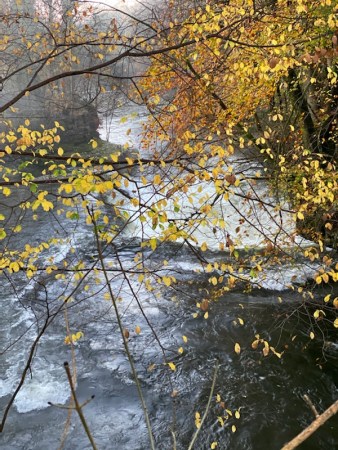
Here’s the other side of the bridge, for completeness. For all the noise of millions of gallons of rushing water, there was nothing but beauty in that place.
©Stephen Tanham, 2020.
Stephen Tanham is a Director of the Silent Eye, which offers a distance-learning program to deepen the personality and align it with the soul.
.
Share this:

+ #Silenti, Ancient Sacred Sites, Christianity and modern mysticism, Consciousness, mystical travel, Photography
Two journeys, one destination (9) : Dunrobin Castle
by Steve Tanham
The beautiful vision of the ‘fairytale’ Dunrobin Castle, seen here from across the bay during our visit to Portmahomack, had tantalised us with the reported splendour of its architecture and gardens. Now, we had arrived at the gateway of its estate.
(1800 words, a twelve minute read)

(Above: Dunrobin Castle through a long lens…)
Dunrobin Castle is the most northerly of Scotland’s great houses and the largest in the Northern Highlands, having nearly two hundred rooms. It has been home to the Earls, and later, the Dukes of Sutherland since the late medieval age. It lies just north of the beautiful coastal town of Dornoch, on Scotland’s far northeastern coast. It is said that, in terms of Scotland’s history, Dunrobin is ‘about as connected as you can get‘.
Leaving the Inverness region behind, we were finally on our way to Orkney to begin the second part of the trip: Ancient Orkney, but not without stopping to see this masterpiece about which we had heard so much. It wasn’t entirely a diversion from the Pictish Trail, the castle actually marks its most northerly point.
Dunrobin has its own museum, which houses one of the best collection of Pictish stones on the whole coast. The clarity of the markings on these stones is said to be unsurpassed, so we were excited to be coming face to face with some of the best examples anywhere in the world.

(Above: the Pictish stones of Dunrobin’s museum. Sourced from Undiscovered Scotland’s website )
The original building at Dunrobin had been a much simpler square-section fort. The family wished to create a house in the Scottish Baronial style, which had become popular among the aristocracy, who were inspired by Queen Victoria’s new residence at Balmoral. From 1835 onwards, two leading architects were commissioned (at different times) to work on the re-design of the castle: Sir Charles Barry, who was responsible for the Houses of Parliament in London; and Scottish architect Sir Robert Lorimer. Their work speaks for itself, and, though the subsequent image of Scotland’s highland culture was largely manufactured during Victoria’s reign–to the delight of the monarch–the beauty of Dunrobin speaks for itself.
The towering conical spires stand out on the horizon, as we had seen from the Tarbat Peninsula across the waters. Now, we were approaching them from the rear of that view, down the long drive which forms a rustic entrance for visitors.
There is no town of Dunrobin. The castle is located near to the attractive village of Golspie, on the main A9 route to the northern tip of Scotland. We had tickets for the evening ferry from that coast to Orkney’s main port of Stromness, so we couldn’t afford to be late. No-one in the party had driven that far north before, but we knew the final fifty miles of the journey involved steep winding roads that hugged the rugged coast and took longer than a glance at the map might suggest. It was sobering to think that we were now on the same latitude as southern Norway…

(Above: our run of good weather had ended. From here to Orkney we were to be rained upon, in true Scottish fashion!)
Ahead of us was the entrance to the castle. We donned our Covid masks and signed into our time-slot. We had exactly one hour to take in as much as we could. Sadly, this would be aided by the closure of the museum, as there were not enough staff available to keep it open during the current period of the virus. Our borrowed photographs (above) would have to suffice. No, matter; Orkney was to provide a rich harvest of archeological treasures of the people who, in their movement south, became the Picts.

(Above: the staircase up from the entrance room does not disappoint – nor does the rest of the castle)
Dunrobin Castle has been home to the Earls and Dukes of Sutherland since the 13th century and was first mentioned as a stronghold of the family in 1401. The Earldom of Sutherland is one of the seven ancient earldoms of Scotland, and the Sutherlands were one of the most powerful families in Britain with many important matrimonial and territorial alliances.

(Above: Dunrobin is, inevitably, a historical celebration of hunting; something I have little time for if it is done as a ‘sport’. However, taken in the context of history, it is an important element of life on the Sutherland estate)
The Earldom of Sutherland was created in 1235 and a castle appears to have stood on this site since then, possibly on the site of an early medieval fort. The name Dun Robin means Robin’s Hill or Fort in Gaelic, and may have come from Robert, the 6th Earl of Sutherland who died in 1427.
To do justice to the sumptuous interior of Dunrobin would take several dedicated posts. To make this review shorter, I have restricted my reporting to a few of the rooms, leaving room for what is beyond them on the seaward side!

(Above: the beautiful library, ornamented by the ‘rugs’ on the floor, but true to the aristocratic history of its time. The guide did point this out, cautiously, so there is a consciousness of modern sensibilities within the team at Dunrobin)
The Library is a classic example of the interior of Dunrobin Castle. It was converted from a principal bedroom by Sir Robert Lorimer, The entire room is lined with sycamore wood. The Library’s focal point is the portrait by Philip de Laszlo of Duchess Eileen. Born Lady Eileen Butler, elder daughter of the Earl of Lanesborough, she married the 5th Duke of Sutherland in 1912. The Duchess, who was Mistress of the Robes to Queen Mary, died in 1943. The romantic story is a classic example of the complex bloodline of those who have lived here.


(Above: The music room. Still in use for small concerts, it also houses a collection of fine paintings, including the portrait of a Venetian Procurator by Tintoretto)
The earlier castle’s keep was encased by a series of additions from the 16th century onwards. In 1785 a large extension was constructed. Remarkably this early keep still survives, much altered, within the complex of the later work, making Dunrobin one of the oldest inhabited houses in Scotland.

(Above: the dining room is the foremost example of a major Victorian public room. It is laid out for dinner in exactly the same way it would have been in 1850. It contains an extensive collection of family portraits)
I took many more photographs, but space will only allow so many. But there’s another reason to be economic with the interior’s real-estate here: the magnificent gardens… even in the drizzling, cold rain that was now a continuous backdrop to our exploring.
My wife, Bernie, was with us on this trip. She is a trained horticulturalist and had dearly wanted us to visit Dunrobin, if only to see the world-renowned gardens. Even the rain didn’t dim the splendour.

(Above: it’s quite shocking… you turn a corner of the balcony terrace and suddenly, as the castle’s ground base drops away, there’s this!)
The gardens were laid out in 1850 by the architect Sir Charles Barry, who was also responsible for the Victorian extension to the Castle. One look from above shows that inspiration came from the Palace of Versailles near Paris, and they have changed little in the 150 years since they were planted, although new plants are constantly being introduced. Despite its northerly location, the sheltered gardens are able to support a surprising range of plants, including, at the foot of the steps leading to the garden, a huge clump of Gunnera manicata, a native rhubarb of South America that has eight foot leaves.

The gardens provide the cut flowers for the displays throughout the Castle. A visit to Dunrobin’s garden is an excellent education in the design of a formal Victorian garden.
Sir Charles Barry was a man of many talents, and had previously designed a large Italianate garden for the 2nd Duke of Staffordshire’s estate at Trentham, in Staffordshire. Dunrobin’s gardens have changed little from Barry’s design of 150 years ago, although new plants are constantly tested, then introduced if hardy enough.

(Above: a few more steps and it broaden to this full view of the parterre landscape below)
Make your way down the stone steps and there emerges a jewel of a garden, full of colour, interest and unexpected features. From below the towering castle provides a splendid backdrop.

(Above: one of the parterres in all its glory…)
The design is much as Barry left it but there have been recent exciting refurbishments to the planting and ornamentation. This includes avenues of Tuscan laurel and Whitebeam and the construction of wooden pyramid features. The old method of tree culture – pleaching – has been re-introduced.
Despite Dunrobin being so far north, the Gulf Stream of warm sea water that flows from the Gulf of Mexico across the Atlantic brings sub-tropical conditions to the UK’s western gardens, from the Isles of Scilly to the North West Highlands, from where it goes on to sweep round Cape Wrath and John O’Groats before making its final landing at Dunrobin. The sheltered and warmed gardens are able to support a surprising range of plants.

(Above: and throughout this, you can look back at the castle and be constantly delighted by the thousand different views)

(Above: that’s Bernie, sheltering under the terrace in the distance. unaware of the cameraman at the end of the avenue, she was actually texting to tell me that our hour was up…)
Knowing we had a long drive ahead, we decided to risk a short visit to the cafe in the castle before setting off. A cup of tea and a piece of cake seemed in order – we’d not had time for lunch, and were due for dinner in the quayside hotel in Stromness, “If the boat was on time,” they’d said, ominously!
We were glad we did, because the cafe is built in what was the estate’s private fire station, and the photographs are some of the best of the trip…


A brief twenty minutes later, we were on the road again, bound for the port of Scrabster and the Islands of Orkney beyond… The Pictish Trail was over. Everyone had loved it. Now, tired but happy, we were on our way to a much more ancient land with an entirely different ‘feel’.
To be continued…
Other posts in this series:
Part One, Part Two, Part Three, Part Four, Part Five, Part Six, Part Seven (a), Part Seven (b),
Part Eight, This is Part Nine.
©Stephen Tanham, 2020.
Stephen Tanham is a Director of the Silent Eye School of Consciousness, a not-for-profit teaching school of modern mysticism that helps people find a personal path to a deeper place within their internal and external lives.
The Silent Eye provides home-based, practical courses which are low-cost and personally supervised. The course materials and corresponding supervision are provided month by month without further commitment.
Steve’s personal blog, Sun in Gemini, is at stevetanham.wordpress.com.
Share this:

+ #Silenti, Ancient Sacred Sites, Christianity and modern mysticism, Consciousness, mystical travel, Photography
Helmsdale : haven of the far north
by Steve Tanham
Not far south of John O’ Groats – the most northerly point of the British Isles – lies a beautiful fishing village with a vibrant present and a fascinating history
(A twelve minute read, 1500 words)

(Above: Helmsdale’s modern outer harbour. It has two…)
We’ve finally caught up with ourselves – this twin-telling of the central and incidental places on the Silent Eye’s Pictish Trail and Ancient Orkney workshops intersects here, just off the main A9 road to the very tip of north-east Scotland.
This thread is the one we’ve worked backwards, from Orkney to Inverness rather than the more serious and sequential Thursday blogs (see below) which tell the story in chronological order. This Thursday’s post will see the story of the Pictish Trail coming north to Dunrobin Castle and then on to the magical island of Orkney, with its incredible place in the ancient world, prior to the Vikings.
This anarchic series of side-stories tells the incidentals, the out-takes, the places of beauty, shock, warm-heartedness… and just plain surprise. And occasionally something as wonderful as a chip butty when you’re at your most hungry!
I’ll get to the chip butty… It was life-saving at the time but it’s trivial compared to the beauty of this lovely fishing village whose story is linked to one of the darkest episodes in Scotland’s history – ‘The Clearances’ – the forcing from the land of thousands of poor farmers; ‘crofters’, whose simple and barely subsistent lives prevented the Scottish gentry farming large flocks of lucrative sheep.

(Above: Helmsdale is located in Sutherland, near the very top of Scotland. The islands above are the archipelago of Orkney, from which we have travelled in these stories, and to which the Thursday blogs are headed for the serious stuff…)
But, unlike the Clearances, this is not a tale of darkness, rather one of compassion and care. Helmsdale is linked to an aristocratic lady who was moved so much by the displacement, hunger and destitution of the poor crofters that, in an age dominated by men, she did something about it…
Helmsdale lies a few miles north of Dunrobin, one of Scotland’s most beautiful castles and the Scottish ancestral home of the Dukes of Sutherland… and our very special lady: Elizabeth Stafford.

(Above: Dunrobin Castle, home of the Dukes of Sutherland. Our forthcoming Thursday blog will highlight this wonderful place)
Helmsdale is named after its river. There has been a port at Helmsdale since 1527. Historically, the North Sea offered plentiful herring fishing, which helped sustain north-eastern Scotland for millennia.
By the 1800s the Scottish Clearances were well under way. The origins of this program of near-genocide were complex, and involved the royal and political powers in England and Scotland, who saw the replacement of simple croft-farming by sheep husbandry as not only a route to riches but also a method of breaking the power of the traditional Clan system, whose existence had resulted in so many uprisings against England.
Elizabeth, Countess of Sutherland, was the wife of the Duke. She was moved by the plight of the simple farmers, who, with their families, were driven into homelessness and destitution by the Clearances. With the backing of her husband, she envisaged a programme that would see many of the displaced Sutherland crofters become fishermen. This was not a simple task for two reasons: the early harbour at Helmsdale was neither sheltered nor deep enough to support the landing of larger boats; additionally, the crofters needed education in the more advanced fishing method to make the project viable on a larger scale than the inshore fishing of the time.

(Above: the original plans for ‘Elizabeth’s harbour’ at Helmsdale)
In 1814, the Duke (Marquis of Stafford) covered the cost of creating an inner harbour; a vast figure for those times of £1,600.

(Above: The inner harbour created by the compassionate vision of Elizabeth Stafford)
The work was carried out by local engineer George Alexander who built a quay with a small rectangular basin on the north bank of the river. This harbour survives today, and was the basis of the growth of Helmsdale, whose fish processing and smoking operations grew up the hill behind it.

(Above: A heritage boat typical of the advanced designs of the early 19th century. Elizabeth’s vision was to re-train the crofters to use such deep-water boats, thereby making Helmsdale viable on a much large scale)
To provide the skills, Elizabeth brought in experienced fisherman from further south to teach the local men to catch fish out at sea, instead of the inshore methods used by smaller boats of the time. It was a dangerous way to make a living. Some crofters elected, instead, to be trained in land-based jobs like curing and coopering. Women were also employed, mainly as herring gutting girls. Helmsdale diversified around its fishing core and grew, rapidly.
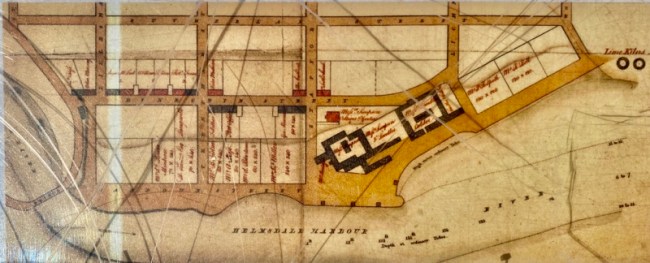
(Above: Alexander Simpson’s fish curing yard, located behind the new harbour)
Success brought streamlined methods. A man named Alexander Simpson became the first herring merchant in Helmsdale. His fish curing yard was built for him by the Sutherland Estate, at the behest of Elizabeth, who continued to watch over the project until her death.
Helmsdale narrowly survived a cholera epidemic in 1832, inching its way back to viability after being abandoned for several years. Eventually, Helmsdale became one of the major Scottish centres of herring fishing. The herring were known locally as the ‘Silver Darlings’.

‘Elizabeth’s harbour’ flourished until 1892, when a deeper harbour – as seen above – was constructed to modern fishing standards. A dramatic change occurred in 1972 when the new road bridge was built to carry the faster and more streamlined A9 trunk road.

(Above: the old (inner) harbour in its entirety. It’s hard to believe that, at its height, over 200 large boats of the time were crammed into its modest space. Ironically, the modern A9 road spans the old harbour entrance with this new bridge)
The Fifie Fishing boat (below) came to Helmsdale in 1990 from Findochty. The boat, on display near the old harbour, is over 100 year old. The Fifie had a vertical stem and stern, two masts and was very fast. It was carvel-built, meaning that planks of the hull meet each other end to end. At the height of the herring boom in the mid-nineteenth century, two-hundred such boats were crammed into the small inner harbour.


And so to the chip-butty… It’s a pile of chips dripping in salt and vinegar between two slices of well-buttered bread. On the day we went to Helmsdale, we’d travelled all the way from Orkney by early morning ferry, via Scrabster, Thurso and John O’ Groats – where we were expecting at least a coffee and sandwich. It was still only nine in the morning when we got there, but nearly five hours into our day.
John O’ Groats was closed… all of it. We journeyed on, and by the time we saw signs to Helmsdale, two hours later and along a very attractive part of the Sutherland coast, we were tired and very hungry. Our final destination of Inverness was still a further two hours away.
We’d never visited Helmsdale, before. Didn’t even know of its existence, to be honest. The sight of the lovely harbour, glistening in the sunlight of a September morning, stole our hearts and we turned down the valley towards the sea. Opposite the harbour wall, there were a few wooden tables with printed menus, outside what appeared to be a cafe. We scanned the menu quickly. Covid-19 rules were in force, so the take-away serving point was a caravan with a hatch in the garden of the cafe.

(Above: The famous chip butty – a north of England speciality we did not expect to find in Sutherland… But we were very glad we did)
It turned out the lady owner, Helen, had been listening to our hungry conversation. She greeted us in a broad Manchester accent. “Will that be chip butties all round then, love?”
We have happy memories of Helmsdale, and plans to return to study and explore it a little more. The story of Elizabeth Stafford is inspirational, and remains, for me, one of the highlights of the trip.
I couldn’t manage another of Helen’s chip butties, through… well, maybe one more for old time’s sake.
Other posts in the Pictish Trail series, here and on the Silent Eye blog:
Part One, Part Two, Part Three, Part Four, Part Five, Part Six, Part Seven (a), Part Seven (b),
©Stephen Tanham, 2020.
Stephen Tanham is a Director of the Silent Eye School of Consciousness, a not-for-profit teaching school of modern mysticism that helps people find a personal path to a deeper place within their internal and external lives.
The Silent Eye provides home-based, practical courses which are low-cost and personally supervised. The course materials and corresponding supervision are provided month by month without further commitment.
Steve’s personal blog, Sun in Gemini, is at stevetanham.wordpress.com.
Share this:

+ #Silenti, Collie dogs, Photographic techniques, Photography, Seasons, Four Seasons, Spring, Summer, Autumn, Winter,, Stream of Consciousness, Travel and people, Travel and Photography
Mellow moods for Autumn (5) : sounds of the forest stream
by Steve Tanham

We’re lucky to live close to two forests. The first is a few minutes’ walk away, the other is further and larger, the main path taking the walker in a slow ascent through the ancient Sizergh estate. At the highest point, you emerge into the open air within a few hundred metres of the local organic farm shop and cafe.
Tess loves the walk. I’m partial, too, and it’s not just the coffee as reward.
The larger forest has this lovely stream running through it. The path meanders as it climbs, crossing the stream several times. Subjectively, it’s as though there are three small rivers, each one with its own sounds…
Autumn adds its own voice: the crunch of leaves under boots, the quietness of the trees, the occasional howl of delight as the collie charges off to chase a squirrel and inevitably ends up gazing at her faster target high above, gazing back down at the slow, crazy dog.
There’s a wonderful sense of presence about a forest stream; as though you have entered a different relationship with time through its flow. Bubbling, swishing, trickling: the same but always subtly unique… completely in harmony with the surroundings it has helped create.
©Stephen Tanham, 2020.
Stephen Tanham is a Director of the Silent Eye, which offers a distance-learning program to deepen the personality and align it with the soul.
Share this:

+ #Silenti, Ancient Sacred Sites, Christianity and modern mysticism, Consciousness, mystical travel, Photography
Two journeys, one destination (8) : the thousand-year fingers
by Steve Tanham
Despite the world of the Picts being so far away in time, there was one man who reached back and ‘touched’ their minds with a language they shared… Art
(A ten minute read, 1300 words)

(Above: George Bain)
He looked, once again, at the beautiful rendering of belief and life and…. everything. Once more, he was swept away by a sense of identity with what he saw–what he felt. He knew he understood how they had created it… and he felt a connection to why they had created it.
He was determined to do it his way… and ‘his way’ was art. He picked up his stump of a pencil and let his fingers approach the circle he had drawn earlier on the graph paper. Across the internal horizon of the figure were seven dots. He hovered his pencil tip over the sixth, wondering how well he could render the curve needed. He’d had plenty of practice. He was, after all, a successful artist.
He was so wrapped up in this that his pipe rotated in his mouth – through lack of firmness of his jaw muscles. He smiled, as though sharing a joke with them…

“Not helpful,” he muttered, reflecting how much easier it was to speak with the pipe the right way up. “But I’m glad you’re here, all the same…”

(Above: gently and with precision, George Bain drew the first of his recreations of Pictish art.. The journey had begun)

(Above: George Bain worked entirely by hand, and was seldom without his pipe and his trusty ruler)
George Bain was born in Scrabster, Thurso’s port in Caithness, in 1881. Throughout his life – he travelled and worked in many places – he always stressed that he was a ‘Caithness man.’
Having journeyed up that beautiful coast on our way to Orkney – ironically via the ferry at Scrabster – I can understand why.
George Bain’s family moved to Edinburgh when he was nine. There, he studied at Edinburgh School of Applied Art, then Edinburgh College of Art. In 1902 he obtained a scholarship to the Royal College of Art in London, where he supported himself by working as a freelance newspaper artist and a magazine illustrator.
After serving in the First World War as a Royal Engineer, he taught art at Kirkcaldy High School, and remained there as Principal Teacher of Art until he retired in 1946. As a watercolour artist, he is best known for his landscapes. He painted his native Scotland, Greece and the Balkans, and held successful international exhibitions in Paris and London.
If he was restless, it was because he had a deeper fascination which was harder to fulfil – penetrating the art of the Picts, which, at that time, was not well known and even less understood.

(Above: this reproduction of a small roundel, created by George Bain, was based on an original Insular piece only 1.5 inches across)
I have remarked before in this series of posts that when I saw a Pictish design up close for the first time, I felt just as I had when I first encountered Egyptian art. It’s an emotional experience and reminds you that there is a real power there. Art has has an ability – like symbols – to convey something deeper than the surface shape. In a sense it still ‘speaks’ – even after a thousand years. We may not comprehend it, but we can share it…
Beyond his watercolours, George Bain made it his life’s work to understand how the Picts had created their decorative art: to unravel its geometric principles and the actual techniques used to create their complex patterns. There was nothing primitive about the Picts’ designs, and by inference, their social and spiritual beliefs.

(Above: George Bains’ drawings of the evolution of the Pictish three-coil spiral)
The Picts’ work survives only in stone, but (as we have covered in previous posts) the monastic ‘Celtic’ world was closely connected across Scotland, Ireland (‘Insular’ art), Cornwall and Brittany, and there were many related examples of jewellery and illuminated manuscripts. The Celtic worlds comprised the Western fringes of the old world.
We were to see how influential that old world was when we reached Orkney…
George Bain unravelled the mathematical frameworks for constructing Celtic art. He ‘decoded’ and reproduced hundreds of examples. It enabled those who read his books to not only understand the art of their forebears, but also to have a go at creating examples of their own. In this he was unique, and it earned him a special place in Scotland’s history – and a place in the hearts of those artists and lay-folk who longed to understand the principles on which Pictish art – and Celtic art in general – was based.

(Above: an example of George Bain’s detailed work. This is the opening page of the Book of Kells’ section on St John’s Gospel, reproduced by the artist, with illustrative notes as to how it was created)
The act of producing authentic designs based upon an historical model requires a deeply focussed mind and a set of refined draughting skills. George Bain produced his classic work Celtic Art: The Methods of Construction in 1951. Initially, the work did not receive a lot of attention, but when it was re-issued in 1971 it caught the enthusiasm for Celtic revival prevalent among young people at that time, and the book has been in print ever since. Creative people of all walks of life were receptive to ‘having a go’ and Bain’s scholarly yet accessible methods became necessary reading to anyone who wanted experiential knowledge of a ‘drawn form’ that had fascinated the world for a century or more.

Our brief time in the company of this man’s works had not been wasted. We all wished that it could have been longer, but the Covid restrictions were in force and we understood the need to honour our departure time.
But we now had a feel, if not the details, of how expertly and geometrically the Picts had wrought their works. Knowing them through George Bain’s efforts, we each would have liked to pick up a pencil and play at Pictish art… exactly as he would have wished.

(Above: More of George Bain’s hand-drawn expositions of classic books)
By all accounts, he was not an easy man to get along with, but he was devoted to his teaching work. His mistrust of academics might have been the scarring of years of dismissal by those who felt that a ‘mere artist’ had little to add to the study of ancient history. How wrong they would have been!
George Bain died in 1968, age 87. He had and has a large following. His writings opened up the intricacies of an ancient civilisation to a wider public, encouraging exploration of, amongst others, The Book of Kells, Celtic Knotwork, the Pictish Stones, themselves, and the Book of Durrow. One of the main reasons for Bain’s success was his practical encouragement for fellow artists to use Celtic principles in their craftwork.

The lasting memory I took away from Groam House Museum, which houses the George Bain exhibit, was the memorial he designed for the grave of his wife, Jessie Mackintosh – the image above. Theirs was a deep love and they were inseparable. He was devastated when she died, tragically and prematurely, in 1957. In the memorial, he represented himself in Celtic style, and the entire work was created according to the principles he had learned in his Pictish studies.


To be continued…
Other posts in this series:
Part One, Part Two, Part Three, Part Four, Part Five, Part Six, Part Seven (a), Part Seven (b),
This is Part Eight.
©Stephen Tanham, 2020.
Stephen Tanham is a Director of the Silent Eye School of Consciousness, a not-for-profit teaching school of modern mysticism that helps people find a personal path to a deeper place within their internal and external lives.
The Silent Eye provides home-based, practical courses which are low-cost and personally supervised. The course materials and corresponding supervision are provided month by month without further commitment.
Steve’s personal blog, Sun in Gemini, is at stevetanham.wordpress.com.
Share this:

+ #Silenti, Ancient Sacred Sites, Christianity and modern mysticism, Consciousness, mystical travel, Photography
“Ain’t this a mess, Sheriff!”
by Steve Tanham

In the film ‘No Country for Old Men’, there’s a famous opening scene at the site of a drugs shoot-out. Everyone’s dead when the local Sheriff and his deputy arrive and start wandering through the bodies as though they were in a Spaghetti Western.
The Deputy stays silent for a long time, then says excitedly, “Ain’t this a mess, Sheriff!”. Sheriff Bell (Tommy Lee Jones) looks askance at his junior and replies, as only Tommy Lee Jones can, “Well, if it’s not a mess, it’ll do till a real mess comes along…’
As you can tell, I think the scene is priceless. It somehow ‘enables’ the rest of what is, otherwise, a very dark movie–but brilliantly told.
I seldom revisit it, but sometimes, if I do something stupid enough, I can hear Sheriff Bell’s words in my head…
As I began to recount the story of the Silent Eye’s ‘Pictish Trail’ weekends, I found the episodes were so full of detail that I had slipped over my target 1000-1300 words. When you write often, you can gauge, almost immediately, when you’ve overcooked something – and you are asking an unreasonable degree of reading from those wonderful souls who follow you.
After the third post, I had already written the next two. When I examined them, they were each twice as long as my new target of approximately 1000 words.
So I cut them in half…
That meant I had four posts lined up in the WordPress firing chamber.
And this is where, as Gerard Hoffnung once said, in his famous and hilarious Bricklayer’s Story, ‘I may have lost my presence of mind…’
Last Thursday, forgetting I’d halved them, I published the post of our triumphant arrival at Rosemarkie, on the Black Isle, and missed out the post that should have preceded it.
So, by way of recompense, here it is…
It’s a fine mess, but hopefully, it’ll do till a real mess comes along...
The Shandwick and Nigg Pictish Crosses
I suspect there’s a certain amount of suspicion – quite justified as it turns out – about how smoothly our workshops go. A sense of ‘they couldn’t possibly have fitted all that into one day, for heavens sake…’
But, so far, on the Saturday of this Pictish Trial weekend, we had.
We’d had the pleasure of seeing the Hilton of Cadboll stone, which time had not permitted on the prep visit, the previous year. Now, the amazed look on the faces of the visitors as we arrived at the glass-housed beauty that is the Shadwick Stone said it all…
Clach a’Charrridh (Shandwick stone) means stone of the grave plots, and was named so after the area was used as a burial-ground during the 1832 cholera epidermic. It’s on the Fearn Peninsula, about a mile from the Hilton Cadboll site, and sits on the crest of the ridge, visible from the sea.

The cross slab has stood majestically overlooking the Moray Firth for over 1000 years. Its present site is where it has always been. There is something wonderful about standing there and knowing that.
Here, I met the first problem: the smoked glass. For me, there is a joy in bringing back images that I know will generate interest. But, at Shandwick, every time I took a shot, all I could see was the reflection of me and the landscape in the glass.

(Above: the spine of the Tarbat and Fearn peninsula is the location for these famous Pictish stones)
I took myself off to one side to try with the editing tools to see if what I had taken was salvageable. As long as I could live with a little colour distortion they would be fine. I returned to snapping…
The thick glass serves a purpose, and it’s wonderful to see these precious artefacts so well protected. The glass and steel housing is locked. You can go inside, but only by appointment with a key holder. And not in the year of Covid-19.
The landward side of the slab is set out in eight panels. They contain a range of symbols. The top panel once had a finely decorated Pictish double disc on it. The central panel contains a hectic scene of Pictish life, with birds, beasts and human figures.

A Christian cross has been carved on the seaward face of the slab. Some of the other motifs on this side may also be religious symbols. Immediately below the arms of the cross are angels with outspread wings. They are placed above animals which could be interpreted as David’s lions. Then there are snakes or serpents. The designers of this and the other stones in the area were certainly not working alone. They must have known of the Christian decorated manuscripts of Lindisfarne and Iona as well as the metalwork and sculpture of Northumbria and Ireland.
This Pictish sculptured stone was carved and erected about 1200 years ago. The stone was presumably quarried from the local cliffs in about 780 A.D. It was moved here using ropes, timber rollers and levers, or possibly a cart. The blocks of pattern were marked out and carved using a hammer and iron chisel.
Such a complicated design using a single motif is unusual. Yet it also occurs as a panel on the Hilton of Cadboll stone and fragments from Tarbat. It is speculated there was a school of sculpture in the area specialising in this style.

(Above: the sides are decorated, too)

(Above: the ‘trinity’ symbol in a Pictish form. The often recurring ‘three as one’ glyph will be familiar to many, and shows the depth of spiritual thought possessed by the Picts)
Our afternoon was passing, fast. Our next stop, the small town of Nigg, is famous for its connection to the North Sea Oil business, which is now diminishing. Back up the hill from the oil terminals is a lovely old church which houses the famous Nigg Stone. It’s run by volunteers, but the website, checked that morning on my phone, said it would be open.

The Nigg Stone is displayed inside Nigg old church in a specially created exhibition area. Admired and studied by scholars from all over the world, its ornamental cross resembles a manuscript page. The fantastic intricacy of the carving, the whorls and spirals, and the heaped up knot of snakes, with tails and tongues endlessly intertwining, is said to be paralleled only in the illuminations of the Great Gospel book of Kells.
Unfortunately, when we got to the door, it was locked…

(Above: Nigg’s ancient and beautiful church… sadly closed)
However…. Sue Vincent is celebrated on the Silent Eye weekends for fearlessly reaching up on tip-toes and sticking her camera lens up against the glass, then pressing away, merrily, to see what she can capture. I thought of her as I jammed my iPhone as close as I dared and took a few exploratory shots. When the results looked interesting, I wiped a tissue on the grass to wet it, cleaned the promising spot on the windows and hit the shutter again.

(Above: the ‘stolen shot’ of the Nigg Stone. It’s long way from perfect, but, given the church was closed, it’s a lot better than nothing… The metal bracket is not vandalism, it was custom-made to fit into an eroded gap in the stone (see below), and also to hold the slab-cross in place in its tiny museum)

(Above: One we took earlier, thankfully! The high quality image of the Nigg Stone at the Tarbat Discovery Centre partly makes up for Nigg Church being closed)
The carvings include a unique illustration of a miracle: the first monks, Paul and Anthony, receiving bread in the desert from a raven sent by God, and David: King and Psalmist saving a sheep from the lion, his harp beside his shoulder.
We had completed our Tarbat Peninsula visits. We dashed down to the shore to show our visitors the dramatic Cromarty Firth, then headed off to the final assignment of the day – Rosemarkie, where one of the most wonderful surprises awaited…

Above: the ferocious Cromarty Firth. Majestic and fearsome. Across this, but not literally (as the ferry wasn’t running!) lies The Black Isle, our final destination for the Saturday, before returning to Inverness.
To be continued…
Other posts in this series:
Part One, Part Two, Part Three, Part Four, Part Five, This is Part Six, Part Seven (Rosemarkie)
©Stephen Tanham, 2020.
Share this:

+ #Silenti, Lake District, landscapes, mystical travel, nature, Photographic techniques, Photography
Mellow moods for Autumn (4) : by the river
by Steve Tanham
Autumn is a beautiful time in the Lune Valley…
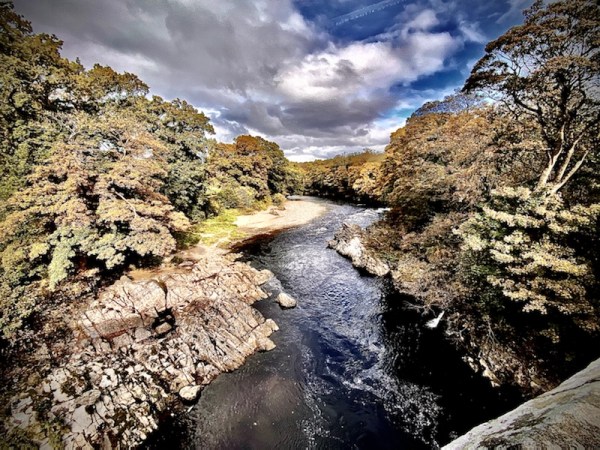
The River Lune rises in the gentle hills of the Eden Valley, in Cumbria, the last western county before you cross the border into Scotland. It flows for 53 miles in long curves, defining a series of beautiful valleys.

It’s most scenic section is where it passes a few hundred metres from the centre of Kirkby Lonsdale, a 13th century market town, famed for its wealth of history and surviving stone dwellings – and also the still-standing Devil’s Bridge, which used to be the main highway into West Yorkshire and offers one of the most photographed views in Cumbria.
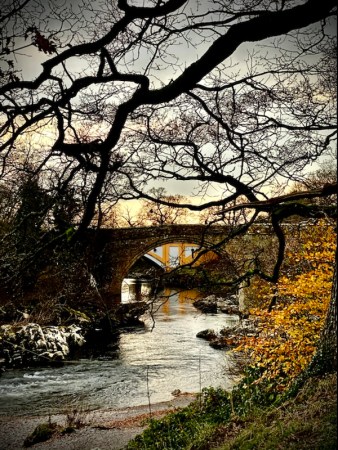

This beech tree lives just above the banks of the Lune, on the footpath to the ‘dreaded’ Radical Steps…
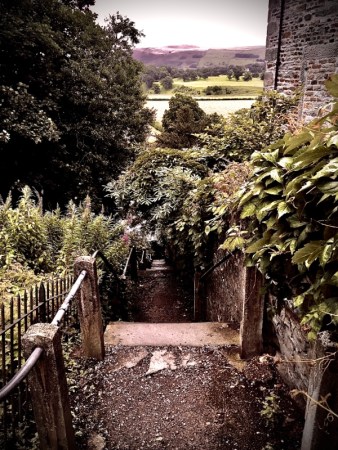
…whose 99 blocks of uneven stone challenge the visitor to ascend from the level of the river to Ruskin’s View – photographed, here, in summer.
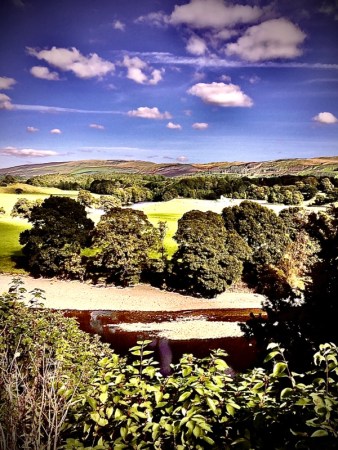
And from here, the entire curve of the River Lune’s passing can be seen. It’s an ascent best attempted in dry weather… But worth it for the view.

There are other views… The many excellent restaurants strive to outdo each other with seasonal delights…
©Stephen Tanham, 2020.
Stephen Tanham is a Director of the Silent Eye, which offers a personally-mentored, distance learning course in the deepening of the personality and its alignment with the individual soul.
Share this:

+ #Silenti, Ancient Sacred Sites, Christianity and modern mysticism, Consciousness, mystical travel, Photography
Two journeys, one destination (7) : Rosemarkie, the Black Isle
by Steve Tanham
The continuing story of the ‘Pictish Trail’, the Silent Eye’s workshop in the far north-east of Scotland. We encounter the best Pictish stone at close quarters… (A ten minute read, 1100 words)
Our final visit of the Saturday was to Rosemarkie, a beautiful village on the Black Isle, whose seafront looks south across the vastness of the Moray Firth.


Rosemarkie was also home to a Pictish Monastery. This is now celebrated by the presence of an excellent local museum – close to the site of the original church. Groam House Museum highlights and celebrates the Pictish connection.

Outside the Groam House Museum is a set of mounted mosaics based on Pictish designs. Several had attached folk tales. One in particular caught my eye as we were entering Groam House. It is called ‘The story of the salmon and the hazelnuts’.


‘There is a mythical tale that hazelnuts are believed to be the source of great wisdom.
‘The story tells of a deep dark pool surrounded by hazel trees. In the pool lives a salmon who loves to eat the hazelnuts as they fall from the trees. It said that whoever catches this salmon and eats his flesh will become the wisest person in the world.’
Nothing else, just those words… But they reminded me of one of W. B, Yeats’ mystical poems, ‘Wandering Aengus’, in which a man stops by a river and fashions himself a fishing rod from the branch of a (magical) Hazel tree. For bait he used a berry. What he catches changes his world, and fills him with a purpose that turns the rest of his life into a quest… Follow the link to read the poem.
Smiling at the connection, I entered Groam House Museum, where we were to find our own ‘catch’ of treasures.

The previous stops had left us all with a sense of wonder at the artistic skills of the Pictish craftsman. We had joked that each person, at some stage in the day, had been found with their head ‘at an angle’ trying to figure out the geometric patterns in the stonework. Yet, nowhere had we found an explanation of the complex geometries used in their construction.

The Groam House Museum is devoted to the Pictish relics found on the excavated site of the former church, itself built on the 7th century foundations of another Pictish monastery; though one smaller than that at Portmahomack.
The Groam House exhibits are centred on the giant ‘Rosemarkie Stone (above and below), a classic Type Two cross-slab over twelve feet high, with Christian markings on one side, and more mysterious and ancient Pictish carvings on the other. At the time of their carving, both the traditions were embraced by the Picts, and hence the use of the double design. Archeologists remark that with the Christian faith dominating the world to the south of Easter-Ross, the Picts may have been hedging their bets!


(Above: the reverse, Christianised face is less distinct due to weathering, but the illustrative drawing, below, helps)
The hand-drawn Illustration of both its faces, below, is taken (via Wikipedia) from Angus J Beaton’s Illustrated Guide to Fortrose and Vicinity, published in Inverness in 1885.

The Rosemarkie stone is carved from fine-grained sandstone. It was disovered in the first two decades of the 19th century in the floor of the old church in the village of Rosemarkie. The stone had been broken into two parts that have since been reconstructed.
The Christianised side is elaborately carved. The reverse side carvings include a double disc and z-rod, and no less than three crescents and v-rods. It is unique to find this repetition of a symbol, and must indicate a local emphasis of whatever it signifies.

(Above: Tree vine and grapes; a Pictish representation of Christ and his Disciples, though the original meaning of may pre-date Christianity)
There are other treasures at Groam House. Rosemarkie’s first stone church became a place of pilgrimage. The sculptured slab above could reflect such a role as one side of a stone shrine – a box that would have held a few bones of a revered saint.

(Above right: St Curadan)
Rosemarkie is generally linked to Saint Curadan, one of the bishops who witnessed St Adnoman’s Law of the Innocents, in 697 AD. This was the first declaration of rights for the safety of women and children during warfare. It was signed by representatives of Christian kingships across the British Isles at a meeting in Ireland. But there is also a story linking the church to Saint Moluag, whose monastic focus was on the west coast, on Lismore. He died in 592 AD. Some of his bones were brought here during the troubled 800s. It was at this time that Saint Columba’s relics were taken from Iona to Dunkeld.
The vine carving was done around 100 years later, at a time when Christianity had become the entire basis of the Picts’ religion. It represents a tree vine with grapes, symbolising Christ’s disciples, his blood and salvation. The imagery is just right for a shrine – perhaps the stone box was prepared for relics of Saint Curadan?

Sadly, the main Groam House exhibits made no mention of how the Pictish works were created, in terms of geometric principles. At that point, I had completed my circuit of the ground floor and was back near the door. My eye was taken by a colourful picture on one side of the notice board. Enquiring, I learned it was of St John, and created by a Scottish artist who had specialised in the reconstruction of Pictish geometry…
I must have looked disbelieving because the guide, smiling, pointed upwards. “We have two floors,” he said. “The upper one is dedicated to the work of George Bain, the man who gave us the keys to the art of the Picts…”
It had been a long day, with a small amount of sustenance. My legs were a touch weary as I climbed the steep stairway to what looked like an extended attic. But what we saw, waiting in that upper floor was refreshment enough…

Forty minutes later, our pre-booked time came to an end. The manager and guide of Groam House had extended it for as long as he dared. Mercifully, the cafe we knew on the seashore was still open, and, as the afternoon light began to fade, we were finally able to have some coffee…. and a little cake.
Next week I will recount the discoveries of that forty minutes and the sheer excitement of seeing the art of the Picts decoded…

To be continued…
Other posts in this series:
Part One, Part Two, Part Three, Part Four, Part Five, Part Six, this is Part Seven
©Stephen Tanham, 2020.
Stephen Tanham is a Director of the Silent Eye School of Consciousness, a not-for-profit teaching school of modern mysticism that helps people find a personal path to a deeper place within their internal and external lives.
The Silent Eye provides home-based, practical courses which are low-cost and personally supervised. The course materials and corresponding supervision are provided month by month without further commitment.
Steve’s personal blog, Sun in Gemini, is at stevetanham.wordpress.com.
Share this:

+ #Silenti, Ancient Landscapes, Ancient Sacred Sites, Consciousness, esoteric psychology, mystical travel, Photography, Travel and Photography
Bridges of Stone and Heart
by Steve Tanham
The emotional story of an unusual wartime chapel on Orkney reveals a different type of heroism… and hope. (A ten-minute read, 1400 words).
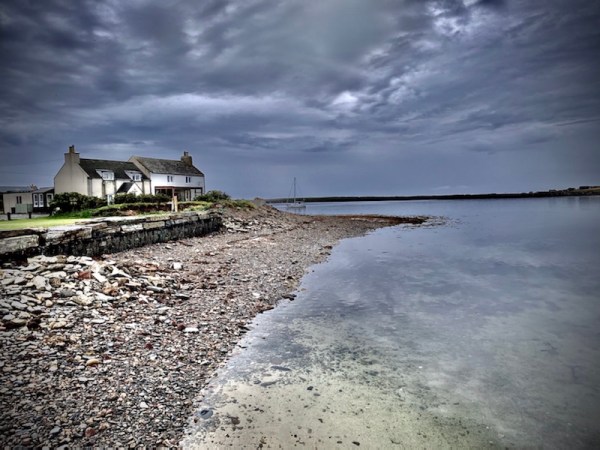
(Above: the waters of Scapa Flow have not always been so calm…)
Shortly after midnight on the 14th October, 1939, a German U-boat, U-47, passed unseen into the vast and hitherto safe waters of Orkney’s Scapa Flow, the base of the British Fleet, and sank the Battleship HMS Royal Oak, with the loss of 834 men. So convinced were the navy that Scapa Flow was impregnable, that over an hour passed before it was realised that the attack had come from the water…

(Above: the doomed HMS Royal Oak. Source Wikipedia, Public Domain)
“The place where the German U-boat sank the British battleship Royal Oak was none other than the middle of Scapa Flow, Britain’s greatest naval base! It sounds incredible…” William L Shirer, journalist, 18 October 1939.
Until that point, the great internal seaway of Scapa Flow had been considered safe waters for the fleet, its narrow entrances already reinforced with an assortment of deliberately sunken, retired merchant ships known as ‘Blockships’. Winston Churchill, soon to be Prime Minister, visited Orkney to inspect the defences in the light of their failure. His naval engineers determined that the integrity of the waters of Scapa Flow could not be guaranteed without a process of sealing off the eastern entrances of the waterway.

(Above: even stranger craft now occupy the centre of Scapa Flow)

The Admiralty concluded that, to make Scapa Flow safe as a continued refuge and harbour for the fleet, they would have to seal off the open waterways between the Orkney ‘mainland’ and the southern islands of Burray and South Ronaldsway. The causeways or ‘Churchill Barriers’ required were the subject of a major civil engineering project awarded to Balfour Beatty.
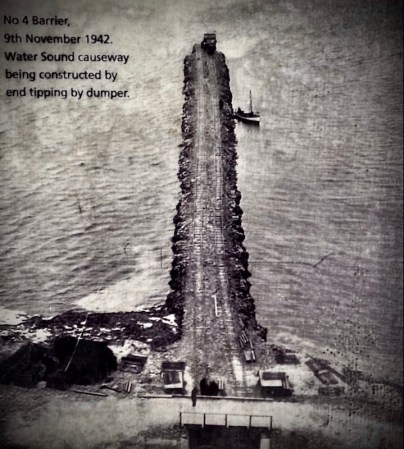
(Above: the early stages of one of the main ‘Churchill Barriers’ shows the severity of the working conditions. The water was freezing and could be up to 70ft deep. An enormous degree of land and sub-sea engineering was required. A private railway line was constructed to supply the massive project)
At first, the contractor’s own workers were employed, but the terrible conditions caused most of them to leave. It was proposed that Italian men from the two local Prisoner of War (POW) camps would be commissioned to take over. This was not without its legal (human rights) difficulties and the Italian POWs only agreed on the basis that it would benefit the local people, many of whom had been kind to them and regularly purchased the trinkets and jewellery they made from scrap materials.
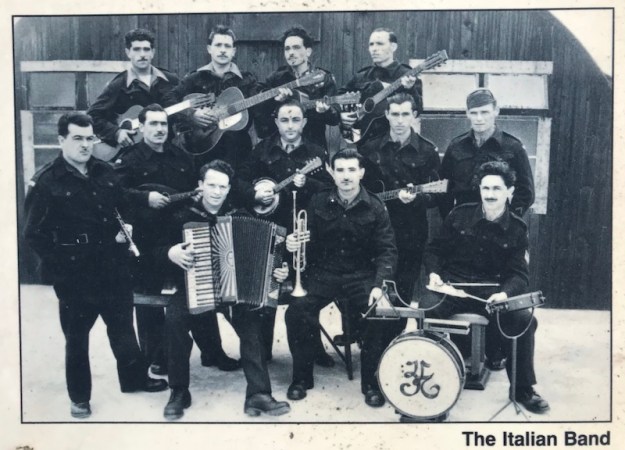
(Above: this and other b/w pictures are from the site’s information board)
The Italians were resourceful men. Many had been captured at the British desert victory at Tobruk, and were engineering-trained tank commanders and crew. They missed their homes and felt deeply isolated so far north. They constructed a small concert stage, on which they would entertain locals and other POWs from afar with their own band.
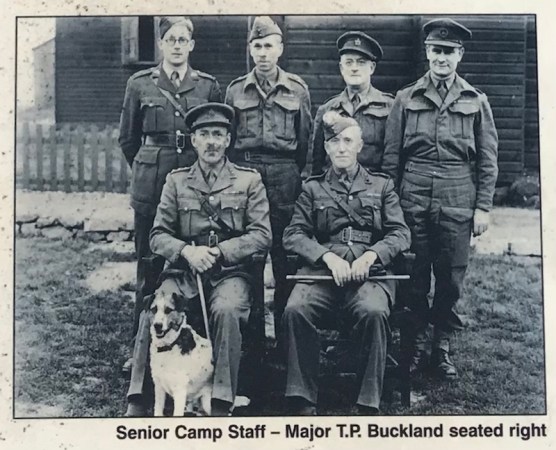
(Above: a wise and considerate Major Buckland eased the Italian POWs into their hard roles as constructors of the Churchill Barriers. Granting them their own chapel was a major part of that agreement)

(Above: a wartime photograph shows how primitive was the accommodation within the Italian POW camp. Despite this, a magnificent place of worship was created)
When, despite the horrific working conditions, the Churchill Barrier project was seen to be progressing, the Italian men asked to be able to construct their own chapel. The British POW Camp Commandant, Major T.P. Buckland, spoke Italian and had formed a good working relationship with his charges. He agreed to supply them with two Nissen huts, originally on the basis that one would become a school, the other their chapel. In the event, the church became so well attended that both huts were used in its enlarged construction.
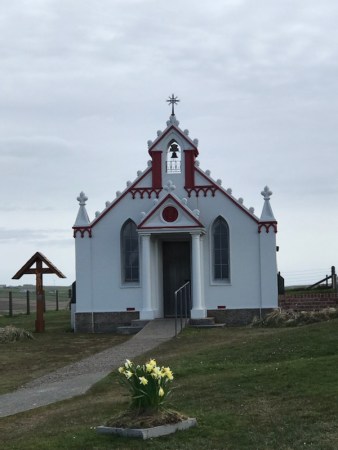
(Above: the front of the Italian Chapel. From here, we can show modern images in colour, for the Orcadian authorities, and the people of this beautiful archipelago, honoured their pledge to look after the beloved chapel, in perpetuity)
On September 30, 1943, the Italians got their own priest. Padre Gioachino Cobazzi of the Order of Little Brothers, arrived at the camp to take up the role. One of the POWs, Dominico Chiochetti, an artist, became a leading light in the design of the new chapel.
His first project, which had preceded the chapel, had been to construct a statue of St George Slaying the Dragon, which presided over the POW camp’s ‘square’.

He gathered together a team of craftsmen and began work on a sanctuary–the first stage of the church.
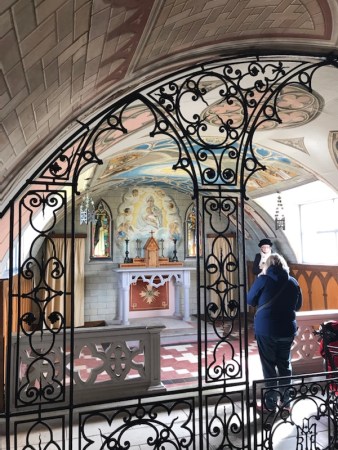
It was at this point that local people began to refer to the emerging building as ‘The miracle of Camp 60’. They watched, emotionally involved, as Chiochetti’s creative magic began to transform the ugly piece of land in which the POWs lived.
As each new section of the emerging chapel was erected and decorated, so the remaining space looked drab – and more and more volunteers arrived to speed up its completion. Soon it was decided to beautify the whole of the interior.

(Above: how to beautify a plain ceiling)
The ceiling features painted relief work and wonderfully rendered Evangelists’ symbols of the Four Holy Creatures: Here are to be seen the Holy Bull (St Luke) and Holy Eagle (St John). The other side of the ceiling show the Holy Man (St Matthew) and, finally, the Holy Lion (St Mark).
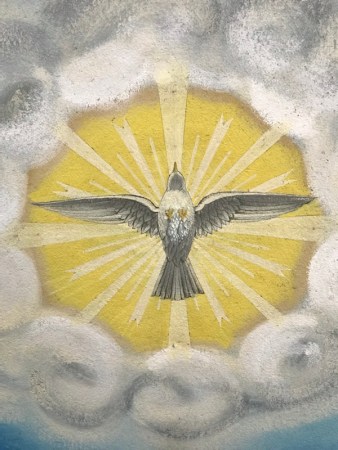
Overhead in the east of the chapel (below) is a symbol familiar to mystics as ‘The ascending consciousness of God working through Mankind’.
The Italians’ attitude to such ‘creativity in adversity’ is best described by a fellow prisoner:
“It was the wish to show to oneself first, and then to the world, that in spite of being trapped in a barbed-wire camp, down in spirit, physically and morally deprived of many things, one could still find something inside that could be set free…”
And then this key sentiment:
“The statue of St George was built first. It shows the patron saint of soldiers ready to kill the Dragon…”
Here the speaker pauses in saying what ‘the Dragon’ symbolised to the POWs and why its slaying was so important to the men imprisoned in the camp.

Chiochetti supervised all the pictorial and decorative work. He also designed the altar, tabernacle, candlesticks, lamps, rood-screen, windows and coloured glass, plus the ornamental woodwork.
All of the work was carried out using the simplest materials, including scrap wood from a wrecked ship. The men also utilised the sculpting of reclaimed concrete!
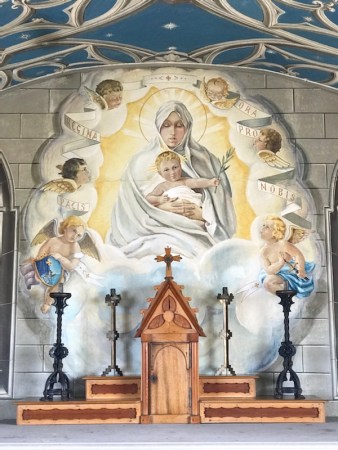
(Above) The altar is Chiochetti’s masterpiece. It is based on Niccolo Barbino’s Madonna of the Olives, from a small picture given by his mother which he carried with him throughout the war.
Sadly, after such an heroic effort, the chapel was in full use for only a short time. Italy surrendered to the Allies, then, having ousted Mussolini, switched sides in the war. In May 1945, their status being changed, the prisoners were moved to Skipton in Yorkshire for repatriation back to Italy.
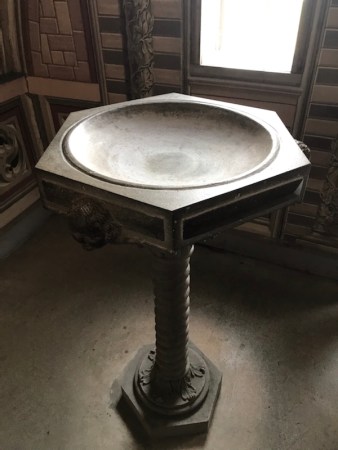
Only Chiochetti stayed behind…to finish the font; the final piece on which he was working.
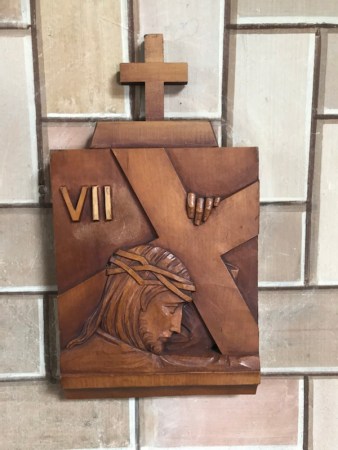
After the war, he returned with his wife to show her the Italian Chapel. Descendants of the Italian POWs still visit and contribute to the church with donations and new objects, such as the stations of the cross, above.

(Above lower) A picture of Chiochetti and his wife visiting the church in 1960. What a moment that must have been for them both…
It is fitting that Orkney has protected and preserved the Italian Chapel. Long before it became a tourist destination, it symbolised the human spirit’s determination to rediscover the core values of love, tolerance and compassion. Orkney stands apart from the rest of Scotland. It is ancient and understands isolation, just as it understood the creation of the Italian Chapel.
The Italian prisoner – quoted in a previous section – finished his sentiments about the statue of St George Slaying the Dragon with the following words:
“It is the symbol of a will to kill all misunderstandings among people of different cultures. As the St George monument was built to express the physical and psychological pain, so was the chapel conceived to meet a spiritual need.”
In a world now ravaged by a different kind of war, I can’t think of a kinder nor more fitting sentiment.
This is part of a series of ‘betweens’ from the Silent Eye’s recent workshops in the Scottish Highlands and Orkney.
©Copyright Stephen Tanham, 2020.
Notes: Original colour photos by the author. Black and white historic images photographed from the Information Boards at the sites, unless otherwise stated.
Stephen Tanham is a Director of The Silent Eye, which offers a distance-learning course to deepen the personality and align it with the individual Soul.
Share this:

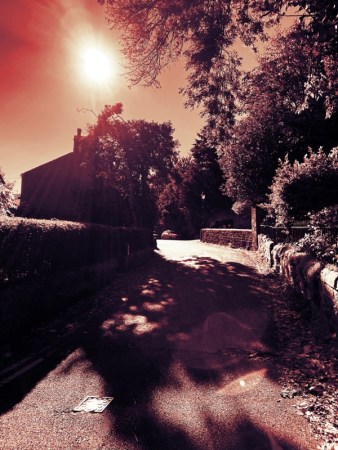
Heysham village is a delightful outlier of old Lancashire…
Its main street curls up from a one-alley access road for a stony shoreline to become a row of beautiful stone cottages that have stood there for hundreds of years.
Near St Peter‘s Church – there since Anglo-Saxon times, the road bends and climbs. This cottage dominates the corner; and today, the light and the shadows it cast were perfect for a monochrome shot.
©Stephen Tanham
Stephen Tanham is A Director of The Silent Eye, a distance-learning school for the deepening of the personality and its alignment with the individual soul.


 Sun in Gemini
You must be logged in to post a comment.