
I thought it might be interesting to take some of the less relevant episodes – the ‘out-takes’ – from the just-completed Scottish workshop (and subsequent journey to Orkney) and run them on Sun in Gemini, in reverse time-sequence. The Thursday blogs, here and on the Silent Eye, will continue with the linear sequence of the Scottish and Orkney explorations.
That way the odd bits of the journey and the main storyline would meet somewhere in the middle – I have no idea where! Let’s see what happens…
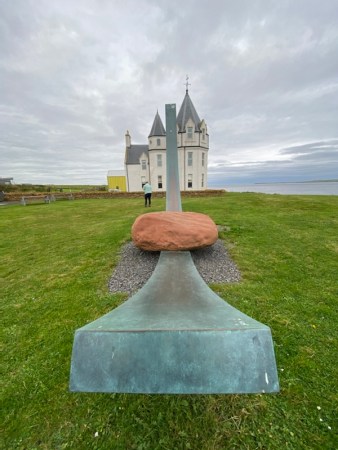
The above image worked better than I thought it would. At face value, it could be a giant slide attached to a hotel on a headland, with a sandstone rock hitching a ride and about to decapitate the observer!
But it’s not, of course. It’s part of a sculptural installation on the headland at John O’ Groats, the most northerly point on the British mainland, and a few sea miles from the archipelago of Orkney, from which we had just sailed… at 06:15 in the morning.
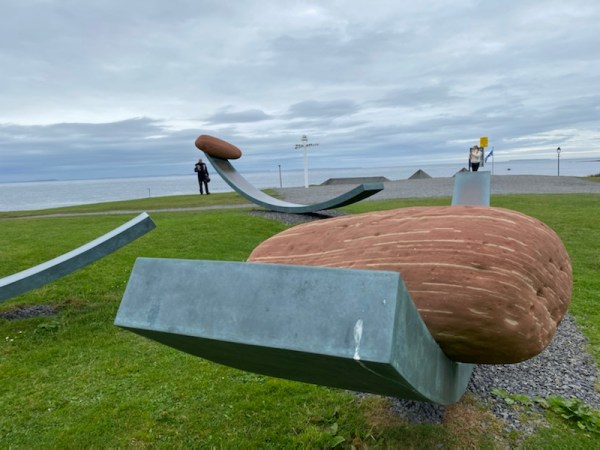
North of John O’ Groats – between the coast and Orkney – is the Pentland Firth, famous for its fast and ferocious tides and cross-currents. Dire-sounding weather and tidal warnings for Pentland Firth are regular features of BBC weather broadcasts.
The deadly tidal rapids on the surface of the Pentland Firth are common knowledge, but less well-known are the resulting activities beneath the sea. Recently, a new insight was gained when researchers, supporting the growing commercial interest in the harnessing of some of the Firth’s vast tidal power, began surveying the seabed with a view to locating permanent turbines on the ocean floor.
During this exercise, it was discovered that large rolling boulders of up to 1.5 tons in weight – similar to that of an average car – were regularly moved great distances across the seabed by forceful currents!
This fascinated local artists Matthew Dalziel and Louise Scullion, whose work focusses on art and sculpture inspired by ecology and natural phenomena.
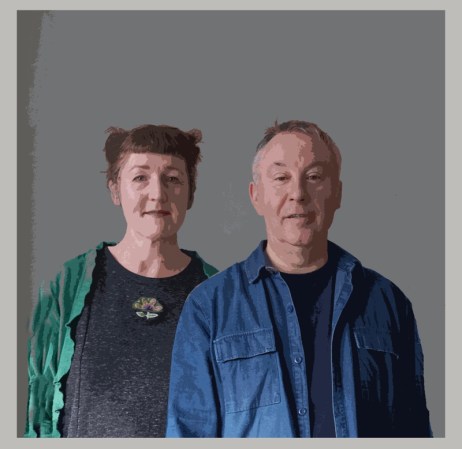
(Above: Matthew Dalziel and Louise Scullion, creators of the Nomadic Boulders sculpture. Their website is here. Image from website)
They put forward a proposal for a sculptural installation that mirrored their own surprise at the thought of giant deep-sea boulders wandering along the sea bed, powered by the giant waves above. The result is what you see here in the above photographs; something that puts John O’ Groats on the modern artistic map.
The information board sets the context:
‘Across the world, boulders that defy the weightiness, their solid stability and static nature and hint instead at a more animated past are often celebrated. Small pilgrimages are made to visit them and share in their unusual power...
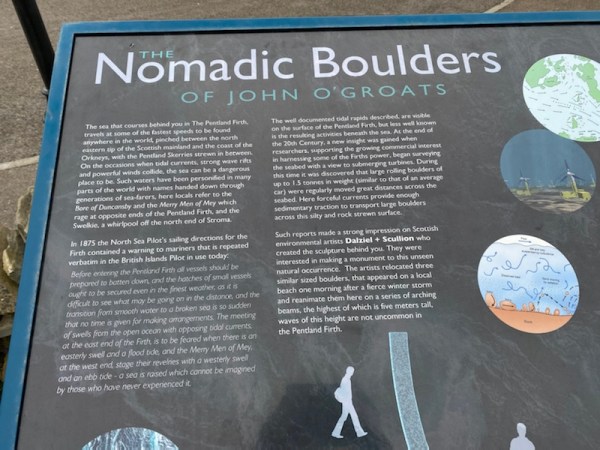
… While the Nomadic Boulders of John O’Groats will forever remain shrouded in the deep and stormy depths of the sea, this monument serves to bring them to our consciousness, perhaps affording a tantalising glimpse of the world beneath the sea.’
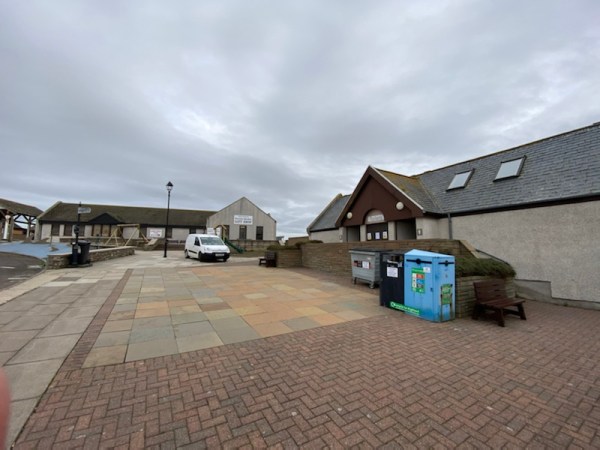
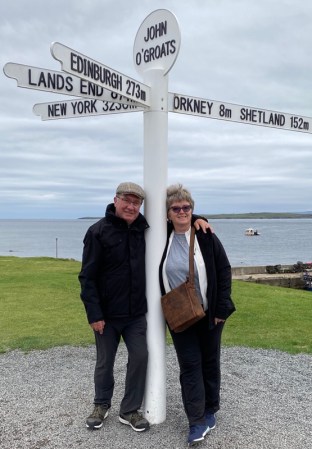
Having sailed from Orkney on the early ferry, we were hoping to break the trip around the coast with a hot drink, before the long drive south. But at nine in the morning, on our first ever visit, John O’Groats was closed. We couldn’t even get a a cup of coffee. Scenic, though, and Larissa, one of our travelling companions and a skilled photographer, did gift us a fine portrait at the famous signpost.
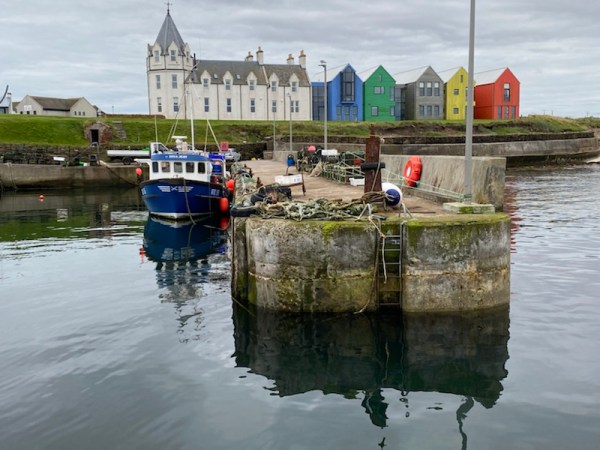
Being fair, John O’ Groats is a fine and symbolic place, The harbour is lovely, and a pleasant place to wander around. The main feature is the sight of the Pentland Firth, and, beyond that, the outline of the Orkney archipelago.
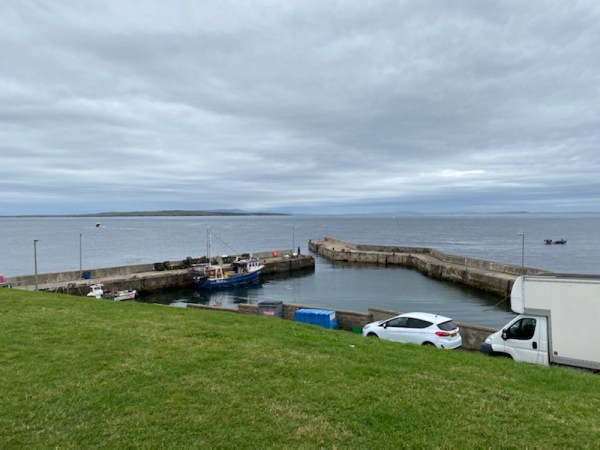
)Above: The Pentland Firth and (right) the outline of Orkney)
©Copyright Stephen Tanham, 2020.
Stephen Tanham is a Director of the Silent Eye, which offers a three-year, personally mentored, correspondence course in self-knowledge and a deeper understanding of how our sense of ‘self’ is built by life and can be deepened.
Click here for more details…
Share this:

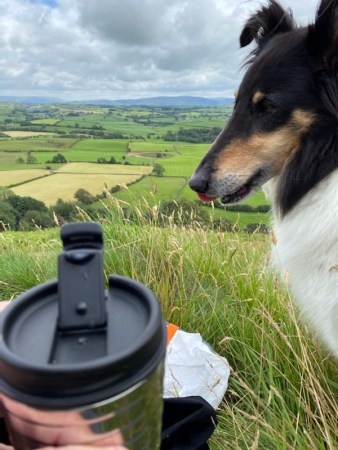
Human: It’s tea! You wouldn’t enjoy tea…
Tess: I know it’s tea, and I’ve had my water. I’m not looking at either of those.
Human: What then?
Tess: That tasty looking biscuit…you’re half way through..
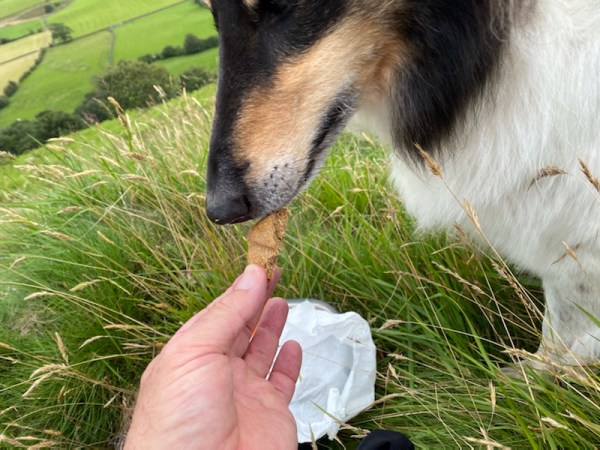
Human: ‘No greater love hath a man, than he share his last biscuit!’
Tess: Huh?
Human: Never mind….
©Copyright Stephen Tanham, 2020.
Share this:

+ #Silenti, Consciousness, guided mystical walks, Higher Mind, Mystery Schools, Photography, Places and Prose, Poetry, Scotland
Two journeys, one destination
by Steve Tanham

I remember listening to T. S. Eliot reading his poem The Four Quartets for the first time. The words held me spellbound:
“We shall not cease from exploration
And the end of all our exploring
Will be to arrive where we started
And know the place for the first time.”
My wife and I had first travelled to Inverness four years ago, we came by rail, en-route to Orkney. A long journey, but we love trains; and being away without the car has a certain ironic freedom…
We stopped at Inverness to change trains for our final destination of the port of Scrabster, the Orkney service harbour of the nearby town of Thurso. Sadly, we only had time for a quick lunch and a walk around the immediate area by the station. I remember looking down the stone-lined street that led deeper into the town and to the river Ness, and wondering what lay there. Then it was time to go, and we got back on the train, replete from lunch, and slept most of the way along the northern coast of the Moray Firth.
Yesterday, we returned to begin the Silent Eye’s first workshop of 2020; the rest having been cancelled due to Covid restrictions. Our party was much reduced, but we decided it was important to honour our earlier commitment and press ahead, mindful of the necessary restrictions.
From our B&B, Bernie and I were able to walk down some stone steps and see the centre of the town for the first time. It’s a beautiful place, and the setting along the river gives it a remarkable grace and peace. Our small party duly arrived and we decided that a quick pizza was in order for dinner – given the lateness of the hour.

Two hours later, we waved goodnight to our companions, and turned to climb the long flights of stone steps back to the ‘plateau’ of streets in which our dwelling was located. Just then, I caught sight of the railway station, and realised that I was now standing in the very place where my eyes had come to rest on the previous trip. Suddenly there was a ‘linking of worlds’, a perfect joining up of events seen from different perspectives but centred on the same point – in this case, me, the observer, gazing out from the railway station.
Despite the apparent simplicity, the moment had a profound impact, with the street seeming to spin in both directions as I aligned memory with present in a wonderful fulfilment of that past moment.
“Through the unknown, remembered gate”
It got me thinking that there are many parallels of this kind of synchronicity in our lives. My second of inner growth in comprehension mirrors how we feel when, travelling in search of personal growth and understanding, we find ourselves looking back on events of a previous time, yet now see them from what we can only describe as a higher perspective. The marriage of past and present knits the outer world of our experience into more perfect garment, and the intensity tells us that though this may be symbolic, what it represents, spiritually, is much more than what is seen.
Eliot’s poem continues:
“When the last of earth left to discover
Is that which was the beginning;
At the source of the longest river
The voice of the hidden waterfall
And the children in the apple-tree
Not known, because not looked for
But heard, half-heard, in the stillness
Between two waves of the sea.”
His words are richer, now. And I know that this observer has grown, through many perspectives on the same thing, to understand that pause between the two waves…
©Stephen Tanham, 2020

Stephen Tanham is a Director of the Silent Eye School of Consciousness.
Share this:

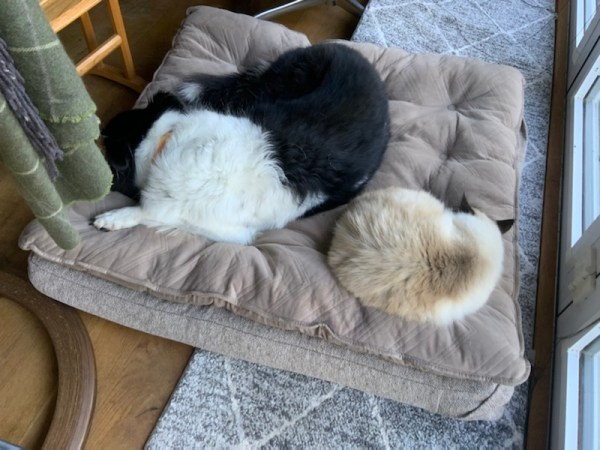
Misti: I didn’t really get more chicken than you!
Tess: You did! You made sure you were there, first.
Misti: I’m smaller. I have to compensate!
Tess: You’re faster over short distances…
Misti: I need more chicken to grow my shorter legs…
©Stephen Tanham
Share this:

+ #Silenti, Belief and Faith, Consciousness, Esoteric Meaning of Myth, esoteric psychology, Psychology, Unconscious
The Entered Dragon (6) : figures in the mist
by Steve Tanham

Continued from Part Five
Centre stage, the King smiles at us. His gaze is strong but gentle. As our eyes touch his, we feel the sense of purpose he holds. Courage and force reflect in the subtle colours that draw us into his very being. We feel renewed by this contact, shown that the burden of what we must face in the day-world is only a necessary stage in our lives; that the sense of inner royalty he represents will carry us far beyond its confines – if only we will hold those eyes…
The scene pans backwards from the purposeful orbs. The gentle hands of the Queen still rest on his shoulders. She smiles, knowing that we have absorbed the essence of this encounter. She brings her face closer to that of the King, and, as their skin touches, we feel her perfumed presence close to our own. It races through our being, filling us with a love and longing that leaves us agape.
In this final part of the series, we examine the nature of what Carl Jung named the ‘Archetype’. Archetypes are an active part of our shared unconscious. They are energy patterns at work within the most fundamental part of us. When we come into contact with them, we are seeing a personalised representation for our life, alone. But the type of figure, represented, for example, by a King, is shared with all humans. In this we can see why such types have been with us in myth, legend, poetry and song for as long as we have remembered and recorded our most meaningful experiences.
We have seen that the whole of the human unconscious is simply the other half of what we are, consciously. Our lives contain what is embraced and what is rejected. But what is rejected does not go away. It is part of our experience and was/is there for a reason. Like the ancient yang and yin, it is the rhythm of alternation of dynamic and passive – simplified, often, as male and female, but more subtle in reality.
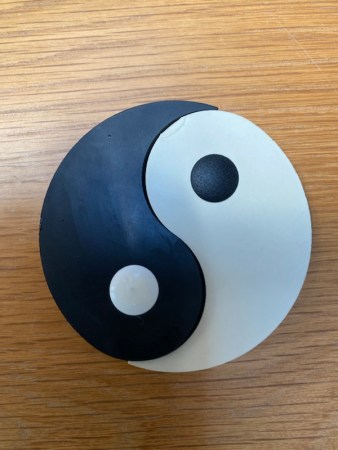
Both have their own power, there is a time to be resistant and a time to embrace, we need to know when to use both, and watch the flow and dance of the harmony of our lives, free, within their selves, of society’s expectations and rules. The unconscious gives us this power, liberating and releasing its vast energies… if we can learn to communicate with it.
There are two techniques we may use to allow the unconscious to communicate with our waking intellect and emotions. The first is by being more conscious of our dreams; the second is a technique known for thousand of years and held sacred within the heart of whole civilisations: active imagination.
Our personal unconscious tries to communicate with us using images and symbols. It does not use our daily language. Dreams are full of images. We normally dismiss these as simply a stream of random recollections from a brain that is half-asleep. But investigation will reveal that they are more than that. They are our own unconscious trying to communicate important perspectives to us. These might include the deeper nature of a current problem causing us great distress.
Habitually, we pay little attention to the detail of dreams. We have to relearn to be aware of the content of dreams, and allow a residue of what we observe to lie in a part of our memory from which we can retrieve it in the morning, writing it down as soon as we wake so that we have a record. Later in the day, its vividness will have faded, but, if we get used to a personal way of noting down the details, we can return to their important points.
As an example, one of my recent dreams was of a black and white comic book. In the dream the actual events of my life were being rendered as part of this book. What did this mean?
Here we enter a second stage of understanding our dreams. We need to take that ‘kernel’ of the dream and let the conscious mind ‘fly free’ with it so that it may make an interpretation. This is not a matter of intellect. Our intellectual minds are used to dominating how we perceive. We should try to maintain a gentle and passive state, forcing nothing, but allowing a reflective part of our minds to ‘mull over’ the stored nugget of the dream. If we make this a habit, the dream kernel will become a trigger and suggest to us the personal relevance of the image or symbol, without needing the use of reason. In my own example above, I concluded that the part of my life illustrated in the ‘black and white comic’ was not receiving the attention it deserved, and would shine in colour if I corrected this…
The other route by which we may converse with our unconscious is what Carl Jung called Active Imagination. Here, we deliberately let our waking consciousness follow a conscious script of imagination. This may be provided for us by a book, or be part of a series of imaginative journeys created by a school such as the Silent Eye. The essence of the induced, inner experience will be a journey of some kind. In that journey we will find archetypal figures like, for example, Kings, Hermits, Warriors, Lovers and Chaste Maidens. We may encounter withdrawn figures who hide from life, but whose knowledge is great. We may find that our King is withdrawn, but strangely not defeated. We may find that he (or a corresponding Queen) is waiting for the arrival of a Hero, one uniquely equipped to heal a rift in the land.
Such an inner journey of active imagination needs to be based upon time-honoured principles in order to engage the unconscious. It is the true work of any school of the mysteries to provide these, and guide others through the journeys – though the real value is the unique experience to be had by the ‘hero’ of the hour – the person carrying out the active imagination.
I suspect that Carl Jung did know of the ancient use of such techniques within magic and the mystical. His great gift was to investigate it, rigorously, and describe it in terms acceptable to the world of psychology. We owe him a great debt for his insight and the descriptive language he bequeathed.
The stage is quiet. The King and his Lover have gone. But one image remains, that of a pair of eyes. Unafraid, we draw closer, finding them strangely familiar. As the swirling mist clears, we realise that they belong to us, that they are a living mirror, yet subtly different, of our self’s eyes. They have much to say to us, as we come together in the laughing depths of our own most secret place..
Other parts in this series:
Part One, Part Two, Part Three, Part Four, Part Five, This is Part Six, the final post
©Copyright Stephen Tanham
Stephen Tanham is a Director of the Silent Eye School of Consciousness, a not-for-profit teaching school of modern mysticism that helps people find a personal path to a deeper place within their internal and external lives.
The Silent Eye provides home-based, practical courses which are low-cost and personally supervised. The course materials and corresponding supervision are provided month by month without further commitment.
Steve’s personal blog, Sun in Gemini, is at stevetanham.wordpress.com.
Share this:

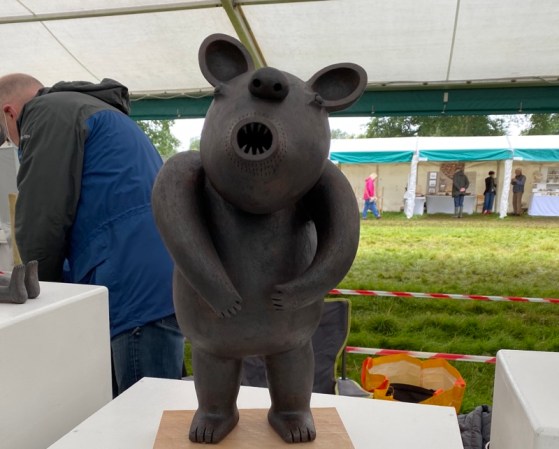
It’s a short post this morning…
I’m awash to the gunnels with prep for this coming weekend’s ‘On the Pictish Trail’ weekend, based in Inverness and a few points north; eventually, (with a whittled-down group) ending up in Orkney, one of the most naturally spiritual landscapes I’ve even visited.
All those will be reported on here, and at the Silent Eye in due course. But for now, couple of photos from yesterday’s PotFest, held at Hutton -in-the-Forest in the heart of Cumbria’s most verdant countryside.
The show alternates between being under a hard roof, in the covered Penrith pens, and out in the open, under canvas, here. Usually the weather forecasting is good, and they take the chance. Yesterday, we arrived to a downpour and were sliding through mud across the field and into the gardens of Hutton Hall.

The show is all about artisan pottery; not the kind you’ll normally find in the shops, but the kind for which one-off potters are famed, often taking weeks or even months to finish a piece.

I nicknamed the opening photo ‘The Hoot’. I loved the piece, immediately. It’s wacky and unusual. It’s also beautifully made by hand. Here are two more ‘baby hoots’.
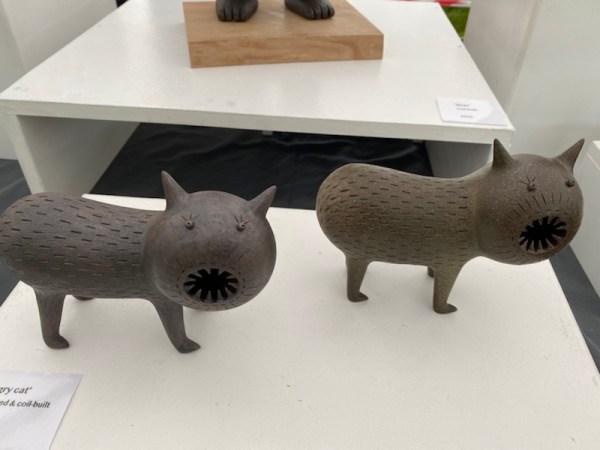
I’ll be doing a full blog on the PotFest show when we get back from Scotland, along with the Scottish trip’s photo-diaries, of course. There will be a lot to cover, all of it reflective of that part of the wonderful Highlands.
©Stephen Tanham, 2020.
Share this:


Tess: Misti, Misti, it’s chicken for tea!
Misti: No, Tess. I only see kibble…
Tess: I’m telling you I can smell chicken!
Misti (mutters quietly): That’s because I’m blocking your view so I can get it first…
©Stephen Tanham, 2020.
Share this:

+ #Silenti, Belief and Faith, Consciousness, Esoteric Meaning of Myth, esoteric psychology, Politics and Power, Psychology, Unconscious
The Entered Dragon (5) : a seat in the gods
by Steve Tanham
Continued from Part Four
The stage is set. The feeling of expectation is deep. In the darkness of the auditorium, we cannot see those sitting beside us.
The stage is dark, yet the darkness is not empty; in fact the darkness is full of that which is not yet formed, but can be. None of our senses can yet register what is happening. But something within us at the deepest place that we can call our selves is filled with this potential. But the potential is not dark, in fact, The potential has an unseen brightness and a powerful sense of immanence.
In this series we have examined the nature of what the early psychologists called the unconscious. We have considered that the conscious part of our existence is like the visible part of an iceberg seen above the water. Most of its mass and energy and potentially dangerous presence lies beneath.
In the last post we encountered Carl Jung’s dramatic conclusion that all consciousness emerged from this ocean of unconscious being. What does that mean? We can be without there being any differentiation between what is perceived and what is considered a centre – an us.
The world is a continuous creative explosion of events, which to us forms a screen of experience around what we call ourselves. This self isolates part of the happenings and calls it its own. As this analysis proceeds the separated being becomes more sophisticated in the way it divides self and not self. It’s crowning glory is to give the things it has perceived names, and language is born.
After a while the self becomes so fascinated with the power of its own separated existence that it does not want to relinquish what it sees as a gain. But the costs of separation are hidden and subtle. Once part of an ocean of creative and continuously changing being, the small self is is now responsible for the maintenance of its entire psychic ecosystem. Its creativity may be bright, but eventually the separation from that which gave it birth becomes painful and depressing. The things of the self-world lose the sparkle; and yet there is the ghost of a memory of what a world filled with joy was like…
Here we have the vast theatre which is mankind on Earth. On the one hand the creation of something so precious that it was worth this lonely journey. On the other the anguished separation from a creative, all-powerful vastness which longs to reconcile it’s ennobled child. It’s a paradox… as so many things of a spiritual nature are.
Going far deeper into this mystical vision Carl Young made it his life’s work to provide us all with a language to map this ‘fall’ and separation from the glory of all-being.
But the journey that mankind undertook was and is not taken in isolation. Throughout our history artists, writers and mystics have spoken of a deep kind of communication from an inner state of ‘holiness’ carried out by beings whose role was to be communicators of hope and inspiration. Sadly, religious metaphors do not always communicate well, nowadays, so a different set of words is needed.
One of the best names for these beings is the word Messengers…
The Greeks had no difficulty in describing a real, but inner, world populated by Gods – plural. To them, the inner experiences of a lifetime had a pattern and were overseen by powerful inner forces that could be courted or challenged. The essence of this inner world was that it was already there… Scholars had not invented in an academic or poetic exercise. If you could find inner quietude, and you were gifted in sincere two-way communication, then you could converse with this inner world. Those with deep skills were cultivated and asked to communicate for others less able – Oracles – but the essence of this inner land was that it was and is there for all of us.
The west’s age of enlightenment, ironically, put an end to this world of ‘myth’, consigning it to the realm of fantasy. In separating it from the ‘demonstrably real’ world of brain-knowledge and quantity, we lost the glory of personal contact with figures from the inner which were sharable among us all.
Carl Jung’s work in psychotherapy – whose main purpose was to restore the ego (self) to health and stability – gave him access to a base of scientifically recorded information of patients’ inner states. He observed that there was a pattern of images described by those he was treating, a commonality of experience, or, rather, a commonality of the inner characters they met within their own mental and emotional worlds. Far from being schizophrenic, these characters enabled a healthy communication with the patients’ inner states, from which Jung was able to provide healing patterns of reconciliation.
As he ventured deeper, he realised that these healing forces had a purpose: that they were actively communicating with their own ‘host’ personality, though the patient might have seen them as fantastical. Further work showed him that the nature of many, but not all, of these inner characters was shared… by all people. Most of us did not seek this active inner communication with the messengers, but some did. After all, the greater part of mankind’s history had revered them. Psychology had provided at least a partly-trusted window back into the ‘realm of the personal gods’ to combat the creeping coldness of the scientific view, though the latter was providing the basis for much more comfort and security in our daily word… as long as you forgot its power to destroy that world, entirely-–in itself, a form of global schizophrenia.
Over many years, Jung got to know these inner figures, and named them ‘Archetypes’, a word overly familiar to us now, but dramatically new in Jung’s time. Freud would have nothing to do with such a concept, which, to them, smacked of mysticism.
Today, through the writings of such authors as Robert A. Johnson, anyone can discover the nature of these inner messengers – whose role is to help us heal our divisions – and work with them, if we are bold enough…
Next week, we will consider some of the faces of our Messengers, and the precious gifts they bring.
The stage is so quiet, it is almost painful. We look into the darkness to see a kind of swirling. Within seconds the smiling face of a King emerges, and behind him, a figure of pure love, so beautiful that tears are unavoidable, rests her gentle hands on his shoulders…
They have come…..
Other parts in this series:
Part One, Part Two, Part Three, Part Four, this is Part Five
©Copyright Stephen Tanham
Stephen Tanham is a Director of the Silent Eye School of Consciousness, a not-for-profit teaching school of modern mysticism that helps people find a personal path to a deeper place within their internal and external lives.
The Silent Eye provides home-based, practical courses which are low-cost and personally supervised. The course materials and corresponding supervision are provided month by month without further commitment.
Steve’s personal blog, Sun in Gemini, is at stevetanham.wordpress.com.
Share this:

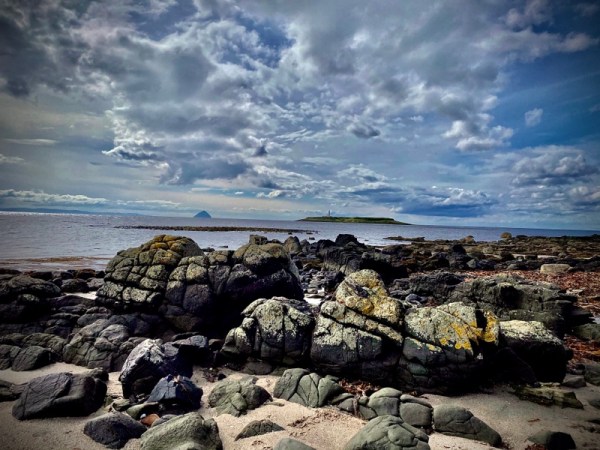
Sometimes there is a kind of poetry in the arrangement of objects in a landscape, not seen, fully, before the finger presses them into personal history.
The symmetry, the visual song, is seen later, as here with ancient rocks, weathered and waiting; the out at sea lighthouse; and the distant volcanic dome, worn down into a bullet by millennia.
The arrangement is not created, but taken, like a poor child arriving in a sweet-shop and being offered three…
©Stephen Tanham, 2020.
Share this:


We had arrived late in the day, on the CalMac ferry from Ardrossan. Dinner in the hotel had seemed other-worldly, as though we and the other diners had just begun a magical adventure whose substance was to be the exploration and understanding of the island of Arran.
The rain storm thrashed the tall windows, and we looked out at the darkening, still unknown world.
After the meal and wine, we put on our most waterproof clothing – meagre, now, in the face of this Scottish August storm, and went out into the night. Brodick’s quayside curved away into the darkness, symbolic of the work we would need to do to find…
©Stephen Tanham, 2020.
Share this:

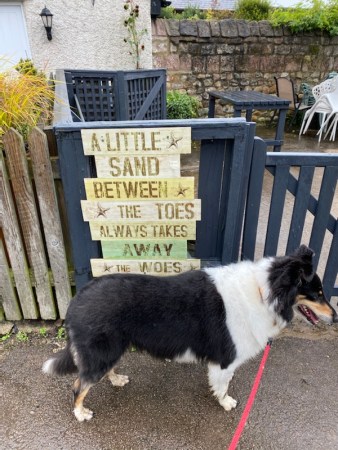
You might not think it from the photo, but the rain was beating down when I took the shot. Tess’ pose gives a clue. She’s fed up, too…
It’s the end of August, for heaven’s sake. But Storm Francis is trying to exterminate everyone north of Birmingham…
For once, the photo is not about the collie… The subject is the faded ‘summer sign’ on the walls of the Mad Hatter cafe overlooking Heysham Beach. I’ve always been a sucker for these. They take me back to my ‘shell seeker’ childhood, when a trip on the train to the seaside was a rare and wonderful thing. Simple sentiments – like the sign – were gems of wisdom, and, having spotted them, my brother and I would run back to mum and dad to pass on the message…
They seemed simpler times…
The Mad Hatter cafe is closed. It gave up on the washed out summer about the middle of August. Some businesses can just tell when there’s not going to be a reprieve.
Other cafes higher up the street in the centre of Heysham village were open – one even letting dogs in for their owners to catch a socially-distanced hot tea and possibly a toasted tea cake, rather than die of hypothermia.
The rain never stopped, all afternoon… torrential; as the latest ‘summer’ beating from the dreaded Jet Stream conspired to drag every low-pressure system in the Atlantic over the north of England and Scotland to dump its load.
Driving home, tea and tea-cake keeping body and soul together, the weather man came on the radio. “I’m afraid the north-west of England is very wet,” he said, with genuine sympathy. They don’t often put that much emotion into the bulletins. Training, of course. Wouldn’t want us leaping off (wet) cliffs to end it all.
We made it home. I could barely see on the M6, there was so much spray. Tess, having spent the better part of two half-hours (either side of the cafe) running into the sea to retrieve her long distance floaty ball, was soaked with salt-water. Arriving at the house, I was still so wet I didn’t bother putting my supposedly waterproof coat back on. I just pulled the sullen collie to the outdoor tap and hosed her down in my jumper. There would be a hot shower, shortly… Once Bernie had stopped laughing at the state of us both.
The shell seekers would have had ‘crumpets for tea’. I think it’s Thai chicken soup… which, under the circumstances, will do nicely.
©Stephen Tanham, 2020.
Stephen Tanham is a Director of the Silent Eye School of Consciousness.
Share this:

+ #Silenti, Belief and Faith, Consciousness, Esoteric Meaning of Myth, esoteric psychology, Politics and Power, Psychology, Unconscious
The Entered Dragon (4) : the world within
by Steve Tanham
I know these posts, so far, have been intense. The picture painted by Carl Jung and his Jungian successors of our linked internal and external lives is a detailed and vivid one. We began by looking at the Shadow, that suppressed ‘mind’ of parts of our psychological self (psyche) that have been pushed, by conditioning, society and personal choice, from our everyday lives. Censored might be a good word to describe their fate… or exiled, perhaps.
By way of a more gentle read, this post will set the scene for the space in which the relevance of Jungian thought is unrivalled in all of psychology – the Unconscious.
The Shadow lives in the unconscious, but so do many other energy patterns waiting to play their parts in our life’s story…
The unconscious is very much present in our lives, and might be said to ride alongside us, in quiet presence… until it interacts, often without our knowing. We think of such things as distant, as though there is depth to the place of the unconscious. In fact, we can easily see how close the unconscious psyche is to our ‘normal’ state by reference to a simple example. Imagine I am playing a game of tennis. I swing my arm back to take the forehand to win the point, but just at that moment, a family member calls to me from the side of the court. My conscious attention is diverted to this ‘high-priority’ interrupt. The relative is simply delivering an unfortunately-timed hello, so, smiling in acknowledgment, my alerted attention is relaxed.
But while the head turns to acknowledge the arrival of the family member, the arm continues its arc. In what seems like a fraction of a second, I re-engage my consciousness with the court to find the ball, bouncing inside the baseline and winning the point.
I nod, sheepishly, at the person across the net. The opponent may have grounds for thinking I am showing off! What’s really happened is that my unconscious, ‘shadowing’ me and able to take over from its normally recessed position, has helped my body to complete the desired action.
Have you ever been lost in an extended creative thought on a car journey home and arrived at your dwelling with no active memory of the last mile? It’s not an ideal way to drive, but our ‘autopilot’ has got us home, safely, once our primary attention wandered…
From these examples we can see that our initial ‘dark’ picture of the personal unconscious may be far short of both its capabilities and its intentions… To get the whole picture, we need to begin with Carl Jung’s radical view (for a psychologist) of the place of consciousness in the story of the universe.
Jung was a religious man in the widest sense, though he often ridiculed the actions of the church. Today, we might call him a ‘mystical psychologist’, but, back in the early years of the last century, mysticism was little known outside of academic circles. His professional work led him to see the unconscious as the real source for all human consciousness. In the unconscious, he saw the origins of our capacity for all awareness, orderly thought, reasoning and feeling. In short, that the unconscious was the original mind of the human species; a matrix of energy that took millions of years to develop a body, then a conscious mind – a stage very different from just awareness…
Jung saw this as a creative force at work in all nature. He envisaged every element of our complex consciousness being born in the unconscious before reaching for the full ‘light’ of human consciousness. Indeed, it might be said that the latter stage created the human…
Put another way, the vast unconscious ‘self’ of nature has slowly made a part of itself conscious. He believed that mankind had a unique potential to carry the evolution of the universe forward – such was the preciousness of consciousness.
Each of us has the capability of reliving the entire history of life and its associated ascent to self in one lifetime. When we do this, we connect with that which gave us life and that which can take us so much farther than we know.
To do this requires that mankind understands this vision – gaining power and inspiration from it; and reconciling the unconscious with the conscious. Modern society created science; and science, having given us so much, superficially, has, tragically and unknowingly, cut us off from the very practices which facilitated integration with the reservoir of the unconscious, branding them superstition… Many of them may have been so, but their origin and essence was from a much deeper wisdom than we commonly possess, now.
The plan for our individual potential in this lifetime is contained in the unconscious. We need to work with our own unconscious to realise this. In the course of that work, we will find a vast reservoir of energy and insight waiting for us, just below the surface…
Having shown in the first three posts the power of one element of the unconscious – the Shadow – to affect our conscious lives, we must now venture deeper into the map of the unconscious and its interactions with what we consider to be ‘us’. In this place of liminal energy, we will find keys to our future.
Next week, we will look at the nature of what Jung called ‘the inner life’, and explore more deeply the relationship with our usually quiet companion who is capable of winning our tennis point and driving our car…
Other parts in this series:
Part One, Part Two, Part Three, this is Part Four.
©Copyright Stephen Tanham
Stephen Tanham is a Director of the Silent Eye School of Consciousness, a not-for-profit teaching school of modern mysticism that helps people find a personal path to a deeper place within their internal and external lives.
The Silent Eye provides home-based, practical courses which are low-cost and personally supervised. The course materials and corresponding supervision are provided month by month without further commitment.
Steve’s personal blog, Sun in Gemini, is at stevetanham.wordpress.com.


 Sun in Gemini
You must be logged in to post a comment.