
I’ve always loved maps…
I can remember, when a child, being bought a fold-out schematic of a town with streets, main roads, a river, a hill and a railway line. It was just a layout – a map – but I had lots of my own cars, a model train and some small figures of the right scale to populate the town with activity.
“Where are you?” my mother asked, shortly after I became joyfully lost in the richly-featured landscape on the carpet. I looked up, puzzled by the question. I picked up a plastic farmer and offered it to her.
“Are you there or here?” she asked. My mother was always good at making you think…
I can’t remember what my reply was – probably just to keep holding out the plastic farmer.
I grew up with a love of walking and cycling… and maps. I would spend my own pocket money to get a walkers’ map of my favourite places so I could pore over them, imagining, with increasing accuracy, what the landscape would look like. It never occurred to me to ask why north was at the top of the map. I knew from my spinning globe of the planet that the north-pole was at the top of the world, so, of course, all maps would be oriented with north as the top.
But it’s not always been so…
Understanding where we are in the world is fundamental to our survival.. and our sanity. It has psychological implications, too – most of them subconsciously acted on. Our brains are specially ‘wired’ to provide us with a continuously changing ‘map’ of where we are – usually relative to safety or ‘the known’.
Have you ever awoken from a disturbing dream and not known where you were for a second or two? It’s can be frightening; and gives us an insight into why our children cry when faced with the same or similar experiences. A dream has taken them out of the ‘familiar’ and they fear what is new, especially, as in the dream state, when rational thinking is unavailable.
The need for that ‘place of safety’ is hard-wired into our brain’s cognitive mechanisms. In so-called primitive mankind, the place of safety was a physical thing: a cave, or a dwelling in a sturdy tree, perhaps. It’s taken us thousands of years to become happy with the idea that we are somewhere safe (for example, staying in a hotel), rather than the actual location of the home.
Perhaps, seeing this, we become more sympathetic to those who lose their homes through economic or political upheaval. There are likely to be many more homeless people as the present Corvid-19 crisis works its way through our societies.
We are almost unique in trying to share the directions to home with others. The only other species with this is the honey bee. Insect species, like ants, leave chemical trails, but they don’t try to communicate through a language of place. Just us and the bees…
Humans have a long history of creating maps. The oldest examples discovered on cave walls are 14,000 years old. During that time, maps have been drawn, etched or scratched on stone, paper and, now, screened on computer devices – particularly portable ones, like phones and tablets.
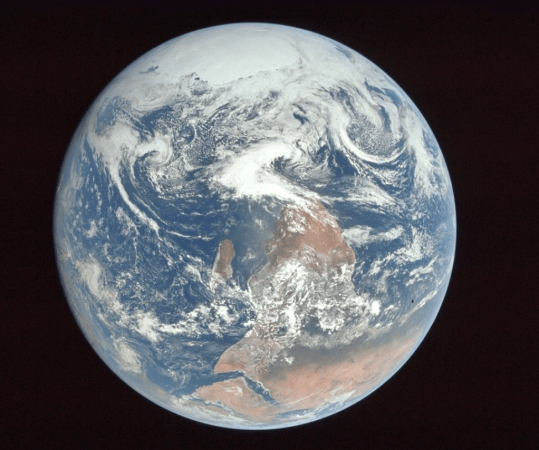
If we were to examine the Earth from space, we would immediately see how difficult it is to identity north. Unless you are long way from the Earth, there are no visual clues, apart from the point of a theoretically huge pencil around which the Earth rotates – the physical (geographic) ‘North Pole’. But this is not the same as the ‘north’ reading on that little pocket device the boy holding the plastic farmer would have got. The two would have been close, but not identical, as the vast and surging currents in the Earth’s iron core creates fluctuations in the magnetic field that swings the little needle on a magnetic compass.
The compass has been an essential part of the story of maps. It’s interesting that its inventors, the Han Dynasty in China (2nd century BCE to 1st century CE), used compasses that pointed to what we now view as south. South was the direction taken by the naturally occurring lodestone used in these early instruments. In ancient China, the ‘top’ of the map was therefore south.
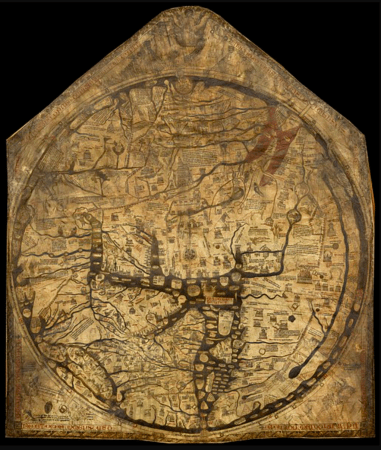
Christian maps from the time of the Crusades were known as Mappa Mundi. East was at the top, towards the Garden of Eden and with Jerusalem in the centre – the geographic focus of their ‘holy wars’.
In ancient Egypt, the ‘top’ of the world was east – the position of the sunrise. The Islamic empire placed south at the top, like China. Most of the Islamic population lived north of Mecca, so it was natural to ‘look up’ to the south.
The west was left out of this history. The place to which humanity ‘looked up’ – the top of the map – was never west. So-called Pagan culture was and is closely aligned with all four cardinal directions, and the west is traditionally the point where the day ends, and mindful humans reflect and later sleep to renew. It also marks the end of the force of life (Solar), for that day, and by inference, eventually, the end of life.
It seems no-one wanted to ‘look up’ to the place where the Sun set.
Governments and their military forces have always been interested in maps. Battles are not always won with good maps, but they are certainly lost with bad ones. Google now dominates the world of computer maps, though there are alternatives. Google acquired a private company named Keyhole, who had US military backing to refine and develop the technology that became Google Maps. It’s a powerful product, and most of us have used it in one form or another. Google’s model with all its ‘Apps’ is to give them away and make revenue by selling your location and preferences to its advertisers. The financial cost is low, but it takes us into potentially murky waters. The average person knows little about what really happens with such data, nor who has access to it. Google recently fought a protracted revolt by its own employees, who considered its mapping developments were in danger of breaching the company’s famous ‘Do No Harm’ ethic…
Apple is the other big Tech player in this field. Apple’s business model is to charge more for premium devices but then guarantee to protect the user’s data. Apple did not back down on this – even when heavily pressured by the US government who wanted a ‘back-door’ into its primary security features for ‘anti-terrorism’ purposes. Many of my friends switched to Apple at that point and now view it as the only ‘safe haven’ for their information.
I use products from both sides of this divide. I like Google’s email and and spreadsheet products. But I use them only on Apple technology, then, at least, I have the tested integrity of its privacy promises. Google’s entire model is web-based, so their applications are not hosted in the device; only the browser is.
But the world is changing fast, as illustrated by Google and Apple now working together in the Covid-19 arena to provide a user-secure, distributed framework for ‘contact tracing’. Interestingly, the French government, one of the first to take this up, immediately demanded that the private user data be made available to their authorities. Both companies refused and the demand was eventually withdrawn. Even non-authoritarian societies struggle with these complex issues of privacy vs policing.
Science, like maps, doesn’t give us hard and fast answers. It provides a better-than-last-time fit of what might be happening, knowing that this iteration, too, isn’t perfect. For politicians to quote that they are being ‘led by the science’, as though that were a binary truth or falsehood, is a lie to an unknowing public.
Maps have become far more potent and powerful things. A map is a world. A map allows us to see a whole. A map invites us in… In many ways, it takes three ‘faces’ to make it work. The first is the nature of what is being mapped; the second is the style of representation, for example, figurative or actual.
We need to become the third face in the success of the map. We should enter into all these things, mindfully, knowing that commerce exploits without morals, that insular politics always leads to Fascism, and that the silent and caring voice of the majority cannot stay silent while our civilisation morally burns.
My mother, who now has dementia, wouldn’t understand the answer, but if she asked the boy-become-man studying the larger map of today’s political world the same question about where he was on that map, I might respond that he had to quickly outgrow the plastic farmer – the replica human – and become the fully empowered and fully responsible human by putting the small figure to one side, standing up and looking down at the whole map. If we don’t, then our star may set in the unsung west and humanity become a footnote in Great Nature’s experiments with Life.
That western horizon of our map is just around the corner… If we love the light, then we had better start running towards the ‘east’, and now.
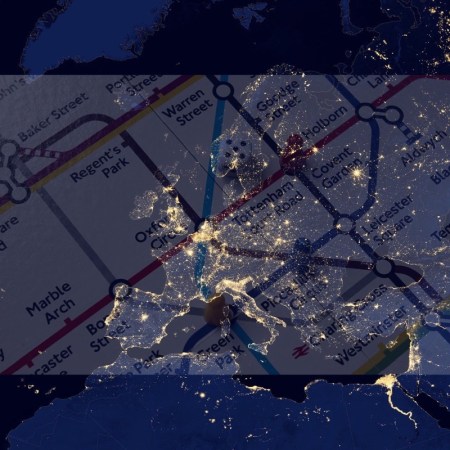
(Opening picture: author-created overlay of two images from Pixabay. Originators: Skease and Philim1310)
©Stephen Tanham 2020
Stephen Tanham is a Director of the Silent Eye School of Consciousness, a not-for-profit teaching school of modern mysticism that helps people find a personal path to a deeper place within their internal and external lives.
The Silent Eye provides home-based, practical courses which are low-cost and personally supervised. The course materials and corresponding supervision are provided month by month without further commitment.
Steve’s personal blog, Sun in Gemini, is at stevetanham.wordpress.com.
Share this:

I didn’t set out to have three drills…
The posh one, a nice DIY model from DeWALT, was bought because both the batteries for my previous drill failed at the same time, after lying idle in their case for nearly a year… My fault. So, with lockdown looming, we dashed out to Wickes in Morecambe and got a new one.

Portable drills have come a long way from the early ‘Black and Decker’ days. Just pressing the trigger on this one and hearing that incredibly potent zzzsweeeesh gives me a rush. I’m a bit odd, Bernie says. But she loves the results.
There’s something about the relationship between man and drill… Women and drills, too, as a growing number of ladies are focussed and proficient DIYers.
You can do with a drill. You can do amazing things that a Leonardo da Vinci could never have envisaged. A simple spinning piece of metal – in various forms – together with that triumph of engineering – the modern screw – can perform miracles… and even transform an interior as hostile as The Saltpetre: Salty Pete’ as we have affectionately come to call it.
My developing man-cave, is definitely a ‘he’, I thought, that bright morning after the bonfire of Peter’s Pride.
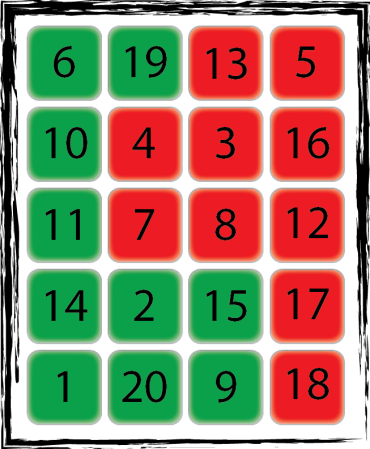
For two hours, and wearing an essential dust mask, I had swept out the cobbles along the entire left side of the emerging space with an industrial brush: squares 1-19 if you’re following this on our ‘lucky bag’ square diagram, above. I dumped the resulting buckets of the black dirt on the compost heap in the lower level of the garden – the ‘U’ shape that used to be the canal basin.

I came back to take a deep breath and surveyed the long and narrow corridor in which I intended to construct the first section of our storage – and the new life of Salty Pete.
The requirements were simple: I needed space and functionality for gardening tools, woodworking tools, a woodworking bench (to be made as part of the project), decorating storage, general tools – car, bikes, motorbike and the like.
I also needed space for four pedal bikes. Before getting our Collie dog, we were passionate cyclists – often taking our summer holidays as cycling trips to France, Italy and Croatia. We have Brompton folding bikes, too, so the bike storage was going to have to be cleverly planned.
Then, lawnmowers… three of them. One is my beloved Honda, bought as the main machine for the Wharf’s large lawns. It’s large but not a ‘sit-on’, as I’d kill myself on the slopes that run down to the old canal bed – see photo below.

Another is the mower from the previous house, which makes a good standby in the event of the primary being serviced. The third is not actually a mower, it’s a petrol-driven scarifier. Used only a few times a year, it saves days of raking and is an essential tool to get air into the soil and eradicate the winter moss. Lakeland’s wet winters make much moss…
There were other, smaller, categories, but each one was important in its own right. Liquid storage, for example. We needed a whole shelf system, at low level – because liquid is heavy – just to cope with two and four-stroke petrol for the strimmer and lawnmowers, white spirit and rubbing alcohol and the like.

Most of these things come in multi-gallon containers that are useful but take up a lot of space. They are also difficult to move around, so this part of the storage had to be close to Salty Pete’s door.

Bernie’s words rang in my ears… “Well, how about not spending any money at all?” It had seemed a fun challenge at the time, but fulfilling the above list of requirements without buying anything new was going take ingenuity… and saws.
Saws are almost as useful as drills. I knew I had a plethora of hand saws… somewhere. My parents spent half their working lives running a greengrocer’s shop along one of the busiest arterial roads in Bolton. When Morrisons supermarket demolished the old factory opposite to build their new superstore, the days of their business were numbered. Mum was near to retirement age and had every intention of, as she put it, ‘not freezing her fingers off, every winter’. Dad didn’t want to stop selling things… he liked it. So he switched the shop’s remit be a to a general gift, handy things and tools shop.

Every birthday and Christmas, I’d be given something new with which to re-model the physical world. He was much better at engineering than I was – he’d been an aircraft factory fitter at the local De Havilland factory in his youth. I think he felt that his love and gifting of tools would result in me getting better at using them… Hmmm.
I knew that Salty Pete contained a lot of these tool presents… I just wasn’t sure where. The one thing I had found was the mitre saw. Old by today’s standards, it was clunky and very heavy. But its motor was as strong as an ox. After much physical exertion and grunting, I had dug it out of one of Salty Pete’s corners the day before, before remembering, with sadness that it was broken. The blade had started making noises because it was slowly working its way off the shaft that should have held it rigid. I’d taken a cursory glance at it – even taken it apart – but, when I tried to bolt the deadly blade back in place, it wouldn’t tighten.
It was a shame, because, in its day, I had used it more than anything else he ever bought me (apart from my first motorbike, but that’s another story…) Reluctantly, I took it around to the ‘crash and burn’ tip behind Salty Pete at close of business that day.
But then I had the dream… and in the dream the axle for the blade had a black line along its length. Waking, I remembered the dream, but none of the details. But, sipping my tea, I got a flash of that black line… and knew what to do to fix it. I walked with confidence to the ‘tip’ behind the shed and retrieved it from the old bin. With a small toolkit in hand, I laid it at an angle on the grass to test my theory. Sure enough, the cutting blade was ‘keyed’ and had to be re-fitted along a line that would allow it to sink deeper towards the base of the shaft.
Five minutes later, I had a mitre saw, again, zinging like it was new… and Dad was smiling from somewhere… I know he was.
A mitre saw is wonderful and deadly. The rules are simple: if you’re wearing armoured clothing, including gloves, you can instantly cut anything wooden or plastic that will fit into its jaws..
There were a few sections of pallets that needed the mitre saw treatment, and the clock was ticking.
Sitting on the box, looking at the now plain walls of the left edge of Salty Pete, I knew I needed a ‘quick win’. Two hours from now, our lockdown ‘working day’ would be ending. Bernie would return with the final mug of tea, and I didn’t want the wow factor to fade. Apart from anything else, the emotional effect of getting a pat on the back was of critical importance at this stage of such a big project, with so little to see so far, apart from tearing things down.

One of the raw materials I had plenty of was a pile of well-used pallets on which various gardening deliveries had been dropped off by brave lorry drivers, at the end of our narrow and long lane. The key to their usefulness lay in something that Bernie had said when she started her horticulture course in Penrith–back in 2013.
“Pallets…” She said, arriving home at the end of her first day to lavish attention from me and the Collie dog. “Are magic! Cut them to size and stick the handles of spades into them, with a twist.”
It took me a while to grasp it. In fact, it was only sitting there on my box with cold tea that triggered the need to make it work. But it did… I fired up the mitre saw and grabbed a hand tool or two for the difficult bits… Oh, and the two drills. I forgot to explain why I have three. Better leave that for next time as the hour is late…
I had two hours to get something useful on that wall. I had a working, if ancient, mitre saw. And drills… and those wonderful long screws that will just about join anything to anything else.

The revealed wall behind Peter’s Pride was already battened… That, alone, would save me hours of work. I dragged the best three of the pallets to the saw. Then, like some desperado, I set up the two drills; one with a long narrow bit to cut the pilot holes, and the other to fix the chopped and chosen pallet to the internal skeleton of Salty Pete with a triumph of gusto over accuracy.
It worked.

Two hours later, I wheeled the motorbike and large mower back into Salty Pete, looking for all the world as though I had been through another day of drudge. Bernie was coming up the drive with that final mug of tea.
“Better call it a day,” she said, consolingly, “Another one tomorrow… make more progress, then”
I nodded, taking the tea, gratefully, and looking over her shoulder to what she hadn’t yet seen.
“Push and twist… the handles?” I asked, cryptically.
She turned, then smiled. It was a moment I will remember for a long time.
“Oh, yes!”
Salty Pete now contained an organised storage system for our long-handles garden tools. Squares 1 and 14. Something was real. Something was done… and it hadn’t cost a penny.
To be continued…
Other parts of the Locked Down and Armed series:
Part One, Part Two, Part Three, this is Part Four
©Copyright Stephen Tanham
Stephen Tanham is a Director of the Silent Eye School of Consciousness, a not-for-profit teaching school of modern mysticism that helps people find a personal path to a deeper place within their internal and external lives.
The Silent Eye provides home-based, practical courses which are low-cost and personally supervised. The course materials and corresponding supervision are provided month by month without further commitment.
Steve’s personal blog, Sun in Gemini, is at stevetanham.wordpress.com.
Share this:

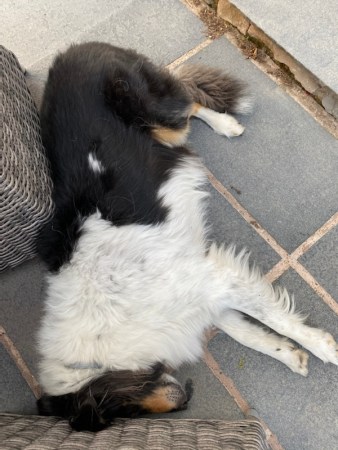
Tess: Misti, quick, look, I’ve mastered the headstand!
Misti: But…
Tess: And I can stretch out my arms, my neck is sooo strong with this yoga.
Misti: But, you’re lying flat on the patio!
Tess: I’m only copying Dad’s book!
©Stephen Tanham, 2020.
Share this:

He carried the box over to the old table and set it down. Despite its size, it was heavy. He reached for the Stanley knife and slit the old tape that held it together, then prized open the dusty lid, revealing the contents.
Immediately, he knew what it was: his old trophy box. He couldn’t believe it was still here? Surely he had thrown it away long ago. He had a half-memory of carrying it out to the recycling – five, maybe ten years ago… or had that just been a dream?
How many years had it languished, dusty and increasingly dirty, on one of the top shelves of the shed? The kind of shelf that you’d use for paint, or an expensive picture frame the wrong shape for any of the photos you had. He had been looking for a pair of snipe-nosed pliers; something you didn’t need every day, until the day you did. The top shelf in the shed was the last resort; the last chance to find a half-remembered tool.
Instead, he’d found the trophy box.
Wiping away the dust that had fallen into the box from the fragile lid, he let his fingers slide down the inside edge of the box, feeling into the layers like a geologist would dig down into layers of sedimentary rock. Four, five, six wooden frames came to life under his scrutiny. He knew what they were: wooden-backed achievement awards from the days of his corporate life. They were in reverse order. The one in front of him was gold.
“Someone else’s idea of gold,” he whispered, surprising himself with the depth of the observation…
The fingers dug deeper. The wooden frames gave way to paper. He smiled as the paper got older and crisper, remembering the earliest days of receiving praise and prize from people he respected, deeply – back then.
They were all part of the rich tapestry that is a life. Meaningless, now. Just layer upon layer of a dead past. Entirely valid back then, but without purpose now other than a set of steps that had got him here, in the old shed, looking in the wrong box…
The best of them had once hung on the walls of his office, in the way that people do when they want to impress visitors.
“Hollow,” he said, softly, watching the motes of dust spin and curl in the the air of his out-breath, in the golden light of the summer sunset.
His fingers had reached the bedrock of the base of the box. They curled, one last time, around the heavy upper rocks of the awards, ready to lift them all out and drop them into the waste-basket. Then stopped…
The card was smaller than the wooden frames; smaller than the letters of congratulation from the oldest of times.
“Zap!’ It read on the back. On the front was an image of a clown with a sad face, his lips curled down in the manner of circus performers. He never found out who sent it. Who had darkened his first day of real victory with a sour note. He looked at it again… The lips were curled down on the white and red face, though the eyes were warmer and kinder than he remembered. Perhaps the clown had grown old, too?
He let the layers of his life fall back into the dusty box, burying the mystery clown, forever.
“Enough!” He shouted, standing up and tucking the box under his arm. He opened the shed door and strode across the garden to the recycling bins at the back of house. As he turned the corner, a breeze blew dust in his eyes, and he had to put the box down to use a handkerchief to wipe them.
Straightening, he saw the smiling face of his wife coming out of the greenhouse with the first of their own tomatoes. She placed one in his mouth, laughing, and was about to turn when she pointed at the box by his feet. She reached down to pick up the lid that the breeze had blown from the top of the box.
“Who’s the laughing clown,” she asked.
Chewing the tiny tomato and shaking his head, he looked down to where she held the card of the clown. Above the striped red and white outfit were the bright eyes… but beneath the laughing eyes was a laughing mouth.
“Will you just hold that for a moment,” he said, wondering if all of this was a dream. The dream held while he took the box and dropped it in the refuse. It held while he walked back to his bewildered wife, and gently took the card from her confused fingers.
The clown was still smiling… He thanked and kissed his wife and dropped the card into his pocket. From now on, it would be all the trophy he needed.
©Stephen Tanham 2020
Stephen Tanham is a Director of the Silent Eye School of Consciousness, a not-for-profit teaching school of modern mysticism that helps people find a personal path to a deeper place within their internal and external lives.
The Silent Eye provides home-based, practical courses which are low-cost and personally supervised. The course materials and corresponding supervision are provided month by month without further commitment.
Steve’s personal blog, Sun in Gemini, is at stevetanham.wordpress.com.
Share this:

(Continued from Part two)
Everything was quiet…
Several hours after I began swinging the sledgehammer, there was finally peace from the destruction. I pulled up a wooden box and sat on it, wiping the congealed sweat from my forehead onto my arm.
The Lucky Bag ‘number square’ idea from the last post seems to have caught the imagination, so I’ve updated it, below, to reflect the actual dimensions of the Saltpetre – or ‘Salty Pete’ as we have come to know it.

My wooden box/seat was located at 2.
I was sitting, gazing at three mountains of shattered and fragmented red pegboard, broken spars of ancient wood, and the surprisingly intact skeleton of an old wall cupboard. This pile of re-organised carbon took up squares 1, 14 and 11.
Hearing the temporary cessation of the apocalypse, Bernie had taken pity and brought me a large mug of steaming tea. I sipped it gratefully and looked around at the remains of Peter’s Pride…
“Wow,” she said, leaving hastily, before the tall red pile could begin sliding towards her.

Peter’s Pride: I had better explain… We bought ‘The Wharf’, as the property is named, in December 2009, during one of the coldest winters on record. On December 23rd, we literally slid along the pavements in Kendal to collect the keys from the seller’s estate agents, keen to, at least, take possession of what would be our new home – once we had thrown our life savings into rebuilding it.
I clearly remember coming back to open our own front door for the first time. The property was a 1960s single storey bungalow with a large plot of land, the plot running along the line of the old Preston-Kendal canal. The canal had been drained in 1958, but the waterway had been unused for decades before that. A man named Peter and his wife had built the house, and brought up their children there. Their son, Richard, still lives in a cottage next door, gifted, by his mother, to him and his wife before, sadly widowed, she moved south to live with her daughter in Cheshire.
The Wharf was left to its own devices, eventually being bought by an ‘investor’ and becoming a rental cottage. It was overgrown, run-down and had a poor bathroom. The place soon got a bad name in the holiday trade market.
On the Sunday when we deliberately got ourselves lost in the car and inched down the tiny lane with the ‘For Sale by Auction’ sign, we found a very dilapidated house on a large and potentially beautiful plot of Lakeland soil, just outside Kendal. The house was behind a huge stockade fence and unoccupied.
As we approached in the car, a man came out of the adjacent cottage, looking a little hostile. We didn’t know him, but it was Peter’s son, Richard. Seeing we were genuinely interested he spent a few minutes telling us the history of the place. He was eager to have someone ‘real’ take over the property that had been so important in his life. Ironically, the house had failed to sell that very weekend. A local builder had been interested but wasn’t prepared to pay the ‘Investor’s’ asking price. For the sake of about ten thousand pounds, the deal had fallen through. Later, we found that the ‘Investor’ had money problems…

The run-down ‘Wharf’ had potential, but you had to have a lot of imagination to see what it could become. Bernie and I got back in the car for a chat. After a long discussion lasting six minutes, we decided it was our big chance to have our own ‘Grand Designs’… On the following morning, we made an offer, subject to survey… and waited.
Several weeks later, the deal was done. It was two days before Christmas when we entered our new house. It was freezing – the heating had failed – something it did all the time, according to the holiday lettings company. We made some tea with the supplies we had brought and explored, with that lovely feeling that we finally had a Lakeland home – no matter how much needed doing to it!
We didn’t need to stay, as we still had Bernie’s house in Chorley to go back to. But we wanted to have good look round what would one day be our dream home. As darkness was falling, we managed to reset the boiler before we left, wishing our new home-to-be a happy Christmas.
Just before driving off, I said to Bernie that I wanted to stick my head into the old outbuilding. We had no idea, at that time, of its importance in the village’s industrial history. It wasn’t a listed building; we could have just knocked it down… but something said, “No…. wait and see.”
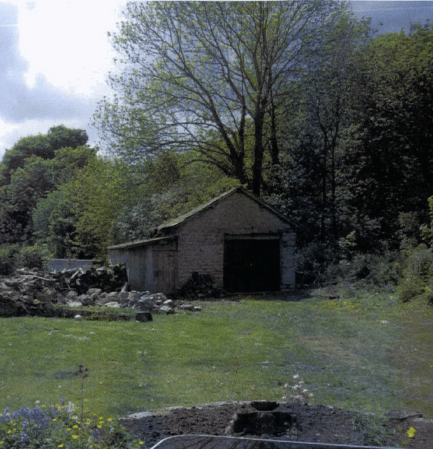
The old door was rusted and hanging off. I managed to prise it open and stuck my head in. It looked to be full of rubbish, but when I peered into the gloom, I could see that all the rubbish on the left side of the building was a faded red colour.
There was no power, so I had to switch on my phone light to take another look. As my eyes got used to the gloom, I could see what looked like a string of cubicles made of red pegboard and hung together with an assortment of cast-off timbers. Months later, I was to find out that Peter – the father of the man next door, who had sadly died five years prior, was a keen radio-ham. The ‘cubicles’ were his radio-shacks, and had been connected to a complex arial system. Each of the huts had a specialised function, but they had fallen into disuse a long time ago. Even his son, Richard, had no idea what they did.
At that point none of this was known. I knew that, whatever the red cubicles were, I would one day have to knock them down. Now, ten years later and sitting on my wooden box, sipping tea, I looked with satisfaction at what the necessary destruction had wrought. The entire length of the radio-huts had been reduced to rubble, and there was an emotional feeling that the ghost of the second Peter had been finally ‘freed’ from the place.
There would be a bonfire that evening. The shattered bits of the old radio shacks would burn brightly in the canal basin. Later, in the smoke-kissed morning, I would have the luxury of the entire left wall to begin my ‘organic reorganisation’ of Salty Pete. Even at this stage, I could feel the place beginning to breathe… though it was still laughing at me. “There’s only so much you can do with a hammer, little man,” it seemed to say.
Giant hammers, I mused–thinking of my boyhood love of the Norse tales–are mighty things. But they are not the only tools in the box…
To be continued…
Other parts of the Locked Down and Armed series:
Part One, Part Two, This is Part Three.
©Copyright Stephen Tanham
Stephen Tanham is a Director of the Silent Eye School of Consciousness, a not-for-profit teaching school of modern mysticism that helps people find a personal path to a deeper place within their internal and external lives.
The Silent Eye provides home-based, practical courses which are low-cost and personally supervised. The course materials and corresponding supervision are provided month by month without further commitment.
Steve’s personal blog, Sun in Gemini, is at stevetanham.wordpress.com.
Share this:


“One, Two, Three….Eight”
“Oh for heaven’s sake, Sidney, everyone’s got to take a turn at the back!”
Written for Sue Vincent’s Writephoto challenge ’Soar’… with apologies!
Share this:

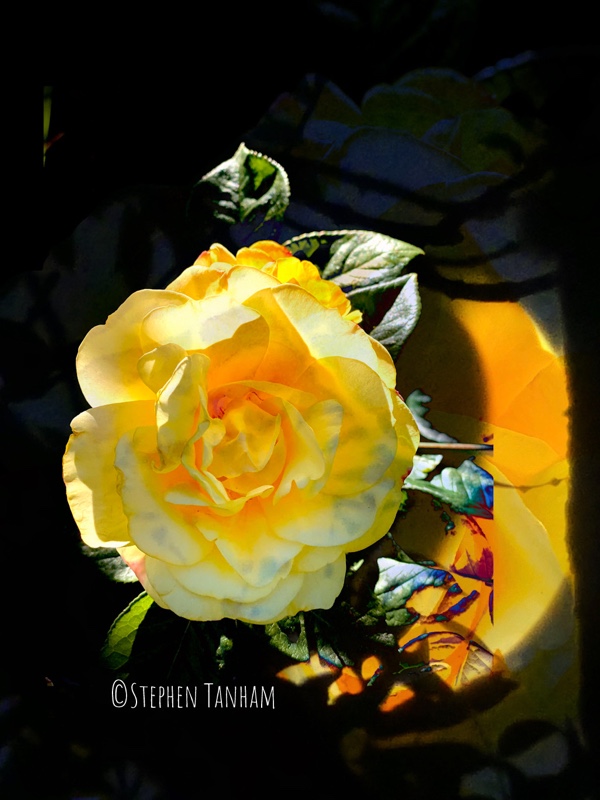

They placed a test within the breast
Of humans, who go round and round
To gaze on fullness, once, and then
Descend, with scent and sigh
From gold on face to black
And back…
➰
So little held, this joy of June’s
Delight and softest night with dawn
A moment’s slumber distant
Long grass between the fingers
Petals’ kiss, a fleeting bliss
A setting sun.
➰
Son of the Sun whose outward star
Then cycles down, withhold the frown
And hide, with pride, regret.
For you alone can see the whole
And shepherd in and out without
Fragility, your true nobility.
➰
©Stephen Tanham 12June2020
Share this:

From Sue…

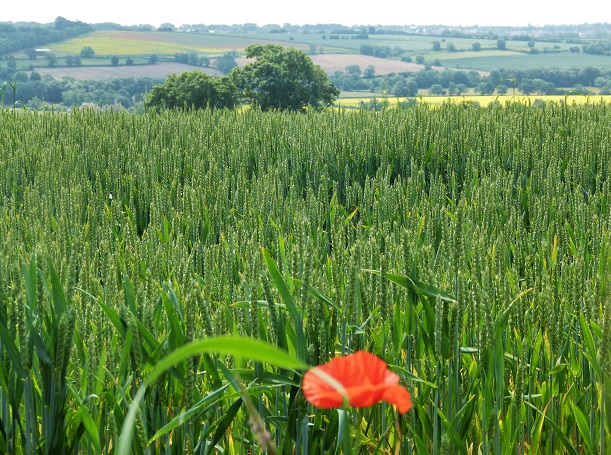
“The spiritual journey is simple, beautiful and full of Love,” read the meme. Perfectly true, but taken out of context it doesn’t actually tell you all that much, does it? Not really. Like so many of the quotes out there on the internet, usually displayed against the background of a sunset, dove or some other visual symbol of serenity, it simply drops a seed into the mind and allows it to grow… or not, as the case may be.
I remember studying the parable of the Sower and the Seed in Religious Education in school, long ago. It tells of how when the Sower sows the seed, it may fall upon stony, barren or fertile ground and where it falls will determine how the seed grows. It is a well-known story, easily understood in symbolic terms, though there are many deeper elements involved in the imagery than may…
View original post 710 more words
Share this:

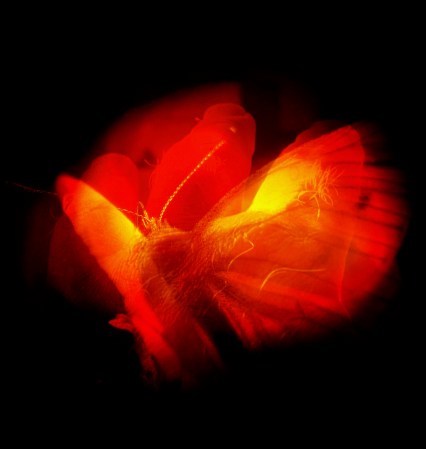
Following my exploration of the I Ching in the recent series of posts (list below), I’ve begun to examine its guidance from the perspective of what I know to be true after a lifetime’s immersion in the mystical arts.
One of the authors I have come to trust is Brian Browne Walker. Brian is the author of several contemporary translations of the I Ching, Tao te Ching, The Art of War and his own work, the Wie wu Wei Ching. His writings are entirely sympathetic to the ancient tradition, while providing an easier daily access to its undoubted wisdom.
We have busy lives, and, often, little time to contemplate how we should start each day, or how we should react (or not react) to a given situation. Brian Brown Walker’s response was to create a ‘pocket version’ of the I Ching to run as an App on mobile phones.

This App is simplicity itself to use, and allows the choice of dropping your own coins (see previous post) or tapping the App’s own coins. The results are ‘randomised’ into the equivalent reading. A small extra charge gets you the further guidance of the Wei wu Wei Ching, an addition translated text whose title translates as ‘Action through inaction’… something that captured my attention, as it was deeply relevant to my current state of mind and internal study.
It’s a concept we are not used to in the west. The idea of doing through not-doing requires a willingness to explore a deeper understanding of our place in the scheme of things. As individuals or societies, we can choose to act or not, when faced with a difficult choice. There are traditional and tribal methods of reaction, but they may not suit the person who is working to find a more harmonic relationship with their world – the world, for there is such thing as a world without its observer…
Each morning, I use the pocket App, above, to generate a view of the opportunities and challenges ahead. Initially, I approached this with skepticism, but, like generations of others, I’ve been astonished at how precisely the I Ching fits its guidance into the specific issues of my life.
On the day of writing this post, my reading was: No 3 – Chun. “Difficulty at the Beginning’. The literal meaning of Chun is a blade of grass pushing gently up through the soil, but meeting an obstacle. Its message is that patience and gentle perseverance is the course of action to take.
The startling part of the reading came from the secondary text provided by the Wei wu Wei Ching, which said:
To realize the Way
you must die and stay dead
and go on living. With one mighty blow,
sever the attachments of mind
and self and dwell in
emptiness.
The idea of ‘dying and staying dead’ is a profound one–if we understand what it refers to. There is a stage in mystical development where we must become dead to the person we were; must leave behind the parts of it that have become old. This act is a metamorphosis, much as the caterpillar undergoes when it spins the cocoon around itself and dissolves; awakening to find its chemical ‘soup’ has been transformed into one of the most beautiful creatures on Earth.
“You must die and stay dead… and go on living”. It couldn’t be clearer. We must make the effort to separate what has been outgrown from a vital core whose components we may not even know. We need to trust… We must trust that the ‘soup’ into which we dissolve will contain, along with the nurturing world around us, the material and forces to re-form us into a more powerful, honest and precise human being, fit to carry out that part of the world’s evolution, grand or simple, that has been allocated to us.
The effect this reading has is dependent on where we are in our life’s journey. It can be interpreted as a simple stage or a major point of transition. Only they who ‘cast the coins’ can know.
The text is not mine to quote freely, but one of the closing sentiments from this part of the book of ‘Action through Inaction’ is:
Where
before there were
ten thousand entanglements, now
there is undifferentiated
Oneness, clarity,
peace.
If we truly seek, what more could we ask?
Other parts of this series of posts on the I Ching:
Part One, Part Two, Part Three, This is part four.
Brian Brown Walker on Amazon. The App is available on the Apple App Store or on Android.
©Copyright Stephen Tanham
Stephen Tanham is a Director of the Silent Eye School of Consciousness, a not-for-profit teaching school of modern mysticism that helps people find a personal path to a deeper place within their internal and external lives.
The Silent Eye provides home-based, practical courses which are low-cost and personally supervised. The course materials and corresponding supervision are provided month by month without further commitment.
Steve’s personal blog, Sun in Gemini, is at stevetanham.wordpress.com.
Share this:

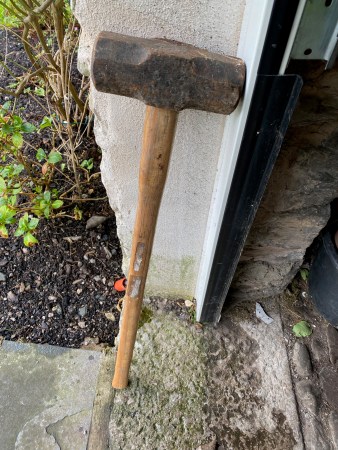
“If I had a hammer…” The words rang out in my head. Peter, Paul and Mary giving it their all with one of the most memorable protest songs of the 1960’s. Now, I did have a hammer – a rather big one – and I was striding up the garden path towards an unsuspecting ‘Saltpetre’ with a hefty degree of intent…
Bernie’s words rang in my ears… “Well, how about not spending any money at all?” The challenge, designed to inject some humour and purpose into the Covid-19 lockdown period, had been accepted over one too many white wines the previous evening in the amber light of the sunset.
I was about to begin the work… but where to begin?
The problem was one of space… To deal with the jam-packed interior of an old and dank stone building (built in 1820 as a gunpowder store for the canal that used to be half our garden) required working space… and that was precisely the problem: there was no space left, inside. Aside, that is, from the tailored holes that remained when you wheeled out either the lawnmower or my motorcycle.

When it comes to tidying, I have what Bernie calls an ‘organic method’. You would have to study her facial expression when she says this to understand the subtlety of the remark. She will approach a similar task with a mental fork-lift truck, wearing battle fatigues and brandishing a couple of litres of bleach wired to the end of a long mop… But me, I prefer to get close and personal and work around the space I’m in.
I don’t mind getting down and dirty… the dark and dubiously-speckled detritus washing off my body in the shower at the end of such a day is all the testimonial I need that it has, indeed, been well spent.
When it comes to working within a confined space, I’ve developed a nimble and strength-inducing set of arm movements that simulate an octopus. In fact, when armed with one of my favourite drills, I can guarantee that…
But we’ll get to drills later. Drills rule, drills are killer-diller old school tech modernised with freedom-bestowing, long-life batteries.
Ok, later then… I say (in the now) to the sequence-loving muse on my shoulder as I type. I’m all right now… Back in the story, I unlock Salty Pete, as we have come to know it. Later in the story it will come to have another name, earned in the battle of the drills… Ok, I know, I know…
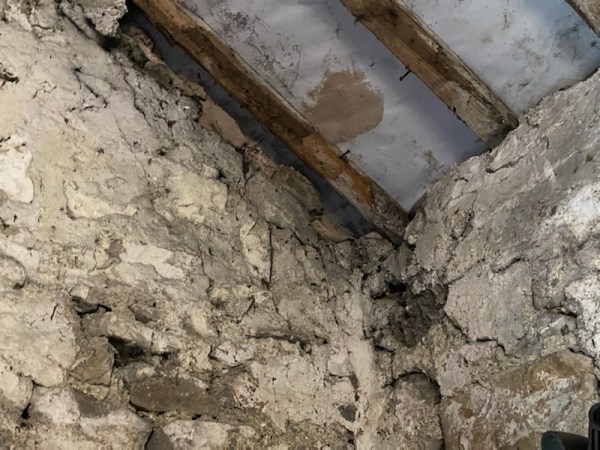
The newly funded door swings up and in. Don’t let it fool you: what’s inside isn’t related to such efficiency. The dark interior sneers at us. “Oh, yeah,” it seems to say. Clearly, we’ve been here, before. But never with a hammer this big. You’ll note I’ve switched to the present tense. I’m taking you with me… kindly buckle up! Those of delicate sensibilities better leave now, I drawl, nodding at the side door and sounding Welsh rather than Texan. It’s the fault of Tommy Lee Jones, always wanted to be able to do his voice at moments like this… Never works, but you’ve got to keep trying…
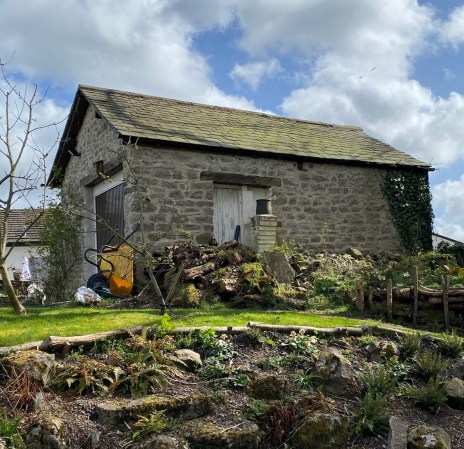
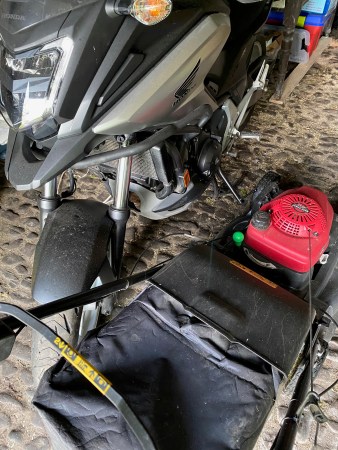
The only accessible space is occupied by the lawnmower and the motorbike. So, as two of the most precious objects in here, we wheel them carefully, backwards, to stand on the garden path, where they will be safe from everything but Cumbria’s dubious climate. Later in the project, the supportive neighbour who’s so adept at DIY he’s just fitted a galvanised roof on his shed, confesses that he knew ‘something was up’ when I did this. One object ‘on the lawn’ he could understand; two meant business…
The effect is electric. Even sneering Salty Pete is considering his options. It’s the hammer in the right hand… Great track here (Jackson Browne) about how the ‘hammer shapes the hand’. It’s dark work, but somebody’s got to do it…
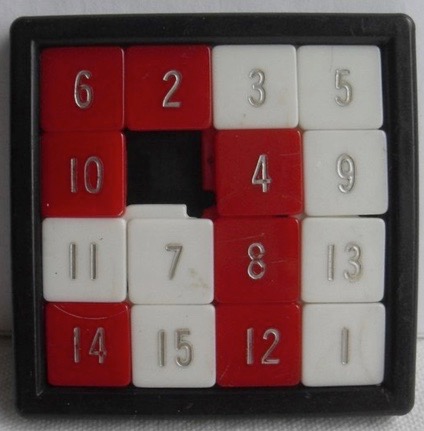
Your childhood may well have been later than mine, but one of the little toys we used to be able to get for sixpence was a ‘Lucky Bag’. Apart from dodgy sweets, they sometimes contained a plastic square of numbers or letters that you needed to slide into new positions to make, say, a chosen word or to allow a line to add to a specific total. It was an intensely frustrating experience, because the initial state of the square had only one blank. Play with it in your head and you’ll see the problem.
We’ve just created two squares… Two squares of space makes all the difference in the world. No wonder Salty Pete has fallen silent.
I pick up the huge sledgehammer and brace my legs across both squares. “I’m comin’ for ya!” Tommy Lee Jones says. It’s getting better… at least it’s not Welsh this time.
We swing the mighty hammer. No going back now… The colossal head arcs, neatly, through the old and dusty air… towards a tall target selected in the dying light of the previous day.
They’re not laughing now, as the comedian Bob Monkhouse used to say…
To be continued…
Other parts of the Locked Down and Armed series:
Part One, this is Part Two
©Copyright Stephen Tanham
Stephen Tanham is a Director of the Silent Eye School of Consciousness, a not-for-profit teaching school of modern mysticism that helps people find a personal path to a deeper place within their internal and external lives.
The Silent Eye provides home-based, practical courses which are low-cost and personally supervised. The course materials and corresponding supervision are provided month by month without further commitment.
Steve’s personal blog, Sun in Gemini, is at stevetanham.wordpress.com.
Share this:

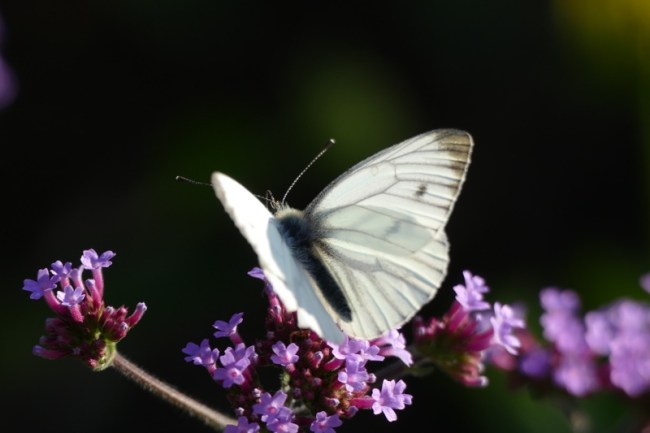
Sometimes, you just get lucky…
You’re standing there with a camera that will actually reach into the shot that you’ve just seen.
You know that the moment will last less than a second, so you don’t even breathe, you just press.
Sometimes, you get lucky. A second later, the glorious white flicker is gone… but left behind is the ghost it allowed you to keep.
©Stephen Tanham, 2020
Share this:


She’d never rescued an angel, before. Never seen one. Never drunk that dark red wine that she would never drink again…at the village dance she wasn’t supposed to go to.
But she had seen it! Had stared, soaked to the skin in the freezing summer storm; gazing up at dark clouds as the bright angel fought for its life against the attack of the orange demon, with its sickly glow.
She scanned the heavens as she waited, dripping at the door of the disused church within which she had placed his injured body, carried and dragged across muddy furrows from the place of battle over the old coppice. The dark sky was still swirling, malevolent with hate. Her eyes would not focus, half-blind with the angel’s brightness. Perhaps the demon had been injured, too? But she knew he was still up there… still waiting.
“He will come back for me,” the angel had said, before she laid him down in the old straw. “Get as far from here as you can!”
She had clutched the old key to her sodden breasts as she stroked his brow, creased with pain. “They will have to get past me,” she whispered, knowing how feeble it sounded. “I will lock you in.”
Despite the pain, he was smiling. He gazed into her crying eyes, then, and whispered back, “Then, perhaps there is a way…”. But he would say no more and fell into a deep stillness, looking beyond her, beyond the stone walls… beyond the world, but touching the key in her hand.
Now, standing with her back to the renewed storm, she turned the key in the old lock, shuddering with fear at what lay behind her, trembling that she was locking herself out of the protective walls within which her bright one rested. She looked down one last time at the key – then gasped. As her fumbling fingers withdrew it, the lock changed shape, becoming, first a black, then a glowing heart.
“Love versus evil, then,” she whispered, wiping tears and snot from her young skin, turning to face her death. Around her the air was suddenly bright – as bright as the angel had been. She realised she was holding up the key as a weapon.
But, as the ground fell away and she soared, sleek and deadly, into the black sky, she knew two things: that her sister, Mary Jane would never call her dull, again; and that it was no longer a key she held…
Written for Sue Vincent’s #WritePhoto


 Sun in Gemini
You must be logged in to post a comment.