
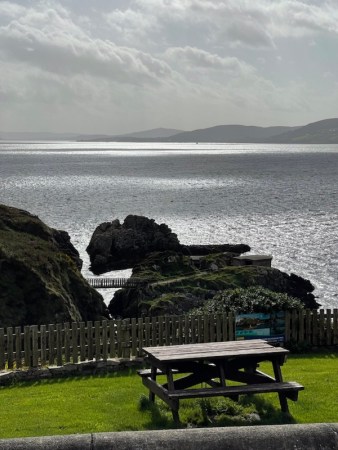
I’d never heard of John Newton, until, walking along the gardens that front the beach at Buncrana, County Donegal, we came across an information board describing his links to the town via the hymn ‘Amazing Grace’.
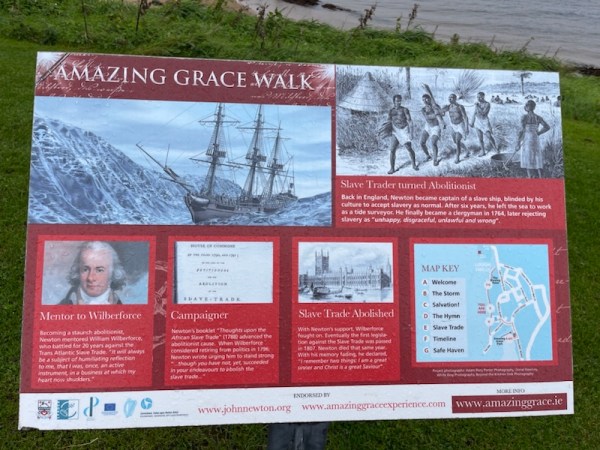
You may already have heard of this man, who could be described – at different times of his life – as both despicable and courageous.
Glancing at the tourist information, my immediate assumption was that Newton was a native of Donegal, and therefore celebrated, here, for his (eventual) dedication to the abolition of slavery. The latter was true, but he was born in Wapping in London, in 1725, the son of John Newton the elder, a shipmaster.
So what was Newton’s connection to this part of Donegal, one of the most beautiful and varied coastlines you could wish to experience? It takes a summary of his fascinating and eventful life to explain…
Following his mother’s death just before his seventh birthday, Newton was sent to spend two years at boarding school. At age eleven he went to sea for the first time with his father; subsequently sharing six voyages before his father retired in 1742.
Acting against his father’s wishes, he signed on with a merchant ship sailing to the Mediterranean.
In 1743, adrift from his father’s care, he was press-ganged into the Royal Navy, becoming a midshipman aboard HMS Horwich. He hated it, tried to desert and was publicly flogged, stripped to the waist and tied to a grating. He was reduced to the rank of common seaman.
He recovered, both physically and mentally, but his journal recalls how it hardened his nature…
Newton was introduced to the infamous ‘slave trade triangle’ of West Africa, America and Britain. Glimpsing a path to personal fortune, he rose to become a captain of several slave ships and, later, a substantial investor in the slave trade. At this stage of life, he seems to have accepted and embraced the ‘normality’ of the upper classes imposing slavery on ‘lesser beings’.
Later, and possibly part of this learning curve, he transferred to the Pegasus – a slave ship bound for West Africa. He had already established a reputation as outspoken, and was unpopular with the crew of the ship. In 1745 they left him in West Africa with a notorious slave trader – Amos Clowe. Clowe promptly gave him as a ‘slave’ to his native wife, Princess Paye, a woman who already owned many native slaves.
Newton later said of this period that he was ‘At once an infidel and libertine, a servant of of slaves in West Africa’. He refused to say much else about his incarceration.
‘At once an infidel and libertine, a servant of slaves in West Africa’.
John Newton
Early in 1748, he was rescued by a sea captain who had been commissioned to find him by Newton’s father. He was returning to England on the merchant ship Greyhound, when it was caught in a terrible storm off the coast of Ireland. He awoke in his cabin to find the ship in distress and listing. In one report, he lashed himself to the untended wheel and stayed there through the days of storm that followed. During this, Newton began to pray and called out for ‘God’s mercy’. After a total of four weeks at sea, the Greyhound limped into Lough Swilly and came into dock at Bruncrana for repairs by a local shipwright.
It was the 10th March, 1748, a date he would mark as the start of his duty to God and fellow men and woman; a path he followed for the rest of his life as an evangelical Christian. He swore an oath to refrain from either gambling or profanity. He renounced alcohol, but continued to work in the slave trade, later saying that his conversion ‘to being a true believer took a number of years.’
Applying modern ‘standards’ of another age is problematic. But it struck me there was a degree of hypocrisy, here.

He returned to the sea and eventually captained three more ships before a stroke put an end to his seafaring career. By then his investments in slavery were considerable and he was secure. Since ‘being spared’ in the storm, he had longed to become a church minister, but found it difficult to gain sponsorship.
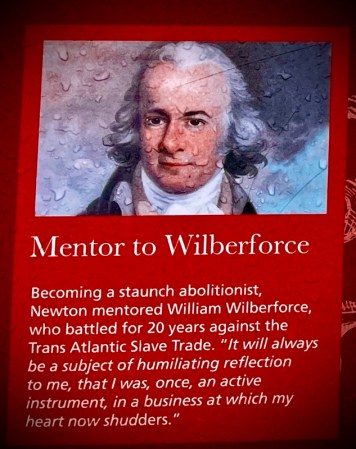
Moving to London in 1754, he took up the position of rector of St Mary’s Woolnoth Church and later contributed to the work of the Committee for the Abolition of the Slave Trade, formed in 1787. He was one of only two evangelical clergymen in the whole of London, and, as good orator, was sought out by young and aspiring minds to develop their own arguments – often about the moral issues of slavery. He was a prolific writer, and published pamphlets espousing his causes.
He wrote: ‘So much light has been thrown upon the subject by many able pens, and so many respectable persons who have already engaged to use their utmost influence for the suppression of a traffic which contradicts the feelings of humanity, that it is hoped this stain of our national character will be wiped out’
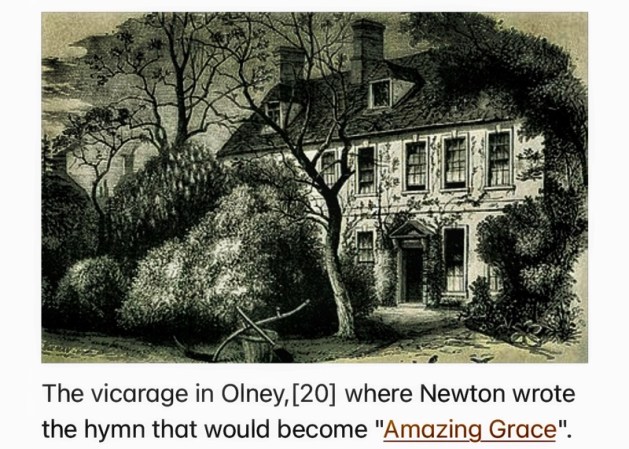
It took many years for him to be ordained as a priest for the parish of Olney, Buckinghamshire. There, in June 1764, he wrote the hymn that would become Amazing Grace. Later, the celebrated poet, William Cowper, worked with Newton on a volume of hymns published as Olney Hymns.
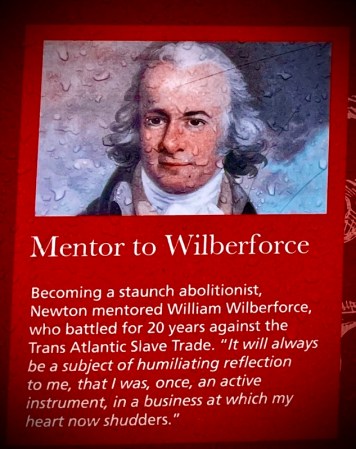
In London, the young William Wilberforce had become one of Newton’s intellectual circle. The now-clergyman and ex-ships’ master was able to give first-hand accounts of the appalling conditions in which slaves were transported and kept.
Newton saw in Wilberforce the presence in politics that he could not hope to attain. He supported the rising career of his new friend, and helped his resolve when the politician’s efforts seemed to be failing.
With Newton’s support, Wilberforce redoubled his political efforts, and the first legislation against the Slave Trade was passed in 1807. It would be decades before the full legislation was enacted, and only then because parliament agreed to recompense every slave-holder for their losses – a national debt that was only fully discharged in recent decades. But Wilberforce began the process, urged on by the ex-slaver who ‘found his living God’ in the waters of Co. Donegal.
Newton died that same year. With his memory fading, he declared “I remember two things; I am a great sinner and Christ is a great Saviour”
Is there a mystical perspective to such a vivid life? I believe so. We need to set aside the instant judgement that we tend to apply, based on modern moral consensus, and look at the ‘long curve’ of a person’s lifetime to see what their overall effect was. Newton, profiteer from the miseries of others’ suffering, became the informed strength that kept Wilberforce constant to his goal.
‘God moves in mysterious ways’ … and over long timescales. Our own existence is filled with opportunity; and that process may span the lives of many people joined in a unity of improvement for mankind. But the path of each will be unique and only found in the personal ‘now’.
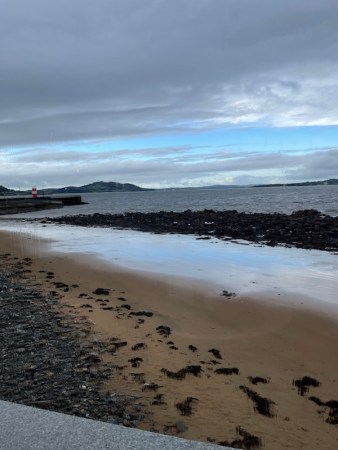
We walked past the memorial to Newton on the next day. Knowing more about the man, and having begun this post, I could sense in the calm waters of Lough Swilly how he must have felt arriving, snatched from what seemed certain death, on this calm shore. We don’t often have monuments to ‘moments’, but this is a good one. Perhaps ‘moments’ more than men and women are what really power history; those times when something from a more causal dimension powers through the fabric of our space, time and event to ignite the waiting threads.
———-
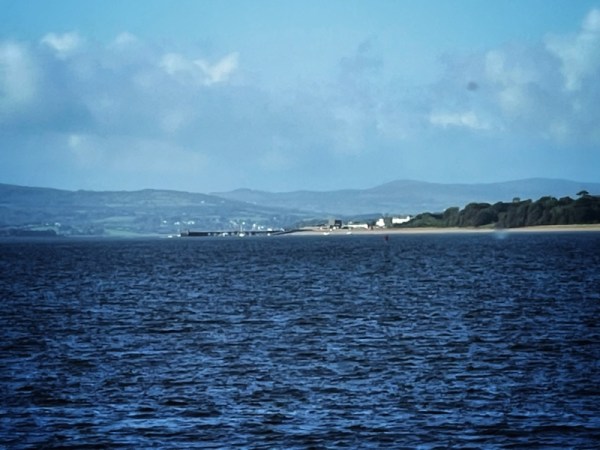
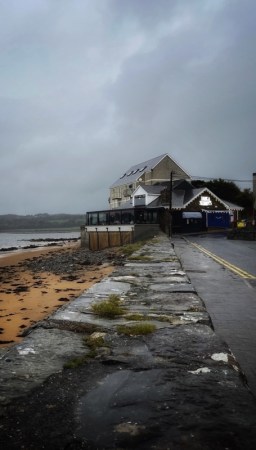
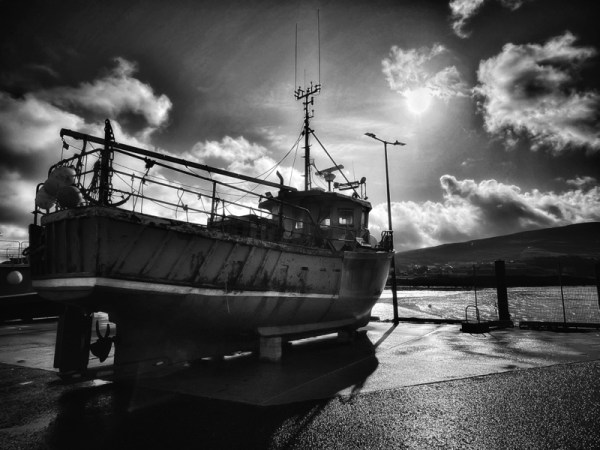
Note: the photos of the environs of Lough Swilly are the work of the author.
———-
©Stephen Tanham 2023
Stephen Tanham is a writer, mystical teacher and Director of the Silent Eye, a correspondence-based journey through the forest of personality to the dawn of Being.
http://www.thesilenteye.co.uk and http://www.suningemini.blog
Share this:

+ #Silenti, mystical travel, Photography, Places and Prose, Travel and people, Travel and Photography
A Donegal Journey (1)
by Steve Tanham
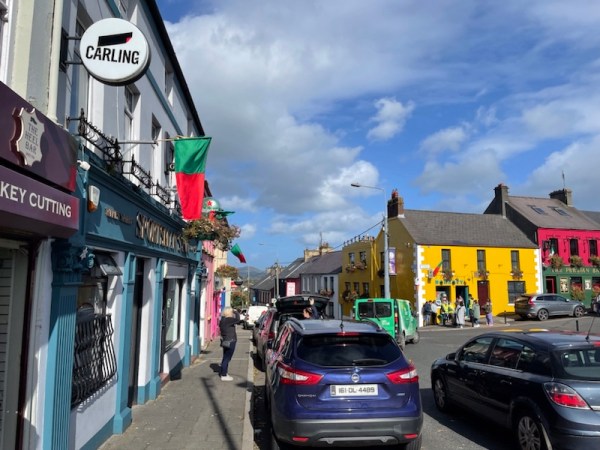
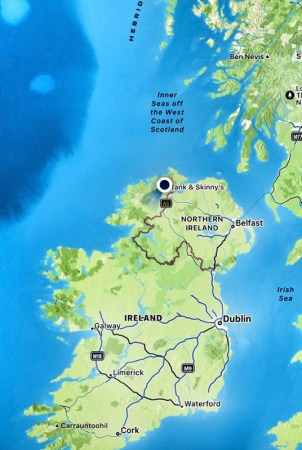
The town of Buncrana lies in the far north-west of Ireland, in County Donegal: that part of the country that is on a line with Northern Ireland, yet is in the Republic.
It’s long been our intention to visit this beautiful part of the ‘Emerald Isle’. Green it certainly is, and currently living up to its rainy reputation… But hailing from Cumbria, we’re no strangers to the element that makes it so.
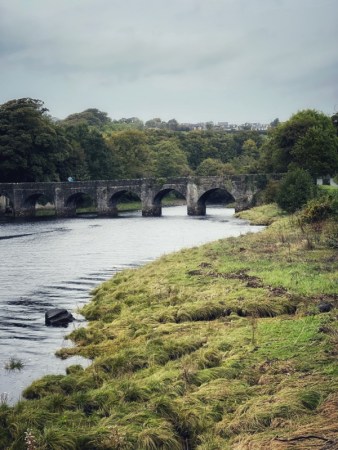
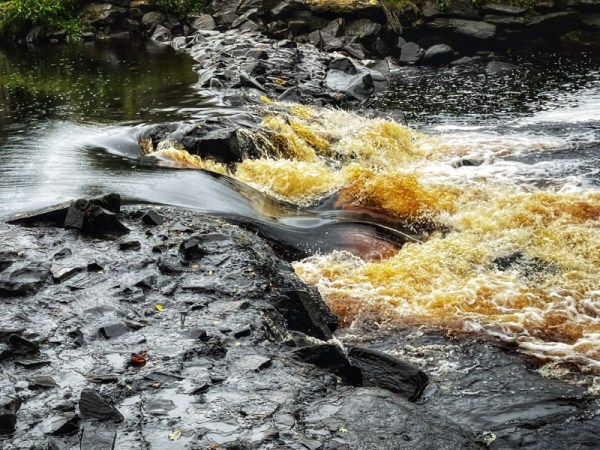
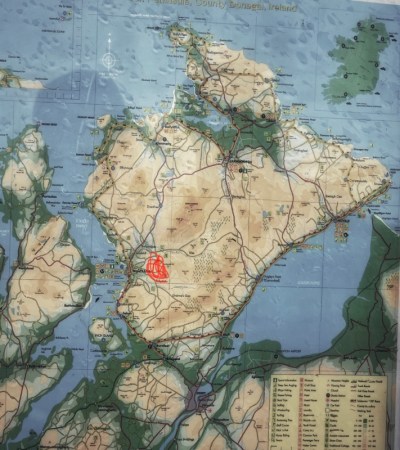
Water is everywhere here, and the twisty and often exposed coast road is part of Ireland’s celebrated WAW – Wild Atlantic Way, a coastal journey of over 1200 miles. We’re at the northern end of that and happily doing a lot fewer…
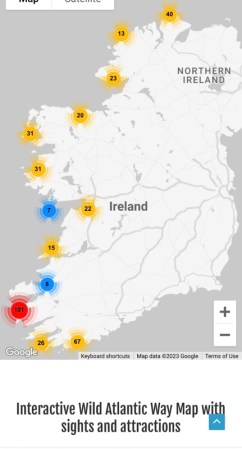
Our stay here is for a week, so I’ll be doing a few mainly-photographic posts. After that, we’ll be moving to County Cavan in the middle of the country to meet up with the family and help look after our 18-month old grandson for a few days.
We’ll finish up by visiting the Antrim coast and a day trip into Belfast and – hopefully, a visit to the Titanic museum.
For now, we’re enjoying the gentle style and pace of Buncrana and its coastal parks. It has some famous sons and daughters, one of whom – following a life-changing journey of survival at sea – wrote the words to the song ‘Amazing Grace’.
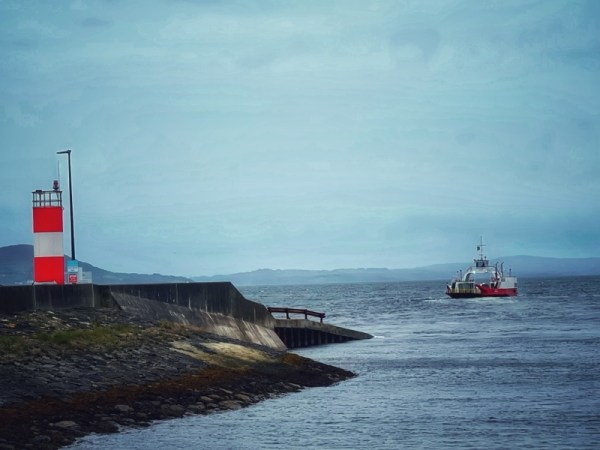
For now, we’ve a plan to try some of the WAW, and, the day after, take a ferry trip across Loch Swilly to Rathmullan, probably a day trip in itself.
Here’s a few photos to close out this first post from Buncrana..
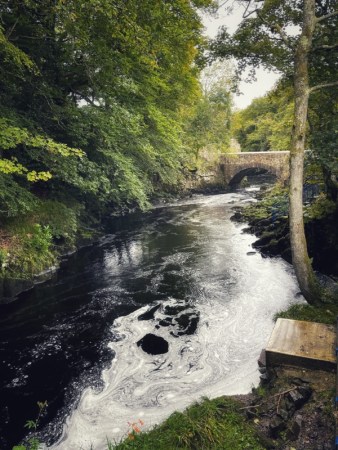
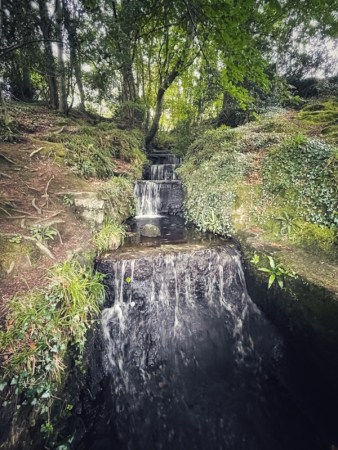
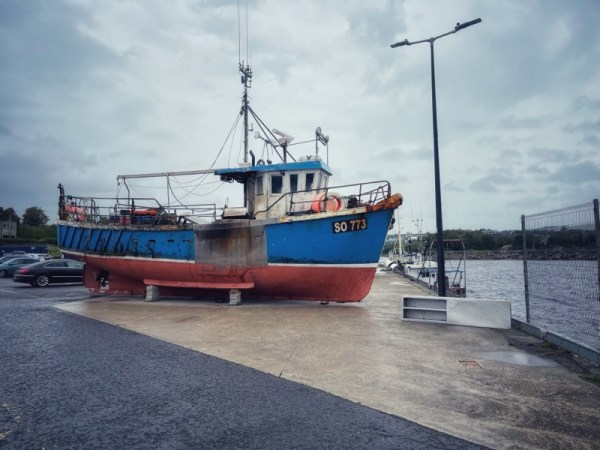
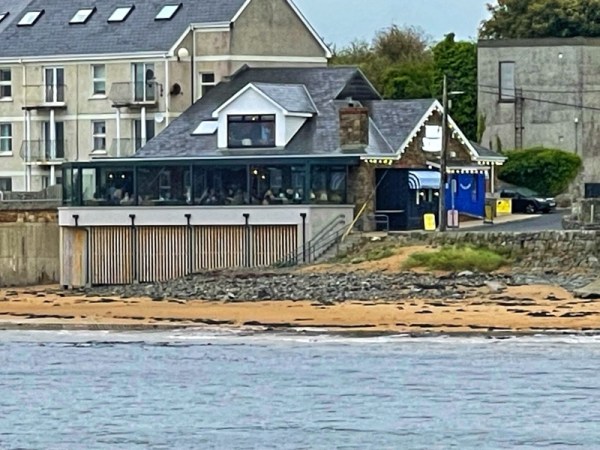
And Guinnesss – my favourite beer – did I mention that every bar and cafe seems to sell its creamy pints!
©Stephen Tanham 2023
Stephen Tanham is a writer, mystical teacher and Director of the Silent Eye, a correspondence-based journey through the forest of personality to the dawn of Being.
http://www.thesilenteye.co.uk and http://www.suningemini.blog
Share this:

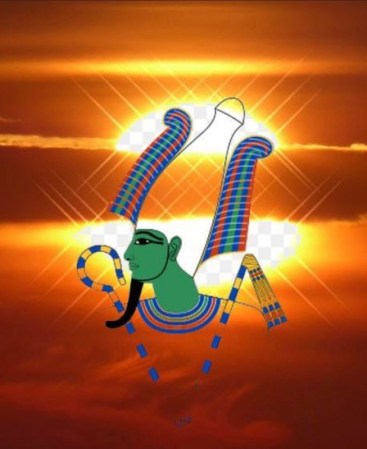
The clothes he wears are not his own
They dressed the flesh to suit the dead
With colours picked from nature’s prime
And perfumes rare that round his head
Entwine a crown of rule and law
In broken pieces whispering of a thread
——-
The white ones came and spun the rope
That covered tailored blood and green
And in his eyes they painted death
To cover tracks of life unseen
Protecting deep and final rest
And shielding paths where none had been
——-
And down this thread his life was passed
To draw all those whose time conveyed
That he might witness love or lack
And, bloodless till all life was weighed
Become the place to which we pass
His breath the stone on which our life’s displayed
——-
Each day our footsteps nearer tread
Unto that chamber where he dwells
In perfect silence now – his inner garb
Awaiting time when scales meet shells
And there will hold and cherish hearts
One life not death revealed in deepest wells
—
©Copyright Stephen Tanham.
Base Osiris image from Wikipedia
Originally published in 2015.
Share this:

On the third Sunday of every month, the Silent Eye hosts a Zoom-based discussion to explore one of the core topics of modern mysticism.
This series of ongoing posts will feature a summary of each monthly discussion; of which this is the first. The talks are open to all, and we welcome new visitors to the group – whether you drop in to take a look, or decide to stay and join our work. There is link at the end of the post to enable you to join one of our sessions.

The SE-Exploration talk for Sunday 17 September 2023 was : The Nature and Function of the Soul.

No-one wants a dry set of ‘minutes’ of such meetings. We’ll tell the story of these special events as informally as possible.
This one began with a story of a ten-year old boy who fell in love in the golden-ness of a village autumn. The girl he fell in love with was in the same class at primary school, but she had no time for this junior suitor.
But that didn’t stop him; he was richly experiencing the inner glow of love…but mixed with the deep greens and golds of the season. He had no reason to question this mix. He was too busy enjoying the rapture.
We’ll come back to his story… For now, let’s get to know the subject.
Any group discussion about ‘the soul’ is usefully begun by an exploration of what those attending feel and know about their own. All of us felt we ‘had’ a soul, but the definitions varied: is the soul something deeply ‘within’ us, psychologically, or does it have a separate ‘being-ness’ independent of our our self – the egoic personality?
Does the soul form a key part of our identity, or is that something that we can, perhaps, work towards as we understand its reality – perhaps the most important reality we can know?
Previous discussions had considered the importance of the feeling of presence that we all understood to be with us at key moments. This is felt by many who venture into an exploration of their inner state, and is most commonly felt as a ‘glow’ over the chest region, which, when encouraged with sympathetic and gentle breathing, will spread over the whole body.
As a species, we are suspicious of simple truths, but this is one of the most powerful and accessible ‘inner’ experiences we can have. It is wholly positive and has no risks, generating a composite sense of wellness in the entire body … and beyond.
There was intense curiosity about whether the soul has a structure and components. One lady, deeply experienced in these matters, suggested that we should consider the soul as ‘connecting’ the essential Self with the ‘surface level’ of our life: the personality.
Some discussion ensured as to whether the personality – psychology’s egoic self – was identical with what we know as character. It was suggested that character was deeper than the event-generated egoic personality whose unfolding – often via reaction to ‘vivid’ events in childhood – dominates the early years of our lives, forming fixed structures of mental response that pattern our lives from then on.
It is at this level that modern developmental psychology and object-relations (how we see all relationships, whether people or physical objects) meet, each potentially providing the other with missing keys vital to the soul’s expression in the world.
We talked about the development of the self (egoic – personality) and how much of it is a result of the stages of exploration and development undertaken by the infant within the confines of a family – hopefully a loving and supportive one, but we all know the consequences of that not be being true. How fragile the road to maturity can be…
To ‘schools of the soul’ like the Silent Eye, there is a deeper self – usually written with a capital ‘S’ as Self. This inner being – belonging wholly to the world of Being and not the physical, is our essential self – Essence, whose goal is to manifest itself in the denser world to ennoble existence. This is a demanding task; an undertaking which, itself, is the journey to ‘enlightenment’.
The lady who shared the idea that the soul connects the Self and the ‘person’ cautioned us that the deep Self was not subject to the laws of organic life…nor to the idea of a lifetime, at all. The implications of this being that elements of character might be inherited by the infant or even the unborn child due to the equivalent of a ‘magnetic’ effect from the powerful presence of the unseen Essence (Self or Spirit in other descriptions)
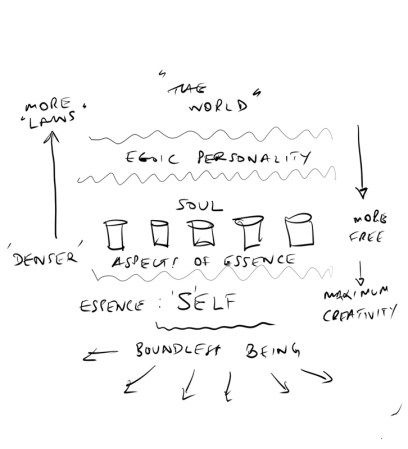
We mentally drew a map of the relationship between the outermost levels of mankind – our personalities, and the spiritually higher domains of the soul. This has been transposed, above.
We concluded that the soul is simply (and wonderfully) the ‘organ’ of experience – and therefore the underlying and ‘non-physical’ Self. The Self was also referred to as the Christ nature, an idea showing that Self, Soul and Personality have the potential to unite all the vehicles of consciousness that span Being to Matter in the expanding cycles of creation.
Such discussions necessarily touch on deep emotions. We encountered the difficulty of refining the personality in line with the energising radiance from the inner presence of the Self, in order to counter the enervating effects of a life of struggle.
And the boy in love? What became of him? Decades later, he was still puzzling the intensity of that episode. Then he began to understand the nature of the soul, and the essential Self that is its deepest foundation. One of the properties of the deep Self is a quality of ‘merging, golden love’ – exactly the qualities of his juvenile adoration… And yes, I was that lad…
Why not join us for our October chat? The details are below:

The SE-Exploration talk for Sunday 15 October 2023 will be : The Magic and Mystery of Identity.
Identity is so deeply rooted in our characters, it’s often impossible to tease out and study; and yet doing so is essential if we are to understand how we ended up where and how we are…
In this talk we will examine what identity is and why it is so important to the flowering of our self in life, and provides us with a faithful pointer to the depths of our being.
Join us for 90 mins of friendship and amicable sharing of views and experiences … not forgetting fun. Bringing a glass of wine with you is perfectly acceptable.

If you’re not on our contact list and would like a Zoom invitation to join us at the next SE-Explore meeting (see above), send an email to rivingtide@gmail.com.
©Stephen Tanham 2023
Stephen Tanham is a writer, mystical teacher and Director of the Silent Eye, a correspondence-based journey through the forest of personality to the dawn of Being.
http://www.thesilenteye.co.uk and http://www.suningemini.blog
Share this:

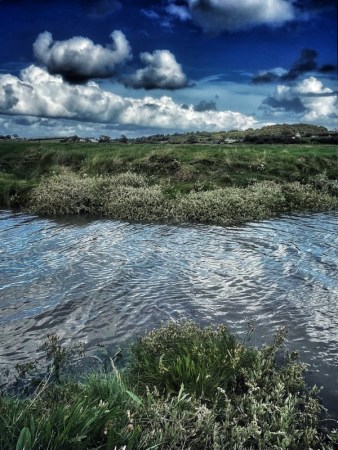
The tidal salt marshes at Bolton-le-Sands – between Morecambe and Carnforth, on the Lancashire coast – are both beautiful and treacherous…
The sea races in and fills the narrow channels, sometimes overspilling onto what seemed safe walking paths only a short time before.
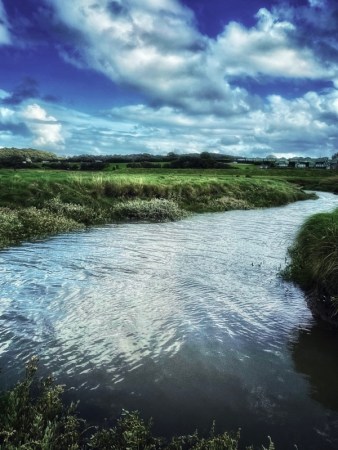
It’s easy to work your way to the sea through the maze of possible paths, only to find the tide has turned and you have to navigate a now unfamiliar, watery landscape in reverse…
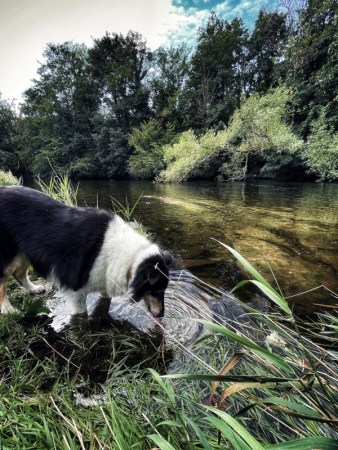
Walkers beware! But the collie and I made it back.
©Stephen Tanham 2023
Stephen Tanham is a writer, mystical teacher and Director of the Silent Eye, a correspondence-based journey through the forest of personality to the dawn of Being.
http://www.thesilenteye.co.uk and http://www.suningemini.blog
Share this:

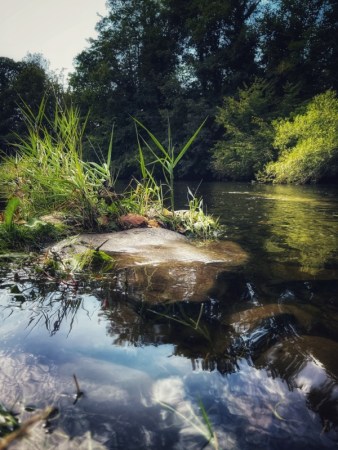
As a child, I remember being conscious of a few autumn days that had a ‘special gold’ in them.
Walking the collie by the River Kent, I realised we were experiencing another. I looked down at the surface of the water and knew I had a short time to record one of the special moments that characterise such mellowness.
©Stephen Tanham 2023
Stephen Tanham is a writer, mystical teacher and Director of the Silent Eye, a correspondence-based journey through the forest of personality to the dawn of Being.
http://www.thesilenteye.co.uk and http://www.suningemini.blog
Share this:


Our modern age speaks glibly of the truth. We might even liken it to ‘knowing’ and entertain the idea that there is truth and Truth. The former would be a convenient or ‘conventional’ truth, a truth accepted as normal by the more prosperous world. But Truth with a capital ‘T would be an appreciation, a living understanding, and a state in which we could feel the presence of our inner being as it turned our discovery into a rightness of time, place, circumstance and heart.
We can adopt a catalogue of modern truths and know that it will take little effort to hide behind them in our actions. There is so much of this hiding in our ‘civilised world’ (and the politics that reflect it) that we would not feel at odds with the mainstream of life.
“Terrible about all those starving children but what can you do? Give money and it just ends up in the pockets of corrupt officials whose actions gave rise to the starving youngsters in the first place…”
All ‘practically’ true. But how do we feel in our hearts when we take such a stance? What happens if we face this cold attitude and challenge ourselves to find a personal answer that addresses that young child’s innocent and desperate eyes?
The degree of success is not the issue here. What matters is the engagement with what we know to be a cruel situation involving people whose lives are every bit as real and important as ours.
The core of this is a society that has taken the immediacy out of our relationship with living. Being shocked hurts. We value the stability and comforts of our way of life, so we build buffers that recognise and ‘front’ the reaction to something shocking that would rock our hearts.
Our fears run amok when challenged in this way. “I’d soon find myself selling my house and losing my job if I set off to help the less fortunate in a reckless way, like that…”
But the Truth in the situation is not asking us to do that. It’s really asking us to face something with presence and therefore know what is true in a living and personal way; to do some semblance of what we we do face to face with the ‘child’.
This state of presence is within us all. It is an unshakable knowing that we have a heart-based core that knows that every situation we face in life is special and different – and has something to teach us. It takes a degree of courage and lots of practice to come to rely on this inner part of us: our soul, if you like.
We cannot deal with any situation we are experiencing as though it is part of a formula of response. Each needs to be viewed as intimately related not just to us, but to this exact moment in our lives. Seeing it like this causes the presence within us to rise to the ‘control deck’ of navigating a truly conscious route through the present.
———-
©Stephen Tanham 2023
Stephen Tanham is a writer, mystical teacher and Director of the Silent Eye, a correspondence-based journey through the forest of personality to the dawn of Being.
http://www.thesilenteye.co.uk and http://www.suningemini.blog
Share this:

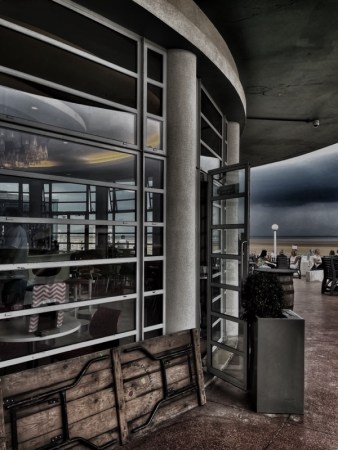
My wife and her sister had just left to do some local shopping. I was set to take the two dogs – one ours, the other minded for two friends touring northern Spain – onto the nearby beach for their second run of the day. It was a prospect neither seemed keen on…
My mind had registered the lowering sky … but only subconsciously. Finding myself suddenly (and pleasurably) alone, I responded to the young man clearing the debris of our Sunday morning breakfast buns and asking if he could get me anything else.
‘Thank you, no. I’m done.” I said.
And then immediately called him back.
He put his tray down at an empty table and returned, smiling.
“Tell you what,” I said, returning his wry smile. “I’ll have another latté.”
The dogs were fine. Another coffee wouldn’t do any harm at all…and it was Sunday.
He nodded and disappeared into the Rotunda’s bar.
The glare from one of the booth’s lamps made me conscious of how dark it was becoming…but this was only late morning.
A few minutes later, as the coffee was set down on my table, there came a loud clap of thunder, seemingly right overhead. Windows rattled. It got even darker.
The place went quiet in shock. Then, slowly, conversation returned – but hesitantly, as though no one trusted that one thunder-clap would be it…
The dogs needed some reassurance, but then settled back to their slumber beneath the table; they had been well exercised earlier in the morning.
Suddenly, the noise level increased. A throng of wet people were pushing through the doors into the Rotunda’s interior. I looked up to see the entire population of the outside deck fleeing the dark skies and sudden deluge. Many arrived with soggy Sunday papers folded over their heads and hot drinks clutched in their free hands.
Tess, our collie, opened one eye and yawned up at me, conspiratorially, as if to say, “Good call…”
Outside, the newly arrived storm tore into the building. I’ve never enjoyed a finer coffee.
©Stephen Tanham 2023
Stephen Tanham is a writer, mystical teacher and Director of the Silent Eye, a correspondence-based journey through the forest of personality to the dawn of Being.
http://www.thesilenteye.co.uk and http://www.suningemini.blog
Share this:

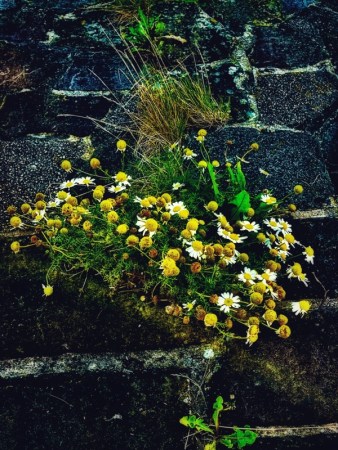
No gardener tends this sea wall
Of stone
The beauty of these scavengers
Of dust not loam
And
Rock as bed
Is all their own
A triumph of
Being improbable.
——
©Stephen Tanham 2023
Stephen Tanham is a writer, mystical teacher and director of the Silent Eye, a journey through the forest of personality to the dawn of Being.
http://www.thesilenteye.co.uk and http://www.suningemini.blog
Share this:

+ #Silenti, Consciousness, enneagram, Higher Mind, Incarnation, Life and Death, Silent Eye School, Soul
Personality: friend or foe?
by Steve Tanham

When reading many modern books on mystical development, you might think that the personality was now viewed as negative; a foe to be overcome on the way to the real self.
There is much truth in this, but it is incomplete and spoken from an ‘immature’ perspective. That partial vision of it misses the finest potential of what we have loving crafted of ourselves during our lifetime, however long or short that has been.
The infant is born with the ability to see, but cannot recognition or sense of what is entering the consciousness via the senses. If the environment, centred on mother, is warm and nurturing, then everything in the infant’s world is grounded in beauty and love.
The new mind is as hungry as the body, and constantly adds to what it can perceive. There is no sense of separation; of a ‘me and it’. The young mind is simply adding to itself. The view through the child’s eyes is like a rich tapestry: differences are seen but there is no sense of objective boundaries, which will later become objects in the child’s world.
Eventually, the child learns that the seen ‘arm’ belongs to a body. Much later, that body is known to be something that others have, too, and is a ‘type’ of object that has arms and legs and other appendages. Each such object has properties knowable from all the senses. Loved objects, like mother; have a rich set of touch, smell and sound vibrations to add to the developed seeing that the human being now possesses.
That sense of personal possession of, say, an arm – of me– eventually becomes part of the young person’s identity. Having an identity is essential to the development of a strong ego – personality.
As the child matures – full of sensory capability and now equipped with logic and reason, the perceived world moves from an exterior reality, conveyed immediately to the senses, to an interior world of abstraction and representation. This power of the Mind uses its memory of ‘like objects’ – ‘all human bodies are similar in the abstracted mental world’ – to make the process of perception more economic. Why look at a hundred bodies in the street when you can scan them and know they are a concept called ‘people’, which share the same properties – at least at the level of encounter.
A lover’s body might well be different, and we take time and effort – at least in the beginning – to see and feel it in intensity each time we make love with them.
So what’s wrong with this loving persona that we have carefully cultured according to our preferences? Nothing at all… The adult has learned to ‘manage’ a complex material environment … but its reality has shifted from a constant stream of the ‘real’ to an abstracted and increasingly dull world based on memory rather than reality. Objects are memory, and the once ‘out-there’ world is now entirely made of them…
The dense world of matter is not our only home. This finite and ultimately corruptible stay in the most ‘solid’ of worlds has been undertaken precisely to give us this perspective and to enable us to objectively use a knowledge of the ending of the life of the body, though that is not a prerequisite of a well-lived life.
The spiritual path is one of moving our consciousness back to where we came from, but not in an immature sense of losing what we have gained in maturity and understanding. The hurdles to that reconciliation are the fixed views of life and ‘the world’ that we formed in early life and that create a constant ‘movie’ (link here) of all we do in our movement through life, twisting our actual perceptions into fixed forms of reaction.
This happens to us all, We have no control over it, and yet we are mainly unaware of it. However this set of ‘fixations’ distorts the whole of our lives.
These interior objects are not an ‘enemy’; they are a natural result of experience, hurts and bruising. They are like a suit of armour that makes our movement sluggish and lacking in grace. They were put in place to protect the developing child and they stayed there long past the need for them. But because they came first, they are the foundations of everything else that followed: our character.
Developmental psychology has shown that there are a small number of such fixations and modern mystery schools have developed their own techniques for the discovery and personal healing of these invisible but pervasive barriers.
The techniques for their removal are a soul-call to the deepest level of our selves – the inner sense of presence and power that we cherish at times of ‘peak experiences’. The joyful energy available to us from this level exceeds that of normal living, and has the power to make our fixations visible, as though we had shone a brilliant and other-worldly light through them – from the far side – exposing their anatomy for the insubstantial yet fearful matrix that it is.
In his book, Diamond Heart, A.H. Almass, the celebrated mystical teacher refers to this as the ‘Embodiment of Essence’, which is a stage beyond the usual reference to transcendence. Embodiment brings back the essential qualities of the personal Soul where they flower in the full potential of the person, now made whole in a truly spiritual sense: body and soul, dynamic, ultimately capable and filled with love.
This entire consideration encompasses the idea of a spiritual ‘death and rebirth’; a theme that has gripped mankind for millennia, as though we have always possessed an inner knowledge that this was and is possible.
©Stephen Tanham 2023
Stephen Tanham is a writer, mystical teacher and director of the Silent Eye, a correspondence-based journey through the forest of personality to the dawn of Being.
http://www.thesilenteye.co.uk and http://www.suningemini.blog
Share this:


Continued from Part One.
I knew the line was coming…
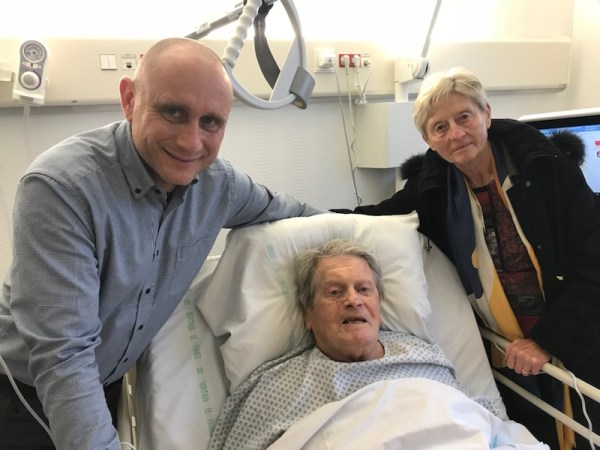
“And I never saw him, again,” said my grandmother.
It was the story of grandmother’s eldest brother; a man deeply important to her, almost another parent – she the youngest sibling.
There was a tone of bitterness there. My Grandmother had suffered a hard life. Her husband, my paternal Grandfather, had also survived the Somme and come home to Bolton, where he immediately sold his medals and turned to drink; the horrors of what he had lived through too powerful for his fun-loving heart and mind.
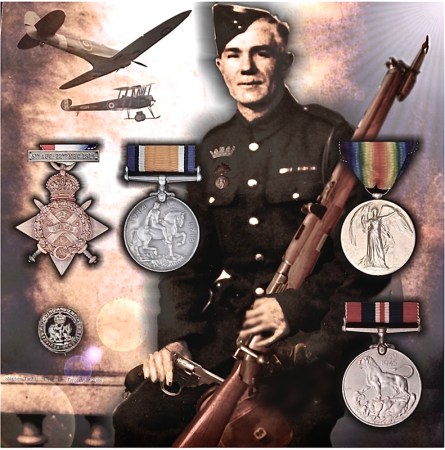
“Stephen survived the Somme and met a local girl…” She always paused at this point. I had heard it many times, but was happy to listen again. It helped Grandma to tell it, though there were always tears in her eyes at the end, sometimes floods of them.
“They married in France, near St Omer, at the end of the war (WW1). She got a wife’s allowance from the British Army. Their daughter, Madelaine, was born here in Bolton.”
“They couldn’t settle in Bolton – she had no English and hated the place!”
Her tears were flowing. “They left… the family in France offered him a future as a baker in their shop.” A whisper. “ I never saw him again…” She died a few years after this. I often thought how wonderful it would be to find the missing relatives. But I was young and without resources.
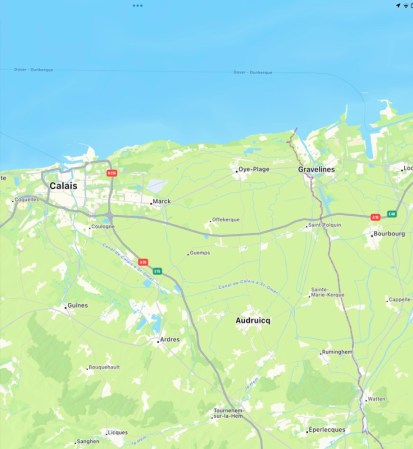
Stephen and Adrienne returned to a small village near Audruicq, south-east of Calais, (see map). His French bread was said to be ‘unusual’; but he was loved and adopted as part of a shaken-up life in post-war France. No-one could conceive, then, that the further horrors of war were only two decades away in the form of a resurgent fascist Germany.
At the start of WW2, Stephen made a last attempt to travel back to Britain, but was stopped by the authorities. Being English – though now a French citizen – Stephen was watched closely by the occupying Nazis during WW2. They did not know that this simple baker, in France because of his new family, was also an active helper of the Resistance.
The family in Bolton knew nothing of all this. They hoped for the best, but feared the worst.
Wars end, eventually… By the time it did, Stephen was living a typically French life and raising a family. Between 1919 and 1927,Stephen and Adrienne had four daughters and one son – also ‘Stephen’ – Etienne. They, in turn had children, taking the timeline to my own generation, where, ironically, I am the only Stephen.
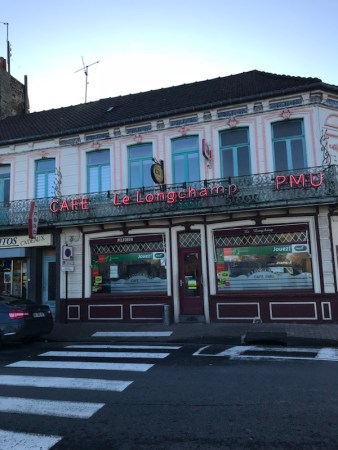
After WW2, the family prospered and eventually took over a classically-French cafe and bar in Audruicq, where they saw out their days.
In 2016, my wife Bernie’s developing expertise in online family-trees set her on a search for my ‘lost French family’. One evening, she turned to me and said with a smile, “I think I’ve found them!’
She showed me the screen of her laptop. There was a simple message from a lady named Mado, who wrote: ‘We have tried everything we know to locate our English relatives but with no success. I am leaving this message attached to our family tree in the hope that someone will find it in the future.”
It was literally the digital equivalent of a ‘message in a bottle’.
Sadly, the note was seven years old. In hope rather than expectation, we sent a message, detailing our connection to Stephen … and waited.
A week later, there came an email from a very excited Mado. The two sides of the family were about to be reunited … after 100 years of separation.
I will tell the story of what followed in another blog post. The above was to set the scene for the ‘girl on a motorcycle’ to appear. One of Stephen and Adrienne’s daughters, Micheline, had two boys. One of the boys had two children, a girl and a boy. The girl’s name is Cecile.
Cecile is the girl on a motorcycle…
The French family were and are based, in Calais, with another smaller group in Lille, near the Belgian border. Over the course of the next three years, until the Covid epidemic, we visited them all, and hosted holidays from them back to our house in Kendal to which others in the English families were invited.
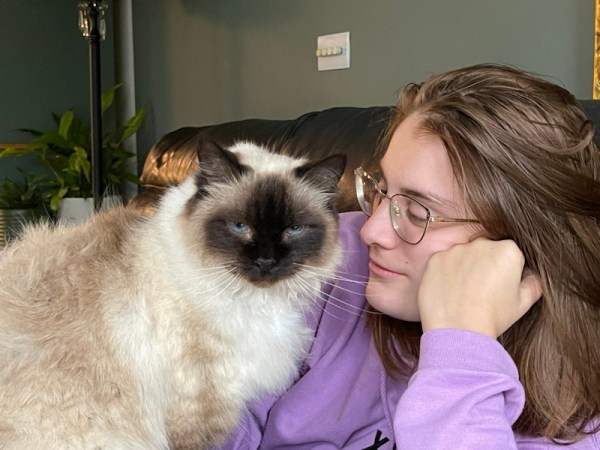
One of the people we met in the second round of visits was Cecile. Her photo is above. She is from the family based in Lille. We first met her when she was visiting her then boyfriend in Edinburgh. Her parents and younger brother were already with us. One evening, they were speaking to her on the phone, in Edinburgh, and I suggested she could easily get the train to Oxenholme – our local station and on the West Coast mainline – and join us for a day or two.
She jumped at the chance, arriving at Oxenholme several hours later and throughly enjoying her stay and the reunion with her own family. She liked where we lived and we said she was welcome to return at any time. I well remembered similar hospitality being extended to me when I was of a similar age. It makes a big difference to a young life.
Fast forward to August of this year…
Cecile contacted us to ask if she could come back and stay for a few days. She said she would be on her way to Edinburgh to visit the Scottish side of the family. We were happy to oblige. We knew she was now a qualified engineer, working in Paris – a job she had always wanted to do.
We assumed she would be arriving by train, again. To our surprise, she said she would be travelling by motorcycle…
On the 13th August, in the late afternoon, a 650 cc Suzuki motorcycle purred down the narrow lane that leads to our house. In typical ‘Cecile fashion’ she swung herself off the bike and took off her helmet, her long hair cascading like a model in an advert. Quite a contrast to my ‘drowned rat’ arrival in Glasgow all those years ago. She had travelled all the way from London using only the A-roads … and looked as fresh as a daisy.
She settled in, and we talked about bikes. She had no idea I was a biker, and she laughed when I told her I had made a sodden journey to Scotland at sixteen at the same time of year. She was going up to stay with Louise – the same Louise who had been the first to greet me when I stumbled, half-dead, up their path in Glasgow. Louise and her family now run a farm in Haddington, near Edinburgh.
We took Cecile sightseeing, and over a coffee in Keswick, she asked if she could plot a route to Edinburgh to take in what she had heard was the beautiful Shap Summit. I had to pinch myself – so many echoes of my 1970 trip!
I smiled and assured her she could and offered to accompany her on my own bike some of the way. She jumped at the chance. I suspect I am her only relative who rides a motorcycle.

On Tuesday the 15th August, we saddled up. She wearing a brightly coloured outer riding suit that I had given her from a box of stuff I no longer use. It would keep her a lot more visible than the brown jacket and jeans she had arrived in.
With me leading at a gentle pace on the Honda, we crossed Kendal to get to the start of the Shap road. When I was sixteen, this was where the rain began to beat down… But not this day. Bright sunshine accompanied us all the way to Penrith and beyond, with her giving me the thumbs-up every time the bikes drew level.
I smiled, ruefully, at how pleasant Shap could be… and how awful.
Cecile was keen to avoid the motorway unless absolutely necessary. We followed the A6 to just south of Carlisle where we had to join the M6 which became the M74. I smiled as the first sign to Glasgow appeared.
The plan had been to try for lunch in Moffat, further north, but Cecile pulled alongside me and indicated she was in distress and needed to stop. We came off the at the next junction… Lockerbie! The place where the lady cafe owner had let me drip all over her floor and fed me hot food to revive my washed out and frozen being.
We cruised slowly into the town and found the main car park. She told me she was getting cramps and needed to walk to relieve them,
“And eat!’ She said. “I’m really hungry.”
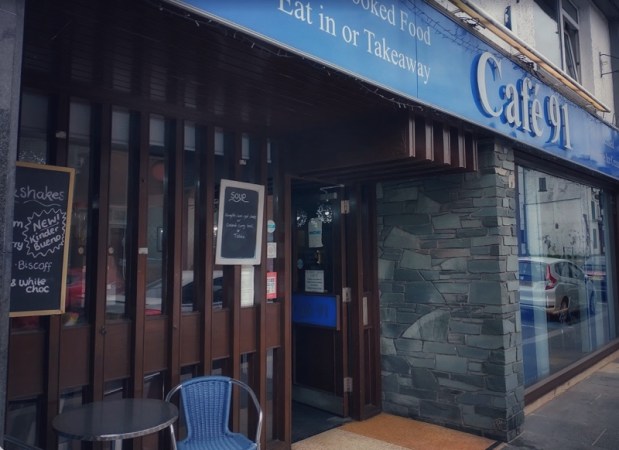
I was not surprised when the Cafe 91 we had spied from the bikes turned out to be the (renamed) place that saved my life that wet day in 1970. I was grinning so much, Cecile asked me – after ordering a huge lunch – what was so funny?
I waved at the interior of the cafe and told her more of the detail of my sodden ride to Glasgow. As I re-lived the tale, I could see she was working on a proposal. “Why don’t you come all the way to Edinburgh? You and Louise are best friends, and she would love to have you..”
We’d covered about two-thirds of the distance to Haddington. But there was a poetry about parting here in Lockerbie. Her road to Edinburgh – the place where nearly all my Scottish relatives now live – was a different road on her different journey. And that was what mattered. Fate and coincidence had provided me with a beautiful experience containing so many magical coincidences, and we had shared that.
It was right that she go the final leg on her own…
The circularity … and lack of suffering of this special day had been wonderful.
An hour later, well fed and with her phone programmed to take her onwards over some of the most beautiful roads in southern Scotland, we parted company at the edge of the car park: she going north, me returning south.
Now it was just her story… and her journey. Perhaps some day she might write it up in her own blog … and mention her second cousin, once removed.
Two hours later, I was home, having taken the fast road back. I hate biking on motorways… but they have their uses.
I thought about the whole improbable story arc on the way back to Kendal, summoning up the face of my grandma in memory to talk to her in my mind.
“I didn’t get to see your beloved Stephen, but I did get to meet his son, Etienne, weeks before he died… but the link – the circuit of time – had been made. After nearly a hundred years the families had been reunited… and now that union continued to flourish.
Cecile arrived safely in Haddington 90 minutes after she left Lockerbie; safe and well. She had a great holiday and is now back in Paris … with a new and highly visible riding suit… which is a bit too big, but not so much that she won’t use it in a downpour…
©Stephen Tanham 2023
Stephen Tanham is a writer, mystical teacher and director of the Silent Eye, a journey through the forest of personality to the dawn of Being.
http://www.thesilenteye.co.uk and http://www.suningemini.blog
Share this:


I used to row whenever I could. I found the action joyful and loved the intake of extra oxygen surging around my bloodstream.
The feeling of propelling yourself across calm water is a meditative experience filled with sensory delights: the ‘chump’ of the oars breaking the water’s surface tension; the accelerating prow’s quiet roar as it fights the clinging liquid, parting it like a comb on oiled hair.
And then, when the effort’s done, and quieter waters reached, the dripping of water from oars as the vessel glides the final few feet back to shore or jetty.
All real but in my mind, like a poem, remembered.
It’s been too long since I held the wood.
Perhaps a haiku is appropriate?
—-
Old wood, wise, defines
Ancient blade’s intent
Part but not to cut
—-
©Stephen Tanham 2023
Stephen Tanham is a Director of the Silent Eye, a journey through the forest of personality to the dawn of Being.
http://www.thesilenteye.co.uk and http://www.suningemini.blog


 Sun in Gemini
You must be logged in to post a comment.