+ #Silent Eye, #Silenti, Consciousness, esoteric psychology, Psychology, Soul, soul in body, Spiritual Enneagram
Nine Keys (9 – final): An emotional reunion
by Steve Tanham


How are we to end this series of posts? Each of these nine has been a glimpse into an aspect of true ‘spiritual’ knowledge … but only that. I’ve comes to trust that the correct alignment of ordinary knowledge will result in it becoming a channel of deeper and truer knowing. That truer knowing is alive and waiting to serve our outer self – the personality, which has a vital part to play in our development; in fact, we could say that it is the raw material of our development, since it is like a set of clothes, rather than the real person in them.
We considered how a certain ‘movie’ of our lives was formed in our early experience of life by reactions to powerful events that imprinted their foundational nature upon us. This crystallised into a set of fixed views, in the language of the spiritual enneagram – the fixations,, which bestowed us attitudes and expectations about life, and these we find recurring, though disguises, in everything we experience, even though that childhood is long gone.

We looked at how that act of ‘experiencing’ has a life of its own in the form of the Soul – portrayed as giant set of ‘sails’ which reacted to the prevailing winds of events and our choice of course – powering the boat along a course set by desire, determination and, as we mature, spiritual aspiration to discover our own true nature.
In our nautical analogy, that true nature is nothing less than the hull – the body – of our boat, with its giant rudder. The sails we can consider as grown from, and projections of this Self (capital ‘S’), whose nature is perfect but not of this world of matter, though it is its heart. Between the Self and the self (the personality, attempting to recreate the Self, via the mind) lies the soul, in contact with both inner and outer aspects of ourselves..
The problem with all of this is that it is theory, and therefore only has ‘life’ in the mind. To bring it alive in our lives, we need to actualise it. To do that we need to go beyond the ordinary perceptions of the discursive self to a place of greater intrinsic power.
People are often shocked to find – when they close their eyes and actually listen to their internal state – that there is a constant dialogue of chatter based on words.
Our outer world is a complex representation or image in the mind, based on the conditioned harvesting of events we have decided are important to us. Our reactions may appear logical, but most of them are emotional. Emotions are mysterious. We know how they feel, but few of us have ever stopped to consider what their nature might be.
Emotions are a release of energy; but where energy originates is the key to its nature. There are many form of energy.
Perhaps it is fitting, then, to end the series with a technique that holds a great degree of power and immediacy: that of an ‘enquiry into emotion’.
Emotions are powerful; they can be friend or foe. By this, I don’t mean that good feelings are friends and nasty ones, foes. I mean that all emotions, made truly conscious are friends. Left as ‘background’ effects in our lives, emotions are utilised at far less than their potential and can act like unseeen ‘anchors’, dragging back our efforts as the interfere, very powerfully, with our resolve.
Next time you find yourself experiencing a strong emotion – say, a sense of rejection – instead of putting your energy into denying it: ‘Don’t be so childish…’ – embrace the feelings being experienced. Try not to judge or mentally ‘comment’ on the feelings; simply let them be what they are. If you can do this without reacting, simply accepting, then you will find a secondary effect arises in your body. In the case of ‘rejection’ you will find a pleasant ‘glow’ of warmth and love arises in your torso.
The effect of this is to show us that the false nature of the emotion is generated by the personality, according to its ‘reactive processing’. This kind of experience often affects our sense of internal value: our self-worth. In the above example, it is the real and eternal self-worth, ‘our real value’ that arises as a feeling of love. Experience this goes beyond logic and so-called rationality. The reality of the feeling is self-evident. To feel this is to know the edge of Being.
That love generated by a successful use of the exercise belongs to our Self – in other words, it is ours in the deepest sense of the word, No-one can ever take it away. It is one of our Self’s primary ‘essential aspects’. When we see and feel this, the theory drops away and we glimpse the new reality of life and its potential.
Once you have tasted and felt that assured sense of contact with a deeper part of you, you can carry on and extend the exercise to other situations where there is strong emotion. At the end of this you will have come to know the existence and nature of some key parts of your own inner architecture.
—-
End of Part 9, the final part of the series.
To join our monthly SE-Explore Zoom meetings, simply send an email to Rivingtide@gmail.com. There are no prerequisites and you will be very welcome.
©Stephen Tanham 2023
Stephen Tanham is a Director of the Silent Eye, a journey through the forest of personality to the dawn of Being.
http://www.thesilenteye.co.uk and http://www.suningemini.blog
Other Parts of this series:
Part Four: The Edge of the Known
Nine Keys (6) An uprising of Self
Nine Keys (8) When experience grows dull
©Copyright Stephen Tanham
Stephen Tanham is a Director of the Silent Eye School of Consciousness, a not-for-profit teaching school of modern mysticism that helps people find a personal path to a deeper place within their internal and external lives.
The Silent Eye provides home-based, practical courses which are low-cost and personally supervised. The course materials and corresponding supervision are provided month by month without further commitment.
Steve’s personal blog, Sun in Gemini, is at stevetanham.wordpress.com.
Share this:


My father’s eldest sibling – my Auntie Mary – though hailing from the family hometown of Bolton, Lancashire, married a highly decorated and highly tall (6’4”) Scottish army officer at the end of WW2.
In 1946, on the way to begin her new life as the wife of a now Glaswegian police officer, two English serviceman in the same train carriage advised her to get off at Carstairs, walk over the bridge, and return home. Glasgow was a terrible place, they said.
She stayed on the train and began her Scottish life, returning to Lancashire to ‘get a refresh’ every now and then. She and her husband raised seven children, getting them all through university and into good careers.

When I was young, we’d visit the Scottish relatives every summer. Somehow, they would squash the four of us into their already-full police house located a short distance from the infamous Castlemilk estate. Uncle Robert was by then a sergeant in the Glasgow police force.
But he, and my beloved Auntie Mary – still with us at 97 – are not the subject of this story.

When I turned 16, my father bought me a Ducati 250cc motorbike and a family friend let me use the internal roadway of the nearby Burton Tailoring factory to learn to ride it – in the evenings.
Having passed my test, I celebrated by setting off on a long-planned odyssey to Glasgow, to stay with my relatives. It was a bold move for a new ‘biker’. This was in the days when the M6 ended at Lancaster, and further progress towards Scotland depended on the trusty A6 trunk road, whose highest point – the Shap Summit – was the scene of frequent ‘strandings’ in the winter, as lorry drivers struggled to haul their loads over the mountains and towards the borders at Carlisle.

Shap is the highest point on the western route to Scotland, and is also one of the most elevated sections of any of the motorway routes in the UK. Its reputation was fearsome, but my trip back then was taking place in high summer. How bad could it be? There was no choice. The A6 was the only sensible way to get north of the border.
The journey from Bolton to Shap had been overcast but dry. The familiar towns of Preston, Carnforth, Lancaster and Kendal passed by as we sped north on the purring Ducati along the venerable A6.
My new (to me) leather jacket had been bought by my mum off the Warburtons bread van driver (they all used to wear them) who delivered bread, daily, to our off-licence.
“It’s due a change,” he said. “Give us a fiver and I’ll tell the boss it’s been nicked again by them kids from Wapping Street!”
The padded and strong jacket was now doing a fine job of protecting me from the inevitable summer chill of riding a motorbike. I’d attached a sheepskin collar with glue and few strategic stitches using an industrial needle and pliers. It was rising up and stroking my face in the wind, a good and warm feeling. A flying ace on his maiden voyage to Scotland… Life was good.
I was exultant, excited and a bit nervous as I took the final sweeping climb out of Kendal and, 30 minutes later, passed the Shap Summit – 1350 ft. It’s a bleak spot, and the winds howl like they’re about to eat your soul – even through the insulation of a second-hand crash helmet.

‘This memorial pays tribute to the drivers and crews of vehicles that made possible the social and commercial links between north and south on this old and difficult route over Shap fell before the opening of the M6 motorway.
Remembered too are all those who built and maintained the road and the generations of local people who gave freely of food and shelter to stranded travellers in bad weather.’
Above: a sober reminder that life was not always comfy cabins and motorway services
And then the rain started… and got heavier and heavier. When I finally passed into the environs of Penrith, I was saturated. My recently acquired leather jacket – not designed for motorcycling – was holding water beautifully, and I was freezing.
The A6 gave way to the A74 and I saw the first signpost to Glasgow … only 90 miles to go…
The sheepskin collar I had proudly added to the jacket had somehow loosened itself. It was sodden and stuck in a vortex pattern that resulted in it slapping me on the cheeks several times a second.
The rain drove at me, horizontally intent on sending me back to Lancashire. When I couldn’t feel my fingers anymore, I pulled into the next town, Lockerbie, and parked the bike in an alleyway visible to the cafe next door.

The kindly lady owner took pity on my state and let me drip all over her floor, bringing me several mugs of sweetened steaming black tea. I hated black tea… but not that day. A bowl of piping hot soup followed, accompanied by thick crusts of buttered bread. Half an hour later, I dug into my meagre reserves and paid her with heart-felt thanks.

Outside, the rain waited… My saddle was as sodden as my jacket. 70 miles to go. I ripped the useless sheepskin collar from my failed ‘flying suit’ and dumped it into the nearby bin. I was now on the A74, nearly as infamous as Shap. I crouched low over the bars and clung on, humming – anything to take away the misery…
When I got to Hamilton, I knew I was near to Glasgow. The rain had continued and I was now shivering all the time. I would look at cars passing me and imagine how lovely it would be in their heated cabins.
With twenty miles to go, the engine began to splutter. The famous Italian electrics, the weak point of an otherwise lovely machine, were doing their best to thwart the final part of the journey. I pulled over. Somehow, I managed to sort it; sitting on the kerb at the side of the road and using my penknife to strip the offending wire and make a new connection.
My brain was numb and slow with cold, I got to the edge of Glasgow; then Castemilk and finally I knew where I was… My destination lay at the end of this dual carriageway, seen, finally, through tired and bloodshot eyes.
Two of my younger cousins came screaming out of the house to greet the ‘drowned rat’ as my Aunty Mary later described me to my mother on the phone, confirming that I was still alive.
I was soon learning to breathe again in a steaming bath…
One of the small girls was Louise, the other Eileen. The elder siblings were all away at Uni or travelling, and Eileen had to leave the following morning. For the next few days, Louise had cousin Steve and his motorbike to herself as she clung to me, young arms strong around my waist while we used the bike to explore local beauty spots, none of them too far from her home, but all of them fun.
All the ‘Scottish cousins’ were our close friends but Louise made heroic efforts to stay closely in touch. Later, as an adult (and qualified Archeologist) she took every opportunity to visit us in Lancashire.
For some reason, my arrival by motorcycle in the storm that day was viewed as heroic. Years later, Scottish family tales continued to be told in summers and at New Year of the cousin who practically fell off his motorbike and staggered to their front door, sodden, bandy-legged and exhausted.
But smiling…
But I am not the primary subject of this double post, nor is Louise, nor even her mother, Aunty Mary…
In fact, the subject of this post will not be born for another 28 years. But she will come to complete this story in a most poetic and wonderful way…
To be concluded in Part Two, next Tuesday.
Share this:

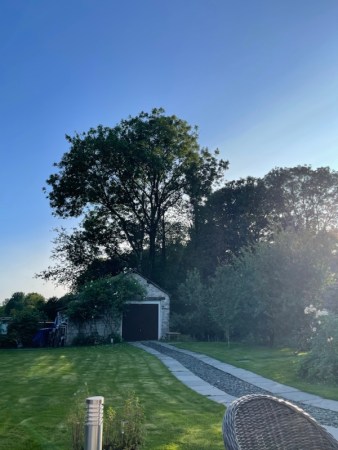
Our beloved ash tree, which defines the far end of the garden, is doomed.
We have several ash trees around the perimeter of the garden, and they – like all the others in this part of the world – seem destined to be either felled or cut right back to a small spread around the main trunk; the latter being left standing as a low-risk object.
Our tree specialist has advised that the process won’t kill the tree, and that it is not known if this might end the die-back disease, with possible recovery. It seems unlikely but we can have hope. Even in the best scenario it will take decades to recover, so we’ll not be here to see it return to its present glory. Let’s hope it brings others the same greeting each day that it’s given us…
There are three trees that need similar work, so it looks like I’ll be spending the next few months chain-sawing wood and chopping it for the log-burner in the house. Good to have the fuel, but that’s my winter sorted…
The ash in question is our largest, and borders on a neighbour’s garden, so they will be relieved at least.
A sad time.
©Stephen Tanham 2023
Stephen Tanham is a Director of the Silent Eye, a journey through the forest of personality to the dawn of Being.
http://www.thesilenteye.co.uk and http://www.suningemini.blog
Share this:

+ #Silent Eye, #Silenti, Consciousness, esoteric psychology, Psychology, Soul, soul in body, Spiritual Enneagram
Nine Keys (8): When experience grows dull
by Steve Tanham
Last Sunday evening, we held our monthly Silent Eye Explorations on Zoom; hosting an international audience for an informal and informative discussion on the subject of the ‘Ways of Knowing’.
These are open to all – see the base of this post for details.
The content of that 90 minutes was a thorough investigation of what it mean to know, and how we take for granted something that goes as deeply into our core as we care to travel… Towards the end of the talk we touched on the fascinating idea that ‘not-knowing’ has its own power and dynamism – a dynamism of surprising potency.
Our ordinary view of knowing might be summarised as this: we take in information via our senses, then organise it into useful structures known as knowledge. Using logic we can enrich this so that, over time, we come to transform it into wisdom; a process that often reverses our gut-reactions to the sensory stimulus.
Someone skilled in martial arts might have learned that the blow aimed at their body by an opponent has its own momentum which can be stopped or stepped aside from. If the latter, the foe is now disadvantaged because the target has moved but their momentum, now invested with all their energy, has not.
Wisdom is often the creation of a non-panicked ‘thinking space’ in which the goal is not to react; instead considering the options from an unhurried and more mature vantage point. Reactive people are seldom the most powerful.
But all this is centred on what we might call ‘ordinary knowing’ – the intake of experience and its transformation into reliable knowledge: something the brain excels at. We have proposed in previous posts that the ‘organ of experience’ is the Soul; and that the processing of experience is tightly bound up with our sense of self.
Ordinary knowledge may come to us in an exciting flash but is soon dulled. People in the SE-Explore group remarked how often in their lives this had happened. That breakthrough in understanding had a palpable excitement to it, and yet, a short time later, the shine had gone off what remained.
The nature of what remains is the story of how experience is translated from vivid reality into something quite different, and grasping this can be the key to opening a different relationship with our real world.
When the mind encounters something for the first time, it does not know its details. But it knows it to BE. In truth, this knowledge of the object’s Being is a deep and mysterious form of knowing in itself. The mind is forced to encounter this new ‘thing’ at a higher level of itself than that of the repetitive ‘now’ – ordinary knowing, as we have termed it.
But the mind’s function is to reduce all experience to concepts: the building blocks of its logic and the basis of the economy with which it can deal with the world’s sensory input. The problem is that such concepts are essentially pictures – representations of what was a vivid new experience, carefully labelled and packaged into the ordinary known.
Over a short period of time, the freshness of the experience is transformed into the ‘sameness’ of memory, and the excitement and energy of the first encounter with the true reality of the ‘object’ is lost. We may wax lyrical with prose or even poetry – which often get closest to restoring a sense of being freshly with the original experience. But the initial vitality of experience is usually gone.
To deepen our consideration, we need to think about the state of not-knowing. Is it valid to ‘not-know something?
It is, in fact we do it all the time…
When we approach something new – perhaps learning so make something in wood, learning a new language or cooking a new dish – we have a beautiful moment where we truly do not know what lies ahead. In view of what we said, above, about the dullness of previous experience, re-experienced as an representation in memory, it is to our great benefit to carry out this learning of something new by assuming a state of mind where we embrace the state of not-knowing. Then, when we embark on the new, the intensity of the experience will leave lasting and very alive traces in our soul.
Repeated use of this will change the way we approach everything new. Gradually, this will alter our consciousness, showing us that vivid experiences are possible at any stage of our lives.
In the final part of the series, next week, we will look at the states of mind and being needed to give your life enough of a ‘shake’ to make an initial path into this most exciting of journeys.
To be continued in Part 9, the final part of the series.
To join our monthly SE-Explore Zoom meetings, simply send an email to Rivingtide@gmail.com. There are no prerequisites and you will be very welcome.
Other Parts of this series:
Part Four: The Edge of the Known
Nine Keys (6) An uprising of Self
©Copyright Stephen Tanham
Stephen Tanham is a Director of the Silent Eye School of Consciousness, a not-for-profit teaching school of modern mysticism that helps people find a personal path to a deeper place within their internal and external lives.
The Silent Eye provides home-based, practical courses which are low-cost and personally supervised. The course materials and corresponding supervision are provided month by month without further commitment.
Steve’s personal blog, Sun in Gemini, is at stevetanham.wordpress.com.
Share this:

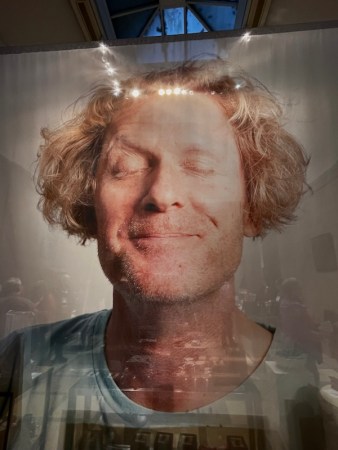
I’ve been fascinated by the innovative and penetrating social commentary in (Sir) Grayson Perry’s work for many years, and not surprised when he was granted a knighthood, recently.
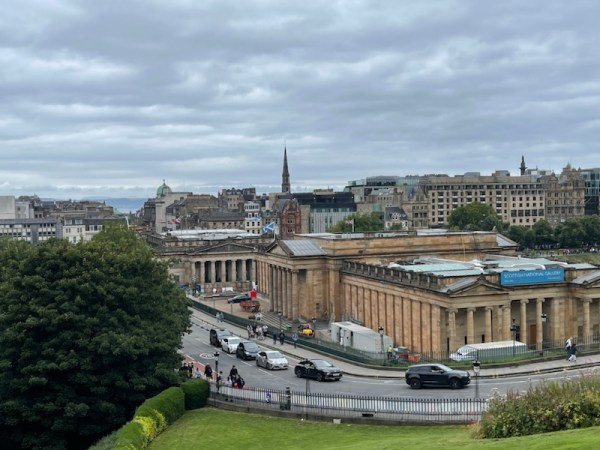
While in Edinburgh for a few days of frantic ‘Fringe’, we decided to also visit the National Galleries’ exhibition of Perry’s work – comprising hundreds of his most famous pieces (many of which have been sold, privately) gathered back together, with the owners’ permission, into a dramatic show on several floors of the main gallery.
Photography was permitted, which is refreshing and welcome. It allows me to share a small cross-section of the artist’s work in this blog.

It’s the biggest ever exhibition of Sir Grayson Perry’s work, covering his 40-year career. Perry has gone from taking pottery evening classes to winning the Turner Prize, presenting television programmes on Channel 4 and writing acclaimed books. He’s a classic polymath, but a most unusual one. Love or hate is often the reaction… Personally, I find his work challenging, refreshing and acute. It’s just the kind of subtly ‘deadly’ commentary we need in these divided times.
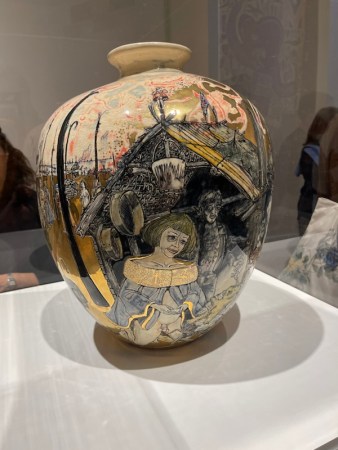
Perry’s vases have classical forms and are decorated in bright colours, depicting subjects at odds with their attractive appearance. There is a strong autobiographical element in his work, in which images of Perry as “Claire”, his female alter-ego, and “Alan Measles”, his childhood teddy bear, often appear.
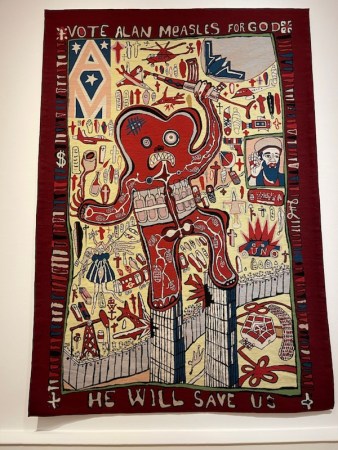
Perry is decidedly odd – and likes it that way – shifting between his cross-dressing feminine side, as ‘Claire’, and his childhood identification with a character created out of the solitary conditions in which he spent many of those years – the teddy bear, Mr Measles was the result.
Perhaps unusually for artists, pottery allowed him the opportunity to indulge his fascination with sex, Punk, and counterculture in the most unlikely and polite of artforms. But he’s not afraid of controversial social issues and uses mixed forms to deliver his observations.
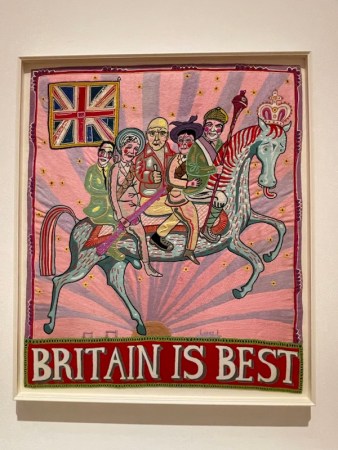
Perry describes Britain is Best as originating from a television programme he made in 2014, in Belfast, called Who Are You? As part of this a group of the production team, including Perry, went to see a march celebrating the 100th anniversary of the Ulster Volunteer Force. Perry interviewed five Unionists and this resulting embroidery depicts them all riding one horse. The image was based on a an existing mural of King Billy painted onto a gable end of a house in Belfast. Perry observed that they ‘seemed to be holding out for an imagined golden age.’
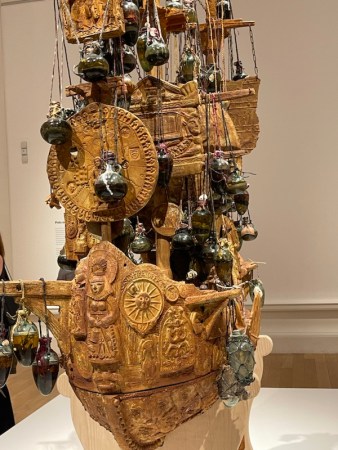
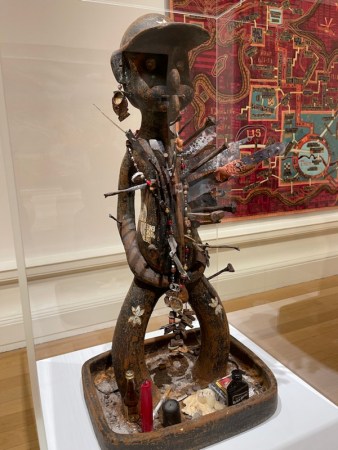
In Perry’s own words:
‘King of Nowhere refers to the gangs that roamed the Digmoor Estate, in Skelmersdale, near Liverpool. A lot of the bits and pieces were picked up off the ground on the Estate. It’s inspired by the African tribal sculpture I had seen at the British Museum. Gangs are tribal too. It’s a kind of power figure for gang members. And with the candles it’s also a kind of shrine to knife violence. Everyone was wearing branded clothing, particularly Adidas and North Face, so their logos are in there.’
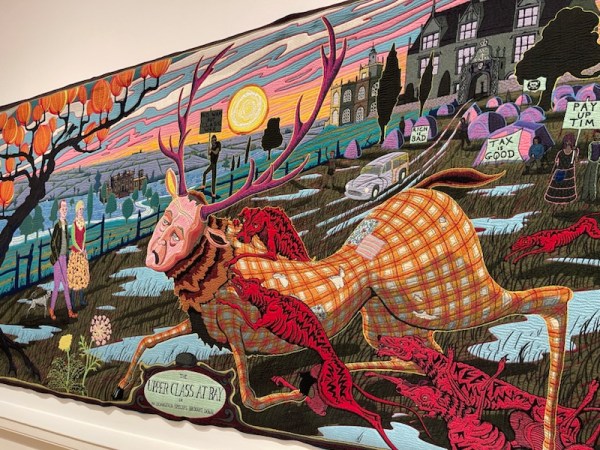
Popular and provocative, Perry makes art that deals with difficult and complex ideas in an accessible and often funny way. He loves taking on big issues that are universally human: masculinity, sexuality, class, religion, politics and more. On view are subversive pots, brilliantly intricate prints, elaborate sculptures, and huge, captivating tapestries, the latter created by hand in Perry’s studio and then transferred to a computer-driven weaving process. They are breathtaking in their scale and intricacy.
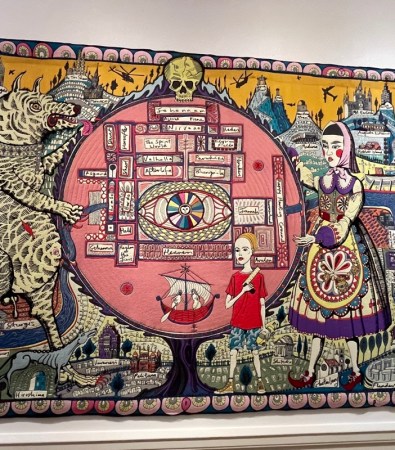
Throughout, the works are imbued with Perry’s measured words, sharp wit and social commentary. Working with traditional artforms, Perry addresses the controversial issues of our times in a way quite unlike anyone else.
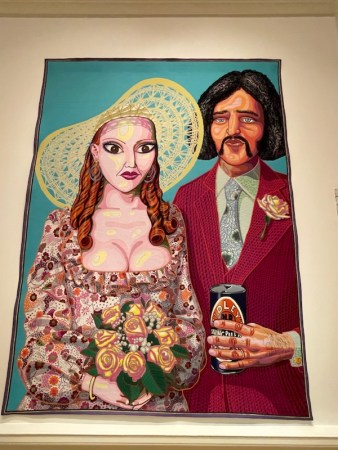
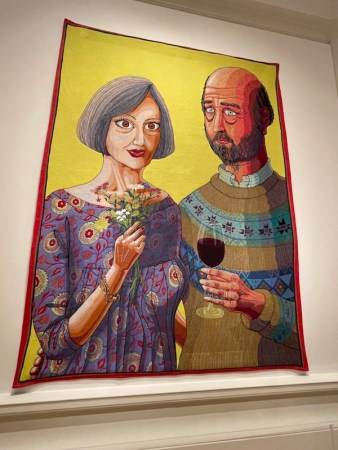
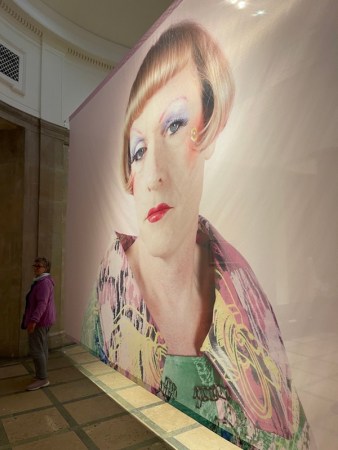
He’s clever; and being unusual and edgy has never bothered him. Two of the large tapestry sequences, each taking a full room of the gallery, depict a life story of an individual or couple as they develop from innocence to a life-finale.
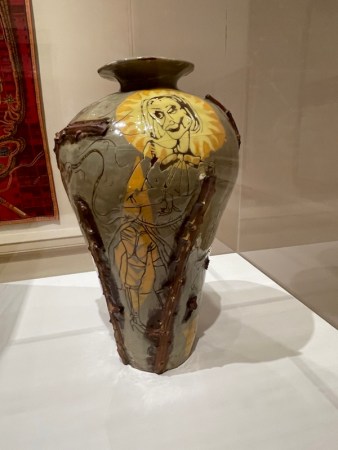
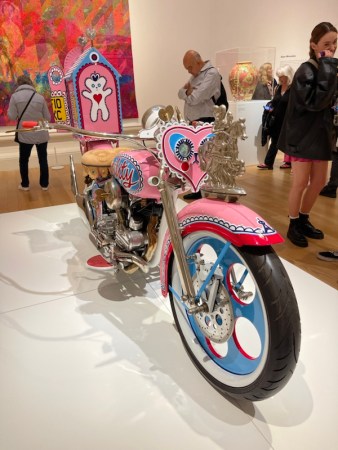
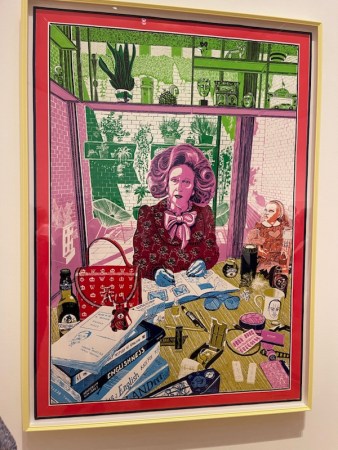
The last piece I had chance to photograph – we were due at another performance in the Fringe programme – was titled ‘Vote for Me!’ The accompanying text, reproduced below, highlights Perry’s basic honesty and also his bravery at tackling controversial subjects…
Vote for Me! 2023 – Colour woodcut
‘I completed this image in early September 2022, long before the problems that engulfed Nicola Sturgeon and the Scottish National Party and now it feels very prescient. A self-portrait in homage to another well-turned-out female politician. I sit in my very nice modern home surrounded by the symbols of identity, success, culture and mortality. I have been asked many times if I would want to go into politics. I admire people who do, it is a hard and usually thankless task, but it is not for me.’
If you get the chance, go visit! We’re unlikely to see another collection of Sir Grayson Perry’s work on this scale, again.
National (Royal Scottish Academy)
On now until Sun 12 Nov 2023
Open daily, 10am–5pm
Bio of Sir Grayson Perry from Wikipedia:
Grayson Perry was awarded the Turner Prize in 2003. He was interviewed about the win and resulting press in Sarah Thornton‘s Seven Days in the Art World.[13] In 2008 he was ranked number 32 in The Daily Telegraph‘s list of the “100 most powerful people in British culture“.[14] In 2012, Perry was among the British cultural icons selected by artist Peter Blake to appear in a new version of his most famous artwork—the Beatles‘ Sgt. Pepper’s Lonely Hearts Club Band album cover—to celebrate the British cultural figures of his life.[15]
Share this:

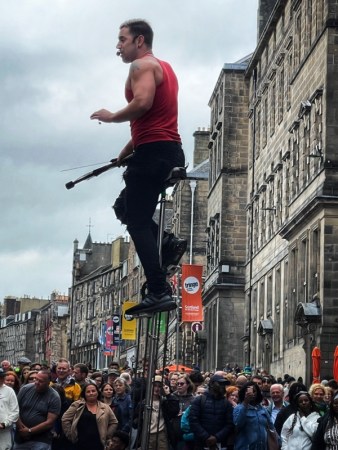
Our first ‘Fringe’. Three days of hectic dashing from one side of the city to the other to find small or even tiny venues where the hopeful entertainers work their socks off.
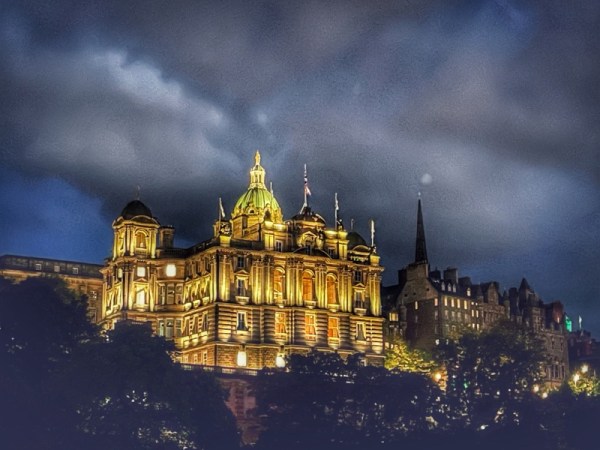
We loved it… but couldn’t have taken another day.
Fabulous drama, incredible live music and acrobatic skills to make you gasp.
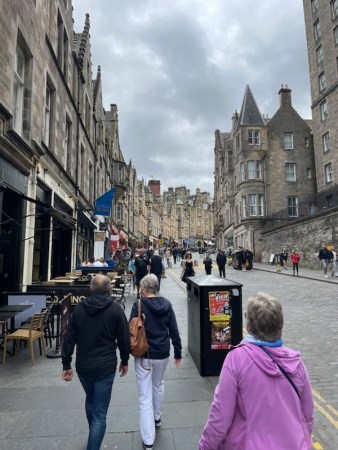
Our favourite was a street juggler cum knife thrower cum reincarnated Bob Newhart raconteur named ‘The Mighty Quinn’. One of the most funny, daring and clever acts you could wish for.
We averaged over 11 km each day. Take your walking boots!
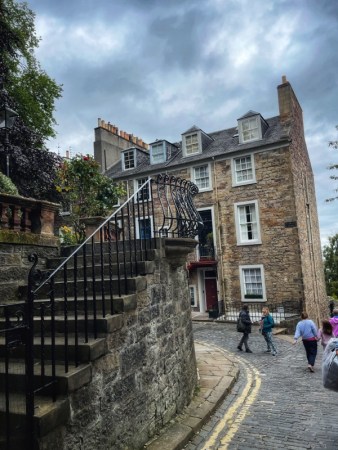
And we slept most of the way back to Cumbria on the train…
©Stephen Tanham 2023
Stephen Tanham is a Director of the Silent Eye, a journey through the forest of personality to the dawn of Being.
http://www.thesilenteye.co.uk and http://www.suningemini.blog
Share this:

+ #Silent Eye, #Silenti, Consciousness, esoteric psychology, Psychology, Soul, soul in body, Spiritual Enneagram
Nine Keys (7): Dying for Love
by Steve Tanham
Inside this new love, die.
Your way begins on the other side.
Become the sky.
Take an axe to the prison wall.
Escape.
Walk out like someone suddenly born into color.
Do it now.
You are covered with thick cloud.
Slide out the side. Die,
and be quiet. Quietness is the surest sign
that you have died.
Your old life was a frantic running
from silence.
The speechless full moon
comes out now.
Rumi
An invitation to … die? It sounds like the title of a James Bond film…
The quotation is taken from the 13th century Sufi poet, Rumi, who was one of the most influential mystics of all time. The Sufis were an inner tradition within Islam, and survive to this day, though fundamentalist pressures threaten that.
Why would we want to die? The poem suggests there is a continuation of existence – ‘Quietness is the surest sign that you have died’. So we’re not talking about biological death, here.
To what does it refer?
In previous posts of the series, we have considered a pattern of interconnected ‘layers’ of what we consider to be our-selves.
We have the all-consciousness of the Universe. Then we have our own Essence, a perfect part of our being that needs no further evolution because it comes from the source of everything, but individualised, so that it may reflect the glory of the cosmos back to itself.
The Essence is known by other names, such as Self with a capital ‘S’, or the Atman, or the Spirit. There are many more…
For the whole of our lives, this Essence works to pervade its nature ‘outwards’ into our lives. The vehicle it uses for this is the Soul, as we have explored in the previous posts.
Normally thought of as the spiritual part of us, we have put forward the observation that the soul is actually our vehicle of experience, and layered above a ‘higher’ or more ‘inner’ part of that experience of self, known as Essence, or the Self (capital ‘S’) to distinguish it from the outermost part of us which forms around the other two: the personality or ego.
All these vehicle of self are playing their part. None of them is bad, not even the personality, which is so often seen as the villain of the piece. The personality has to manage the ‘dense’ world of matter on behalf of the expression of the other vehicles of self, and this is not a trivial task.
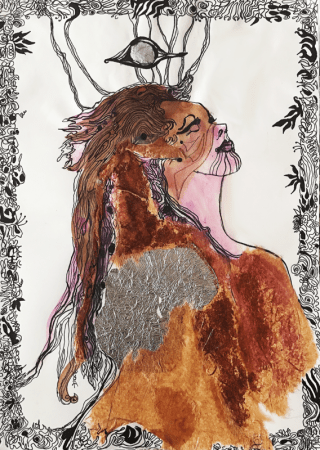
©️The Silent Eye, 2023, created by Giselle Bolotin)
As we discussed in previous posts, the soul is pliable – and also absorbent. It absorbs impressions, which gives us memory and the benefit of experience. But experience can also be negative and hurtful. Repeated negative emotional experiences condition the soul, which limits the expansion of its consciousness.
What dies, then – in the sense of Rumi’s poem?
The outward ‘radiation’ of the love of the Essence has the power to literally ‘burn away’ the negative parts of our personality, leaving it as a clear channel for the spiritual.
This journey is not for everyone… But for those who have encountered its ‘qualities’, it becomes an imperative.
To be continued in Part 8.
Other Parts of this series:
Part Four: The Edge of the Known
©Copyright Stephen Tanham
Stephen Tanham is a Director of the Silent Eye School of Consciousness, a not-for-profit teaching school of modern mysticism that helps people find a personal path to a deeper place within their internal and external lives.
The Silent Eye provides home-based, practical courses which are low-cost and personally supervised. The course materials and corresponding supervision are provided month by month without further commitment.
Steve’s personal blog, Sun in Gemini, is at stevetanham.wordpress.com.
Share this:

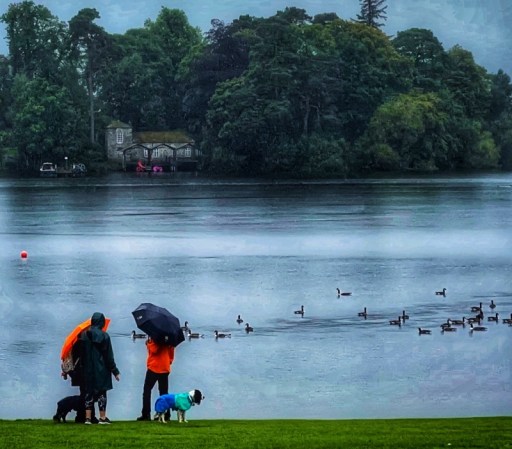
It was all entirely accidental, though no-one would believe me, later.
A flock of birds flying low over Derwent Water drew my camera eye away from the colourful couple in front of me, their dogs (one could only assume they were their dogs) barking at them as though they were in charge of the outing and hadn’t approved the new storyboard.
I love these subtle conspiracies of events, and the noisy, spoiled dog with the blue duo-tones was growing on me… Which was good because he only had eyes for the geese, now on final approach. Had he seen me snooping with phone-camera in hand, anything could have happened.
And then the birds landed on the water, seeming to fill the decidedly non-linear space to the right of the photogenic twin figures…whose fine umbrellas now seemed to be focussed – like a parabolic dish – on the source of the greater noise: the scattered geese reforming their assembly..
Mmmm a little circular and self-referential, I remember thinking, which prompted me to check that I wasn’t feeling nauseous.
“Sweetheart, what’s a migraine like?” I asked my wife.
For a second I was worried my mind was dropping into overload … since I had just spotted something large and very pink, moored across the water on the billionaire’s island.
But the thing that got my fevered and unravelling attention the most was the dawning comprehension that the two humans had complementary coloured umbrellas… And, on closer inspection, his was dark blue – which exactly matched her jacket; and hers was bright orange – which exactly matched his jacket.
Back at the movie, the leading dog (did I just type that?), clearly peeved by not having anything that matched anybody, returned to barking at the geese, who ignored it again.
The goulash stew at the Dog and Gun pub was restorative.
The torrential storm that followed us down the M6 and back to Kendal was hell on earth, and practically impossible to see into while driving. We must have been close to thirty near-crashes as idiots drove at sixty plus into a wall of water spray through which no-one could see.
The red wine on arriving home was purely medicinal. Honest.
I’ll be fine in the morning.
©Stephen Tanham 2023
Stephen Tanham is a Director of the Silent Eye, a journey through the forest of personality to the dawn of Being.
http://www.thesilenteye.co.uk and http://www.suningemini.blog
Share this:

+ #Silenti, Lake District, landscapes, Photographic techniques, Photography, Places and Prose, Short stories
Yard 17
by Steve Tanham

Kendal has a network of old alleyways. I’ve written about them before. They form useful shortcuts across the town. A kind of ancient ‘worm-hole’ is how it feel when you’re striding along one, knowing that you’re shaving precious seconds off the normal time; or sheltered, collar up on the long raincoat, from the cutting wind and rain of a Cumbrian January.

Yard 17 is one of my favourites. Its gritty, faded – and dark in the winter. In the summer, we could be somewhere in a Sicilian market town, perched high above the ocean.

I play a mental game of writing the opening to a detective story there. Perhaps just footsteps heard, and maybe a single clue left on the cobblestones next to one of the doorways. No crime visible … yet.

But then we get to the end of alleyway and the sun bursts through the morning clouds and fills Yard 17 with blazing light – the opening shot.

And any idea of writing such a dark tale vaporises…
©Stephen Tanham 2023
Stephen Tanham is a Director of the Silent Eye, a journey through the forest of personality to the dawn of Being.
http://www.thesilenteye.co.uk and http://www.suningemini.blog
Share this:

+ #Silent Eye, #Silenti, Consciousness, esoteric psychology, Psychology, Soul, soul in body, Spiritual Enneagram
Nine Keys (6): An uprising of Self
by Steve Tanham
Our soul – likened here last week to a giant sail – is not the only occupant of our ‘interior’. At the fundamental level of our consciousness is a foundation of Being which is perfect and full of loving and potential…
‘It’ only needs a Soul for its completeness.
Normally thought of as part of the soul, this layer of our true Self has been more accurately described as our Essence. It is the ‘ground’ from which the soul – in our metaphor the ‘sail’ and collector of our life’s experiences – extends into the world of matter.
There is much confusion about the soul because, though it is always present to ‘us’, it’s seldom seen because it is always there. To untangle this and achieve a degree of real seeing, we need to know what to look for.
Pure awareness is our essential nature and the foundation of everything else – including the essence and soul. It is not a result of brain or even mind activity. It is part of the ‘is-ness’ of our deepest nature. Awareness is our basic being – though there’s nothing basic about this primordial capability of being human.
The destiny of the human essence is to ‘work in the world’. To achieve this it must learn and interact with the ways of the world. This requires a mind and body, but first, it must extend itself towards the world of matter in the form of a soul.
As we discussed last week, the soul – this sail or movie screen – is malleable. It absorbs impressions, giving us memory and the benefit of experience – understanding and wisdom. But experience can also be negative and hurtful. Repeated woundings to the sensitive soul become conditioning, which limits the expansion of the soul’s consciousness.
We can liken our Essence to the main body of the boat: the hull and the strong mast. Its nature is perfect. Its role is to pass to the developing soul the pattern of its impeccable nature (the heading for the boat), so that nature can be manifest in the world of the individual. The essence cannot do this by itself. It needs the soul and its body to be the vehicle for the passing of personal insight and light into that human being’s existence – and hence to be shared by others.
In this way, matter is spiritualised, and ‘the creation is fully entered into’.
The balance of positive and negative impressions, stored in the malleable structure, become hardened into patterns recognised by modern psychology – though the latter’s concern is usually the stability of the character or ego.
At a relatively young age, the person feels themselves to be a character possessed of certain crystallised traits. This is the personality, which gradually ‘sets’ to become the identity of the person and this is the core energy pattern of its outer being.
The identity strives to protect the soul from being further harmed by conditioning. But the price of that is a much more rigid set of responses to life as the identity becomes fixed and armoured.
From then on, life is a balancing act between the ‘faces’ of being open to the new (and therefore potentially hurtful) and being protected from changes by the identity’s hardening. We all recognise this pattern, which develops with age. The problem is that spiritual development – conscious movement towards our essence – is dependent upon us being open…
This is one of the many examples of paradox in spiritual work.
It is for this reason that Schools of the Soul – like the Silent Eye – use carefully developed methods that facilitate the relaxation of this life-tension. They do this by making visible the power locked up in the identity of the person – their ego or personality.
All good teaching is a journey. In our case, that journey is a three year intellectual and emotional voyage in which we meet and interact with certain strong fictional characters, each of which typify one of the energy blocks we are likely to have in varying degrees.
©️The Silent Eye, 2023, created by Giselle Bolotin)
These energy blocks stop us receiving the impressions of the Essence, which is the dominant light in our lives – and the route to reunion of body, soul and spirt (essence).
The soul has properties. Aliveness is one of the key essential aspects of Soul. Aliveness is what is seen as immediately missing when we consider a newly deceased body. The ‘coldness’ and lack of an ‘animation’ are felt by all yet are impossible to define beyond a holistic word like ‘aliveness’, itself. This is typical of the properties of the soul, and demonstrates the level at which our search needs to be undertaken.
The best secrets are, in the words of the mysteries, ‘hidden in plain sight’.
Another property of the soul is growth. That sense of vital expansion is one of the fundamental experiences of life – as with ‘being alive’. In both cases, their ‘ever-presence’ and familiarity result in them being effectively hidden. We need to be shown that they are not the kind of properties we thought; that their origin is not of the body and brain. They are the fundamental building blocks of what came before.
Of course, such properties work though the body – all these layers of the human are interwoven – but they do not originate there. This is ancient spiritual knowledge. For example, the Sufis assign a separate ‘energy body’ to each of the above properties of the soul. Growth is living energy in itself, and the Sufis assign it to the animal body. Aliveness is a a living energy too, and assigned to the plant, or vegetable body.
In the next post, we will consider more aspects of the soul and the part they are capable of playing in our return journey…
Other Parts of this series:
Part Four: The Edge of the Known
©Copyright Stephen Tanham
Stephen Tanham is a Director of the Silent Eye School of Consciousness, a not-for-profit teaching school of modern mysticism that helps people find a personal path to a deeper place within their internal and external lives.
The Silent Eye provides home-based, practical courses which are low-cost and personally supervised. The course materials and corresponding supervision are provided month by month without further commitment.
Steve’s personal blog, Sun in Gemini, is at stevetanham.wordpress.com.
Share this:

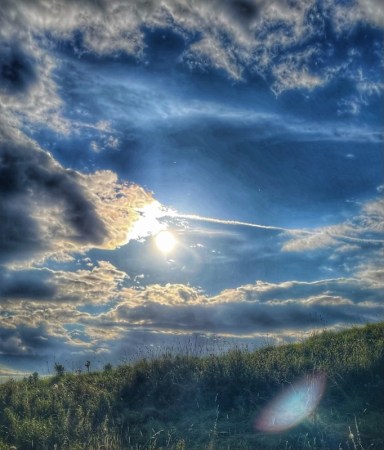
A friend and I were talking about parabolas; those strange curves which take a wide section of incoming light (or other electromagnetic transmissions) and reflect it back to a single point, concentrated.
The radio telescope is a good example. The tiny radio waves from distant objects in space are bounced back off the parabolic dish to a ‘collector’.
The two of us (on different continents and connected by Messenger) were discussing how the human soul sits at a seeming centre of its own universe. It came to me that the analogy between our consciousness and the collector in parabolic devices was a good one to use as a metaphor of consciousness viewed in this way.
My photo has the happy ‘accident’ of a lens distortion which looks just like a parabolic surface, seen from the side. In the picture, the collector would be the Sun, frequently spoke of as the symbolic soul.
The human soul has been well-mapped by spiritual teachers over the centuries; and now by developmental psychology. It follows the outer and inner growth of the child after separation from the all-important mother who has carried it to term and bequeathed it life: its own life, with its own consciousness.
From then on, wherever it turns its ‘dish’, which we can examine as ‘attention’, a vast range of signals – which are already present – will be concentrated via the senses, into the arisings within its soul – the human organ of experience.
It’s a rich metaphor, and one worthy of a thought or two…
There is more detail, here, if you’d like to follow the trail of recents posts on the subject.
©Stephen Tanham 2023
Stephen Tanham is a Director of the Silent Eye School of Consciousness, a not-for-profit teaching school of modern mysticism that helps people find a personal path to a deeper place within their internal and external lives.
The Silent Eye provides home-based, practical courses which are low-cost and personally supervised. The course materials and corresponding supervision are provided month by month without further commitment.
Steve’s personal blog, Sun in Gemini, is at stevetanham.wordpress.com.
Share this:

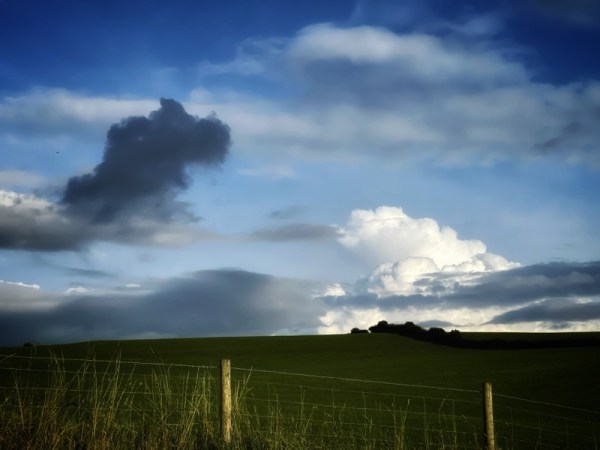
It’s an effect I often try to achieve and seldom do.
But on this occasion…
Taken in Sedgwick on our evening dog walk last week. The dark July rain had relented, granting us a few hours of sunshine.
The ‘washed’ feel of the landscape seemed to add to the feeling of something painted. And the clouds, well…
©Copyright Stephen Tanham 2023
Stephen Tanham is a Director of the Silent Eye School of Consciousness, a not-for-profit teaching school of modern mysticism that helps people find a personal path to a deeper place within their internal and external lives.
The Silent Eye provides home-based, practical courses which are low-cost and personally supervised. The course materials and corresponding supervision are provided month by month without further commitment.
Steve’s personal blog, Sun in Gemini, is at stevetanham.wordpress.com.


 Sun in Gemini
You must be logged in to post a comment.