
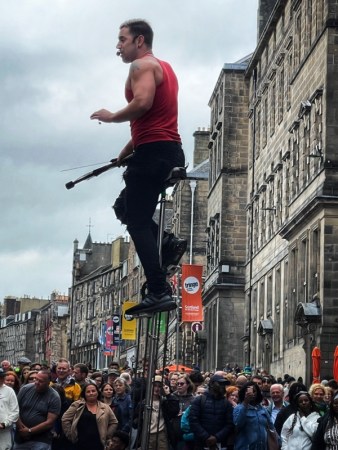
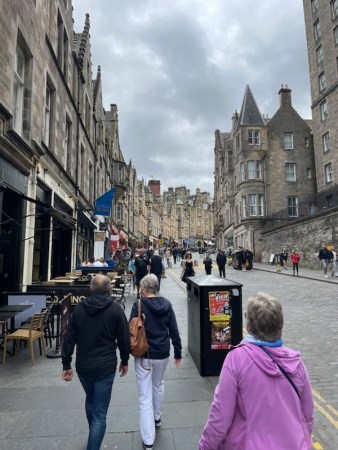
Our first ‘Fringe’. Three days of hectic dashing from one side of the city to the other to find small or even tiny venues where the hopeful entertainers work their socks off.
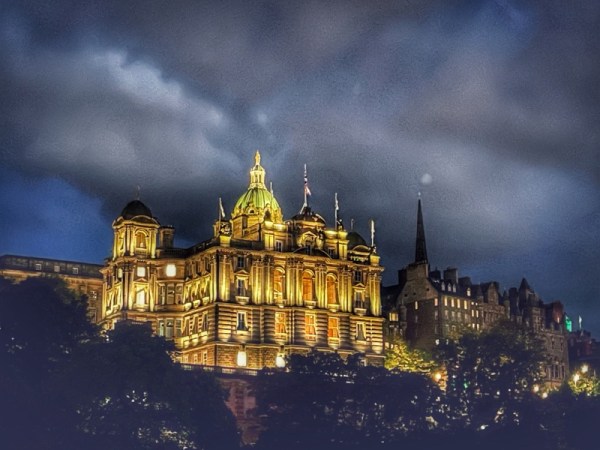
We loved it… but couldn’t have taken another day.
Fabulous drama, incredible live music and acrobatic skills to make you gasp.
Our favourite was a street juggler cum knife thrower cum reincarnated Bob Newhart raconteur named ‘The Mighty Quinn’. One of the most funny, daring and clever acts you could wish for.
We averaged over 11 km each day. Take your walking boots!
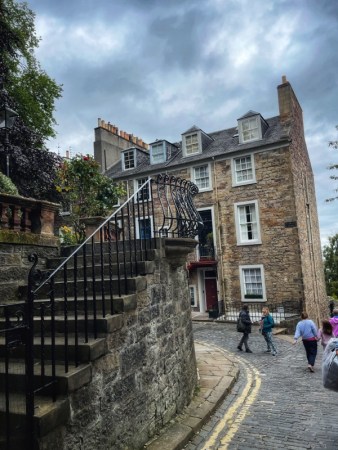
And we slept most of the way back to Cumbria on the train…
©Stephen Tanham 2023
Stephen Tanham is a Director of the Silent Eye, a journey through the forest of personality to the dawn of Being.
http://www.thesilenteye.co.uk and http://www.suningemini.blog
Share this:

+ #Silent Eye, #Silenti, Consciousness, esoteric psychology, Psychology, Soul, soul in body, Spiritual Enneagram
Nine Keys (7): Dying for Love
by Steve Tanham

Inside this new love, die.
Your way begins on the other side.
Become the sky.
Take an axe to the prison wall.
Escape.
Walk out like someone suddenly born into color.
Do it now.
You are covered with thick cloud.
Slide out the side. Die,
and be quiet. Quietness is the surest sign
that you have died.
Your old life was a frantic running
from silence.
The speechless full moon
comes out now.
Rumi
An invitation to … die? It sounds like the title of a James Bond film…
The quotation is taken from the 13th century Sufi poet, Rumi, who was one of the most influential mystics of all time. The Sufis were an inner tradition within Islam, and survive to this day, though fundamentalist pressures threaten that.
Why would we want to die? The poem suggests there is a continuation of existence – ‘Quietness is the surest sign that you have died’. So we’re not talking about biological death, here.
To what does it refer?
In previous posts of the series, we have considered a pattern of interconnected ‘layers’ of what we consider to be our-selves.
We have the all-consciousness of the Universe. Then we have our own Essence, a perfect part of our being that needs no further evolution because it comes from the source of everything, but individualised, so that it may reflect the glory of the cosmos back to itself.
The Essence is known by other names, such as Self with a capital ‘S’, or the Atman, or the Spirit. There are many more…
For the whole of our lives, this Essence works to pervade its nature ‘outwards’ into our lives. The vehicle it uses for this is the Soul, as we have explored in the previous posts.
Normally thought of as the spiritual part of us, we have put forward the observation that the soul is actually our vehicle of experience, and layered above a ‘higher’ or more ‘inner’ part of that experience of self, known as Essence, or the Self (capital ‘S’) to distinguish it from the outermost part of us which forms around the other two: the personality or ego.
All these vehicle of self are playing their part. None of them is bad, not even the personality, which is so often seen as the villain of the piece. The personality has to manage the ‘dense’ world of matter on behalf of the expression of the other vehicles of self, and this is not a trivial task.
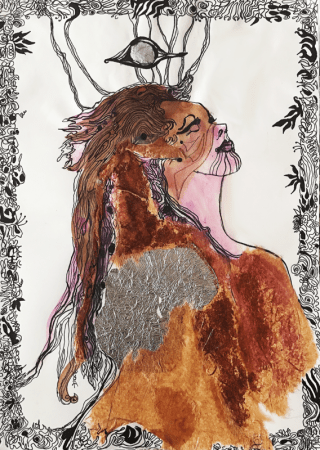
©️The Silent Eye, 2023, created by Giselle Bolotin)
As we discussed in previous posts, the soul is pliable – and also absorbent. It absorbs impressions, which gives us memory and the benefit of experience. But experience can also be negative and hurtful. Repeated negative emotional experiences condition the soul, which limits the expansion of its consciousness.
What dies, then – in the sense of Rumi’s poem?
The outward ‘radiation’ of the love of the Essence has the power to literally ‘burn away’ the negative parts of our personality, leaving it as a clear channel for the spiritual.

This journey is not for everyone… But for those who have encountered its ‘qualities’, it becomes an imperative.
To be continued in Part 8.
Other Parts of this series:
Part Four: The Edge of the Known
©Copyright Stephen Tanham
Stephen Tanham is a Director of the Silent Eye School of Consciousness, a not-for-profit teaching school of modern mysticism that helps people find a personal path to a deeper place within their internal and external lives.
The Silent Eye provides home-based, practical courses which are low-cost and personally supervised. The course materials and corresponding supervision are provided month by month without further commitment.
Steve’s personal blog, Sun in Gemini, is at stevetanham.wordpress.com.
Share this:

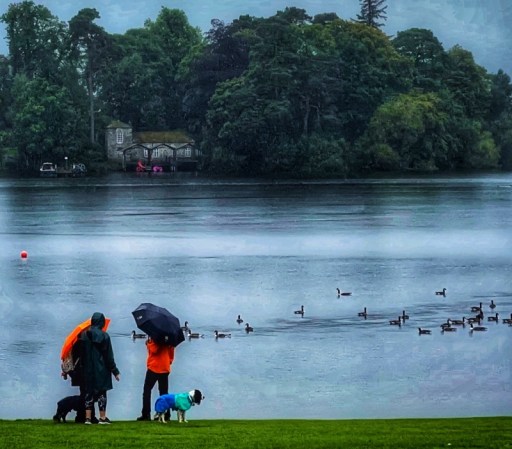
It was all entirely accidental, though no-one would believe me, later.
A flock of birds flying low over Derwent Water drew my camera eye away from the colourful couple in front of me, their dogs (one could only assume they were their dogs) barking at them as though they were in charge of the outing and hadn’t approved the new storyboard.
I love these subtle conspiracies of events, and the noisy, spoiled dog with the blue duo-tones was growing on me… Which was good because he only had eyes for the geese, now on final approach. Had he seen me snooping with phone-camera in hand, anything could have happened.
And then the birds landed on the water, seeming to fill the decidedly non-linear space to the right of the photogenic twin figures…whose fine umbrellas now seemed to be focussed – like a parabolic dish – on the source of the greater noise: the scattered geese reforming their assembly..
Mmmm a little circular and self-referential, I remember thinking, which prompted me to check that I wasn’t feeling nauseous.
“Sweetheart, what’s a migraine like?” I asked my wife.
For a second I was worried my mind was dropping into overload … since I had just spotted something large and very pink, moored across the water on the billionaire’s island.
But the thing that got my fevered and unravelling attention the most was the dawning comprehension that the two humans had complementary coloured umbrellas… And, on closer inspection, his was dark blue – which exactly matched her jacket; and hers was bright orange – which exactly matched his jacket.
Back at the movie, the leading dog (did I just type that?), clearly peeved by not having anything that matched anybody, returned to barking at the geese, who ignored it again.
The goulash stew at the Dog and Gun pub was restorative.
The torrential storm that followed us down the M6 and back to Kendal was hell on earth, and practically impossible to see into while driving. We must have been close to thirty near-crashes as idiots drove at sixty plus into a wall of water spray through which no-one could see.
The red wine on arriving home was purely medicinal. Honest.
I’ll be fine in the morning.
©Stephen Tanham 2023
Stephen Tanham is a Director of the Silent Eye, a journey through the forest of personality to the dawn of Being.
http://www.thesilenteye.co.uk and http://www.suningemini.blog
Share this:

+ #Silenti, Lake District, landscapes, Photographic techniques, Photography, Places and Prose, Short stories
Yard 17
by Steve Tanham

Kendal has a network of old alleyways. I’ve written about them before. They form useful shortcuts across the town. A kind of ancient ‘worm-hole’ is how it feel when you’re striding along one, knowing that you’re shaving precious seconds off the normal time; or sheltered, collar up on the long raincoat, from the cutting wind and rain of a Cumbrian January.

Yard 17 is one of my favourites. Its gritty, faded – and dark in the winter. In the summer, we could be somewhere in a Sicilian market town, perched high above the ocean.

I play a mental game of writing the opening to a detective story there. Perhaps just footsteps heard, and maybe a single clue left on the cobblestones next to one of the doorways. No crime visible … yet.

But then we get to the end of alleyway and the sun bursts through the morning clouds and fills Yard 17 with blazing light – the opening shot.

And any idea of writing such a dark tale vaporises…
©Stephen Tanham 2023
Stephen Tanham is a Director of the Silent Eye, a journey through the forest of personality to the dawn of Being.
http://www.thesilenteye.co.uk and http://www.suningemini.blog
Share this:

+ #Silent Eye, #Silenti, Consciousness, esoteric psychology, Psychology, Soul, soul in body, Spiritual Enneagram
Nine Keys (6): An uprising of Self
by Steve Tanham
Our soul – likened here last week to a giant sail – is not the only occupant of our ‘interior’. At the fundamental level of our consciousness is a foundation of Being which is perfect and full of loving and potential…
‘It’ only needs a Soul for its completeness.
Normally thought of as part of the soul, this layer of our true Self has been more accurately described as our Essence. It is the ‘ground’ from which the soul – in our metaphor the ‘sail’ and collector of our life’s experiences – extends into the world of matter.
There is much confusion about the soul because, though it is always present to ‘us’, it’s seldom seen because it is always there. To untangle this and achieve a degree of real seeing, we need to know what to look for.
Pure awareness is our essential nature and the foundation of everything else – including the essence and soul. It is not a result of brain or even mind activity. It is part of the ‘is-ness’ of our deepest nature. Awareness is our basic being – though there’s nothing basic about this primordial capability of being human.
The destiny of the human essence is to ‘work in the world’. To achieve this it must learn and interact with the ways of the world. This requires a mind and body, but first, it must extend itself towards the world of matter in the form of a soul.
As we discussed last week, the soul – this sail or movie screen – is malleable. It absorbs impressions, giving us memory and the benefit of experience – understanding and wisdom. But experience can also be negative and hurtful. Repeated woundings to the sensitive soul become conditioning, which limits the expansion of the soul’s consciousness.
We can liken our Essence to the main body of the boat: the hull and the strong mast. Its nature is perfect. Its role is to pass to the developing soul the pattern of its impeccable nature (the heading for the boat), so that nature can be manifest in the world of the individual. The essence cannot do this by itself. It needs the soul and its body to be the vehicle for the passing of personal insight and light into that human being’s existence – and hence to be shared by others.
In this way, matter is spiritualised, and ‘the creation is fully entered into’.
The balance of positive and negative impressions, stored in the malleable structure, become hardened into patterns recognised by modern psychology – though the latter’s concern is usually the stability of the character or ego.
At a relatively young age, the person feels themselves to be a character possessed of certain crystallised traits. This is the personality, which gradually ‘sets’ to become the identity of the person and this is the core energy pattern of its outer being.
The identity strives to protect the soul from being further harmed by conditioning. But the price of that is a much more rigid set of responses to life as the identity becomes fixed and armoured.
From then on, life is a balancing act between the ‘faces’ of being open to the new (and therefore potentially hurtful) and being protected from changes by the identity’s hardening. We all recognise this pattern, which develops with age. The problem is that spiritual development – conscious movement towards our essence – is dependent upon us being open…
This is one of the many examples of paradox in spiritual work.
It is for this reason that Schools of the Soul – like the Silent Eye – use carefully developed methods that facilitate the relaxation of this life-tension. They do this by making visible the power locked up in the identity of the person – their ego or personality.
All good teaching is a journey. In our case, that journey is a three year intellectual and emotional voyage in which we meet and interact with certain strong fictional characters, each of which typify one of the energy blocks we are likely to have in varying degrees.
©️The Silent Eye, 2023, created by Giselle Bolotin)
These energy blocks stop us receiving the impressions of the Essence, which is the dominant light in our lives – and the route to reunion of body, soul and spirt (essence).
The soul has properties. Aliveness is one of the key essential aspects of Soul. Aliveness is what is seen as immediately missing when we consider a newly deceased body. The ‘coldness’ and lack of an ‘animation’ are felt by all yet are impossible to define beyond a holistic word like ‘aliveness’, itself. This is typical of the properties of the soul, and demonstrates the level at which our search needs to be undertaken.
The best secrets are, in the words of the mysteries, ‘hidden in plain sight’.
Another property of the soul is growth. That sense of vital expansion is one of the fundamental experiences of life – as with ‘being alive’. In both cases, their ‘ever-presence’ and familiarity result in them being effectively hidden. We need to be shown that they are not the kind of properties we thought; that their origin is not of the body and brain. They are the fundamental building blocks of what came before.
Of course, such properties work though the body – all these layers of the human are interwoven – but they do not originate there. This is ancient spiritual knowledge. For example, the Sufis assign a separate ‘energy body’ to each of the above properties of the soul. Growth is living energy in itself, and the Sufis assign it to the animal body. Aliveness is a a living energy too, and assigned to the plant, or vegetable body.
In the next post, we will consider more aspects of the soul and the part they are capable of playing in our return journey…
Other Parts of this series:
Part Four: The Edge of the Known
©Copyright Stephen Tanham
Stephen Tanham is a Director of the Silent Eye School of Consciousness, a not-for-profit teaching school of modern mysticism that helps people find a personal path to a deeper place within their internal and external lives.
The Silent Eye provides home-based, practical courses which are low-cost and personally supervised. The course materials and corresponding supervision are provided month by month without further commitment.
Steve’s personal blog, Sun in Gemini, is at stevetanham.wordpress.com.
Share this:

A friend and I were talking about parabolas; those strange curves which take a wide section of incoming light (or other electromagnetic transmissions) and reflect it back to a single point, concentrated.
The radio telescope is a good example. The tiny radio waves from distant objects in space are bounced back off the parabolic dish to a ‘collector’.
The two of us (on different continents and connected by Messenger) were discussing how the human soul sits at a seeming centre of its own universe. It came to me that the analogy between our consciousness and the collector in parabolic devices was a good one to use as a metaphor of consciousness viewed in this way.
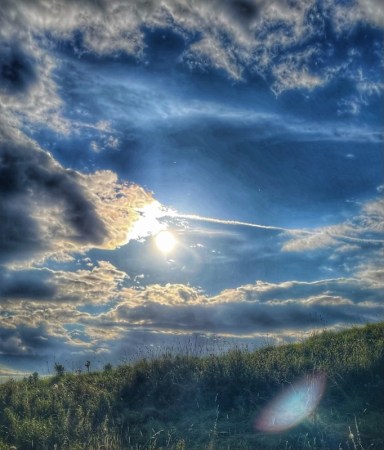
My photo has the happy ‘accident’ of a lens distortion which looks just like a parabolic surface, seen from the side. In the picture, the collector would be the Sun, frequently spoke of as the symbolic soul.
The human soul has been well-mapped by spiritual teachers over the centuries; and now by developmental psychology. It follows the outer and inner growth of the child after separation from the all-important mother who has carried it to term and bequeathed it life: its own life, with its own consciousness.
From then on, wherever it turns its ‘dish’, which we can examine as ‘attention’, a vast range of signals – which are already present – will be concentrated via the senses, into the arisings within its soul – the human organ of experience.
It’s a rich metaphor, and one worthy of a thought or two…
There is more detail, here, if you’d like to follow the trail of recents posts on the subject.
©Stephen Tanham 2023
Stephen Tanham is a Director of the Silent Eye School of Consciousness, a not-for-profit teaching school of modern mysticism that helps people find a personal path to a deeper place within their internal and external lives.
The Silent Eye provides home-based, practical courses which are low-cost and personally supervised. The course materials and corresponding supervision are provided month by month without further commitment.
Steve’s personal blog, Sun in Gemini, is at stevetanham.wordpress.com.
Share this:

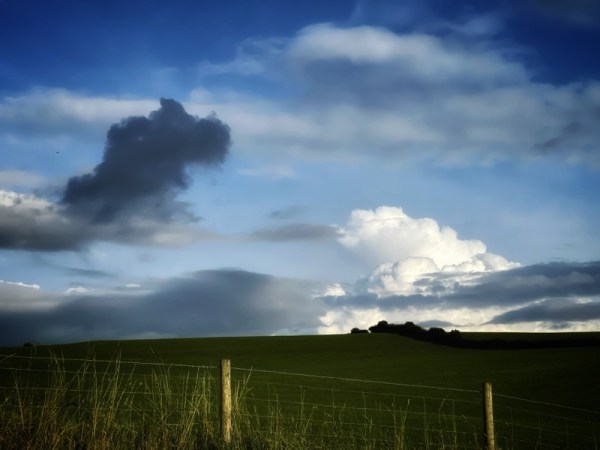
It’s an effect I often try to achieve and seldom do.
But on this occasion…
Taken in Sedgwick on our evening dog walk last week. The dark July rain had relented, granting us a few hours of sunshine.
The ‘washed’ feel of the landscape seemed to add to the feeling of something painted. And the clouds, well…
©Copyright Stephen Tanham 2023
Stephen Tanham is a Director of the Silent Eye School of Consciousness, a not-for-profit teaching school of modern mysticism that helps people find a personal path to a deeper place within their internal and external lives.
The Silent Eye provides home-based, practical courses which are low-cost and personally supervised. The course materials and corresponding supervision are provided month by month without further commitment.
Steve’s personal blog, Sun in Gemini, is at stevetanham.wordpress.com.
Share this:

+ #Silenti, Consciousness, esoteric psychology, Higher Mind, Incarnation, Powers of the Mind, Psychology, Silent Eye School, Spiritual Enneagram
Nine Keys: (5) The Giant Sail
by Steve Tanham

So far, we’ve looked at the development of the self – the ego-personality. We’ve seen how our ‘being’ arrives, entirely whole but naked to this world, at birth. It then begins to develop a protective shell as it finds its place in a world that is not entirely comforting.
We moved on to consider the layers of perception, and how there is a fundamental awareness at the heart of everything we are. That awareness is the most alive part of us. The mind – the thinking machine – is built to equip the soul with the power of concepts with which we can separate out and handle the world of the separated object.
Beneath the conceptual awareness of mind, at the level of the soul, there lies our original ‘knowing’ of unfiltered experience – a tapestry of the universe revealing itself …. here, where the observer is apparently separated. At this level of perception, we have no awareness of objects, just differentiated ‘patterns’ in the whole. We see differences, but have not conceptualised them into objects like ‘cars’ or ‘chairs’.
What, then, is the soul? It’s one of the most used words in all of philosophical thought, but seldom defined. It carries the idea of an ‘essential me’, yet perhaps not that of the egoic self, the personality – would we consider the weak or greedy parts of our behaviour to belong to our soul, too?
That can be a sobering thought… But one whose meaning we have to chase, for internal division of ideation or purpose will not serve us well in this most important of journeys.
Is there a relationship between the earthly personality and the ‘refined’ soul? Can we reconcile the mental and reason-based human mentality with the eternal and essential Self (Being) experienced as the soul?
To begin this, we need to extract the most beautiful conceptions of the soul laid down by those who have touched their own inner experience beyond the egoic self; a place reached when we quieten the chattering of the personality so that the inner presence of the spiritual may be felt.
Imagine the largest of sails on an elegant boat – our boat. In your mind, let this be the home of all your experience.
At the heart of our personal development is how we come to know things, and whether there is anything in our field of constantly-changing perception that we don’t know. This will require that we revisit the concept of the ‘known’.
We begin our consideration of this here.
To know is to find a trusted familiarity with an object of consciousness. Can we dig deeper into this feeling. Isn’t the core of this a ‘oneness’ with what we are perceiving.
Later, we will define this more deeply and say that to know is to find a trusted familiarity all of consciousness. In doing so, we will leave out the idea of an object, because this separates us from experience, and leaves us always on the ‘mind-side’ of the perception field. Who wants to be separated from a constantly opening flower of creation, drinking in its being via a poorer mechanism of rational thought, logic and memory?
The soul is our organ of experience. Like that towering sail above us, it responds to everything we experience. Years of conditioning in ‘logic’ have restricted the value we attribute to the power of this all-encompassing awareness, but that can be undone, slowly and safely.
Every experience we have – both the taking in of the presence of what can be experience and our reaction to it – is a part of this single organ of experience. Our giant sail not only flutters in the slightest of breezes, but it powers the direction and pace of our movement through the ocean of life. The mast connects both the tiny breeze and the hurricane with the depths of the boat – our inner being.
Do we really have a body? Most certainly. But our field of experience – our soul – is much larger than the body. The most vivid of impressions – really signals – come from the body, and so we have come to associate our ‘selves’ with this. But the body is made from the organic stuff of the world, and not the finer essential material of the vast sail – which stretches far above into the blue sky.
We will have much more to say about this very special ‘sail’, and its relationship to our true Self.
The soul needs the mind to work with the world. But the soul sees what is…
This consideration throws up a paradox… and we will investigate this apparent duality in the next post – Part Six.
Parts of this series:
This is Part Five: The Giant Sail
This is Part Four: The edge of the known.
Part Four: The Edge of the Known
©Stephen Tanham 2023
Stephen Tanham is a Director of the Silent Eye, a journey through the forest of personality to the dawn of Being.
http://www.thesilenteye.co.uk and http://www.suningemini.blog
Share this:

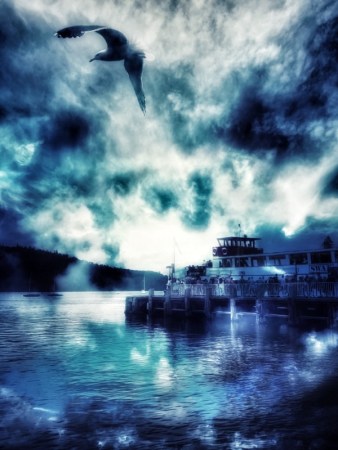
A test, perhaps, to see who lives till August
With mind and heart intact
Boiled down, diluted, merged with wet earth
In all its sodden tones, from dark to dank.
A sense of did that happen?
Pale shadows – memories starved of sun
Recounting, beer or second wine in hand
The glory of that ‘ May, then June, then…
This
©Stephen Tanham 2023
Stephen Tanham is a Director of the Silent Eye, a journey through the forest of personality to the dawn of Being.
http://www.thesilenteye.co.uk and http://www.suningemini.blog
Share this:

+ #Silenti, Consciousness, English Lake District, nature, Photographic techniques, Photography, Places and Prose
Insurgent Thistle
by Steve Tanham

The come by stealth; just when you think the summer landscape is settling down for its slow decline to autumn…
Aggressive, spiky green – enough to make you walk several paces to one side. The thistle knows how to make an entrance.
But then that beautiful flower emerges; an inonimate shade somewhere between vibrant pink and soothing lilac.
A wonderful paradox, reminding us that life is just a bigger version of it…but what emerges is worth it.
©Stephen Tanham 2023
Stephen Tanham is a Director of the Silent Eye, a journey through the forest of personality to the dawn of Being.
http://www.thesilenteye.co.uk and http://www.suningemini.blog
Share this:

+ #Silenti, Consciousness, esoteric psychology, Higher Mind, Incarnation, Powers of the Mind, Psychology, Silent Eye School, Spiritual Enneagram
Nine Keys: (4) The edge of the known
by Steve Tanham
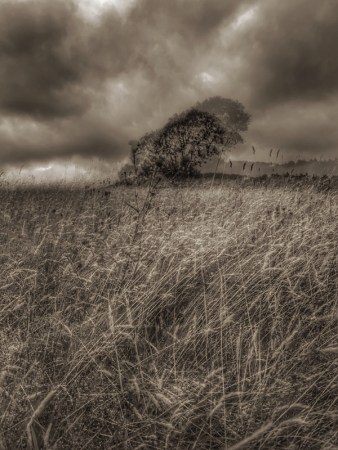
We look out at the world with our eyes. There is a strong, conceptual basis for our looking. We look out from an in-here to an out-there. In other words, we locate ourselves – the ‘me’ – inside something that we regard as an intimate ‘home’, never seeing, perhaps for all of our lives, that we have created the division. The immediate effect of this is to locate the rest of our ‘world’ as exterior to our selves, and therefore to define it as ‘not us’.
Because of this, we live our lives in a kind of perpetual conflict…
It is the personality (ego) that does this. And it does it in conjunction with the mind. The rest of our lives is spent at one end of this division. Its effect is therefore profound, and conditions everything that follows.
At the heart of our personal development is how we come to know things, and whether there is anything in our field of constantly-changing perception that we don’t know. We begin our consideration of this here.
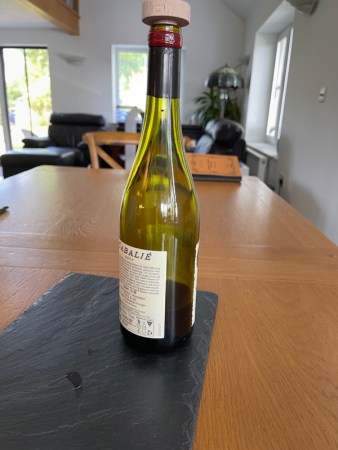
We seldom examine why we are so sure there actually is an in-here. The only thing we can be sure of is that there is an awareness (me) that has a senses-based relationship with the world around it.
This view of self belongs to the personality, and develops as the use of mind grows. Mind reinforces our separation from the world … but it doesn’t have to. Mind does what we ask it to do – what we focus on in our thoughts. We can alter the focus of our minds.
We said in Part Three that the core of a person is their essence. Another word for this is the soul. The soul is our wonderful organ of experience, and the mind is our organ of knowledge or knowing. We take ‘knowing’ for granted, but its power is at the heart of our lives, and a full investigation of this will enhance our relationship with all of life.
Everything out-there is what modern developmental psychology calls an object. We make ‘objects’ of things so we can recognise, understand and manage them. The bottle of wine before me in the above picture is known to me. Therefore I know how to interact with it, including whether I like or dislike it.
Years of familiarity mean I don’t need to look at it in detail to know it as a wine bottle. If the type of wine is one I drink often, just glancing at the label without actually reading it will allow me to know what’s before me.
Any bottle is an object; the wine bottle is a further defined object with certain properties – like its shape. The specific bottle and label of a wine type – here, the French wine Cabalié – give it complete visual identification. But I would still need to taste it to double-check its integrity.
Now, say we imagine our view of the bottle was a ‘painting’ like this.
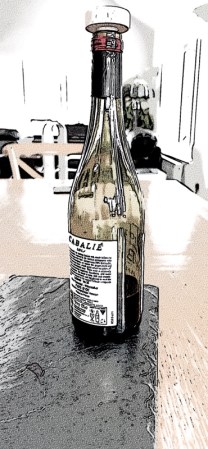
If I asked you to examine Bottle No. 2) and estimate the distance between the bottle and the dining chair behind it, you might – rightly – look at me and smile, replying that there is no distance in the unreal depth of a picture.
The same applies to the photo in the image of Bottle No. 1, but because we are used to seeing such photos as real, we easily project our logic into the equally false distance.
The overall image of our world at any time is not what is ‘actually there’; it is a learned version of that reality. When we were the new-born we spoke of in Part Three, we developed the ability to focus our eyes, but what we saw was a field of vision where there were differences but no objects. Objects belong only to the mind, and are an instrument of separation.
The infant’s view of the world is like a quilted bedspread. There is a lot of variety, but the child simply sees it as a pattern. There is no attempt to see each element as separate.
The details above are not just theoretical, they are the basis of a very useful exercise with which we can challenge the supremacy of the mind’s dominant view of our reality … and make it open its powerful eyes to a new world where division falls away and freshness rushes in.
The Exercise:
Consider the images of the two bottles. Look around you at any scene that takes your attention; either inside or outside the house. Concentrate on ‘framing it’ so that it looks to your mind like a photograph.
Now, instead of seeing this as 3D image with depth, imagine it rendered ‘flat’, as in Bottle No. 2. If you achieve this even for a second, you will notice something new in your consciousness, and the beginning of a deeper understanding of how your presence really works with the world.
Make this gentle, and as though you are interacting with an inner friend. There should be only relaxation in the experience.
In Part Five, we will deepen this journey into the known.
Parts of this series:
This is Part Four: The edge of the known.
©Stephen Tanham 2023
Stephen Tanham is a Director of the Silent Eye, a journey through the forest of personality to the dawn of Being.
http://www.thesilenteye.co.uk and http://www.suningemini.blog
Share this:

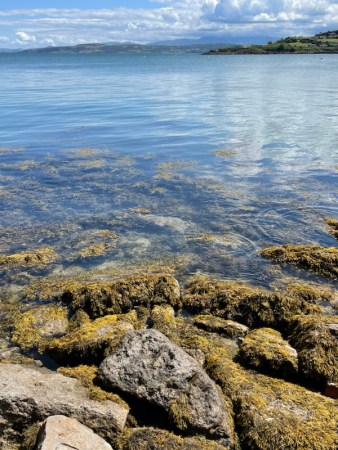
Never go back! It’s a frequent admonition, reminding us that the world we find on our return may not have the magic it possessed at the time it was laid down, ‘shining’ in our memories.
It’s often used in the context of a romantic involvement; the futility of attempting to recreate real emotion through place.
But what if the going-back involved an early first-stage development of a skill – an ability? Would the same disappointment apply?
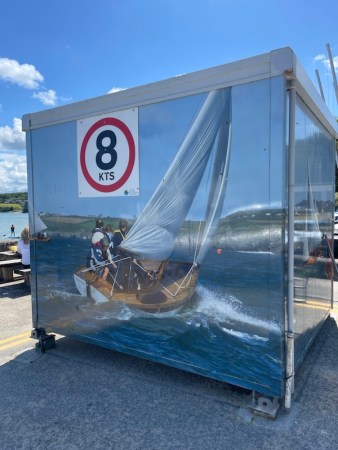
When I was 13, my father bought a small sailing dinghy while we were on holiday in the Tenby region of South Wales. We spent the holiday learning to launch and row it, but didn’t dare put the sail up with such large crowds to witness our fumbling.
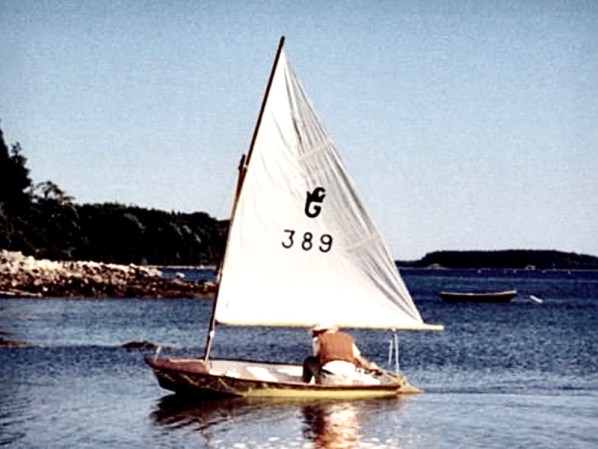

The next two years saw us learning to sail in a rather haphazard, but delightful fashion. On various lakes in Cheshire, and then – gloriously – along the Red Wharf Bay coast of the north-east corner of the island of Anglesey, we achieved hard-won competence of a rugged variety; and could take to the water with the best of them…
Messing about in a boat had become the most fun.
We visited Anglesey often in the summer, months, back then. I also had a memory of snorkelling somewhere sheltered in the same place – I was an active teen! My best memories of that time were of a small cove with a strange name where the bay seemed sheltered by a rising headland from the wilder expanse of Red Wharf Bay.
As an adult, I often returned to Anglesey, usually staying on the western coast around Rhosneigr and Trearddur. Whenever had the chance, I would take a detour across the island and try to find that little bay where I had learned to sail all those years ago. But I never could. Seemingly familiar places turned out to be different, and that magical goal of reunion eluded me.
I left it behind, along with other unfulfilled youthful wishes.
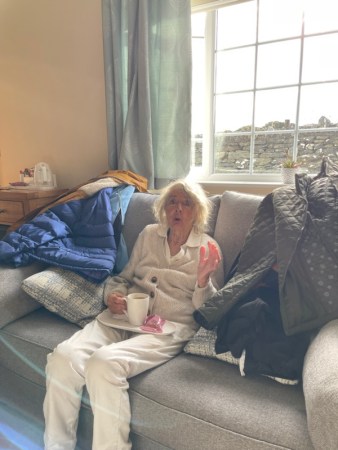
As I’ve written before, my mother is 93 and her vascular dementia is advancing… Holidays were always a very special part of her life and I like to take her away for a short break from the care home in which she lives on Morecambe seafront. She’s happy enough, and the care is excellent and friendly, but the idea of revisiting one of the places she loved, if only for a few days, still fills her with delight.
Some years ago, my wife discovered a converted farm, near Amlwch (pronounced Am-Lock) that had been turned into a modern but cosy hotel – and it was dog-friendly. We loved it, and have returned several times in and out of season. We contacted them and they were happy to have mum stay there in her own room, next door to ours, so we weren’t far in the event of a panic.
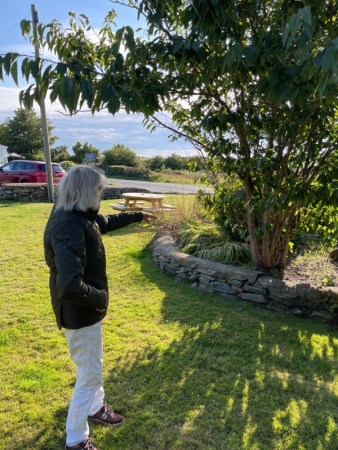
Sadly, our local cattery could only take our Rag Doll cat (Misti) for two nights, so my wife offered to come down in her own car with the dog and return early so that mum and I could have the extra full day of what might be our last chance at such a holiday. At 93 nothing is certain.
On the morning of our final full day, with the sun bright in the sky, we decided to play one of our ‘let’s get lost’ travel adventures. This comprises heading for a rural location and literally taking a random set of turns to see where we end up. The satnav will usually rescue us at the end of such playful folly, but the ever-new exploration is worth the disorientation.
We found ourselves in a warren of tiny roads near Dulas, and through this, discovered two new tiny bays… but neither was the mysterious sailing beach of long ago. Eventually, feeling hungry, we decided to abandon the game and let the car take us to the more populous Red Wharf Bay Area.
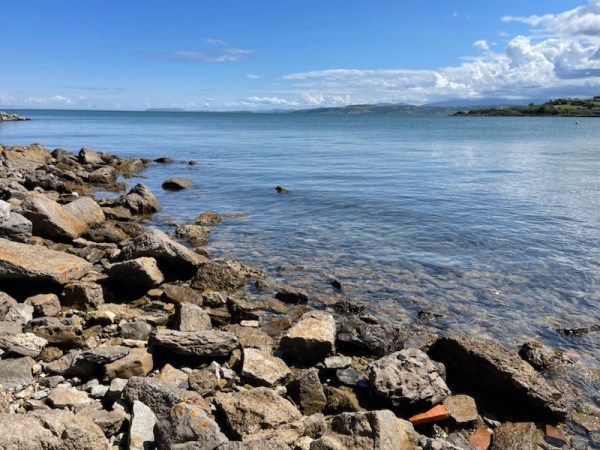
At this point, mum said she had a craving for pizza – one of her favourite foods. I explained that we would be lucky to find such an establishment, but we’d give it a go. Within twenty minutes the satnav had returned us to the main coast road, and I switched it off, confident I knew where I was.
Then I took a left turn towards the sea and realised I hadn’t known at all.
The country lane was narrow, steep and unfamiliar. There would be no chance of turning round until we reached a farm or similar at the bottom.
Suddenly, the landscape changed and became less wooded and much more ‘managed’. There emerged a large car park on our right and, next to it, a modern white shop displaying water-sports equipment.
I began to get that tingly feeling…
The tinglies only increased when we parked the car and approached the white shop. There were tables under an overhang and people were chatting and eating in the midday sun. The menu was limited – just pizza, served in a box for eating at the tables or taking to the beach…
It was excellent pizza!

Thirty minutes later, and replete, we made our way on foot down the last curve of the road. There on our left was an entrance track to a small marina with steps down to the sheltered water…
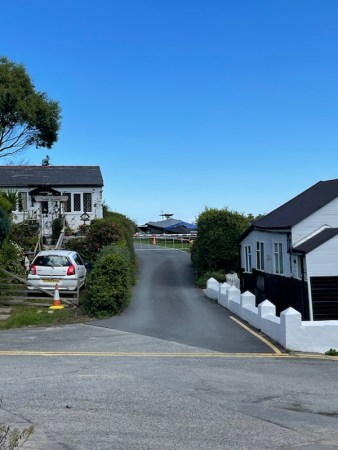
… from which the boy I had been at 13 had entered the cold sea, venturing out between the bobbing boats, into the fullness of the bay.
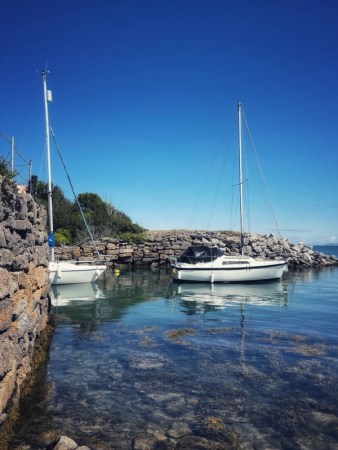
The joy of recognition matched the perfect day… and I was mentally and emotionally carried back to the time and place of my first sailing adventures.
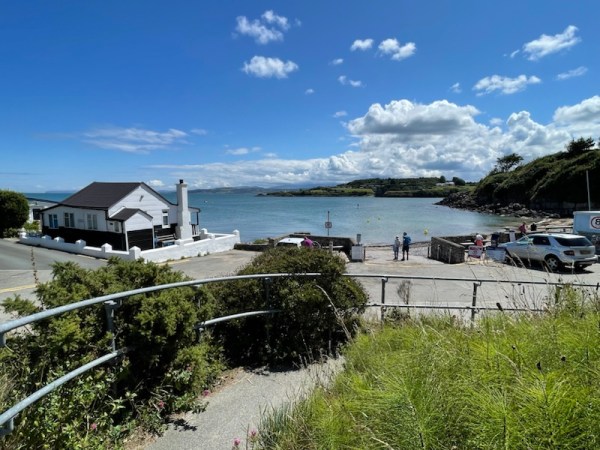
And in a vivid continuation of memory, on that lovely bay, shining now as it had then, was a small ‘Golbin-class’ dinghy, and a thirteen year old boy, his heart racing with excitement, the master of sail, rudder and rope as his small craft zig-zagged across the choppy waves of the waters of Traeth Bychan.
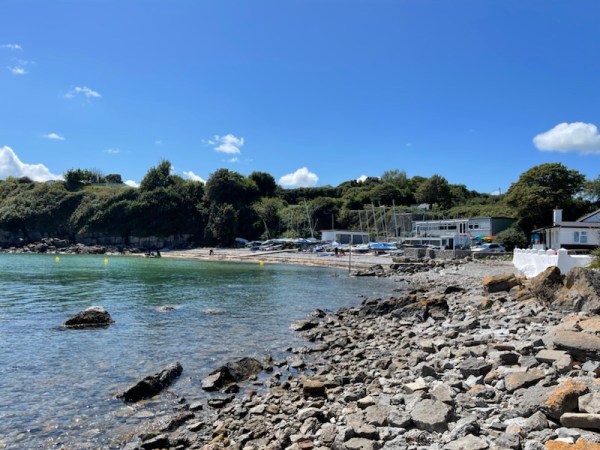
The joy was compounded by the knowledge that I had not found the lost place, but rather, it had, in a very real sense – with my mother in tow – found me… We sat on one of the benches next to the small beach. Mum began talking to a fellow artist and they spent the next two hours chatting, while I smiled at her happiness and drank in the powerful presence of the reunion.
Never go back? Well, maybe once or twice, just in case…
©Stephen Tanham 2023
Stephen Tanham is a Director of the Silent Eye, a journey through the forest of personality to the dawn of Being.
http://www.thesilenteye.co.uk and http://www.suningemini.blog


 Sun in Gemini
You must be logged in to post a comment.