
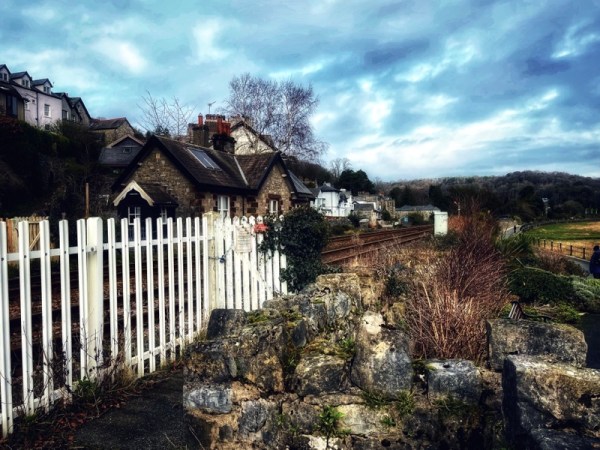
It’s one of the most scenic parts of Grange-over-Sands. The old railway pedestrian crossing connects the town centre with the seafront by providing a walking space across the twin railway tracks. A simple enough role and one that you might think would endear it to both visitor and resident, alike.
But the picture-postcard crossing at Bailey Lane now lies closed to pedestrians, despite an illustrious history. The same trains still pass by as before, but pedestrians can no longer cross the track, as they have been able to do since Edwardian times. Other crossing are available, but the Bailey Lane gated crossing is the oldest.

Lying a few miles south of Lake Windermere, Grange-over-Sands is a prosperous town with excellent communication by road and rail. It’s popular with those who wish to retire to the fringes of the Lakes District. Unusually, these days, it is self-sufficient in local shops, having at least one of just about everything…
The entire Cumbrian coast is served by the connection to the West Coast Main Line, with trains south to Lancaster, Preston and all points to Manchester, including its busy airport.

Grange sits on the northern end of the viaduct across one of the main estuaries of Morecambe Bay. It is a thoroughly pleasant place, with an unrivalled set of volunteer-tended gardens along most of the mile-long promenade. In the summer, there is an art exhibition the shore that brings in thousands of visitors.
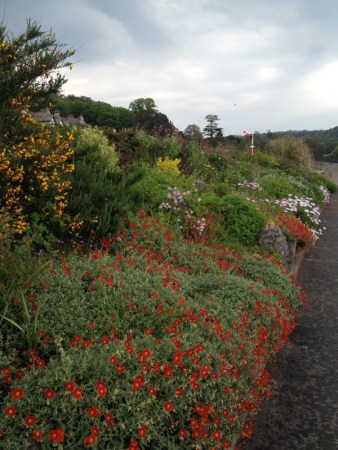

This mixture of ‘old and new blood’ provides a heady, if conservative, melting pot of intellect and opinion. And the closure of the direct foot crossing to the sea seems to have divided opinion equally.
Network Rail, which controls the tracks and stations, has long campaigned for the closure. The long history of the line – first as a freight carrier, and subsequently as a passenger service – has seen an often quoted ‘two deaths and several near-misses in the past thirty years’. But, as one of the locals said to me, ‘You could find that statistic connected to any busy line… and much worse, in cities’.

In 2017, the near miss of an inattentive couple crossing the line was used by Network Rail as justification to close the crossing, which has remained locked ever since.
The town is not without an alternative, but it is one that does not have the cultural history of the Bailey Lane crossing. A nearby car park hosts a dedicated underpass constructed by Network Rail in 2005, at a cost of 5 million pounds. Its a very sound piece of civil engineering, and works well.
Local council planning officers had recommended that the older level crossing remain open, but the council majority disagreed, illustrating the strong division of opinion.
We had often crossed the line here, to climb the very steep lane into the centre of the town, affording wonderful views back across the sea. There’s a sadness about the fact that this interesting foot route is now unusable. You can still access Bailey Lane, even from the car park that houses the alternative; but the ‘energy’ is gone, and part of the lovely town’s fine history has been removed.
It is likely that it will never be restored.
©Stephen Tanham 2022
Stephen Tanham is a Director of the Silent Eye, a journey through the forest of personality to the dawn of Being.
http://www.thesilenteye.co.uk and http://www.suningemini.blog
Share this:

+ #Silenti, Consciousness, esoteric psychology, Love, Photography, Silent Eye School, Spirit, Spirituality
Being being…
by Steve Tanham
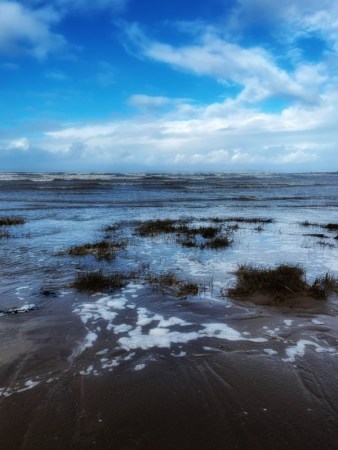
I usually write it with a capital: Being. But strictly it is just another noun, so it’s fine as simply being.
Except it’s not…because that devalues its importance.
Being is the word. Being is the gold ‘hidden in plain sight’ of the alchemists.. They were searchers for the inner nature of Nature. Some of them found it but had to create a language of obfuscation or be burned at the stake.
Let’s set it in context: Being is the highest state of existing we can envisage. It is a state of such utter fullness-in-itself, that all else in creation aspires to it, the aspirer believing itself to be separate, then finding that the separation was an illusion, all along. Nothing actually changes except the consciousness of the experiencer. And then that changes everything. It’s a paradox. The highest concepts in mysticism often are. It’s a deliberate way to turn the mind.
The world ‘plane’ is often used here; in the sense that Being is ‘on a different plane”. Frequent use and repetition of ‘plane’ takes away the true sharpness of meaning; and the modern association with an aircraft doesn’t help. Rosicrucian mystics of a previous generation, like my father, used ‘plane’ extensively to paint an inner picture of a world tightly linked with ours, but above it.
‘Above’ it creates its own problems, as we immediately look up! This involuntary vertical association undoubtedly derives from religious pictures of holy figures in the air, or on a kingdom of clouds. Saints, Saviours and God were to be seen in this different land – represented as elevated humans of course… which has an amusing irony of its own.
Being is more correctly placed as ‘within’ the other, rather than above it. That sense of inner separation at least implies that Being is at the heart of everything – although its very nature may later suggest that there never was an outer… Paradox is everywhere at this level of language, and used to tease at something that can only truly be experienced, not written about. But we must try; to recombine old words so that a hint of what lies beyond the tired letters may trickle through.
There are, then two worlds: Being and Becoming. Being does not become. It is already what the next state is. It unfolds. Human consciousness sees a past and a future and ascribes becoming to the prior state of what has just arrived in front of us.
In last week’s blog I wrote about how our use of language literally locks us into the ‘level of being’ that we currently occupy. I catch the ball is an example. ‘I’ is the subject. ‘ball’ is the object. There is a verb – a doing word in the middle. One of the keys to understanding the role of language in spirituality is that there must always be a subject and a doing-word for ordinary consciousness to make sense of it.
Language does permit ‘the ball is caught’. But it’s an abstraction. We envisage that here is someone, as yet unstated, who, as subject, has caught the ball. So, all is right with the world. No-one has broken the laws of doing by getting rid of the doer.
If we postulate that there could be a ‘state’ of caught…. Without there necessarily being a catcher, then our brain consciousness begins to get a bit queasy. Our mind quickly constructs something like: ‘He has been caught’ to correct the potential void that looks troublesome.
This can rapidly get academic, whereas Being is not at all academic. It’s a state of experience. More accurately, it’s a state of consciousness beyond the brain’s normal world of perception; a state in which the observer is changed into something else – without loss of continued consciousness.
It’s a state in which the experiencer and what is being experienced are the same. There is no subject-object relationship, no ‘me and it’. There is a continuous stream of knowing – the origin of the world ‘gnosis’. Some of our Silent Eye students humorously remark that this crystal-clear consciousness is an act of gnowing… And that’s accurate.
The mind is a better word. The mind has a magical ability to look out on the world… or back on Being – the place it came from. When the mind looks at the world it sees duality: subject and object, me and it, the world of doing. When it looks back at its source, it sees an all-and-everywhere centre of the universe, its home, and its substance. Being birthed the mind, which bore the egoic self; each is a reflection of the source at the next outer level. Only a return to that source – fully conscious, restores mankind’s rightful place in the universe.
All spiritual journeys are along this path. Various techniques are used, but the inner goal is the same. Eventually, we loosen the ties between subject and object, me and that, so that we cast off our ‘subject anchor’ and learn to sail on a different sea. Nothing of real value is lost. The ship is better navigated from the top of the mast rather than at the wheel on the deck…and the air is beautiful up there.
Other parts of this series:
Part One: Language: maker and destroyer of worlds
©Stephen Tanham 2022
Stephen Tanham is a Director of the Silent Eye, a journey through the forest of personality to the dawn of Being.
http://www.thesilenteye.co.uk and http://www.suningemini.blog
Share this:


I remember finishing the count… And being astonished that there were fourteen of them.
Suits… two and three piece suits. For younger readers, the three-piece ones were so called because they had matching waistcoats…whose bottom button was never fastened.
Fourteen is quite a number. They were all expensive, mainly double-breasted, and made of the lovely variety of silky textiles that so proliferated in the business world of the late 80s and early 90s. I was not alone. In the office of the Californian computer company for whom we were the most northern base in England, there were another six people for whom quality of dress was essential to success.
We were selling expensive, fault-tolerant computer systems to many of the most senior board members in the north of England.
Life was good…but I’m not here to brag about those illustrious days. They served their purpose and the world moved on… though many of those mainframes are still in place at the hub of major banking systems.
The reason the former platoon of suits is relevant to a post about blue denim is that I bought what must be my seventh pair of jeans the other day, and the number reminded me that I had double that number of suits. I was amused that my new and trimmed-down wardrobe depends almost entirely on these blue denim garments: simple, warm and un-sophisticated. And they last forever.
We buy my jeans – and just about every other domestic item – from a general purpose warehouse fifty miles away called CostCo – a far cry from the neon lights of Manchester’s Piccadilly district where many of the suits originated.
CostCo specialise in high-quality merchandise that they buy in bulk, receive in the store then scatter over frankly unimpressive pallets in the middle of acres of space containing everything from the best consumer electronics to salted nuts. Although the quality of everything is top-notch, the experience is functional, to say the least, and requires some getting used to.
But the merchandise is top quality, and offered at reasonable prices, providing you have the energy to leaf through piles to find your size.
Jeans-wise, they delight folks like me because they do winter versions as well as the more usual summer ‘fashions’. The last three pairs of blue jeans have been made from a thicker denim with a winter lining… They are sheer heaven to put on, and you know that your dog walking in the wet and freezing Lakeland countryside will at least be accompanied by toasty legs.
They aren’t waterproof, but I never found a pair of waterproofs that were remotely comfortable.
These days, I only have two suits. The first is black and only deployed for the not infrequent funerals that pervade this time of one’s life. The other is a Rohan travel suit that does everything else that involves a matched jacket and trousers.
The rest of my outfits are constructed from my jeans upwards; which just shows how well blue denim has stood the test of time… It’s more than can be said for my fourteen suits; now long departed.
I held onto a few of my smart blazers. To my – now simpler – eyes, they look great with a newly-washed pair of jeans and my small assortment of tan loafers.
And I’ve never felt more comfortable.
Neil Diamond sang about being ‘forever in blue jeans’. Here’s a snippet. I smile every time I hear it…even though it’s ancient. Something about his voice said he understood – even if it was going to take you a few years to get there.
©Stephen Tanham 2022
Stephen Tanham is a Director of the Silent Eye, a journey through the forest of personality to the dawn of Being.
http://www.thesilenteye.co.uk and http://www.suningemini.blog
Share this:


It’s around November time when I begin to think about the ‘vastness’ of the winter, ahead.
I let my mind play over the run up to Christmas, which, although increasingly dark, is brightened by the colourful lights and the spirit of the season.
My mental journey continues through New Year, which always seems an anti-climax, and on into the wasteland of January. I can feel a certain tension as I think about the cold and the days of rain and overcast skies that offer little light to lift the heart.
But that long dark month is good for testing one’s resolve, and getting more done than is strictly necessary… to set the scene for the year ahead.
And then something wonderful happens… My memory of that reverie is replaced with the pristine silver-whiteness of a hedgerow filled with the real thing. We are lucky to have a road lined with a wide bank, on which hundreds of snowdrops spring to life in the first few days of February.
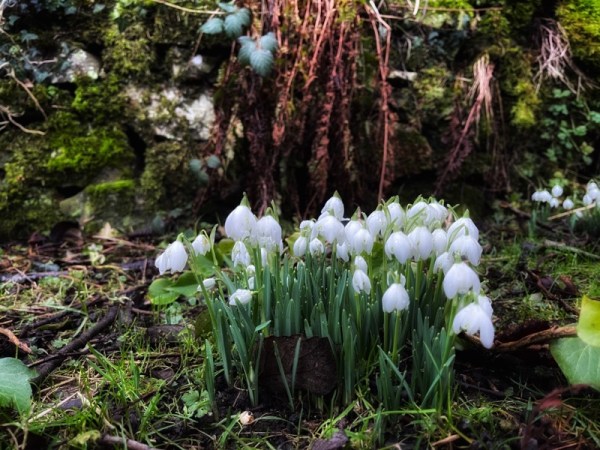
Although still a long way to the spring. There is suddenly an emotion like ‘hope’ in the heart; and the idea of trudging through the mud for another two months isn’t so bad.
All contained in those beautiful silver-white petals… and their supporting stems of virgin green.
©Stephen Tanham 2022
Stephen Tanham is a Director of the Silent Eye, a journey through the forest of personality to the dawn of Being.
http://www.thesilenteye.co.uk and http://www.suningemini.blog
Share this:

I remember the admonition from decades ago, though I’ve forgotten who wrote it:
Admire and beware language, for it frames the mind and blockades the spirit…
Bold words; and possibly overstated, until you come to certain stage of your own inner journey and realise how true they are.
In general terms, our western languages are predicated on the style of the following sentence: ‘I hold my wife’s hand’.
I ( the subject of the sentence – the do-er)
hold (the doing-word, the verb)
my wife’s (a relationship between the subject and object/recipient)
hand – the object; the recipient)
The subject-object relationship is at the heart of our sentence… and at the heart of our world.
This constantly repeated identification acts like a mantra at the heart of language – and therefore at the heart of our thinking.
In the intellectual west, this is at the core of who we are.
Most modern languages are structured this way, but some ancient ones were not. Sanskrit, the western world’s oldest language, had an optional alternative – often used in the most sacred of the texts, such as the Rig Veda: “There is holding of my wife’s hand.”
At first glance, this may seem less specific, as though we had stepped back and generalised the ‘holding of my wife’s hand’, but used within the sacred texts, such as the oldest – the Rig Veda – its meaning is something entirely different… to which we will return, later in this post.
Language is one of the foremost powers of the mind; along with logic, memory and the power of visualisation – the forming of an image (or something corresponding to an image, like music) to be held in the consciousness in order to bring it into existence – as a great sculptor like Michaelangelo would have done.
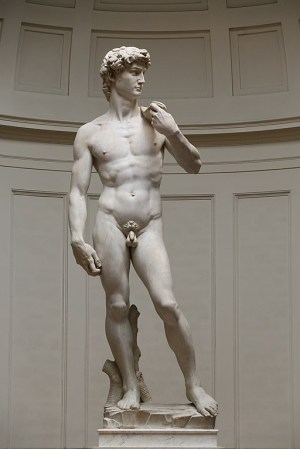
We can mirror this, now, by imagining that we are Michelangelo; standing in front of a block of pristine marble for days, walking around it… assembling millions of possibilities until, with an intake of breath, you settle on where the hammer and chisel will begin their work. It’s interesting to consider that the sculpture of David, above, was already in the stone… The sculptor simply chipped away what wasn’t it.
This duo of subject and object is at the heart of one of the most powerful finds within meditation, where the practitioner comes face to face with the idea that the mind may only exist because it is dancing between ‘out there’ objects at such a rate that it appears to have continuity.
That should make us all think, and possibly rush to have a go… Imagine the edge of reality being so close!
What lies beyond? Sages have spoken for millennia about the new land of pure consciousness that lies across that threshold of a quieted mind. That last sentence may contain a surprise if we think that consciousness is on the same level of the ‘self’ as the brain and its mind-mechanisms. It’s not. It’s higher…
The mind is actually a ‘filled arena’ of consciousness, and the brain keeps it that way because of the essential need to protect the egoic self – the only centre it knows.
But this self – though essential for the wold of ‘doing’ – is only a shadow of a deeper and far more personal inner Self whose outward facing aspect gives rise to the mind, which gives rise to language in order that it may continue its existence, in the form of continual chatter about what it sees.
See the pattern?
One of the time-honoured exercises for getting that all-important first glimpse of the world of the higher Self, is to take away the ‘subject’ of the sentences. “I see the house” becomes “The house is seen”. This immediately shifts the ‘lower me’ out of the equation. Suddenly, we are in a space where the joy of seeing is something that is part of consciousness and not predicated on the existence of an ‘I’.
There are many more… and deeper techniques for this, but it’s important to feel comfortable with the intention before working deeper back toward the Self (also called, but less precisely, the Soul).
It may just be that those ancient writers of the Vedic ‘poems’ were communicating a new landscape; one in which the ‘gods’ of their prayers were the forces and faces of Being that they found in the land of the inner Self; the place of ‘love beyond words…’
©Stephen Tanham 2022
Stephen Tanham is a Director of the Silent Eye, a journey through the forest of personality to the dawn of Being.
http://www.thesilenteye.co.uk and http://www.suningemini.blog
Share this:

©Stephen Tanham 2022
Stephen Tanham is a Director of the Silent Eye, a journey through the forest of personality to the dawn of Being.
http://www.thesilenteye.co.uk and http://www.suningemini.blog
Share this:


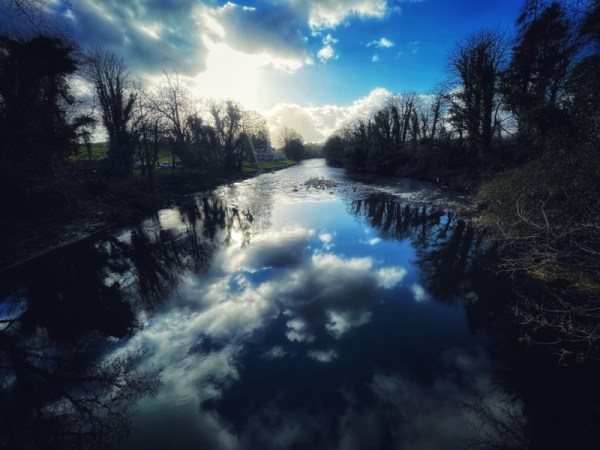
I took this the other day, on a walk with Tess the Collie. Looking at it, later, I thought ‘What was that?’ I’d forgotten where I’d taken it, and I took me a minute to reconstruct where we’d been.
On that basis, I thought, it would make a fine what is it? The kind of photo people used to shoot, deliberately, to be a puzzle… on Sunday mornings, when we’re supposed to have a bit of time on our hands…Hmm.
So, it’s Sunday morning… and if you fancy a go, tell me in the comments. Bottle of something fizzy for the best response… Sort of!
And the Answer Is:


Jaye from Books and Bonsai gave a great answer, but Di from Pensitivity 101 got it on the nose with the word ‘Bridge’. My virtual bottle of bubbly goes to her.
This was simply a one-off promoted by a curious photo, but if there’s an appetite, I could run others from time to time.
A big thank you to everyone who took part.
©Stephen Tanham 2022
Stephen Tanham is a Director of the Silent Eye, a journey through the forest of personality to the dawn of Being.
http://www.thesilenteye.co.uk and http://www.suningemini.blog
Share this:


Have you ever watched your own mind racing between thinking and feeling? Usually, just before it triggers something about which you have a long-term feeling of unease?
We all do this. Our habitual reactions are based upon pre-formed responses, which, themselves, may be constructed from older building blocks of like and dislike going all the way back to our earliest childhood… These may be old, but they still skew our behaviour.
Many people – looking at their own lives – say that feelings are faster than thought, so thought isn’t involved in the experience. There is some evidence for ‘feelings’ being a faster response, but I maintain that there’s a tiny gap where conscious and ‘deliberated’ thought can enter the process of feeling a certain way. And it does so, right up front – if we let it.
None of this implies that thoughts are superior to feelings. Feelings are the key to the release of deep energies, energies that can be used for good or negative work. Thoughts are there to allow us to do real time ‘what ifs’, amongst other things. Used together, as they were meant to be, they are a dynamic combination.

This tiny space between thought and feeling is like one of those decision boxes in a logical flowchart; and it may just be that its presence is a deep part of our spiritual potential.
Say we have noticed, with surprise, that we have something in common with someone we regard as our ‘enemy’. We may harbour a strong dislike for this person. Whenever we come across them or their actions, we find ourselves getting tense and invoking an almost prepared script that rattles out the justification of our dislike.
Occasionally, we may be in a non-antagonistic situation where this disliked figure is seen responding to another and revealing part of their past. In a situation like this, I once found myself examining the previously unknown conditions of this foe’s past. For the first time, I could see how and why I reminded him of the adversity he had to face as a younger man.
Armed with this – and with a mysterious sense of heightened inner awareness, as though the moment were listening to itself – I said something supportive about him, giving reasons as to how a theoretical person might have developed aggression from that moment.
His eyes widened and he looked at me ‘in a new light’. I made sure we carried on the discussion, socially, after the encounter, in order to give this new condition between us chance to mature and stabilise.
We’ve been good friends, since…. To my astonishment.
Shortly after this turn-around, he and I were at a gathering of people, but far apart. At one point, I heard him speaking – and watched as my older reactions to his voice took over my responses. Knowing it would be instructive, I ‘hovered’ over my own triggered reactions and watched them play out. Assuming the role of a silent witness in my own mind. I saw, again, how decades of self-conditioning had formed something hard and ‘solid’, like an entire inner routine that played itself out when switched on by his presence.
And I could see how much energy was tied up in the creation of that construct… and keeping it alive.
As this continued, I substituted my new understanding of the man – now friend – and watched how my entire inner state changed; becoming ‘plastic’ instead of solid. This plastic mental and emotional state allowed me to take something new from the moment, something real, instead of the locked up and frozen negative of the past.
There was nothing special about me in that situation. Everyone has the capability. We just need to overcome that habitual ‘don’t want to go there’ barrier.
If we step back and look at our lives, honestly and in the light of such a moment, we see that a high proportion of what we do… and therefore are, is habitual. Even worse, it’s made up of frozen energies from our past that lock us into responses we have outgrown. This ‘self’ is lesser than we can be. Each of the elements of this habitual creature can be examined in the manner of my example, above. When we do this, we find patterns – entire patterns that have, literally, robbed us of ‘being there’ in the passing now.
Winter is a good time to reflect, and to review how we are and how much of that is down to how we react to things. Many aspects of nature are ‘frozen’ at this time of year, and we can use this to align with that which is in a similar state within us.
This allows us to begin the ‘spring-cleaning’ long before the renewing energy of nature’s cycle. Having derived and visualised such targets for positive treatment, the incoming spring tide of energy will flow straight into the negative and locked conditions – melting them… and showing us the boulders left behind, now devoid of anything fearful.
The ancients might have called it inner Alchemy. But we can think of it as using the wings of the bird of reason and emotion.
©Stephen Tanham 2022
Stephen Tanham is a Director of the Silent Eye, a journey through the forest of personality to the dawn of Being.
http://www.thesilenteye.co.uk and http://www.suningemini.blog
Share this:


I’m not sure there’s ever been a rigorous definition of gluttony, but a series of incidents have made me wonder if we are suffering from its effects, in the form of book-fat.
I can hear wincing noises in the seats at the back, there… I certainly winced when I thought about it. I winced a lot more as I tipped boxes full of old books into a skip, devoid of anywhere locally to re-home them, despite great efforts.
“Nobody wants books, anymore, mate!”
Manager of a charity shop in Kendal.
We’ve had a great big tidy up, recently, Mrs Tanham and I. She’s as much a book lover as I am, perhaps, more so. A childhood in which her father died when she was six years old, and in which she and her elder sister became the main support structure for a mother who struggled to cope with the emotional impact of widowhood, let alone borderline financial stability, set her on the road for books for life. Books were friends: an escape and a source of knowledge; knowledge that could pass cold hours wrapped in a coat in a house without enough coal…and could, later, get you to university with a real love of history – consumed from books with a deep love of the subject matter.
She loves books…
In my own case, books were correct knowledge; a knowledge beyond the possible truth of what my parents – in good faith – gave me as their helpful opinions. It’s a growing thing, and a rite of passage, to know that, if you know how to look, there’s a book out there that can expand your knowledge and widen your horizon.
It was a library book that first alerted me to an emerging field called ‘computing’, and changed my choice of college and course… and the rest of my life.
As in everything it touches, the internet is at once a blessing to, and a killer of, books. Good, because you can now search with previously unheard-of accuracy, for that rare source of specialised knowledge for which you’ve been hunting all year to finish your project/novel/research paper etc…
But the internet has also seen the triumph of what Herman Hesse called the ‘Feuilleton’ in his brilliant final novel: The Glass Bead Game‘, published as the Nazis came to power in Germany.
The Feuilleton was the opposite of the deep knowledge pursued by the Magister Ludi and his followers; knowledge in which that depth threw up deep and potentially spiritual connections between ideas, connections that were previously unthought of – and wise.
The Feuilleton is the necessary result of too much information and too little contemplation of its meaning… resulting in the exaltation of the mindless and twisted ‘truth’ seen in today’s gutter press; an instrument that deprives many of understanding by wrapping it in glitz, glamour and sex. The Feuilleton makes us fat, because it deprives us of real nourishment, whilst increasing our hunger for more…
We’ve all seen the price of empowered ignorance. On both sides of the Atlantic, our newly fractured societies are its children…
Pure scholarship may not be the answer, either. Would any of us turn back the clock and not have the internet? Pandora’s box was well and truly opened when the humble ‘browser’ came along and masked all that technical spaghetti in relative simplicity. The rest is history…and is here.
And then the book, itself, changed. Probably entering our lives when we flew on holiday – with a limited weight allowance on the plane, and took that new-fangled Kindle with us – “It’s just for holiday, it won’t replace my lovely bookshelf…”
Has it? it’s a good question. In my case, I still have a room full of books, but equally, I’ve had to get rid of another room full that I finally realised were never going to be read. Now, my Kindle is mirroring that second room of books. Am I ever really going to read all the books on my TBR (To Be Read) list… to be honest, do I even really have a TBR, aside from the Kindle, itself…
Wince, indeed!
I love books…I love their feel. I love the physical craftsmanship that goes into their making. I love the feel of quality paper turning in my fingers, even their smell. Virtual paper may change – to be honest it has to, because the Tech leaders are waking up to the fact that our favourite looks shabby in its virtual book device.
I predict we will each have a ‘meta book’ of our favourite size and, binding, in which there is what appears to be blank paper. The paper will feel like the most exquisite paper we’ve ever held, but ‘washable’. When we select a book from the meta-library in its spine, linked to the all-books depository on the web, the download, in glorious full colour, will feel and look like we’ve just been granted a visit to our national archives. I will turn my pages, hearing a delicious sound and feel. When I get to page (say) ten, the last, it will refer me back to page one, and so onwards through the book. AI will tune my searches so that I can ask: Can we go back to the page where the idea of parliament first appeared?
There are many ways to treat this topic, and dark humour has to be one of them.
Diana Wallace Peach of the excellent Myths of the Mirror website had a new writing challenge for the new year called ‘The teetering TBR pile’. The link is below.
I hadn’t written any poetry for a while and decided to have a go at a little black humour on this subject. If you received Sunday’s post – which was Diana’s cut-off date, you may have already read it. If not, then here it is… and thank you!

Five Spines of Doom:
Five spines of doom, the living pile declares
To struggling mind awakening in the gloom
Of winter morning in the dreaming room
Who shouts? He whispers to the wall
➰
Five spines of doom, where will has failed
To clear the conscience of the might
of these five books which through the night
Have taunted sleep of he who put them there!
➰
Beside the bed, next to his head…
That, given this priority
They would at last be read and free
And not in their minority
➰
Alas…
➰
Like struggling morning’s light
He grasps, past January’s tea gone cold
The truth his doubting mind foretold
‘Five spines of doom’ … it rings, a nightmare’s fright
➰
Five spines – now books – declare his guilt
Short days, he blames…or longer nights
The five lie mute, abed.. And sadder, yet, unread.
His rising knees make wall from quilt.
➰
Around the Kindle fingers fumble
Seeking to suppress the mumble
Of words in millions’ silent plea
A digital majority.
————
©Stephen Tanham 2022
Stephen Tanham is a Director of the Silent Eye, a journey through the forest of personality to the dawn of Being.
http://www.thesilenteye.co.uk and http://www.suningemini.blog
Share this:


Diana Wallace Peach, over at Myths of the Mirror set a writing challenge prompt for the new year… which I’ve just found out expires today!
Here’s my offering, ‘Five Spines of Doom’ for her ‘Tottering TBR pile’ prompt: a nightmare of the ‘to be read’ books we all have – particularly on our Kindles…
Five spines of doom, the living pile declares
To struggling mind awakening in the gloom
Of winter morning in the dreaming room
Who shouts? He whispers to the wall
➰
Five spines of doom, where will has failed
To clear the conscience of the might
of these five books which through the night
Have taunted sleep of he who put them there!
➰
Beside the bed, next to his head…
That, given this priority
They would at last be read and free
And not in their minority
➰
Alas…
➰
Like struggling morning’s light
He grasps, past January’s tea gone cold
The truth his doubting mind foretold
‘Five spines of doom’ … it rings, a nightmare’s fright
➰
Five spines – now books – declare his guilt
Short days, he blames…or longer nights
The five lie mute, abed.. And sadder, yet, unread.
His rising knees make wall from quilt.
➰
Around the Kindle fingers fumble
Seeking to suppress the mumble
Of words in millions’ silent plea
A digital majority.
————
© Stephen Tanham 2020
Share this:


It’s a morning photograph, taken last week. I wandered into the en-suite bathroom to find this beautiful display of light splayed across the end of the bath, onto the wood of the cabinet and then, fading, on to the white tiles.
It was one of the most beautiful and ‘fine’ displays of natural light I’ve ever seen; and I had no idea how it was forming…
Before working back along the lights-beams, I ran into the bedroom for the phone, which was still lying in its charging cradle on set of drawers near the window. Returning to the bathroom, I was delighted that the light patterns were still there – the reverse is usually true; these are fickle effects and often short-lived.
Several photos later, I turned to trace the source. By now, the light was fading, fast, but I caught a final twinkle from what we call the ‘theatre mirror’. Bought from a rather trendy furnishings shop in Chorley, several years ago, this glitzy item – deliberately ‘over the top’ – features edges made of prism-like glass. A line of these had caught the bright, winter light and flashed it back into the bathroom.

A stroke of luck, but I was glad I had some evidence of its beautiful existence…
©Stephen Tanham 2022
Stephen Tanham is a Director of the Silent Eye, a journey through the forest of personality to the dawn of Being.
http://www.thesilenteye.co.uk and http://www.suningemini.blog
Share this:

+ #Collie dogs, #Silenti, Ancient Landscapes, Photographic techniques, Photography, Silent Eye School
The hill with two stations
by Steve Tanham

photo taken in summer)
Our small village, Sedgwick, near Kendal, has a landscape shaped in the classic terminal topography of ancient glaciers. This area of gentle, rounded hills is typical of the final stages of the glacier’s course. The English Lake District, where we live, has them in abundance. ‘Basket of Eggs’ is another term you may remember from those geography text books at school. They are also known as ‘drumlins’.

These small hills get bigger as you journey nearer to the centre of the region. The northern half of Lake Windermere was formed from a glacier whose origin was the mountain of Fairfield, a few miles north of Ambleside, at the head of the lake. See picture, above.
It’s the Friday before the third Sunday in the month. You’ll find me with a very happy Collie dog – Tess, walking from Sedgwick along the quietest country lanes and tracks towards the hill you can see in the distance in the opening photo – The Helm (also spelled Helme). It doesn’t look too far in that shot, but it’s a three mile walk, and takes about ninety minutes at a fast walking pace.
I love walking. You couldn’t live here and not do. But there’s a practical side to this monthly outing. I’m meeting up with Stuart France, my co-director of the Silent Eye… and we’re planning on having a couple of beers, whilst mapping out the next month of activities – including our new monthly Zoom chat – open to anyone interested.
That’s right – it’s a board meeting! But one held in a station… which may sound odd, but all will be revealed…
A year ago, Sue Vincent – as the third Director of the School, would have been part of the group meeting. This would have taken place in the distant hills of Derbyshire – the place where we’ve regularly held our Spring workshops.
Sadly, as many readers will know, Sue passed away last Spring, leaving the two of us to sail the Silent Eye ship. We are not alone, though, and have a great team of people to assist us – for everything from healing groups to highly-skilled administrative and document production assistance.
Technically, Stuart and I are ‘retired’…but you wouldn’t know it from our average working week of writing, teaching and lesson supervision.
Stuart used to live in Sheffield, which was an ideal base for our monthly meetings in the hills of Derbyshire. After Sue’s passing, Stuart decided to relocate back to his native Lancashire. This was to our mutual advantage because there is a fast rail connection between Preston and the place I’m headed – Oxenholme; the only mainline station in the UK located in a village. Quizzers take note. This might win you a prize!

My journey takes me from our house near the centre of Sedgwick, along a steep country lane that runs beneath the West Coast Main Line. We’ll meet this vital link between London and Scotland, again, later. The bridge and line are only ten minutes from the house. If the wind is in the right direction, you can just about hear the trains at night as they thunder northwards to and from Glasgow and Edinburgh. There’s something magical about it…
The road crests a hill then descends to the village of Crosscrake, where we take a tiny lane up the first of several steep ‘drumlin’ hills. These are lined with dense hedges, most of which have just been trimmed. The resulting sharp relief is a pattern to be exploited by the photographer.

Frustratingly, the lane then plunges down the hill to climb all the way up again – an unavoidable property of the egg ‘basket’ hills. This one is very steep. But, ten minutes later, and somewhat hotter, we’re at the top.

Soon, we pass one of my favourite gardens, with its oak tree set just off the entrance drive. The photo was taken in October, and the autumn colours allowed me to indulge in a little fine-tuning.

The country lane marks the end of the ancient drumlin and leads to a minor junction of the celebrated A65 – the old trunk road that links Kendal to Skipton – and beyond to York and the East Coast.
There is always beauty to be found in the hedgerows, even on the busy A65. This image was taken here in October…

Beyond the major road the way begins to climb up the initial slopes of The Helm, but the trees are so dense you can’t see the large hill looming above.

We now have a choice… We can continue along the narrow lane and skirt the base of The Helm… or, with the Collie expressing a strong preference, we can set off on a rapid and lung-challenging ascent of the steepest face of the hill.

If we are feeling fit – and the Collie insists – we arrive, breathless at the summit of The Helm, fifteen minutes later. It’s a steep but rapid scramble to the ‘trig point’, but the views are worth it. Kendal is laid out below us like a street map, with the West Coast Main Line skirting the base of The Helm. The air is always pure… and often freezing!


Tess loves being here because it’s where we often come (by car) to ‘chuck the frisbee’. Today, however, her fun is curtailed by the sound of shotguns in the next valley. She scampers around, tail down and frightened. Collies are very sensitive creatures…
We’ve done all we can up here. The Collie’s walk will have to be sufficient. Now it’s time to descend to the edge of the village of Oxenholme, where Stuart will be arriving by train in the next 30 minutes.
The Helm is topped by a beautiful, long ridge. We can follow this all the way down to the road that leads into Oxenholme Station.


Stuart arrives on-time from Preston. We’re now going to leave one station to have our ‘board meeting’ in another – and its not the one in Kendal.

Fifteen minutes later, two human and a Collie are ready to have their meeting…

And that’s the end of the journey…. Except if we decide to walk home at the end of our chat. The alternative is to ring Bernie, who will gladly drive the fifteen minutes to collect me, while Stuart strolls down to the station to catch his train.
But the thought of walking home through that beautiful coming sunset and the photographs it might offer is calling… But we’ll not be going over The Helm!

©Stephen Tanham 2022
Stephen Tanham is a Director of the Silent Eye, a journey through the forest of personality to the dawn of Being.
http://www.thesilenteye.co.uk and http://www.suningemini.blog


You must be logged in to post a comment.