+ #Silenti, Consciousness, esoteric psychology, Mystery Schools, Mystical poetry, Photographic techniques, Photography, Poetry, Silent Eye School
The Quiet Places
by Steve Tanham

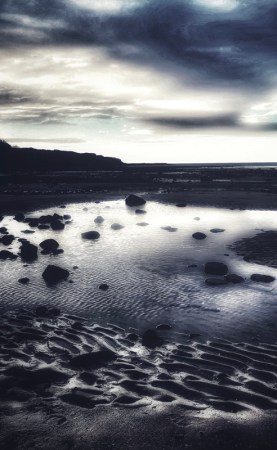
They live concealed within the ebb and flow of life recycled. That very nature is why they are so hard to find. The extraordinary hidden in plain sight…
Their camouflage is the blindness caused by seeing what we saw, before, and not what is before us.
A spell so strong, it takes our will to see it, differently. To reach into what seems to be ‘it’, but is really ‘me’; a world painted on our eyes by our mind.
From memory, of course; that pale repeater and drain of the new.
Close your eyes, facing the unfolding, and will to see what was not seen before, knowing it can never been seen again beyond this.
But this once…
Not recycled: lived again, but lived anew. And then the act of seeing the quiet places will become a song whose chords that stroke the soul will never be repeated in that symphony of delight that is our new-seen life.
Only the see-er changes. The rest was always there.
©Stephen Tanham 2021
Stephen Tanham is a Director of the Silent Eye, a journey through the forest of personality to the dawn of Being.
http://www.thesilenteye.co.uk and http://www.suningemini.blog
Share this:

I suppose the surprise arrival – by post – of a batch of smoked kippers that morning should have triggered the gene in me that I’ve named: How Strange!
I’ve mentioned our love of a kipper breakfast in previous posts. We had recently returned from our annual November visit to see our good friends on the Isle of Man. Part of our trip had been a visit to a pub that offered a ‘kipper tea’, something we all enjoyed. Kippers are polarising; you either love them or hate them. Our friends had decided to follow up our visit by sending us a fresh kipper package from the island – a lovely and much appreciated gesture.
We put most of them in the freezer, but kept out two pairs for later. They made the basis of our evening meal. Then we hunkered down from the gathering winds of storm Arwen… which had begun to throw things around the garden…
I had spent the whole day raking up the last of the leaves on the lawns. Our house has numerous large trees on two sides of the property. It’s strenuous exercise and I was tired by the end of it. The compost heap had swelled to three times its normal size – though that would soon reduce, as the leaves compressed under the weight of two cores from an ash tree we had to have felled due to Ash die-back – that horrible disease that is decimating the ash population in the UK. At least you can use ‘green’ ash in domestic log-burner. The log store at the back of the property was full to overflowing with top-quality fresh wood, and we had selected some to burn that night, by way of a distraction from the coming gales.
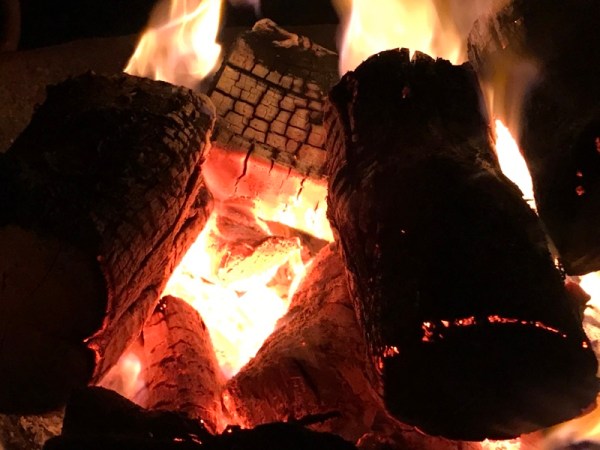
Replete with our kipper meal, we settled in front of the freshly-lit wood fire and watched the ash burn brightly and fiercely, filling the living room with a warm glow and the roar of the flames.
With a log-burner, once the fire ‘takes’, you reduce the intake of air so that the wood lasts longer. It was then that things began to go wrong…
No sooner had I done this, than the wind outside began to howl and we noticed that smoke was escaping around the door of the log burner. I jumped up and opened the fire, checking for splinters of wood that were possibly preventing it sealing. Nothing amiss, I closed it again.
This time it was worse. The howling outside increased, but it was essential to open the patio doors to clear the smoke that was now filling the living room to a dangerous degree. Still coughing, I stood outside and just about held the patio door open while the gale tried to wrench off my right arm.
Still the smoke billowed from the log-burner… I knew that something else had to done, or we would shortly be dying of smoke inhalation. I ran upstairs to open the door to the small balcony. Nothing I did seemed to generate enough through-draft to clear the air. It was while upstairs that I realised that this was due to the gale creating a freak down-draught in the dedicated chimney stack for the log-burner. By moderating the fire in reducing the air intake, I had allowed the atmospheric chaos to overcome the established flow of the rising heat.
We were close to calling the Fire Brigade when I persuaded Bernie that we should try one more thing: to remove the burning timbers from the fire and douse them! I had a pair of long fire-proof gloves; not cheap, but worth their weight in gold in an emergency.
Three minutes later, I was reaching into the flames and extracting the burning logs of wood, dumping them into a brass bucket filled with water, then carrying out their hissing remains and leaving them on the wet grass. No-one was injured, or even scalded, but it was a surreal few minutes…
We still had a house full of smoke, but at least it was no longer being added to. I had a hunch that height was the issue. If I could open the right high window, then a sufficient draught would ensue – and slowly clear the smoke.
My study is just about the highest point of the house, and it has a Velux window that rotates vertically. Standing on my chair I opened it to its full extent – and was nearly spun off the chair as a huge up-draught began, dragging the smoke from the rest of the open-plan core of the house.
It took about an hour to clear the air, though the smell of smoke was to last for several days. Thankfully, apart from coughing a lot, neither of us suffered any injury, and the pets seemed unmarked by the episode. The whole thing lasted no longer than half an hour, though it seemed like a lot longer at the time. The problem has not recurred, despite residual high winds after the gales had passed.
The humour of smoked humans; on top of the receipt of the kippers, was not lost on us…
©Stephen Tanham 2021
Stephen Tanham is a Director of the Silent Eye, a journey through the forest of personality to the dawn of Being.
http://www.thesilenteye.co.uk and http://www.suningemini.blog
Share this:

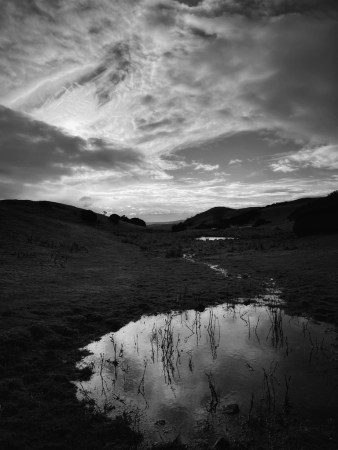
In part one, we travelled through a world of autumn’s dying colours to consider the continuing life beneath the earth – the world of the root. There is an inevitable sense of loss as the warm months fade away, leaving us with memories of pale blue skies and the perfume of the summer days… and the fullness of life.
We are presented with a ‘bare’ world, where only evergreens break up the grey and ochre of the wet and frozen world of winter. But we know that life continues beneath the damp earth, indeed, we can say that the very foundation of upper (or outer) life is approaching a subterranean frenzy. The beneath is also the world of the ‘blind creatures’ such as worms, whose role is essential to the quality of the soil and hence the continuation of life on earth.
We are not present to this world, though it supports our life. Even if we could see into it, our normal range of bright and varied colours would not be present. It’s a good illustration of how fundamental colour is to our sensory existence. We associate colour with life and health; we say ‘you’re looking’ pale. And mean that someone is ‘off-colour’.
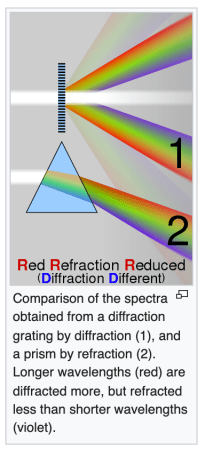
Much of our existence is based on seeing the colour of things; so, let’s have a closer look at colour. We all remember the school experiment where a beam of light is separated into the colours of the rainbow as in the image, above.
We can probably name the colours if this rainbow, and in right order, but, if asked to name the single colour from which they came, we would reply, ‘white light’. If, at night, we employ a domestic torch and point it at an object, we would see its features and colours highlighted in the circular beam. But we may not stop to consider what colour that beam is before it reaches the objects.
If we stand back, holding out our torch arm, what we see is a beam of light made slightly visible by tiny dust particles in the air. In all other respects, the beam is colourless and invisible. It is not white light, it is bright light. Light is visible to our eyes as brightness, but only visible as colour when it reflects off something else.
The property of colour is a puzzle for science. It can be described, mathematically, as a vibration – a wavelength and frequency; and even a particle – but its experience in consciousness cannot be described in scientific terms. To our minds, the idea of a warming red is the simplest of experiences but our consciousness of it remains outside of the descriptive powers of science. It is as though its realm existed before science… and has never been subject to the powers of number as quantity.
The fact that light has no colour except ‘bright’ might make us think that nature has set a trail for us to follow? When bright light strikes an object, its ‘rays’ are reflected. Used to our scientific thinking, we assume this reflection is to ‘everywhere’ within range of the object; but the experience of colour is present only in ‘your’ eyes – and each human has a unique experience of their own colours.
The meanings of the word ‘reflection’ are many. The mechanism for colour’s perception is only one of them. Psychologists have long detailed the mechanism of ‘projection’, which externalises powerful aspects of our conscious and unconscious natures onto other people. The implications of this are seldom discussed as part of everyday life, and yet they are as important as the fact that the traffic-light ahead has just changed to red.
Everywhere, there is reflection. In the summer, we drink the colours, yet we are the source of their meaning and effect, the sea in which they generate their emotive results. In the winter, we are robbed of this brightness… perhaps to make us look harder?
The winter takes away much of nature’s outer colours. The solar brightness fades and we are left to explore the life that is ‘dormant’ yet busily unseen beneath the earth. It was no accident that many of the ancient religions and mystical schools had their most potent rituals in association with this period approaching the shortest day and longest night. Sunrise on the winter solstice was considered one of the most powerful times of the year. Its effects were on the natural world, most certainly, but also on the inner person, the one from whom the ‘colour of life’ originated. Infused, he or she would be filled with power seeded in the deepest winter. Thus, the priest earned his influence and his respect.
Just as the summer solstice celebrated and enjoined the powers of the full visible outer cycle of nature, so too did the winter solstice celebrate the height of the invisible powers of nature at work in that which is fundamental to – and the basis of – the inner life.
It’s not obvious, but we have the deep, ancestral and unforgotten ability to attune with this profound time in the spiritual calendar. All we need to do is open different eyes to the Sun behind the Sun.
©Stephen Tanham 2021
Stephen Tanham is a Director of the Silent Eye, a journey through the forest of personality to the dawn of Being.
http://www.thesilenteye.co.uk and http://www.suningemini.blog
Share this:

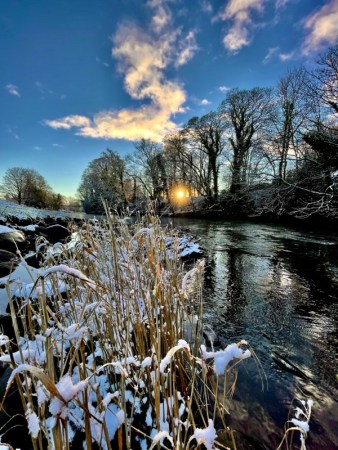
I walk a lot. it’s a necessity when you have a collie. Fortunately, we live in the country and the scenic walks begin through the gate in the bottom of the garden…
There are lots of variations, but the standard walk, when we’ve only got an hour or so, is to follow the line of the old canal for about twenty minutes, then take a sharp left, which then turns sharp-left down across farmland and into a ‘tunnel of a path’ that leads to the meadows beside the River Kent.

The walk begins by crossing two fields which usually house local sheep. Here we encounter the first of the ‘bridges to nowhere’, as we have named them. It seems to be a popular nickname, as we have noticed others using it… The original land has been bought by householders or farmers. It can be incorporated into agricultural land or landscaped as part of a garden, but may not be built on, as it retains the full rights of a a ‘navigation’: and basis of public transport which is protected by old parliamentary laws.
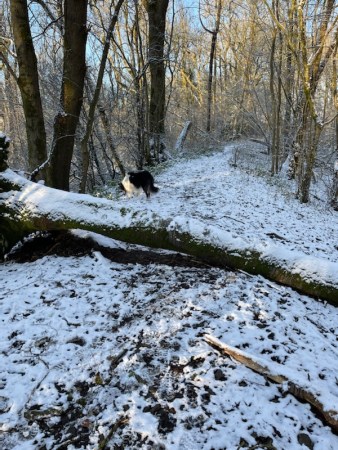
The walk then enters a small forest, again following the line of the old canal. Here the old towpath is currently blocked by three large fallen trees which will probably take months to chainsaw into pieces and clear.
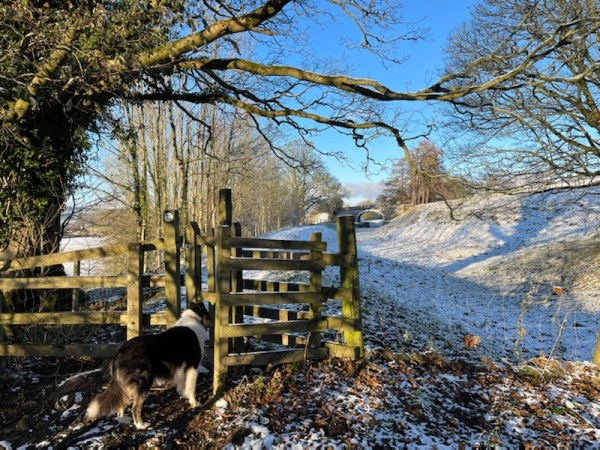
The stile, above, marks the end of the forest. Still on the old canal towpath, we approach the last of the ‘bridges to nowhere’.
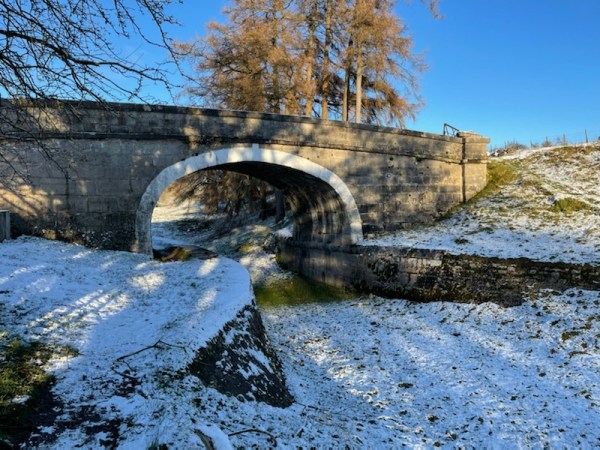

Here, we leave the canal path and descend into the adjacent sheep-meadow. At a gate, this narrows into a track that skirts a second forest before turning sharp left and descending to the meadows that borders the River Kent.
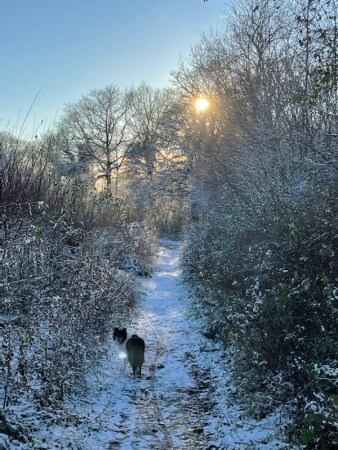
At the end of this descent is a final gate. Through this we reach the edge of the River Kent, one of Cumbria’s rivers that flow out into the northern side of the vast Morecambe Bay.
I decided, long ago and in one of those philosophical yet anarchic moments, that certain sections of a walk tend towards a ‘particular kind of emotional feeling’. It’s a bit like ‘strange attractors’ in Chaos Theory – a comment I will explain further in a coming blog, but, for now, let me illustrate the idea by saying that every time I have passed this beautiful section of the river, I have had a peaceful feeling, but one that has a deeper component.
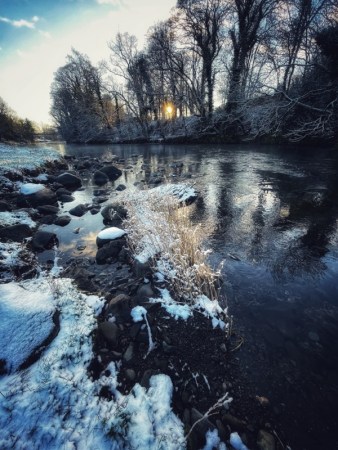
At first this was a vague feeling, but in the past two years it has resolved itself into an warm and peaceful feeling of ‘acceptance’. The idea of acceptance will be familiar to those whose life-journeys have taken them into anything mystical. The ‘doctrine’ of acceptance says that to resist what ‘already is’ is futile. We can spend years resisting something that we despise, but we cannot refute that ‘it is’. By the time we have accumulated enough energy to truly resist, the ‘battle’ has moved on to something else; which in turn we may view as good versus bad.
As the years pass, I have realised that much, if not all, of this is in the head of the individual. The real battles are those that take place in our consciousness… and heart.

More of this in posts to come. Hopefully, these images have illustrated the walk to the River Kent’s ‘watery curve of acceptance’, allowing me to further discuss this at another time.
Perhaps you, too, have a favourite place that has, over a period of time, introduced a deeper understanding of a characteristic of reality that has become precious to you?
©Stephen Tanham 2021
Stephen Tanham is a Director of the Silent Eye, a journey through the forest of personality to the dawn of Being.
http://www.thesilenteye.co.uk and http://www.suningemini.blog
Share this:

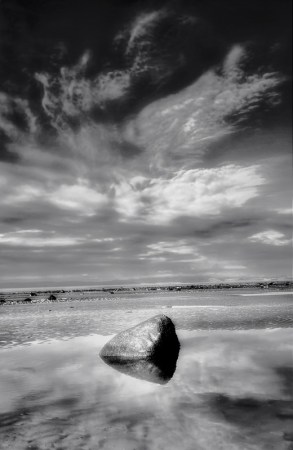
It sat there… peaceful; serene, even. The tide came in, washed off the loose, blown sand, then went back out. Pretty much like any other day, really. But the rock knew this day was different…
The young boy came over and stared at the rock, as he had done most days since that first day – the day they had started speaking to each other.
“Can we talk?” asked the young boy, his golden curls flying in the summer breeze. The plastic bucket and spade dangled from the fingers of one hand, the spade about to fall out and onto the sand.
“I’ve got to go away,” said the boy. “Auntie Sarah is better now and mum says we have to catch the train and go home.” He shuffled his bare feet on the sand, digging with his toes.
The rock said nothing. But it did look sad.
“You could come with me?” ventured the boy, but without much hope. “ I suppose you’re a bit big for my small suitcase…?”
The rock nodded, thinking how much of its shape was below the sand, even below the ever-refreshed water pool in which he lived, like a king with a moat. No castle, just a moat… unless he was the castle. He often wondered about that. A friend rock had said that was an existential issue that he shouldn’t lose any sleep over.
“There’s always a way,” said the rock, sensing the boy’s sadness. “You just have to hang on till everything else falls off… then it’s there; what you wanted.”
The boy thought about it, then walked all the way round the rock, as if studying it. He said nothing, but waved his spade as he trundled back up the beach towards his mother.
——
“Bloody miracle – a train on time…” said Dad, fifteen minutes late to the station at Fernmoor. “Cat got yer tongue?” he said, half turning to the back seat. Roger continued his silence… not even gazing out of the window, just staring straight ahead, letting it all fall off. Mum said nothing, too. But for other reasons…
Once home, the boy ran through the house and made straight for the back door, not even looking at the pile of accumulated comics sitting on the toy box.
“He’s keen!” Muttered Dad, walking to the window to follow the flight of his son. Then he froze, drumming his fingers on the cold glass.
“Cynthia!” he said “Is that your giant rock sitting in the garden pond!”
©Stephen Tanham 2021
Stephen Tanham is a Director of the Silent Eye, a journey through the forest of personality to the dawn of Being.
http://www.thesilenteye.co.uk and http://www.suningemini.blog
Share this:

+ #Silenti, Consciousness, Ecology, landscapes, Mystery Schools, nature, Photography, Seasons of the year
The other side of colour (1 of 2)
by Steve Tanham
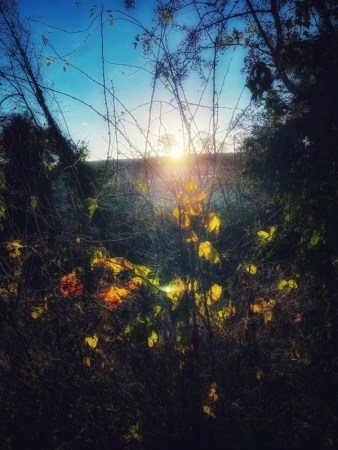
It’s a poignant time of year…
I love colour. I’m sure we all do. It’s difficult to say farewell to the mellow flashes of autumn; to know that it will be four months – one third of a year – before renewed colour returns in full to this beautiful land.
It’s important to make the best of the last; to have the camera always ready for those few instances of brightness holding out against the rising trails of mud.
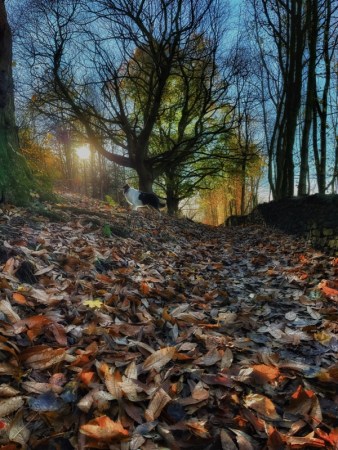
I’m a bit sentimental about this. I always say a silent thank you to the traces of colour that retain their brightness against the brown and grey. Sometimes, I find a single object worthy of more detailed study and bend or kneel to take a close-up shot of it. My favourites are ‘lines of things’ that draw the eye into the distance.
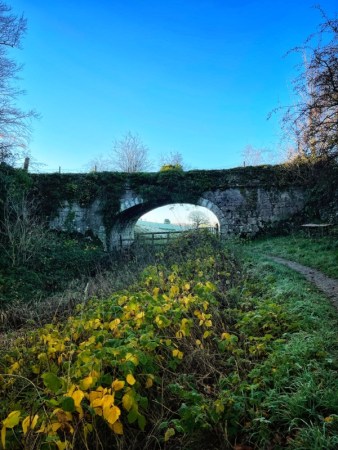
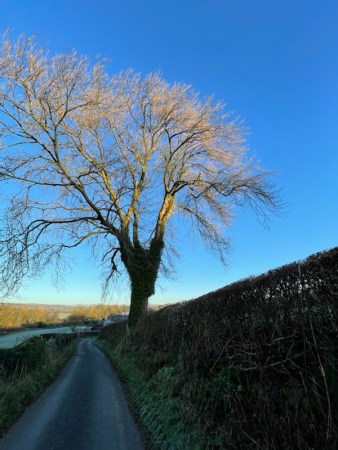
There are compensations… The blue skies of the winter are more intense than the summer’s softness and pastels. Best in the early morning, as below, when the sun’s capture of the leafless and bare branches of a tree contrasts in a deeply poetic way with the frosted darkness below it.
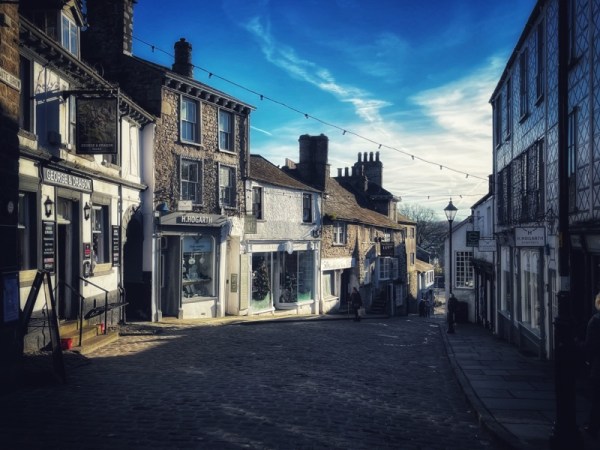
Buildings, too, respond to the stark contracts between winter’s light and shadow. The days are short, but the energy in the sky often makes up for this with intensity.
It’s important that we find a way to react to the darkness, loss of colour, and short days in a positive way. That seems a tall order… but perhaps the winter has a story of parallel life to that of the spring and summer: one that is the key to our own psychological well-being… and one that may even have significant signposts to our spiritual development.
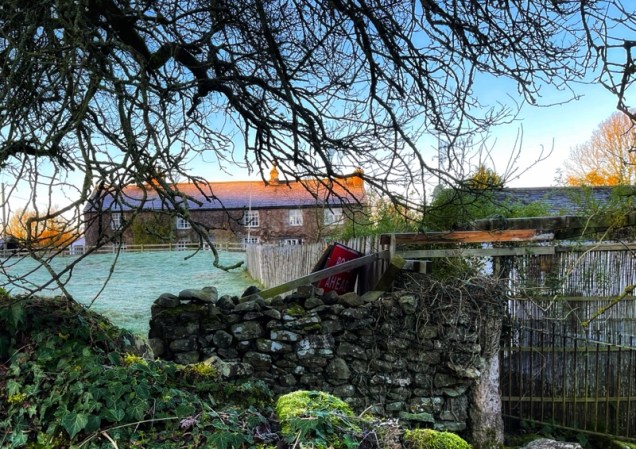
The ancient world had a different perspective on the ending of colour and the decay of ‘life’s bodies’. In this view, the processes had not stopped, but had removed themselves to the space beneath the ground, where, protected deep in soil, their activity intensified. The roots of organic forms are, literally, the foundations of life. In this view, life does not begin in the spring; it begins at the winter solstice deep in the warm and nurturing earth where there is protection from the bare, saturated and freezing surface of the earth that bears the full force of the winter… As do we.
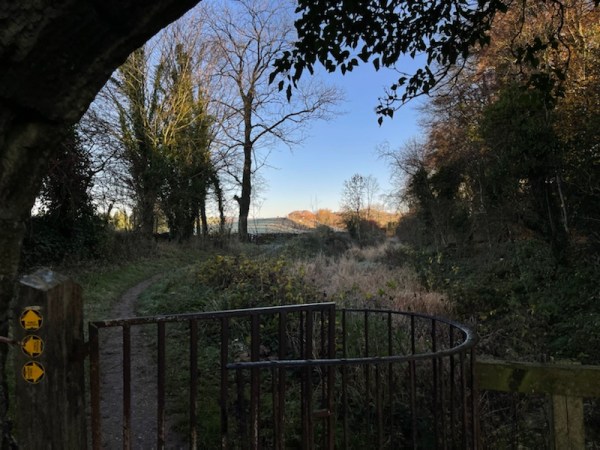
We live on that bare and freezing surface, but we have been gifted intelligence to mitigate the hardship. We also have eyes to see the whole process of the four seasons, each with its own definite purpose and ‘essence’. Such a quaternity features strongly at the heart of many of the ancient myths and religions.
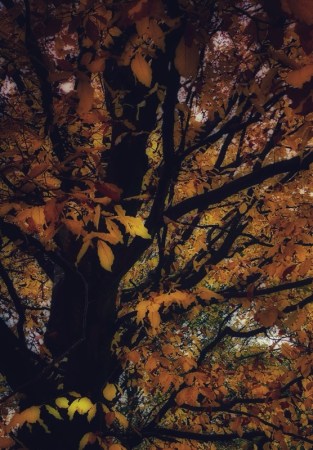
I cannot follow the underground life with my camera. And even if I could that life would look quite alien and colourless, just as our organs would if we saw them outside the body. Their beauty is in the function they perform for the whole rather than the dance of colour in the visible world.
One day, our own physical organs will falter, then fail. Whether we see this as death or an embrace of unity depends on whether we can find a parallel in ourselves.
Perhaps our task is to see the cycle of four seasons as a whole, taking rest when we can in the darker months and letting a different, more contemplative part of us delve into the mysteries of life and possibly-not-death. The seasons are very present to us – they directly affect our lives and can be a threat to our survival. But to the globe of the planet, what is happening in the northern hemisphere is mirrored and reversed in the south. It is always summer, somewhere, as it is always winter, somewhere else.
Everything is in balance, as long as we see the whole of the cycle. As long as we raise our eyes to see.
To the ancients, the turning points were the four dates of solstice and equinox. The equinox gives us equal night and day, but travelling in different directions with respect to maximum light or darkness. The solistice gives us those maxima. Their significance was so great that the Christian church layered its own religious festivals over them, rather than trying to replace their historical and cultural presence. Its seldom remarked on that Jesus the Christ was born in mid-winter, at the time of the deepest darkness, rather than in the spring.
How we relate our lives and selves to nature’s entire cycle of life and death may be one of the key questions of our lives.
Our individual lives, like the beautiful leaves, dance in the sun until their term ends. We have been gifted the use of our intelligence to combat the cold and dark so that we may remain fully conscious during the winter. Our struggle – our challenge – is to locate that part of us that develops as invisible light in the darkness, and thus reconcile life and death to something far more embracing in the long life of this beautiful planet… and beyond to the Sun, which sacrifices all its life to the support of its children in all their forms.
With energy, everything else happens. With gravity and the radiation of light, the Sun provides stability and the basis of life within the Earth as well as just on its surface. Beyond the ‘big bang’ everything depended on the blue giant suns, whose dying nuclear furnaces gave us the very chemistry of life, itself.
Could we ask for a clearer lesson, or a more noble purpose, than to mirror this in our own way?
In part two, we will examine and, possibly, challenge some of the accepted ideas about colour; with the possibility that this familiar quality of life, most poignant in the autumn, will enable us to find a deeper understanding of life and death.
©Stephen Tanham 2021
Stephen Tanham is a Director of the Silent Eye, a journey through the forest of personality to the dawn of Being.
http://www.thesilenteye.co.uk and http://www.suningemini.blog
Share this:


Who knows which way-less-taken lies beyond the stile
The openings of now, unnumbered, mapped in dew
Unfamiliar potentials – whispers in the icy wind,
Cry ‘untrod, unheard’ alone in wandering air
Yet one of them, clear with rising light, will claim the right
To be tomorrow…
©Stephen Tanham 2021
Stephen Tanham is a Director of the Silent Eye, a journey through the forest of personality to the dawn of Being.
http://www.thesilenteye.co.uk and http://www.suningemini.blog
Share this:

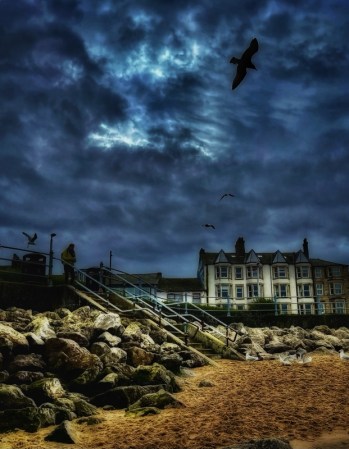
It’s not, of course. There is just a man, there is a bird and a mysteriously lit stretch of sand.
But the man – dark coat, collar up, intent on his descent… is there a gun in that pocket? Surely, he has no reason to be going down to the beach in what is clearly an early winter evening lit by the moon hiding behind the clouds.
And the bird: a very dark creature, unusually solitary. Surely not linked to the man… or his actions, though its presence has assumed cinematic intentions because of the mirroring of the direction of gull and man.
The bird’s not tame… couldn’t be, could it? A dark-coated man hurrying down mysteriously lit steps to a brightened beach… guided by a dark bird?
And then the strange band of light affecting both the rocks and the promenade buildings, beyond. Do we speculate a boat with a searchlight? Possibly a police boat chasing the man and his seagull accomplice? And have we caught the scene at the moment of his arrest? What a useful photo that would be for the papers the morning after!
And that’s the difference between the film director and the photographer. The director would be compelled – at least in some small measure – to explain what’s really going on…
Whereas the photographer knows he has only a few such moments of captured, extraordinary reality, and why spoil it when so much fun could be had by not knowing?
©Stephen Tanham 2021
Stephen Tanham is a Director of the Silent Eye, a journey through the forest of personality to the dawn of Being.
http://www.thesilenteye.co.uk and http://www.suningemini.blog
Share this:

+ #Silenti, Consciousness, esoteric psychology, Healing, Higher Mind, meditation, Mystery Schools, Photography, Psychology, Silent Eye School, Unconscious
The Size of Life
by Steve Tanham
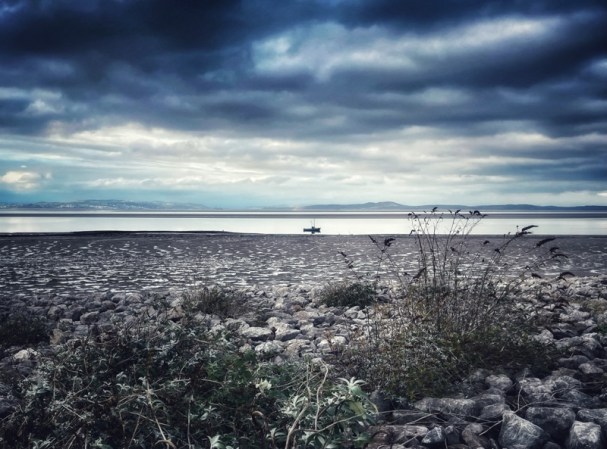
What size is our life?
It’s an odd question, but the kind of challenge that gets us thinking… Does our life have a ‘size’? We can measure it in years elapsed, of course, and that may have a lot to do with how we think we got ‘here’. But that continuity is entirely in our head, and, has little to do with the real world of now, out there. It’s curious that we allocate more reality to the solid stuff beyond our eyes than we do to the supposed ‘supercomputer’ that is busy assembling all this into reality.
Eyes, it is always said, are the ‘gateway to the soul’. But they are also the gateway to what we are taught is the world. The eyes detect a vast part of what we assemble into that world – which exists only in the mind. And yet, when we look out with those eyes, we see a world with which we are totally involved, with no sense of distance or division, and no real distinction between the in-here and the out-there – that is only added when someone invites us to consider that there may be a duality at work. Even then, the duality may be false.
There are eyes, and then there is seeing. How big is our seeing? There’s another odd question. I know that science says that what sees is in my head, but how much of my head does it take up? Is it, symbolically, like a vast cinema screen that I watch all the time, except when I’m sleeping, and maybe even then – in the form of dreams; which may explain why they make so little sense. Perhaps the part of the supercomputer that makes things make sense sleeps, leaving the connected feed to the outside world intact… But that seems not to be the case. The senses shut down the second we fall asleep, which is why we drop that teacup onto the carpet when we fall asleep in our armchair. The dream, then, seems to deal only with what we already have inside us.
The ‘me’ seems to return with wakefulness, which shows how interlinked with ‘the world’ it is. It makes us wonder what the other, dreaming self, really is? Perhaps that dream awareness is more machine-like than we think? Or maybe it’s just connected to the universe in a different way…
Back to size. In my waking ‘self’, I don’t feel any size at all. I have been taught by the world that I’m a certain size, so I behave according to that and perhaps look to bolster my medium height with other strategies that make me important, which makes my-self feel good.
But really the ‘point’ of me has no size at all. It’s simply the act of watching. When my mind is not watching the world, it is usually in that dream state, because the constant change of sensual stimuli is not present. If there are changing things out-there, my mind is busy watching and interpreting them. There is even a kind of voice that narrates the watching, giving each thing its name, like in the Bible book of Genesis. We are not only close-coupled with the world, we are also habituated to narrating its stream of existence.
Why is our existence so complicated? Mystically speaking we have two answers: It may not really be so complicated at all; and, secondly, finding the answer is what makes the whole journey so worthwhile.
In order to get out of our habitual way of being locked into the world and give our deeper ‘self’ its rightful place, we need techniques that ‘shake’ the questionable foundations of our perception. One of these, handed down from the spiritual wisdom of old, is related our opening focus on size.
Place a candle in front of you. Lean forward to light it. Be conscious of the distance. Sit back in your chair and focus only on the very centre of the flame. Notice its twin nature, with intense brightness forming a ring around a sometimes black centre where the flame begins.
Now imagine that your world is the bright ring. See its constantly changing nature and watch how it commands your attention. Then gaze into the middle – the point of origination of the flame – and let your whole attention be drawn into the central dark area within the light. Feel the unity of both aspects of the flame but know that your own ‘point’ of true self is at the centre, and that the rest is a process of reflection. Imagine you are nothing (no-thing) in that central point, yet completely present to everything.
©Stephen Tanham 2021
Stephen Tanham is a Director of the Silent Eye, a journey through the forest of personality to the dawn of Being.
http://www.thesilenteye.co.uk and http://www.suningemini.blog
Share this:


It’s a building I’ve always loved – along with the period from which it came. It looks modern but it was opened in July 1933, at the height of the Art Deco movement in architecture and design. Morecambe, along with most of the classic ‘railway seaside resorts’ has had its fair share of economic challenges since, but the ‘mighty Midland’ remains classy, elegant and, above all, popular.

The hotel was designed by Oliver Hill with interior decoration by Eric Gill. It lies across the main promenade from the station building of the old London, Midland and Scottish Railway, which, at its height, was one of the largest railway companies in Britain.
All the railways hotels owned by the group were named ‘Midland Hotel’. There were also close ties with the nearby ferry port of Heysham, from which ships travelled to Ireland, Scotland and the Isle of Man.
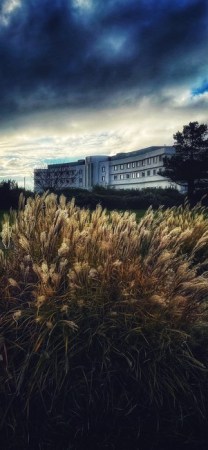
The Midland has always been a favourite of celebrities. These have included Coco Chanel, Sir Lawrence Olivier and Noel Coward. The hotel was the centre of a swathe of Art Deco buildings that made 1930’s Morecambe world famous. Among these were the ‘Super Swimming Stadium’, one of the largest Lidos in the world, with a main dimension of over 400 ft. and the ability to accommodate 1200 bathers and a further 3000 spectators.

Sadly, the rising costs of running this old pool resulted in it being demolished in the 1970s, but there may be good news for the town and the region in the shape of the Eden Project North – a vast marine centre, reflecting the bio-diversity of Morecambe Bay. The plan (below) to build a four-dome marine centre on the site of the old Super Swimming Stadium is in its final planning stages.

The designer of the Art Deco Midland Oliver Hill was a visionary who believed in such buildings, backed by the ‘spirit of the new’ that so typified the 1930s. He realised that the new hotel would give him a chance to put into practice his vision and took personal control of its creation and construction.
Hill observed that “You have here a unique opportunity of building the first really modern hotel in the country.” Hill also took a keen interest in furniture, décor, upholstery and costumes and had gained a reputation for his extravagant interiors using such materials as glass, chromium, vitrolite, marble and exotic woods.
Hill believed that the exterior design should be intimately linked to the interior decor, and followed the details right down to the colour of the hand towels and the shape of the door handles. He saw these as counterpoints to the austerity of (1930s) modern architecture, providing harmony and balance in an age that was considered quite shocking… and often ‘cold’.
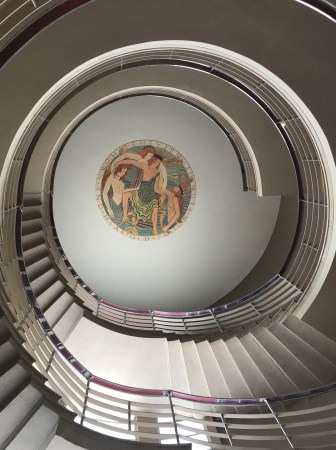
The Midland Hotel is also famous for its sculptures and murals. Oliver Hill commissioned the renowned sculptor and engraver Eric Gill to carve two seahorses for the outside of the building. Inside the building he carved a circular medallion in the ceiling overlooking the staircase. It shows a sea god being attended by mermaids and is edged with the words “And hear old Triton blow his wreathed horn”. Gill also designed an incised relief map of the Lake District and the Lancashire coast for a wall of the South Room, which is today the Eric Gill Suite.

Sadly, the hotel fell into disrepair from the 1970s onwards, like much of the rest of the town. The Midland Hotel was forced to close its doors in 1998, and stood derelict and at the mercy of the sea for nearly ten years.
In 2006 the Manchester-based property developer, Urban Splash, finally commenced restoring and refurbishing the building. Without Urban Splash this beloved building would have been demolished. The success of what Urban Splash achieved was totemic for Morecambe; and galvanised the old town into seeing that things could change. The council began to redevelop the entire promenade – all three miles of it! Today, Morecambe is talked about as an example of a Victorian resort climbing out of the ashes of its past – whilst retained the best parts of its history.

The Midland re-opened its doors on the 1st June 2008, with beautifully restored existing features, such as the grand cantilevered staircase and a number of artworks by the renowned artist, Eric Gill, which had been illegally removed from the old building.
It’s easy and reasonably priced to dine at the Midland. The Rotunda bar admits dogs, and the Murder Mystery evenings are really well done, and lots of fun. We took our French relatives for one of these evenings three years ago. The murder theme was based on the TV series ‘Allo, allo.’ The leading actor was playing a Frenchman and came round to our table to introduce himself. I explained that we actually had two French people with us… he stared at me in horror before saying, “Zut, alors, what could possibly go wrong!)
I’ve written quite enough for one blog, but hope to do more on this subject in the future. Time to let the timeless and beautiful lights of the mighty Midland’s front doors say night night…

©Stephen Tanham 2021
Photographs by the author unless otherwise stated.
Stephen Tanham is a Director of the Silent Eye, a journey through the forest of personality to the dawn of Being.
http://www.thesilenteye.co.uk and http://www.suningemini.blog
Share this:

+ #Poetry, #Silenti, Consciousness, esoteric psychology, Politics and Power, Silent Eye School, Speaking truth to power
Within the mud, that narrow eye…
by Steve Tanham

He died when I was thirteen; but none of us knew his full story, which he refused to glorify. He lied about his age to join the Army. He survived WW1, including the Battle of the Somme, and enlisted again, for WW2.
The fact that he was an Irish citizen gifted me an Irish passport, allowing me to have dual citizenship and remain a European citizen after Brexit, something deeply important to me, and to many others.
We cover the truth of the ‘Great War’ with solemn ceremony that hides us from the screaming. It’s well-intentioned. The war poets – who were there – such as Siegfried Sassoon and Wilfred Owen, described the horror as it was.
The man in the picture came home to Dublin, then moved to Bolton, where he met my grandmother. He never talked about the war. Drink dominated much of his life, and corresponding poverty my Grandmother’s. My father and his siblings had difficult lives until they were old enough to create their own futures.
I could never judge that. I wasn’t at the Somme. I didn’t come home shaking and coughing. I didn’t sell my medals within two weeks of returning from France.
I created the above montage in Photoshop some years ago. The core photograph is real. The rest of the artefacts have been placed on the image. We spent a day at the Imperial War Museum in London, learning and photographing the objects that would have been his world, including the medals.
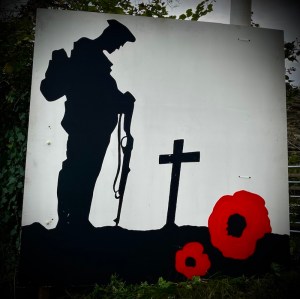
I wrote the poem, below, in tribute to Grandad, and also to those war poets whose stark honesty inspired my youth. Europe would emerge from the ‘world wars’ with a determination to shape a continent in shared prosperity whose values began with peace and marked an end to the glorification of war.
It didn’t happen quickly. Nothing hard ever does. Britain played a great part in that work, and our dead of both wars deserve our respect and our silence…
Thank you Grandad Tanham. And thank you to all those who were there with you, many of whom did not return from those sad trenches where human suffering reached a new low.
_______________________
Within the mud, that narrow eye
Focussed further, blinking dirt
Of rifle pointed at the foe
Forgetting lice at four
Or deathly cries of left-behind
Those comrades from next door
Back in the dark tenement
Of where you took King’s shilling
A thousand days of shells and gas
And stench and blood
Ago…
——-
Ignoring bullets, the eye that did not blink
Curled light through Enfield’s barrel
To find the only thing that truly lived
Above this trench of suffering.
And in the Sun of the beginning
Found the end of war…
©Stephen Tanham 2021
Stephen Tanham is a Director of the Silent Eye, a journey through the forest of personality to the dawn of Being.
http://www.thesilenteye.co.uk and http://www.suningemini.blog
Share this:

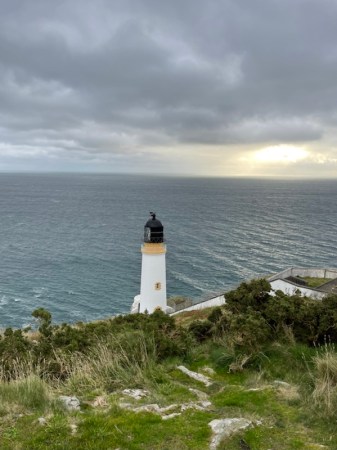
We have friends who live on the Isle of Man, a once-Viking stronghold which lies in the Irish Sea between England and Northern Ireland. Once or twice a year we exchange visits. I’ve always been fascinated by the presence and the symbolic importance of lighthouses, and this trip offered the opportunity to discover a new one, in a wild and wonderful setting.
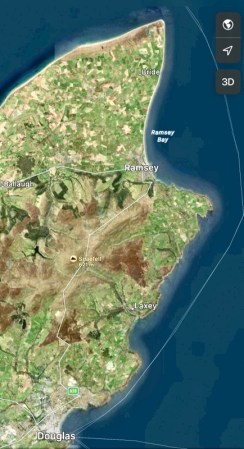
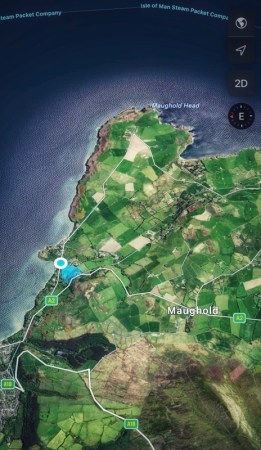
Our friends live close to the sea in the area just east of Ramsey. Mark is a keen walker and has explored most of the local paths. We had a morning to spare while the ladies visited the town. Mark proposed a walk to Mooar Bay whose return leg would take in the Maughold Head Lighthouse.
To me, a lighthouse is more than just its physical presence. These are quite ‘ancient’ monuments to mankind’s ingenuity and our desire to protect and guide those brave enough to sail on the unpredictable sea. I find in that a parallel to the mystical path, and those who have gone ahead to explore what appears to be a mysterious world where solid land gives way to the more shifting realms of our shared sea of underlying consciousness…
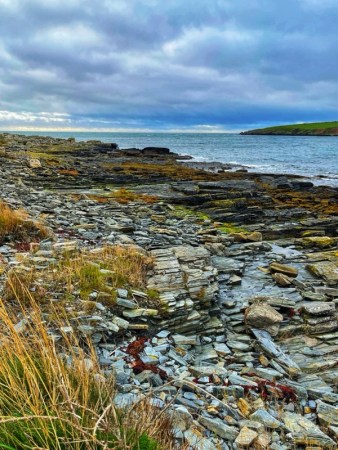
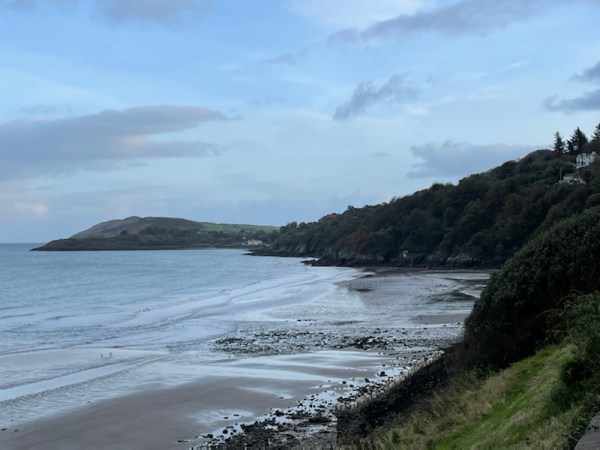
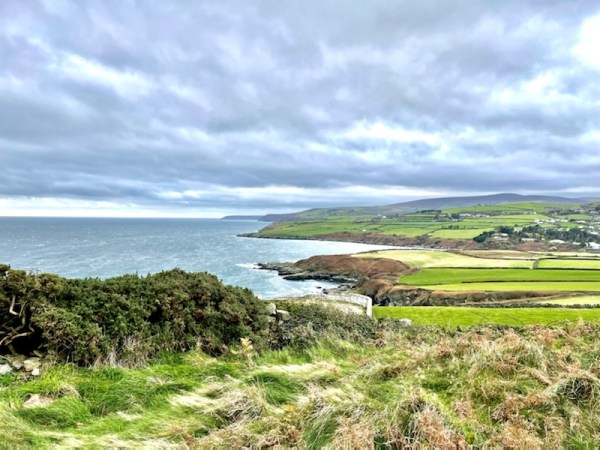
November is an enjoyable time to visit the island. The TT Motorcycle races are in the summer, when, for two weeks, the place is packed with tourists. In contrast, the pre-Christmas months are quiet, and you can often have an entire cove to yourself, as we did when we reached the farthest outward point at Mooar Bay: photos above and below.
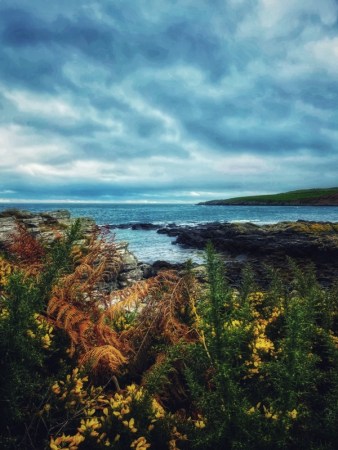
Until Mooar Bay, we had been following the county lanes. Now, it was time to leave the security of the paved tracks and pick our way across the rocky shores and onto the coastal path – which rises steeply towards the distant Maughold headland and its lighthouse. The gentle walk soon became a lung-stretching climb, as we got our first glimpse of the lighthouse.
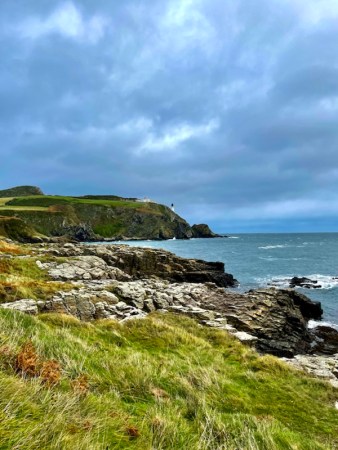
A lighthouse is a fixed object, yet it guides those who are travelling. Its light rotates – each one a unique number of seconds to complete a rotation. This warns the mariner to avoid the deadly rocks, but also shows them where they are, with reference to their nautical charts. A sighting of two such ‘blinking’ lights leads to a process of triangulation, whereby a ship can locate its precise position. Take two of these over an interval and you have a line of travel – the course you are on.
In the days before satellite-based location systems, this (and the stars, if you can see them) were all the sea traveller had to locate themselves, often in perilous and stormy conditions. After that, survival was down to good maps and even better seamanship.
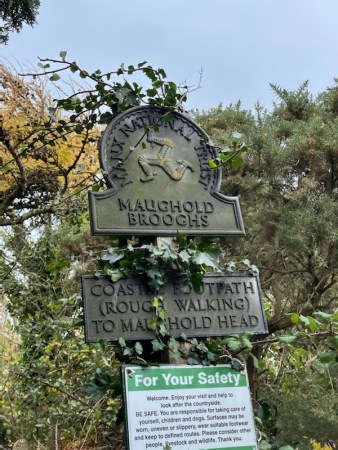
It’s interesting and symbolic that the lighthouse helps mariners to locate themselves. We can compare this with the great works of spiritual writers whose power of description of the progressive experiences on the inner sea enables us to locate where we are in that great quest to arrive at an inner ‘us’. Guided by these lights, we leave behind the ordinary life of ‘the world and me’ and begin to take a different voyage – one where the shifting sea is very much a friend.
The climb was arduous, but, soon the lighthouse was not only ahead of us, but below… We stood in silence for a while. No words were necessary to augment the enduring edifice.
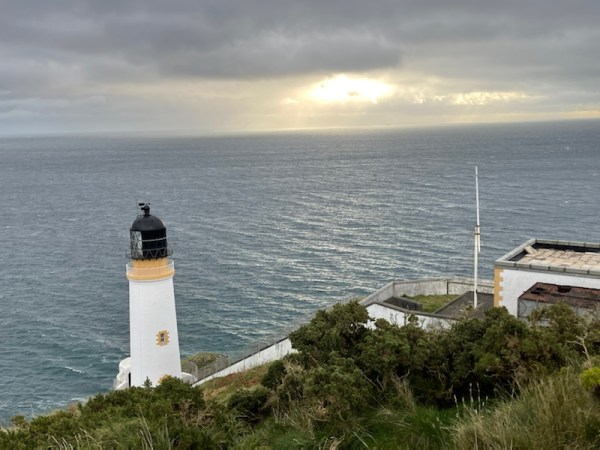
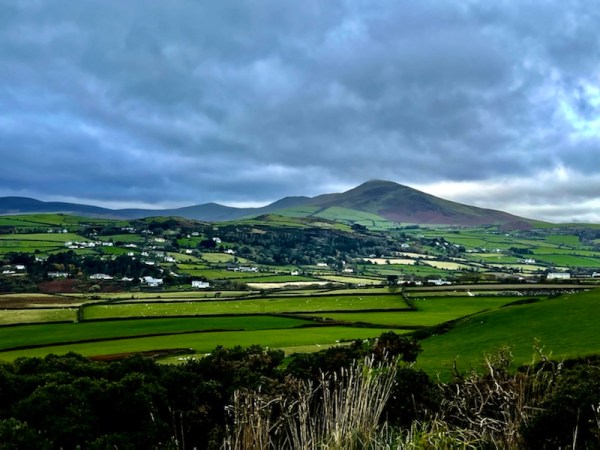
Beyond the lighthouse, the path continues to climb, until a new view is revealed. To our left and further south arose the spine of the North Barrule range of mountains, second only in height to the famous Snafell – the highest point on island, and one of the most fascinating challenges of the TT races, as the bikes climb the mountain switchbacks at over 150 mph.
Extending my lighthouse analogy, the darting and nimble motorbikes could be likened to our thoughts: useful in the moment, but unable to give us a secure path without the deeper aid of the road. The well-travelled road becomes our personality; but its routes are not the only way from A to B. Looked at from an ‘aerial’ view, we might come to some startling conclusions.
There was one more uphill section before we reached the highest point on the coastal path. From there we could see several miles along the coast to the sunlit buildings on Ramsey’s seafront.
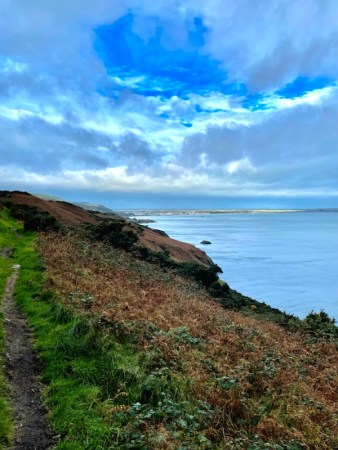
It was at this point that Mark said that we were headed for what is known locally as the ‘Bus Shelter’. The reference being to a concrete building dominating the headland at the path’s highest point. The building was built and gifted to the walking community by the original owners of this section of the Brooghs at the same time as the land was gifted to the Manx National Trust.
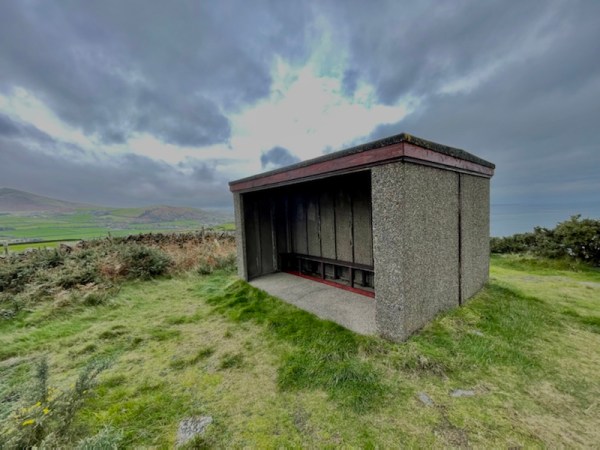
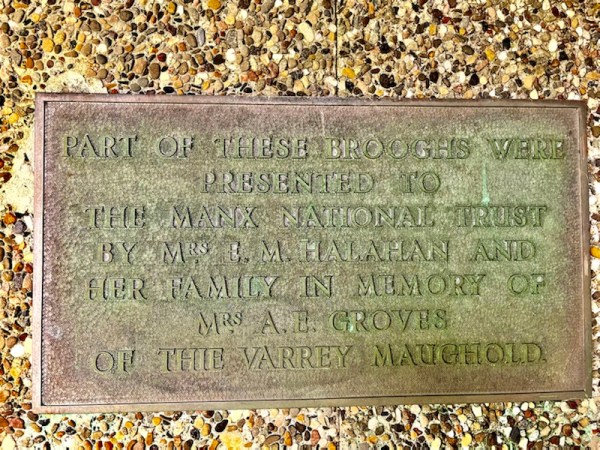
The inscription is not clear, due to decades of weathering. It reads:
‘Part of these Brooghs were presented the Manx National Trust by Mrs E.M. Halahan and family in memory of Mrs A.E. Groves of the Varrey, Maughold.’
From here, the path is much easier, gently winding up and down so that height is maintained. Ramsey is a busy working port, and several ships were moored off the coast, awaiting clearance to enter and dock.
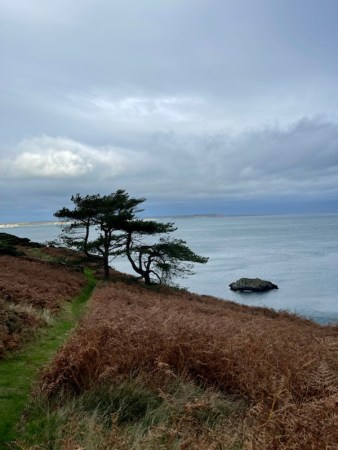
Finally, the path turned back inland, and we knew we were descending and returning to the road on which we had begun, two hours prior. But the adventure was not over…
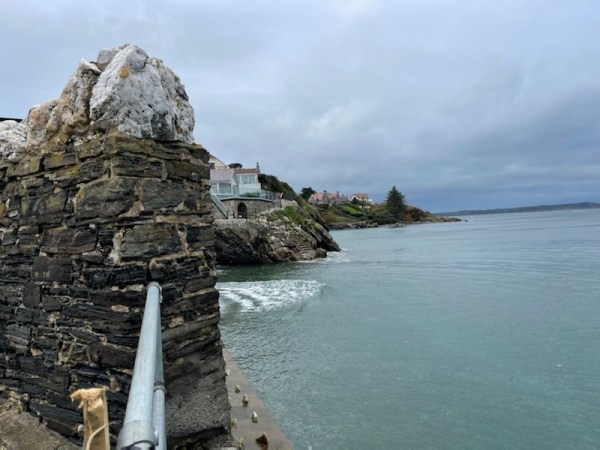
There are many grand houses, here, and several directly overlook the sea. But the ancient paths and tracks that have direct access to the beaches and sea have been maintained. You can walk down what looks like someone’s drive and find yourself overlooking the beach – with stone steps down. When I took the photos, it was high tide; the beach was under several metres of water, but it’s there and accessible whenever the tide permits.
A popular pastime is to walk, a low tide, into Ramsey, which has an excellent social life. There are no worries about having a drink or two, and you can get the bus or the famous tourist tram home. The local stop is just up the road…
Soon, we were back home, with an hour to relax before setting off for a well-deserved Manx kipper lunch at the fishing port of Peel…. But that’s for another day.
Mind you, there’s a lighthouse in Peel, too…
©Stephen Tanham 2021
Stephen Tanham is a Director of the Silent Eye, a journey through the forest of personality to the dawn of Being.
http://www.thesilenteye.co.uk and http://www.suningemini.blog


 Sun in Gemini
You must be logged in to post a comment.