+ #Silenti, Consciousness, esoteric psychology, Healing, Higher Mind, meditation, Mystery Schools, Photography, Psychology, Silent Eye School, Unconscious
The Size of Life
by Steve Tanham

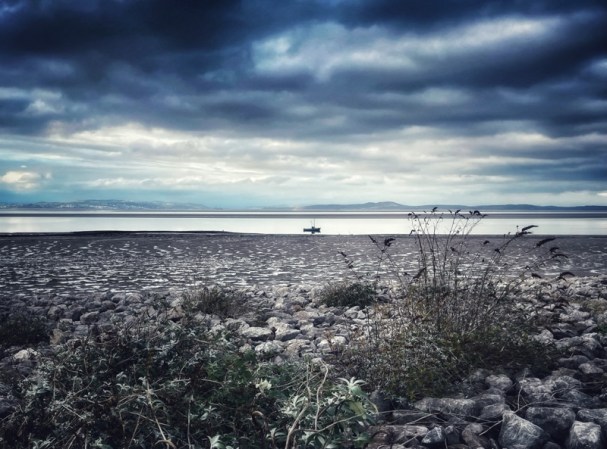
What size is our life?
It’s an odd question, but the kind of challenge that gets us thinking… Does our life have a ‘size’? We can measure it in years elapsed, of course, and that may have a lot to do with how we think we got ‘here’. But that continuity is entirely in our head, and, has little to do with the real world of now, out there. It’s curious that we allocate more reality to the solid stuff beyond our eyes than we do to the supposed ‘supercomputer’ that is busy assembling all this into reality.
Eyes, it is always said, are the ‘gateway to the soul’. But they are also the gateway to what we are taught is the world. The eyes detect a vast part of what we assemble into that world – which exists only in the mind. And yet, when we look out with those eyes, we see a world with which we are totally involved, with no sense of distance or division, and no real distinction between the in-here and the out-there – that is only added when someone invites us to consider that there may be a duality at work. Even then, the duality may be false.
There are eyes, and then there is seeing. How big is our seeing? There’s another odd question. I know that science says that what sees is in my head, but how much of my head does it take up? Is it, symbolically, like a vast cinema screen that I watch all the time, except when I’m sleeping, and maybe even then – in the form of dreams; which may explain why they make so little sense. Perhaps the part of the supercomputer that makes things make sense sleeps, leaving the connected feed to the outside world intact… But that seems not to be the case. The senses shut down the second we fall asleep, which is why we drop that teacup onto the carpet when we fall asleep in our armchair. The dream, then, seems to deal only with what we already have inside us.
The ‘me’ seems to return with wakefulness, which shows how interlinked with ‘the world’ it is. It makes us wonder what the other, dreaming self, really is? Perhaps that dream awareness is more machine-like than we think? Or maybe it’s just connected to the universe in a different way…
Back to size. In my waking ‘self’, I don’t feel any size at all. I have been taught by the world that I’m a certain size, so I behave according to that and perhaps look to bolster my medium height with other strategies that make me important, which makes my-self feel good.
But really the ‘point’ of me has no size at all. It’s simply the act of watching. When my mind is not watching the world, it is usually in that dream state, because the constant change of sensual stimuli is not present. If there are changing things out-there, my mind is busy watching and interpreting them. There is even a kind of voice that narrates the watching, giving each thing its name, like in the Bible book of Genesis. We are not only close-coupled with the world, we are also habituated to narrating its stream of existence.
Why is our existence so complicated? Mystically speaking we have two answers: It may not really be so complicated at all; and, secondly, finding the answer is what makes the whole journey so worthwhile.
In order to get out of our habitual way of being locked into the world and give our deeper ‘self’ its rightful place, we need techniques that ‘shake’ the questionable foundations of our perception. One of these, handed down from the spiritual wisdom of old, is related our opening focus on size.
Place a candle in front of you. Lean forward to light it. Be conscious of the distance. Sit back in your chair and focus only on the very centre of the flame. Notice its twin nature, with intense brightness forming a ring around a sometimes black centre where the flame begins.
Now imagine that your world is the bright ring. See its constantly changing nature and watch how it commands your attention. Then gaze into the middle – the point of origination of the flame – and let your whole attention be drawn into the central dark area within the light. Feel the unity of both aspects of the flame but know that your own ‘point’ of true self is at the centre, and that the rest is a process of reflection. Imagine you are nothing (no-thing) in that central point, yet completely present to everything.
©Stephen Tanham 2021
Stephen Tanham is a Director of the Silent Eye, a journey through the forest of personality to the dawn of Being.
http://www.thesilenteye.co.uk and http://www.suningemini.blog
Share this:


It’s a building I’ve always loved – along with the period from which it came. It looks modern but it was opened in July 1933, at the height of the Art Deco movement in architecture and design. Morecambe, along with most of the classic ‘railway seaside resorts’ has had its fair share of economic challenges since, but the ‘mighty Midland’ remains classy, elegant and, above all, popular.

The hotel was designed by Oliver Hill with interior decoration by Eric Gill. It lies across the main promenade from the station building of the old London, Midland and Scottish Railway, which, at its height, was one of the largest railway companies in Britain.
All the railways hotels owned by the group were named ‘Midland Hotel’. There were also close ties with the nearby ferry port of Heysham, from which ships travelled to Ireland, Scotland and the Isle of Man.
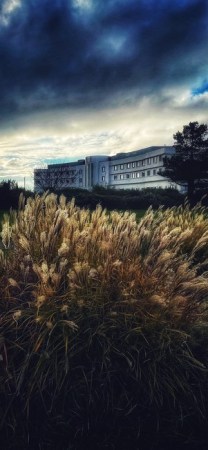
The Midland has always been a favourite of celebrities. These have included Coco Chanel, Sir Lawrence Olivier and Noel Coward. The hotel was the centre of a swathe of Art Deco buildings that made 1930’s Morecambe world famous. Among these were the ‘Super Swimming Stadium’, one of the largest Lidos in the world, with a main dimension of over 400 ft. and the ability to accommodate 1200 bathers and a further 3000 spectators.

Sadly, the rising costs of running this old pool resulted in it being demolished in the 1970s, but there may be good news for the town and the region in the shape of the Eden Project North – a vast marine centre, reflecting the bio-diversity of Morecambe Bay. The plan (below) to build a four-dome marine centre on the site of the old Super Swimming Stadium is in its final planning stages.

The designer of the Art Deco Midland Oliver Hill was a visionary who believed in such buildings, backed by the ‘spirit of the new’ that so typified the 1930s. He realised that the new hotel would give him a chance to put into practice his vision and took personal control of its creation and construction.
Hill observed that “You have here a unique opportunity of building the first really modern hotel in the country.” Hill also took a keen interest in furniture, décor, upholstery and costumes and had gained a reputation for his extravagant interiors using such materials as glass, chromium, vitrolite, marble and exotic woods.
Hill believed that the exterior design should be intimately linked to the interior decor, and followed the details right down to the colour of the hand towels and the shape of the door handles. He saw these as counterpoints to the austerity of (1930s) modern architecture, providing harmony and balance in an age that was considered quite shocking… and often ‘cold’.
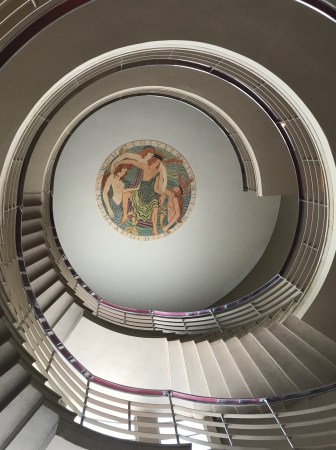
The Midland Hotel is also famous for its sculptures and murals. Oliver Hill commissioned the renowned sculptor and engraver Eric Gill to carve two seahorses for the outside of the building. Inside the building he carved a circular medallion in the ceiling overlooking the staircase. It shows a sea god being attended by mermaids and is edged with the words “And hear old Triton blow his wreathed horn”. Gill also designed an incised relief map of the Lake District and the Lancashire coast for a wall of the South Room, which is today the Eric Gill Suite.

Sadly, the hotel fell into disrepair from the 1970s onwards, like much of the rest of the town. The Midland Hotel was forced to close its doors in 1998, and stood derelict and at the mercy of the sea for nearly ten years.
In 2006 the Manchester-based property developer, Urban Splash, finally commenced restoring and refurbishing the building. Without Urban Splash this beloved building would have been demolished. The success of what Urban Splash achieved was totemic for Morecambe; and galvanised the old town into seeing that things could change. The council began to redevelop the entire promenade – all three miles of it! Today, Morecambe is talked about as an example of a Victorian resort climbing out of the ashes of its past – whilst retained the best parts of its history.

The Midland re-opened its doors on the 1st June 2008, with beautifully restored existing features, such as the grand cantilevered staircase and a number of artworks by the renowned artist, Eric Gill, which had been illegally removed from the old building.
It’s easy and reasonably priced to dine at the Midland. The Rotunda bar admits dogs, and the Murder Mystery evenings are really well done, and lots of fun. We took our French relatives for one of these evenings three years ago. The murder theme was based on the TV series ‘Allo, allo.’ The leading actor was playing a Frenchman and came round to our table to introduce himself. I explained that we actually had two French people with us… he stared at me in horror before saying, “Zut, alors, what could possibly go wrong!)
I’ve written quite enough for one blog, but hope to do more on this subject in the future. Time to let the timeless and beautiful lights of the mighty Midland’s front doors say night night…

©Stephen Tanham 2021
Photographs by the author unless otherwise stated.
Stephen Tanham is a Director of the Silent Eye, a journey through the forest of personality to the dawn of Being.
http://www.thesilenteye.co.uk and http://www.suningemini.blog
Share this:

+ #Poetry, #Silenti, Consciousness, esoteric psychology, Politics and Power, Silent Eye School, Speaking truth to power
Within the mud, that narrow eye…
by Steve Tanham

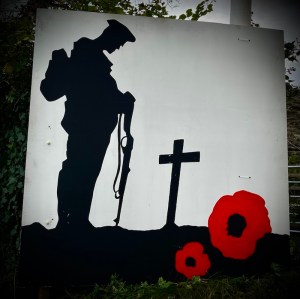
He died when I was thirteen; but none of us knew his full story, which he refused to glorify. He lied about his age to join the Army. He survived WW1, including the Battle of the Somme, and enlisted again, for WW2.
The fact that he was an Irish citizen gifted me an Irish passport, allowing me to have dual citizenship and remain a European citizen after Brexit, something deeply important to me, and to many others.
We cover the truth of the ‘Great War’ with solemn ceremony that hides us from the screaming. It’s well-intentioned. The war poets – who were there – such as Siegfried Sassoon and Wilfred Owen, described the horror as it was.
The man in the picture came home to Dublin, then moved to Bolton, where he met my grandmother. He never talked about the war. Drink dominated much of his life, and corresponding poverty my Grandmother’s. My father and his siblings had difficult lives until they were old enough to create their own futures.
I could never judge that. I wasn’t at the Somme. I didn’t come home shaking and coughing. I didn’t sell my medals within two weeks of returning from France.
I created the above montage in Photoshop some years ago. The core photograph is real. The rest of the artefacts have been placed on the image. We spent a day at the Imperial War Museum in London, learning and photographing the objects that would have been his world, including the medals.
I wrote the poem, below, in tribute to Grandad, and also to those war poets whose stark honesty inspired my youth. Europe would emerge from the ‘world wars’ with a determination to shape a continent in shared prosperity whose values began with peace and marked an end to the glorification of war.
It didn’t happen quickly. Nothing hard ever does. Britain played a great part in that work, and our dead of both wars deserve our respect and our silence…
Thank you Grandad Tanham. And thank you to all those who were there with you, many of whom did not return from those sad trenches where human suffering reached a new low.
_______________________
Within the mud, that narrow eye
Focussed further, blinking dirt
Of rifle pointed at the foe
Forgetting lice at four
Or deathly cries of left-behind
Those comrades from next door
Back in the dark tenement
Of where you took King’s shilling
A thousand days of shells and gas
And stench and blood
Ago…
——-
Ignoring bullets, the eye that did not blink
Curled light through Enfield’s barrel
To find the only thing that truly lived
Above this trench of suffering.
And in the Sun of the beginning
Found the end of war…
©Stephen Tanham 2021
Stephen Tanham is a Director of the Silent Eye, a journey through the forest of personality to the dawn of Being.
http://www.thesilenteye.co.uk and http://www.suningemini.blog
Share this:

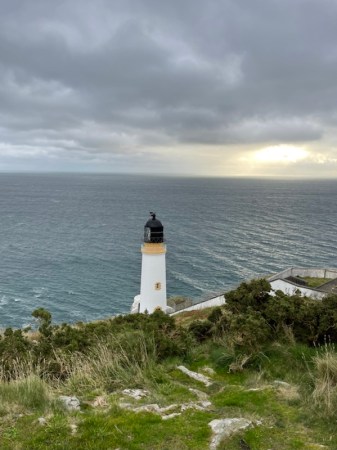
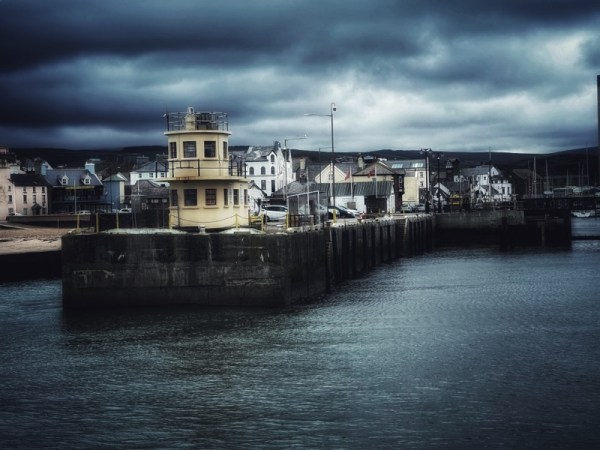
We have friends who live on the Isle of Man, a once-Viking stronghold which lies in the Irish Sea between England and Northern Ireland. Once or twice a year we exchange visits. I’ve always been fascinated by the presence and the symbolic importance of lighthouses, and this trip offered the opportunity to discover a new one, in a wild and wonderful setting.
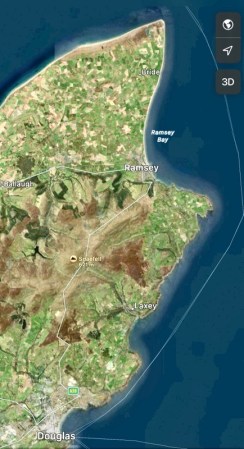
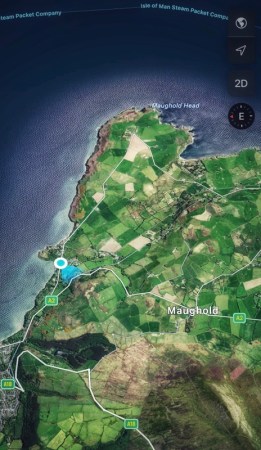
Our friends live close to the sea in the area just east of Ramsey. Mark is a keen walker and has explored most of the local paths. We had a morning to spare while the ladies visited the town. Mark proposed a walk to Mooar Bay whose return leg would take in the Maughold Head Lighthouse.
To me, a lighthouse is more than just its physical presence. These are quite ‘ancient’ monuments to mankind’s ingenuity and our desire to protect and guide those brave enough to sail on the unpredictable sea. I find in that a parallel to the mystical path, and those who have gone ahead to explore what appears to be a mysterious world where solid land gives way to the more shifting realms of our shared sea of underlying consciousness…
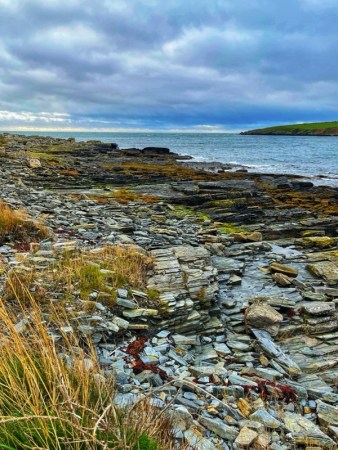
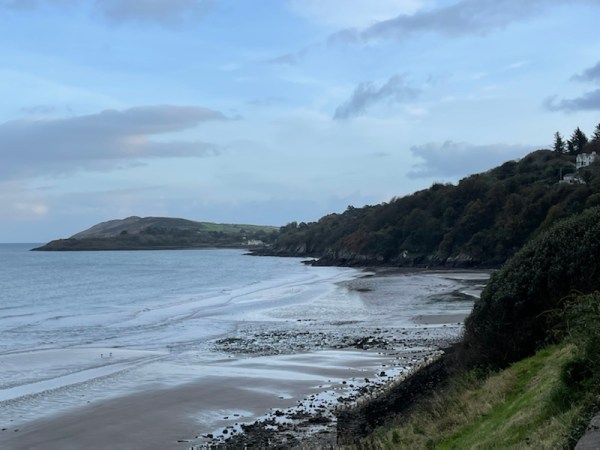
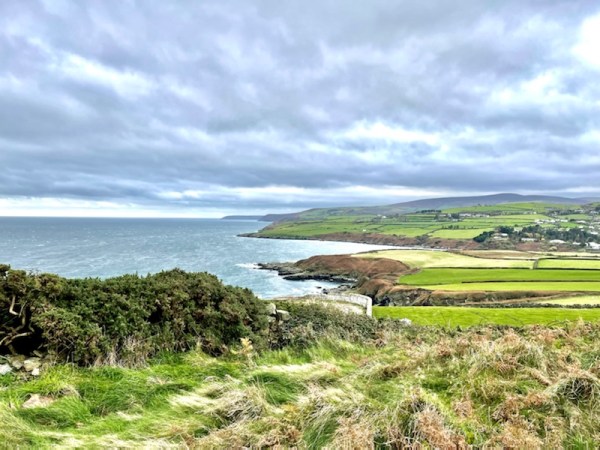
November is an enjoyable time to visit the island. The TT Motorcycle races are in the summer, when, for two weeks, the place is packed with tourists. In contrast, the pre-Christmas months are quiet, and you can often have an entire cove to yourself, as we did when we reached the farthest outward point at Mooar Bay: photos above and below.
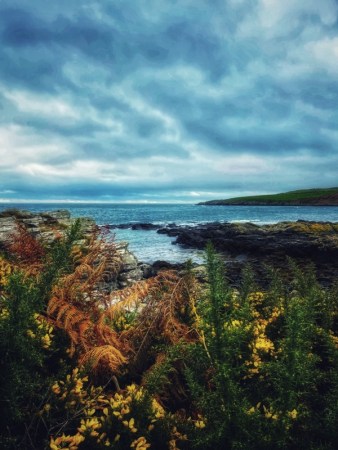
Until Mooar Bay, we had been following the county lanes. Now, it was time to leave the security of the paved tracks and pick our way across the rocky shores and onto the coastal path – which rises steeply towards the distant Maughold headland and its lighthouse. The gentle walk soon became a lung-stretching climb, as we got our first glimpse of the lighthouse.
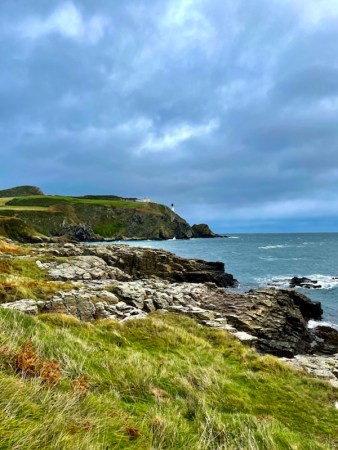
A lighthouse is a fixed object, yet it guides those who are travelling. Its light rotates – each one a unique number of seconds to complete a rotation. This warns the mariner to avoid the deadly rocks, but also shows them where they are, with reference to their nautical charts. A sighting of two such ‘blinking’ lights leads to a process of triangulation, whereby a ship can locate its precise position. Take two of these over an interval and you have a line of travel – the course you are on.
In the days before satellite-based location systems, this (and the stars, if you can see them) were all the sea traveller had to locate themselves, often in perilous and stormy conditions. After that, survival was down to good maps and even better seamanship.
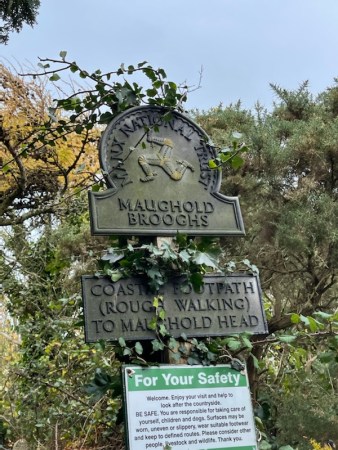
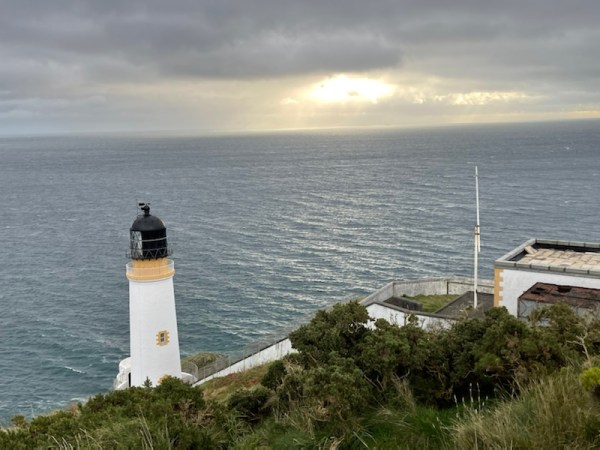
It’s interesting and symbolic that the lighthouse helps mariners to locate themselves. We can compare this with the great works of spiritual writers whose power of description of the progressive experiences on the inner sea enables us to locate where we are in that great quest to arrive at an inner ‘us’. Guided by these lights, we leave behind the ordinary life of ‘the world and me’ and begin to take a different voyage – one where the shifting sea is very much a friend.
The climb was arduous, but, soon the lighthouse was not only ahead of us, but below… We stood in silence for a while. No words were necessary to augment the enduring edifice.
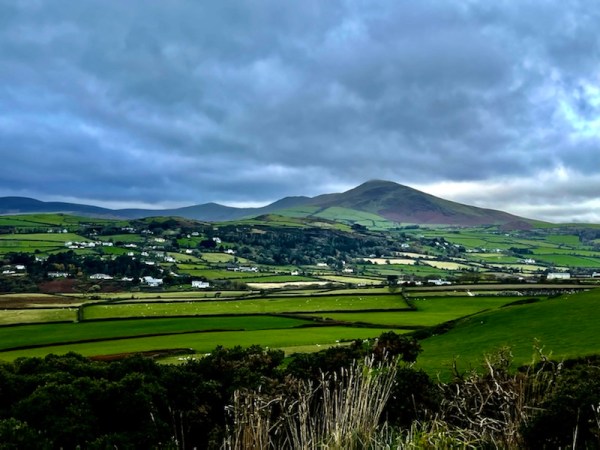
Beyond the lighthouse, the path continues to climb, until a new view is revealed. To our left and further south arose the spine of the North Barrule range of mountains, second only in height to the famous Snafell – the highest point on island, and one of the most fascinating challenges of the TT races, as the bikes climb the mountain switchbacks at over 150 mph.
Extending my lighthouse analogy, the darting and nimble motorbikes could be likened to our thoughts: useful in the moment, but unable to give us a secure path without the deeper aid of the road. The well-travelled road becomes our personality; but its routes are not the only way from A to B. Looked at from an ‘aerial’ view, we might come to some startling conclusions.
There was one more uphill section before we reached the highest point on the coastal path. From there we could see several miles along the coast to the sunlit buildings on Ramsey’s seafront.
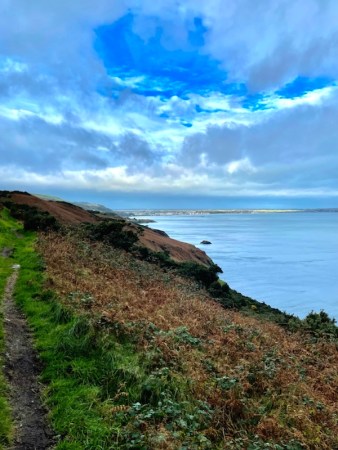
It was at this point that Mark said that we were headed for what is known locally as the ‘Bus Shelter’. The reference being to a concrete building dominating the headland at the path’s highest point. The building was built and gifted to the walking community by the original owners of this section of the Brooghs at the same time as the land was gifted to the Manx National Trust.
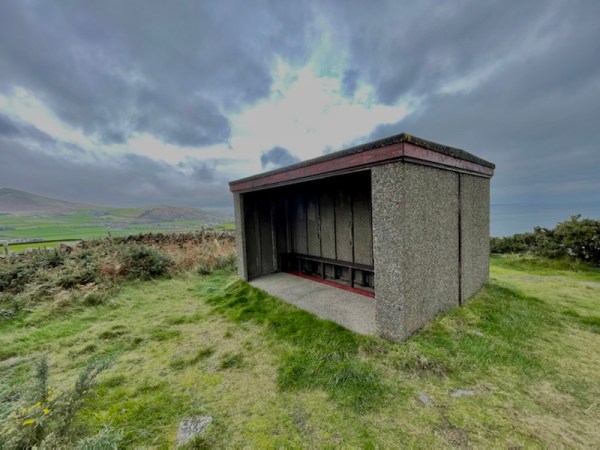
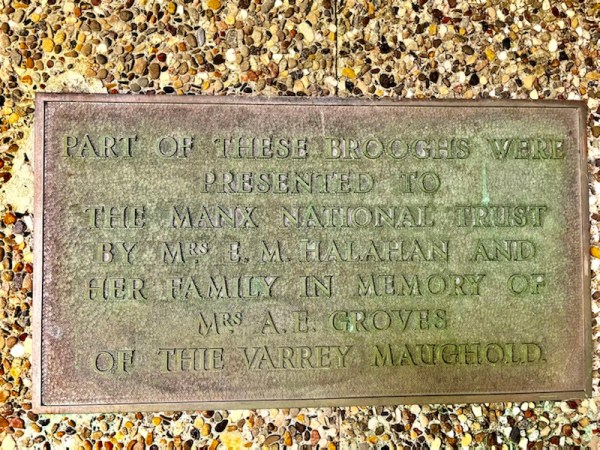
The inscription is not clear, due to decades of weathering. It reads:
‘Part of these Brooghs were presented the Manx National Trust by Mrs E.M. Halahan and family in memory of Mrs A.E. Groves of the Varrey, Maughold.’
From here, the path is much easier, gently winding up and down so that height is maintained. Ramsey is a busy working port, and several ships were moored off the coast, awaiting clearance to enter and dock.
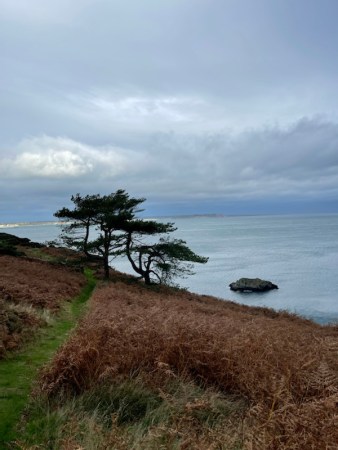
Finally, the path turned back inland, and we knew we were descending and returning to the road on which we had begun, two hours prior. But the adventure was not over…
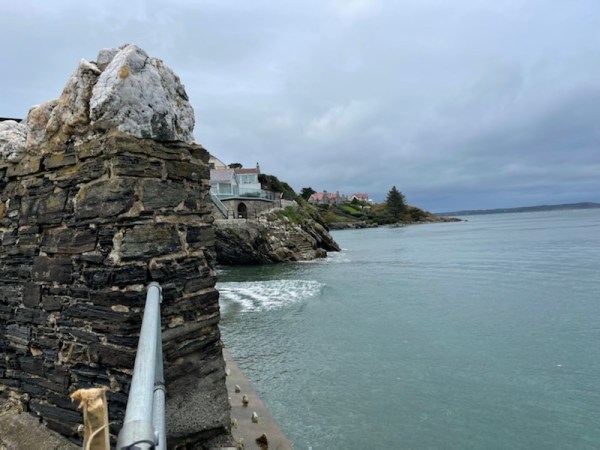
There are many grand houses, here, and several directly overlook the sea. But the ancient paths and tracks that have direct access to the beaches and sea have been maintained. You can walk down what looks like someone’s drive and find yourself overlooking the beach – with stone steps down. When I took the photos, it was high tide; the beach was under several metres of water, but it’s there and accessible whenever the tide permits.
A popular pastime is to walk, a low tide, into Ramsey, which has an excellent social life. There are no worries about having a drink or two, and you can get the bus or the famous tourist tram home. The local stop is just up the road…
Soon, we were back home, with an hour to relax before setting off for a well-deserved Manx kipper lunch at the fishing port of Peel…. But that’s for another day.
Mind you, there’s a lighthouse in Peel, too…
©Stephen Tanham 2021
Stephen Tanham is a Director of the Silent Eye, a journey through the forest of personality to the dawn of Being.
http://www.thesilenteye.co.uk and http://www.suningemini.blog
Share this:


It’s one of those love-hate things…
Apart from a bacon sandwich – crispy, of course – it’s my favourite breakfast… assuming Manx kippers aren’t on the menu…
The humble French croissant, bought frozen from M&S, baked for twenty minutes in the oven then served alongside a fresh latté made in our Nespresso machine.
We’re ‘dunkers’ my wife and I. The croissant reaches new heights of perfection when ‘dunked’ into a creamy latté and slid, skilfully, into the expectant mouth.
We’re moving pretty quickly at this point in the day. The collie needs her walk and we have to get going. But not before consuming this small feast, whose goodness will set us up for the day.
But there’s a battle ahead..
Anyone who’s ever eaten a croissant, fresh from the oven, knows that, just as your goal is to consume it while all the flavours are fresh, its ambition is to remove as much of the skin from your fingers, lips and mouth as possible; and, failing that, or possibly alongside it, spread its flakes across most of your immediate furniture, then on the floor.
Round 1: you reach for the ‘horns’ of the beast, sure that the nuclear furnace lurking in the middle is suffering from a low coefficient of heat transmission inherent in the pastry. It works for a second, until a mixture of gravity and over-confidence causes the beast to deform in your fingers and bringing the still-molten core a half-inch nearer to your flesh. The escalation of pain is so rapid that you decide to stage a tactical withdrawal.
You drop the croissant… It lies, battered and snarling, on the edge of your small plate, defying you to try again.
Round 2: You use the white serviette to create a handle around one horn of the beast. Trying it out for ‘asbestmosis’, as veterans of such encounters have named it, you manage to get it halfway to your mouth before it folds itself back over your defenceless fingers…
You look down at the leering object, freshly landed on your plate, and consider your options. The dilemma is an exquisite one that makes you admire the mind of the inventor, and wonder if he was related to a senior figure in the Spanish Inquisition.
To create such a masterpiece of taste; and know that the partaker would seldom be able to get at it in time, speaks of sadistic genius.
You wait one minute – measured by the second hand of your watch, and strike again, this time boldly. Your combined action of raising the horns and, at the same time, pulling away from the centre results in a very thin croissant ten inches long, steaming with frustration and out to get you. You’ve been here before and know that there’s still enough heat in the middle third to take the skin off your nose… So you drop it back down onto the small plate and reach for the silver butter knife that’s been there all along, winking at you… and slice through the stretched and vulnerable edges of the core; then pick up both of the now-severed horns and, laughing manically, dunk them in the still-hot latté.
They are delicious. Apart from a slight dribble of coffee from one side of your lips to the mysteriously inaccessible crease in your chin, you are unscathed and part fed. But the croissant core glares at you across the battlefield, secure in the knowledge that the small butter knife won’t be able to help you now…
Round 3: Surprise is nine-tenths of victory… with a move worthy of Bruce Lee (sorry millennials, you’ll have to look it up) you grasp first the crumpled serviette, then the small plate containing the limbless trunk of the simmering opponent. In a single pull, you stretch the serviette so that it forms a pliable extension to the plate. The elegant move, perfectly executed, slides the croissant rump onto the paper, where friction brings it to a halt, partly hanging in space, and opposite your bared teeth.
Risking a finger-tip to steady the beast, you bite a small piece off, and before the heat can fry your tongue, put down the plate and take a swig of the rapidly cooling coffee, obliterating the last of the threat from the piece of croissant.
Feeling smug, you repeat the procedure four more times. Soon, there are only flakes on the plate and a smile on your face. Not ready to face the mess, yet, you shake the serviette over the plate then tip the combine residue into the last of the coffee.
Reaching for the teaspoon, you complete your victory by creating the perfect ‘cool coffee aux flakes de croissant’ and rise to collect the dog’s lead from the rack near the front door.
It’s been a straight run of victories so far this week. But tomorrow’s another day…
The flaky remains can wait. The portable Dyson will make quick work of them when you return with a happy dog and tenacious smile.
©Stephen Tanham 2021
Stephen Tanham is a Director of the Silent Eye, a journey through the forest of personality to the dawn of Being.
http://www.thesilenteye.co.uk and http://www.suningemini.blog
Share this:


I was lucky with this one…
We’d stopped the car to buy some eggs from our local farm. I spotted the tree and its supporting mound, and noticed the exceptionally clear light in which it was bathed.
Snap first, seek explanations later…
The months of October and November have the Potential to give us morning brightness and high contrast. The tree in the above shot had benefited from both, as had the contours of the mound on which it stood.
I decided to render it in black and white, with a mild ‘smoothing’ treatment.
When I stared at it, later, I was drawn by something in the curls and curves and sparkles. The word ‘Hokusai’ came to mind.
Hokusai is one of Japan’s most famous artists, and was responsible for the well-known work ‘The Great Wave’.

I had not set out to do this. Any coincidence of ‘looks’ is accidental – and likely to be subjective. But I was pleased with the result.
©Stephen Tanham 2021
Stephen Tanham is a Director of the Silent Eye, a journey through the forest of personality to the dawn of Being.
http://www.thesilenteye.co.uk and http://www.suningemini.blog
Share this:


It’s a song by Blur and an iconic book by F. Scott Fitzgerald. The latter is autobiographical, and tells of the steady decline of his beloved wife, Zelda, as she descends into madness…
I don’t often write about dementia. But my mother’s own final years are proving to be a similar descent. She’s in a care home in Morecambe, on the seafront with beautiful views across to the Lake District where I can visit her with a short journey from Kendal… in normal times, that is…
The home is now in its third lockdown, following a mysterious and recurring outbreak on one of the upper floors; something that no-one, including the local health authority, seem to be able to get to the bottom of. People in care homes are subjected to far more screening that anyone else in the population, and yet they are the most mentally vulnerable.
The effects on the residents’ mental health have been devastating. My mother’s mental and physical wellbeing revolves around walks along the promenade into the centre of Morecambe. When Covid is not locking her up, she does this every morning, rain or shine. She’s nearly ninety-two and magnificent in her resolve to keep active; both mentally and physically. But the vascular dementia, diagnosed over fifteen years ago, is now approaching an advanced stage.
Because I have spent half my life teaching mysticism, I can see what is happening to her mind in a way that is easier to compartmentalise. From birth to the age of around seven years, we build our sense of ‘self’. Many people can remember the moment when they realised they had a self… and they stood on the edge of a changed and empowered world, full of a consolidated ‘me’ with all its hungers, fears and preferences.
This self strengthens until we mature into adults, then forms a stable layer of interaction with the world. All the ‘voluntary’ aspects of our nervous system are at its disposal. It’s truly captain of the ship, and has control of ‘the life’. It’s not the whole story, as mystical work reveals that there is a ‘higher self’ waiting to guide our lives… but that is for another post and speaks of a realm that requires the lower self to be fully functioning, too.
Part of that self-mechanism is responsible for checking itself. When we are young, we develop a tuned awareness of others’ opinion of what we do, achieve and when we disappoint. This is a conditioning that moulds our lives, and it’s central to how we feel about ourselves.
If mystical training is to be of use, this is the first thing that we need to learn to examine, checking that its values really represent the new and higher life we sense deep within us. Often they don’t; they were kindly imposed by a parental need for us to ‘fit in’ and have now become a prison. But the mechanism survives, albeit in diminished form.
The statistics tell us we are living longer, though given the levels of poverty one wonders why. On this basis, we will all face the slowing of memory and the mind’s logical workings. Are we able to equip our-selves to deal with this, not just for the care of others but also, in some small measure, for us? It’s a radical thought, and not one that psychology makes readily accessible.
Much of this is illustrated by some of my mother’s recent ‘behaviour’ – I hate that word, it makes you think she’s been ‘naughty’ in some way. It’s typical of how society shoves the elderly into a cupboard…
Typical dementia-related behaviour involves loss. Not just loss of memory, but loss of things – usually precious things, though the condition increases the sensitivity of the sufferer to the loss of anything. We’ll look at the reasons for this in a moment.
In Mum’s case, she has been losing things for years. When she was still independent, she would phone me in the middle of the night in a panic to say that ‘the thief’ had been in her house, again, and stolen her stoma supplies. She has a ‘bag’ following a near-death encounter with ulcerative colitis sixteen years ago. She rallied and has lived each day, fully, since then. But the importance of the stoma kit is deeply embedded, and often features in her panic.
Finding the stolen things was usually quite easy for me, my wife or my brother, but Mum’s mind was losing its ability to focus on problems. This is common with dementia, and shows how ‘problem solving’ is layered on top of ordinary thinking, and does not correspond with verbal logic, which usually remains high till near the end of life.
Following a fractured spine, when she fell out of bed while staying with us for a period of rest, we arranged, at her insistence, for her to go into a nearby home in Morecambe. It would take all her savings, but that was money well spent, and we weren’t worried about inheriting anything.
The first few months went well. She settled in, made a few good friends, and looked really healthy. Once Covid restrictions had lessened, the home was happy to let her walk along the prom each day, and she always came back, safely and on time. Her sense of direction – operating at a deeper level than the ability to find things, was (and is) intact.
But then the ‘thefts’ returned. And her fading mind told her that it was because none of the residents’ doors had locks… Item after item disappeared, until one day at the close of the latest partial lockdown, I was able to go in and find them hidden – by her – in her room; and action she had subsequently forgotten.
You could watch her mind working at that point – and what it was protecting was her self. She didn’t want to be ‘mad’. She wanted there to be a reason that she hadn’t been able to find the ‘stolen’ goods. The reason was that the thief was also sadistic and was putting the missing items into places where she wouldn’t be able to find them.
It’s part of the agony of having a loved parent with this condition that, no matter what you do, dementia will find a way of thwarting it. We discussed Mum’s fears with the home, who offered to install a lock in her door. For two weeks, she was gleefully happy, displaying the key on a string around her neck… until the thief returned, and something important went missing.
I walked with her along the seafront, and we discussed her new depression. She told me that she had worked out what was happening. There was a ‘skeleton key’ kept by the staff for safety, and the thief had somehow gained access to it… and continued to do so. At the time of writing, she is a depressed about this as before the introduction of the life-changing key. We are back where we started.
The sadness in watching each new thing we come up with fail is difficult to counter. Professional advice is simply to agree with them when they say something has been stolen. There is no way you can take them out of this perceived zone of peril and insecurity, because its the last thing protecting their sense of self…
When my time comes to face this decline – and I’m sure I will, given the genetics of both mother and grandfather, I want the night to be tender and for that night to know why I need to protect that most precious of possessions – my right to be the ‘me’ I’ve always known. I know that what I’ve been in this life – my personality – will die with the body. But the deeper Self will come to harvest the good of that lifetime, and learn the imbalance of the not so good. Then, we will move on, as the Cosmos constantly does… to new adventures, new learning, new development.
©Stephen Tanham 2021
Stephen Tanham is a Director of the Silent Eye, a journey through the forest of personality to the dawn of Being.
http://www.thesilenteye.co.uk and http://www.suningemini.blog
Share this:


There is within this ring of gold and green a voice
Not of the river rushing by in flood
Nor of the nearby street where cards of early Yule, like fallen leaves
Are themselves passed by, vapid and unloved
➰
The old tree speaks an ancient tongue we recognise
The naked and the dressed are what is sung
The outer life stripped bare by winter, whereas we
Rush to clothe against the growing cold, feeling little
➰
Perhaps our warmth is sign of greater being
A light revealed amidst the crying green?
Perhaps, unable to mature as race
We, as stories of old, will perish in the flood…
➰
The old tree sheds its leaves
The ground around is lit with golden death
Take it, grow and glow, his ancient voice implores
My garments – lay them, wet upon your head
And make of them a wise one’s crown…
➰
©Stephen Tanham 2021
Stephen Tanham is a Director of the Silent Eye, a journey through the forest of personality to the dawn of Being.
http://www.thesilenteye.co.uk and http://www.suningemini.blog
Share this:

+ #Cats, #Humour, #RagDollCats, #Silenti, nature, Pet Heaven
The Cat and the Executioner’s Block
by Steve Tanham

It’s made of oak and is very heavy. Sir Gawain of the Round Table knelt at it to have his neck severed by the Green Man in ‘Leaf and Flame’, the Silent Eye’s 2016 workshop by Stuart France and Sue Vincent.
I know, I played the part of Sir Gawain, the knight who wanders in search of his death, a forfeit undertaken to protect the life of his beloved King Arthur. It’s a role I’ve played many times in my mystical life, and not through choice – he’s a complex and not always pleasant character.
Gawain doesn’t die, of course, though the huge axe is swung in earnest by his seeming oppressor, following the attempted seduction by his wife. But the blade, with ferocious accuracy, does nick his neck. The small flow of blood satisfies the honour for the act begun Arthur’s packed Christmas Court.
As objects go, it’s definitely mine…except it isn’t…
The small, furry object in the photo, above, is Misti, our exotic rescue cat. “I’ve been expecting you, Mr Bond” is the most frequent comment when people meet her, or even see a photo.
The problem is, for the five years since the workshop, ‘Gawain’s execution block’ as we have come to know it, has been living at the foot of the stairs next to Misti’s feeding table, which is raised to prevent Tess, the collie, from stealing her food. We only put it there out of expediency, but soon Misti was using it as a kind of high-speed runway to complete her frequent dashes around the house…ending, paws up, on her bowl.
If you have a cat, this manic behaviour might be familiar.
And so Gawain’s execution block stayed where it was. Until recently, when with the approach of the winter months, I decided it would be better restored to its original position by the door, thereby allowing us an easier position for tying the laces on our outdoor boots – essential equipment if you live in a muddy Cumbria.
The cat agrees. She can have much more fun by the door, she says, it’s a wooden block for heaven’s sake. Which just shows the power of the imagination. And cats…sigh.
©Stephen Tanham 2021
Stephen Tanham is a Director of the Silent Eye, a journey through the forest of personality to the dawn of Being.
http://www.thesilenteye.co.uk and http://www.suningemini.blog
Share this:


Are we losing the spirit and purpose of quietness?
Quietness and privacy are intimately linked. We need that space inside us that can’t be intruded upon. It’s a place to go when we must make the most important decisions of our lives.
Are we are losing the art of privacy? Perhaps even losing the idea of a right to privacy? The result is that we are further enmeshed in the ‘machine of society’ that appears to be the world ‘out-there’; something that, from a spiritual point of view, is deadly, for it robs us of the only true source of knowledge about our real selves.
Much of this is fuelled by the digital age. Most people have far more digital connections than actual friends. Spending time with our digital friends is easy – we just sit down with our device and that cup of coffee, and message, share emails or even video-talk face to face… There is another sense of ‘needing to’ here. There is an expectation that, since we are part of this or that group, we need to spend time within it, to help keep it functioning.
It’s not the real thing, but it’s a significant part of the real thing. My son’s family live in Australia, just about as far away as you can get. We have visited, but not recently, due to Covid. The years are passing, and the joy of being face to face with our two young grandchildren is deeply missed. But at least we have the ability to make video calls, which maintains some semblance of connection. In this sense, the connectedness is a good thing. We are choosing to use the only link we have to connect. Privacy is not an issue.
But our relationship to social media is a much more complex thing. If we have achieved a stable adulthood we have the discrimination to know when to ‘pull back’ and live in the real world. But our children are growing up in a world where the expectations in digital space are just as powerful as we used to have in the school playground. There is, in the child’s mind, very little differentiation between a conversation in reality – with all its subtleties of non-verbal communication – and one carried out in cyberspace.
Recent allegations about social media have revealed an institution that is alleged to take a middle-ground opinion and steer it towards an extreme view; and this deliberately designed into the algorithms that govern what we see. To an adult this is dangerous – few of us have the time to really research a political situation, so we look for a ‘trusted’ source of condensed research. To a child, it’s deadly; forming early views that can become fanaticism: like the shooting of others in a college gardens… Once, again, the healthy mature mind is not in danger; but a mind nudged towards an extreme is.
With governments, the position of social media is even more scary. Good government is by consensus and encouragement, not the imposition by authority. The police, as tools of the state, walk a fine line between the democratic and the overbearing. With social media, we have the authoritarian’s perfect tool: a mechanism to sway opinion to a degree that will ensure a manipulation of democracy – with lies, of course; but lies wrapped up in memes that appear to make clarity of complex situations.
Life is complex. The patterns of the truth, like those of lies, must be arrived at with long consideration, for they will form the basis of how we make decisions that affect the rest of our lives.
We are not just sponges that absorb other people’s hatred. We are complex beings who take in information in a variety of subtle ways. The truth is part of that distilled information if we let it be so. If we are consumed by the prejudice inherent in whoever is paying the social media big bills, then we are not using what nature has provided us with – the ability to think, feel and decide for ourselves.
It may be that the digital age was always going to be a pathway to doom. But equally, it can be democratic and ‘info-cratic’. It need not reflect the lower part of our individual humanity – the base reactions and unthinking, inherited opinions. Most of us are not like that, anyway – except when we’re lazy and don’t take the time to value truth. Some don’t want the truth; they are happy with the sideswipes and sleaze of the ever-present gutter-press and the new gutter-bytes.
All the world’s a stage, Shakespeare wrote; now perhaps a loud concert. With the volume at max the chances of having a deep relationship with our own thoughts and true feelings is minimal. But we can ‘package’ that external noise into a single ‘thing’. And by seeing it like that and seeing that it is not ‘us’, we can push it away to a safe distance… and spend some time with the loving and deeply considering being we really are.
©Stephen Tanham 2021
Stephen Tanham is a Director of the Silent Eye, a journey through the forest of personality to the dawn of Being.
http://www.thesilenteye.co.uk and http://www.suningemini.blog
Share this:

+ #Poetry, #Silenti, Alchemical Poetry, Consciousness, Mystery Schools, Mystical poetry, nature, Nine Deadly Sins with Coffee, Seasons of the year
Pale sun into a hallows pool descends
by Steve Tanham


©Stephen Tanham 2021
Stephen Tanham is a Director of the Silent Eye, a journey through the forest of personality to the dawn of Being.
http://www.thesilenteye.co.uk and http://www.suningemini.blog
Share this:


I’m not fond of practical jokes. They’re usually performed by people – famous or next door – who you’d cross the street to avoid.
But there is a level of trickery that can be justified as long as one is prepared to face the consequences…and only as a matter of important principle.
My lovely wife, Bernie, would tell you that my most ‘celebrated’ example of this was during a holiday in Cyprus, many years ago. On the first morning, we awoke to find a parade of cats on the patio. Mindful that such places are full of hungry strays, we simply stared out of the patio doors at them.
Secure in the knowledge that they had our attention, most of them left; leaving an elegant ginger pair: father and son, to parade around our pool before junior was ceremoniously dumped on our doorstep as the ‘lion king’ went about his reproductive business elsewhere.
I’m a sucker for cats… this little fella gazed up at me as if to underline my duty for the next ten days: feeding him…
My blinking eyes accepted this miracle of causation, and I turned to my wife, who knew well my weaknesses.
“No!” She said “We are not feeding that kitten!”
I closed my mouth and let my brain engage the little used room in my mind labelled ‘necessary deceit’…
Through a union of loving gazes, we reached an understanding, little Oscar and I. He ‘agreed’ not to come into the villa, and I undertook to find a way of feeding him.
Bernie knew I loved tinned tuna, so she was not surprised when, on a trip to the local supermarket that afternoon, I bought six tins. “They will make a quick snack if we don’t want to cook,” I said, casually. From then on, I made sure to make no reference to the stack at the back of the larder. Had my wife picked them up, she would have discovered that the lower ones were remarkably light. Using them to feed little Oscar, I was gradually washing the tins – thoroughly, then returning them to the bottom of the stack.
My duplicity was not uncovered until the end of the holiday, when, having our last home-cooked meal on the patio, the original theatre troupe of cats re-appeared and took their places on the seats around the large table…
I’ve never taken drugs, but I would imagine this is the kind of thing you see if you do. My pathetic attempts at “Shooo!” Were met with derision, as one of the she-cats moved over to let little Oscar take his place.
Surreal doesn’t begin to describe it.
I turned to see my wife arriving with the main course. She placed it down and gave me ‘that look’; then poured herself a large glass of red wine.
“There’s a story here, and I have all night to watch this steak, baked potatoes and salad ruin,” she said.
My intra-family courage has seldom matched my ingenuity… I confessed all. She even applauded my motives amidst her laughter. The fact that little Oscar had kept his part of the bargain and not urinated in the villa, nor anywhere near the patio, must have swung it.
The expensive piece of gold jewellery purchased for her in the departure lounge, the following day, was over-reported, in my opinion….
Which brings us, rather obliquely, to today.
The present Mrs Tanham, as Terry Wogan used to say, referring to his one and only wife, was exhibiting a rare streak of what psychologists used to call ‘obsessive-compulsive’.
We were at the end of our weekly shop in Grange-over-Sands. I say shopping, but my job is to walk the collie while she dashes, in a very structured fashion, around the excellent local shops.
We’re a bit older than we were in the Cyprus years and have no doubt developed various annoying traits that are to be found in any successful marriage.
“The one with ‘V’ on it is yours,” she said, needlessly, returning to the car with two coffees in a cardboard papier-mâché tray. I like a shot of vanilla with my tall latté; and a coffee at the car has come to be the Covid- era treat that a snack used to be.
I settled Tess, our collie, down in the back and closed the tailgate.
“You need to get in the car so I can pass you the coffees.” Bernie said. “Yours is the one with the ‘V’ on the lid.” I said nothing. Seconds later, she passed me the tray of two coffees, one with a ‘V’ on it. As she closed the door and began to cross round the back of the car, I looked down at the two coffee cups and the two lids, one with a ‘V’ in it, resting on the centre console.
She slid into the drivers seat. I pushed the coffee tray slightly towards her. The protest was immediate: “I told you yours was the one with the ‘V’ on the lid!”
“I’m sure that one will suit you best,” I said.
Exasperated, she didn’t try to read the mirth in my eyes, but reached over and took the other coffee, She flicked the lid off and took a large sip…
“You switched the lids…” she whispered; but couldn’t suppress a small laugh.
“Cats and tuna tins,” she chuckled… taking another and larger drink of my coffee, a slow smile spreading over her face. “I could develop a liking for this…”
©Stephen Tanham 2021
Stephen Tanham is a Director of the Silent Eye, a journey through the forest of personality to the dawn of Being.
http://www.thesilenteye.co.uk and http://www.suningemini.blog


You must be logged in to post a comment.