+ #Cats, #Collie dogs, #FurryFives, #RagDollCats, #Silenti, Cats, Collie dogs, Consciousness, Dark Humour, Dementia
Books, coffee, knowing things…
by Steve Tanham

(This post is 600 words, a five-minute read)

I loved the image… I’d credit its creator if I knew where it came from; but there it was in my in-tray. The cool black cat with the importantly steaming mug of coffee, and an engrossing book with covers in my favourite colour… all of it pushing back the awfulness of an English February.
There’s a certain involved-detachment about the cat. I’ve always been a sucker for cats – and that attitude. We have one: a beautiful rag-doll that emerged from a large bush and followed my mother and her dog home one day, then refused to leave. It turned out that the cat was close to starving and had been living in the bush for who knows how long, just a few streets from where my mother lives… lived.
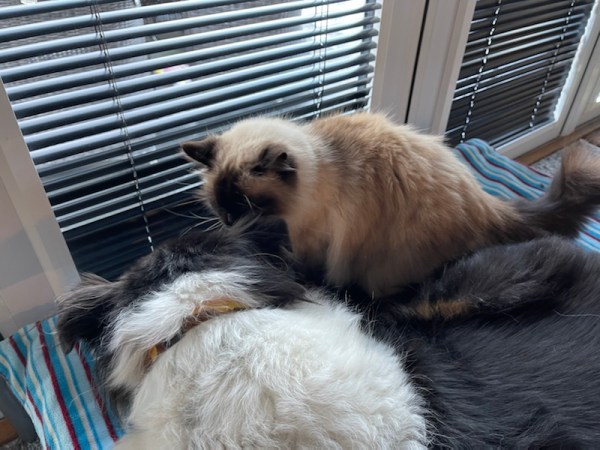
Taking it back to the bush twice didn’t work. It kept following her and the Pomeranian dog, knowing, beyond knowledge, that her cat future lay with this unlikely twosome. The faith of a centurion, perhaps…
In her mid-eighties at the time, Mum was a due to go with a group of her life-long friends on a river cruise in Germany the following week. We stepped in, of course. Driving down to Bolton to collect the cat, who bounced out of her front door and literally, into my arms.
You can’t argue with fate like that… She obviously ‘knew things’. By that time, it was obvious that she would have a better time here in Kendal, rather than sharing a home with a jealous Pomeranian. I took her to our local vets and they gave me strict instructions to check out every vet and animal shelter in Bolton to see if she had been reported missing. Only then would they look at letting us adopt her. It took me a full day of increasingly tense phone calls to verify that even if someone knew of her, no-one was telling. Later, we came up with a plausible reason for at least one of the silences…
“You’ve landed on your feet,” the lady vet said to the cat, but grinning at me, on the next visit. We had duly and officially adopted the cat Misti… Rag Doll, formerly of Bolton, Lancashire.
Since then, she’s shared our lives here in Cumbria. She and her Collie ‘sister’ have the life of Riley, whoever he was. One of the likely reasons she was dumped was her cat-flu. It’s viral and you can’t shift it. It comes back every few weeks and she snots over everything as she fights for breath and life. We hold her, boost her cat-vitamins and make sure she’s warm. Eventually it passes. Life can be messy when you love something fragile. Something bursting with love but physically flawed.
Now, fate has arranged that Mum, an increasingly frail ninety-one year old, with vascular demential, no lower intestine, and a newly-fractured spinal injury, has also followed us home… She obviously knew something, too. She’s offered to go into a home, but, Covid-wise, it’s not a good time for care homes at the moment. For now, she’s the latest Bolton resident in Kendal.
Our life is a recurring cycle of caring, learning patience beyond patients, and holding on to the interwoven gold that always accompanies such a task. There is a specialness about accompanying someone you love dearly to the end of their lives. You have to keep holding on to that, pushing back the grind and the sometimes near despair.
You have to know things…
So… I thought an occasional series of blogs about the lighter side of all this would be an idea. I’m not interested in writing up the grind. I’m interested in the moments filled with irony and the gold of that soul-to-soul contact that flowers briefly at the end of life and is gone. Thereafter, held only with a smile, in the memory… and perhaps, here in the words.
Opening image taken from Peedeel’s blog, an eclectic mix of poetry, art and other stuff.
©Stephen Tanham, 2021.
Stephen Tanham is a Director of the Silent Eye, A journey through the forest of personality to the sunrise of Being.
Share this:

We think of winter as being full of disadvantages for the photographer, but it also brings unique colours and dynamic contrasts: from clouds in the sky to the low sun on the landscape.
(200 words, a two-minute read)
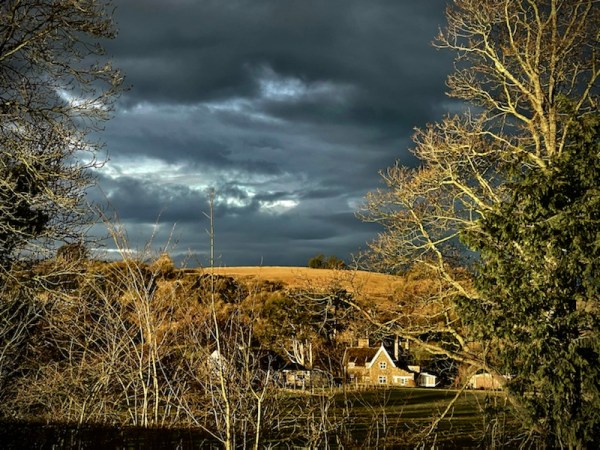
One of the most subtle contrasts is between the dull green of winter’s foliage and the colour of the residual life of trunk, branch, twig and crop stubble… each coming to life with the touch of the sun.
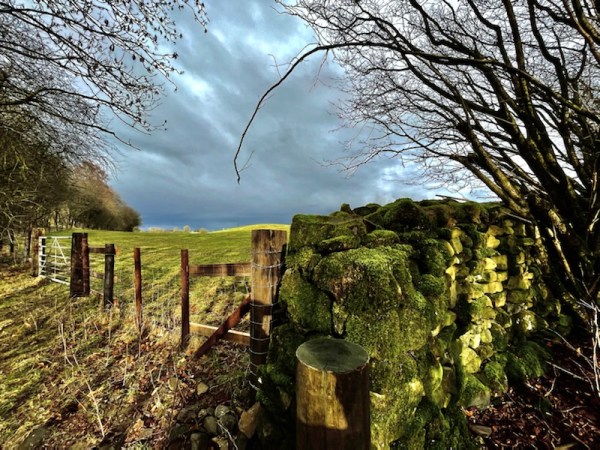
One of the brightest winter greens is the moss, especially in very wet parts of the countryside – like we have in Cumbria. Combined, here, with the limestone walls and soft afternoon sun, it produced a subtle composition.
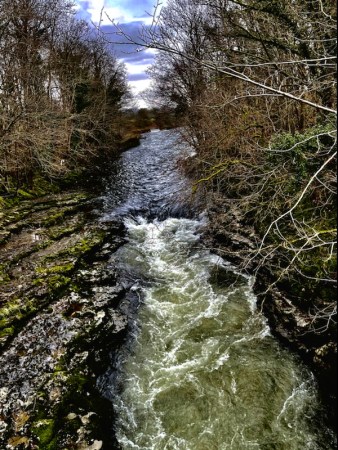
Winter’s effects on water can be dramatic, too. After days of intense rain, the local rivers – all bound for the vast expanse of Morecambe Bay, exhibit different colours depending on their speed and depth. Here, the River Kent begins its ‘drop’ (also know as a ‘force’) through the edge of the village of Sedgwick. The change in velocity produces a change in the volume of air in the water, resulting in a spectrum of colours.
Stephen Tanham is a Director of the Silent Eye, A journey through the forest of personality to the sunrise of Being.
©Stephen Tanham, 2021.
Share this:

+ #Silenti, Biology and mysticism, Consciousness, esoteric psychology, Higher Mind, Life-sciences, Psychology, Silent Eye School, Unconscious
The Big Picture (3) : objects of desire
by Steve Tanham
The word ‘object’ has many meanings; but none more mysterious and potentially wonderful as the meeting of spirituality with the findings of psychology’s Object Relations Theory…
(1400 words; a ten minute read)

Everything in our daily world comes from them; they are the highs and lows, the anguish and the triumphs, the misery and the joy… and above all else, the overwhelming violence of the world, permeated, occasionally, by the heroic kindness of someone selfless, someone who only wants to add a little love to the sad garden.
But it may not be entirely so…
Our world reflects our thoughts. Our thoughts are mainly habitual reactions to conditions, some are pleasurable but many induce a sense of anxiety, if not actual fear.
If we are fortunate, our inner relations are within a harmonic family – though this is by no means guaranteed. When we are older, we look back on our lives and sigh at what might have been, but also take some pride in what was.
Yet, through all of this, a sense of ‘I was there’ prevails. We can see the key decisions we made; can wince at the costly mistakes, and bask in the sometime triumph over adversity that we – often in concert with others – made happen.
We feel a pride in that accomplishment. The aspect of us that feels this pride is the self.
When the world of psychology came into existence in the early years of the last century, it caused quite a stir with its promise to accurately explore what it meant to be a self.
A ‘self’ is a permanent place of accumulated beliefs, views and and reactions that crystallised into a sense of ‘me-ness’ around the age of seven. One view, developed by Sigmund Freud and still used as a basis for much of modern psychology, is that our sense of self is threefold and divided into an energetic under layer – the id; an overbearing ‘should do’ layer – the superego; and a core of ‘conscious me’ stuck in the middle and attempting to mitigate between the wild, energetic and sexual creature and the overbearing tut-tutter that society might expect.
Anyone who tries to understand the world sees that our societies are also a response to the collective presence our psychologies – our selves. The individual adds their own psychological presence to the society in which they live. The pressures, norms, expectations and authoritarian tendencies of our societies can be a heavy burden throughout our lives.
We can retreat from the world, or we can face it with an intelligent and loving intent to react differently to it… or not react at all. By reducing our direct reactions to the world, we generate more power of self, and often find the world has changed, accordingly… which can be surprising, to say the least.
To live a life within a new ‘chamber of calmness’ is not to cut ourselves off. Rather, it requires the will to introduce a ‘catching gap’ between experience and reaction. In creating this, we begin to notice how powerful certain aspects of our lives are, and how difficult it is to control the reactions to them.
Sometimes, it is all we can do to watch this taking place. Any idea of control needs to be a secondary stage. Often, in watching deeply and not needing to react, the present reveals itself in a different way, perhaps not requiring our active participation at all… There is always a third force at work; the power of the ‘present’ helps us to recognise this, as we develop this side of our minds and hearts.
What we react to, and the way we react, became the subject of a new branch of psychology, beginning in the 1930s and extending to the present day. It is called Object Relations Theory. It developed from and extended Freud’s psychoanalytic theory into a more detailed view of how we visualise what affects us.
It also provides a shared space of understanding in which mysticism and psychology may meet and harmonise.
In 1975, physician turned psychiatrist Margaret Mahler wrote a radical and seminal work: ‘The Psychological Birth of the Human Infant: Symbiosis and Individuation’. The title surprised people – as it was meant to, implying that the physical birth of the body is not the same, nor synchronous, with the birth of the child in the sense of what will become the personality.
The personality develops from the mixture of experience and reaction. But the idea that the infant is simply a junior ‘us’, issuing automatically from the body, is wrong.
The psychological infant has to develop in parallel with the healthy body, but its development is of an entirely different order to the biology of cells. The essence of this – ultimately the goal of present day psychology – is the development of a strong and stable self. The goal of spirituality is to investigate the deeper mysteries of actually having a self.
Mahler showed that the infant exists, pre-birth, in a state of parallel life with the mother, knowing nothing else. This is bliss to the unborn soul. When birth occurs, the infant slowly discovers the sadness and dissatisfaction of separation, which is essential for its growth towards what Mahler called individuation.
It is important to grasp this: the unborn infant does not exist, in its own awareness in a state of oneness with mother, it exists simply in a state of oneness… There is no knowledge, and no presence of anything but this.
In terms of the world’s myths and religions, we might reflect that, at this stage, the infant knows nothing of the father, though his contribution was the seed that found its place within the ‘ground’ of the mother, triggering the process of new life and contributing half its DNA.
Mother and child move from oneness to a separation in which the child must increasingly come to know the world as an ‘other’ from itself, in order to fulfil its needs. The oneness becomes, first, two tightly-coupled entities, then two separate beings. How well and harmoniously this is achieved shapes the rest of our lives. The physical side of this is obvious to us, but not the stages of the psychological progress. Mahler revealed this in detail, and analysed the criticality of each aspect of healthy physical, mental and emotional development.
Within Object Relations, the word ‘object’ is used to describe an ‘other’ – typically a person, and this is not meant derogatorily, it is simply a notation. Our world comes to be populated with ‘others’ as we develop an inner vocabulary of ‘types of other’. Within the mind, such objects are always seen as pictures, as images. These images can be rich, with all manner of sensory information attached.
Mother is the first ‘other’, and definitive. Each subsequent stage bears the imprint of the mother experience. Mystically, we can also equate Nature with mother, a model that implies that the life-force may come from somewhere else…
The child comes to recognise another object called Father. Though there is no consciousness of shared origin in the same sense as that of mother. Father becomes important, ideally, as role model for individuation – making our own way in the world.
So far, you may rightly ask what this has to do with mystical development of the self. The key is that the early infant, although not individuated, is in touch with the states of inner beauty and completeness that are also the goals of all spiritual quests. What the child cannot do is function in the world. This must be learned, and as it is achieved, the beautiful early states of essence are gradually lost in the stuff of outer life, though, as Wordsworth wrote, we come into this life ‘trailing clouds of glory’.
As a mature person, of whatever age, we have a strong sense of self. We know, to some degree, how to work the world. The early lessons of survival are long behind us, and their wisdom is embedded in our matrix of stored reactions. At a certain age, we may feel that the early vividness of the world is gone; that life and duty are making us dull.
When faced with this, we are at what we call in the Silent Eye, the ‘turning point’. We now have the chance to take all our worldly competence, our balanced ego, and embark on a search for those ‘clouds of glory’ that still inhabit our innermost spiritual rooms.
Next week, we will look at how we begin such a quest – among the ‘objects’ our life has gathered. We will examine the nature of the new world we encounter as this unravelling begins. We are not talking about becoming an infant, again. We are looking for adult experiences of the active imagination that will act as triggers for a vast and excitingly new state of Self. The ‘objects’ we already carry with us will provide the fuel…
Other parts in this series:
Part One, Part Two, This is Part Three
©Stephen Tanham, 2021.
Stephen Tanham is a Director of the Silent Eye, A journey through the forest of personality to the sunrise of Being.
Share this:

As January lets go its dark and icy grip, passing us, with a smirk, into the often colder clutches of February, the marginally lighter mornings contain surprises that are harbingers of the spring to come.
(440 words. A three minute read)
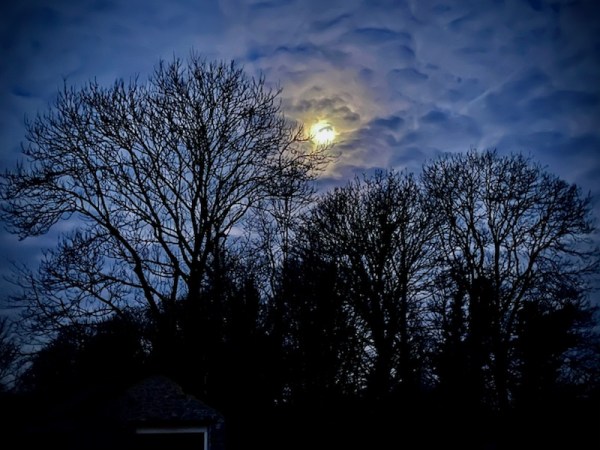
One of these is what I have come to think of as the ‘winter morning moon’. Often quite high in the sky, the pale gold of this moon combines with the clearness of the winter air to provide a quality of light more associated with the sun.
The course of the moon follows the line of the back of our house. Often, a visit to the bathroom during the night does not require the bathroom light, as the moon’s quiet radiance streams through in the darkest hours. It has surprised me how much more of a ‘moon’ place Cumbria is, compared with my native Lancashire. It may be the quality of the clearer air.
I am usually first up in our household. I empty the dishwasher and make the tea. This gives me a head start on the day – and the all-important time to write. Bernie is not an early morning person and is grateful for the two cups that get her started… We have complementary strengths, which helps when you are both looking after another – my elderly mother.
The Cumbrian winter can be dark, wet and savage but sometimes contains surprises. This morning, turning from the switched-on kettle, I was drawn by the pale gold light of what felt like the sunrise, but had to be the moon. Photographic opportunities can be fleeting, so I swiftly retrieved my iPhone from the still-sleeping bedroom.
The pale gold wasn’t the only joyful object in the sky. The thin, mottled clouds were letting through the awakening blue of what would be a rare clear morning. I jammed the camera into the doorframe and took several shots using ‘night-mode’.
The best one is above.
And then I realised it was the first day of the new month, and the sky seemed filled with the promise of the spring to come, and hopefully some respite from the COVID virus, in the shape of the mass vaccine programme.
One day at a time… Winter is a hard road, but the delight of such a start to the day gives you the sense of not being entirely alone in the struggle.
Happy February! – although it will be the day after by the time this publishes.
©Stephen Tanham, 2021.
Stephen Tanham is a Director of the Silent Eye, A journey through the forest of personality to the sunrise of Being.
Share this:

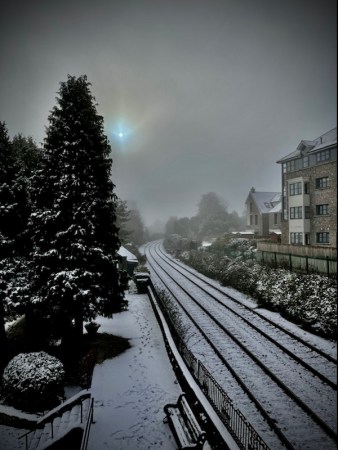
I love that fragile first coat of snow that changes the landscape like a frosting… yet leaves the main features visible behind the sheet of white. Here, the thin snow is not sufficient to do anything but emphasise the railway tracks and the tall, bordering conifer trees.
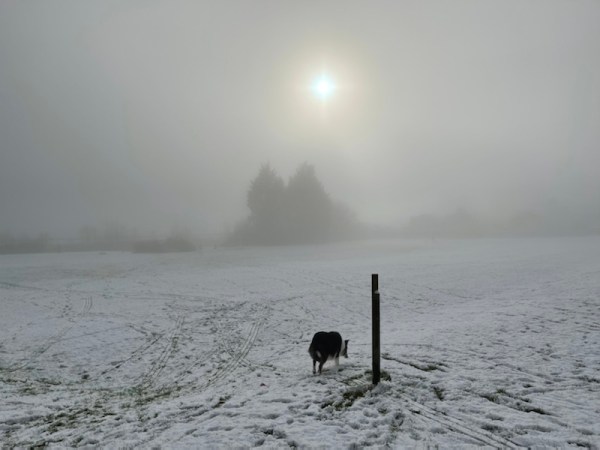
There was something stark about the collie and the single post in the field near the coastal path. The distant sun, pale in the morning mist, seemed intimately linked to both of them…

Photographed before, but this time from a different angle to capture the sun over the trees, there is something exotic about the bandstand in the snow and mist…
©Stephen Tanham, 2021.
Stephen Tanham is a Director of the Silent Eye, A journey through the forest of personality to the sunrise of Being.
Share this:

From Sue… and evergreen.

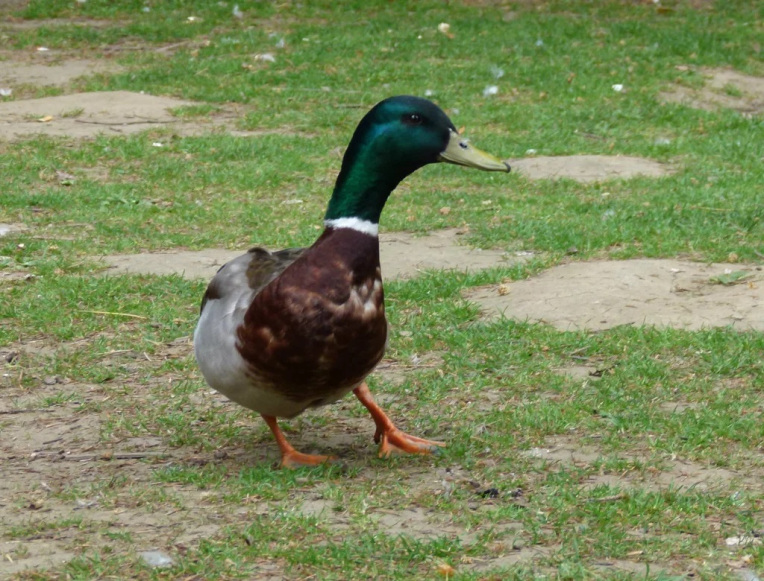
Yesterday, I was looking through my photo files in search of a particular shot amongst the tens of thousands of files stored on my various drives. Most of those photographs document our journeys through the landscape, visits to sacred places and the beauty and history hidden within our mediaeval churches and cathedrals. Some, though, document the events we have held at many of these places and in particular, the faces of those who have attended, caught, almost inevitably, in laughter.
Just looking at the pictures from those weekend events, I found image after image of smiling faces, happy to share a moment with the camera or caught off guard in merriment. Even the ducks were smiling. And I found myself smiling back. It was not something over which I had any control… each smile drew a response, both in memory and in actuality. The photographs may have been taken…
View original post 535 more words
Share this:


I’ve drowned before…
Drowning comes in the form of waves. Eventually, when your ability to fight back has gone, even the smallest wave can make the difference and take you beneath the surface to a place of the unknown.
Many years ago, I faced the inescapable collapse of the software business that we had spent eight years building from nothing. The business climate had nose-dived, and no-one was spending money in the sector that our products served. We went from healthy company to likely extinction in about four months. It seemed that nothing we could do would make a difference.
It was likely we’d end up with nothing. We were going to drown…
Nothing can be a potent idea, and more potent than we know. Facing the idea of nothing – of the removal of our normal world – is a truly sobering process.
The world seems to be drowning at the moment. Hospitals are drowning in the fight against Covid, with doctors and nurses working on seriously ill patients at a level of four or five times their previous maximum load.
Compared to that, our own troubles should be trivial, but often aren’t. If you can’t escape them, then they matter – especially if someone else’s health or even life is in the balance. Not all problems are Covid related.
Two days ago, I was staring at the living pink tube of flesh that protrudes from the lower stomach of a person who survived ulcerative colitis via an operation that removed all of the lower intestines. Such operations require a ‘stoma’ – an aperture stretched into a tube (stomata), through the skin of the abdomen to the outside world from the digestive tract.
The most common forms involve the patient wearing a ‘stoma bag’. The bag replaces the bowel, and often the intestine, and must be emptied, manually, whenever needed. In the case of the ileostomy, which applied in this case, the waste matter is continuously produced by the body without the normal regulation of the intestine and bowel.
The person whose fleshy ‘stoma tube’ I was looking at is a ninety year old woman. She is my mother… Somewhat exhausted, I was wondering why my (untrained) third attempt to attach her stoma bag hadn’t survived for more than two hours.
Two days before that, I had been in an ambulance for the first time in my life, being ferried from Westmorland hospital to the larger Lancaster hospital for my mother to have a CT scan. She had fallen out of bed and landed on her lower back. Resistant to any form of medical treatment at the best of times, she had protested that it was ‘just a bruise’.
The morning after, we knew it was more than that and I drove her into the local Westmorland hospital, where the wonderful Urgent Care Team saw her rapidly, shook their heads and wheeled her off to “give her a rapid MOT”. This led to the rapid diagnosis of a fractured lower back, but, thankfully, not a pelvic injury. The bad news was that it needed a CT Scan at Lancaster Hospital to confirm, which might then lead us on to the specialist team at the Preston Spinal Unit.
An ambulance team were on their way. I was assured that my now-insufficient parking ticket would be overlooked, and mentally watched my car disappear in the distance as the ambulance crew took charge of us – mum now on a stretcher.
She had been staying with us for a few days of care and company to warm her spirits in these difficult and isolating times. Being heavily dependent on us for her health, this was within the brief of the current guidelines. Her vascular dementia has been getting worse, and we hoped that a weekend in Kendal would restore her spirits… and alleviate some of the paranoid fantasies (of theft of money and keepsakes by relatives, for example) that dementia sufferers, living alone, often face.
The ambulance staff were fabulous. They briefed me on how to not be separated to my mother and tagged her so everyone would know I was her official carer and allowed to enter Lancaster A+E alongside her trolley.
There was nothing I could do about it. I made sure we were liberally doused with hand gel and wearing surgical masks. Then I stayed with her, standing by the trolley, within the main A+E corridor.
After two hours, we were told that she could go up to the CT Scanner unit. A porter collected us, and, only fifteen minutes later, we had the results. She had fractured her ‘L3’ vertebra. This had been diagnosed by Westmorland, but needed the more powerful scanner to confirm. Treatment was not possible, but rest and painkillers would assist her body’s own recovery and bone-healing. It could have been much worse…
Fortunately the Preston team, having been sent the scans, confirmed they could add nothing to the diagnosis and the ‘rest and painkillers’ treatment.
My wife, Bernie, came for us at Lancaster…. It was nine in the evening on a day that had begun at ten in the morning.
But now a three day break with us had just become an indefinite period of residence, as there was no chance of her returning to the Bolton terraced house with its steep staircase… possibly ever. Mum has always been fiercely independent and we could imagine what this news would mean to her. But she was uncharacteristically accepting.
We settled her in as best we could. She slept well, exhausted by the events of the day. The following morning I helped her out of bed and she took some painfully slow steps around the bedroom. I helped her to the bathroom and was about to leave when she called out that her stoma bag had burst.
Her Ileostomy operation was sixteen years ago. She nearly died from the colitis in the days leading up to it, the surgeon describing her chances as no better than 50:50. The family have been deeply grateful to the surgical team at the Royal Bolton Hospital for those extra years. The stoma is a small price to pay for continued life, and she has managed it on her own, with an occasional visit to the stoma team at Bolton.
But we had not reckoned with the effect of the dementia, combined with the shock of the fall and the spinal fracture. She had literally forgotten how to change her own ‘bag’. Fortunately, we had a box of the stoma supplies at our house for safekeeping. I sat her on the toilet seat and grabbed a pack… I would have to figure it out from the spoiled one now in front of me. I gently peeled it from her sore flesh.
I do not propose to dwell on details. I am the father of two boys and remember the more pungent details of their infant life with nappies. There is a difference between the peachy bottoms of babies and a ninety year old’s stomach, but it’s basically the same science at work.
At that moment, the dawning extent of our new situation was a point of drowning. They are characterised by the knowledge that you can do nothing about the overall nightmare. You just have to put one foot in front of the other and look for any help that might come your way.
Now, three days later, I am able to change a stoma so that it stays sealed, but I’ve made a lot of mistakes. Living in Kendal, Cumbria, we are three counties away from where she is medically registered, but, as she cannot go home, we have at least been able to register her with the local stoma clinic in Lancaster. Some help will be forthcoming, if only to teach me how to do the job properly. We have discussed the situation with her local Bolton doctor of thirty years – who has been very supportive, and advised us that my mother really needs 7×24 care.
It’s that external help that makes all the difference. You know that organised assistance is out there, but can’t access it until someone at the centre of things shows you how.
The experience took me back to the commercial nightmare, now so long ago. Then, three of our largest customers said they did not want us to go bust, and brought forward enough business for us to survive the cash flow crisis. We did; and eventually prospered for another fifteen years until it was time for me to hand over the reins and step away… to do something else, which turned out to be the Silent Eye.
Sometimes we’re not meant to see the logic, or even the pattern. But the rescue from drowning can be there, and not within the scope of our own minds. Small miracles do happen.
So, forgive me for not doing the next instalment of the ‘Big Picture‘ series. By next week, I should be more settled on this new ocean of ongoing uncertainty. I have no intention of drowning.
©Stephen Tanham, 2021.
Stephen Tanham is a Director of the Silent Eye, A journey through the forest of personality to the sunrise of Being.
Share this:

Mystical poetry.
(140 words, a two minute read)

➰
In icy dream
We ate our picnic, you and I
And watched while moonbeams
Lit the curls of how and why
And seated watchers watched the sky
➰
No frozen crusts of bread:
This food of soul was liquid light
Drawn, once, upon the glittering night
Enmeshed, entwined, in meanings bright
Like crystals on the icy table
➰
Afar, you gazed
And with your pointing finger
Sought my leave – I feared
But when I looked, the end
Now so far beyond the means
Had disappeared
➰
Instead, where finger had
Above the crystal surface, been
Was drawn in quickly melting ice
A signature concealed
That, grasped with eyes and ‘I’,
Revealed the path to morning
➰
©Stephen Tanham, 2021.
Stephen Tanham is a Director of the Silent Eye, A journey through the forest of personality to the sunrise of Being.
Share this:

+ #Silenti, landscapes, Photographic techniques, Photography, Silent Eye School, Silent Eye Workshops, Yoga
Winter walks with Camera (7) : panorama
by Steve Tanham
The modern mobile phone puts an arsenal of photographic tools at our disposal. One of the strangest and most difficult to master is the panorama… yet the results can be wonderful.
(550 words. A four minute read)
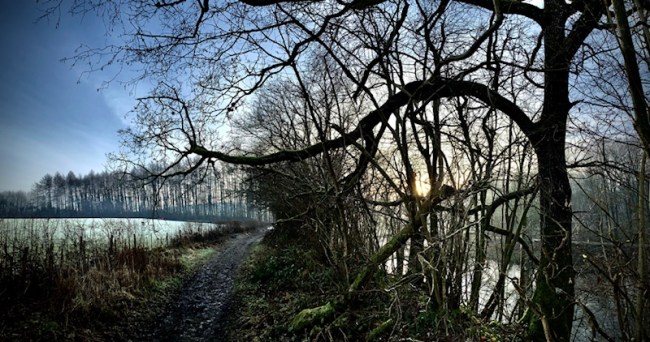
The panorama is not a gimmick. It’s a wide-angled shot in which the correct proportions are retained, rather than the treatment of a ‘fish-eye’ lens, where the extremes are increasingly compressed as you approach the edge of the image. We can look on it as a short piece of video, panning left to right, where all the shot is retained and formed into a wider picture.
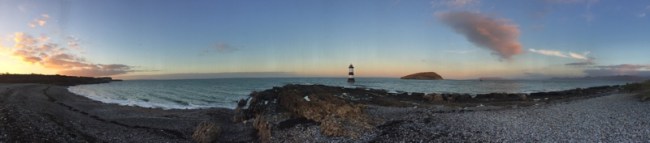
There are many difficulties; chief of which is how hard it is to stay level and steady as you pan across the shot. Ideally, we would have an electronic, rotating tripod in our pockets! With practice, and by carefully following the indicated line in the viewfinder, we can get a degree of stability into our photos. Also, modern phones allow a faster sideways movement than their predecessors, as they need less light to function well.
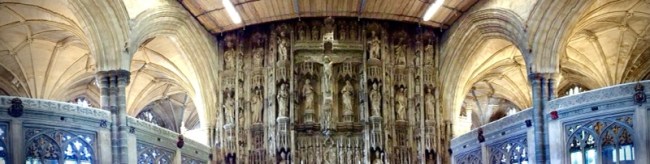
Panoramas are great at capturing the grandeur of large or historic buildings, as with the shot of Winchester Cathedral, above.
One of the little-known wonders of panoramas is that they can be taken vertically!
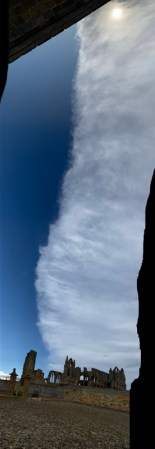
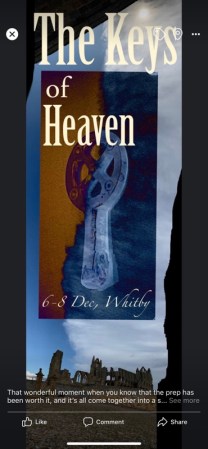
The above shot illustrates the usefulness of this. It was taken on a preparatory visit to Whitby, in 2018. I needed a long, thin vertical image for the sidebar of a pocket brochure for the Silent Eye’s Whitby weekend, in December of that year.
As I focussed on the ruins of the Abbey, I realised that the whole sky was covered by a single, dramatic cloud leading to the sun. But this was only available by scanning the camera vertically.
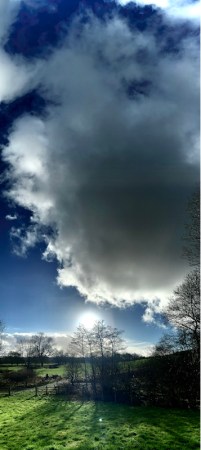
The closing images, below, are what I call ‘sky-shots’. Some of my favourite photos have been taken this way.
There’s nothing better than the successful capture of a huge, bright sky. The trick is to hold the arms out, level with the ground and then rotate the shoulders upward, in tandem, finishing overhead with the back arched. It’s a bit like yoga and takes a bit of practice, but the results are unlike any other type of shot you will take.
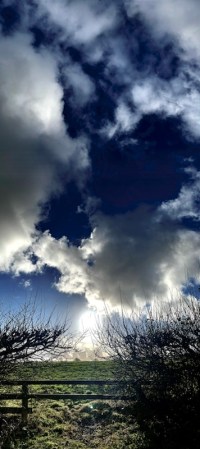
The key is to have a go… After a while you become your own best teacher. If it feels good to you, it is good!
©Stephen Tanham, 2021.
Stephen Tanham is a Director of the Silent Eye, A journey through the forest of personality to the sunrise of Being.
Share this:

+ #Silenti, Biology and mysticism, Consciousness, esoteric psychology, Higher Mind, Life-sciences, Psychology, Silent Eye School, Unconscious
The Big Picture (2) : a portrait of the archer
by Steve Tanham
If we’re going to set off in search of the spiritual – as seen in humanity’s ‘internal pictures’, we need to have a more modern definition of what ‘the spiritual’ actually is…
Imagine we are reading a paragraph in an absorbing book – something like the image below. Normally, our brains would assemble a sequential stream of characters into recognised words, then meaning. The meaning would be gradually tuned as we read into the context of the whole.
Clever stuff… Our minds equip us well to interact with the information sources in our world – some of which could kill us, if wrongly interpreted: think of a traffic crossing. We have a life-imperative to protect our organic existence, but it does not mean that, beyond the needs and duties of this lifetime, it was ever truly our home.

Back to the paragraph in our book. Imagine if, instead of that sequential, character-by-character interpretation of the language, we looked at the set of words and suddenly sat back with surprise as the whole thing sprang into vivid life in front of us!
Now, everywhere we look, and from every angle, the deepest meaning of the text becomes vital; and with a force that simply leaves no room for it being wrong…
That’s what seeing with a ‘spiritual eye’ is like. The sense of ‘me and it’ is lost in a glorious, calm involvement with what had been the object of our vision – and this can be the whole world. What’s happened is the sudden and miraculous removal of the learned idea of a separate entity for me and it. Instead, there is a seamless and deeply personal absolute knowledge that we are seeing the truth of where we look.
The experience is completely real. It means the state we have entered is a higher one. By that, we mean that it came first… It is a parent of the state we are now in.
The state we normally live in, this lesser ‘ordinary’ consciousness where understanding comes through slow absorption of ideas, is the product of a natural process as we enter life and become in-volved with our new world.
It is essential that we do this; that we experience this biblical ‘fall’ into the denser world of organic matter. Why this is so is a much deeper answer, one requiring a more developed vocabulary for the shape of our existence. The brain cannot fully comprehend it, but it can string the bow… What happens next requires that we have an arrow.
Our personal power in life comes from having a strong ‘identity’ with ourselves… and this is a picture of self. This self, and its interactions with the world, are gradually assembled into a composite which solidifies with a psychological ‘whoosh’, somewhere around our seventh year of life. From then on, this ‘me’ becomes the core of how things are felt, and how we take things forward. It is the personality; but it is built on many, smaller units of ‘me’ that are part of a process of deeper involvement with the world.
The prenatal infant does not know itself to be separate from mother. But ask any mother and they will tell you the poignancy of knowing something that your body has ‘made’ will have to leave your warmth to achieve its life, separated. The mother knows the infant is not her, the infant does not… until, mirroring the deepest spiritual tales from our collective past, it is born, a stranger in a strange land.
Instantly, there is it and the world. The most beautiful state of Oneness, paradise, has been lost… And only the most magnificent human potential could justify that event.
Mother is there, of course. Her breast and her warmth are everything to the child, but they are not the exact match to her needs as when in the womb. There begins a process of not just separation, but of ‘lack’, especially orally when there is not enough milk for the infant’s hunger.
From these early events is formed a set of relationships with the new experience of independent life. The infant is always present to its experience, so everything is seen in a relationship to itself. The whole of the infant’s life will be patterned by these formative experiences.
One way of examining this development – which is mainly psychological – is the technique of ‘Object Relations’: one of the tools of modern psychology, and one that finds itself most closely allied with certain mystical schools – though not by intent. An understanding of Object Relations will help reveal the pictures formed during this first stage of our-selves.
We are not attempting regression, here. The goal is to unite the adult mind’s power with the early and potent feelings of being human. We do this because there is a correspondence between those early events and the patterns of experienced energy we find when can touch our own essence.
It is no accident that the ability to form good mental images – visualisation – has always been one of the key tools of spiritual development. Ignatius Loyola, founder of the Jesuits, is most famous for his exposition of building living images of oneself ‘imitating Christ’. These techniques are truly ancient, and have been the tools of ‘priests’ throughout history. To get what we want and hopefully need, requires a ‘clear picture’ of the desired state, even if it is partial.
But there is a problem when it comes to visualising a higher spiritual state. The mind cannot conceive of something higher than itself. However, we can assemble a small armoury of self-tools certain to take us at least part of the way to the spiritual eye spoken of in the opening paragraphs. It’s time to make our arrow…
In the next few weeks, we can follow an overview of the Silent Eye’s method for:
- Understanding the most important of the early pictures of self, and how they became the foundations of ‘us’.
- Examining the aspects of ‘ancient wisdom’ that correlate most closely with the pictures.
- Reconciling the adult and powerful self with the fears of the infant, experiencing a ‘washing away’ of that early anxiety, thus freeing the energy inherent in the early states that were so close to Oneness.
- Finding the separate ‘faces’ of that Oneness, and forming a new picture of each, as the Sufis do, as Intimate Friends on our deeply personal path.
Equipped with the above, we truly notch our arrow into the taut and harmonic string of a mighty bow, and, standing tall, fire it into the heavens of our own sky.
We might even get an answer to this focussed message. But its nature may surprise us…
©Stephen Tanham, 2021.
Stephen Tanham is a Director of the Silent Eye, A journey through the forest of personality to the sunrise of Being.
Share this:

I had such a peaceful blog planned… Creative and poetic, taking a whimsical look at a key modern event.
But… instead, I’m typing this on my much-loved Apple iPad, with a sour taste in my mouth.
Better start at the beginning.
I was queuing for a take-away in Costa Coffee, Morecambe, on a particularly nasty day three weeks ago. The rain and wind were battering the windows, and Joanne, my sister-in-law, was having to stand outside in the gale because only one person per group was allowed to queue inside the coffee-house. Bernie was walking Tess, our collie, and she was joining us, in the park area across the road, to have our coffee – the only kind of social event we can do, now.
Joanne is not good in high winds and I had to keep looking back to check she was okay… Not a good way to concentrate.
Wallet in one hand, I was using the other to check in with the Covid QR code. That’s when I dropped the phone, and watched in slow-motion as it spun down to land, screen-first, on a metal bar fronting the base of the counter. My much-loved iPhone 11 is the device on which I have taken most of the blog photos for the past two years.
The screen had fractured into dozen of cracks… it was still usable but a mess. At least I had it insured. With a bit of cash up-front, I could replace it with the latest model… the one with the bigger lenses and dramatically increased processing power. Mmmm.
One of my sons, Daniel, had been seen at our most recent get-together jubilantly flashing his brand-new iPhone 12 Pro – supposedly the best ‘phone camera’ on the market. Now, I had the chance to get the same device. If you’ve followed this blog, or are a friend on Facebook, you will know how passionate I am about photography through the seasons.
The new model duly arrived. Unwrapped, it looked stunning in its cool gun-metal case. I couldn’t wait to set it up. The older iPhone 11 had, in its time, taken less than an hour to configure itself by automatically copying everything on the previous phone and re-verifying my security via its sophisticated algorithms.
I pressed ‘Go’, on the new one… and made a pot of tea, expecting it to be practically finished when I got back.
Three days later, I’m still waiting. Apparently, Apple know they have a set of problems with this release. The hardware is great. The core operating system comes up straight away…
But most of us have a vast array of ‘Apps’ that do specific and important things for us, including advanced processing of our photos. These are currently sitting, ‘greyed out’ on my new phone, unable or unwilling to jump into life on the replacement. I’m no beginner, and have followed exactly what I did with the last device. But every time I chase the next logical path to a fix, it turns out not to be.
I’ve been a vocal fan of Apple for decades and am an enthusiastic advocate of its stance on protecting our individual security. When my wife asked me what I wanted for Christmas, I unhesitatingly asked for an Apple Watch.
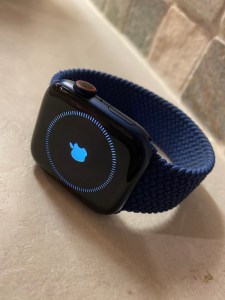
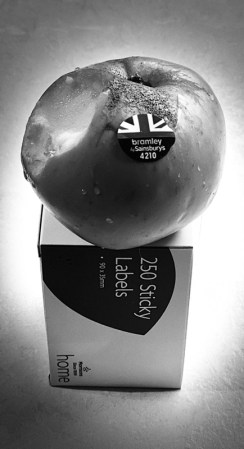
That’s it, above. Dead as a dodo, presumably in limbo between two generations of its host phone. Sadly, the price of reliance on a single technology.
As you can tell, I’m struggling with all of this. Bernie has just opened a bottle of wine and we stared, through tired eyes, at the reset button that would eliminate two days of partial work and take us back to the beginning of the whole upgrade via a recovery from the last iCloud backup. Someone on one of the internet support groups said this may be the only way out.
We press it… turning away while it starts at the beginning, again. All this might be my fault. The wrong decision, something odd installed on my phone – like a virus checker. The thing is, though, Apple have always protected me from that. They’ve always been there, one step ahead of what I might do in error, next.
So far, the reset from iCloud appears to be working… But it’s going to take a while to take this sour taste from my normally sweet mouth.
©️Stephen Tanham
Share this:

+ #Silenti, Consciousness, nature, Photographic techniques, Photography, Seasons of the year, Silent Eye School
Winter walks with camera (6) : the shape of drama
by Steve Tanham
Drama comes in many forms, but those forms can be accentuated by the rigours of Winter
(250 words, a two-minute read)
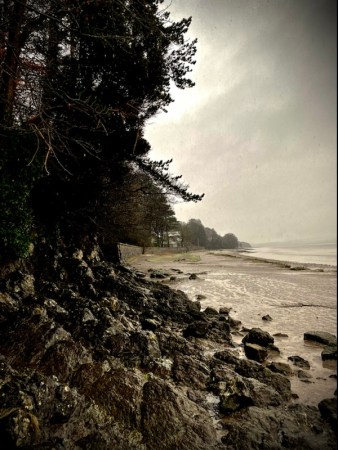
The estuary to the west of Arnside has an ancient feel, and is filled with dramatic shapes and foliage. In Winter, some of these can look primeval, and the natural desaturation of colour caused by the lower levels of light play to the mind looking for objects of potential menace…
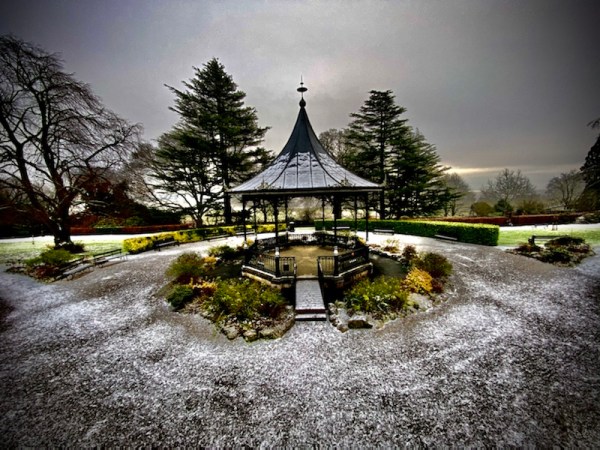
Familiar objects, like the park bandstand above, can take on a more dramatic form when photographed in a way that emphasises their aloneness. We are invited to enter… but what awaits?
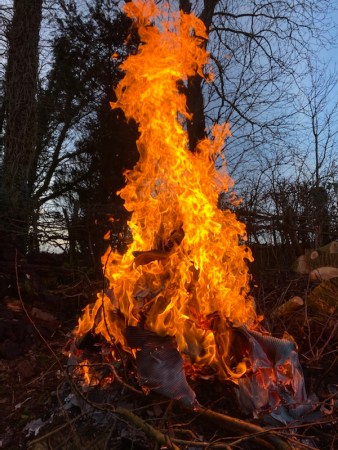
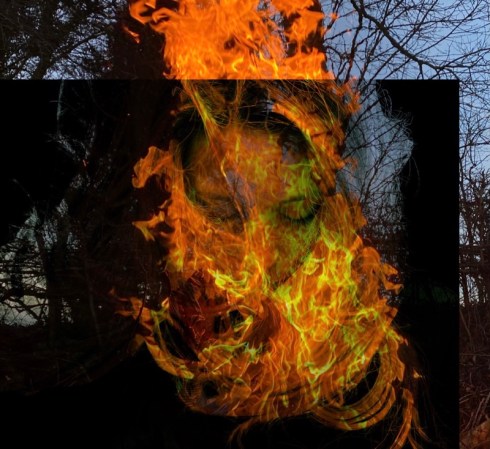
Fire is one of the most dramatic things, and has ancient links into the human psyche. Protector or destroyer may hinge on circumstance…
Fire is notoriously difficult to photograph realistically. The twilight helped with this shot, giving the dancing flames a vivd life of their own.
I was able to re-use this image to create a blend of flames laid over a woman with flowing blonde hair, sourced from Pixabay. The finished montage became the keynote picture of a new series of blogs on the power of the image within our psychological makeup.
©Copyright Stephen Tanham, 2020.
All photos by the author unless otherwise stated.
Stephen Tanham is a Director of the The Silent Eye, a journey through the forest of personality to the sunrise of being.


 Sun in Gemini
You must be logged in to post a comment.