
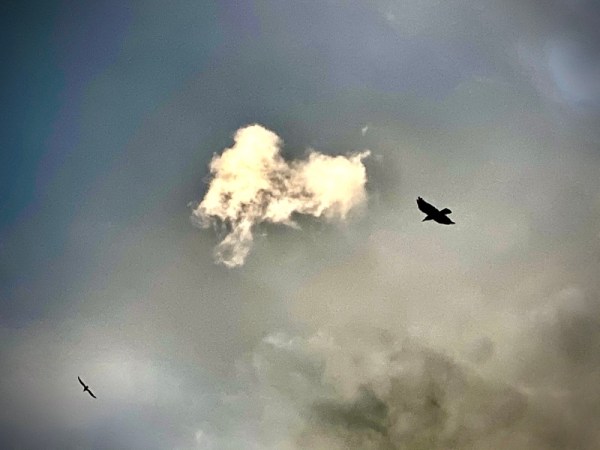
We sat, in end of day repose
To speak of evenings drawing cold
And grass with moisture in its folds
And share our wine with crows
➰
One, bolder than the rest
Climbed high, as if to rise and reach
A silver phantom, caught in sun’s
Descending rays out of the west
➰
Within the moment’s crest and hiss
What thoughts, I wondered, passed
As pictures, sounds and smells
Upon the waning summer’s kiss?
©Stephen Tanham, 2020
Stephen Tanham is a Director of the Silent Eye School of Consciousness.
Share this:

+ #ShortWrytz, #Silenti, Ancient Landscapes, Collie dogs, Consciousness, Lake District, nature, Photography
#ShortWrytz : The house by the river
by Steve Tanham

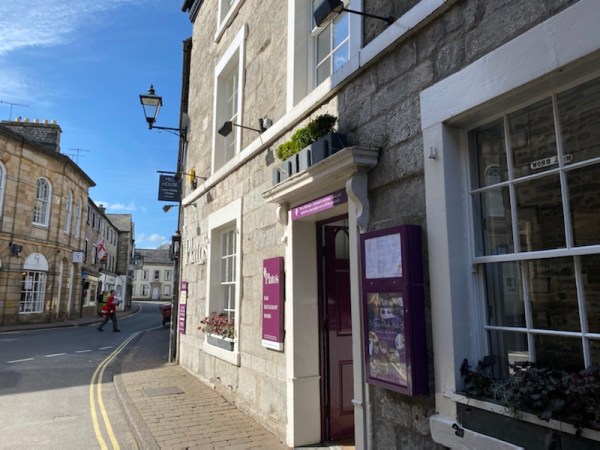
We’re often in Kirkby Lonsdale. It’s the perfect dog-walk for Tess, our collie, who loves to chase the ball in its riverside park, then sniff her way along the riverbank as we enter the town by the steep steps that lead to one of the best views in the county – Ruskin’s View.
This part of the Lune Valley was a favourite haunt of the artist Turner who famously painted this view.
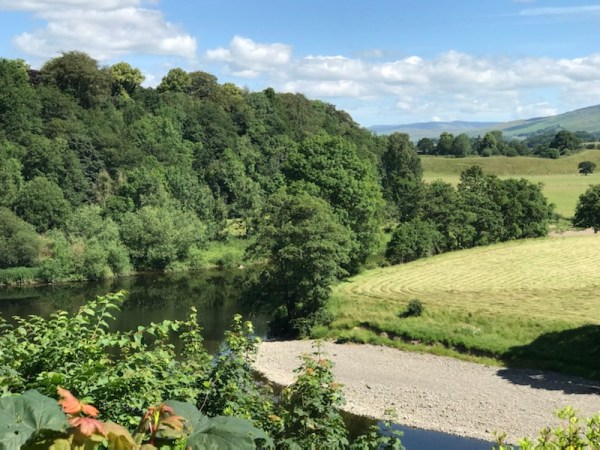
The town is recorded in the Domesday Book of 1086 and used to be the only river crossing of the River Lune for miles around, making it an important meeting point and marketplace. The market charter was granted in the 13th century.
The history of the town is written in its buildings, which date back to medieval times. The old river crossing ‘Devil’s Bridge’ being the best example.
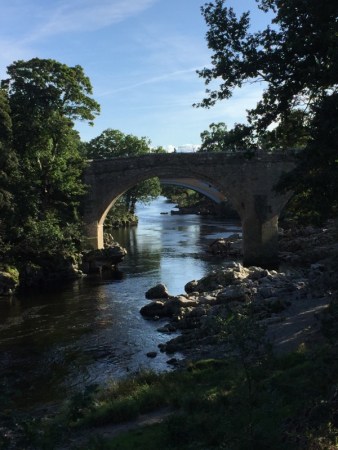
The majority of its 17th and 18th century buildings still stand, making a walk through the town like being on the set of a Jane Austen novel.
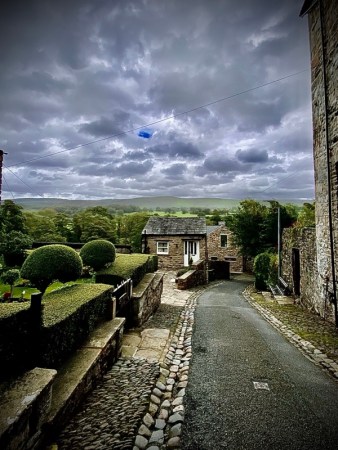
The town was a finalist for the High Street of the Year Award in 2016. Kirkby Lonsdale was voted as the ‘Best Place to Live in The North West’ in 2019
My favourite building is the Old Mill at the end of the Mill Brow descent. Devastated by the floods of 2015, the owners rolled up their sleeves, wrung out the carpets and started again. I always have to stop and photograph it, each mood is different. It’s located between the river and the sheer wall of the plateau on which the town is built, so the merciless river rises straight into its driveway when it floods.
Somehow, its the perfect symbol of everything that’s good about Kirkby Lonsdale – authentic and enduring. There’s a new multi-million pound house next door. The new house is beautifully designed, but the old mill exudes character by comparison.
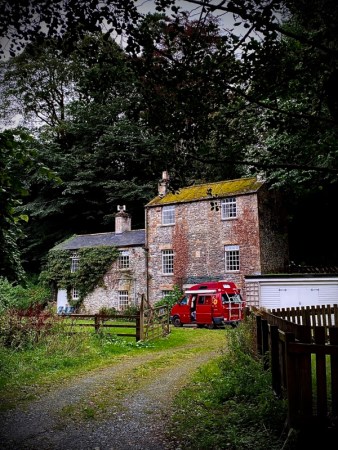
I expect I’ll go on photographing it whenever the light or the season changes.
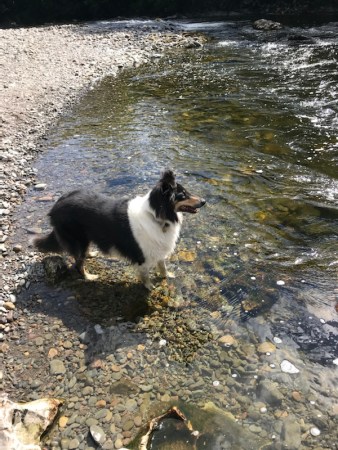
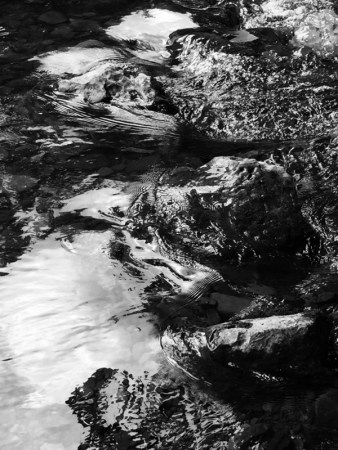
The River Lune, here, is also beautiful. Always different- sometimes very violently. It’s a place you can stand and marvel that so much liquid can flow past without ripping the world apart.
It’s great to photograph in black and white, too – particularly close-ups.
©Stephen Tanham, 2020
Stephen Tanham is a Director of the Silent Eye School of Consciousness.
Share this:

+ #Silenti, Belief and Faith, Consciousness, Esoteric Meaning of Myth, esoteric psychology, Politics and Power, Psychology
The Entered Dragon (3) : beauty and the beast
by Steve Tanham

Continued from Part Two
The dream continues…
We are frozen, the dragon and I. He cannot be seen, as he is mirroring my every move, behind me. My fingers explore the tip of the spear, the only movement left…
I press the sharp tip into the skin of my right thumb. There is a slowing of time as the ancient metal pierces the flesh. Then I can feel the tiny warmth of blood dripping from the wound.
“Don’t…” comes the hissing red voice from behind my head. “Please don’t…”
The holding of values must be ranked as one of the highest achievements of civilisation. From the perspective of religious morality, each human is born with a challenge: to choose which side of their nature to supply with attention and therefore energy – the man or the beast.
But the Jungian psychologists discovered it was by no means that simple…
Within mankind are represented all the kingdoms of matter and life. We are made from supposedly inanimate matter at the atomic level. Biological life, based – apart from viruses -entirely on cells, is an organisation of that matter into self replicating structures. Over billions of years, these became plants, then animals, then humanoid bodies.
Sophistication through evolution produces higher levels of creature intelligence, but we do not lose the supposedly lower aspects of our physical being. As the brain and mind mature, the choice of internal government is ours, just as it is within society.
Something is trying to express itself through increasingly higher levels of organisation. Concordant with that should be an external level of civilisation that mirrors the sophistication of the inner, creative urge.
But we experience, at both the individual and societal levels of our lives, continuous challenges to our ideas of society. These cyclic challenges are not based upon forces separate to those in the individual human psyche. What we see in darker ages, such as the one we are living through, is a collective externalisation of the shadow within each individual being.
Examined in this way the legacies of deceit, populism and authoritarianism are simply an externalisation of the darker side of our psyche. Within darkness like attracts like, for its nature is weak and it seeks collective strength against what it knows to be superior yet repressing higher intelligence.
“I’ll show them!”
This is the true arena of events within which we as a species have always struggled. It may be necessary that each ‘third generation’ fights once again for the values of good, truth and vision. Values, like any organic fruit, decay over time when the source of their vitality ceases to pulse.
The Jungian model of the psyche, which includes the shadow, is of great value in understanding what happens within an individual life and within the life of that person’s country.
It would seem that humans as a species are forced to live within a continuous paradox. Individually, we seek to better our circumstances and provide for our families. Collectively, our animal-derived focus on success and individual supremacy produces a society with an increasing lower tier who struggle to survive in a medium where the nutrients are syphoned off to furnish luxury at the top.
‘Power corrupts and absolute power corrupts absolutely’.
Can Jungian thought suggest answers to a life of paradox? In looking at this we come face-to-face with our own past. The age of science has worked wonders for the physical side of our lives, but has emasculated folklore and tribal practices that were exactly designed to balance the individual and collective forces of chaos generated by a suppressed and unheard shadow.
The answers lie in the functioning of consciousness. We have seen that what we call the subconscious or unconscious is simply that from which we have withdrawn attention. Few people, for example, study their dreams, and yet dreams are the other half of our lives. This does not mean that we should fret and go without sleep, simply that a parallel sleeping consciousness – a kind of night eye – exists within our being which can gain great insight into the truth of what is happening to us in our day world.
This night eye may be much closer to the creative forces of nature than we have ever envisaged.
We cannot hope to examine the shadow of a society without first understanding our own. To do this we must know it and then make peace with it. Once we have achieved that the power of its friendship is immense.
Does this mean that we have to release its chaotic wildness into our world? Thankfully not. The processes of the subconscious do not differentiate between our waking and unconscious existences. The way we regain the conscious and positive friendship of the shadow is to ‘dance’ with it. Dancing can be any creative act which allows it to exist in an un-persecuted state. Actual dance, theatre movement, poetry, visual art are all examples of a kind of ritual which opens the harmonic door to the other half of our being.
Carl Jung and Sigmund Freud parted company because their understanding of the unconscious became fundamentally different. Freud considered the subconscious to be largely concerned with the energies of sex. Jung saw the subconscious as the gateway to the spirit… and the history of non-dogmatic spirituality would agree with him.
The temples of the ancient world were focussed on loosening the intellect and giving the ‘other half’ of us life; and opening the gate to spirit in the process…
Next week, we will look at the nature of the paradox in which mankind lives, and ask if we must be eternally trapped between its twin polarities, or whether their inescapable presence is the gateway to something else…
Other parts in this series:
Part One, Part Two, This is Part Three
©Copyright Stephen Tanham
Stephen Tanham is a Director of the Silent Eye School of Consciousness, a not-for-profit teaching school of modern mysticism that helps people find a personal path to a deeper place within their internal and external lives.
The Silent Eye provides home-based, practical courses which are low-cost and personally supervised. The course materials and corresponding supervision are provided month by month without further commitment.
Steve’s personal blog, Sun in Gemini, is at stevetanham.wordpress.com.
Share this:

+ #Silenti, esoteric psychology, Magic, Mystery Schools, Powers of the Mind, Silent Eye School, Silent Eye Workshops, spiritual turning around, Spirituality
My Own Trumpet
by Steve Tanham
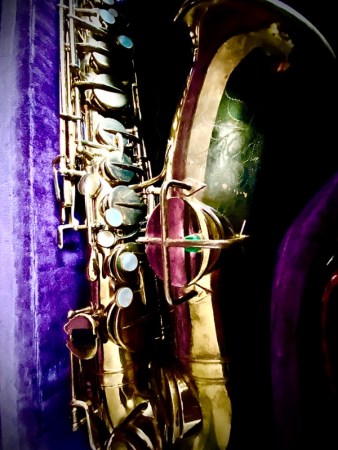
I’m not very good, nor comfortable, blowing my own trumpet…
Writers on the internet know this feeling well: we are urged to promote our presence, yet our inner nature knows what sort of people talk about themselves all the time…
This is particularly true if your main activity is of a teaching nature within a spiritual discipline. The road to understanding the ego – the lower self – is one of self-observation, with many cringing and disbelieving moments as the truth unravels.
Sue Vincent, Stuart France and I created short versions of our spiritual history for the Silent Eye website some time ago. We were aware there were more tech-savvy ways of doing this, but lacked the expertise to stand ourselves in front of a video camera and have ago. I remember from my ‘corporate’ days in the IT industry how difficult video was to work with. It’s the kind of medium in which a lack of experience and professionalism shows up immediately… and people switch it off; because we’ve all got used to the well-produced product.
When it comes to sound, it’s easier, but, again, wholly reliant on the experience – and sympathetic depth – of the person doing the interview. The human voice conveys a million nuances, all of them detectable by the listener in ways that filter through into our consciousness as ‘mood’ or ‘quality’. The mind has to learn to condense at an early stage; if it didn’t, it would literally go mad.
Enter Gary Vasey. Dr G. Michael Vasey, to be precise, for he holds a PhD in geological sciences. He’s one of those ‘polymaths’ who’s good at everything, yet manages, beneath his occasional Yorkshire gruffness, to remain kind and warm in his interactions. He’s the co-author, along with Sue Vincent, of The Magical Hexagram. His other blogs and books cover magic and mysticism… and he has more than a passing interest in ghosts and ghost stories.
Like Sue, Stuart and myself, he has followed a variety of mystical and magical paths in his life. He lives in the Czech Republic, but likes to come back to visit his mum and siblings when he can. Gary has attended a few of our ‘Mystery in the Landscape’ weekends, and knows us well.
Gary is also a singer/songwriter and a skilled sound recordist. The era of the Podcast has been key to his ability to promote his songs. Recently, Gary has widened his Podcast work to include interviews with some of the people he’s got to know over his several decades in the world of the magical and mystical.
Gary had already created a podcast interview with Sue, and wanted to do one with me as the founder of the Silent Eye. A short time ago, we convened across a Skype link to carry out the interview: subsequently turned into a podcast in his studio. To be honest, I was a little apprehensive, which sounds daft when I look back on the hundreds of talks I have given to audiences of various sizes over the past thirty years. I needn’t have worried.
Within minutes, and with little prompting, I was relating my early years of being victimised by the local church and school headmaster in the tiny village where I grew up; then passing on to a childhood in a Rosicrucian family, before becoming a leading figure in one of many organisations that eventually led to meeting up with Sue Vincent and Stuart France and the creation of the Silent Eye…
But why read it, when you can make a cup of coffee, put your feet up and spend a gentle and undemanding half-hour listening to the podcast? With, hopefully, an occasional smile, the odd tut and a wry thought of ‘I know just what that feels like…’
If it’s not a very human and unpretentious story, then I’ve got it wrong.
Those of you into jazz will have spotted that the opening photo is not a trumpet at all, but a saxophone. It is mine. I’m not very good at playing it, yet… but it’s on the list….
Below is the link to the podcast… And please tell your friends if you think they’d be interested. Thank you!
The links:
Direct link to the Podcast with Stephen Tanham (37 mins). The link is in the first line of the text click here
Or past this link into your browser.
Podcast with Sue Vincent: click here.
©Copyright Stephen Tanham, 2020.
Stephen Tanham is a founding Director of the Silent Eye School of Consciousness, which offers a not-for-profit home study programme covering three years of inner and outer exploration of the self, leading to a deeper knowledge of our personality and the links to its more powerful originator, the Soul.
Share this:


Human: Dont get any ideas!
Misti: About what, Father?
Human: About diving on my feet!
Misti: it’s the way they wiggle…
Human: It’s called fear!
©Stephen Tanham 2020
Share this:

+ #Silenti, Belief and Faith, Consciousness, Esoteric Meaning of Myth, esoteric psychology, Politics and Power, Psychology
The Entered Dragon (2) : dancing with shadows
by Steve Tanham
This time the dream is different. I know the dragon is there, but can’t see it. But I can see the heavy spear on the ground in front of me…
I bend to pick it up. Something moves behind me, something heated and red, but no matter how fast I turn or twist, I can’t get a glimpse of it.
Until I touch the tip of the spear… then, I feel the presence behind me still itself.
In triumph, I will my body to turn… but it won’t. My hand is held rigid to the very tip of the spear and my body flexes out in immobility behind it.
“Mmmm?” says the dragon, behind me, revealing itself by sound, alone. But now there is a feeling of consideration, of weighing up the options, though they are few. The immediate threat is gone, but so is the ability to change anything.
My fingers explore the tip of the spear, the only movement left…
——-
He was about a foot taller than me. Rugged and athletic, but dim. He hated that I wasn’t…
It would have taken three of us to subdue him, but that wasn’t an option; not at age twelve. He was captain of the school football team and he and his mates made our lives miserable. In the large playground of the secondary school he loved to slam into you from the side while you weren’t looking, causing muscle damage and a big bruise and resulting in having to limp to the bus stop to get home that evening.
And he loved to spit in your face… I remember that, vividly. Somehow that was worse than the pain.
He was a thug, and, I suspect – unless he got into the armed forces – remained that way. After I got transferred to a grammar school in the next town I never saw him again. On my final day in the old school, the form teacher organised a football match for all the tough guys and let the rest of us go early. I suspect they had been tipped off about plans to beat me up on that last journey home.
Unsurprisingly, I was conscious of what civilisation was from an early age. It was a place where the majority stopped the thugs, where there was respect for the individual being different, as long as they contributed to the society. It was a place of caring and consideration. In short, it was a place where something invisible called ‘values’ mattered. They didn’t earn you money, though money could buy you a place to live where the risk of living near to a large thug was minimised.
When I got a bit older, my uncle, who had emigrated to California, spoke about the American’s right to bear arms. He said it helped the good guys defend themselves and the neighbourhood. I asked what happened when the bad guys had guns, too.? Was the answer that the rich folks had better guns?
If we’re lucky enough, rich or poor, to be brought up in a loving home, then we have a series of expectations placed on us at an early age. “Nice children don’t to that, Stephen!”. The love of our elders binds us to adhering to this code. Eventually the code of expectation locks itself into our lives and becomes how we live… mostly.
The problem is all those wild things we came into the world inclined to do are still there… down in the supposed vault where we keep this ‘other side of us’ locked away. A metaphor of light and dark is used both in spirituality and in early psychology – the time before WW1 when Carl Jung introduced his ideas on the ‘self’ to the world. Dark forces were certainly at work, then…
Carl Jung’s ‘Analytical Psychology’, to give it its full name, was the first modern science of motivation and behaviour to recognise the significance and breadth of this dark force in our lives – and in our societies. The name he gave it was the Shadow Self... usually known as just the Shadow.
Our reasonable assumption might be that, given we had locked the bad bits of us into our internal vault, never to be seen again, we might expect they would function as prisoners. And this they do – ragged, desperate and deadly. But, instead of being hidden ‘down there’ they have found a way to be ever present in our lives, hidden in plain sight, so to speak.
To their immense joy, there is no prison at all, just the light and dark. The light is the light of understanding created by consciousness. The dark is the withdrawal of that consciousness in a deliberate act; like the horrible childhood practice of ‘sending someone to Coventry’ – cutting them off from conversation and acting as though they weren’t there. It’s not just children of course. Its a standard management technique when a senior bully wants to get rid of or undermine a subordinate…
‘Subordinate’ – there’s a name from the dark side if every there was one…
But back to our prisoners who aren’t really in prison, just ignored. By repeatedly learning to take away consciousness and interaction from them, they become ‘dark’. We learn to make them disappear.. except they are still there. Moreover, they are the key to a vast reservoir of our energy, and our ‘aliveness’ and so our world becomes paler and thinner, until, usually in middle age, we begin to question the validity of how we have lived our well-behaved lives.
But what of the dark ones?
If these dark creature were weak, it wouldn’t be a problem. But they’re all a foot taller than we are and like spitting in our faces… And they’re not at all passive.
The prisoners know that if they were to appear as we knew them when they were sentenced, they would be locked and bolted down even harder. So, they use a technique where they project themselves onto our world instead of onto our faces. They are so powerful that they can take over another person in our lives and wear them like a mask…
This is not as far-fetched as it sounds. We create our world in the first place. Those flavours of courage and fear, like and dislike, anger and pleasure, all go to colour a world perceived as ours. The fact that something untended in our depths has the capacity to change key parts of that ‘willed’ world is entirely logical.
This is all very scary… And so it should be, though we are working towards a deeply positive ending to this.
The above process of conscious and subconscious works within each individual, but more powerfully within our carefully controlled and regulated societies. To counter this requires the fine tip of a heavy spear… And a different way of viewing the self-created dark ones.
In the next post, we will examine the nature of these matured dark creatures and the essential relationship they have with our emotional, mental and spiritual health…
Other parts in this series:
Part One, this is Part Two
©Copyright Stephen Tanham
Stephen Tanham is a Director of the Silent Eye School of Consciousness, a not-for-profit teaching school of modern mysticism that helps people find a personal path to a deeper place within their internal and external lives.
The Silent Eye provides home-based, practical courses which are low-cost and personally supervised. The course materials and corresponding supervision are provided month by month without further commitment.
Steve’s personal blog, Sun in Gemini, is at stevetanham.wordpress.com.
Share this:


I am crow, on summer’s breeze
Glimpsed in love with beating wings
Within the bright sun’s leaving.
➰
My feathers’ strong and hollow shafts
Are filled with air you breathe
And softly lit in our reflected passion.
➰
Remember this when dark and sodden bird
Looks out, short day’d from tree of Ash
Asking nothing of your walk of logs to fire.
➰
Raise then your shuttered gaze
And for a moment hold my own
Before you pass into your tree-flamed cave
➰
No-one sees behind the crow’s black looks
For writers do not live in winter trees
Freed here, in heights of soft blue union.
➰
Write it narrow now, before we both forget
As autumn winds engage our throats.
And winter’s ice, our memories.
➰
©Stephen Tanham 2020
Stephen Tanham is a Director of the Silent Eye School of Consciousness, a not-for-profit school of mystical living.
Email us at rivingtide@gmail.com
Share this:

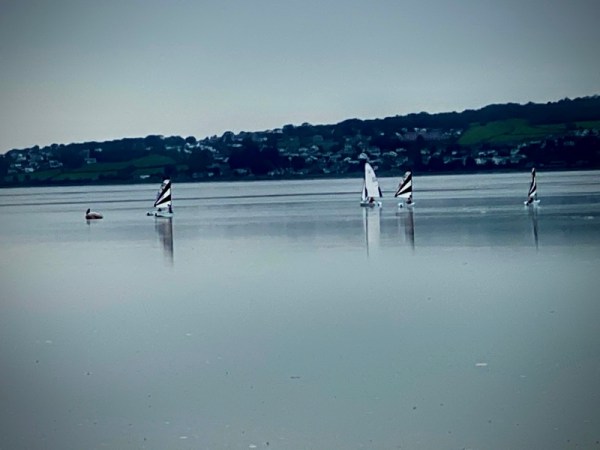
We were walking Tess, our collie, along the estuary shore at Arnside. We had seen the stripey sails of the boats from the local sailing club and wanted a closer look. There was something odd about a passing seagull. I smiled, sure of my evidence for once…
“Tide’s going out,” I said.
My wife, Bernie, responded immediately. “Nope…”
She was born in Heysham, across the bay from the estuary here. Living by the sea throughout her childhood and into her teens gave her an uncanny ability to ‘just know’ the state of the tide.
But I had a secret weapon – logic! The seagull that had caught my attention had floated by on the water backwards; headed towards the open sea, but facing inland.
Case closed, I reasoned.
But fellow blokes will know that to be so certain of anything in the presence of one’s wife is an insecure business… I glanced at the seagull, stealthily, not wishing to give away my source of certitude. It was still facing inland but being carried out to sea. No doubt about it – I was right!
“Look at the edges of the water,” she said. “There, the water is flowing the other way, the outflowing river in the middle channel is fooling you..”
Just then the klaxon went off… There are dangerous tides in these parts. The klaxon warns anyone using the estuary that Morecambe Bay’s vast and swift tides had turned and were racing inland – in this case, sweeping up the edges of the estuary at Arnside. During high tides, there is even a ‘bore’ – a small, single wave that continues up the local rivers for some distance.
Crushed, I turned to look at Bernie, who was looking at me and smiling. Beyond her, the mystery seagull had acquired a chip. We’d just had chips…
©Stephen Tanham 2020
Share this:

+ #Silenti, Belief and Faith, Consciousness, Esoteric Meaning of Myth, esoteric psychology, Politics and Power, Psychology
The Entered Dragon (1)
by Steve Tanham
Like waking within a dream – or, at least, the point where the lucidity begins…
I turn my head in the small theatre, expecting others to be smiling, if not laughing. But no-one is, because no one else is here…
Just me and it…where ‘it’ is not the theatre.
The curtains part and what I knew to be behind them takes centre stage. Leathery pads, soft on the well-trod wood, make a sliding sound as it turns to face me. The eyes are glittering, but not as much as its breath, gathered to strike in elongated curls of superheated air.
The redness is appalling. So filled with force, so intimate…such a deadly embrace.
At its feet is a long, metal object – a spear, shaped in a very modern way, with a thick shaft at the back, full of mass and purpose, tapering to a tip so fine you can actually see the point at which its material ends and the menacing presence of ‘nothing’ begins.
The crimson creature shuffles forward, its walk a deliberate caricature of panto.
The glittering breath hisses, “Your move, surface child…”
To the hoots of its laughter, I force myself to a waking dominated by an even, thin film of sweat on all of my skin.
——
Increasingly, I read that we ‘live in an age of evil’. The state of the world’s politics is close to turmoil. Dictators dominate nuclear states and elections are warped from near and far by digital manipulation. The elusive ‘man in the street who can’t be fooled all the time’ is, sadly, absent. The drums and revenues of war are more important than the deaths of the millions of children crushed in its wake.
Perhaps they have a point; those who proclaim evil is with us as never before – evil armed with the power to finally destroy the world?
It’s a striking feature of the technological age that we don’t talk about nor believe in evil as a real thing – a real force, in itself. And yet, for most of the world’s history, that’s exactly how it was viewed. Today, we may adopt the maxim that evil is simply ‘the absence of good’. Hitherto, I might have agreed with this, but the ‘New Age’ dismissive approach to evil has, in my opinion, been shattered by the acceleration of dark deeds as we race towards the victories of ignorance on a grand scale.
But deep considerations of such things have a home, and the word for that home is ‘psychology’. As a lifelong mystic, I may feel that psychology fights shy of embracing spirituality. It seems frightened of losing its respected ‘ology’ and remains detached and clinical, treating our deepest contacts with a creative source as just another interior experience. And if you use the language and precepts of psychology, itself, you would find this hard to rebuff.
It is only when we dare to take up and trust the poetry of being that the walls begin to shake…
There is, though, a branch of psychology that dares to deal with evil; that declares that our turning away from an active ‘dark force’ within us costs us dearly – as individuals and societies. The science of such encounters was created by Carl Gustav Jung – Jungian Psychology. Most people have heard of it. Many know of the wrok of
Jung was a contemporary of Freud, the most famous of the 20th century founders of modern psychology. Freud gave us the Ego and Superego as the first structures of the ‘psyche’ – the internalised sense of self, the ‘me‘. Beneath them, he placed the dangerous powerhouse of ‘inner self’ and named it the ‘Id’ – literally the ‘IT’. From Jung’s perspective, Freud was obsessed with showing that the sexual force was the driver for the Id. Carl Jung accepted the existence of the Id, but set out to show that its power and expression was far more sophisticated than just sex. Even then, Jung had glimpsed the place where historic evil entered the life of mankind, if the whole of the psyche – ‘the whole of me’ was not understood and given life… The imposed societal pressures of the Superego were at odds and often at war with the needs of the complete human.
Our everyday experience as a ‘me’ is dominated by an ‘in-here’ and an ‘out-there’. During the day, we are bombarded by sense impressions, and, in secondary fashion, by the responses to those. Such responses can be physical (such as pain or pleasure), or psychological; affecting the wellbeing of our sense of self. Thus a ‘bad’ experience, like being degraded by our boss, can make us feel internally diminished or smaller, regardless of whether or not it has actually ‘hurt’ the senses.
Until the last century, no-one thought it possible to create a map of why this happened, It just did. Strong people figured out their own rules, and thrived. More sensitive people didn’t fare so well.
But the pre-psychology age inherited millennia of reflection about good and evil. Those who embodied good were considered to ‘shine’ – attracting and encouraging others to an inner yardstick of wellbeing shared. Those from whom evil flowed would pursue their selfish aims, regardless of the cost to others, who were crushed beneath the wheels of the advancing personal ambition.
As ‘society’ became more mechanised, expanding and changing the individual’s emotional and physical landscape, the principles and methods of industrial organisation were encouraged to overtake any notion of societal good – unless it happened to be a happy by-product. There were always exceptions; the local civic authorities of the nineteenth century did much to improve the lot of the ‘common man’. Such works were often the result of ‘societies of good’ like the Quakers and the Cooperative Society in Britain. There were many more.
There is a common thread here. Today, we would say that those who pursued their own ambitions, mindless of the costs to others, had huge ‘egos’. At the time there was no such thing as an ‘ego’. Our sense of the ‘selfish-selfless‘ balance at work was simply an expression of the evil or the good. Poor people of any age of mankind have been habitually pummelled so that they were incapable of questioning why the ruthless rich had so much more than they did…
Nothing changes until that difference in wealth becomes a living force of widespread dissent, itself, and people actually begin to ‘taste’ it. At that point the consciousness of unfairness spreads to include those who also used to be comfortable but whose own hard-working prosperity has now faded. As a man on a plane – an American – said to me not long ago, “Don’t let them tell you that the USA is prosperous. The guys in the middle who used to have a good living are desperate…”
The answers to such deep issues are often revolutionary… If we could actually see that the psychological forces at work are reflected in the whole of society, we might be able to recognise why egoic monsters can take our beloved countries swiftly into decline and why the country’s core can be polluted in a way that takes decades to redress… If they are fortunate.
In Part Two, we will look at how the work of Carl Jung and many in the mystical traditions pointed to this process of devolution, and how it throws light on the ‘awe-full’ power of the hidden parts of the ‘me’, singly and collectively.
©Copyright Stephen Tanham
Stephen Tanham is a Director of the Silent Eye School of Consciousness, a not-for-profit teaching school of modern mysticism that helps people find a personal path to a deeper place within their internal and external lives.
The Silent Eye provides home-based, practical courses which are low-cost and personally supervised. The course materials and corresponding supervision are provided month by month without further commitment.
Steve’s personal blog, Sun in Gemini, is at stevetanham.wordpress.com.
Share this:


Mum had begun to look restless. She’d spotted something…
We’d skipped breakfast, and were hungry, but had been assured that our destination was more than capable of feeding us. Overhead, an old steam engine thundered – way too fast – towards a bend in the track. I would have studied its doomed motion had my mother, who, at ninety, has dementia, not just wandered off in the wrong direction towards a tall shelf full of used paperback books…
She loves books even more that I do. At the last count she had thirteen of them open on her double bed…

(Above: as befits a former station, there are regular trains…)
I was struggling to see her among the many people in the narrow spaces between the tall shelves. My stripey anti-Covid mask wasn’t helping, either, as most of those in Alnwick’s former railway station weren’t wearing one, and kept looking at me as though my frantic movements were a prelude to armed robbery…

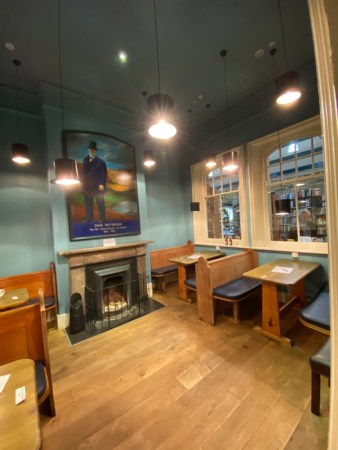
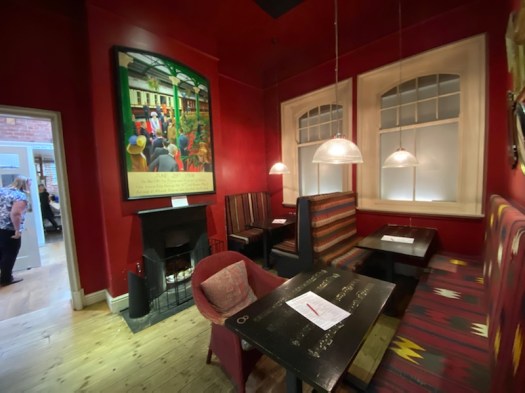
It sounds like a dream sequence in one of those arty movies where you have no idea what’s going on–and still have no idea at the end… But it wasn’t. It was a Friday morning in Alnwick – one of Northumberland’s most historic places. We had just entered a place that’s nearly as famous as the castle: the celebrated Barter Books.
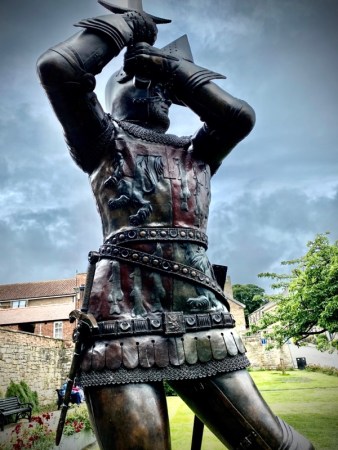
Alnwick’s most famous son lived just across the road from the site of the future Alnwick Station.
Henry (Hotspur) Percy was born 20 May 1364 at Alnwick Castle. He was the eldest son of Henry Percy, 1st Earl of Northumberland, and Margaret Neville. His grandmother Mary Plantagenet was the Granddaughter of the ruthless King Edward the III.
Harry was taught to fight as soon as he could hold a sword. Brilliant in battle, he was knighted at the age of 13 by the King, Richard II, and, in 1385 accompanied the King on an expedition to Scotland where he distinguished himself in battle and ingenuity when he set fire to a besieged castle, causing a breach in its walls – through which he leapt, sword in hand, to claim the victory. The Scots, in recognition of his continued bravery, bestowed on him the name of ‘Hotspur’.
Shakespeare immortalised him in Henry IV, Part II. “… and by his light did all the chivalry of England move to do brave acts.”
All of which has nothing to do with our story and my lost mother, apart from the fact that Alnwick seems to produce acts of innovative bravery…
Through a gap in the bookshelves, I finally saw a flash of her blue jacket, and managed to retrieve her, guiding her to the nearest tearoom and sitting the two of us down. Our food order was taken promptly, and we began to relax.
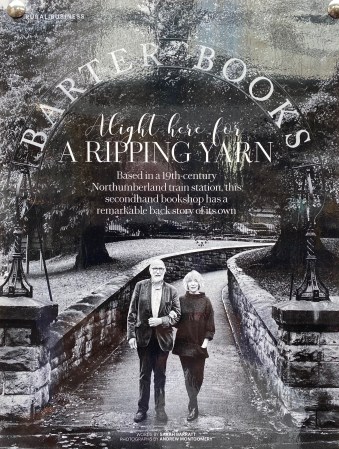
Barter Books is housed in what was Alnwick’s grand Victorian station. Twenty years ago, the derelict building was transformed from ruin to success story.
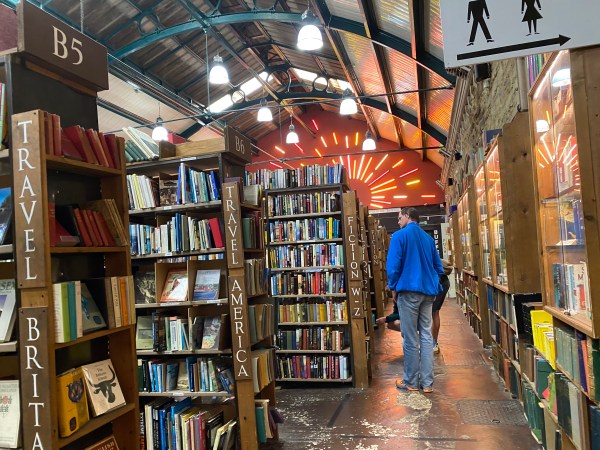
Its main inhabitant now stocks more than 350.000 books, ranging from historic collectors items to modern paperbacks. All are good-quality and second hand. Barter Books buys books, too, as long as they are clean, likely to be popular or rare.
You enter into the former parcel room, greeted – in winter – by a blazing fire and a worn but comfortable studded leather armchair. In summer, the old stone keeps things cool.
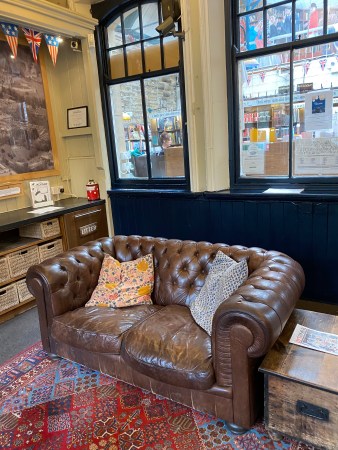
The owners, Mary and Stuart Manley set out to create an oasis of books for ‘booky’ people: the sort that will stay, wander, eat a cream tea or a bowl of winter soup and, at the end, buy a book and leave feeling that their world now makes a little more sense…
The station hasn’t offered real trains since the Beeching cuts of the 1960s, but, thanks to Stuart’s love of model railways, the shelves in the forward part of the building – beneath the spectacular glass and iron entrance roof, are topped with their own ‘garden gauge’ railway, along which locos and their troublesome trucks thunder.

It’s a great love story. Stuart’s wife Mary had little interest in the engineering of precision parts for model railways – which had been Stuart’s source of income in one of the small units on this converted site in the 1990s. Mary had been an art history teacher in Tennessee, but life took her to New York, where she worked in a second-hand bookstore… and met Stuart.
They were both broke, but Mary had the idea of combining their unusual skills…
In 1991, she set up a small stall in a corner of Stuart’s engineering shop in the former Alnwick station. Now, 30 years later, their success story fills 9,000 square feet of the restored site.
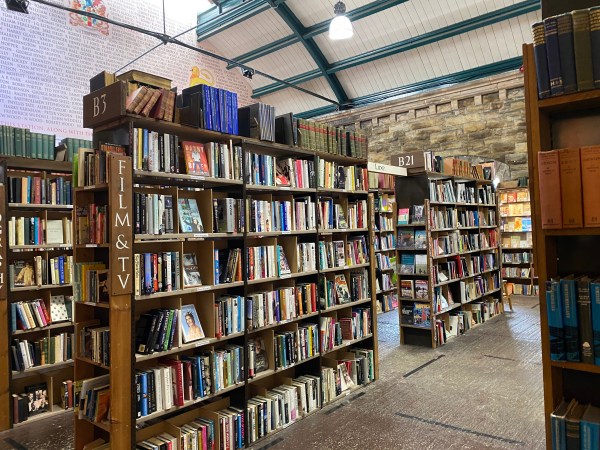
The original entrance to the station is focussed on books for children. The old first-class ladies’ and gentlemen’ waiting rooms – which are now called the ‘Blue’ and ‘Red’ rooms -provide seating for the Station Buffet. Good food – and shelter from Northumberland’s changeable climate – is a central theme; as is a cheery welcome and excellent service.

Many of the original fittings were taken when the station became disused; some of them stolen. The couple salvaged a replacement fireplace for the Red Room from a nearby station at Iderton.
The main hall, which was once the outbound platform, is packed with shelves full of books on subjects ranging from woodwork to philosophy.

Barter Books will sell you that ‘I had this as a child and never thought I’d see it again!’ book for cash; but they also operate a true barter system. You may bring back your used books, as long as they are in good condition, and receive a partial credit towards another purchase.
Stuart and Mary also attend upwards of twenty antiquarian book auctions each year, so their stock includes not only rare books, but a wide selection of 1st editions.
Will they continue to be successful? Stuart painfully remembers the time his own children got bored with his model railways and turned, instead, to their video games. He points to their 350,000 customers, and an astonishing 3,000 books sold per week.
“But nothing is certain…”
I hope something is certain. My mother and I want to return again and again to Barter Books, regardless of how many times I have to go looking for her….
References:
Barter Books one-page flyer:
Note: I have no commercial connection with Barter Books, other than liking them, very much!
©Copyright Stephen Tanham
Stephen Tanham is a Director of the Silent Eye School of Consciousness, a not-for-profit teaching school of modern mysticism that helps people find a personal path to a deeper place within their internal and external lives.
The Silent Eye provides home-based, practical courses which are low-cost and personally supervised. The course materials and corresponding supervision are provided month by month without further commitment.
Steve’s personal blog, Sun in Gemini, is at stevetanham.wordpress.com.
Share this:

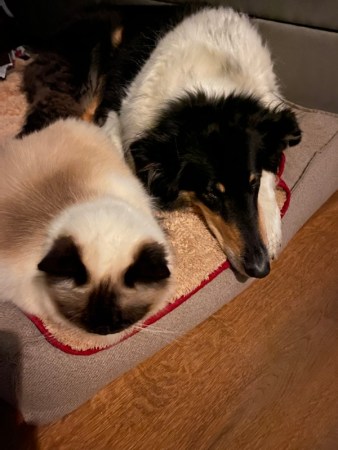
Misti!
Yes, Tess?
Let’s have a nose race and see who can cross this red line first!
But your nose is already there…
Sometimes you’re cleverer than Mum says…
©Stephen Tanham, 2020
Share this:

From Stuart

*
There are other sections in the Book of Genesis
which may be pertinent to our survey of St Michael…
*
… ‘Left alone at night, Jacob was attacked by an unseen presence
which wrestled with him until day-break, whereupon his adversary cried,
“Desist, for the dawn is here!”
“Are you then a bandit, that you fear the dawn?” asked Jacob.
“At this time, we angels must sing dawn’s praises!”
“I will not desist until you bless me,” said Jacob.
“What is your name?” asked the angel and when Jacob answered, he continued,
“From this time on you shall be called Israel, for you have struggled
against me without succumbing and fire should guard fire.”‘
*
Candidates for Jacob’s adversary include Michael, Gabriel and Samael,
although Gabriel’s water associations might count against him.
*
Traditionally, Michael is associated with fire, but it is not
altogether clear why, unless he was…
View original post 194 more words


 Sun in Gemini
You must be logged in to post a comment.