
+ #Silenti, Consciousness, enneagram, esoteric psychology, Incarnation, Silent Eye School, Spirituality
The Mysterious Self
by Steve Tanham


One of the most wonderful elements of being Human is the sense of self; yet there is great confusion as to what the ‘self’ really is… even whether it exists at all.
Something harvests the experiences of each day yet declares itself separate from them. This accumulation is deemed to be a living entity – the ‘me’ – resplendent with a memory of having lived it, rather than the actuality of what was lived, and containing a trace of the story of that day, which, over time, is consolidated into ‘like’ experiences.
Language cements this relationship with experience. In western languages, we have the basic construct of ‘I do this’: subject, verb and object. Some older languages – often associated with highly spiritual societies – do not have this structure. Sanskrit, for example, the ancient language of India, would say “This is being done”.
It is memory that gives us this certainty of self. Its power of continuity becomes vital to our wellbeing. We take this completely for granted. We do this because we have no choice – it became our dominant perspective at a young age, typically before the age of seven. Because we ‘live in it’, we no longer see it – like so many aspects of our individual worlds.
Although wonderful, it is also a spiritually-deadly perspective, because it separates ‘us’ from the rest of our world.
Let’s consider the elements of this.
Having a sense of Self means that I separate out parts of my experience and call them ‘me’. This act, alone, is quite remarkable. On what basis did my young self determine which bits were me and which were something else?
Vividness of experience must have played a big part. What my attention is drawn to becomes that which I focus on. My attention is grabbed by immediacy and there is nothing as immediate as my body. Continued focus on my body dulls the attention given to the rest of ‘my’ world, even though it is still there with all the power it had when I was a new-born.
This sense of my body becomes, in many ways, my first self – and this will remain dominant for the rest of my life. Spirituality in all its forms, faces this as the first barrier to development. We have to come to see that the solid reality of our own cluster of matter – our bodies – is only one reality; and that the dominance of this in our consciousness is due to habit, rather than any superiority of existence.
The dominance of self as body has another consequence – it locks us into pain. When the body is in pain, so becomes our whole self, if it is focussed in this way. Pain in the body will always be real, but its effect on our overall aliveness is determined by our attention. This discipline is one of the tenets of Buddhism.
The founding psychologists of the early part of the last century worked hard to establish a structure of the Self, or Psyche, so that they could truly investigate its workings. This was a giant leap in mankind’s ability to analyse its own existence. Freud is somewhat dismissed these days, largely because of his singular focus on the sexual power as the dominant ‘drive’, but he gave us a lasting legacy and some major insights into how the self develops and sustains itself. These are of great service to the spiritual seeker.
His description of the structure of the self is of great use to those pursuing a spiritual path; and has echoes across traditions as varied as the Kabbalah and Sufism.
Freud proposed a three-layer hierarchy for the psyche. The first of these was what became known (in English) as the ‘Id’. The translation serves us badly, because the native German was much more instructive. This word, (Das Es) was, literally, the ‘It’. Using the word ‘it’ distanced the observer of her own psyche from this ‘beast’. The sentiment being: “I may need it for my survival, but I don’t have to suffer its beastiality in my normal life.”
And yet, the beast of the Id contains all our energy . . . Coming to terms with it is really important, if we want to lead a vital life. The sad part of this rejection is that it also locks away our younger self, with all its innocence and its delight – because it had appetites for things the subsequent world found ‘antisocial’.
This act of staring at the Id generated a kind of second self, known, in English, as the ‘Ego’. The native German, again more helpful, was ‘The I,’ (Das Ich). The ego’s job became to manage the monster below, allowing us to fit into society without picking our noses all the time – feel free to substitute your own metaphor . . .
But the Ego borrows all its energy from the Id, which it then seeks to manage . . .
The final layer of the Freudian self is, in English, ‘the Superego’; in German, the Uber-Ich (the over I). This is largely concerned with the ‘should-dos’ of our lives – the development of morality; that which is handed down to ‘well brought-up children’. Again, the Supergo borrows all its energy from the Id, to give the final structure and management to the concept of the self.
So… we have a beast and a trapped child, not allowed to develop into an adult self because we have rubbed up against the edge of acceptable society. Above that we have a parentally-created pattern of authority, that lives with us all our lives until we decide to break that ice ceiling and see the sky . . .
None of these things have been created by bad people. They result from two things: the commonly accepted concept of Ego, which is really the Personality; and the nature of Society – which centres itself around consensus and power, and therefore cruelly robs the individual of full life. If mankind has a purpose, it is to reconcile these forces, for the good of the life that follows.
These elements of the greater Self can be ignored – in which case the patterns of ego-driven personality will return to haunt us all our lives, producing similar patterns of events as the years progress. The alternative is to embark on a journey into the self; spiritually, we would say to go in search of the Self.
There are many trials to such a quest, the biggest being the act of turning away from the chosen path when the going gets difficult. The ego, which, remember, is a mental and emotional construct and has no real existence, has an armoury of below-the-radar weapons against such a frontal assault on its (false) kingdom.

Techniques can help. One of the most powerful tools for providing us with a personal map of the journey is the Enneagram. Originally developed by Gurdjieff as a key to how the world ‘unfolded’ in its process (the spiritual ‘Word’), it was added to by deeply spiritual teachers, such as Ichazo, Naranjo, Alamass and Maitri, to become the basis of a way of understand the ‘whole in diversity’ in the sense of how the human personality obscures the greater part of the Soul, within.
The Silent Eye has combined this knowledge with the insight from a triad of mystical and magical pasts, to offer the student (we prefer Companion) a three year guided journey, taken by monthly correspondence course with personal supervision, where every aspect of the Self is encountered, deepening each year as the journey takes us to the realm of the soul-child and beyond.
Companionship is one of the keys. Schools like the Silent Eye offer this even more than they offer teaching. This is because the journey can only belong to the one taking it. In the real journey of the true Self, which brings us face to face, via the Soul-Child, with the Essence (Being) from which our Soul formed itself, we reach a point where no system or religion can have any power over us. We come, quite early on this path, to a place where we know that truth belongs to us, and only truth learned and experienced in this way has any value.
To stand alone and look out at that which we distanced ourselves from, when the founding layers of our personality separated us from the “Other”, is a moment that brings us to stand before reality – possibly for the first time. The new Self generated at that point is one of immense power . . . and intense humility.
10 June 2020
©Stephen Tanham 2020
Steve Tanham is a Director of the Silent Eye School of Consciousness, a not-for-profit, teaching organisation which delivers stages and mentored lessons via correspondence course. For more information contact us at rivingtide@gmail.com
Share this:


I am not a tidy person. My wife, Bernie, is much better than I am but even she admits that, as a couple, we have to work at it.
At the bottom of our garden is a large stone building called ‘The Saltpetre’. Built around 1820, this ‘expense magazine’ (and no, I haven’t just made that up) used to house gunpowder awaiting transportation the following morning via the canal that was once next to it. I’ve mentioned it before, but this post is nothing to do with the history of the village… other than the legacy of caring for something that old.

The ‘Salty Pete’ as we’ve come to know it, is not a particularly pleasant place to inhabit. The old stone walls are unrendered and it’s cold and draughty in winter. If you wanted a classy man-cave, you wouldn’t start here.
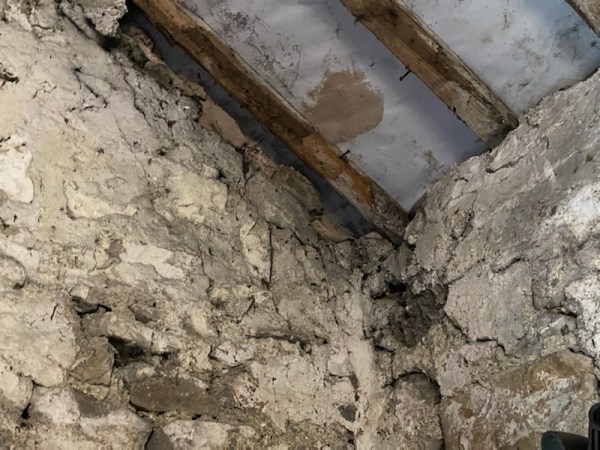
The floor still comprises the original cobbles, which are impossible to sweep clean. They are also the reason there isn’t a truly level surface in the whole edifice.

My study in the house is much more hospitable… but you can’t drill, saw and sing Meatloaf to yourself in a study. And, somewhere in the old ‘shed’ near the back wall, was a set of power tools my father bought me for assorted birthdays and Christmases… He used to sell them in what had been a converted fruit and veg shop, driven out of business by Morrison’s supermarket opening across the road. So there was some buried sentimental treasure in the dark stone interior of the Saltpetre… which may feature later in our story.
We’ve lived here for 10 years, and each year another layer of our stuff has been pushed into this cavernous storage space. I did have the decency to fund a new roof and door, and at the same time took advantage of somebody else’s building skills to have an interior loft installed, thereby increasing the already vast storage capabilities for yet more stuff…
Year on year, as it filled, the task of cleaning it out ballooned in my consciousness, as things do when put off for a decade…
Then came March’s virus lockdown… But that wasn’t an immediate problem, as there was a list of ‘unperformed other jobs’ that were actually much easier – like power washing the flags around the house. That took two days. Then we had the major task of tidying up the study (me) and the next door room (Bernie) that looks out, via a tiny balcony, over the garden, and which we always planned to use for a morning coffee on bright summer days… That took two weeks, but both rooms looked wonderful when we’d finished…. Which had the unfortunate consequence of giving us an appetite for getting things done. Hmmm, dangerous that!
An assortment of sweaty garden jobs in the hot sun followed, but finally, there was nothing left of the list but the Saltpetre. Bernie assured me that I would at least have a true man-cave at the end of the job. I saw through this shallow ploy, of course..
Desperately seeking reasons not to begin, I clutched at “But it will cost a fortune!” She just smiled at me – with that inmate skill that women have – and said, “Well, let’s make it a double challenge: don’t spend any money at all…”
She watched the cogs work… I do like challenges.
The day was ending. We had been successful in our work in the garden and opened a bottle of New Zealand white wine. We sat at the garden table, watching the sun descend behind the ash trees and discussing the feasibility of doing ‘Salty Pete’ at zero cost.
An hour and a bottle later, with Bernie agreeing to lead the charge by sorting out the gardening tools, we agreed that it would be fun to try.
It must have been the wine…
To be continued…
Share this:

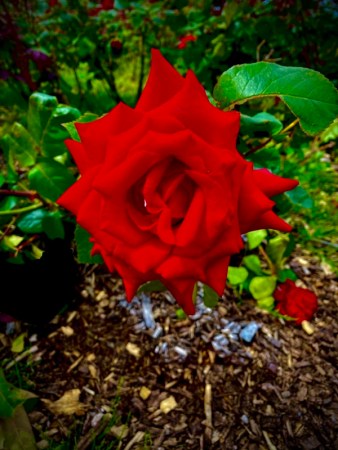
There are colours so deep, so pure
They drop beneath the colour word
Into a hue of inner meaning
—-
There are some reds
That are not red, but blood
Not spilled, not end of life
But beginnings
—-
When the red that is not blood
Speaks through the blood that is not red
And spills our life upon the opened palms
Then it is wise to listen
—-
With a listening that is so deep
That red, alone, dares speak
Its name.
—
©Stephen Tanham
Share this:


The archer stands before our target. His skill is deadly; he never misses, but there’s a catch: he’s also blind… and he never speaks, except with his arrows. No-one knows how he does what he does, but if you ask him a question, he will fire his arrow at the target. The place where the arrow lands is his answer to your question…
The target looks like this:

You are allowed to touch him, once, before he fires the arrow. You touch him with your sincerity; with your voice if you wish – though your focussed thoughts will do fine. After that the arrow flies into one of the 64 squares of the matrix of truth.
He never misses because his arrow always lands in the middle of one of the sixty-four squares. The squares represent the hexagrams of the I Ching – the ancient Chinese book of Changes discussed in the previous parts of this series – see references at the end of this post.
You may not see him (or her) as a Divine Archer. This is just how I have chosen to illustrate the process; but it does represent how I see him when I cast the coins.
If you look at the archer’s matrix, you will see the same words written along the top as are written down the side. The words are: Heaven, Thunder, Water, Mountain, Earth, Wind, Fire and Lake.
Casting the coins is how I know what the Archer has done in response to my question. As with other oracles, there are various methods for arriving at (in this case) one of the 64 squares, but throwing three coins is the most commonly used I Ching method.
Here are all the possible ways that three coins having heads and tails can fall. The values are explained, below.

How we consult the Archer from the coin drop:
We count heads as value three. Tails as value two.
We shake three coins in our closed hands and drop them, together, onto a flat surface.
From these number values, we are now going to construct a vertical series of lines to form our hexagram. Each line is derived from the value of the coin-drop. We begin these lines at the bottom of our space and add each new one on top of the previous.
If the number is odd (seven or nine) we draw a line that is continuous, and we write the value of the coin-drop next to it.
If the number is even (six or eight) we draw a line that is broken in the middle, then write the value of the coin-drop next to it.

The lines we are drawing are the yin and yang lines. Yin is broken – ‘Yielding’; and Yang is whole – ‘Active’. What we have created, above, is half of a hexagram, which is known as a trigram. But a trigram is far more than just half of the whole, it is the essence of the I Ching.
Consider the diagram, below:

A hexagram is made from six of these lines stacked together in two groups of three. In Figure 4, if we look down the emphasised left column, under the word ‘Lower’, we can identify our lower trigram as SUN – meaning Wind. Within the archer’s matrix, we can see a (red) row of squares next to SUN. Our target square lies somewhere within this line, but to find where it is we have to complete our hexagram by adding the ‘Upper’ trigram. Both, together, will then point to the address of our answer.

We can now return to our Archer’s matrix and add the vertical line to find the intersection:

From the above, we can see that the union that resolves our ‘reading’, is the crossing of two variants of the same eight figures. Each of these is reached by casting three coins to determine the balance of Yin-Yang and hence the whole or split nature of the line.
It is worth pointing out that the Yin and Yang lines are a binary system. They result in only one of two possible states, and therefore can be indexed as a simply binary number of ones and zeros. I am indebted to Michael Graeme for pointing this out in his (free) summary of the I Ching which can be downloaded from his website: The Rivendale Review.

Back to our Archer’s matrix… We have made our sincere request for insight; have created the ‘wings’ of our bow using two arms of eight figures, and the arrow has been fired by the blind archer. Where did it land and what does it mean for us?

Cross-reference the combination of Wind below and Mountain above and you will come to the square marked in red in Figure 6. This is now revealed to be Hexagram 18. To obtain our answer we look this up in a reputable table of I Ching wisdom. The classic text is Richard Wilhelm’s book I Ching or book of changes.

I’ve had my copy (above) for nearly thirty years. It’s battered but much loved. We mentioned Micheal Graeme’s free PDF book before, and he has decades of experience with the I Ching; so let’s see what his highlights are for this reading. Bear in mind that, like last week, I did this divination on the day of preparing the blog – Wednesday 3 May, 2020.
Michael’s text for Hexagram 18 reads:
———-
18
Decay
Poison
Renovation
Work on what has been spoiled
~Keywords: Obsession, Narrow Minded, Dogmatism, Degeneration, Old Fashioned, Corrupt, Rotten, Decaying… Renovation, Cleaning Out, Purging.
When we follow something with a sense of enthusiasm, we may sometimes forget to ask what is right, or we may become careless and allow corrupt influences to assert themselves, So, after Following comes Renovation.’
———-
I can’t think of a better summary of what we’ve been watching from America over the past few days… and also the spirit of the thousands of brave people conducting peaceful protests and standing in front of lines of bewildered soldiers who have orders to kill citizens if necessary…
For a full reading, go to Micheal’s website and look up Hexagram 18. It’s a free PDF text that you can keep.
A final technical note about the figures in red on Figure 5. The dropped-coin values of 6 and 9 are considered worthy of special attention in a reading, and will be given special notes in the hexagram text. They are representative of the periods of greatest change, like the peaks and troughs of the classic waveform. It is also customary to change these lines to their opposites and create a new hexagram, one which is then read in the context of providing further emphasis to the primary hexagram.
Copyright notice: All diagrams used in this post have been created by the author and are copyrighted 2020.
Previous posts in this series:
The Old One and the Gatekeeper: Part One, Part Two, Part Three
Divination – Art or Science?: Part One, Part Two This is Part three, the final post.
3 June 2020
©Stephen Tanham 2020
Stephen Tanham is a Director of the Silent Eye School of Consciousness, a not-for-profit teaching school of modern mysticism that helps people find a personal path to a deeper place within their internal and external lives.
The Silent Eye provides home-based, practical courses which are low-cost and personally supervised. The course materials and corresponding supervision are provided month by month without further commitment.
Steve’s personal blog, Sun in Gemini, is at stevetanham.wordpress.com.
Share this:


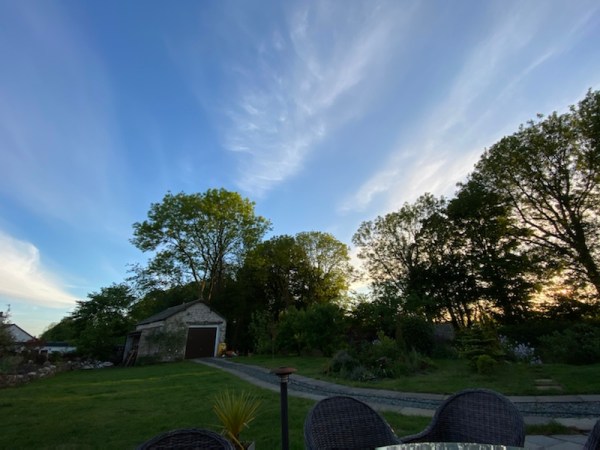
For as long as I can remember, I’ve been entranced by the soft skies of the warmer months – particularly those of late spring, which heralds their return.
Their beauty speaks for itself… but there is something else that haunts.
The word ‘soft’ is the key. Every one of our senses is touched in a silken way by the early mornings, long days and beautiful twilights. The air is not only warm, but fragrant with the perfumes of flowers, cut grass and the smell of the powerful sunlight bathing us all.
And beyond even this, if you listen deeply there is an emotional and voiceless voice:
“I have brought this to its fullness. Put away thoughts and drink it… Let it become part of you.. Take what you can from it; let its life be yours. It is fragile because it is perfect; it lives for an instant because it is timeless – but needs you for its completion; for it to say ‘I was there…’. But part of you, being creature, must move beyond completion in your life within these cycles.”
The ancient Vedic civilisation of India had the concept of ‘Soma’. Ostensibly a drink given to mankind by the gods, it renewed the vitality of the whole being, and connected us with the heavens. When I gaze upwards into soft blue skies, I think of Soma.
The Sufis spoke of wine as a divine metaphor with much the same properties. These are experiences waiting for us in body, mind and heart. The approach to the longest day is a powerful time to invoke them… When I gaze upwards into soft blue skies, I think of Sufi wine.
Later, as the summer wanes, like Alph the sacred river, we must pass through this beauty and down to a sunless sea on our way from Xanadu. (Coleridge – Kubla Khan)
The pre-solstice is a difficult time to capture and hold. The painter has a good chance; Van Gogh came close… The photographer can only render one aspect of it. The poet is, perhaps, best equipped… The words of Kahlil Gibran come to mind:
“One day you will ask me which is more important? My life or yours? I will say mine and you will walk away not knowing that you are my life.”
Each year, I like to make a silent resolution for the three weeks leading up the Summer Solstice. Each day, I will find a right moment to say, softly: ‘I walk slowly, I walk softly. The life around me is my life. I drink it now. Let it be like ancient Soma in bringing me more alive…’
1 June 2020
Stephen Tanham is a Director of the Silent Eye School of Consciousness, a not-for-profit teaching organisation that provides home-based, mentored training in modern spiritual development.
Share this:

+ #Poetry, Seasons of the year, Seasons, Four Seasons, Spring, Summer, Autumn, Winter,, Spirituality
Hissing Curve of Summer
by Steve Tanham

A curve of summer hissing
A ripple in the eye
A bending line of space and time
A bluer kiss of sky
—-
A light that dances richly
A silken masquerade
So filled with longing long ago
So poignantly now fades
—-
In gaze that opened slowly
Upon creation’s art
Which only dies before our eyes
Remembered in the heart
—-
©Stephen Tanham 2020
Stephen Tanham is a Director of the Silent Eye School of Consciousness, a not-for-profit teaching school of modern mysticism that helps people find a personal path to a deeper place within their internal and external lives.
The Silent Eye provides home-based, practical courses which are low-cost and personally supervised. The course materials and corresponding supervision are provided month by month without further commitment.
Steve’s personal blog, Sun in Gemini, is at stevetanham.wordpress.com.
Share this:


The man, still distinguished though his hair and moustache were now silver, sat before the fire. Once more, he was alone in his home by the lake. Before him, the old kettle, as black with age as he was white, rattled on the small iron grate beneath it. The flames from the burning wood flickered up around its sides and the noise from within said the water was approaching the boil.
Carl Gustav Jung kept his retreat primitive. Here was where he came to be alone, not to entertain. Here was where he experienced life as it was before the modern world fabricated its layers of comfort and distraction. There were no wires, no heating, or lighting. Running water was taken from a mountain stream. Burning wood, like that in the fire, was the only comfort. Each morning and evening, he bathed in the icy waters of Lake Zürich.
He looked again at the kettle on the fire… and smiled. ‘Chi Chi’. It came to him quickly, bringing a smile.”No-one in their right mind would put water over fire, surely?” he mused to the morning’s sunlight, filtering in elongated patterns through the old window shutters.
His mind raced over the numbers and meanings of the I Ching Hexagrams to locate the one triggered by the kettle and the fire. ’63 – After Completion’. A very strange notion to the western mind… How could you have anything meaningful ‘after’ completion? “Live happily ever after,” he smiled into the cold morning air. “But life’s not like that, is it? It goes on, round and round. What rises falls, what falls rises.”

His memory took him deeper into the meaning of the hexagram. The water in the kettle was now boiling, rocking the vessel on its narrow base. He knew it would not fall; knew that he had designed the iron support well, allowing most of the heat from the surrounding burning wood to get to the kettle and heat the water. The Chi Chi hexagram told of the need for intelligence in the control of such potent forces – brought together in sophistication, even in this simple technology. Everything the mind of man was good at… if only the heart of man would catch up..
He probed deeper, letting his eyes gaze into the middle distance, a kind of trance state he found creative.
The luxury of something completed was dangerous – especially if the stakes were high, such as a societal upheaval, like a war, or a rift in the population. Healing that was long and hard, and required mediators who could bridge both sides. When people were exhausted with hatred and division, they turned to such wisdom… and the wholeness came back; allowing differences, seeing differences as an essential part of the whole. Then came the greatest danger – when the pot came to the boil and the tea was ready to make and drink. The potent forces of fire and boiling water had not gone away. The stewardship into the making of tea was filled with danger – something no-one would entrust to a child…
The wise one would extend their vision beyond the fire, beyond the tea, into the field of tranquility and know that only vigilance and the continued drinking from the fountains of wisdom would hold it that way… for a while, at least. For the universe knew no permanence. The universe was change.
The above is part fiction, yet wholly true. Carl Jung did have a ‘primitive’ dwelling on the shores of Lake Zürich. He was so influenced by his personal discovery of the I Ching (via his strong friendship with Richard Wilhelm, the scholar and renowned sinologist who carried out the classic translation of the Book of Changes) that he described it as ‘the end of my loneliness’. His idea of ‘synchronicity’ exactly mirrored the I Ching’s concept that the well-crafted oracle could become a ‘purse of the now’ (my phrase) into which we delve for help, comfort and advice.
In the previous post of this series, I promised to carry out a reading in preparation for this post. The question posed was: what is the relevance of the I Ching to the readers of this blog?
The method of the reading will be discussed in the next post. The answer I got was that quoted in the semi-fictional story, above: ’63 Chi Chi’. The content of the story is an attempt to give a first-level understanding of its implications.
Personally, I find it describes well the nature of our slow emergence from the tragedy of the Covid-19 virus, and the folly of ‘rushing back to the beaches’. The wise ones will go inside their wisdom and wait until their inner senses tell them the time is right. Then the wheel will turn, again, and we will be on with the next set of challenges. There are many that await us. You may find your own, individual meanings in the readings of Chi Chi. I hope you do.
The I Ching comforts us that, no matter how horrific the face of the tyrant, they are not bigger than the Cosmos and its wheel. Their arrogance and power will be the seed of their own undoing. There are many parallels of undoing in the world at the moment.
Carl Jung was a sincere and dedicated investigator of the inner nature of mankind. His concepts of synchronicity, archetypes, and the nature of extroversion and introversion fitted well into the deep and parallel map of life on Earth as given in the I Ching. In his introduction to Richard Wilhelm’s classic translation he says many things. For me, the most profound is:
“The method of the I Ching does indeed take into account the hidden individual quality in things and men, and in one’s own unconscious self as well.”
In the next and final post in this series we will look at the method of taking a reading from the I Ching.
Previous posts in this series:
The Old One and the Gatekeeper: Part One, Part Two, Part Three
Divination – Art or Science?: Part One, This is Part Two
To be continued
27 May 2020
©Stephen Tanham 2020
Stephen Tanham is a Director of the Silent Eye School of Consciousness, a not-for-profit teaching school of modern mysticism that helps people find a personal path to a deeper place within their internal and external lives.
The Silent Eye provides home-based, practical courses which are low-cost and personally supervised. The course materials and corresponding supervision are provided month by month without further commitment.
Steve’s personal blog, Sun in Gemini, is at stevetanham.wordpress.com.
Share this:

+ #ShortWrytz, nature, Photography, Places and Prose, Seasons of the year, Silent Eye School, Solar Year, Spirituality
#ShortWrytz : Fractal Loving
by Steve Tanham

I confess, I’m in love with the sky…
A strange opening to a blog post, I know, but, when I came to think about my photographic relationship with the sky, it was simply one of love.
“Look up!” The admonition was from Sue Vincent, one of my fellow Directors of the Silent Eye, when talking about churches and what lies above the normal eye-level. It’s a good watchword… and the same can be said about the sky. Ever new, like life, it’s as fascinating in winter as it is in spring or summer.
In winter it’s dramatic and you get those huge vistas that seem to go on forever above the Earth’s surface. In spring, you get the softness of the deep blues and the candy-floss whiteness of the clouds that deliver a feeling of sheer excitement that the infinitely-recharging energy of the deep summer is just around the corner.
I was delighted to read, many years ago, that Benoit Mandelbrot – a father of one of the many sciences that led to Chaos Theory, had taken the inspiration for his idea of ‘Fractals’ from clouds. He was looking for a way to describe the 3D structures of those carriers of moisture in the air; a way to convey the constancy of their type whilst still recognising that they are all unique; a bit like human beings – different but essentially the same. Much like the idea of the Platonic form.
The science of Fractals gave us an understanding of why coastlines are infinitely longer than we can ever measure, of why our lungs have a true inner space bigger than trees, of how impossible volumes can be fitted into any small space with the right ‘organic’ structure.
It’s old science now. Except when I look up… then that fluffy white on blue grabs me by the follicles and I stop doing anything else except the act of fractal loving.
©Copyright Stephen Tanham
Stephen Tanham is a Director of the Silent Eye School of Consciousness, a not-for-profit teaching school of modern mysticism that helps people find a personal path to a deeper place within their internal and external lives.
The Silent Eye provides home-based, practical courses which are low-cost and personally supervised. The course materials and corresponding supervision are provided month by month without further commitment.
Steve’s personal blog, Sun in Gemini, is at stevetanham.wordpress.com.
Share this:

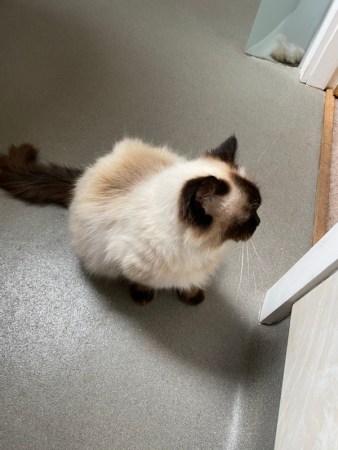
You’re here, somewhere!
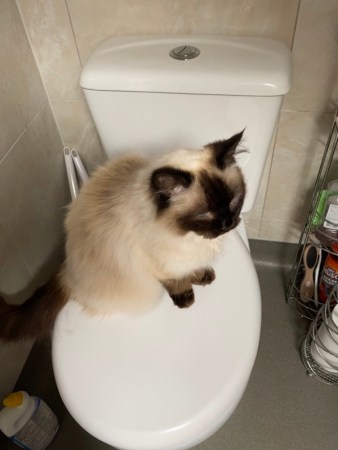
Maybe here?

Possibly here?

Or even here?

Ah, there you are – my human!
©Copyright Stephen Tanham 2020
Share this:


For as long as there have been humans on Earth, we have sought to find answers. Wise women and wise men have been cherished throughout history for their ability to throw ‘light’ on complex problems and situations. In our modern age, more people than ever find at least comfort and, often, guidance in some kind of fortune telling.
My grandmother used to read tea leaves, using the pattern left when the (leaf) tea was swirled out of a cup at the end of a routine or ritualised consultation. Her advice was often sought.
I had a interesting childhood. I was raised in a mystically-active family, but felt the pull of a scientific career – ending up in computing. I never had any trouble reconciling the two, but was always hesitant to talk about it to other scientific types… There is a ‘religion’ of despising such things among the purists of science. Their prejudice is a strong as any of history’s zealous priests. Having said, that, the scientific method has brought immense benefits to mankind.
I was comfortable with divination because I could always see a bigger picture… Let me try to describe the basis of this:
What happens ‘inside me’, in terms of consciousness, is not really separated from the ‘out there’ of the world and its constant changes. I felt this long before I could offer any explanation for it. I knew that if I changed how I felt about someone, their behaviour to me would miraculously change, too. This doesn’t mean that I always did this, far from it…. our emotions are very strong with those we dislike and often override the still small voice of inner guidance.
We began this consideration of ancient Chinese wisdom by looking at the work of Lao Tzu (The Book of the Way – Dao Je Jing); (see The Old One and the Gatekeeper series).
The other great ‘book’, older than the Dao Je Jing, is the Book of Changes, otherwise known as the I Ching. Adopted by pop culture in the 1960s, the Yin Yang symbol was seen on everything from notebooks to tee-shirt. The I Ching came first. The Yin-Yang symbol is a later development, and has been associated with I Ching because its elements representing Yin – black, and Yang – White, are found in the broken and unbroken lines of the Hexagrams that form the basis of what is to be ‘read’. We will examine this process in the next post.

The Yin Yang symbol illustrates an idea from ancient times that the ‘whole’ is in constant motion – change. And that change, itself, is the real nature of the world. Things can be opposite yet still exist harmoniously. Each thing contains its opposite. Each thing becomes its opposite when it has reached its fullness and begins to decline.
We must learn to ride that constant change and be at peace with this. This is quite a statement. We are used to reality being the solidity of what is – and endures. Within the I Ching, the reality is shifted ‘upstairs’ to that process of change from which we take snapshots of our reality, much like, in quantum physics, how an electron in an atom obligingly reveals itself under quantum measurement, but is otherwise indeterminate in velocity and position.
Evolved and educated to seek stability as a basis for survival and prosperity, human nature finds this idea of harmony through change a difficult concept to embrace. Without stability, we reason, ‘fortune’ may be a fickle companion.
This idea has its parallel in Newton’s older and simpler non-quantum physics. Objects that move seldom do so with constant speed (velocity) – unless they are spacecraft. Newton showed, through a maths process called differentiation, that the derivative of a formula for velocity (speed) would produce a formula for acceleration. The latter is far more revealing, since it is linked to the real world of force.
To slow an object requires force – imagine the sting of catching a well-struck cricket ball! Equally, to make an object move away from you with a throw requires the force of an uncurling arm. The ‘speeding up’ – acceleration, is equal to the force divided by its mass: the amount of substance it possesses.
Driving a car is, for example, a continuous process of acceleration and deceleration; controlled through exploding petrol in an engine moderated by the right foot. No wonder driving takes a while to grasp…
Perhaps the difference between a driver and a watcher of fortune is that the driver is following a short-term goal of getting somewhere, whereas the ‘fortune hunter’ just wants to feel secure.
It’s a dramatic conclusion, but the universal Sea of Being does not offer security. Instead, it offers a science of personal change and an opportunity to learn how to sail.
All this may seem academic. However, in order to see that there is a ‘higher science’ of existence that lives happily in a dimension of ‘change’, we need to have these proven models to align us, correctly, with the potential to see differently.
This is the I Ching…
If we see the ‘out there’ as divided, we are not in harmony with the inevitable currents of change. If we see it as a fluid medium which must change, we begin to bring our consciousness into the ‘now’, taking new nourishment from the fact that its sparkling presence is the result of that constant ‘replenishment’. The present state cannot do anything put ‘perish’ to make way for the next packet of the new…
Science has shown us that both matter and energy cannot be destroyed. We can only change the form – the organisation – of its substance. Nor can we know that substance as something separate from our own consciousness.
The I Ching is a ‘book’ of collective wisdom, drawn from truly ancient times, and refined over the centuries. One of the most insightful teachers I know refers to it as a ‘Solar Work’ and uses it, herself, to describe the inner detail of a pattern of events. She has done this for many decades and views the I Ching as a constant and reliable companion.
This ‘book’ has been condensed into 64 ‘cores’ of wisdom, rendered as hexagrams, as in the image, below. The process of consulting the I Ching is one of ‘drawing’ a randomised reference to these hexagrams and reading the wisdom it offers, at various levels of detail.

You can even buy I Ching Apps for your mobile phone…. good ones, too. The best give you a choice of having random numbers generated for you or letting you throw three coins and entering the results to get the reading.
We will look at this, the consulting process, in the next post. For now, it is important to consider the idea of divination, itself…
The elements of effective divination are:
- To have a repeatable process of consultation – ‘looking up’ a guiding text or picture in response to a question, a feeling, or just to set a reflective theme for the day.
- To actively feel a connection to the external actions. In the sense of my explanation, above, to know that there is no real separation from in-here and out-there, other than what we are taught about the pre-eminence of reason over everything else.
- To loosen the faculty of reason and let something else speak, by way of inspiration.
- To open and close the process with respect… and a certain feeling of love for something that is letting us ‘touch’ another reality.
Next week, I will consult the I Ching before writing the Thursday blog. We shall see what it has to offer us in terms of describing itself!
To be continued
21 May 2020
©Stephen Tanham 2020
Stephen Tanham is a Director of the Silent Eye School of Consciousness, a not-for-profit teaching school of modern mysticism that helps people find a personal path to a deeper place within their internal and external lives.
The Silent Eye provides home-based, practical courses which are low-cost and personally supervised. The course materials and corresponding supervision are provided month by month without further commitment.
Steve’s personal blog, Sun in Gemini, is at stevetanham.wordpress.com.
Share this:

+ #Silenti, Consciousness, English Lake District, Photography, Spirituality, Stream of Consciousness
Painted Pebbles in the valley of the Moon
by Steve Tanham

John Ruskin was the leading English art critic of the Victorian era. He was also an art patron, watercolourist, prominent social thinker and philanthropist. He wrote on subjects as varied as geology, architecture, myth, education and political economy. For the last quarter-century of his life, he lived at Brantwood – a house he designed on the shores of Lake Coniston.

Despite this, one of his favourite places was outside the Lake District on what is now the Cumbria-Yorkshire border, some thirty miles east of Coniston. Kirkby Lonsdale is the most picturesque of the small towns that lie on the River Lune, which flows through this beautiful, limestone scenery, to emerge into the Irish Sea near Lancaster.
In 1875, Ruskin, standing on the escarpment above the River Lune by Kirkby Lonsdale’s St Mary’s church, described it as ‘one of the loveliest views in England, and therefore the world’. Ruskin was fulfilling a long-held ambition; to see the view that the English artist, Turner, had painted in 1822, about which the critic had said ‘I do not know in all my country, still less in France or Italy, a place more naturally divine.’
The modern guidebook says the scene ‘presents a gentle panorama of river, meadow, woods, and hills.’
The valley inspiring this praise was that of the River Lune, which flows through the gentle valleys carved over millions of years in the native limestone – once the bed of a tropical sea, and flows out into the Irish Sea beyond Lancaster.

Kirby Lonsdale is famous for both its beauty and its history. Devil’s Bridge, which used to be the place of the primary road between Westmorland and the West Riding of Yorkshire, is the most photographed (and painted) part of the river.

From St Mary’s Church and nearby Ruskin’s View, we can take the eighty-sxi (uneven) ‘Radical Steps’ down to join the river path, and there we will find a surprise…

After a short distance, we encounter a band of colour on the side of the path.

On closer inspection, the band of colour turns out to be painted pebbles, done by the local children and their families to say thank you to the NHS and others who have been providing the vital care during the Covid-19 epidemic.

The stones are themed in different ways. One set even portrays a train – an ingenious use of pebbles!

The artistic line continues for a way along the riverbank.

The hand of both adult and child is reflected in the lovely painted stones. Left purely for our enjoyment….and, possibly, reflection.

After a while, the line of stones ends, but we are tipped off by passing walkers that it continues in small sections in the streets of the town… Fortunately there is an alternative to the Radical Steps; one that will bring us directly into the Main Street.

Turning back towards the river, we pick up the trail of the painted pebbles, again.

I can’t help thinking that both Turner and Ruskin would have been proud of the good people of Kirkby Lonsdale for this lovely gesture…about which I can find no official announcement!


©️Stephen Tanham 2020
Share this:

From Sue…

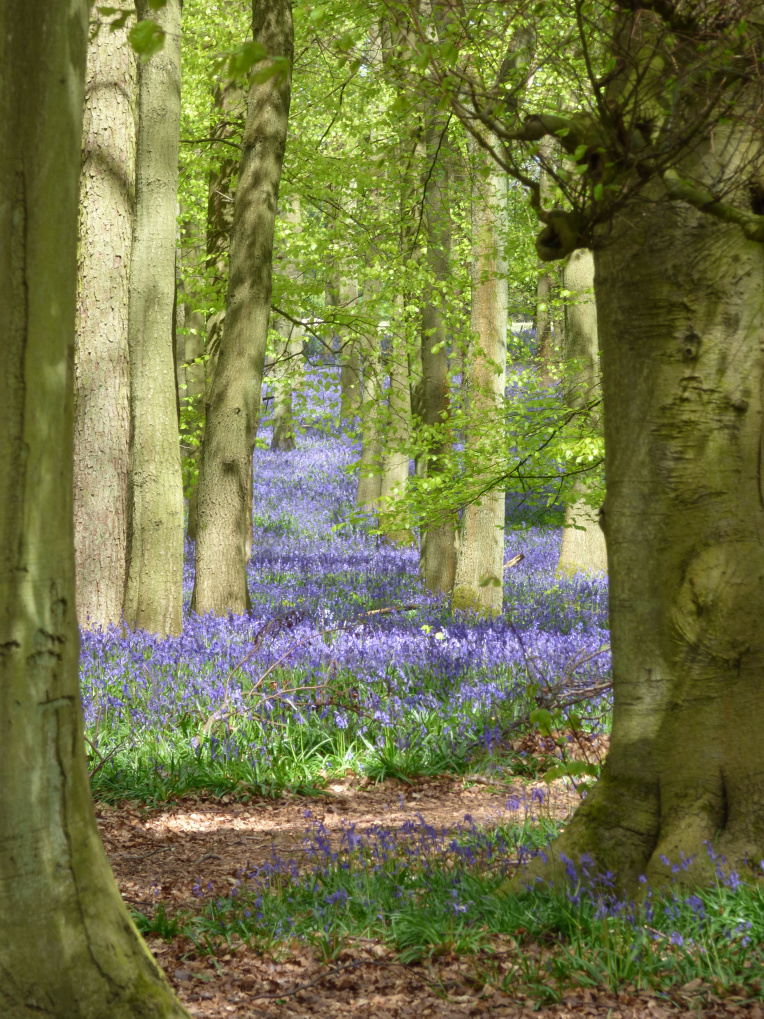
Locus iste a Deo factus est,
Inaestimabile sacramentum,
irreprehensibilis est.
This place was made by God.
A priceless mystery,
it is without reproach.
Anton Bruckner.
I was talking this morning with a friend about the different directions that the spiritual journey may lead us and the effects that can have on a life… your life or mine. There is no way of knowing or predicting when, or indeed if, that journey will change gear and lead you to a place unknown, changing your expected destination for another as you enter a new phase of a life suddenly unfamiliar. It is like stepping through a doorway to another world, one where the demands are unknown, different and beyond the norm.
There are degrees, of course, from the ‘turning point’ we speak of in the Silent Eye, that point where the world dims and the eyes of the heart seek another Light…
View original post 641 more words


 Sun in Gemini
You must be logged in to post a comment.