
From Sue…


‘Know thyself’… Pausanius tells us it was inscribed in the court before the temple of Apollo at Delphi. We are given to understand it is associated too with the Inner Temples in ancient Egypt. It is one of the first phrases we come across in esoteric studies and where else could we begin? It is not the easiest thing to look into the mirror of the soul and admit to oneself what one finds there. Even less to share that openly with others by dropping the social masks and simply being who we are.
I first learned the concept as a child from my grandfather, but it was one it took years to begin to truly understand and longer still to try and put into practice. As we grow through adolescence and youth our self-image constantly shifts, changing as it reflects the desire to become who we think we ought…
View original post 548 more words
Share this:

+ #Silenti, Ancient Sacred Sites, Astrology, Astrophysics, Consciousness, enneagram, esoteric psychology, Harmony, Higher Mind, Life-sciences, Magic, myths and spirituality, Pentagram, Photography, Sacred Geometry, secret language of mythology, Silent Eye School, Spirituality
The Golden Eye of Fiveness (3)
by Steve Tanham
“It is highly dishonourable for a Reasonable Soul to live in so Divinely built a Mansion as the Body she resides in, altogether unacquainted with the exquisite structure of it…”
Robert Boyle
In Part One, and Part Two we looked at a the emergence of a special number, Phi, that allowed the division of any ‘whole’ – like a figure in a painting or a building – into a series of proportions that divided it, but also retained its original relationship to the overall dimensions. the original ‘parent’. The number cannot be written, exactly, because it is ‘irrational’ – really an infinite relationship whose digits never recur. But the table below shows its emergence, to three decimal places, from the Fibonacci series. See Part One for the details.

This magical number, often called the Golden Mean or the Golden Section, was named Phi after the Greek artist and sculptor, Phidias, best known for his design of the statue of Athena within the Parthenon in Athens and the celebrated status of Zeus at Olympus. Both works were famous for their beauty… and also a sense of ‘specialness’. The reason for the latter is less well understood, yet central to our final consideration of this essence of ‘fiveness’.
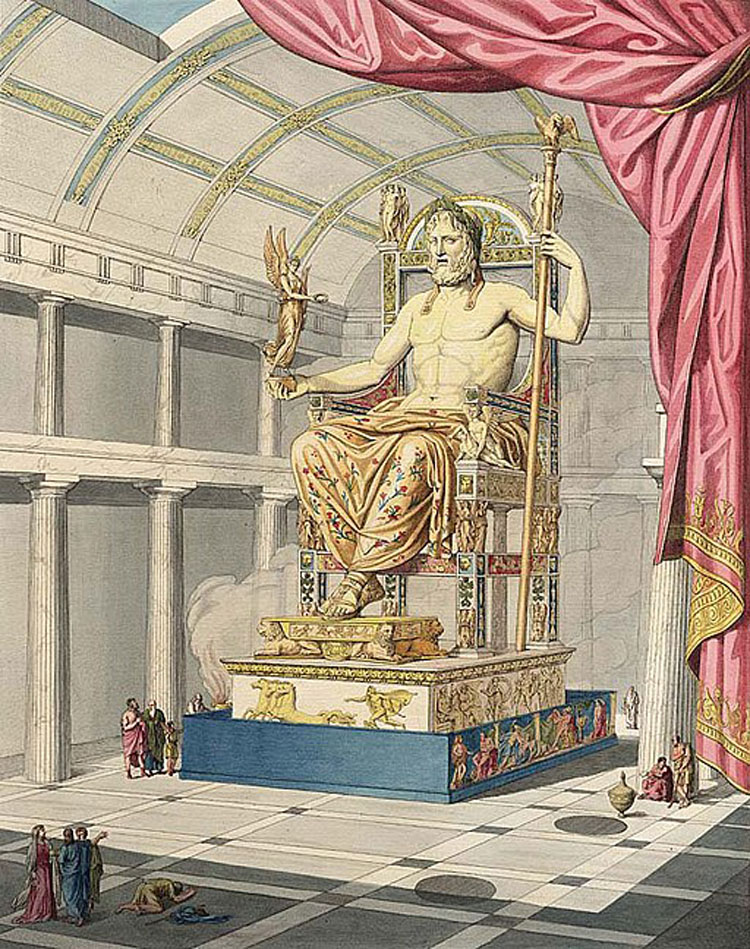
Phidias, or the school he belonged to, had discovered that the human body followed ‘divine proportions’ – all based on the magical number of Phi – approximated as 1.618.
In the human form, the primary unit of this ‘divided divinity’ was the vertical distance between the brow of the face (the top of the eye, as in ‘eyebrow’) and the tip of the nose. Taking this as a base, the the vertical distance from the brow to the crown of the head is Phi times the base unit -the brow to tip of nose.
Moving the other way, the Phi ratio applies between the nose tip to the base of the neck. Travelling down the body, the same ratio applies – but with increasing lengths – from the neck to the armpit, then the navel, to the reach of the fingertips, and, finally from the fingertips to the soles of the feet. Using this analysis, there are seven harmonic sections to the human body.
Phidias used these proportions to create his breathtaking art. His approach was copied by many throughout history, including Leonardo Da Vinci, who had also inherited a love of another symbol that encapsulated the uniqueness of this magical proportion – the pentagram.
The origin of the pentagram is lost in ancient history, but was known as an astronomical symbol around 6,000 years BC in the land that became Sumer – possibly to represent the visible planets: Jupiter, Mercury, Marks, Saturn and Venus.
Its rise in Western history is due to the adoption by the School of Pythagoras (approx 500 BC), who shaped so much of our philosophical thought. The Pythagoreans knew the mathematical properties of the Golden Ratio and its relationship to the pentagram. Pythagoras was said to keep his own small pentagram with him at all times.
To conclude this series of three posts. Let’s examine the pentagram in the light of what we have learned about the Golden Section –
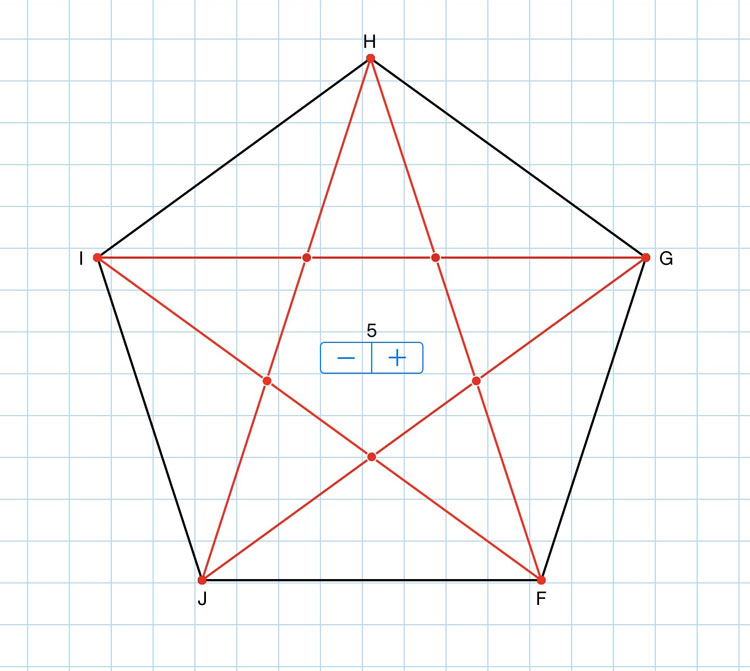
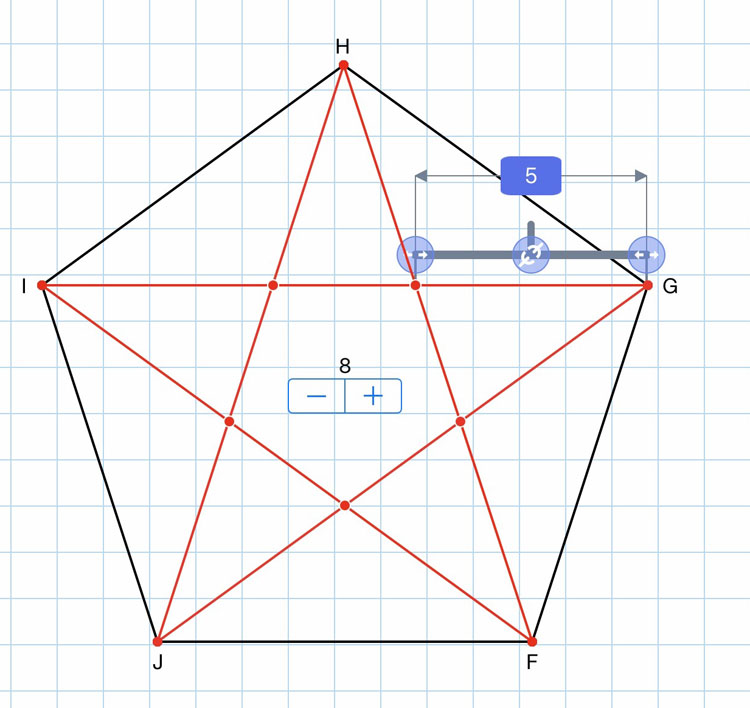
This five-sided ‘star’ can stand alone, or can sit within either a pentagon or a circle. The simple iPad geometry app I’ve used to create these diagrams (Geometry Pad) allowed only one measurement to be shown while the snapshots were being taken. We need to combine the measurements shown in Figure Four and Figure Five.
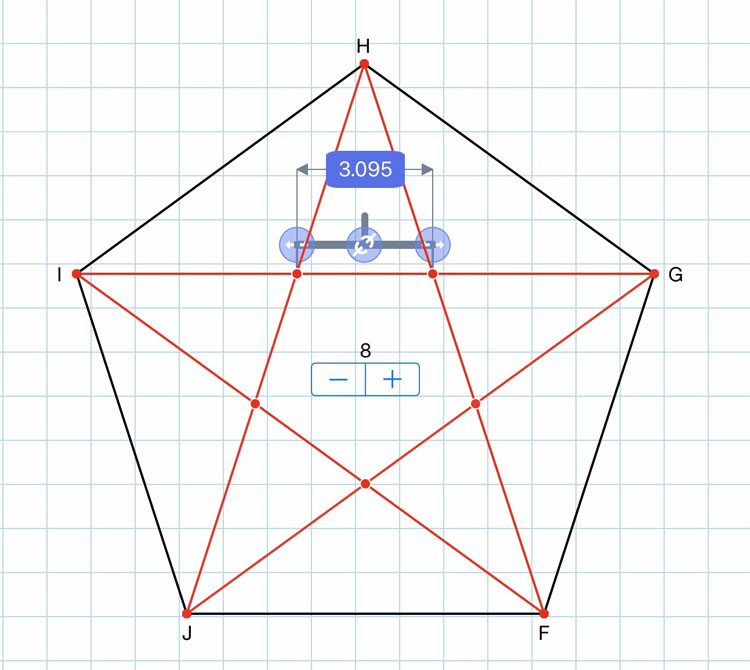
Look at the line running from G to I. It has three divisions caused by the intersections with the other vertices. From Figure Four we see that the distance from G to the first intersection is 5 units. Figure five shows us that the next section is of length 3.095 units. Allowing for the slight inaccuracy of the graphics we can divide the smaller by the larger and get 1.618, which is the value of Phi – the Golden Section.
This is only one instance. The pentagram is entirely constructed from Phi and Phi squared. As we have seen, it is truly the glyph of the human, and its Phi-based symmetry is too closely allied to our proportions to be considered an accidental result.
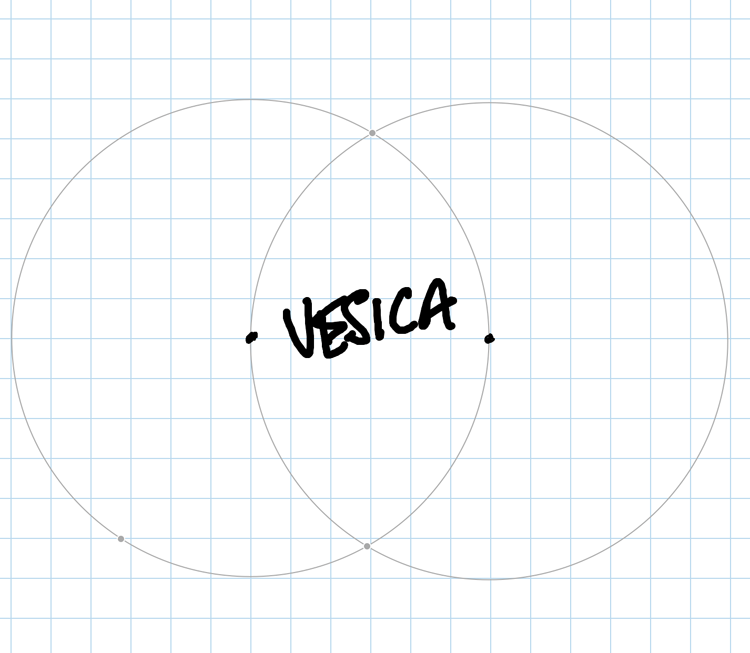
It is beyond the scope of this post but the pentagram first emerges – graphically – from the interaction of two circles, as above. First comes the point, then the line, then the triangle, then the square – then the pentagram. It occupies a very special place in Creation…
I believe we will go on discovering further depths to the pentagram in the years to come.
Other posts in this series:
©Copyright Stephen Tanham
Stephen Tanham is a Director of the Silent Eye School of Consciousness, a not-for-profit teaching school of modern mysticism that helps people find a personal path to a deeper place within their internal and external lives.
The Silent Eye provides home-based, practical courses which are low-cost and personally supervised. The course materials and corresponding supervision are provided month by month without further commitment.
Steve’s personal blog, Sun in Gemini, is at stevetanham.wordpress.com.
– Have you studied me recently?
That’s my footstool, you know
– I’m very beautiful…
But I’ve had a long day. I want my feet up!
– I’m still beautiful
©Stephen Tanham
From Stuart… and timely
Share this:

+ #Silenti, Ancient Sacred Sites, Astrology, Astrophysics, Consciousness, enneagram, esoteric psychology, Harmony, Higher Mind, Life-sciences, Magic, myths and spirituality, Photography, Sacred Geometry, secret language of mythology, Silent Eye School, Spirituality
The Golden Eye of Fiveness (2)
by Steve Tanham

In Part One, we looked at a very simple sequence of numbers that ‘orbited’ or homed-in on a certain value. Now we need to examine that value and look at the sheer magic of what it represents.
This new number was 1.618. It’s derivation is summarised in the diagram above, and described in the previous post. Simply: (red numbers) we add the two previous numbers to get the next. Next: (green numbers) we offset the first line of numbers one place to the right and, using a calculator to three decimal places, we treat the offset numbers of fractions, one number above the other. The third (black) line gives the calculator results, which stabilise at 1.618.
The ‘series’ that generates it – known as the Fibonacci series – came into existence at the time the world was abandoning the old and (by then) clumsy Roman notation (I, II, IV etc) and moving to the Arab-derived numerals that we use today.
The special number 1.618 is known by many names, such a the Golden Ratio and the Golden Mean. It is a number that shows us how we can divide something to protect its ‘wholeness’ in a harmonic way. By doing this, the divided figure will always exhibit pleasing proportions when placed next to (or within) the ‘parent’ figure. For example, Leonardo Da Vinci used it, extensively, in his most famous pictures.
But there are much deeper implications to this than something that looks or feels good, important though that is.
The materialist sees the world as having numbers by virtue of an ‘accident’ that they fit how we see and describe things. The mystic looks for the experience of ‘oneness’ with the processes that created the universe. You can’t find that experience unless you look for it. The universe owes us no debt of making it happen in our minds and hearts – the search must be ours… then the doors of perception will be opened.
Imagine that we have a strip of paper that we are going to divide by cutting with scissors. Let’s say the length of the initial strip is represented by the letter ‘A’. When we cut the strip we will have three values: the initial length (A); and the lengths of the two pieces we produce. We can name the two ‘child’ pieces (a) – the longest, and (b) – the shortest.
Under all circumstances, the original length (A) would be equal to the sum of the two children (a+b) . We can write this A=b+c, the most simple kind of ‘equation’ we could every want to see.
The miraculous Fibonacci number (given the name Phi in the 20th century) gives us the means to divide the original strip of paper such that the longer of the two child pieces bears the same relationship (ratio) to the original strip, as the larger child does to the smaller…
We can keep on doing this – cutting each successive larger portion – with smaller and smaller divisions of the original strip of paper. The whole ‘creation’ will be in harmonic proportions. This generation of smaller and smaller ‘harmonic’ children is called self-similarity.
Nature uses ‘Phi’ all the time. The recent science of Fractals shows how essential self-similar division is for nature to achieve its purposes. A tree is a fractal, for example, as are our lungs. Our blood vessels can carry oxygen to our cells because they follow fractal rules of becoming smaller and smaller within the finite space of our bodies. Only by using such structures can incredibly large processes fit into small spaces. The generation of Phi is not a fractal process, but it perfectly illustrates the marvel of the related fractal structures in nature.
Examples of this in nature include the petals of flowers, such as the sunflower, and the spirals of nautilus sea shells… But there are innumerable examples.
So, how would we actually work out the Phi-derived point of where to cut our twenty-unit strip of paper? We can arrange the self-similar formula so that we have a quadratic equation to solve, but where’s the fun in that!
Instead, we can look at the workings of the older graphical method carried out with the use of compass and straight edge. This brings home the inclusive and ‘connective’ nature of working by hand and is illustrated below:

The horizontal line A-B is the length of paper we wish to divide into the harmonic proportions given by the Fibonacci-derived Phi number 1.618. In this example, the length is 20 units.
To begin, we imagine we have turned the base line (A-B) into a square of four sides and select its right-hand vertical halfway point.
To shorten this, I have simply created point C at the correct half-value (10). The compass is placed on point C and set to the distance of C-B. We begin to draw an upward arc from B to the intersection with the hypotenuse A-C. We then set the compass to a base at the origin – A, and extend its pencil to the previous intersection with the hypotenuse. This time we draw downwards until the curve intersects with the original length A-B. The point of crossing is the length of the largest ‘child’ as above.
The length value, the golden ratio, gives us a new ‘longest child’ length of 12.36 units. We could cut at this point. The relationship of the larger child to the smaller is the same relationship as the original full length to the largest child.
This process could be repeated to infinity using the successive larger pieces. The entire family of larger pieces would inherit the divine proportions of the ‘mother’ length.
In the final post, next week, we will examine how the pentagram combines all the above properties into a single figure of dynamic value to mankind.
Other posts in this series:
One This is Two.
©Copyright Stephen Tanham
Stephen Tanham is a Director of the Silent Eye School of Consciousness, a not-for-profit teaching school of modern mysticism that helps people find a personal path to a deeper place within their internal and external lives.
The Silent Eye provides home-based, practical courses which are low-cost and personally supervised. The course materials and corresponding supervision are provided month by month without further commitment.
Steve’s personal blog, Sun in Gemini, is at stevetanham.wordpress.com.
+ #Silenti, Ancient Sacred Sites, Astrology, Astrophysics, Consciousness, enneagram, esoteric psychology, Harmony, Higher Mind, Life-sciences, Magic, myths and spirituality, Photography, Sacred Geometry, secret language of mythology, Silent Eye School, Spirituality
The Golden Eye of Fiveness (1)
by Steve Tanham

In the dream the Hermit was speaking. “I am the eye of fiveness,” he said.
I listened… dreams are not always this lucid.
“In the beginning was the division, not the multiplication; and the division contained what divided it, but in another form…”
I was listening, intently. The figure of the Hermit promised great insight…
“No-thing can be a principle. It does not have to be nothing…” He paused, smiling. “But it does have to be a ghost…”
I wondered if you could blink in a dream… apparently not. He placed a dot in the centre of the sky. Then extended his arms into the shape of a draughtsman’s compass and drew, black on azure, a circle.
I smiled, understanding something, at last. “Ah, yes,” I said. “The dot is no-thing, but has existence – if only as a position. The dot is zero.” I paused, aware that my thinking was waking me up… I had to get to a point of…. memory or I would lose it all…
“The circle is everything and everywhere,” I said. “The circle – One – is the arena of existence!”
The way the Hermit faded indicated he was pleased. And then, like the Cheshire cat that left only a smile, he was gone…
That dream was many years ago. I was studying the pentagram and the way it was used in a magical school of the soul. I knew that the geometry – and hence the numeric basis – was closely linked to the organic life we all share.
But I wanted something deeper… and had asked for it.
I consider that my attitudes are roughly half ‘science’ and half mystical. That way, I avoid the worst excesses of both, such as mysticism’s inclination to be fluffy, and to espouse the most complex ‘magical’ theories, even if they are twice as forced as the simplest scientific truths.
Equally, science’s dogmatic adoption of the ‘we are the only truth‘ attitude is to be avoided. Consciousness is not rooted in numbers, but the human mechanism – the body and how it works – is.
So, if you’d like to join in, let’s go in search of what’s at the heart of the pentagram: ‘fiveness’. Stand up and take yourself into a different mental and emotional ‘space’. Tell yourself that you’re not doing something trivial, but something that’s a living key to how you are, or were, before the layers of civilisation, work and family walled us all in numbness.

Stretch out your arms and legs so you look like Leonardo Da Vinci’s famous picture of the ‘Vitruvian Man’. Each hand’s five fingers and each foot’s five toes make up four of the five points of your human pentagram. Your head – the controller, communications receiver and maker of your organic ‘me’ – forms the other. We may reasonably ask what is the fiveness of the head? The question may already have triggered an answer in your mind….
If you’ve never encountered the Fibonacci series, stay with me and I’ll do my best to explain it – very simply. It’s worth the few minutes it will take to understand it.

We begin with zero, then one, because the whole of metaphysics is based on their relationship. Zero is the potential for all numbers to exist. One is symbolically the ‘monad’ – the complete everything from which we come and to which we will return; but One is also the first number, so is doubly useful in this example. We could say that, in Nature, everything is a fraction, yet Nature knows no fractions… Mankind sees only fractions, yet contains the seed of that which caused that division in the first place.
From zero and one, the next term in the series of Fibonacci numbers is generated by adding the two previous numbers. So, (from 0+1) we get another 1. At this point the series starts to take shape, growing quickly as each new number emerges from the sum of the previous two.
The row of green numbers is exactly the same line of numbers as the red ones above. But they have all been shifted one place to the right. What we’re going to do now is to create a fraction (don’t panic – I’ll do the calculations!) from each of the sets of two numbers; one above the other. So the first one would be 1/0 which is an invalid number, since we cannot divide by zero in ordinary mathematics. The next one is 1/1, which is just 1. The next one is 2/1, which is 2. We can see from this that we are swaying from one ‘extreme’ to the other; between the numbers 1 and 2.
Let’s continue to work these numbers to see what it is that we are swaying around… This is a bit like finding you’re a spaceship being pulled into the orbit of an unknown planet… but this planet holds one of the fundamental keys to the Universe…
It takes only ten ‘terms’ of the fractions from the Fibonacci series to produce the hidden planet to which our spaceship is being drawn. If you have a calculator you can check the fractions which lead to it; 5 divided by 3, 8 divided by 5, etc. Each of these divisions gets closer to a number that emerges in the greyed out boxes of term ten, above. From there onwards, the number 1.618 is present in all the results, which continue to ‘sway’ around finer and finer divisions of this mysterious destination.
In fact, we can never get at the final answer, since it is what maths calls an ‘irrational’ number – one that isn’t really a number at all, but is only defined by (in this case) an infinite (never-ending) convergence towards smaller and smaller units.
In practical terms this doesn’t matter. The three decimal places of 1.618 will do us fine. To go beyond this would involve us worrying about one ten-thousandth of a unit, which would be needed in only the most specialised engineering application, such as space travel!
But enough of the maths! We’ve landed on planet Phi… This mysterious number is so important that, like its cousin Pi, it has its own name. Phi is also known as the Golden Mean, the Golden Ratio… and a host of other historic names. It has been with us for a long time.. and very few people know its full significance.
In the next post we’ll examine what it Phi really means; and why it makes the Pentagram and Pentagon such important geometric figures in any world where harmony is important… which is just about everywhere. We’ll also consider why Phi is truly the ghost in the machine…
©Copyright Stephen Tanham
Stephen Tanham is a Director of the Silent Eye School of Consciousness, a not-for-profit teaching school of modern mysticism that helps people find a personal path to a deeper place within their internal and external lives.
The Silent Eye provides home-based, practical courses which are low-cost and personally supervised. The course materials and corresponding supervision are provided month by month without further commitment.
Steve’s personal blog, Sun in Gemini, is at stevetanham.wordpress.com.
Share this:

From Sue…
 Cave of the Hands: artwork created up to thirteen thousand years ago. Image: Mariano CCAS3.0
Shadows dance in the firelight. A hand, warm upon cold stone, where many other hands have rested. The breath of the shaman, blowing ochre, staining the wall at this moment of passage. Rite of recognition within the tribe. Kinship and continuity indelibly inscribed upon the body of earth
***
The restaurant is quiet now, many of the tables are empty. Sunset gilds the weathered stone of the window frames and casts ghosts of a beautiful day across the table, igniting the ruby heart of the half empty glasses. The woman tapping away at the little keyboard glances at her companion. There is an expression of deep concentration, emotions flitting across the unguarded face… She smiles. He is lost in the story, seeing it played out on the screen of imagination, reading from the heart, feeling…
View original post 1,238 more words
Share this:


Human: Good girl! More later…
Collie: But…
Human: Our lunch will be here in a moment.
Collie: But, there’s… one left!
Human: Ah, here are the sandwiches…
©Stephen Tanham
+ #Silenti, Ancient Landscapes, Ancient Sacred Sites, Astrology, Belief and Faith, Biology and mysticism, Castles, Child of Light, Consciousness, Egregore, Esoteric Meaning of Myth, esoteric psychology, Higher Mind, Highlands of Scotland, Initiation, landscapes, Magic, Mindfulness, Mystery Schools, Mystical ritual drama, myths and spirituality, Scotland, Silent Eye School, spiritual turning around, Spirituality, Travel and Photography, Understanding Fear
Five Faces of the Macbeth Human
by Steve Tanham

Exploring the faces of the ‘human condition’ should be consuming our world at the moment. We might reasonably conclude that understanding the heights and depths of our shared experience, as we drain the planet of its living life, would be of interest to us.
But we don’t…
Instead, if we ask any questions at all, we spend months looking at things from a political perspective – from power; assuming against expectation, that somehow, the political process will throw up something good for our world.
Psychopaths are having a field-day. Across the globe, they are running things, some of them even showing us how deluded we are to worry about this; that it’s all nonsense…
The story of one of the most successful psychopaths in fictional history was set in northern Scotland. A hardy group of us are shortly to spend a day driving to the town of Grantown-on-Spey, in the northern Cairngorms, to work out our personal and mythical relationships to Macbeth – Shakespeare’s fabled warrior, who, assisted by his wife, Lady Macbeth, rose from glory to bloody dominance before being toppled by forces from within himself – and herself, if you widen the mystical interpretation of the story.
We will carry with us the means to construct our own ‘Guiding Star’ – a five pointed figure well known to everyone as the pentagram.

Throughout our history, scholars have questioned the source of the negative side of being human. Since ancient times, geometric figures have been used to explore and question human nature, often being viewed as somehow ‘magical’ when they were simply an aid to what we now call psychological understanding. The value of such figures – derived from the properties of the circle – is to show how forces that act upon us – psychologically – are related to each other, and do not act in isolation. That, alone, should give us food for thought.
Within the Silent Eye, we use another figure – the enneagram, which is ‘nine pointed’ – as the basis for our self-exploration. But the pentagram is older, and considers the inner and ‘magical’ nature of mankind within a mapping of five qualities: Air, Earth, Fire, Water and one other…
Mystically, these are called the Elements. Although they derive from an age in which modern science had not thrown its analytical light on the atomic and vibrational nature of matter and energy, the philosophers of that age did not see a valid division between the inner and outer worlds experienced by our consciousness.
Because of this, the four elements were seen to be both subjective and objective, coming together in a fifth – Spirit- which opened the door to mastery and harmony in which the created and the creator were re-united, within the creation; the world in which we live and breathe and have our being.
At a simple level, the element of Earth may be seen as our foundation of physicality. It is slow and cold in its operation. Without animation from others elements, it cannot evolve.
Air is what we breathe and also how we communicate. It provides one of three elements of what makes our biology work: the other elements being the intake of Water (also emotions) and the stability of the foundational Earth. Fire is something different and is closely aligned with energy and transformation; burning off the dross of the lower forms of mortality.
The sequential alignment of the self with each of these Elements is a key process in so-called ‘magic’. For magic, we should read self-transformation; a concept for which we now have deeper psychological understanding, though psychology still does not acknowledge the deeper implications of this approach.
The key is the sequence used, and the fundamental attraction generated with what turns out to be higher aspects of the self; known as the Self. Implicit in this approach is the presence of the famous golden ratio – an intrinsic property of the pentagram, and one of the basic dimensions of biological life.
In a triangle of landscapes between Grantown-on-Spey, the highland coast at Findhorn and the historic Macbeth castles near Inverness, we will explore these relationships and the potential for alignment with the Self, using prompts from Shakespeare’s famous play. The story of Macbeth, seen as an allegory, is the story of our own confrontation with materiality and the wrong kind of ambition.
Dean Powell, who is based in the north Cairngorms, runs a local esoteric group: Lodge Unicorn n’ha Alba. Dean will be leading our group through his adopted Highland landscape in an exciting journey of self-discovery shared by all.
The Silent Unicorn is the name of a workshop (14-16 June, 2019) which will bring together the work of Lodge Unicorn n’ha Alba and the Silent Eye into a weekend of physical and spiritual exploration in the setting of the Scottish Highlands.
If this blog has given you an appetite to join us, there are still a few places remaining. Send an email to rivingtide@gmail.com and we’ll provide more details.
©Copyright Stephen Tanham
Stephen Tanham is a Director of the Silent Eye School of Consciousness, a not-for-profit teaching school of modern mysticism that helps people find a personal path to a deeper place within their internal and external lives.
The Silent Eye provides home-based, practical courses which are low-cost and personally supervised. The course materials and corresponding supervision are provided month by month without further commitment.
Steve’s personal blog, Sun in Gemini, is at stevetanham.wordpress.com.
Share this:

A glimpse of another side of Sue’s life…

I had been called to my younger son’s home on a matter of vital importance… almost a mission of mercy; I had to teach him the innermost secrets of baking my lemon meringue pie. It had been too long since he’d had one and he could wait no longer. Making one for him would have been fine…but, conscious that I am getting no younger, and afraid that the recipe might follow me to the grave, he thought it best that I teach him to bake it himself. I sent him a shopping list and arranged a time to bob round when he was not at work. Assuming that my decrepit and ageing bones would support me, of course…
Pushing open the gate to his back garden, I found father and daughter engaged on building garden furniture. Hollie looked up with a smile and the shout of ‘Grandma!’ that always warms…
View original post 717 more words
Share this:

+ #Poetry, #Silenti, Consciousness, Higher Mind, imprisonment, Journey of the hero, prisoner, Speaking truth to power, spiritual turning around, Spirituality, Truth and Esotericism
An idea whose time has come
by Steve Tanham

An idea: invisibly potent
A watery creek
A new and gentle breeze of ripeness
Felt by few
A red propeller spinning in the soil?
A sail – unfurled and flapping
Held fast with thin steel ropes
which ‘clack’, dull metal, at its imprisonment
…
Whose time: like the now-revealed spinning toy
Whirring in the wind
Unwraps, revealing shining teeth
Rotating gear, synchro-meshed
Engages, beneath everything, changing all
…
Has come to this:
The smug steel wires groan taut
And break…
The great mired ship slides free of oily, stinking mud
The jetty, rent like severed, ageing limbs,
Becomes confetti as the wind and sea
Too long unwed
Collide
…
©Copyright Stephen Tanham
Share this:


C: It’s a bug…
D: It’s a ladybird. Leave it alone.
C: One more inch and…
D: It will taste horrible! And I’ll…
C: One, two… spoilsport!
©Stephen Tanham


You must be logged in to post a comment.