+ #Poetry, #Silenti, Ancient Landscapes, Consciousness, Mystical poetry, Neolithic, Silent Eye School, Spirituality, Stone Circles
Long Meg
by Steve Tanham

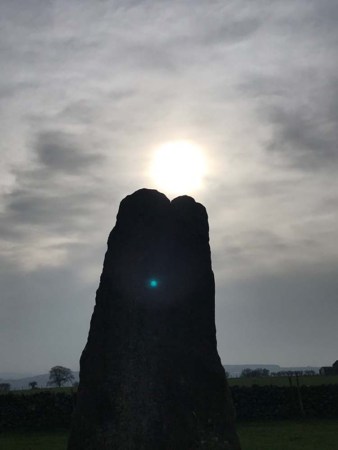
Lady of the northern light
Your stone too old to reach
Offset with spirals on your flanks
With children circled round your banks
Give us the grace to see you teach
And under stars approach your sight
➰
© Stephen Tanham
Stephen Tanham is a director of the Silent Eye School of Consciousness, a not-for-profit organisation that helps people find a personal path to a deeper place within their internal and external lives.
The Silent Eye provides home-based, practical courses which are low-cost and personally supervised. The course materials and corresponding supervision are provided month by month without further commitment.
Steve’s personal blog, Sun in Gemini, is at stevetanham.wordpress.com.
You’ll find friends, poetry, literature and photography there…and some great guest posts on related topics.
Share this:


What’s all this Silent Eye stuff, then?
– It’s not ‘eyes’, it’s ‘eye’
But look, I have two of them!
– So do I but, that’s not the point
‘So do I‘! now who’s confused…
©Stephen Tanham
#FurryFives – Just five lines that capture the essence of your moment with that beloved pet. If you want to join in, publish one and send me the link. I’ll reference it with my next #FurryFives post.
Share this:

From Sue…

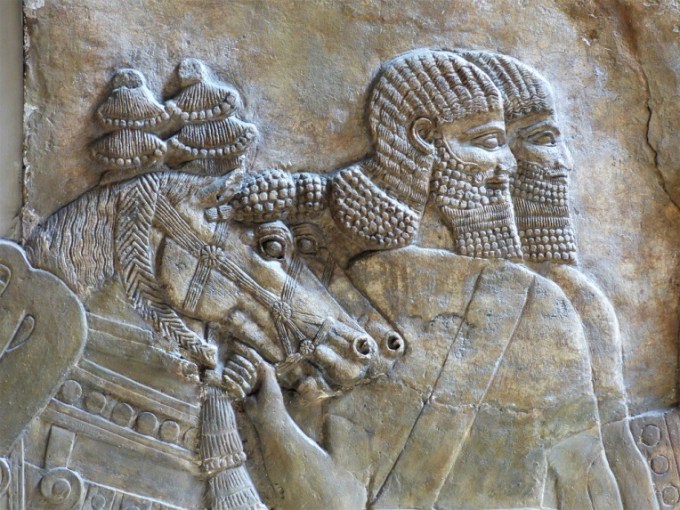
There was a jaw-dropping moment when it finally hit home…
We knew the story… we had discussed it long before Stuart had started working with it. The ‘hero’ was a historical king who lived around five thousand years ago. About a thousand years later, tales of his doings, combining events both real and symbolic, were collected and written down. Given the way that history…and particularly folk history… works, the scribe probably included tales once told of even older characters, going back seven thousand years or more, and reassigned them to our Hero. A few hundred years later, they were standardised under the title ‘He who Saw the Abyss’…
Facts, dates and historical data are all very well. They allow you to arrange events on the canvas of space and time. What they do not seem to do is to really put things in perspective. When the realisation hit…
View original post 615 more words
Share this:

+ #Silenti, Astrology, Astrophysics, Consciousness, esoteric psychology, Higher Mind, Mystery Schools, Silent Eye School, Spirituality
The rotating blade of meaning (6)
by Steve Tanham
 (Above: the original Bell 30 which established commercial helicopter technology, and was invented and developed by Arthur M. Young. Picture Wikipedia, public domain)
In our last post, we looked at those most frightening objects: numbers which are squared and cubed. This exercise in cruelty was an attempt to remove the fear of these things in order to put them in a very special place: Arthur M. Young’s conception of how consciousness worked – and its simplicity.
Arthur Young discovered that how the human mind grasped ‘meaning’ could be represented in a very simple graphical figure; one which gave greater depth to our understanding of consciousness. As well as being a scientist and famous inventor (the Bell helicopter was his creation) Young was a master astrologer – a very unusual activity for a scientist. He did not feel that astrology was antithetical to science, and admired the way the ancient science tried to encompass the whole of mankind’s experience rather than just the workings of the material world.
Young reminded us that our picture of the ‘world’ is our own; and is formed as a composite of information from our senses and our mind. This includes the way we react to it, as well. Let’s absorb this. There is no world, except the one we make. We are incapable of a full consciousness of the ‘out there’. That is not to say that we will always be limited in this way, but the present development of our species forms a very subjective picture: what I think, as opposed to what is. And we need to remember that it is very much a picture, though it has more dimensions than the area of the ‘picture’ we constructed in last week’s blog (Part 5).
There are certain things that have always been with mankind. A good example is the sky with its sun, moon and the mysterious planets – those ‘wanderers’ in the night sky that behaved very differently from the constellations around which ancient peoples spun their stories.
Arthur M. Young had determined that there were four stages, or aspects of how the pictures formed by our consciousness. Now, we must bear in mind that all of these are projected by the mind onto what we paint as ‘out there’. These stages have been carefully constructed during the course of our evolution, so Young felt justified in placing them at the centre of things.
One of the drivers of evolution was how we reacted to the motion of objects, friends and predators. To Young, the motion-related issues of distance covered, velocity and acceleration were related to three of the four aspects of meaning that we humans need to fully comprehend what is happening to us, and how we should interact with it. We examined this in Part Three and Part Four, like this:
(1) Distance travelled is seen to be the baseline of motion. It is analogous to our simple line of blocks in the last blog. The diagram is reproduced below:

(2) Velocity (or more commonly Speed) is Distance divided by Time, as in miles per hour. In other words, it’s a rate of change. With a constant speed (as in car staying at 70 mph on a motorway) the motion is at a constant rate. In our simplification of the formula we saw that Velocity is equal to Distance divided by the Time taken to cover it. in the diagram below, the distance is simply the length of the top line of blocks.

3) Acceleration is the rate of change of the previous aspect of Velocity. A car travelling at a constant 70 miles per hour is not accelerating. If our car, which had been travelling at constant 70 miles per hour, suddenly accelerated to overtake a wagon, there would be an increase in not only the distance, but also the velocity. This equates to the distance divided by time squared. We have seen that anything squared is equal to a square. Here’s our square from last week:

In each case of the above aspects, we have evolved our understanding by creating a ninety degree (a right angle) turn. We moved from a line (1+1+1) to an area, a square, by turning our evolving shape through ninety degrees and extending all of it by the same length.
Have we finished what we can know? Our blocks have been carefully drawn to show that another transformation is possible. One more turn through ninety degrees is, effectively, extending all the squared blocks backwards into the diagram three times (1+1+1) as we hinted in the final diagram from last week, reproduced below:

Do we know this figure? Most certainly – it is a cube. We got to it by dividing distance by time cubed. We live in a world of cubes; that is , we live in a three-dimensional world. Arthur M. Young proposed that there is a missing type of motion related to this final transformation of the aspects of motion.
In the next part of this story, we will look at the nature of this third derivative of distance and time; and the vital link it provides between a scientific world of ‘only matter’ and the presence of the observer as an intelligent part of creation…
To be continued…
{Note to the reader: These posts are not about maths or physics; they are about a unique perspective on universal meaning created by Arthur M. Young. If you can grasp the concepts in this blog, your understanding of what follows will be deeper.}
Previous posts in this series:
Part One, Part Two, Part Three, Part Four
©️Stephen Tanham
Stephen Tanham is a director of the Silent Eye School of Consciousness, a not-for-profit organisation that helps people find a personal path to a deeper place within their internal and external lives.
The Silent Eye provides home-based, practical courses which are low-cost and personally supervised. The course materials and corresponding supervision are provided month by month without further commitment.
Steve’s personal blog, Sun in Gemini, is at stevetanham.wordpress.com.
You’ll find friends, poetry, literature and photography there…and some great guest posts on related topics.
Share this:

April is fast approaching. A few places are still available for our annual weekend. Come and join us…
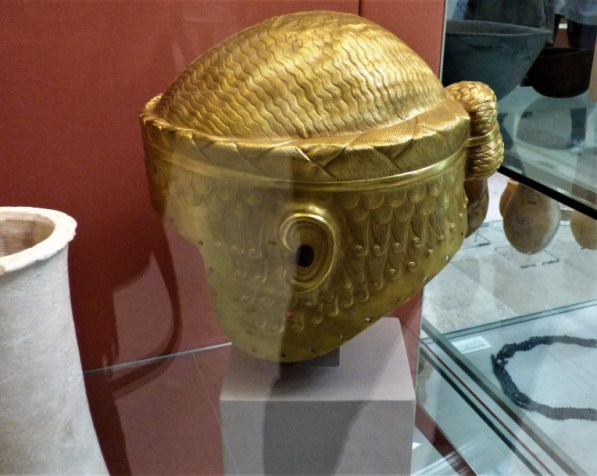
January…and the clock is ticking down to spring. Work that has been going on all year now changes gear. It began in earnest last year, with a research trip to the British Museum to see the art and artefacts of an ancient civilisation that was at least the equal of Egypt, but which is less well known today… Sumer.
Over seven thousand years ago, long before the pyramids were dreamed of, the people who would become the Sumerians settled in Mesopotamia. Their culture was rich and colourful. We know that music and the arts were of great importance to them…and their city of Uruk, home to up to eighty thousand people at its height, was the centre of their world.
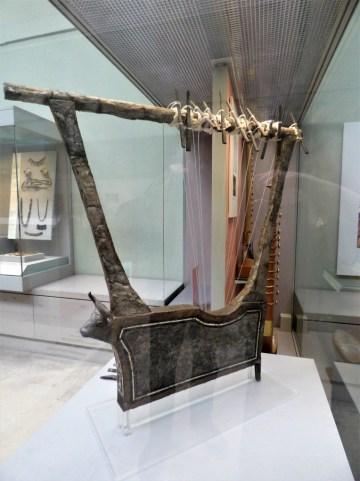
Gilgamesh ruled in Uruk almost five thousand years ago and his story passed into legend and thence into myth. It comes down to us, echoing through the ages, as the…
View original post 1,040 more words
Share this:


“Stand still…” I placed the newly-found basis of a godly crown upon his head.
“I am not wearing a plant pot on my head!” To be fair, I should probably have waited until there was nobody else in this section of the garden centre, but we were on a mission. And I needed the right sized plant pot.
“No-one will ever know.” He had little cause for complaint… I’d be wearing one too, seeing as I could not have the glorious golden crown of ancient Sumer.

It would be my job to make sure that we did not end up looking like a latter-day Bill and Ben… but a little ingenuity and gold paint should do the trick.
“Well, our ‘Ben’ will be playing Gilgamesh…”
“…and Gilgamesh was called Bilgamesh in the Akkadian version of the story…”
“Wiki says that translates roughly as ‘the ancestor was a young-man.'”
“Or…
View original post 338 more words
Share this:

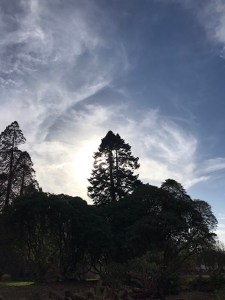
It’s a slow, slow tango
An explosion of deepest bright
A passion written in held-back movement
A surrender to the night
That follows…
➰
As, soft within the darkness
The folds of black reverse
And singing not heard in daylight
Is loosed upon the universe
In perfect union.
➰
© Stephen Tanham
Stephen Tanham is a director of the Silent Eye School of Consciousness, a not-for-profit organisation that helps people find a personal path to a deeper place within their internal and external lives.
The Silent Eye provides home-based, practical courses which are low-cost and personally supervised. The course materials and corresponding supervision are provided month by month without further commitment.
Steve’s personal blog, Sun in Gemini, is at stevetanham.wordpress.com.
You’ll find friends, poetry, literature and photography there…and some great guest posts on related topics.
Share this:


Maybe she’s got my sausage, this time?
– She’s busy. Give her chance, you’ll get it…
But she’s been past more times than usual!
– Shows how busy she is
You’ve finished yours…
©Stephen Tanham
#FurryFives – Just five lines that capture the essence of your moment with that beloved pet. If you want to join in, publish one and send me the link. I’ll reference it with my next #FurryFives post.
Share this:


So far, we have examined how Arthur M. Young, inventor of the Bell helicopter, engineer and astrologer/philosopher, used his skills and insight into how our minds determine meaning. Within this, he began to discover that there was a graphical symmetry to this process; a set of shapes that explained many of the ancient symbols that mankind has come to view as sacred. These will shortly be unveiled in more detail, but, first, we need to complete our tour of the foundations of how he approached it, for the symmetry emerges from those foundations and how we represent them.
In the last post, we looked at how Isaac Newton investigated the motion of things that move, discovering that – for example in the motion of a cannon ball – there were different aspects, faces, of that motion; and that although they were often hidden, they were tightly related to each other. Arthur Young used the equations that Newton produced for this. Unfortunately, this led us into numbers, squared numbers and, horrors, cubed numbers! Several brave readers made it to the end of last week’s post, but not without difficulty. So, for this week, I decided to take a small detour to illustrate how these types of number can be seen as pictures instead of fear-inducing maths.
As a child, I had a terror of maths, assisted by an ex military ‘Desert Rat’ of a headmaster who believed that beating boys and throwing board-dusters at girls would help their education. That was the 1960s, not Victorian England; and the dubious joys of a Church of England country primary school. Times have changed, but for most people, the horror of seeing something squared or cubed has not. So, by way a small gift, let me share with you one of the most beautiful insights I ever learned – though, sadly, beyond my school days.
It was the ancient Greeks who developed the idea of squares and cubes and the numbers that represented them. They ‘saw’ numbers as representing both qualities and quantities including what they thought of as other things, like distance from a point of origin.

In the diagram above, a unit of distance, marked ‘1’, (inches, metres, feet, etc) is added to others, in the form: 1 + 1 + 1 = 3. Nothing too complicated about that; it’s simply addition, the sort of thing we use every day.

Now, imagine that these numbers are a child’s counting blocks, as above. We arrange them in a line to produce the three, again. But this time, we begin another line of them with the last block of the first line. In doing this, we have changed the nature of what lies before us – what we are creating. As an example we might say we have begun to make a picture frame to contain our favourite photograph. In the process (and intuitively to our minds) we have turned a ‘perfect’ corner to begin the second row of blocks. This perfect corner is what we all know as a ‘right angle’, so named because of its special – and ancient – properties of ‘rightness’.
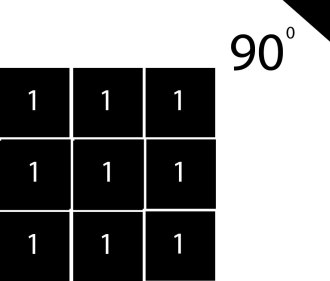
We can fill in our photograph frame with other blocks. Because of the right angle – which we know to be ninety degrees – the blocks will all fit together to form something dramatically new. What started off as a line has now become an area…. Our simple maths formula was just 1 + 1 + 1 = 3. But now we have an area whose properties can be derived from the counting blocks that make each side. We have a choice: we can simply count all the ‘one’ blocks, or we can ask our Greek teachers if there is a quicker way. They will tell us that we can multiply or ‘times’ the length of one side by the other. This would result in 3 x 3 = 9. Again that’s not too frightening. Our picture frame could have been a 3 x 4 rectangle, which would have given us an area of 3 x 4 = 12.
The first one above (3 x 3) has a special symmetry in that each side is the same length. Because of this identical symmetry, our line of three has become not just an area of nine but a SQUARE. This is the origin of square numbers: they are the same number multiplied by itself. And they produce a very magical figure – the square. To the ancient Greeks, this was very special. They envisaged that the square reflected a manifestation of divinity. From an origin – which had no quantity, but had a location – it led to a line, which did have a dimension, then to another line at the ‘right’ angle to produce a square, when we multiplied the length of the two lines together to give an area.
You can’t square a number to get a rectangle; you can only get a square. Anything ‘squared’ therefore is based upon the union of two identical things, but arranged in a certain way, so that they have a relationship to each other. In this case that relationship is ‘times’ or multiplication. We shall see later in this series of blogs how Arthur M. Young expanded these relationships to provide us with a full diagram of human meaning – and reconciled much of the diverse ancient wisdom in the process.
Back to our squares and rectangles. A rectangle is useful, of course – most framed pictures are set in rectangles – but a square is ‘perfect’ and quite capable of being used as a sacred symbol, as, for example. Masonic teaching shows. Within the Masonic teachings (I am not a Mason, but have great respect for what masonry sets out to do) someone of right character is described as ‘being on the square’.
Let’s summarise so far:
-We have an invisible point of origin (where we begin our construction or drawing);
-As soon as we start to draw our line, we have a point, which has no length, but exists, unlike the origin, which is just an idea;
-When we have an extension to that point in a certain direction, we have a line: in this case of length three units – but this could be any number.
-When our length (or extension) is done at three units, we turn our construction through 90 degrees – a right angle – and begin another line.
-We could have continued this process, just doing the edge of our picture frame, and we would have arrived back at our start point – having created only the edge of our square. But along the way, we learned that to ‘square’ the length gave us the area contained by the whole figure: a surface or ‘plane’ of a higher order.
Can we continue this, or is the process finished with the area of our picture frame? We learned that the mystical key to the creation of a higher order was the Right Angle – 90 degrees. This whole process has been about the generation of space in which life (and motion) can happen. Can we take our figure and extend it through another 90 degrees, without repeating what we have done? And, if we get there, what will it teach us about a number cubed?
The picture below contains the answer. Enough for one post, I think. We will elaborate on this next Thursday…

To be continued…
{Note to the reader: These posts are not about maths or physics; they are about a unique perspective on universal meaning created by Arthur M. Young. If you can grasp the concepts in this blog, your understanding of what follows will be deeper.}
Previous posts in this series:
Part One, Part Two, Part Three, Part Four
©️Stephen Tanham
Stephen Tanham is a director of the Silent Eye School of Consciousness, a not-for-profit organisation that helps people find a personal path to a deeper place within their internal and external lives.
The Silent Eye provides home-based, practical courses which are low-cost and personally supervised. The course materials and corresponding supervision are provided month by month without further commitment.
Steve’s personal blog, Sun in Gemini, is at stevetanham.wordpress.com.
You’ll find friends, poetry, literature and photography there…and some great guest posts on related topics.
Share this:


Summer does not come at once
Its grip on that which gives it birth
Lingers…
In glimpse and taste and smell
With grind and crunch on dale and fell
From frozen earth to green stalk’s birth
It rises.
⦿
And in that rising is our eye
Serene…
Which sees the whole but touches part
A joining of the mind and heart
And knows in that unchanging change
There lives Creation
⦿
©Stephen Tanham
Stephen Tanham is a director of the Silent Eye School of Consciousness, a not-for-profit organisation that helps people find a personal path to a deeper place within their internal and external lives.
The Silent Eye provides home-based, practical courses which are low-cost and personally supervised. The course materials and corresponding supervision are provided month by month without further commitment.
Steve’s personal blog, Sun in Gemini, is at stevetanham.wordpress.com.
You’ll find friends, poetry, literature and photography there…and some great guest posts on related topics.
Share this:

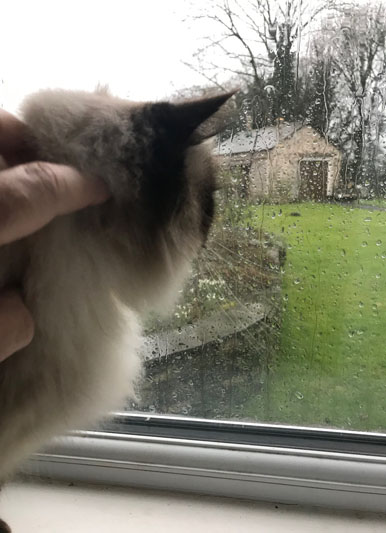
It’s been doing this for weeks, you know
– I wish I could give you a different window
You said that in November, when it got dark
– And it was the truth
I don’t understand truth, I want the window into summer
©Stephen Tanham
#FurryFives – Just five lines that capture the essence of your moment with that beloved pet. If you want to join in, publish one and send me the link. I’ll reference it with my next #FurryFives post.

Thank you to Sue Vincent for joining in #FurryFives with:
Share this:

From Stuart.


 Sun in Gemini
You must be logged in to post a comment.