
(📩100 words, a one-minute read)
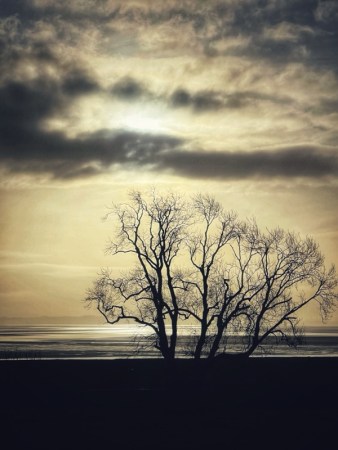
The sky lit bright with promise
The dark earth sodden and soft
The tree – the form returning life
will use to shape itself.
Like, yet unlike,
Each season different yet the same
With a billion variants we do not see…
———-
©Stephen Tanham 2024
All photos taken and processed on an iPhone 12 ProMax.
Stephen Tanham is a writer-photographer and mystical teacher.
He is the founding Director of the Silent Eye, which offers a journey of the soul guided by lessons, inner guidance and outer companionship.
There are two blog streams:
(mystically-oriented writing)
and
(general interest, poetry, humour and travel)
Share this:

(📩700 words, a ten-minute read, final part)

(Note: due to a technical error, Part Two of The Touch of Experience did not publish on Sun in Gemini, though it did on The Silent Eye. There is a link at the end of this post if the reader would like to read the full set of three, in sequence. Apologies)
In Part Two, the ‘Apple’ became a friend that helped us quieten the mind’s focus on concentration (of things) and created a ‘light and bubbling’ sense of ourselves, a kind of glow…
In this final part of the series, we are going to do something quite wonderful … and very simple. I hope you will take this with you and use it, often.
When we feel the gentle affinity with the apple – or whatever object we have used to help us – we are going to include it in our being.
That’s right, we’re going to relate to it as though it were part of us; a part of the ‘me’ that is ‘you’ – your very special sense of self.
We do this by holding that bubbling glow that we feel at the presence of this friendly object and transposing it back to us, as though some invisible process was absorbing it back into our body.
Immediately we do this, we will feel that, actually, it already was part of our body, and that the bubbling glow we now feel was really coming from us, all along. Only now, we recognise the signature of that focus on the apple was actually the sense of peaceful self.
While the energy of this is glowing, use it to sweep up your whole body, starting with the muscles and bones of your feet and rising up within the legs to the mid-section, stomach and chest, and holding it in your heart. Then, let it rise through your throat and head with a sense of ‘flowering’ at the very top of your head and out into the space above you.

As though you were a flower, feel your feet rooted to the Earth and your flowering head connected to the sky (and stars) above you.
It’s a beautiful feeling, isn’t it?
The body is always in the now, but we don’t often pay this kind of attention to it, so we stay lost in our thoughts and concerns and feelings – the mind. All of these are imaginations compare to the reality and ‘present-ness’ of the body.
Go back now and feel how much your body is in the ‘present moment’. Does it have that gentle inner glow? If so, then the whole of it is present to the beautiful now, and the phantoms of the busy or troubled mind have been pushed where they belong.
The future is an idea. The present is where everything happens; and it is constantly changing, Our lives can change in an instant, so our heavy thoughts and worries simply hold us away from the power of the now and that which is present in the now to change things.
Our minds are usually in a chaotic state of ‘must do this, must remember to do that … and worry about things that have yet to happen to us. The body is always in the now, and when we return our full presence to it, it glows with joy.
Experience –where we started – touches the body, first. That is reality, What we then make of that touch of experience is down to the state of our emotion and thoughts – the mind, in other words,
With care and love for our-selves, we can separate these, and see how they work. At any stage, we can stop the compulsive busyness and simply be present to our bodies, re-inhabiting the bubbling joy of being alive and being ‘me’.
This ‘other realm’ of being is what we always had before our minds became ‘sophisticated’ and cluttered with concerns, anticipations and worry.
It belongs to us. It is us. We can reclaim it so simply.
I hope this works for you… Its effects can be a revelation.
Previous parts of this series:
This is part Three
———-
©Stephen Tanham 2024
All photos taken and processed on an iPhone 12 ProMax.
Stephen Tanham is a writer-photographer and mystical teacher. He is the founding Director of the Silent Eye, which offers a guided inner journey from the state of conscious personality to the awakening of realised personal Self and its world of Being.
There are two blog streams:
(mystically-oriented writing)
and
(general interest, poetry and travel)
Share this:

(-📩 500 words, mainly photos. A five minute browse)
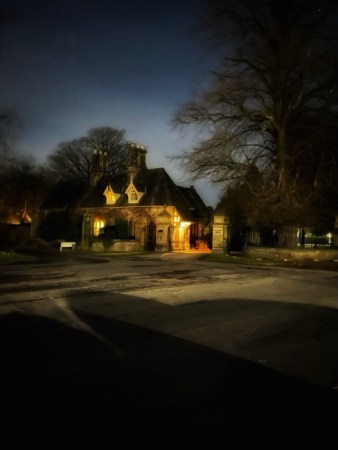
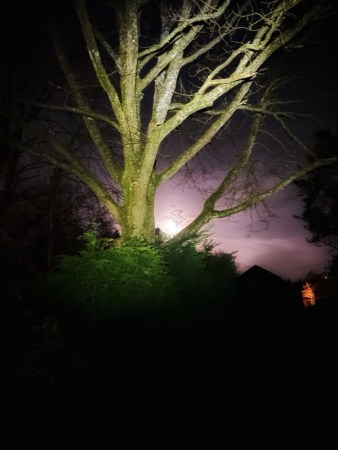
It was so late there was literally no-one else around.
An unsettled dog with an upset tummy had led me out into the unlit streets of Sedgwick: our small village, which lies about 25 miles from Lake Windermere.
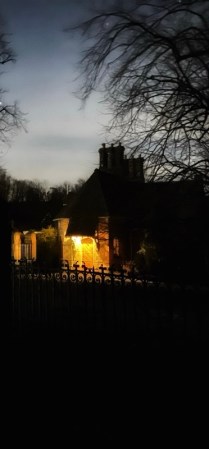
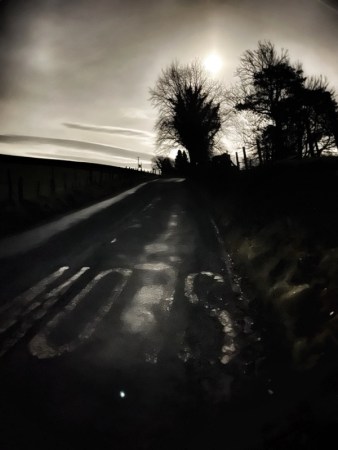
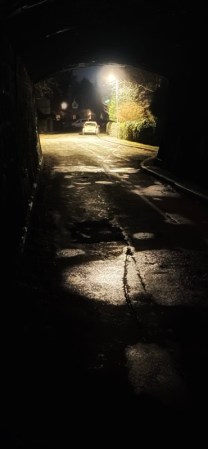
With nothing else to do except walk the poor collie until she was tired or cured, I got the iPhone out and began to play with ‘Night-mode’, switching the flash off and letting the lens and internal computers do their best against the darkness. There are no street lamps in Sedgwick; the village has a dark-skies policy.
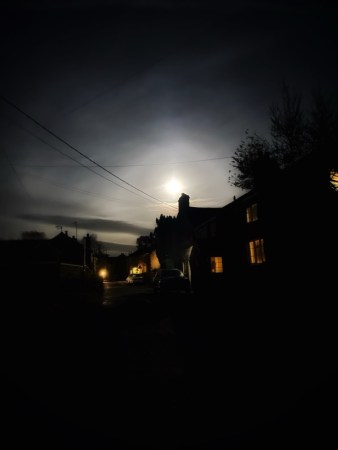
I don’t use a tripod, so half the shots were taken just standing up and holding the phone as steady as possible. The rest were taken jammed against a fence post, lamp-post or anything else that was tall enough to brace and steady the shots. I did, though, have the benefit of a bright and full-ish moon, which made all the difference at the ‘cold’ end of the spectrum.
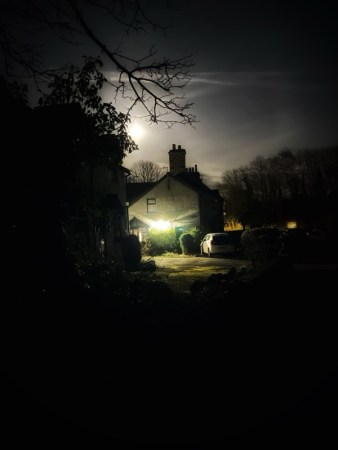
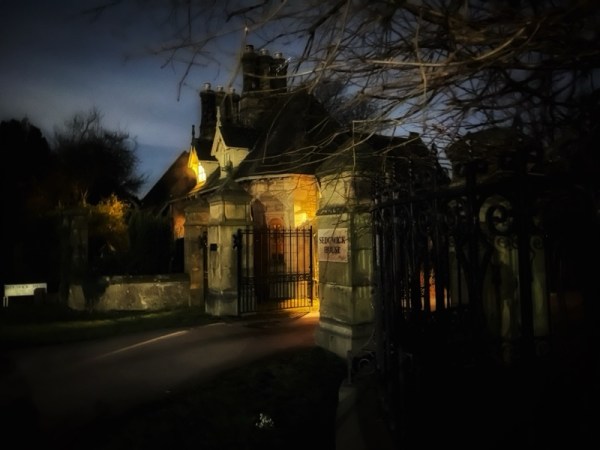
Opposite the old Wakefield estate, there is a row of individual houses, built at various times in the village’s history. Geographically, this is the centre of the village.
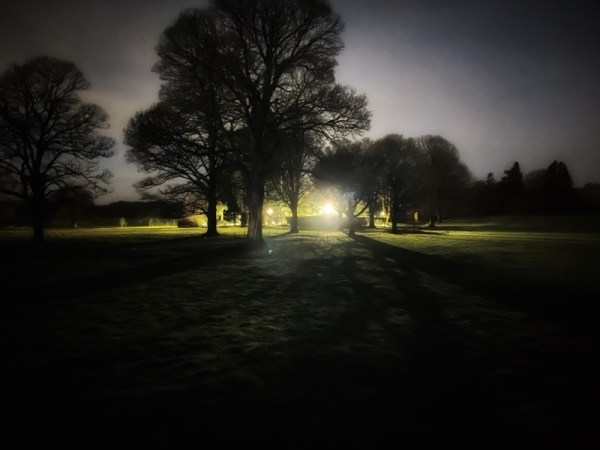
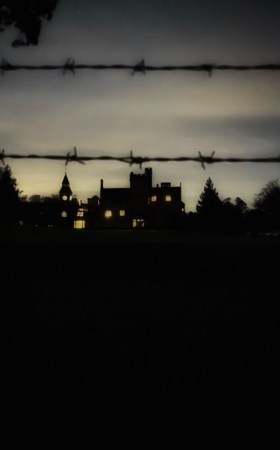
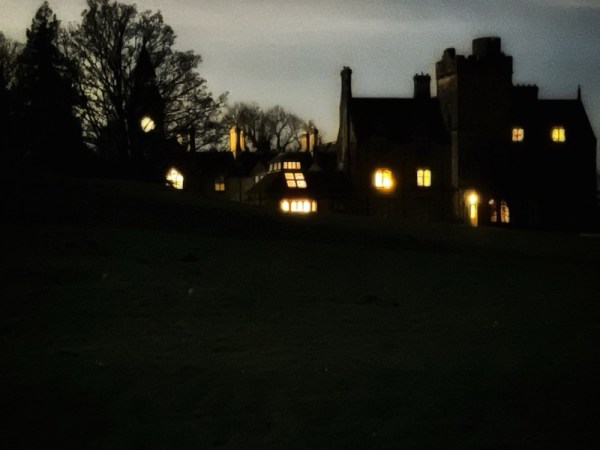
The old Wakefield house and gardens are extensive. In the darkness they look ominous… The perfect setting for a ghost story, perhaps?
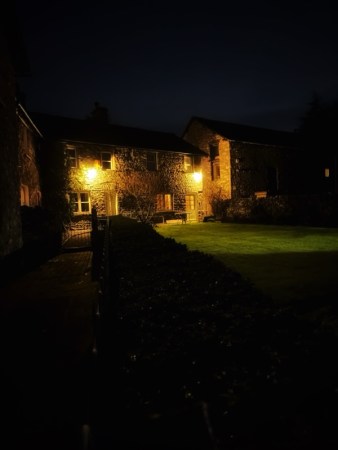
Apple’s night-mode on the iPhone works by using AI to evaluate what’s being asked of it, then taking and merging multiple shots to get the best result it can. All this without using the flash – which makes it good for any kind of landscape photo; near or far.
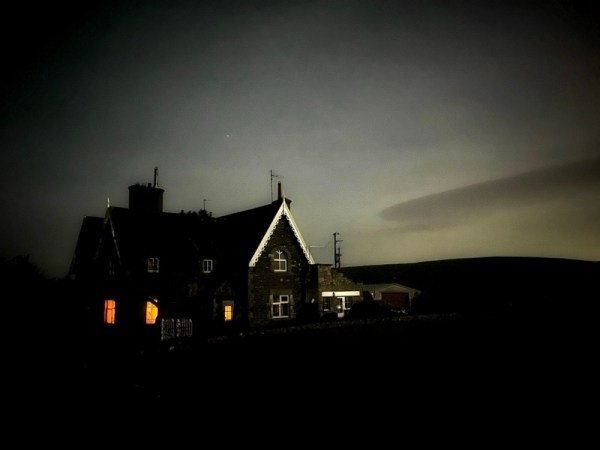
As the hill steepens towards the River Kent, the houses thin out. This is one of the old gunpowder-foreman’s houses , now divided into two dwellings.
©Stephen Tanham 2024
All photos taken and processed on an iPhone 12 ProMax.
Stephen Tanham is a writer-photographer and mystical teacher. He is the founding Director of the Silent Eye, which offers a journey guided by lessons, correspondence, exercises, zoom reviews and personal meditation. This takes the conscious personality to the dawning of realised personal Self and its restored home of Being.
There are two blog streams:
(mystically-oriented writing)
and
(general interest, poetry, humour and travel)
Share this:

📩 humorous photos, fright. 17 words. One minute read)
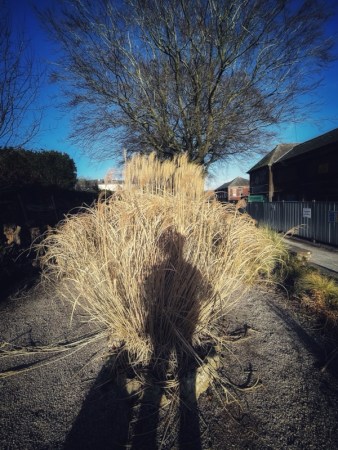
Winter shadows are great fun.
The strong sun, coming in at a low angle, creates images of high contrast. Many of these carry a degree of humorous ‘threat’: the kind one can imagine on the cover of a dark novel.
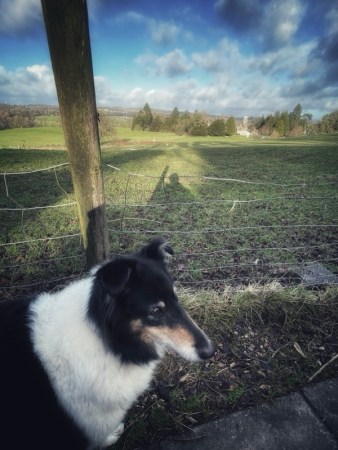
The ‘intruder’ appeared when I was framing the shot of Tess, sitting on a bench. The sun came out behind me and suddenly there was a new figure in the shot… An ancient monk, perhaps, bearing a staff!
And he’s behind us!!!
———-
©Stephen Tanham 2024
All photos taken and processed on an iPhone 12 ProMax.
Stephen Tanham is a writer-photographer and mystical teacher. He is the founding Director of the Silent Eye, which offers an intuitionally-guided journey from the state of conscious personality to the awakening of realised personal Self and its world of Being.
There are two blog streams:
(mystically-oriented writing)
and
(general interest, poetry, humour and travel)
Share this:

+ #Photography,, #Silenti, iPhone photography, landscapes, Photography, Places and Prose, Travel and people, Travel and Photography
A round of Roundhay
by Steve Tanham
(📩 300 words, a five-minute read)
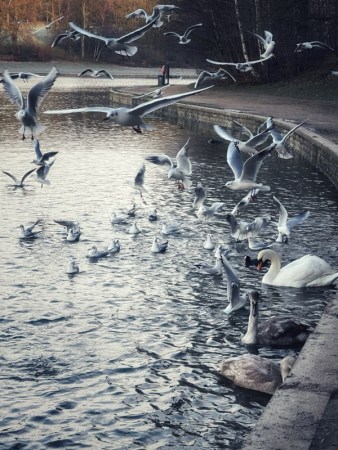
Roundhay Park in north Leeds. I had stepped in at short notice to drive over the Pennines to help ‘toddler- sit’ our grandson.
He was under the weather; possibly teething, and had been sent home from nursery. Dad – my son – was abroad on business and unable to return at short notice.
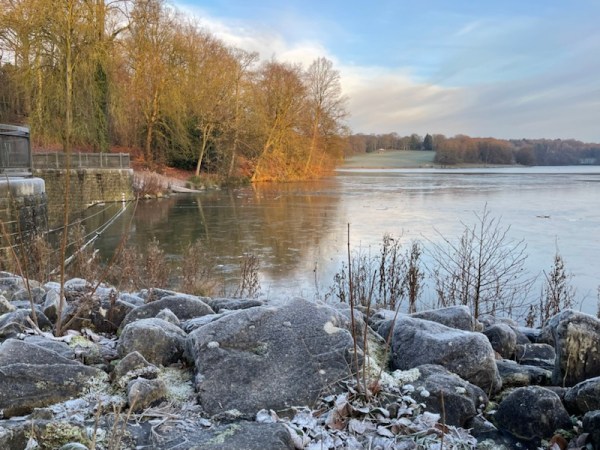
A well wrapped-up walk with the grandson in his buggy was in order; giving mum some precious time to get on with working from home.
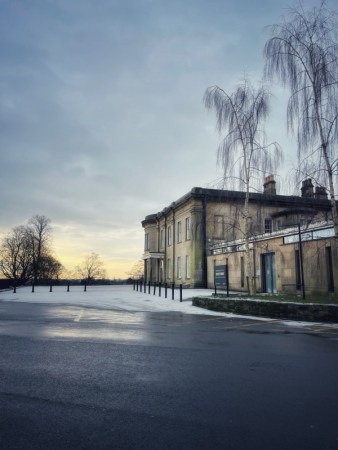

Just me and the young lad, who, I’m told – and apropos of nothing – could play for Yorkshire at cricket, since he was born there. The rest of our Lancashire-bred family is, of course, distraught at the prospect.
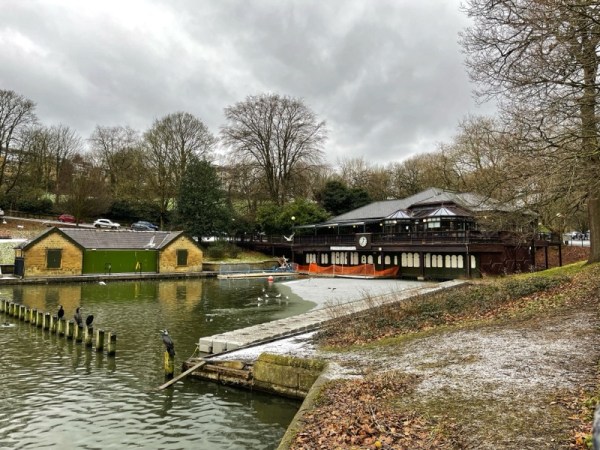
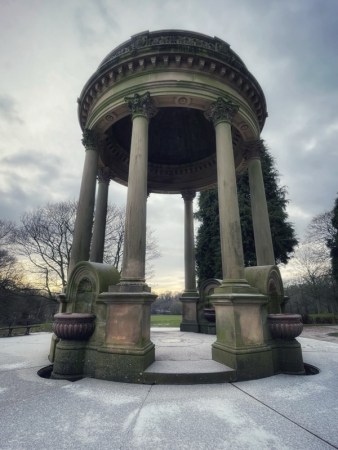
Roundhay park is famous for its birdlife. The 700 acres boasts a huge lake as the centrepiece of literally dozens of walking routes.
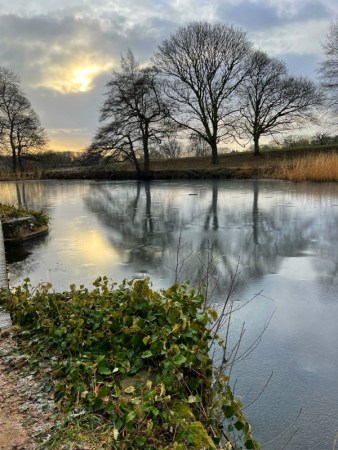
The park is beautiful, and has over a million visitors each year. One stroll around it tells you why.
©Stephen Tanham 2024
All photos taken and processed on an iPhone 12 ProMax.
Stephen Tanham is a writer-photographer and mystical teacher. He is the founding Director of the Silent Eye, which offers an intuitionally-guided journey from the state of conscious personality to the awakening of realised personal Self and its world of Being.
There are two blog streams:
(mystically-oriented writing)
and
(general interest, poetry and travel)
Share this:


And, far overhead, top right, in fact, Marjory ordered a gin and tonic…
©Stephen Tanham 2024
All photos taken and processed on an iPhone 12 ProMax.
Stephen Tanham is a writer-photographer and mystical teacher. He is the founding Director of the Silent Eye, an online school of the Soul that provides monthly lessons, assignments and personal mentoring.
There are two blog streams:
(mystically-oriented writing)
and
(general interest, poetry, humour and travel)
Share this:

(📩 740 words, a ten-minute read)
To enter a process of mystical training is often considered an intellectual experience, with limited connection to everyday experience.
In practice, the opposite is true. The everyday experience is the heart of the matter.
There is no finer example of this than the admonition, given early, to ‘experience, fully, what is happening to you, now.’
At first hearing, this sounds self-contradictory. How can we not experience what is happening to us?
Try it for a moment: fix your attention on a familiar object in your house. It doesn’t matter what it is. Take that apple over there in the fruit bowl….
Look at it, then really look at it. At first you’ll get a reaction from ‘the objector’ in your mind. Oh, not this nonsense again, it might say. I’ve focussed on apples and oranges a hundred times, before. It’s boooooring!
It is boring, for the first few seconds. The wandering mind doesn’t want its precious single point of attention limited like this. It wants to retain the butterfly nature that it luxuriates in, floating from one bright and juicy ‘fix’ to another. Why would it look at that apple (note the movement to enemy status, here). We’re now dealing with something that’s in the way of our freedom!
At this point, you pick up your hiking pole and whack it – the butterfly mind – and tell it that you’re serious about doing this exercise because you sense something important beneath it.
Return to the ‘apple’ and literally trap your own mind in its enduring state of reactive resistance.
Where did that come from? You initiated this search of the experience of the apple, yet a whole wave of resistance followed it…
The truth will make us think … deeply.
We are not really in charge of our minds. Instead, we have built up – or allowed to be built up – a whole set of layers of resistance to ‘deeper thinking’, most of which follows habit.
Deeper thinking isn’t our sole goal, but it is a gateway to it. We do need to be able to direct our attention, fully and at will, and the most powerful object of that attention is our experience of ‘the world’
We all know the power of habit. Often, it’s a brilliant thing. I don’t ‘really’ have to think about driving my car. After so many years behind the wheel, my mind-computer has developed a sophisticated and very accurate set of monitors and reactive processes that, basically, drive the car for me, allowing my attention to be brought instantly back into focus if something new or urgent interrupts my journey.
This is not inattention; it’s the human’s mechanism for not being exhausted all the time – which would be the result if we had to live in the hyper-attentive state, fear-driven that we needed when we were learning to drive.
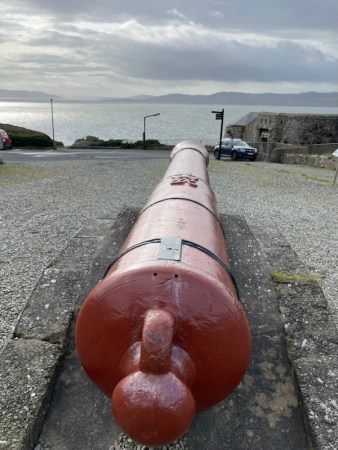
So we can see the pattern. Our mind comprises layers of wonderful processing power which have developed during our lives. It has a very fixed view of its world, based on looking after us and streamlining what we need to focus on.
So what’s the problem?
The problem is that, as we get older and hopefully wiser, we want to delve into deeper states of our experience. Why? Basically, because before we leave this mortal coil, we have a deep desire to know ourselves, and we have seen that we don’t.
When we have this thought – and allow it. We feel an immediate connection with a deeper and neglected ‘layer’ of me.
What we know is the ‘habitual human’, many of whose characteristics are admirable … but now antithetical to our more sophisticated need to get to the truth of what we see to be our real existence.
In the next post of this ‘touch of experience’ series, we’ll grasp that enemy apple and go deeper – much deeper…
©Stephen Tanham 2024
All photos taken and processed on an iPhone 12 ProMax.
Stephen Tanham is a writer-photographer and mystical teacher. He is the founding Director of the Silent Eye, which offers an intuitionally-guided journey from the state of conscious personality to the awakening of realised personal Self and its world of Being.
There are two blog streams:
(mystically-oriented writing)
and
(general interest, poetry and travel)
Share this:

(📩260 words plus photos. A three minute read)
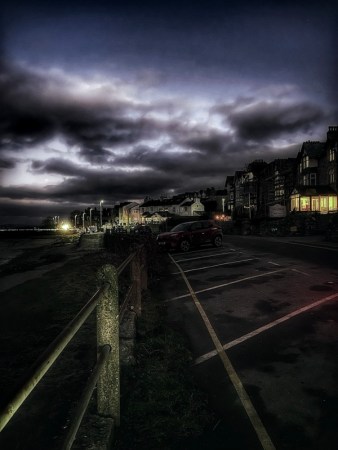
Although we live on the edge of the Lake District, one of our treats, at the end of a cold winter day, is to drive south on the old A6 trunk road to Milnthorpe, then take the right turn to follow the River Bela along the edge of the Levens estate.
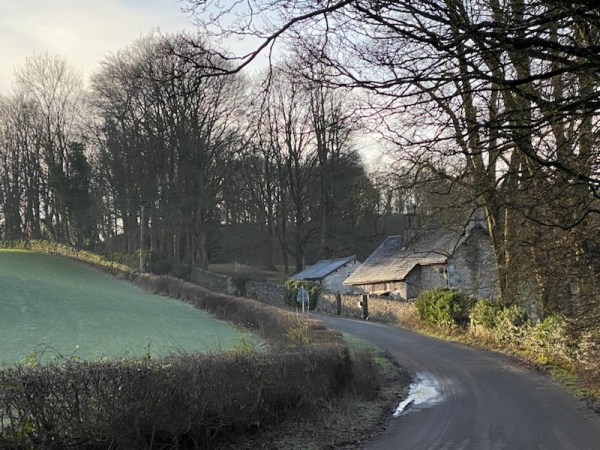
Ten minutes later, we’re in the small seaside village of Arnside. Ideally, we arrive with about thirty minutes of daylight left (currently around four p.m.)
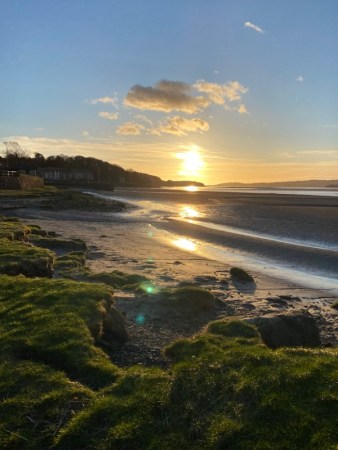
which gives one of us time to run Tess on the shore while the other collects the pre-ordered fish and chips.
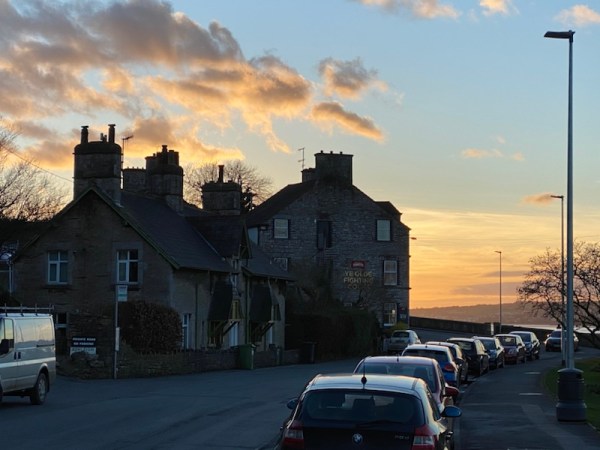
Shortly thereafter, with the car warming up further along the promenade, so we can watch the energetic tide race in or out, often twinkling with the light of Grange – across the estuary, while we eat our meal in hungry silence.
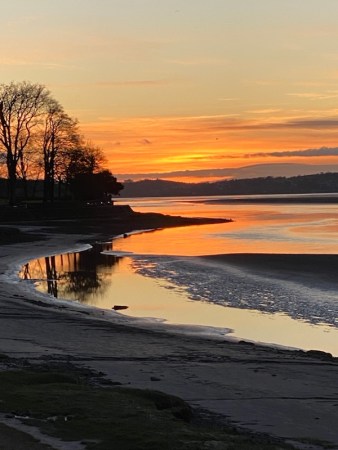
Somehow, it’s more fun in winter. But Arnside’s ‘chippy’ is justly famous all year round.
A simple pleasure … but wonderful. The opening photo may convey something of the atmosphere.
©Stephen Tanham 2024
All photos taken and post-processed on an iPhone 12 ProMax.
Stephen Tanham is a writer-photographer and mystical teacher. He is the founding Director of the Silent Eye, which offers an emotionally-guided journey from personality to the awakening of realised personal Self and its world of Being.
http://www.thesilenteye.co.uk and http://www.suningemini.blog
Share this:

(📩 140 words, poetry, a four-minute read)
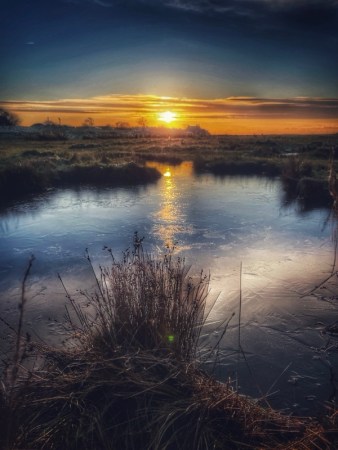
The last car, angry, leaves the sloping bank
Bullets from rubber as gravel flies
Inside, warring words, a hiss of parting
Then gone…
◽️◽️ ◽️
Devoid of jagged sound, our ears extend
The tiny hum of far-off workers’ journeys
Streaming home, their day is done
◽️◽️◽️
Save those last few miles, then softer, glorious home
A place to which we will return – in normal time
But this is not complete, nor here…
◽️◽️◽️
…And now, when light falls from darkening sky
And mercury melds the tidal ponds aflame,
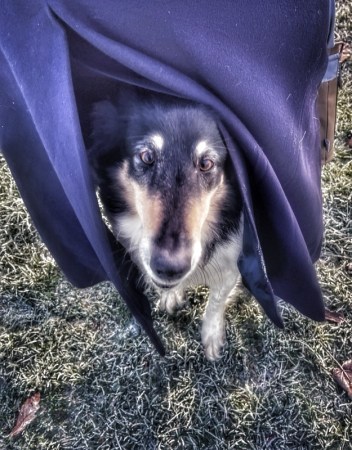
The Collie’s eager call; the ball that must be thrown,
The simple sense of now; cold sea and harsher winds.
◽️◽️◽️
The inner glow that shines the silence of unsaid,
She watches me, hearing nothing, sensing all,
Brown love, golden, pierces my eyes
And once, again, the shore is hers … and mine.
◽️◽️◽️
©Stephen Tanham 2024
All photos taken and processed on an iPhone 12 ProMax.
Stephen Tanham is a writer-photographer and mystical teacher. He is the founding Director of the Silent Eye, which offers an intuitionally-guided journey from the state of conscious personality to the awakening of realised personal Self and its world of Being.
There are two blog streams:
(mystically-oriented writing)
and
(general interest, poetry and travel)
Share this:

+ #Photography,, #Silenti, Consciousness, iPhone photography, Lake District, Mindfulness, nature, Photographic techniques, Photography, Places and Prose, Seasons of the year
The liquid depth of January
by Steve Tanham
(📩 330 words, a two minute read)
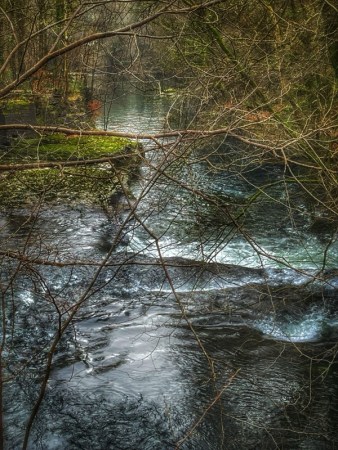
I love to discover a scene that epitomises (for me) the main characteristic of each month. January is a particular challenge!
I took this one dangling the iPhone precariously over the safety railings of the village’s old bridge. As can be seen, the River Kent is in full flood, though not dangerously so.
In mid December, 2015, the ‘once in a lifetime’ flood waters came to within four feet of the road level. One hundred metres along the road the tarmac was six feet below the water’s surface.
Today, the river was energetic but stable. We get used to its background noise but it really does ‘roar’ as it adds another fraction of a millimetre to the depth of the gorge. The South Lakeland limestone here is mercifully very hard.
Advanced canoeists shoot these rapids. It’s quite a sight and not for anyone else. Occasionally, a police helicopter is seen hovering over this stretch of the river. It’s the nature of the gorge to reveal the body of anyone who has tragically entered the river upstream in Kendal… and lost their lives or been injured.
It’s deep, powerful and potentially ominous. But most of all, it’s Nature in January at its most potent.
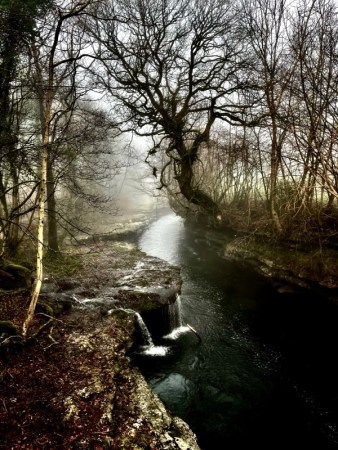
The other side of the bridge reveals one of my favourite views. It’s a great vantage point from which to capture the melancholy ‘fullness’ of what can be a rather depressing month.
But not here…
©Stephen Tanham 2024
All photos taken and processed on an iPhone 12 ProMax.
Stephen Tanham is a writer-photographer and mystical teacher. He is the founding Director of the Silent Eye, which offers an emotionally-guided journey from the conscious state of personality to the awakening of realised personal Self and its world of Being.
There are two blog streams:
(mystically-oriented writing)
and
(general interest, poetry and travel)
Share this:

+ #Silenti, Christianity and modern mysticism, Consciousness, esoteric psychology, Mystery Schools, Psychology
In the world but not of it (3) : True to Type
by Steve Tanham
(-900 words; a ten-minute read)

Not ‘typing’ in the sense of my fingers tapping across this keyboard. Something else is conveyed, here: the idea that although we are each a unique example of walking, talking protoplasm, we exhibit patterns of behaviour that are so strong they can be ‘collected’ into groups – ‘types’.
Astrology is good example with which to explore the idea.
The notion that there is some ‘pattern and purpose’ to us as tiny beings living on a giant, partly-cooled volcano full of comet-donated life-giving water and rocks ground to soil over billions of years, and that this life is bound tightly to cycles that encompass behaviour as well as biology is a foreign one to science…
Its stance is that until it can understand the mathematical ‘nature’ of the mysterious vibrations that link us to the ‘stars’ (sun and planets), it will continue to pronounce it as nonsense…
Civilisation has a history of studying human behaviour for good reason. From saints to tyrants, it’s rather important that we comprehend the pattern of events exhibited by ‘types’ of people who might drastically affect our lives. We wouldn’t to hand a nuclear trigger to a child. Yet, I can think of a few world ‘leaders’ who have or are aspiring to that power, and have less emotional intelligence than your average nine year old.
We all know how a dictator behaves. We can chart the rise of his or her bullying and subsequent crushing of more gentle – and usually more intelligent, opponents. It begins and ends in violence, which is an obscene wound on the human soul.
Stanley Kubrick and Arthur C. Clarke knew exactly what they were portraying when the triumphant giant ape held up the bloody bone – the ‘first weapon – in the groundbreaking film ‘2001: A Space Odyssey’.
I went to see it nine times…

Thankfully, the public continues to believe in types and find them educational – as in popular astrology, which is oversimplified but continues to be looked on favourably. We like the suggestion that all Geminis are having a bad Monday; it reduces our isolation.
Most people don’t take astrology seriously, but in general it is considered fun and benign – leaving the professional astrologer as ‘wise counsel’ if something complex is happening in our lives. The key is that astrology on the fun level is not threatening, whereas other tools, such as psychological profiling, can be so, especially if their use is linked to our employment, as often occurs with tools like the Myer-Briggs ‘test’. The latter, and its derivatives, is often employed for the recruitment of key executives to deliver a reliable profile of who we are beyond any clever interviewing skills we may possess.
I vividly remember taking several such tests in my professional career, they were not relaxing events; and there’s food for thought in that, alone. How are we to truly measure a person’s suitability to ‘fit in’ (to a key team in a business organisation, for example) without seeing them at play? True, major corporates will have sophisticated ‘selection boards’ whose process includes social profiling as well as professional considerations, but these are expensive and only operate at the ‘top of the market’.
Typing may seem to be a modern concern, but if we extend our definition of it, we will find a very familiar example that has been with with us for nearly two thousand years.
When what was left of the Roman Empire adopted Christianity in the fourth century CE, the much more ‘mystical’ sects of the Christian Gnostics were persecuted and eventually driven out. Fleeing, some of them came to settle in the deserts of Northern Egypt in an ascetic monastic culture that we know, today, as the Desert Fathers.
The word Gnostic is derived from ‘gnosis’, a Greek word that means a higher form of knowing. To ‘gnow’ is to literally be at one with what is being contemplated. Truth is felt, not reasoned towards. The heart, which knows truth, becomes the organ of knowing. The gnostics practiced this, experiencing Christ as the ‘Christos’ or living presence within themselves. Their role was to perfect this presence as a lived and felt reality. In the form of the Desert Fathers, they devoted themselves to identifying the barriers to this inner love, a sentiment that exactly mirrors the famous Sufi mystic, Rumi.
“Your task is not to seek for love, but merely to seek and find all the barriers within yourself that you have built against it.“Rumi
The leader of the Desert Fathers was Evagrius Ponticus, referred to as a saintly man and teacher. His crowning work was to identify and categorise the behaviours that stand in the way of such inner harmony and union.
He described these behaviours as ‘eight evil thoughts’. They were gluttony, lust, avarice, anger, sloth, sadness, vainglory and pride.
Evagrius wasn’t writing for a general audience; he was instructing monks whose daily life was what we would now call ‘deep meditation’.
We have lost the context of ‘evil’ as used then. He was having a practical discussion with those dwelling in the inner realms of their consciousness about technique. These eight – whose exact number and nature has changed little over the centuries – became, under Pope Gregory in the sixty century, the Seven Deadly Sins.
And the typical modern reaction to that shows how far we have drifted from its initial intentions.
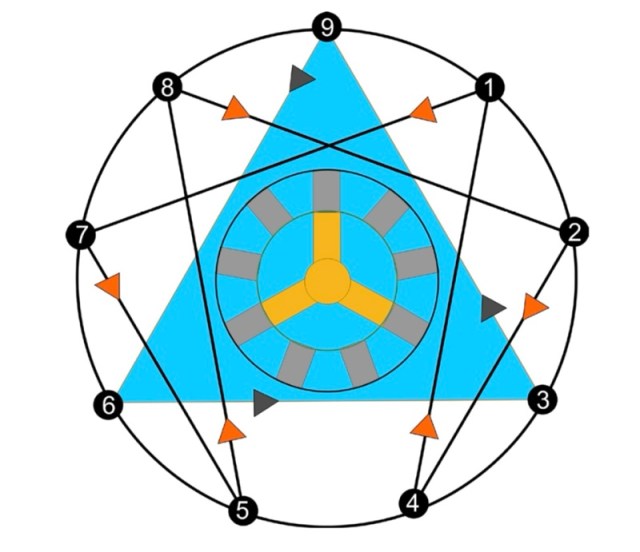
Really, these ‘evil thoughts’ were the known world’s first classification of psycho-spiritual types, and were, much later, to profoundly influence the journey of spiritual psychology into its modern and far-reaching forms.
In the next post, Part 5, we will examine how these ‘deadly sins’ actually describe the psychological kernel of a typing system that describes the modern spiritual journey; and look at how a miracle of discovery in the desert brought us a lost Gospel directly influenced by the mystical monks of that era.
“Until you make the unconscious conscious, it will direct your life and you will call it fate.” C.G. Jung
To be continued in Part 4.
—————-
Other parts of this series:
This is Part Three
———-
©Stephen Tanham 2024
Stephen Tanham is a writer-photographer, mystical teacher and Director of the Silent Eye, a correspondence-based journey through the forest of personality to the dawn of Being.
Share this:

(-790 words, a five minute read)
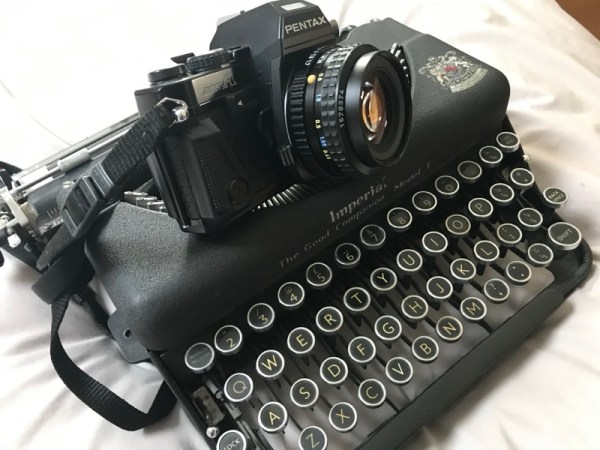
There’s nothing like having a good rest from blogging to make you think about what your blogging life should be like.
I’ve been musing for the past three weeks – between Christmas family warmth and New Year’s ‘Auld Lang Syne’ – about the nature of blogging and why we do it. Reading others’ similar reflections has been instructive.
The new year is a good time to consider such ‘housekeeping’, though, apparently, a bad time to physically clean the house. The Christmas break is just that: a chance to step outside of the blogcadian rhythms that govern us – pretty sternly if other writers’ observations are anything to go by; and there is no finer source of feedback than one’s peers.
What we produce will determine how we go about it. I’ve created several self-published books (Amazon), but most of them were done in the early and heady days of the Silent Eye. Sue Vincent was our nominated ‘publisher’ and all one had to do was send her the MS and await international fame. She is missed… as is the international fame.
So, equipped with a new technique of ‘personal inquiry’, I sat down and let it flow… Looking deep for the reasons behind the reasons.
In no particular order, this is what came back.
1. I write because I want to. It feels good to write; but I also know when I’ve written something good and sometimes, not so good. The problems come when it’s late at night and I realised the confused 1500 word ramble I’ve just spent five hours editing is not sufficient…
2. It’s a creative discipline – and good things come from such focus. Rhythm carries energy with it, which flows in cycles – like tides. As in the old adage “A tide taken at the flood leads on to fortune…” Looking back on my time as a blogger, I feel good that I’ve kept my nose to the grindstone for a considerable length of time. But that adds weight to the need to review what I do and how I do it. Simply ‘carrying on’ sidesteps what could be a wonderful opportunity for a personal refining process.
3. This is a big one: blogging keeps us in a community of fellow bloggers. Not all may be book writers, some may be happy with a life producing their own ‘magazine’ on a regular basis. If so, this further emphasises the importance of a regular cycle of publication. For me, the idea that blog posts can be the equivalent of a good magazine article is important, and provides a model to aim at.
4. We should never forget to entertain. People keep reading our words because (a) they like us, and (b) they feel either warmth, humour or companionship from what we write. That’s a complex mix and does not readily accommodate a ‘one size fits all’ approach. How to work with this is a challenge.
There are some simple practicalities here. Taking poetry (which I love writing) out of the mix, I know from many years experience that my most popular blog posts have been between 500 and 900 words. Longer ones may well be of interest to a few people looking for greater detail, but isn’t that the role of a book, or at least a series of posts?
I have ambitions to return to book-writing, but we’ll see. This is about blog posts published twice or three times per week. That’s a lot of writing, and I need a coherent plan. In this endeavour, I’ve decided I need to model the work on what I would find attractive elsewhere. Someone buying a technical mag is probably happy to find instructive articles of several thousand words, but that’s not what we typically do.
Really, we keep in touch by blogging, don’t we? A group of online friends and ‘colleagues-in-writing’. My posts need to reflect this. 500-900 words is just fine and will be central to my future plans.
Also, I think we should tell people how long it will take to read. I’ve seen this used, before – in other channels, like Medium. It’s polite and helpful. Subjective, but in a constructive way. I did it for a while but dropped it. It can only help, so I think it’s time to revisit,
So those are my thoughts. I’m happy to be back at the keys. Those few weeks away from ‘tap tap evenings’ have been a tonic, and have made me focus on what’s important and realistic. But they’ve also made me realise how important regular blog-writing is.
I’m looking forward to seeing how this evolves in 2024, as I know my fellow bloggers are with their projects.
Let’s keep in touch!
©Stephen Tanham 2023
All photos taken and post-processed on an iPhone 12 ProMax.
Stephen Tanham is a writer-photographer and mystical teacher. He is the founding Director of the Silent Eye, which offers an emotionally-guided journey from personality to the awakening of realised personal Self and its world of Being.
http://www.thesilenteye.co.uk and http://www.suningemini.blog


 Sun in Gemini
You must be logged in to post a comment.