


It’s a song by Crosby, Stills and Nash, written in 1970 by their new band member Neil Young, for the best-selling album Déjà Vu; the event that propelled them to achieve what the music world described as ‘supergroup’ status.
Link. https://youtu.be/pWMyLDia6R0
It was a transformative moment for a sixteen year old boy-man who had just been bought the album as a Christmas present…
But it has nothing to do with the subject of this post, apart from the song title, and that the words ‘Country Girl’ have always carried a special magic.
Nor is the woman who owns this rather tasty Mini Countryman a country girl… Well, she might be, but that’s not our story, which is the nature of the chrome-plated letters that make up the revised model name shown in the second image.
I’m fond of gestures. I’m even fonder of clever gestures whose impact is understated…
Clearly irked by the misogynistic nature of the model name ‘Mini Countryman’ – bought by BMW as part of the bargain bucket of what was left of British Leyland, the unknown lady sourced an additional ‘W’ and ‘O’ , in matching chrome font and re-sited the letters:
‘C O U N T R Y M A N’
Giving us the full spread of
‘C O U N T R Y W O M A N’
Country Girl, I think you’re pretty. And you have a fabulous sent of humour…
©Stephen Tanham 2022
Stephen Tanham is a Director of the Silent Eye, a journey through the forest of personality to the dawn of Being.
http://www.thesilenteye.co.uk and http://www.suningemini.blog
Share this:

+ #Humour, #NightMoves, #Silenti, landscapes, mystery, Photographic techniques, Photography, Places and Prose
Night beginnings…
by Steve Tanham
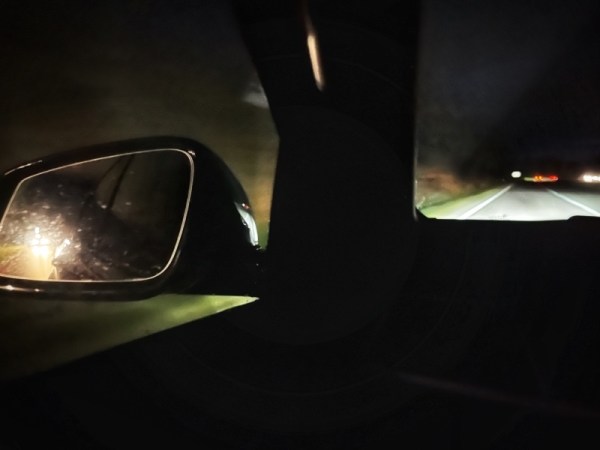
I love images that pull you in and suggest what might follow…
‘The car behind had been gaining on her for the past few minutes, getting closer with every mile. How far was she from civilisation! Would she be able to outrun him…assuming it was a him!’
—-
‘He looked ahead and saw the car slowing… No! It had stopped. And he was hurtling towards it at fifty miles an hour! Only then did he see the other car behind racing to close the gap; they were either going to crush him, or force him to stop for a robbery…or worse…
—-
Difficult to stop once you start!
Taken towards the end of our journey to The Black Isle, a very dark section of the A9. Happily we weren’t crushed or kidnapped… but that photo holds a fascination.
©Stephen Tanham 2022
Stephen Tanham is a Director of the Silent Eye, a journey through the forest of personality to the dawn of Being.
http://www.thesilenteye.co.uk and http://www.suningemini.blog
Share this:

+ #Silenti, Child of Light, Consciousness, enneagram, Esoteric Meaning of Myth, esoteric psychology, meditation, Metanoia, Mindfulness, Photography, Silent Eye School, Spirituality
Mind – mover of the Soul (4) Where is the World?
by Steve Tanham

Where is the world? Is this a fair question to ask ourselves or some pointless intellectual game?
A friend sent me a beautiful piece of writing, created by a Kabbalist teacher. The Kabbalah is a system I’m very familiar with, though the Silent Eye uses the enneagram as a map of egoic and spiritual consciousness, rather than the Tree of Life used by the Hebrew-derived Western Mystery Tradition (WMT).

Modern ‘magical’ systems also use the Tree of Life, so I’m always keen to understand how what is really ‘one truth’ is mapped onto each one, differently.

Both the Kabbalistic Tree of Life and the Mystical Enneagram have the concept of a higher state that we already possess. We are simply asleep to its presence – but the inner identity knows itself.
Your mind is a powerful tool. Your mind is what connects you to Heaven…
Rabbi Ariel Bar Tzadok
At birth, we had no choice but to use our worldly-facing senses to ‘make sense’ of where we found ourselves. Conscious of material realities only, we made our slow and careful way to maturity, gradually losing the sense of that ‘other world’ which was always ‘in-here’ rather than ‘out there’.
In reality, this is a meaningless division, since science confirms that the ‘atomic world’ we inhabit is actually nothing like the one our consciousness ‘assembles’ from the sensory information it receives. We build our world by education and consensus. That’s why we all agree with what is in our reality.
There is a division; our body. The senses our body convey to us provide more immediate information than that available by secondary analysis of what we received – such as logic.
There are many paths before us that are only hard in the mind of the beholder.
Rabbi Ariel Bar Tzadok
We take for granted that, psychologically, we live in our own worlds. Yet we persist in thinking that the greater reality is shared, rather than being entirely relative to our-selves… What creates this is our societal agreement as to what that big ‘container’ is ‘out-there’ The process also gives us the relative freedom to be individuals in this world, as long as we conform to societal conventions. The picture cements itself into place, and we grow in its environment… conditioned.
Welcome to the world.
But there is one added aspect. Because our senses feed us such vivid signals, we come to think of them as ‘me’. We create a centre for our selves and regard it as our primary reality. So, we have the new ‘me’ and ‘the world’. We have entered a state of total duality, all based on the primary illusion of separation and the growth of a personality – the egoic self.
Your mind is what connects you to Heaven. At the same time, your mind is what connects you to Earth. Do you see it?
Rabbi Ariel Bar Tzadok
There is a personality and, in reality, there is the higher Self, but the me-ness of that higher Self is the same as the person – the personality. Within the personality there are barrier to spiritual progress. The task is to find and remove them.
We build and wear a ‘suit of armour’ against the hurts (and dullness) of the adult world. We mature to deal with that world, but at the cost of our spirituality, which is pushed away in favour of ‘real things’ that benefit the personality – the eogic self. To set out ‘back’ on that road to get beneath the heavy armour that life has built requires a certain bravery, dedication and self-honesty… but it is open to anyone who is sincere.

The Tree of Life views reaching our original state of Oneness as a ‘vertical’ ascent of consciousness’, from an earthy base to a vastly expanded role for the mind and heart and touching the spirit- connected with our source. This is the mind freed from its limited world of ‘objects’, its focus of looking ‘down’ at the ground instead of up at the stars… metaphorically.
The Silent Eye uses the circular enneagram for the same journey, but with the more modern language of spiritual psychology to take us from the edge of the circle (personality) towards the centre, where living knowledge and experience of the true Self reside. Indeed, it can be said that the inner Self is just a name for what cannot be described yet is utterly personal to the person who finds it!
The circle, like the tree, is only symbolic and representative of a vivid and utterly real journey of self to Self.
The ‘circle’ has always belonged to the Self, but with this journey, is seen as the individual path back to the higher state – our true home.
Your mind is what connects you to Heaven. At the same time, your mind is what connects you to Earth. Do you see it? Do you understand? Your mind is the ladder, the ladder is YOU
Rabbi Ariel Bar Tzadok
©Stephen Tanham 2022
Stephen Tanham is a Director of the Silent Eye, a journey through the forest of personality to the dawn of Being.
http://www.thesilenteye.co.uk and http://www.suningemini.blog
Share this:

+ #Poetry, #Silenti, Consciousness, esoteric psychology, Mystical poetry, Photography, Seasons of the year
The Human Eye in Winter
by Steve Tanham
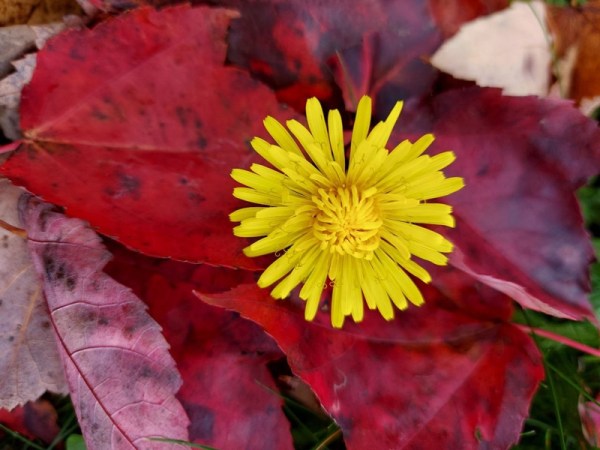
Within the blood of life the love is colour:
The lime-shine kiss of spring’s new fingers
The rising sun, the heart of gold
The mellow blaze as autumn lingers.
And listens to the human eye in winter
—-
Dark path the seeming death that follows fall
Pale exile when the tints have turned to bone
A zero-state as life, slow-frozen, bares its truth:
That colour moves from seen to see to none
Which listens to the human mind in winter
—-
The green, the gold, the falling mellow fold
The hardening of the ground, the ice’s splinter
The glimpse of death revealed as life unseen
Whose key we have to ask within, then silent be
To listen to the human heart in winter
©Stephen Tanham 2022
Stephen Tanham is a Director of the Silent Eye, a journey through the forest of personality to the dawn of Being.
http://www.thesilenteye.co.uk and http://www.suningemini.blog
Share this:


I find the autumn has distinct stages, and that these are subtly different on the coast.
I suppose the adjacent presence of the sea – with its residual warmth from the summer – has a modifying effect on the foliage of the trees, but this may be fanciful on my part.
Either way, as colour fades, the intensity of shadows becomes more important; knowing the light as well as the colour is draining from the landscape as we head down to the winter solstice.
©Stephen Tanham 2022
Stephen Tanham is a Director of the Silent Eye, a journey through the forest of personality to the dawn of Being.
http://www.thesilenteye.co.uk and http://www.suningemini.blog
Share this:

One of the most important things we do with our minds is to learn, yet we seldom ask: how do we learn things, and is it a single process?
How do we learn things, and is it a single process?
How do we learn things?
We have to be careful to define what we mean by learning. The child or young student gains praise by learning facts. Facts are important, as we are discovering in a world where idiots are given microphones and loud-hailers so they can bay at other adoring idiots; the entire set of bayer and recipient comfortable in a self-enclosed bubble, protected from knowledge osmosis.
Our collective sense of outrage at this treatment of the truth appears to have evaporated. Every day, the headlines bring us another loud idiot, looking to score in the rankings.
Every day, the headlines bring us another loud idiot, looking to score in the rankings.
On both sides of the Atlantic, we can point to populists who knowingly harvest the opinions (and votes) of people who do not have the capacity to question the noises they rally around. The protagonists here are in possession of the facts; the truth, but their character is such that the exploitation of the opposite side of that coin – the deliberate untruth – is acceptable as a route to power.
their character is such that the exploitation of the opposite side of that coin – the deliberate untruth – is acceptable as a route to power.
It’s a well-trodden path. Every fascist dictator or religious strongman/woman who rose to prominence claiming they represented ‘the people’ repeats the assault on the truth. In politics it is not unusual; even expected. But episodes like Covid vaccines and attempted overthrowing of audited national voting have exposed the new fragility of what used to be the self-evident.
…have exposed the new fragility of what used to be the self-evident.
Society depends upon that outrage. The collective derision of the deliberately twisted truth is one of our most powerful weapons to protect our civilisations. This is mirrored in the individual by the corrosive effect of having to live with untruths. We can rightly say that the soul is less bright; even dimmed, in the face of untruth.
This is not a political blog, though I may have opened with a rant…
Rather than look at the abuse of opinion, we might gain insight from examining the wider processes of truth, and how we truly learn – or surrender to happy not-knowing, but comfortably the same as our friend, Jack, in the pub.
The schoolboy’s accumulation of facts, regurgitated as multiple choice ‘ticks in boxes’, is valid for that stage of their learning. We can assemble accurate but empty facts into a ‘kit-bag’ of relevant information and have it to hand when we need to carry out something more important.
Which begs the question: what is the nature of that which is ‘more important’?
Which begs the question: what is the nature of that which is ‘more important’?
When information stored by us as reliable facts becomes part of something we can do, can achieve, then we know that the fact – the information is ‘a seed’.
A seed cannot fulfil its potential without soil in which to grow and water to trigger its life. Yet the seed contains all the ‘process’ it needs to set in motion the potential it holds.
If I know the radius of a potential circle, it might help me as long as I know that a piece of string constrained to stay taut and then allowed to move at one of its ends, would ‘describe’ a circle with that length of string as its radius.
More theoretically, I might be able to design a circular garden feature if I know that within any circle, the diameter and the circumference are related by the multiplication of the former using a mysterious number called Pi – approximately 22 divided by 7.
Put simply: the diameter (all the way across the circle and crossing the middle) times Pi is always equal to the length of the circumference; the length of the string stretched equally all the way round.
This means that the inner meaning of a circle is to be a ‘growing machine’; one that converts straight lines of certain lengths (single dimensional) into a higher two-dimensional figure (the circle) which has the unique property of that first length as its child… or more accurately, its seed.
The seed in this case is the mysterious number ‘Pi’, which is not really a number, but a process. hidden in our number system to point out to us that our rational view of the world has a few cracks in it. In schoolboy facts, Pi is thought of as the number 22/7 or 3.142. But that is just an approximation which works, as long as you don’t ask philosophical questions of it…
If you are fascinated by the truth of Pi there’s a bit more below, taken from the Careers in Maths website: Did you know Pi has your birthday written in it?
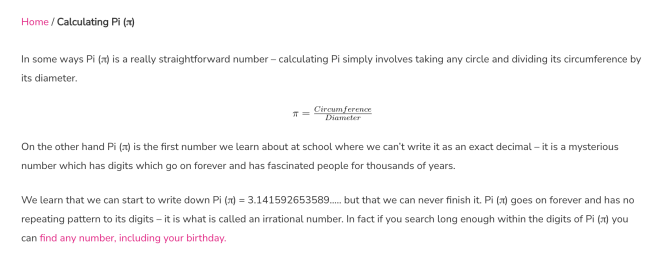
This means that the inner meaning of a circle is to be a ‘growing machine’!
To my knowledge, the ‘zombies against truth’ have not derided the properties of the circle in favour of an opinion to the contrary, though they might be preparing such a case…
Does this radical idea of a ‘growing machine’ have parallels in the human mind?
The philosopher Jidhu Krishnamurti considered such questions deeply. He studied the process of learning from a spiritual perspective; meaning that spiritual learning not only has the power to transform us, it must transform us…
He said some wonderful things about learning; including the statement “Learning is not additive – you cannot gather learning.”
Learning is not additive – you cannot gather learning
To the rational mind, this is anathema…
The mind gathers – accumulates – for a living. Its greatest joy is to add to the store of facts. This is not to say that those facts are not true, nor that they are not capable of being ‘seeds’ for action. But Krishnamurti was on the trail of a much higher goal: He wanted to find the ‘Pi of the mind’, and he found it in a different type of learning, one in which the mind has to be placed into a state of emptiness of (even) facts…
In this state, if we hold it open, the incoming seed, the ‘Pi’, does its work and converts our straight line into a mystically-experienced circle, where learning is immediate and total…
You cannot see if you are not empty. This means no commitment, always learning, not accumulating; it means observing, being awake, being aware without any choice, and therefore giving tremendous attention
Jidhu Krishnamurti
Does this denigrate the mind? Not at all… But it does point to where the mind might be more powerfully employed…
In the next post, we will examine this ‘other place’.
©Stephen Tanham 2022
Stephen Tanham is a Director of the Silent Eye, a journey through the forest of personality to the dawn of Being.
http://www.thesilenteye.co.uk and http://www.suningemini.blog
Share this:

+ #Silenti, Child of Light, Consciousness, esoteric psychology, meditation, Metanoia, Mindfulness, Photography, Silent Eye School, Spirituality
Mind – mover of the Soul (3) Seeing Pi and finding your birthday…
by Steve Tanham
One of the most important things we do with our minds is to learn, yet we seldom ask: how do we learn things, and is it a single process?
How do we learn things, and is it a single process?
How do we learn things?
We have to be careful to define what we mean by learning. The child or young student gains praise by learning facts. Facts are important, as we are discovering in a world where idiots are given microphones and loud-hailers so they can bay at other adoring idiots; the entire set of bayer and recipient comfortable in a self-enclosed bubble, protected from knowledge osmosis.
Our collective sense of outrage at this treatment of the truth appears to have evaporated. Every day, the headlines bring us another loud idiot, looking to score in the rankings.
Every day, the headlines bring us another loud idiot, looking to score in the rankings.
On both sides of the Atlantic, we can point to populists who knowingly harvest the opinions (and votes) of people who do not have the capacity to question the noises they rally around. The protagonists here are in possession of the facts; the truth, but their character is such that the exploitation of the opposite side of that coin – the deliberate untruth – is acceptable as a route to power.
their character is such that the exploitation of the opposite side of that coin – the deliberate untruth – is acceptable as a route to power.
It’s a well-trodden path. Every fascist dictator or religious strongman/woman who rose to prominence claiming they represented ‘the people’ repeats the assault on the truth. In politics it is not unusual; even expected. But episodes like Covid vaccines and attempted overthrowing of audited national voting have exposed the new fragility of what used to be the self-evident.
…have exposed the new fragility of what used to be the self-evident.
Society depends upon that outrage. The collective derision of the deliberately twisted truth is one of our most powerful weapons to protect our civilisations. This is mirrored in the individual by the corrosive effect of having to live with untruths. We can rightly say that the soul is less bright; even dimmed, in the face of untruth.
This is not a political blog, though I may have opened with a rant…
Rather than look at the abuse of opinion, we might gain insight from examining the wider processes of truth, and how we truly learn – or surrender to happy not-knowing, but comfortably the same as our friend, Jack, in the pub.
The schoolboy’s accumulation of facts, regurgitated as multiple choice ‘ticks in boxes’, is valid for that stage of their learning. We can assemble accurate but empty facts into a ‘kit-bag’ of relevant information and have it to hand when we need to carry out something more important.
Which begs the question: what is the nature of that which is ‘more important’?
Which begs the question: what is the nature of that which is ‘more important’?
When information stored by us as reliable facts becomes part of something we can do, can achieve, then we know that the fact – the information is ‘a seed’.
A seed cannot fulfil its potential without soil in which to grow and water to trigger its life. Yet the seed contains all the ‘process’ it needs to set in motion the potential it holds.
If I know the radius of a potential circle, it might help me as long as I know that a piece of string constrained to stay taut and then allowed to move at one of its ends, would ‘describe’ a circle with that length of string as its radius.
More theoretically, I might be able to design a circular garden feature if I know that within any circle, the diameter and the circumference are related by the multiplication of the former using a mysterious number called Pi – approximately 22 divided by 7.
Put simply: the diameter (all the way across the circle and crossing the middle) times Pi is always equal to the length of the circumference; the length of the string stretched equally all the way round.
This means that the inner meaning of a circle is to be a ‘growing machine’; one that converts straight lines of certain lengths (single dimensional) into a higher two-dimensional figure (the circle) which has the unique property of that first length as its child… or more accurately, its seed.
The seed in this case is the mysterious number ‘Pi’, which is not really a number, but a process. hidden in our number system to point out to us that our rational view of the world has a few cracks in it. In schoolboy facts, Pi is thought of as the number 22/7 or 3.142. But that is just an approximation which works, as long as you don’t ask philosophical questions of it…
If you are fascinated by the truth of Pi there’s a bit more below, taken from the Careers in Maths website: Did you know Pi has your birthday written in it?
This means that the inner meaning of a circle is to be a ‘growing machine’!
To my knowledge, the ‘zombies against truth’ have not derided the properties of the circle in favour of an opinion to the contrary, though they might be preparing such a case…
Does this radical idea of a ‘growing machine’ have parallels in the human mind?
The philosopher Jidhu Krishnamurti considered such questions deeply. He studied the process of learning from a spiritual perspective; meaning that spiritual learning not only has the power to transform us, it must transform us…
He said some wonderful things about learning; including the statement “Learning is not additive – you cannot gather learning.”
Learning is not additive – you cannot gather learning
To the rational mind, this is anathema…
The mind gathers – accumulates – for a living. Its greatest joy is to add to the store of facts. This is not to say that those facts are not true, nor that they are not capable of being ‘seeds’ for action. But Krishnamurti was on the trail of a much higher goal: He wanted to find the ‘Pi of the mind’, and he found it in a different type of learning, one in which the mind has to be placed into a state of emptiness of (even) facts…
In this state, if we hold it open, the incoming seed, the ‘Pi’, does its work and converts our straight line into a mystically-experienced circle, where learning is immediate and total…
You cannot see if you are not empty. This means no commitment, always learning, not accumulating; it means observing, being awake, being aware without any choice, and therefore giving tremendous attention
Jidhu Krishnamurti
Does this denigrate the mind? Not at all… But it does point to where the mind might be more powerfully employed…
In the next post, we will examine this ‘other place’.
©Stephen Tanham 2022
Stephen Tanham is a Director of the Silent Eye, a journey through the forest of personality to the dawn of Being.
http://www.thesilenteye.co.uk and http://www.suningemini.blog
Share this:

+ #Humour, #Silent Eye, #Silenti, Ancient Landscapes, Ancient Sacred Sites, Consciousness, English Lake District, Lake District, Photographic techniques, Photography, Travel and people
Cartmel, anarchy and the perfect morning…
by Steve Tanham
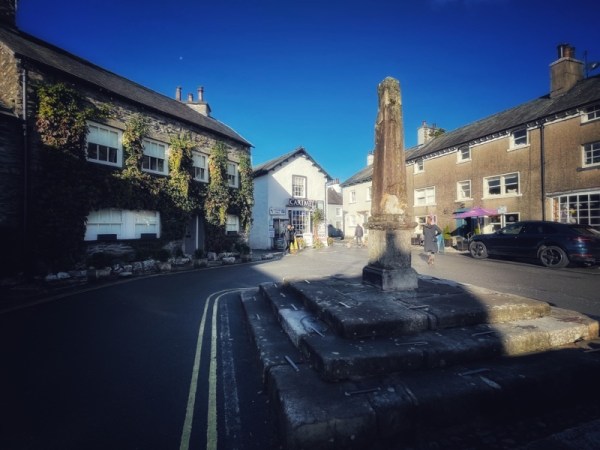
The Cumbrian village of Cartmel is most famous for its racecourse, but it is difficult to find any part of it that is not also beautiful or at least interesting. There are also examples here of innovative responses to hard times… Something we all need to take note of.
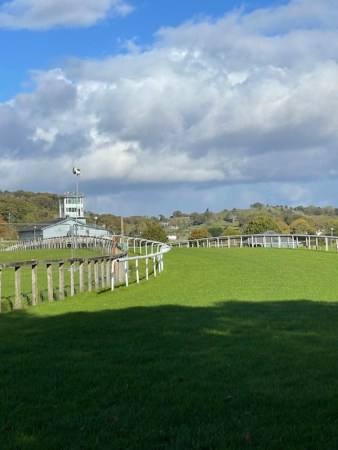
Cartmel lies two miles northwest of Grange-over-Sands, on the northern edge of Morecambe Bay, just outside the Lake District National Park and alongside the River Eea. It takes its name from the Cartmel Peninsula and used to be called Kirkby in Cartmel.
The village is the location of the 12th-century Cartmel Priory, around which it initially grew. There is free, two-hour parking at the rear. This is where we begin our photo-walk.
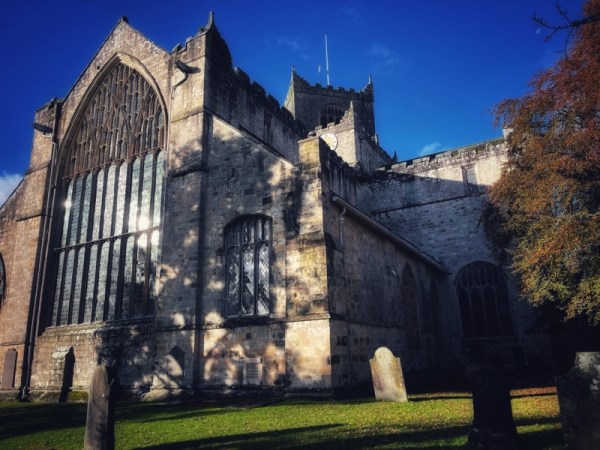
I’m here for my NHS-booked Covid booster: my fourth vaccination in the Covid sequence. The day before, I had my flu jab. When I view it this way, I’m beginning to feel like a pin cushion…
I’m a believer in being protected. I don’t subscribe to the idea of micro-robots shaping my mind into governmental compliance. My bodily inclinations seem more or less as they were…
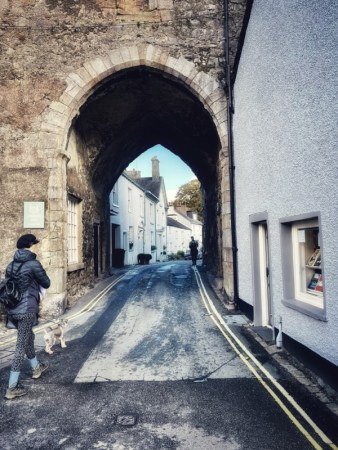
We skirt around the back of the Priory to get to Cartmel’s main street, where most of the shops are still closed. No chance of an early take-away coffee, then… pity; a good coffee can cheer up any queue)
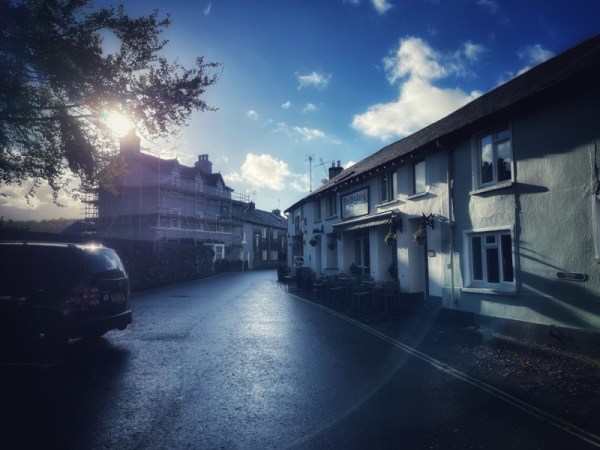
The doctor’s surgery (where the vaccinations are being offered) is on the outskirts of the village. On the way, we pass a couple of places I have wanted to photograph but never had the time. The mellow but bright autumn morning light is perfect… and I’m still fifteen minutes early for my jab… what an opportunity…
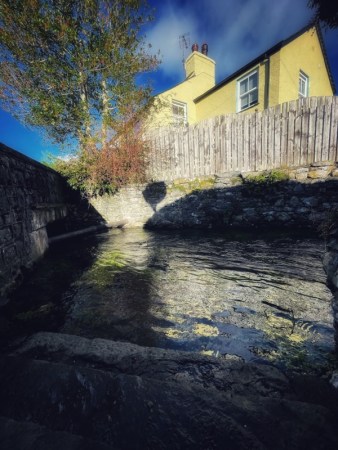
I’ve been waiting to snap this beauty for a while. The small river; a tributary of the Eea, makes a perfect foreground and generator of contrasts, Rivers are hard to avoid in Cartmel. Several of them cross-cross the village centre)
The vaccine injection is handled in a friendly and efficient manner, and the event even has a burst of humour when the lady doctor dealing with me confesses that she’s been at it since dawn and is dying for a break and a coffee.
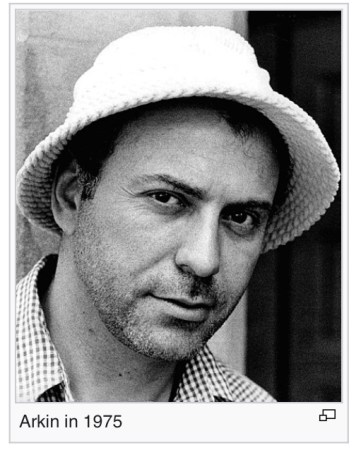
In my best impression of Alan Arkin, one of my favourite humans, I surprise her by calling out of the office: “This doctor needs a coffee!”.
For a second there is silence… Then she dissolves into laughter… as do the reception staff who come to check on her well-being with the potential madman… We part on the best of terms, no police involved, and the quiet and creepy web of doctors’ waiting rooms slightly ripped…
I have a very small anarchic streak… Usually, it’s in a well-taped box in my pocket. But every now and then, when the fabric of ‘space-time- process’ needs a magical kick, I’m happy to oblige…
Reverting to normal human, I venture out dragging the second of two pierced arms in as many days. Perhaps the number of holes in my arms has tipped me slightly over the edge?
I get a grip and we walk… The weather is even nicer than it was when we arrived. The main street in Cartmel holds some visual gems.
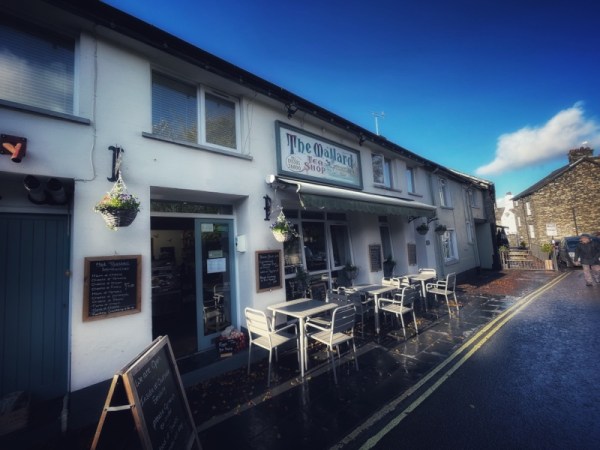
Next door is a new shop offering ‘Vintage goods’. They look good but I’ve just had a text from my wife and ‘abandoned collie’ to say they are waiting in a coffee shop at the top end of The Square.
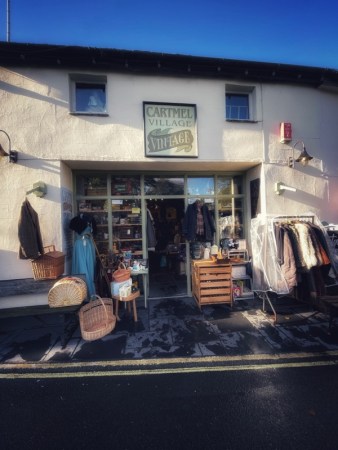
Several older buildings in the main street have been modernised to offer modern facilities for snacks, wine and dining.
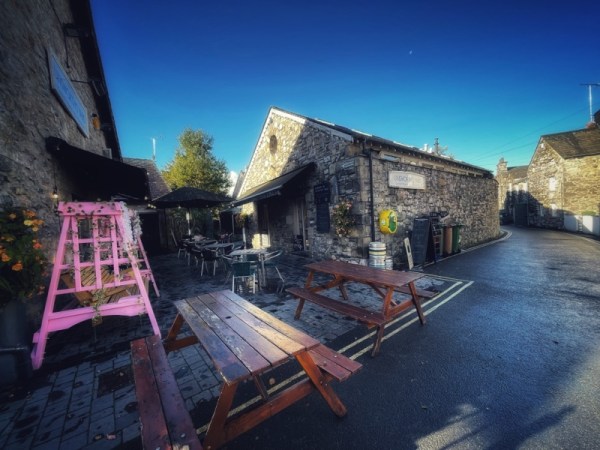
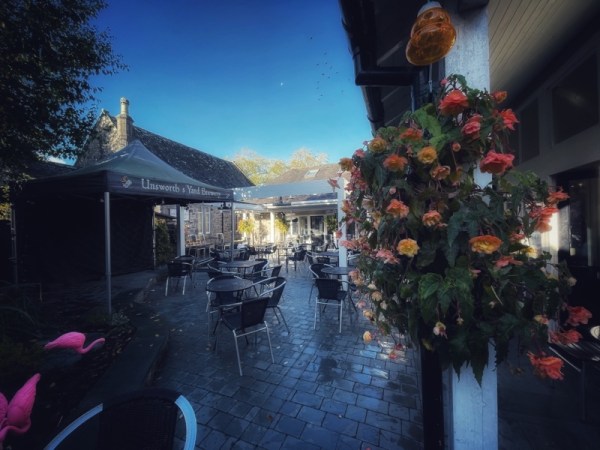
Further up the street are two of Simon Rogan’s famous eateries, including ‘L’enclume’: his top-class Michelin 3-star restaurant, and Rogan and Co, a more modest bistro-style establishment.
My phone beeps. My wife’s coffee is going cold and so is mine. I must rush back. I can choose to photograph the Paul Rogans for you…. Or choose another, little-known route…where there’s this:
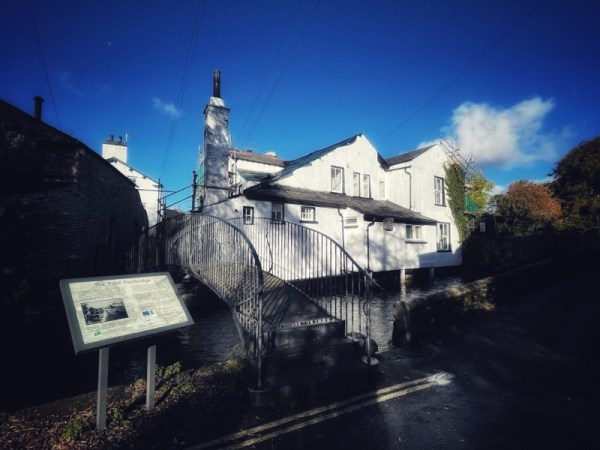
At the end of an uninspiring alley lies the The ‘Ford’ Footbridge. In medieval times, Cartmel was a bustling market village centred around the walled 12th century Priory Church.
The only access across the River Eea running North to South, which separated the village, was by using the ford crossing along the line of the new footbridge. During times when the river was in flood only horses and carts could pass, leaving pedestrians to pay a toll to use the narrow Penny Bridge downstream.
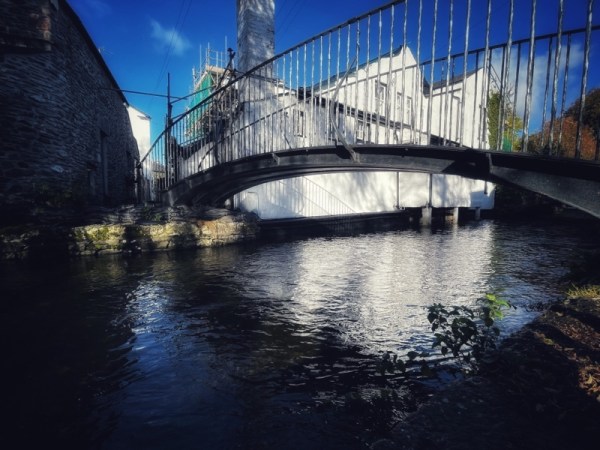
With the formation of the Carmel Township Initiative in 2014, progress was finally made towards raising the necessary funds.
Despite numerous difficulties including securing Planning Consent, consents from the Environment Agency and United Utilities, as well as other statutory bodies.
A scheme was finally agreed in 2019 and the footbridge laid in place in 2020 with funding from: the European Agricultural Fund, many local sources including South Lakeland district council and the Cumbria Fells and Dales LEADER programm. Local residents also provide a significant contribution.
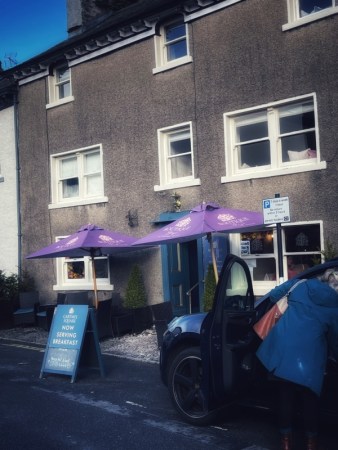
Our walk ends with my arrival at the Cartmel Square Cafe and guest- house – newly opened and an example of the kind of innovation that’s going to be needed to get small businesses through the next few years of extreme economic challenge.
They have formed a partnership with the nearby pub – which, post-Brexit, was finding it impossible to recruit an affordable chef. The Cartmel Square cafe cooks the breakfasts for the hotel’s guest and ferries them across the square… Simple and effective, and benefits both.
And the cafe makes great breakfasts… With holes in both arms, and government nanobots flowing through my veins, I needed one…
Hope you enjoyed the walk…
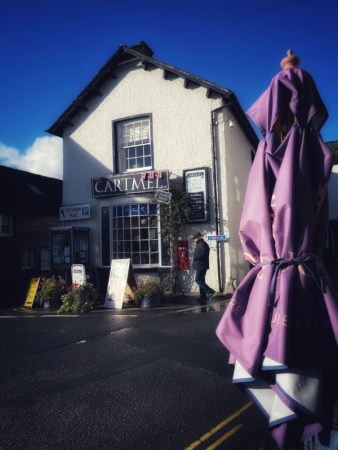
©Stephen Tanham 2022
Stephen Tanham is a Director of the Silent Eye, a journey through the forest of personality to the dawn of Being.
http://www.thesilenteye.co.uk and http://www.suningemini.blog
Share this:

+ #Silent Eye, #Silenti, Lake District, Mindfulness, Photographic techniques, Photography, Places and Prose
Bardsea Sunset
by Steve Tanham
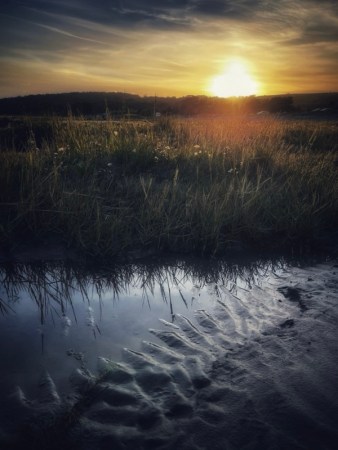
Just about my favourite shot of October so far.
Bardsea is a vast beach a few miles along the coast road from Ulverston. It looks south over Morecambe Bay and is a favourite walk for dog owners. Frisbees can be thrown ‘for miles’!
When we returned to the car, the sun was setting and I could see its reflection in one of the pools. That gave me the idea for this shot, which contrasts the warm sun and the cold ripple of the sandy mud that makes up the beach.
I took one version of the sunset, then bent a little lower to include the ripples in the mud.
A small amount of tweaking with the colours and the contrasts were effective – and the overall ‘feeling’ was exactly what it was like to be there.
I hope it conveys it to you… Just feel that autumn chill!
©Stephen Tanham 2022
Stephen Tanham is a Director of the Silent Eye, a journey through the forest of personality to the dawn of Being.
http://www.thesilenteye.co.uk and http://www.suningemini.blog
Share this:

+ #Silenti, Child of Light, Consciousness, esoteric psychology, meditation, Metanoia, Mindfulness, Photography, Silent Eye School, Spirituality
Mind: mover of the Soul (2)
by Steve Tanham
The consideration of mind is a journey, not a concept. There’s nothing theoretical about the degree to which we believe we are ‘in-here’ in our body.
That statement has two parts: the sense of us -the observer, being contained inside something, and the inherent idea of ‘self’ in the status of the observer. To the mind, the observer self-evidently is... The place where she/he is, is the mind. This apparent tautology has a wonderful cause…
Let’s explore the territory in which this self – this ‘me’ – lives and operates. This can prove deeply revealing!
We don’t have an issue with the assumption that we are contained inside something. We feel no sense of restraint, no confinement. Why is this? In a sense there is actually comfort in this. The internal ‘me’ has never been anywhere else. The mind as we know it has grown up here in this space. Its home is here. Its exploration of the world out-there is via the senses. The senses are the experiential nature of the body; hence we associate our self with the body.
And we don’t need to interfere with that in our explorations. This exercise is not about unsettling the mind, far from it… It is about a wider empowerment. But it is important to know that the mind did not precede everything…
But we do want to explore the ‘architecture’ of this core of what it is to be us.
We can think of the mind as simply the brain, but that is like pointing to all the parts of a disassembled car and saying: ‘that’s all there is to driving’. The act of driving brings together the mechanism, purpose and joy of the whole endeavour. Simply put, it gives it life.
This process of synthesis is one of the main pointers to the ‘spiritual’. It shows us an alignment of conditions and intent that add up to ‘more than the sum of the parts’. This is a classic hallmark of the phenomenon of emergence, which is found in all natural systems, such as the flying formation adopted by a flock of migrating birds.
Can we even be aware of our own minds? This is one of the key questions, and it has deep implications. We can watch our own minds at work: following the logic of our lifetime’s nurture and training; some of which is positive; some negative… But we can watch it at work. There is, though, something deeper than the mind, and there lies one of the deepest of surprises…
We can watch the process of choosing pleasure…or not. If, for example, we are dieting for our health, we can see that chocolate eclair and make a willed decision not to have it. Our body might make us feel bad at that point, increasing our sense of hunger, but our will can carry us through. With repetition, such acts of will create a resolute response mechanism, the opposite of a weakness.
This is particularly true with things for which we have strong likes and dislikes. If we look closely, and ahead of the usual ‘programmed’ reaction, we can be witness to our working of preference and prejudice: a powerful tool for our inner journey of reorientation.
Becoming aware of our thinking is instructive. Usually, we think in words – itself a surprise to those studying themselves. Hunger and fears, for example, don’t originate in words, but our minds may have a ‘discussion’ once they are registered.
There are many more examples of the activity of the mind, but to summarise: it is a set of mental and emotional triggers and responses that act as a collective automated response to the challenges, rewards and impulses of our lives. The mind is the vehicle that extends our deepest consciousness into the world.
What that deepest consciousness is, and how much ‘me’ it has in it, we will consider soon.

Core to any work with the mind is to see that such responses need not be automatic, nor even followed at all. This kind of life-system looks for the hidden spaces between stimuli and reaction; then teaches how to enter and use them as a buffer against habitual behaviour. Making things conscious is the heart of inner health.
That process can be the start of a fascinating and deep road (really several roads) leading inwards to show how these responses were formed from things in early life that were not fulfilled. Using this, we can see how what we consider ‘me’ came about. This is not regression. It uses certain archetypes to help us in technique of inner encounters in a specific lanscape.
Psychology confines itself to the restoration of a healthy ego. Schools like the Silent Eye are not so constrained. They use a mixture of traditional and modern methods to build intellectual and emotional ‘bridges and roads’ through the personality and back to the truly spiritual in our natures.
Once the ‘real map’ of the human is seen, the consciousness changes in harmony with that vision. This is not a process of intellect, though the mind plays its part. The intellect cannot conceive of what precedes it.
The mind is brought into being by an inner spiritual process, one native to the human but unseen behind personality. We can change this…
©Stephen Tanham 2022
Stephen Tanham is a Director of the Silent Eye, a journey through the forest of personality to the dawn of Being.
http://www.thesilenteye.co.uk and http://www.suningemini.blog
Share this:

+ #Poetry, #Silenti, Consciousness, English Lake District, esoteric psychology, Mystical poetry, Photography, Poetry
Only the Eye that Sees
by Steve Tanham
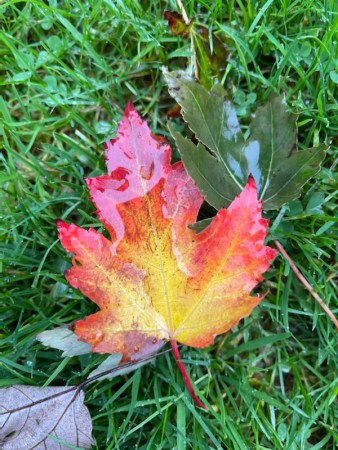
Without the autumn
I could not know the spring.
The fulsome green, harmonic
To elegance of death by colour,
Made crisp by failing light.
–
Without the winter
I could not know the summer’s
Smile, written in the dance of life
Zenith’d with burning Sun
Born, frozen in the still of ice.
–
Without the spring
I could not know the autumn’s
Parting glory, life turned mellow
The going down and rising up
The pendulum of nature.
–
We are both one and legion
We are the single eye
That sees the many changes.
–
©Stephen Tanham 2022
Stephen Tanham is a Director of the Silent Eye, a journey through the forest of personality to the dawn of Being.
http://www.thesilenteye.co.uk and http://www.suningemini.blog
Share this:

+ #Silent Eye, #Silenti, Ancient Landscapes, Consciousness, English Lake District, landscapes, Mindfulness, Photographic techniques, Photography
When colour drains…
by Steve Tanham
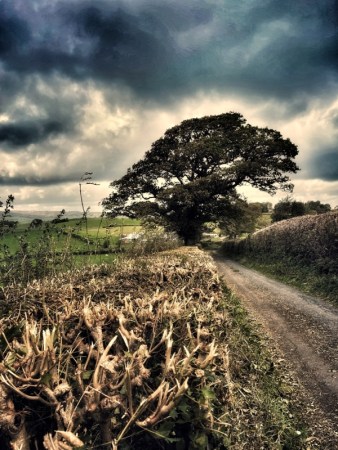
There are a few weeks of the year, in the early stages of autumn, when the combination of soft light, pale sun and changing foliage creates quite magical landscapes here in South Lakeland.
This is particularly true of the small, quiet lanes on the southern outskirts of Kendal, home to the celebrated ‘basket of eggs’ landscape that marks the final stages of the glacial flows which carved out the Lake District.
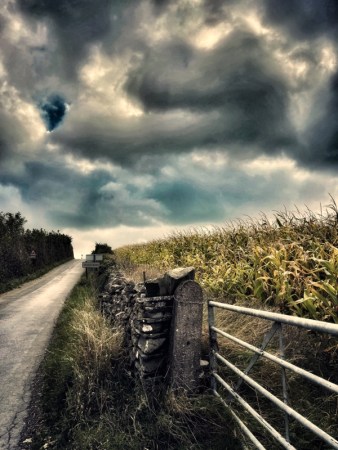
The hedgerows are freshly cut; ‘topped’ as the farmers say in these parts. This provides a stark, raised surface for photography which – like the ancient stone walls – is perfect to lead the eye into the distance.
Colour is the key…or rather the muting of it…
The exuberance of summer has gone. The few remaining patches of it no longer form part of a coherent whole. But the ‘pale fade’ that it leaves behind is lovely, in itself, and with the correct camera placing, can be revealed in its own beauty.
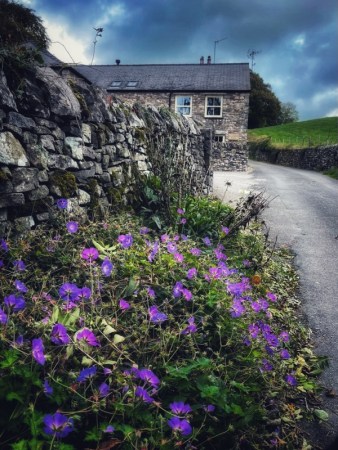
©Stephen Tanham 2022
Stephen Tanham is a Director of the Silent Eye, a journey through the forest of personality to the dawn of Being.
http://www.thesilenteye.co.uk and http://www.suningemini.blog


 Sun in Gemini
You must be logged in to post a comment.