+ #Silenti, Child of Light, Consciousness, esoteric psychology, meditation, Metanoia, Mindfulness, Photography, Silent Eye School, Spirituality
Mind: mover of the Soul (1)
by Steve Tanham


Science has its definitions of what the mind is, yet, for most of us, we don’t even consider the question; driven by the fact that what would do the ‘considering’ is the mind itself.
It’s like one of those logical traps, like why it’s a bad idea to saw off the branch of the overgrown apple tree that you’re sitting on… Can the mind be aware of itself? Being self-aware; or aware of oneself is a key component of any consideration of our full being.
The mind is firmly established as ‘me’. So powerful is this identity that we can even use the mind to interfere with our vital functions – like breathing, for example.
The instinctive functions, like fear, so this for us as well, but they are developed to take their own actions – though we can interfere with that if we choose.
Our will operates through the mind. We consider a course of action, test its safety with memory, debate it ‘in our minds’ then make a decision, passing that to the agents of action within our mental and physical makeup. In the early stages of the action we are operating at the microsecond level to check that what we thought we had initiated is actually coming to pass.
‘Like turning the corner, when driving the car…’

The mind is mainly concerned with the world – the ‘out-there’. The autonomic nervous system takes care of most of our internals, including our mind’s infliction of various poisons, like alcohol. We are complex beings, and pleasure (and avoidance of pain) makes up a whole chunk of our identity.
What unsettles the mind is if we ask the question “Who am I”, and do so holding the possibility that our minds may not be the whole story.
This may seem trite: “I’m me of course!” That should be the answer.
But it’s not…
In simple terms, we cannot find ourselves in the mind. No amount of searching will tease out a place or a ‘thing’ that we can fully endorse as ‘me’.
We can clearly feel the mind as the place of intent…. But it’s not the place ‘where we be’. It’s not the oasis of our Being…
The way the mind deals with the ‘out-there’ is by allocating everything the status of an object. We are used to the idea of objects: individual things that are separate from each other… and, most importantly, from us.
We spend our lives refining the nature of our library of external objects. The four-legged thing that we sit on as a child becomes a universal ‘set’ of things called chairs. Once learned we can recognise not just that the wooden object over there is a chair but also what its function is – no matter what the shape or material… I’ll just go and have a snooze in that armchair rather than at the kitchen table.
It’s seamless. But the mind is clever enough to know that such categories of objects must always be capable of extension. The chair that the man in the car workshop is sitting on turns out to have three legs rather than four. Yet he sits safely… Note to mind: chairs for sitting on don’t necessarily have four legs, and some of them are called stools.
The deepest journey we can take with our mind is to get it to quieten itself. It will object this because it ‘knows’ that if it’s not running and constantly interpreting the world for ‘us’ Then we are in danger. There’s a paradox in that, as you may have spotted.
But perhaps we are not in danger if we drop beneath the mind, at least most of the time. It may be that under the object-based vigilance there lies a layer of true self, a place from which the mind actually arises, like a giant wave rises up from the sea, yet never ceases to be part of it…
This might just be a place of real and not false identity. It may be a place and a self whose authenticity could never be questioned…. Because its nature is undeniably real, and does not have to be built by logic, learned and remembered as important.
It may simply – with all the power in the universe, BE.
In this series of posts, we will examine this possibility, and find a ‘richness beneath and within’ that we may never have considered.
and find a ‘richness beneath and within that we may never have considered…
©Stephen Tanham 2022
Stephen Tanham is a Director of the Silent Eye, a journey through the forest of personality to the dawn of Being.
http://www.thesilenteye.co.uk and http://www.suningemini.blog
Share this:

+ #Silenti, Ancient Landscapes, Consciousness, Lake District, landscapes, Photographic techniques, Photography, Places and Prose, Seasons of the year, Silent Eye School, Travel and people
Maple Quay
by Steve Tanham

There’s a giant maple tree on the quayside at Waterhead on the northern shores of Lake Windermere. Waterhead is the most northerly ferry stop on this, England’s biggest lake. Boats from Waterhead link the town of Ambleside to Bowness and Lakeside at the southern tip of the lake.
We call it ‘Maple Quay’ though it has no official name. In the autumn, the tree is so beautiful that visitors to Lake Windermere take the ferry from Bowness with it on their agenda for the typical ‘flying visit’. The fact that it is only a short distance from the ferry point makes it a must-see.
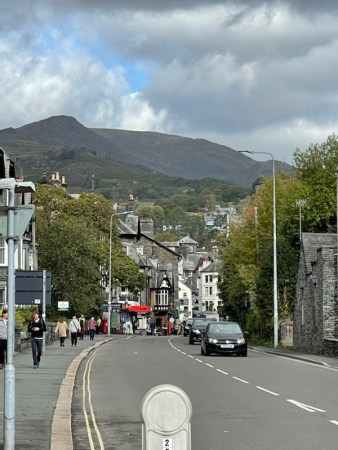
Many don’t realise that the town of Ambleside – one of the most popular in the Lakes – is a thirty minute walk further north from ‘its’ ferry point, though there is an ancient looking bus to transport those who don’t wish to, or can’t walk. For these folks, who typically have less than an hour to spend at Waterhead, the famous maple is a key part of their time spent here in the Autumn.
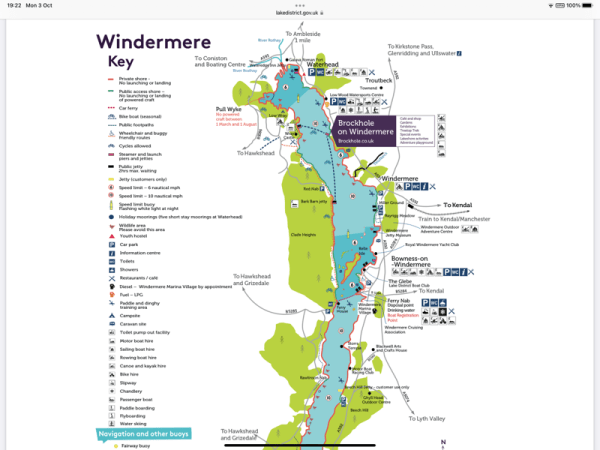
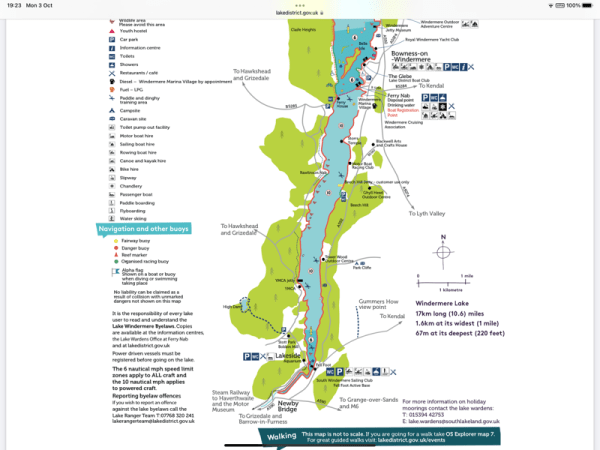
The two photos of a tourist map of Lake Windermere show the location of the lake’s towns.
When I took the photograph, last Sunday, an American visitor was balanced, precariously, on a concrete fence post across the road – risking life and limb to get a good shot of the tree and, the lake and the hills beyond.

The tree was planted over 40 years ago, and occupies a beautiful position halfway between the ferry pier and the ruins of the Roman fort. The stonework around its base has been progressively improved.
For us, the Autumn is not complete without a visit to ‘Maple Quay’.
The ‘Maple Quay’ tree will feature in the Silent Eye’s May 2023 weekend: ‘The Waters of Life’, a mystical journey based on the landscapes around Lake Windermere and several crossings of the lake, itself…
Contact us on: rivingtide@gmail.com for details.
©Stephen Tanham 2022
Stephen Tanham is a Director of the Silent Eye, a journey through the forest of personality to the dawn of Being.
http://www.thesilenteye.co.uk and http://www.suningemini.blog
Share this:

+ #Poetry, #Silenti, Consciousness, nature, Photographic techniques, Photography, Seasons of the year
Ark of the Berry
by Steve Tanham

When Winter’s bite
Makes clear it’s first and full intent
There comes to pass a holy summer berry,
Both food and ark of life renewed.
Which eaten and dispersed, begins
The dark and bitter climb, through
Root and branch and stem
Until within the flower of year to come
It finds itself remade but one
—————————————
©Stephen Tanham 2022
Stephen Tanham is a Director of the Silent Eye, a journey through the forest of personality to the dawn of Being.
http://www.thesilenteye.co.uk and http://www.suningemini.blog
Share this:

+ #Silent Eye, #Silenti, Consciousness, Higher Mind, Initiation, Love, Metanoia, Mindfulness, Mystery Schools, Psychology
Eye, aye and I…
by Steve Tanham
One of the many paradoxes of modern mysticism is that there is no good word to describe the ‘sense of self’ that we all have, but which does not appear to be shareable as meaning.
It is as though the real meaning of ‘me’ always slips away when we try to define it. We point to ourselves and say, “Well, it’s just me!”
And it is… in the most fundamental way possible – to which we will return at the end of this piece. But first we need to try to explore this sense of self that is at the heart of our lives and yet which we so take for granted.
We have not always have this overriding sense of ‘me’. In my own life, I remember quite clearly when this ‘self’ happened -when I knew that ‘something’ had entered my consciousness (or had become my consciousness) and transformed me; connecting all the bits into a much more purposeful ‘being’.
This transition is usually experienced around the age of seven, though that can vary. I was standing in the back-yard of my grandparents’ house in Bolton. I was staring at the great stone blocks that formed the ‘fence’ between our house and the next one up the steep street of terraced houses. At that time my Victorian great-grandmother was still alive, though I didn’t see much of her. My beloved grandma and she did not get on…
Decades later, I was talking to my mother on one of our frequent walks. She was telling me about her own similar experience of the ‘entry of self’… and she said the words ‘in the backyard’. I stopped her to ask which backyard, realising that this could be a ‘spooky’ moment. She said matter of factly that she meant their house – my grandparent’s house.
Fascinated, I described exactly where this had happened to me… and she confirmed it was the exact same place it had happened to her…
What does our sense of self do? For one thing, it makes us into a person. A person is someone who has a personality – created by some mixture of innate traits and self-development: astrological mapping may play a part here, but there are other systems of understanding personality as described by modern developmental psychology.
Either way, the journey of the infant to ‘self-hood’ is a journey of reaction to the world. From birth, we encounter things we need, we love and those we are frightened of. They all contribute to what becomes our personality; which, in turn, forms the basis of our adulthood.
Thus equipped, we step, often naively, into the adult world, where we usually get our ‘rough’ edges’ knocked off so that we can become a useful and adult member of society.
But that inner sense of self doesn’t seem to change…
We have all heard older relatives say, “I don’t feel any older. My body may be so, but what’s inside doesn’t feel a day older than my youth”
What’s inside is that ‘crystallised’ self that came into existence at the end of our childhood, and before our hormones began to drag us into the world of the adult.
Does this have spiritual significance? In the deepest sense, this is the story of the ‘spiritual’ retold in modern language.
Because that strong sense of my-self, our identity, patterns our lives, yet is not based upon our fundamental layer of experience. It is all built on the halfway-house of the personality.
Our experience of the world is one of developing awareness. We cannot descend a ladder of consciousness and find a layer of shared awareness; it is unique to each one of us. Language helps us share experience, but the raw stuff of fundamental awareness cannot be shared, simply because its nature is to BE.
There is no getting beneath it. If we follow any deep enquiry into our selves, we come up against this fact: the deepest part of our aliveness is simply a peaceful world of uncritical awareness. Whatever we truly are, its single property is being a point of awareness.
Whether that ‘point’ really exists is a conjecture beyond the scope of this blog. But it is a question to be asked…
In the body, the personality feels contained within the biological structure. This gives rise to the sense of self: bodies are separate, therefore so is the self. And so the self develops, an island of itself, as we have seen. Self gives us a strong personality which we need for success in life. But balance is important. We all know, or know of, ‘egoic monsters’ in our own and public life.
Mystical development is the ‘road back’ to a renewed relationship with that fundamental awareness and its ‘loving kindness’ deep within us.
Mystical simply means a re-experience of these deep mysteries of our selves. Seen this way, our entire life has been a partnership – not a struggle – between the egoic ‘must exist as me’ personality and the never far away urging of something deeper, something not born of life, but with which we came into the world.
This inner voice, to which we often reply ‘aye’ or ‘no’ makes no judgement on us. Our egoic natures do that all by themselves with guilt and stored ‘scoldings’.
The inner urging is always towards unity of the self – the soul, if you like, though there are a hundred definitions of what the soul is.
Somewhere along our road, we realise that what actually looks out on the world is that original being. What reacts to that world is the personality. When, unhappy with the shallowness of our personality, we begin to shift ‘who we are’ in the direction of the inner awareness, we loosen the ties of the world, and begin to re-evaluate the truly fundamental nature of what lies beyond the ‘me’ as we know it
Nothing is lost in this journey that wasn’t illusion in the first place….
If we are ready – and this is what mystical and mystery schools do – we might find ourselves grasping that moment and taking our ‘selves’ to a place where they are ‘washed and made ready’ to greet the forgotten twin… who may just have been at the heart of our lives all along.
©Stephen Tanham 2022
Stephen Tanham is a Director of the Silent Eye, a journey through the forest of personality to the dawn of Being.
http://www.thesilenteye.co.uk and http://www.suningemini.blog
Share this:

+ #Silenti, Consciousness, Lake District, landscapes, Mindfulness, Photographic techniques, Photography, Places and Prose
Lines on Stone
by Steve Tanham

It’s amusing to watch your own progress with a pastime, hobby, or even a skill. I was new to creative photography a few years ago, and set about it with the usual Gemini enthusiasm.
It doesn’t take long before you’ve taken hundreds of shots, some of them credible renderings of beautiful things – like our local River Kent, or buildings, or even skies – which seem so ‘big’ in this Cumbrian landscape…
But after a while, it’s other things that capture your attention, often unexpectedly.
Currently, my ‘eye’ is drawn to what I think of as ‘lines on stone’. The above monochrome image is an example. The symmetry of the lines of solid railings, merging into the curves at the end of the jetty is fascinating.
I have set of software filters that enhance the monochrome and give it soft edges and a dreamy look. The distant line of bright clouds on the horizon helps pull the eyes beyond the end of the structure. Above all, the brightness of the foreground rail draws your interest into the picture.
Your eye becomes trained in hunting out what you might find attractive. Many times I will take a shot without knowing why I find it interesting – but knowing that I do.
Later, sometimes on magnifying the image, I find what it was that the mind saw; as though it has its own grasp of interesting patterns and symmetries – which I think we all have.
We just need to develop it…
I think I’ll call this one ‘End of the Line’. Double-meanings can be fun.
©Stephen Tanham 2022
Stephen Tanham is a Director of the Silent Eye, a journey through the forest of personality to the dawn of Being.
http://www.thesilenteye.co.uk and http://www.suningemini.blog
Share this:


The afternoon sun was bright in the sky. We were walking back along Morecambe’s Stone Jetty – one of mum’s favourite short walks.
We had just passed the half-way point by the old cafe, when I noticed we were approaching one of the tallest lamp posts – and the sun was very close to it’s line in the sky.
I had been looking for a ‘noir’ image to go with a short story. I had a flash of inspiration that if I aligned the lamp with the sun behind it, the brightness would look like it came from the lamp, itself.
By converting the bright day image to monochrome, the contrasts assumed a very different tone… and I had an image full of unknowns and menace…
I’ll keep it for a matching story!
©Stephen Tanham 2022
Stephen Tanham is a Director of the Silent Eye, a journey through the forest of personality to the dawn of Being.
http://www.thesilenteye.co.uk and http://www.suningemini.blog
Share this:

+ #Silenti, Consciousness, Esoteric Meaning of Myth, esoteric psychology, History, Journey of the hero, Photographic techniques, Photography, Places and Prose, Psychology
Theatre of the Mind
by Steve Tanham
Once a month, on the evening of the third Sunday, the Silent Eye hosts a zoom-based get-together on the internet. People join us from across the world.
The purpose is to share our (and others’) explorations of the mystically-oriented life; hence its name: SE-Explorations.
In the comfort of our own homes, those who might be curious and those who seem to have been curious all their lives, get together to exchange insights and ideas for the practice of what is simply a journey into the deeper parts of our selves.
This is not an academic pursuit… The complex and shrouded language of the past has done little to point the road to the soul, a path that is startling simpler and more personal that history’s priests of all colours would have us believe…
Our zoom meetings begin with a simple opening ceremony. We light a candle and quieten our minds to be in tune with our shared purpose and each other across the planet.
This Sunday’s exploration was a virtual guided ‘walk’ of an unusual nature…
Guided meditations are familiar things, these days. The one at the heart of our meeting used a different formula: guided images.
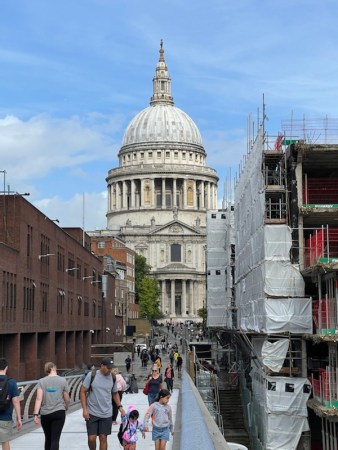
We envisaged being in London, next to St Paul’s Cathedral. We imagined being collected by our guide for a journey: a woman who seemed familiar, yet none of us could say why…
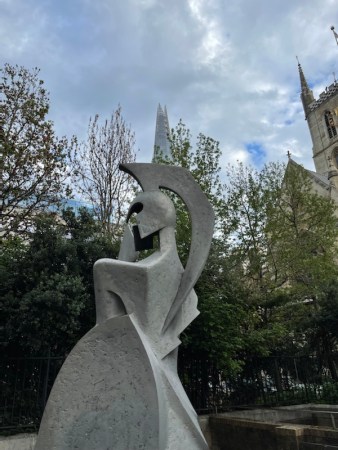
Shall we follow her now?
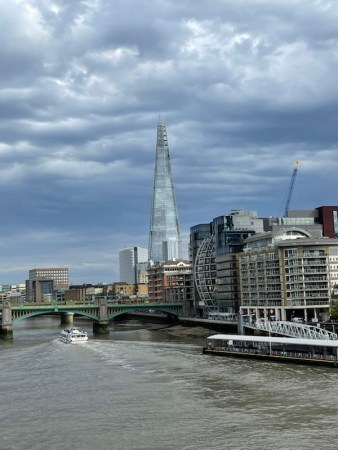
She takes us along river path towards the financial district. We begin to think there might be some significance in this choice as a first stage. Perhaps the heart of the City is symbolic of the importance of the material world, with its focus on monetary values and the rigid ideas of success and failure?
Ideas that often leave the creative and sensitive soul feeling cold and abandoned…
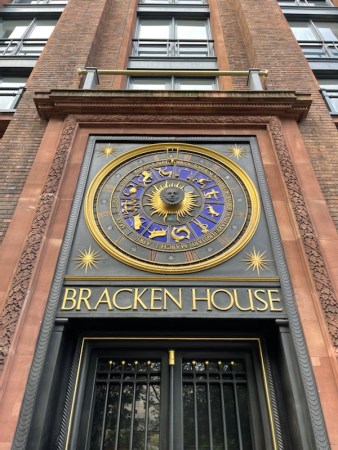
With each step, we feel we are coming closer something different. She points to the river, asking us to remember it.
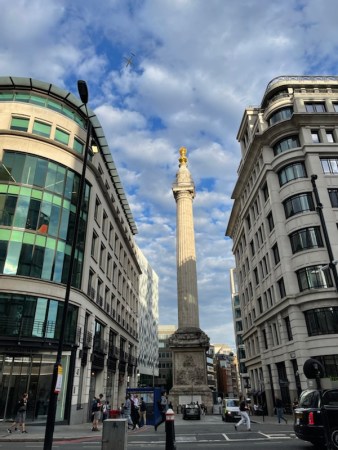
The closely-packed buildings represent history, too. We can be so defined by history – societal and personal, that we have no means of expressing ourselves in terms that are deeply us, and of the now.
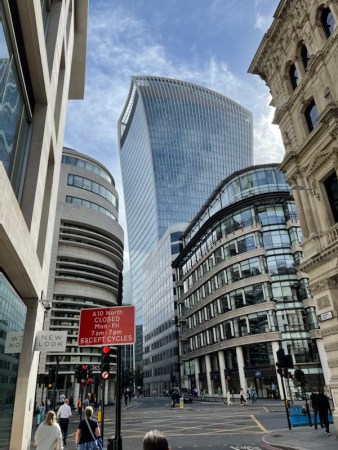
Finally, we come to a strangely shaped building whose upper floors appear to lean out, over the world.
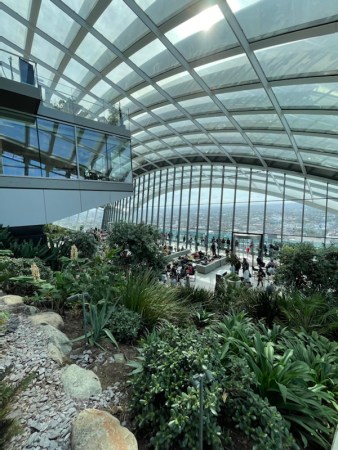
It’s not so much a building, more a state of mind… and beyond. The lush garden looks down on the whole of London. We can choose to look at anything.
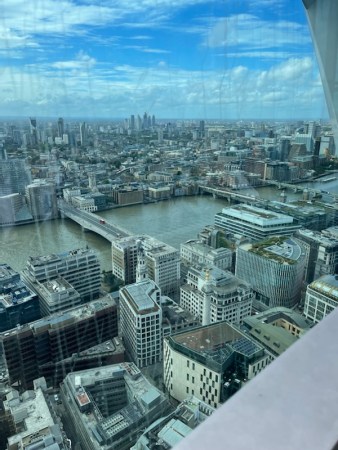
The guide points to St Pauls, in the distance. She also asks us to consider the mighty river, the Thames. She tells us it represents time and that our personal evolution happens in time…
She invites is to consider whether we would voluntarily enter the world of time in order to advance our selves; to enhance our souls with experience of the world – the Creation.
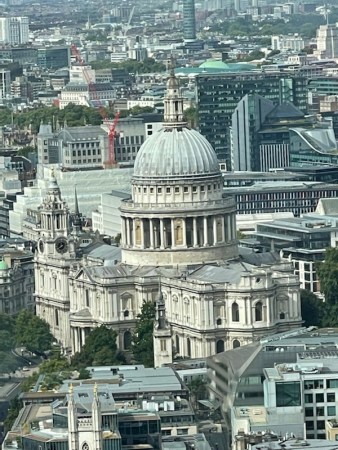
She looks around at our eyes… we seem willing to do this. She leads us from this high place, where we can see everything but are part of nothing…
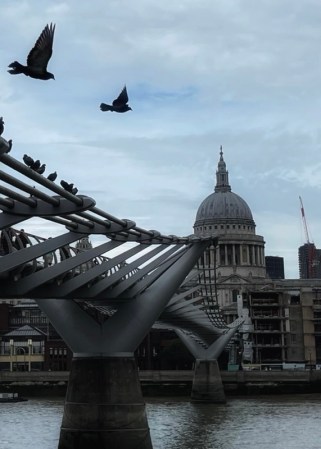
We descend and regain the riverbank, this time turning to cross the mighty river of Time, and emerge on its other bank – entered into life, to find a strange building before us.
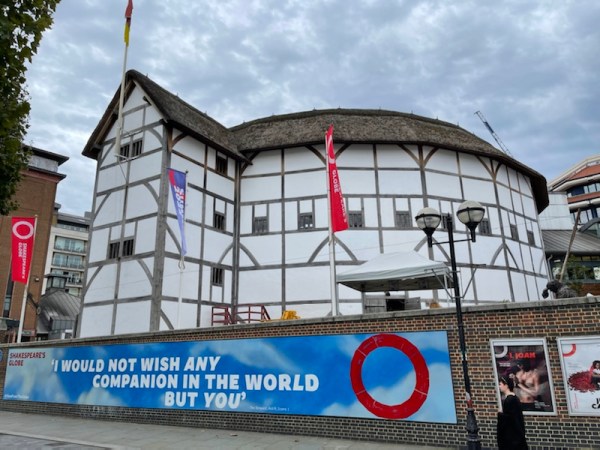
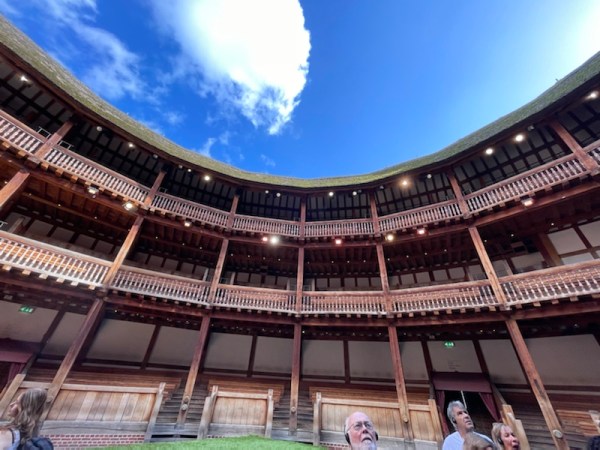
It’s a reconstructed theatre from the Elizabethan period. Its name is Globe, and it is a microcosm of human evolution.
We enter…
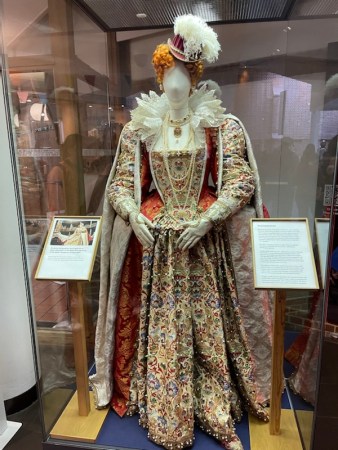
Inside are examples of the parts great actors have played, here. They were praised for their ability to assume the personality of those whose lives or stories they enacted. In some cases, too well – thinking themselves the actual character they played!
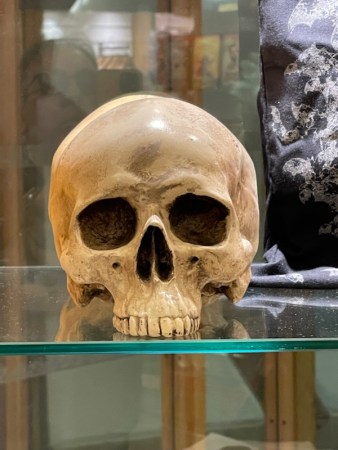
Acting can have far-reaching consequences… And not all the plays staged here have happy endings…
The guide asks if we are ready to ‘take the stage’ and we follow her along the curving corridors and past the ‘cheap seats’ – the ‘penny stinkers’ where the poor and tradespeople came to see the afternoon performances and wonder at the many kinds of life other people led.
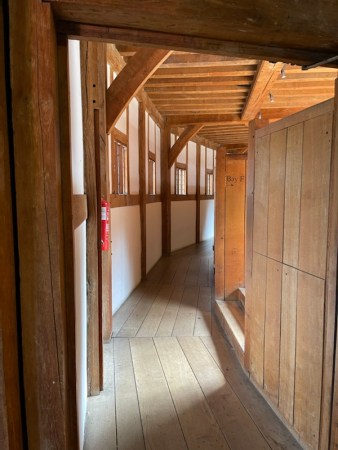
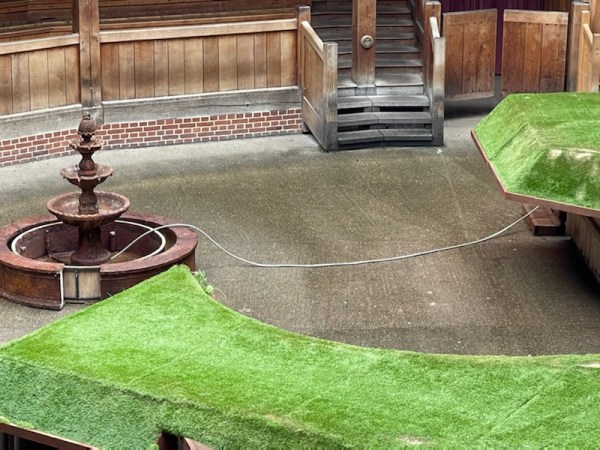
And the we are suddenly ‘in the arena’… and the light is bright. All around us the world of this Globe is alive. Directly ahead of us is a huge platform over the main stage. This was for the rich and titled of the day, and, though they could not see the stage below, they achieved their purpose – which was to be seen in their splendour. Perhaps little changes…
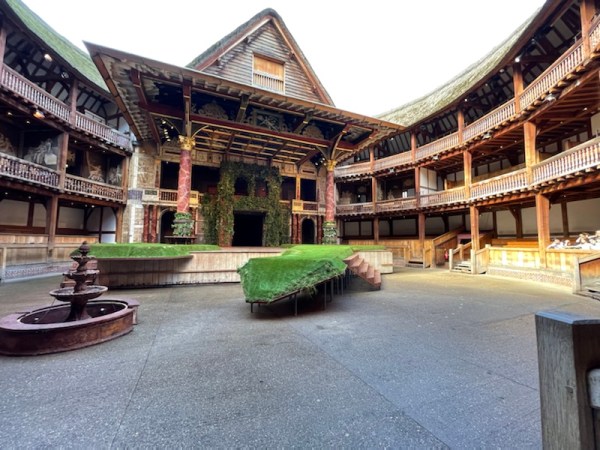
The splendour of this concept of ‘theatre’ is brought home to us; the power of rendering life as drama, and finding writers and actors powerful enough to become the characters they portray.
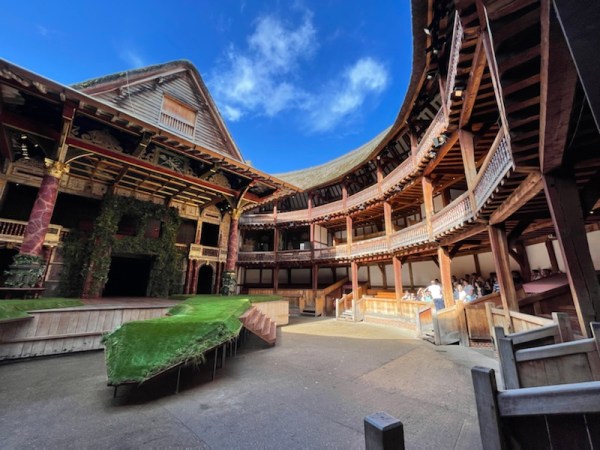
And now the guide ask us if we are ready to take our place in this stream of time and play our allocated parts?
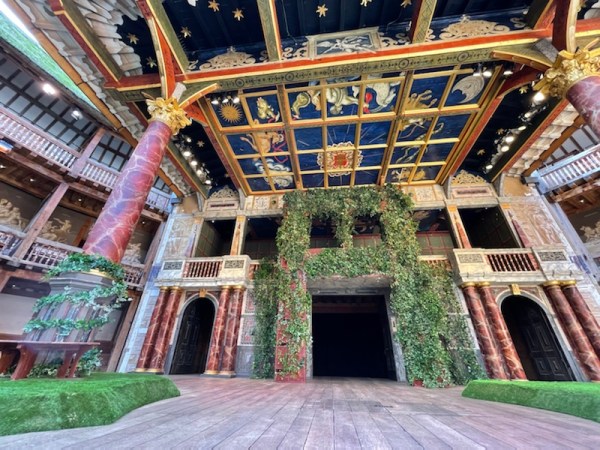
We climb, one by one, onto the central stage and she gives us our character parts. We study them and immediately feel an identity with them. Soon, our parts are all we know.
One man, last to climb the stairs, is taken to one side by the guide. In hushed tones – which we hear but then immediately forget – she tells him, “Your role is to waken the actors when they have finished the play and show them that they were never the part they played, but something much more conscious of the world…”
A few actors have even awakened, joyfully, while playing their parts…
The Silent Eye holds SE-Explore meetings every month, on the third Sunday, at 8:00 pm, London time.
We would love to have you join us, even if you simply want to be there and watch what happens.
Email us at Rivingtide@gmail.com. We’ll send you a link.
You’d love it!
©Stephen Tanham 2022
Stephen Tanham is a Director of the Silent Eye, a journey through the forest of personality to the dawn of Being.
http://www.thesilenteye.co.uk and http://www.suningemini.blog
Share this:

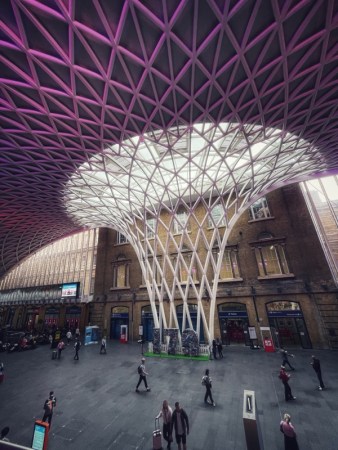
We know very little about King’s Cross Station. Our rail journeys to Cumbria always begin at Euston Station, a fifteen minute walk away.
A journey via Leeds gave us the chance to pass through this venerable part of Britain’s infrastructure, and I immediately noticed the roof. My first thought was that it had been designed by the same architects as the roof of the British Museum – Foster and partners.
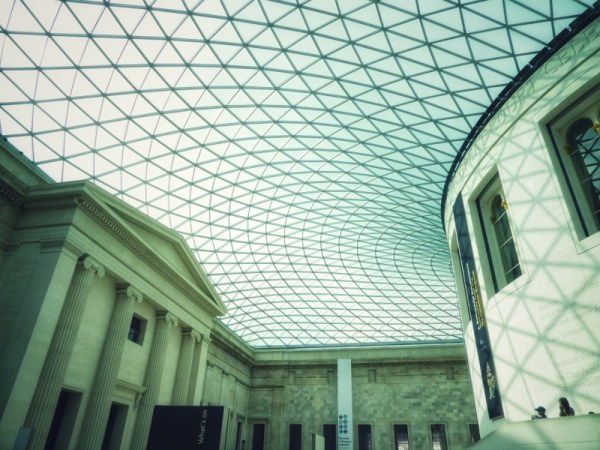
But there seems to be no connection. In fact, upon further reflection, one is a lattice support structure and the other a roof… One is made of thick steel tubes and the other…. Is not.
Photography is like that. You focus on one aspect and forget the ‘big picture, so to speak…
On to the next!
©Stephen Tanham 2022
Stephen Tanham is a Director of the Silent Eye, a journey through the forest of personality to the dawn of Being.
http://www.thesilenteye.co.uk and http://www.suningemini.blog
Share this:

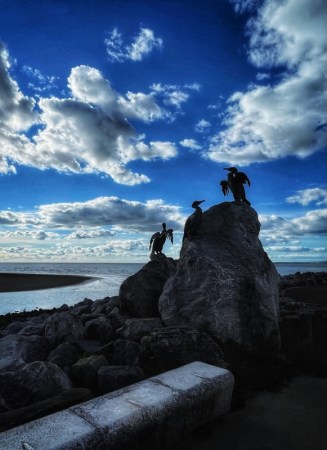
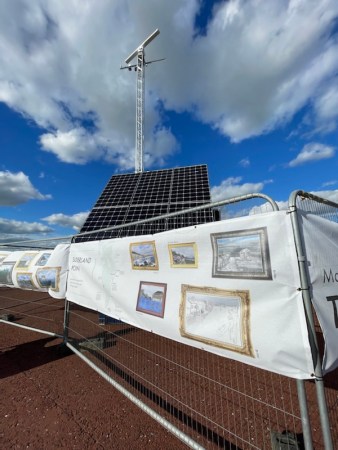
There’s a strange object near the end of Morecambe’s long Stone Jetty pier. From a distance, it looks like a large piano…
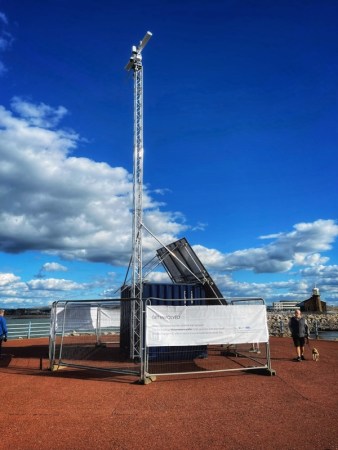
Beyond it is only the sea, so, really, it’s stuck out in the middle of Morecambe Bay. It’s actually one of two new radar stations designed for detailed analysis of the intense tidal flows of these parts – some of the largest in the world.
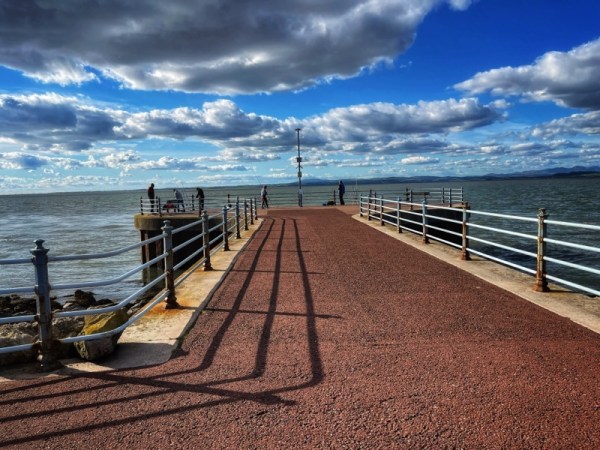
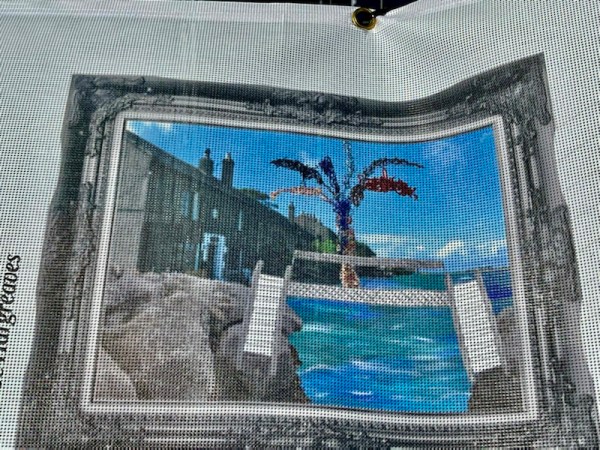
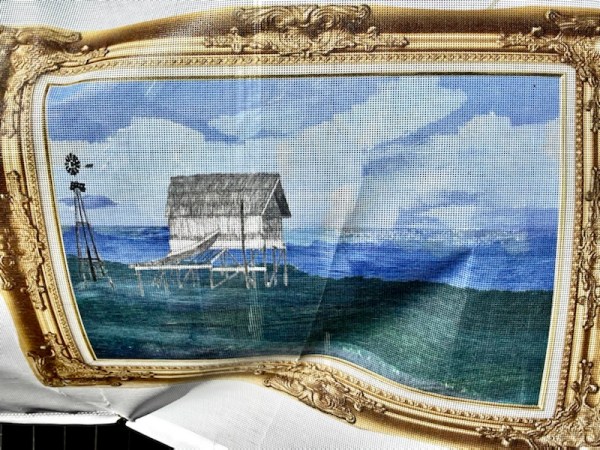
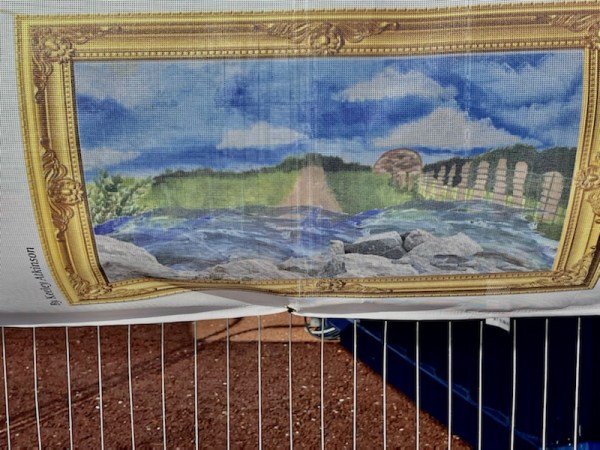
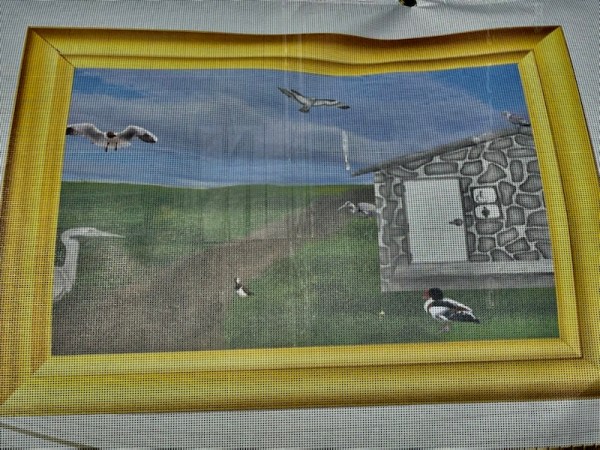
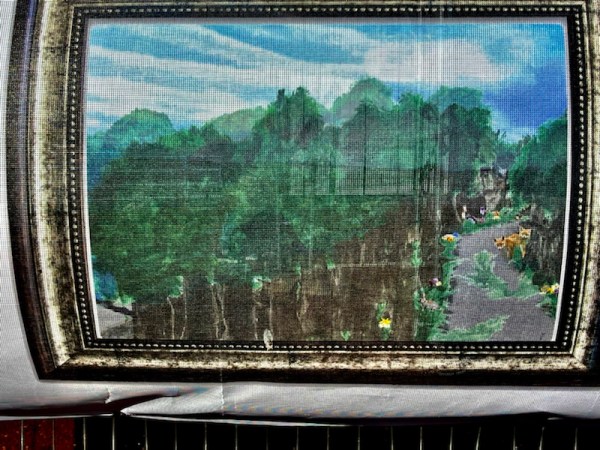
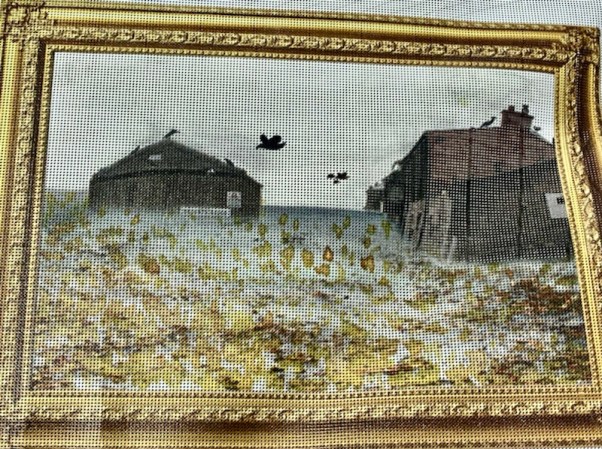
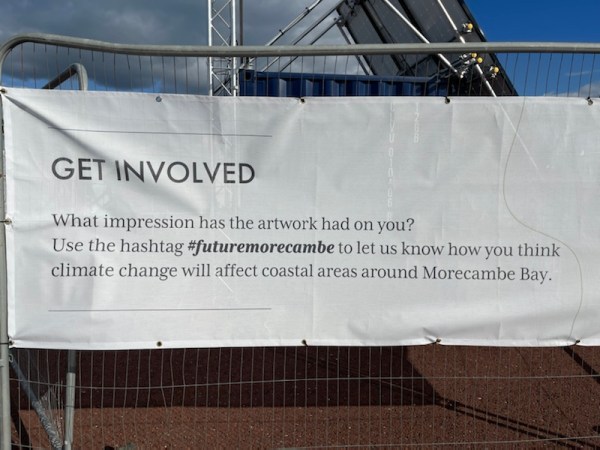
The strange object turns out to be a mixture things: there is the shiny new tidal radar station, but its protective fence is also being used as a temporary art exhibition to show the ecological work of local students of Lancaster and Morecambe College.
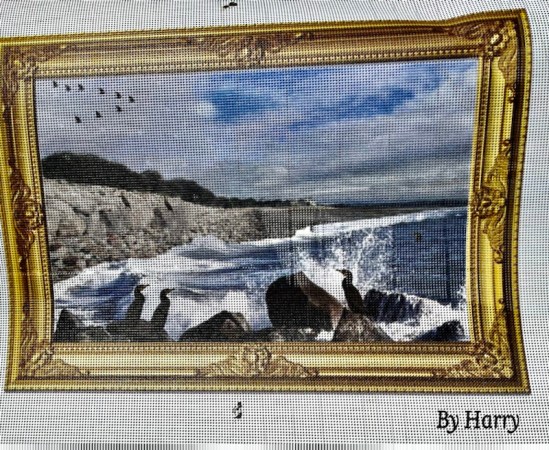
The picture have been printed onto a fabric sheet that wraps around the fencing, so their rendering is subject to breeze distortion.
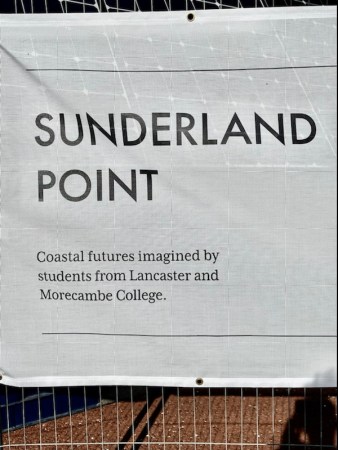
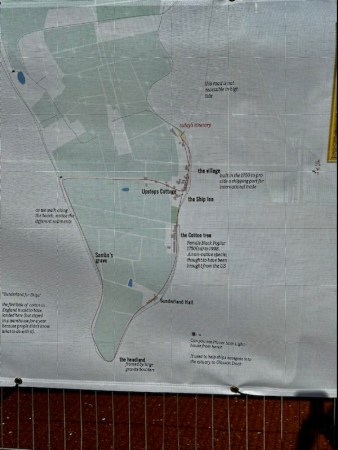
The project set the challenge of painting likely results from rising water levels and selected two areas of the Morecambe Bay Area: Sandylands, not far from the pier, and historic Sunderland Point, once a bigger port than Liverpool.
Various age groups were encouraged to enter, as indicated by the sophistication of the images.
©Stephen Tanham 2022
Stephen Tanham is a Director of the Silent Eye, a journey through the forest of personality to the dawn of Being.
http://www.thesilenteye.co.uk and http://www.suningemini.blog
Share this:

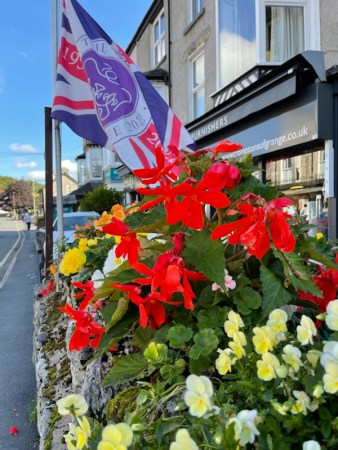
I was born the year after Queen Elizabeth’s coronation, so it’s fair to say she has been ‘with me’ all my life. Like many of us, I have known no other monarch.
The rarity of this situation is worthy of reflection, as is the very notion of royalty in our high-tech age. Are they simply symbolic figures, animated from our past? Or might there be something deeper, something that only shows its inner face at times of unpredictable – but special -significance.
Our politics are ‘rotten’. Corrupt and self-serving, they have been lured far from the ideal of universal representation that they were designed to deliver to all of us. The simple statistic that 90% of the wealth belongs to 10% of the population speaks for itself, regardless of the platitudes from those in the entitled cluster.
Against this decline, we might expect the importance of the Queen to be diminished; and she might well have agreed, as she wrestled with a sniping press on an almost constant basis, not to mention the undercurrent of ‘republicanism’ that would sweep away the very idea of a ‘royal’ having any importance in our modern world.
And yet, this remarkable woman, small in stature, yet tall in resolve, stayed true, through the seventy years of her reign, to the service of the country and the people she loved.
In life, we might have found her remote. In death, she showed us how a life lived in constant resolve and principle releases at its end an energy that causes us all to think we may have been dreaming; that there is in the British soul – and those across the world who still view her in the same way – a nobility that has nothing to do with physical kings and queens, yet is epitomised by this very special one.
And in that we perhaps see the paradox: that there is something deeply significant about the idea of Queen, King, Prince and Princess that is above the human vessel that contains it.
These deeply ancient roles are holders of intent and true nobility – a nobility that we all share in potential.
When a great one like Elizabeth II leaves us, the scales drop, briefly, from our eyes. When the public respect and grief becomes the vessel; dare I say the grail of her life, distilled into a few short days, it gives us time to pause and not only say thank you, but to whisper,
“Oh… I had forgotten that this was still a living thing…”
©Stephen Tanham 2022
Stephen Tanham is a Director of the Silent Eye, a journey through the forest of personality to the dawn of Being.
http://www.thesilenteye.co.uk and http://www.suningemini.blog
Share this:

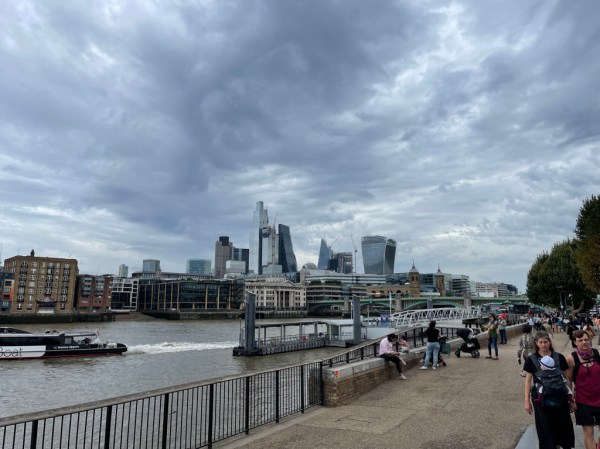
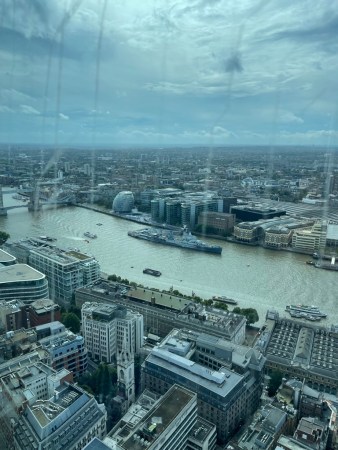
At the end of the summer each year, we try to spend a few days in London. The South Bank is our favourite haunt. The opening photos of the city’s financial district, above and below, were taken from a point adjacent to the Globe Theatre, overlooking the Thames, and looking northwards.
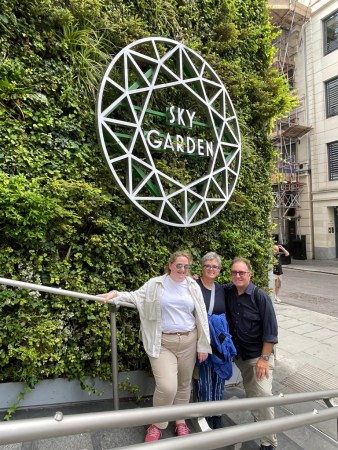
This year the trip was set up by our goddaughter, Karen, who had booked a special ‘no-cost’ excursion to visit the Sky Garden, atop the controversial tower block on Fenchurch Street, close to the Bank of England – see photos above and below.
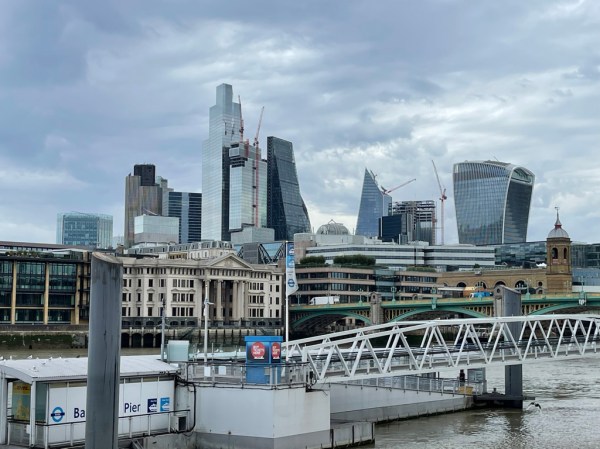
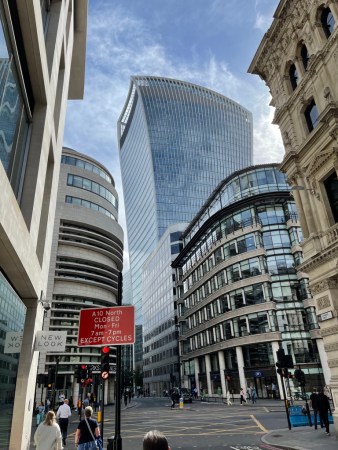
The odd-shaped tower block – background right – is the building in question. Its name is simply The Fenchurch. It’s also known, irreverently, as the ‘Walkie- Talkie’. Those who remember the first generation of mobile phones may want to add a third moniker…
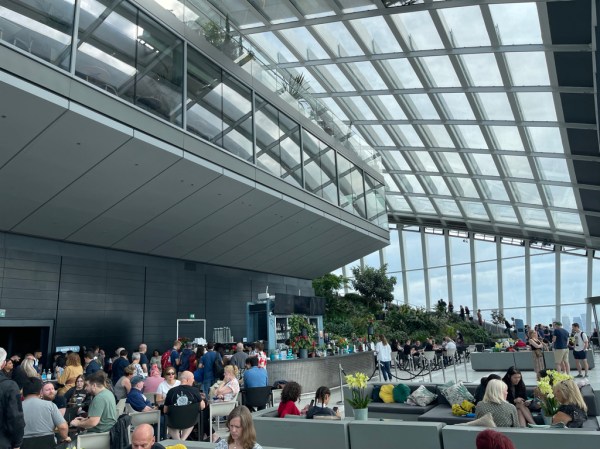
Despite this, the Fenchurch holds a delightful surprise on its rooftop, as Karen had discovered.
But it’s a long way up!
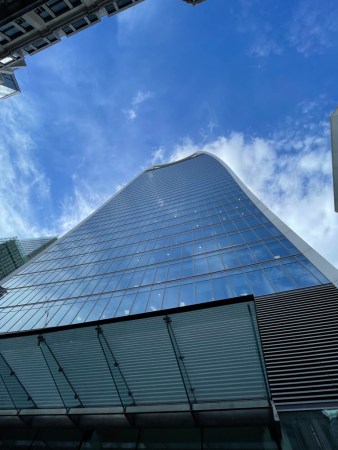
Designed by architect Rafael Vinōly and costing over £200 million, 20 Fenchurch Street features a highly distinctive top-heavy form which appears to burst upward and outward. The entrance floor and 34 floors of office space are topped by a large viewing deck on three levels. A bar and restaurants are included on the 35th, 36th and 37th floors; these are open to the public but with restrictions, and only via bookings.
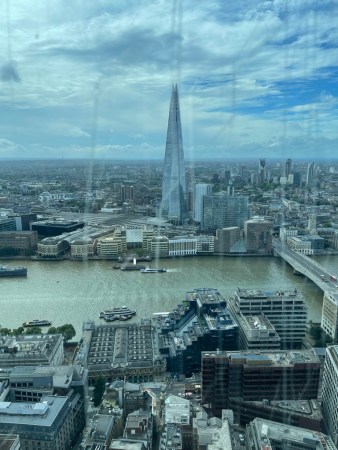
When you exit the lift, you enter a world filled with light and with breathtaking views all around.
Construction was begun in January 2009 and completed in April 2014. From the visitor perspective, the jewel of the building is definitely in the crown… But the only way to appreciate that is to share the views:
The tower block was originally proposed at nearly 200 m (656 ft) tall, but its design was scaled down after concerns about its visual impact on the nearby St Paul’s Cathedral and the Tower of London.
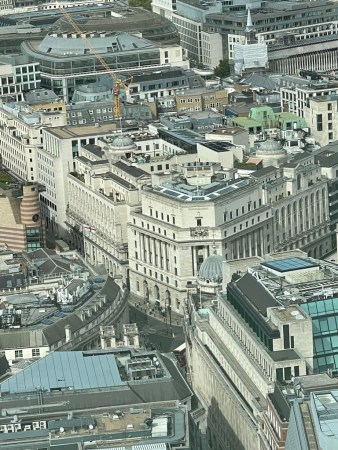
It was subsequently approved in 2006 with the revised height but even after the height reduction there were continued concerns from heritage groups about its impact on the surrounding area. The Secretary of State for Communities and Local Government, Ruth Kelley, called in the project for another public enquiry.
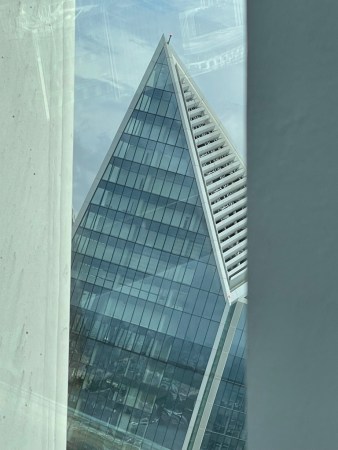
The project was consequently the subject of a public inquiry; in 2007 this ruled in the developers’ favour and the building was granted full planning permission.
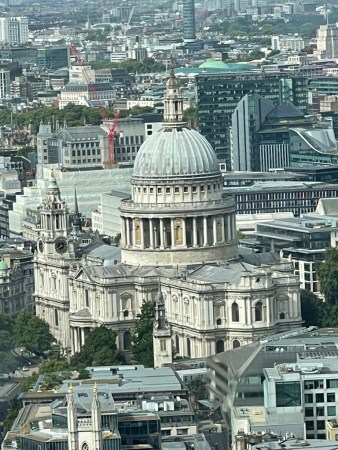
In 2015 it was awarded the ‘Carbuncle Cup’ for the worst new building in the UK in the previous 12 months. Architecture can be a savage business!
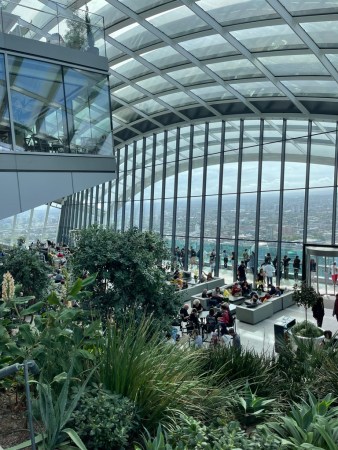
In 2013 Paul Finch of the Design Council CABE said he regretted supporting the project during the public inquiry, saying that the developers “made a mess of it” and were architects of their own misfortune.
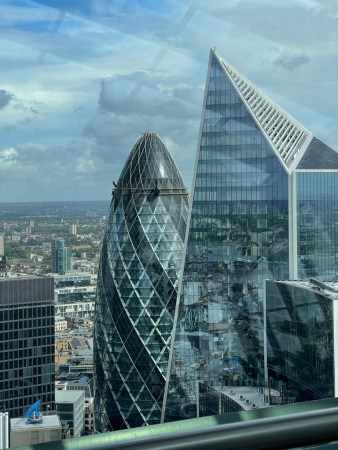
Strange times… But then opinion has always wavered… Being there, on the top floor amidst all the natural light, you can only see the beauty of the conception. We loved it…
(Note: some of the historical text in this blog was sourced from Wikipedia)
©Stephen Tanham 2022.
Stephen Tanham is a Director of the Silent Eye, a journey through the forest of personality to the dawn of Being.
http://www.thesilenteye.co.uk and http://www.suningemini.blog
Share this:

+ #Silenti, Ancient Landscapes, Consciousness, English Lake District, landscapes, Photographic techniques, Photography
Back lane to the river
by Steve Tanham

It is said by local historians that if Kendal had not fallen prey to the soulless developments of the 1960s, the town would now rival York in the historical interest offered by its venerable streets – and its living links with long-disappeared ways of life…

There are numerous alleys that lead from the town centre to the River Kent. It’s fascinating to walk these and realise you are travelling an ancient route that now offers a hidden and alternative way down through the town.

The variety of stone dwellings and offices is large and seemingly organically mixed – office next to house and so on, down the gradient. A delightful change to the rigidly organised zoning of modern design.
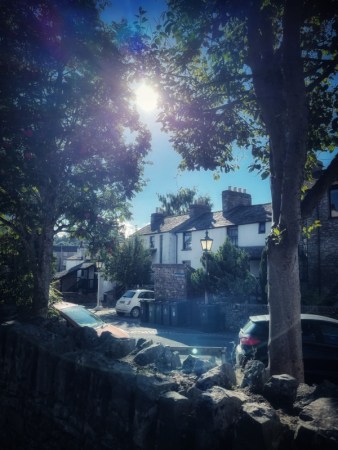
The day I took these shots, it was beautiful weather: still warm but a hint of Autumn’s freshness on the breeze. The feeling of nature enjoying the fruits of the Summer and beginning to rest…


So many questions are raised by signs, new and old… There are plaques for historic locations, but most simply challenge the eyes – and mind – to be creative and have fun…

The first glimpse of the shining River Kent emerges at the base of the slope, the site of the oldest of the several bridges that cross the rivers and create a patchwork of curling roads that are confusing (to say the least) to the casual visitor…

But finally, we stand above the full width of the River Kent, looking upstream, back towards the fells of the Kentmere Round. In the middle distance is the new footbridge to replace the one destroyed in the devastating 2015 floods.
©Stephen Tanham 2022
Stephen Tanham is a Director of the Silent Eye, a journey through the forest of personality to the dawn of Being.
http://www.thesilenteye.co.uk and http://www.suningemini.blog


 Sun in Gemini

You must be logged in to post a comment.