
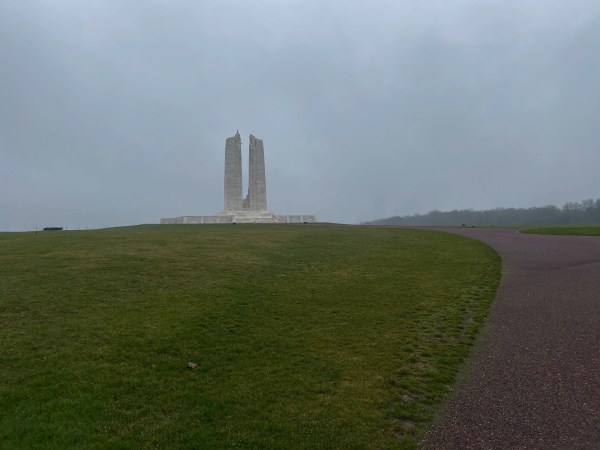
Continued from Part One.
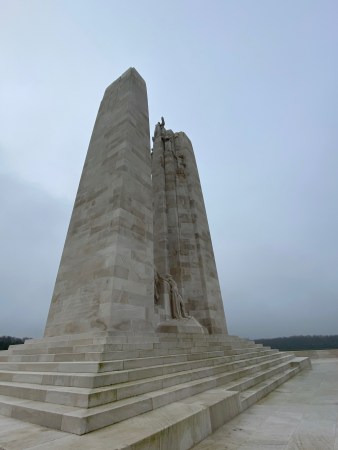
From a distance it looks too stark to be a monument. The eye is, initially, disappointed as the form makes its modernistic impact. Both the height of the pylons and the width of the base ( a massive 6,000 tonnes of steel-reinforced concrete) look devoid of detail… but this is an illusion, for the Canadian National Monument on Vimy Ridge is designed to have many faces; some of them literal, others spoken of in bare symmetry.
The icy mist had continued to haunt us. Our last-minute dash to see Vimy before heading for Calais was a gamble. The damp and misty air made it almost impossible to hold the camera, making the fingers numb after only a few seconds of exposure.
But, if anything, the weather was perfectly aligned with the emotional goals of Canadian architect and sculptor Walter Seymour Allward (1876-1955), who, in 1921 won a competition set up by the Canadian government to create a national monument commemorating its soldiers killed in the First World War. His winning design became the Canadian National Vimy Memorial, established on the peak of Vimy Ridge – the site of one of WW1’s most horrific battles.
Walter Allward said the idea for the monument came to him in a dream:
“I turned my eyes and found myself looking down on an avenue of poplars… I have tried to show this in the monument to Canada’s fallen, what we owed them and will forever owe them.”
Walter Allward
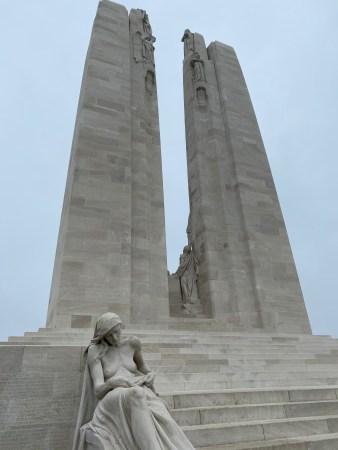
As you draw closer along the path that appears to be the entrance, two figures stand out from the base of the shining stone (6,000 tonnes of the purest limestone, quarried from a disused Roman mine in what is now Croatia). The first is a mother figure, naked from the waist up and looking down at her empty womb. The symbolism of her forlorn breasts stabs at the heart; it warns you that this monument is not for the faint-hearted, and marks the place where thousands of young Canadian soldiers died storming the ridge against the well-armed German army.
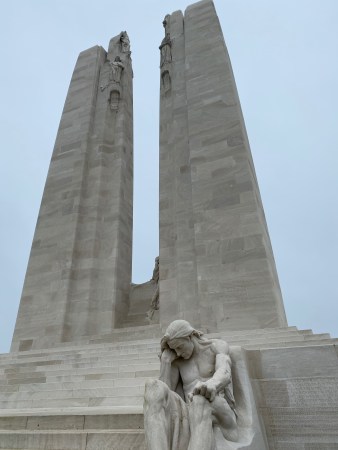
To the right along the base of the monument is the father figure, also half-naked and seated in anguish with his left hand clenched in anguish along the skin of his thigh; his right hand supporting the organ of thought and regret – his head.
The sheer poignancy of these two figures brings home the central story of the monument, which is one of time and events. We were not at the front of the sculptures but at the back. But there are no signs to say so… The visitor centre was closed for maintenance, so only exploration and understanding would bring that knowledge.
And, suddenly, you realise you are not only in story but a process of consciousness…
The two grieving figures represent the sorrow and mourning that comes after the deaths of the young men of their nation on an unprecedented scale. Though compelling, it is desperately sad… and immediately changes your consciousness. From here on across the monument, you are going backwards in time and events, in order to see what led to such loss.
Our eyes were beginning to grasp the design. There are figures high on the pylons at the front and in the rear of the central twin-structure. They represent Peace and Justice, Knowledge and Truth. We would only come to understand them in the context of what lay on the other side of the pylons…
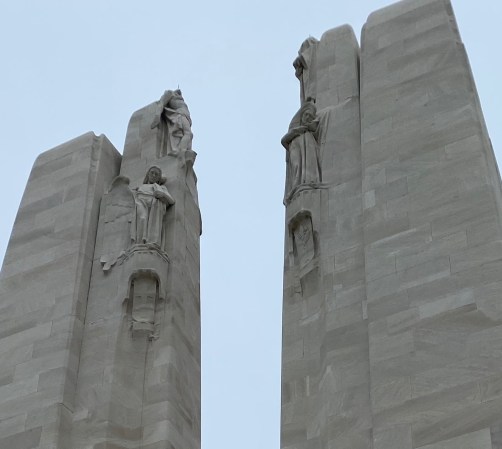
Beyond the vast base of the monument is the edge of Vimy Ridge; the downward slope is the site of most of the battle. A story was opening up before us, told in classical figures worked with beauty and precision in shining limestone – each one carved by Walter Allward in situ, even those at the top of the near-100ft pylons!
I looked up and wondered, given the state of my fingers here at ground level, how cold it was up there… That sense of having gone beyond and into the unknown must have been one of Allward’s main intentions. It’s beautiful and chilling at the same time; and speaks of the power of youth to go where it is guided – in this case into into the hell of war and isolation found at the top of those towers… the place of death in the wall of bullets from the German machine guns. But that is telling the story on the physical and not the moral level.
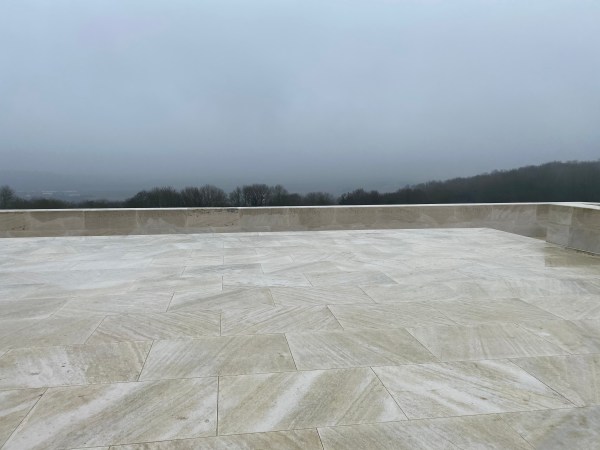
Inscribed on the far wall of the terrace is: ‘The Canadian Corps on 9th April 1917 with four divisions in line on a front of four miles attacked and captured this ridge’
Having understood the physical layout of the whole monument, we realised that we could not penetrate the symbolism further without descending to the lowest level and looking back from the perspective of the ridge being ‘attacked’ by the Canadian Army and defended by the German forces.
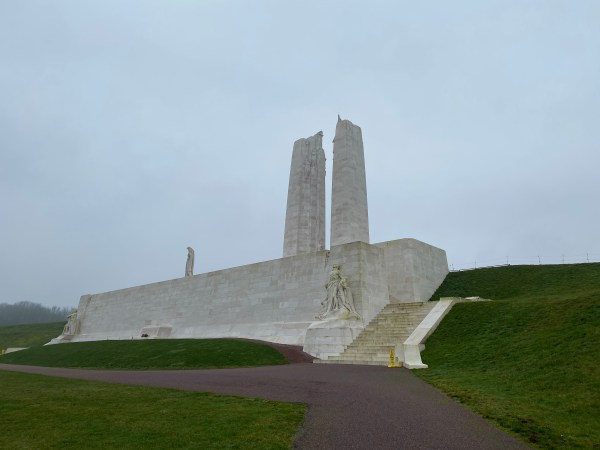
Knowing what was on the opposite face, we could now appreciate the whole of the monument. Visually, we were ‘advancing’ from below – just as the four divisions of Canadian soldiers did, as told in the words of the visitor plaque:
“After two unsuccessful Allied attempts to dislodge the Germans from this heavily fortified height, the four Canadian divisions, fighting together for the first time, seized the ridge on 12 April 1917 after four days of intense fighting. Meticulous preparation, the use of advanced technology, teamwork and the sacrifice of thousand of Canadian lives produced this remarkable result, It was an important turning point for Canada in the war.”
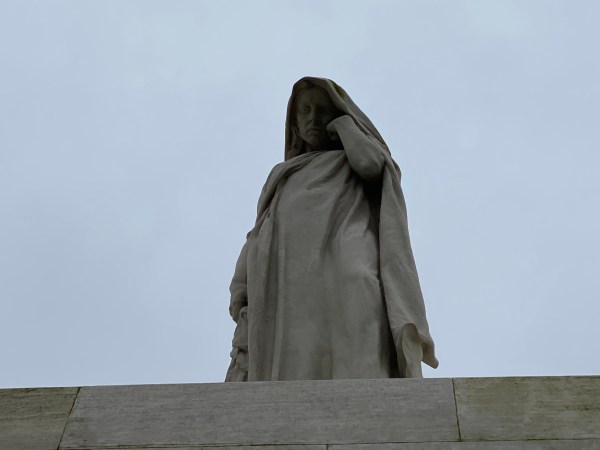
The single, central figure is revealed to be that of ‘Canada’. She gazes down Vimy Ridge, moved beyond words… but unmoving. Directly beneath her, at the base of the tall wall, is a tomb.
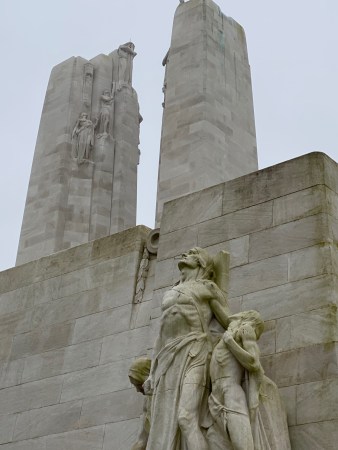
To the right of the downward-gazing figure of ‘Canada’ are the multiple figures of ‘Sympathy of Canadians for the Helpless’. It’s a beautifully carved sculpture and leads the eye to the twin pylons above – representing higher principles and forces at work in the human consciousness. This is an important point – the whole of the monument is about the human mind and heart, and their capacity for greatness or war – the ultimate failure of humanity’s communication and learning.
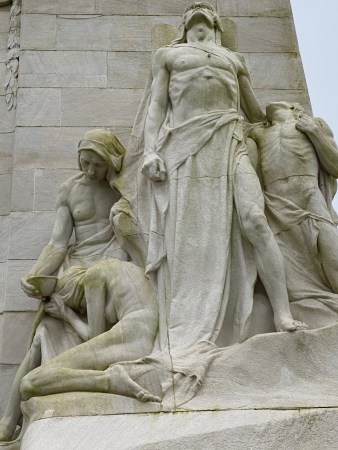
The basal wall is massive and runs the whole width of the monument. On the left of its face is an enigmatic piece known as “Breaking of the Sword’.
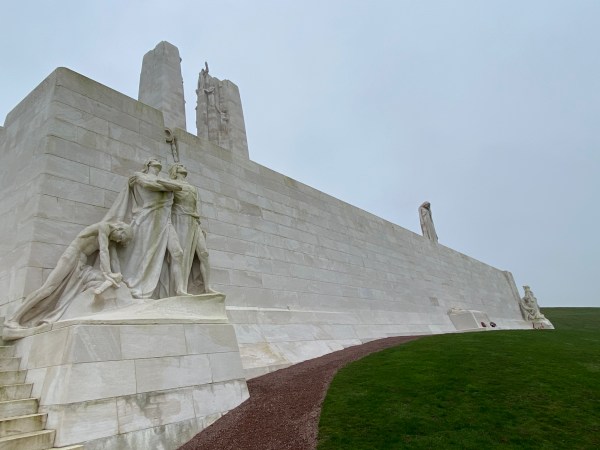
Beyond the guardian figure of ‘Canada’ the upper level can be gained by either set of stone steps. We returned to this and faced the complete set of figures on the twin pylons.
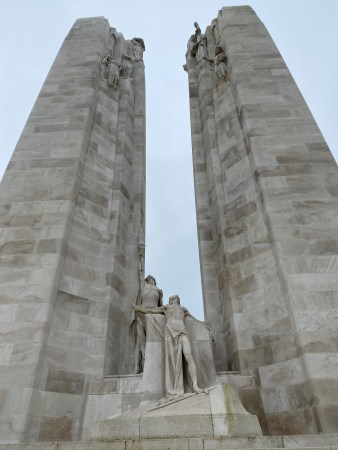
The middle two figures, between the bases of the pylons, are ‘Sacrifice’ and ‘The ‘Torch Bearer’. Both stare upwards into the heights of the cold sky… The demands of society and civilisation will carry a high price…
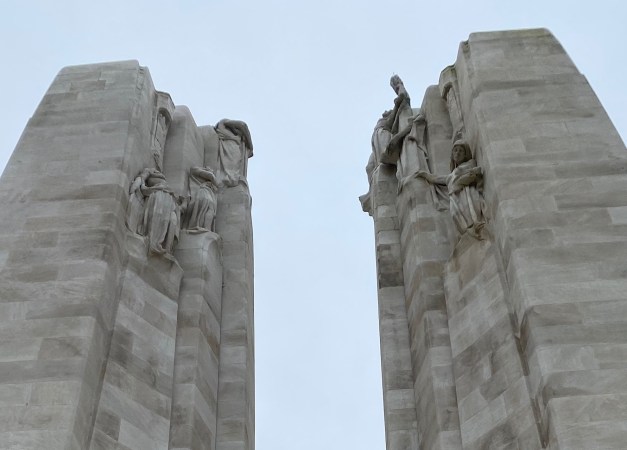
The figures here are curious. They are listed as (left) ‘Faith’ and ‘Hope’, but my eyes saw three ‘headless’ figures on the left (see photo) They may have been weather-damaged and in the process of restoration, but I definitely see three!. The figures on the top of the right pylon are listed as ‘Honour’ (top) and ‘Charity’.
Together, these are the focus of the figures of the Torch Bearer and Sacrifice – the very centre of the monument. These two are the ‘centre of the pillars’ – spiritually significant on any level. They tell the story of the whole of mankind, embarked on a near-impossible struggle between the inheritance of the animal nature–and its evolutionary ladder back to matter, and the inner flame of the divine; that which fights entropy by creating its own gradients.
The one quality I found to be unreferenced was ‘Will’. But then, I looked again and could see how Walter Allward had created the perfect tableau, one which took all his own willpower, but left the final ‘stone’ to the future observer. Only in our own hearts and minds will we find the inner will to gaze upwards, with the Torch Bearer and the Sacrifice our witnesses, and seek the peace that encompasses all differences.
I think Walter Allward, and, hopefully Canada, might echo that…
©Stephen Tanham 2020
Stephen Tanham is a Director of the Silent Eye School of Consciousness, a not-for-profit teaching school of modern mysticism that helps people find a personal path to a deeper place within their internal and external lives.
The Silent Eye provides home-based, practical courses which are low-cost and personally supervised. The course materials and corresponding supervision are provided month by month without further commitment.
Steve’s personal blog, Sun in Gemini, is at stevetanham.wordpress.com.
Share this:

It would have been difficult to foresee the full social effects of the internet. It is now apparent that our lives have been changed, forever, in ways that are simultaneously warped and wonderful.
Being socially and politically aware was difficult enough in a pre-online world. In this new, ‘wired’ age, where perceived connections of opinion are shared across social media, the intersection of money, politics and psychological manipulation has created an entirely new ‘world’ in which groups of people live immersed in opinion which they believe to be shared by the majority of that world.
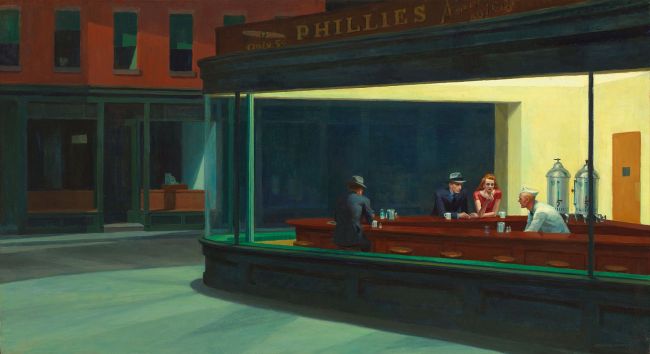
To my mind, a powerful way of visualising this is as a cafe, where we may drop in at any time of the world’s day and night. It never closes, though we may experience peak response determined by the physical location (otherwise irrelevant) of our fellow customers. The cafe does not charge entry, and its drinks and meals are free, too… It’s very popular, especially with younger people – though specific groups of oldsters are catching on, fast.
The cafe is styled to appeal to us. It may be subtle and muted or vividly angry The really great thing is that the cafe’s owners have just the same taste in texture, colour and how information is displayed as we do!
The cafe has eye-catching posters that challenge legality, or use advanced digital techniques to show famous people speaking – or, more likely, shouting, angrily. Most impressively, the posters know who is looking at them and seem to focus on their watchers very carefully, getting pleasure from knowing the highs and lows of attention paid. This is great, because each time we go in for a coffee or a burger the electronic posters get more and more interesting – sometimes anticipating that subtle opinion towards which we were edging – prompted by our mates, of course.
Soon, with a few visits, we get a real feeling of warmth and belonging when we enter this cafe. An increasing number of our new friends come to sit with us to sip the delicious coffee, with its many exotic syrups. The food is cooked exactly as we like it, and the general decor keeps being updated in a way that makes us feel entirely at home.
One of the great things about our cafe is that it doesn’t argue with us. At home, or back in the dull world of work, we are struck by how stupid other people are; how they don’t feel this rush of emotion and righteous anger when the self-evident truths shown in the cafe posters are updated on our entry into its warm interior.
It’s the Echo Cafe, of course. And a frightening number of voting-age adults eat and drink there. We all live there in some fashion, unless we have become digital monks and eschew the cafe’s delights, altogether. It’s the most powerful cafe in history, and shadowy billionaires pay vast sums to tailor the fabulous posters on its walls.
The problem with the Echo Cafe is that it only shows us what we already ‘like’… There is no plurality of opinion, because we do not want our posters clogged up with the musing of idiots. By signing up to groups, we can immediately add hundreds of new friends to our dining and coffee sessions. In a way, it’s a new kind of village – but one in which the population is millions, possibly billions.
The Echo Cafe is deadly because it’s taking our very real leisure time (upstairs in our den, say) and joining us with great numbers of people who think exactly as we do. A humans, we grew into adulthood by facing up to the challenges of working with people who thought very differently than us. Some of them were just losers. Others turned out to be profoundly intelligent and knew the side-roads we had to learn to navigate before we could join the highway, safely.
We didn’t learn much from those that thought as we did. But those that didn’t changed our lives, not our comics.
©Stephen Tanham 2020
Stephen Tanham is a Director of the Silent Eye School of Consciousness, a not-for-profit teaching school of modern mysticism that helps people find a personal path to a deeper place within their internal and external lives.
The Silent Eye provides home-based, practical courses which are low-cost and personally supervised. The course materials and corresponding supervision are provided month by month without further commitment.
Steve’s personal blog, Sun in Gemini, is at stevetanham.wordpress.com.
Share this:

From Stuart… and a preview of Avebury in June

*
…It was, after all, rather disconcerting to be thus accosted by a total stranger…
*
“Does this count?” he demanded, ferociously,
and pushed an admittedly intriguing photograph across the bar at us.
“Does that count as what?”
*
“One of them ‘Black’ places”
“Well, it might do, what is it?”
*
“It’s one of them there mounds.”
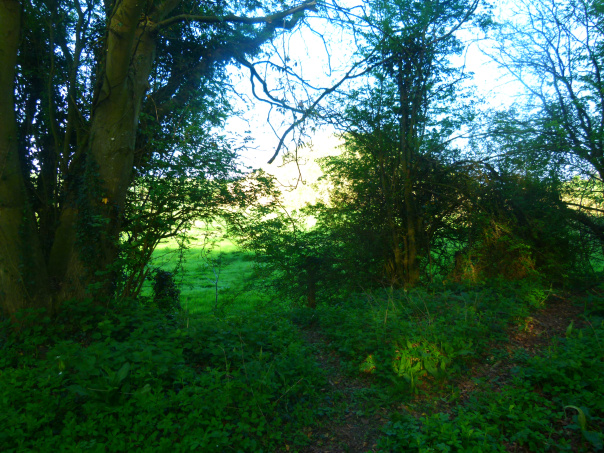
“Is it really, it looks just like a pyramid of light?”
*
“That’s why I was thinking it might count.”
“Strictly speaking, in order ‘to count’ it would have to be called
‘Black-something’ or ‘Something-black’. Does it have a name?”
*
“Oh aye, it’s got a name alright.”
“And that name is?”
“Silbury Hill!”
*
And at that, the Red-Lion, or so it seemed to us,
burst into a collective paroxysm of laughter…
*
Hidden Avebury: Seeking the Unseen
Avebury, Wiltshire
12th – 14th June, 2020
*
A Living Land…
View original post 244 more words
Share this:


We had never been to the First World War monuments and graves in northern France. As a young man, I considered them part of a national mindset that glorified war. But, over the decades, that view was moderated and I realised that such places are the result of something much deeper in the national psyche.
And not just national. Like a vast whirlpool, WW1 drew in polarising forces from across the world as the British Commonwealth and its allies faced the might of the armies of Wilhelm, the last Kaiser and Emperor of Prussia. The opening picture is from the deeply moving Canadian monument at Vimy Ridge – to which the second post in this series will be dedicated.
But the first part of our journey was the road up the hill from the small town of Amblain St. Nazaire to the French monument of Notre Dame de Lorette. As we climbed the hill the mist thickened. It was fitting weather to come face to face with a part of France that has been the focus of such intense emotion and international remembrance.

Notre Dame de Lorette is the name of the French Military Cemetery on top of the ridge which was the scene of so much conflict and death in the ‘Great War’. The name applies to the ridge, the basilica and the French national cemetery building. The hump-backed ridge stands nearly 170 metres above the surrounding land and the nearby town of Arras, which I wrote about in the last blog. This hill and Vimy ridge are the most dominant features of this otherwise flat part of northern France.

Two buildings appear on the left-hand side of the road as you approach the cemetery. First the basilica of Notre Dame de Lorette, then, behind it, a tall tower, known as the Lantern Tower. They form an odd pair… until you stand in the space between them and something dramatic happens.

This part of the ridge has long been consecrated ground. Centuries ago, it was the site of a miraculous cure and gained the name of Notre Dame de Lorette because of the association of the miracle with the Virgin Mary. The present building is really a basilica built in the Romano-Byzantine style but retained the name of ‘chapel’ to honour the older tradition. It is unusual in that the small altar of the chapel is located outside the building at the entrance to the east door. The Notre Dame de Lorette statue of the Virgin Mary with Jesus stands next to the main altar inside the chapel.
Sadly, the basilica was closed for maintenance during our visit, so we had to be content with a tour of the exterior and the space between chapel and tower. But this did give us time to consider several of the beautiful inscriptions on the walls of both buildings.


Between the Chapel/Basilica and its associated tower is what can only be described as vast ‘plain’ paved in the same sandstone as the entrance walkway. Nearer the chapel, but dividing the two structures is what appears to be mausoleum which draws the eye from both in a way reminiscent of Egyptian temples..

The ‘red plain’ – whose symbolism is later obvious, but not immediately grasped, is a completely flat surface and draws the eye outside of a human frame of reference and into the ‘spiritual’ world, beyond. Before turning to look at the tower, a larger context needs to be held in the mind and heart: that given on the side of the basilica in the photo below. Bearing in mind its religious link with the Virgin Mary; no stranger, herself, to suffering…

My French is limited, but Sue has lent a hand: “To thee who from the heart of pain gave birth to Holy Hope, to thee this temple born of tears… Offered by the women of France…”
It just gets to you… In the freezing fog, with tears in my eyes, having grasped some of the import of the inscription and with my un-gloved hands hurting with cold while I held the camera, I turned, in order to look across the ‘red plain’ to grasp the importance of the Lantern Tower. But my eyes were captured by the ‘mausoleum’ building next to where I was standing.
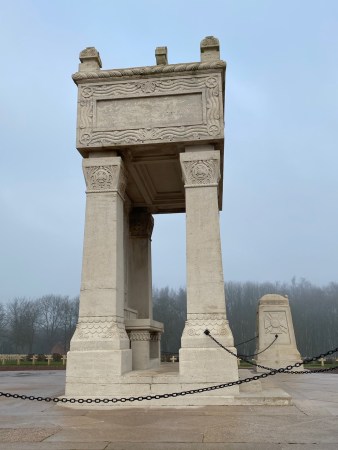
The significance of the supposed mausoleum becomes apparent at this point. The sheathed crossed-swords of valour are stationed outside this portico, whose purpose is solely to house the external altar of the ‘Mother Mary’. The relationship is to the words written on the facing walls of the ‘chapel’.
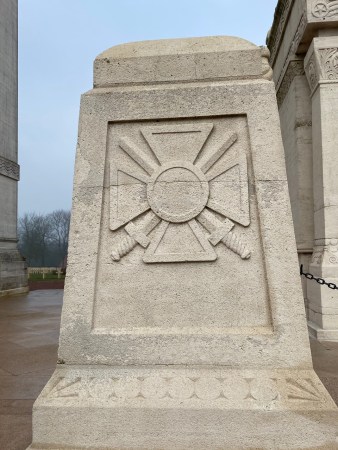

The Lantern Tower has, as its name suggests, a light at the top. Louis Cordonnier designed it to revolve five times each minute, once darkness falls… It’s a very poignant monument, and sits 150 feet high, above what is already the highest point on the ridge. The Lantern Tower was inaugurated in August 1925. Until recently, the 200 internal steps could be climbed by visitors, but the viewing gallery at the top has been closed for security reasons.

The light from the Lantern Tower can be seen for 45 miles – encompassing all the local battlefields at the time of WW1. The base of the tower is a 25 metre square which frames a crypt containing the remains of 6,000 soldiers and a chapel of rest.
A container for relics was placed in the tower in April 1955. It contains soil and ashes from the concentration camps of World War II.

But the left-hand side of the road does not encompass the whole of the monument. Across the way, and only opened in 2014, is a vivid reminder of the horrors of war, and a moving memorial to all those who died in WW1. The French government decided that a monument of total inclusion was appropriate. This means that the names of the fallen among the ‘enemy’ were included in the monument’s role to the casualties of WW1.

Such an inclusive approach may be our only hope to prevent such catastrophes in the future: to regard all people involved in wars as victims, and thereby point back along the chain of causality to the real causes… ego, power and bullying in human nature.

Written on the entrance to the circular monument is written this:
“The 580,000 names are listed in alphabetical order, without distinction between rank or nationality, former enemies and friends side by side……. This memorial was erected in a peaceful Europe in memory of a terrible tragedy which devastated a generation of young men, who for the most part could read and write.
L’Anneau de la Memoire”
“Who for the most part could read and write…” a poignant and telling end to the dedication to an entire generation.
Our time had run out. We were due in Calais in a few hours. But we had found out that, nearby, was another major memorial site: that of the Canadian Monument at Vimy Ridge – the site of one of the major battles of WW1. We decided to steal some time and make the short journey.
It was to be one of the best decisions we could have made… and brought us face to face with what I’ve come to think of as one of the most dramatic of monumental sculptures in the world.

To be concluded in Part Two.
©Stephen Tanham 2020
Stephen Tanham is a Director of the Silent Eye School of Consciousness, a not-for-profit teaching school of modern mysticism that helps people find a personal path to a deeper place within their internal and external lives.
The Silent Eye provides home-based, practical courses which are low-cost and personally supervised. The course materials and corresponding supervision are provided month by month without further commitment.
Steve’s personal blog, Sun in Gemini, is at stevetanham.wordpress.com.
Share this:


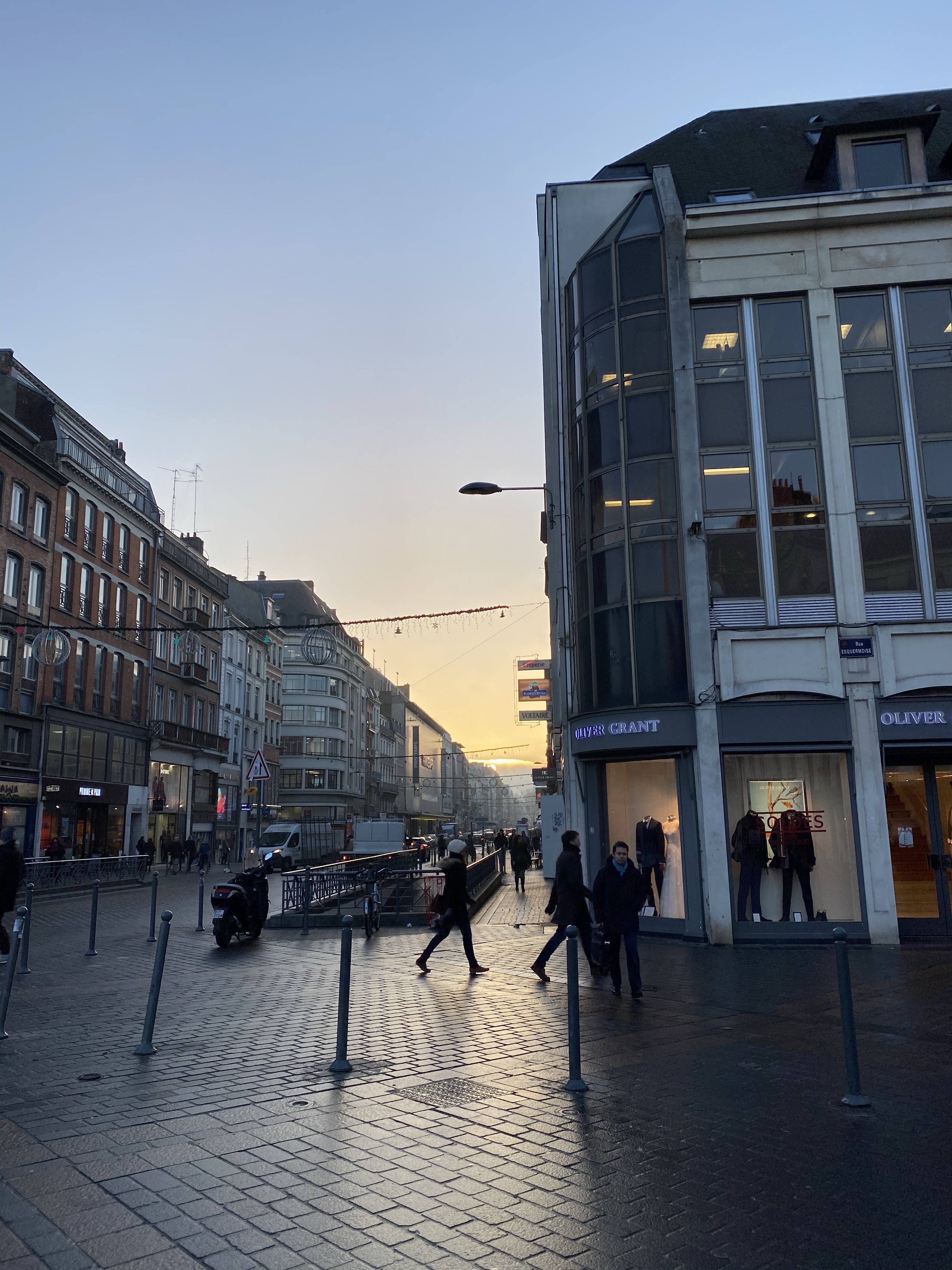
It was late afternoon in the city of Lille in northern France. We were making our way back to our relative’s house on the outskirts of the centre when we turned a corner and found the sunset breaking through the heavy clouds at the ‘end of the street’.

Being January, the sky was rapidly darkening, but suddenly the street was filled with golden light as the clouds parted, briefly. Everyone stopped to look at the rare winter gold…
©Stephen Tanham
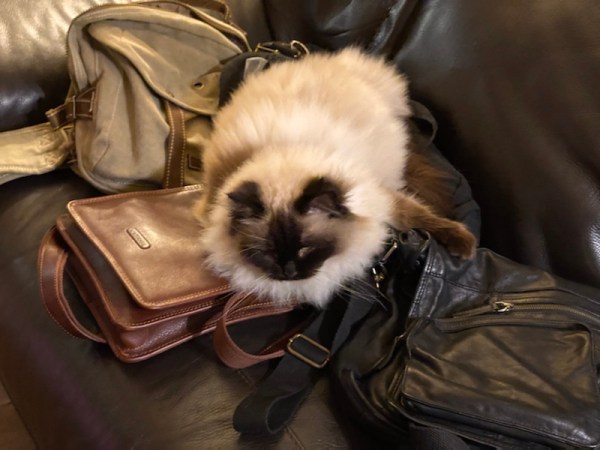
Human: Pretty please?
Misti: Not in a month of Sundays…
Human: We can’t leave for France if you don’t get off the travel bags…
Misti: Exactly!
Human: Chicken?
©Stephen Tanham

We are in northern France, visiting relatives that were only re-discovered three years ago, after an eighty years gap… My paternal grandmother was the youngest sister of an elder brother (also Stephen) who survived the horrors of WW1, married a French girl and eventually settled near Calais.

When France was overrun, the Nazis wouldn’t allow Stephen to take his family back to England and, eventually, contact was lost… He escaped arrest because his adopted craft of running a local bakery – which his wife’s family had taught him, was a ‘protected’ occupation and so, apart from being watched, periodically, he was left alone.
His frequent assistance to the Resistance went undetected, or his fate would have been very different…
Today there are two branches of our once-lost family: one in Calais (the Duffys – after my great uncle) and the other in Lille (the Bertaloots) near the Belgian border. For the first few days of our trip, we are staying with the family in Lille. Nearby is the small city of Arras, an ancient Roman town whose last-century history is dominated by the First World War. The damage to the town, and the magnificent reconstruction undertaken by the local people faced with the devastation of their home is the basis and the inspiration for this post.
We; the Tanhams, the Duffys (Stephen’s surname) of Calais and the Berteloots of Lille have become good friends – indicated by the fact that these lovely people have taken two days off work to show us around a couple of the places we asked to see.

Returning to WW1, the ‘Battle of Arras’ was fought in May 1917, as a joint operation between general Haig – at odds with his Prime Minster, Lloyd George – and the senior French commander, General Neville. The French forces dominated this part of the war’s front and it was Haig’s job to support them.
The French plans proved over-ambitious and Haig’s forces suffered heavy casualties for little gain, though four divisions of the Canadian army combined to take the important Vimy ridge. The nearby town of Arras was largely destroyed during the shelling.
Following the Armistice in November 1919, hostilities ceased and the battered French citizens set about the huge task of rebuilding their city…

I found the photos of the post-war ruins poignant and relevant to current British politics.
Recently, the same people who drove the ‘Brexit’ process turned their backs at the opening session while a dignified European Parliament looked on in disbelief. The same people, still funded by the EU, now want to have London’s Big Ben strike out the chimes of Britain’s official ‘leaving date’ at the end of January in a show of jingoistic pride… one could hardly write a novel to match the recent events, but we would be unwise to consider this fantasy… nightmare, maybe.
For me and people like me, they have created a similar devastation in the minds and hearts of the half of Britain’s population who wished to remain part of the united Europe that emerged from the ashes of blitzed London and shelled Arras.

Fascism is innate in human nature. The school bully is a fascist, recruiting the weak and unthinking to a cause of personal glory which elevates his or her ego above any common cause of progress. By doing this, he finally exists… However, the emotionally settled child, perhaps growing up in a good family, knows that their existence must be balanced with the needs of a wider circle of caring humans.
What is little considered is that the dictator-fascist is only a school bully… and that sustained courage will unseat them.

Arras emerged from its ashes when its people rejected the devastation bequeathed to them by the madness of privileged ego. Everyone came together to rebuild the town; and the collective consciousness of that town recreated the ‘extravagant gothic’ style of each house and shop, street by street.

A little-known fact is that, from the 17th century, it was obligatory for anyone building a new house in Arras to submit a copy of the plans to the town hall. It was the possession of these plans that enabled Arras to emerge, accurately, from the devastation of the war that exploded like a volcano around it, to reconstruct what it had been… Its past, with all its art and tolerance was documented.

The process of war via fascism – all war and all fascism – is, for me, perfectly symbolised by the nearby Vimy Ridge monument. This startling sculpture by Canadian artist Walter S. Allward rises high above the ridge-line at Vimy – a place where eleven thousand Canadian soldiers were killed in order for the ridge to be taken back from the Germans.

I intend to write a post dedicated to this moving monument and reveal some of its intricately-wrought emotional detail. For now, here is a glimpse of two of the figures that are revealed when you pass through the anguish of the parents and into the actuality of the war as it happened before their loss…

To conclude, let’s go back to the title of the blog: The Sun, the Lion and the Ashes.


We can all find ourselves the wrong side of how we think things should be. The views above are my own and do not necessarily represent anyone else in the Silent Eye School. What is important is how we react to the ‘ashes’ of our perceived world. If, like the people of Arras, we have ‘documented’ what be believe to be vital in our world, we will be able to begin again in the new circumstances secure in the knowledge that we brought the best of it with us.
©️Stephen Tanham
Stephen Tanham is a Director of the Silent Eye school of consciousness, a distance-learning organisation that operates on a not-for-profit basis to help people deepen their life experiences without fluff and with personal supervision. You can find out more about the Silent Eye by clicking here.
Share this:

+ #ShortWrytz, #Silenti, Lake District, landscapes, nature, Photographic techniques, Photography, Spirituality
#ShortWrytz – Intricate Outlines
by Steve Tanham
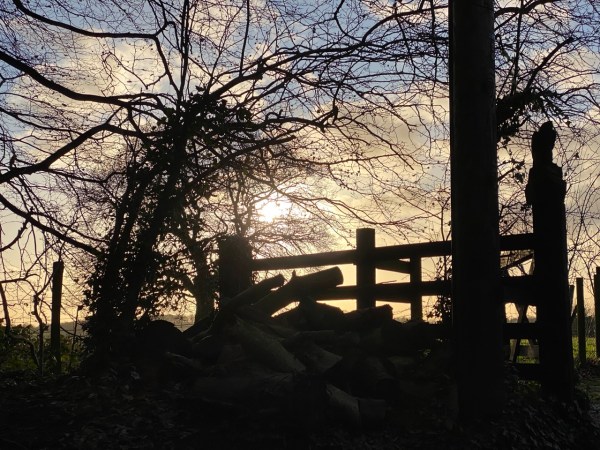
Winter offers the photographer a challenge – to be creative with what little colour there is…
One way around this is to look for the most contrast to be found. In this shot, taken on a walk in the mid-afternoon, the pale sun was already falling towards the horizon, filling the shadows with a rich, inky darkness. Lovely!
I walked for a while until this scene was framed against the diminishing afternoon sun. It’s not always easy to say why something ‘works’ – it just does…
Intricate nature in all her glory. Withdrawn, but with the forms of growth bare for us all to see and marvel at. And the fence and gate provided a nice counterpoint; suggesting that, for all our love of straight lines, the eye, at least, can play the two together.
©Stephen Tanham 2020
Stephen Tanham is a Director of the Silent Eye School of Consciousness, a not-for-profit teaching school of modern mysticism that helps people find a personal path to a deeper place within their internal and external lives.
The Silent Eye provides home-based, practical courses which are low-cost and personally supervised. The course materials and corresponding supervision are provided month by month without further commitment.
Steve’s personal blog, Sun in Gemini, is at stevetanham.wordpress.com.
Share this:

+ #Silenti, Ancient Landscapes, Ancient Sacred Sites, Celtic Christianity, esoteric psychology, Photography, Spirituality
Keys of Heaven (10): final resting place…
by Steve Tanham
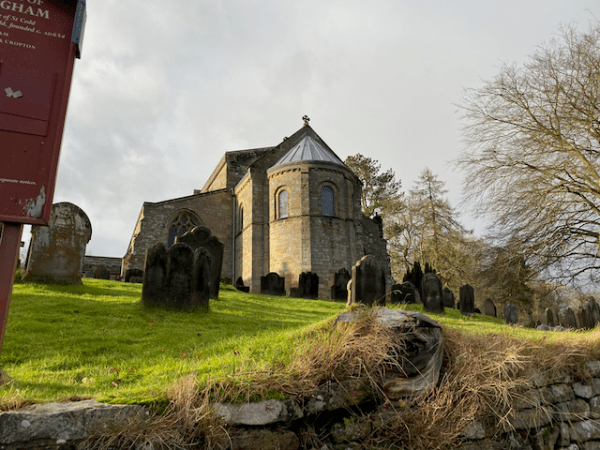
continued from Part 9
The village of Lastingham, of the southern edge of the North York Moors, was a fitting place to end our weekend – both for its mysterious wells and also on the basis that the crypt of St Mary’s Church marks the final resting place of St Cedd. Following the fateful Synod of Whitby in AD 664, Bishop Cedd returned to his beloved Lastingham, the place where he had founded his originally monastery; but tragically caught the plague and died, bequeathing the care of Lastingham to his brother, Bishop Chad – later St Chad. Chad became bishop of Lichfield shortly thereafter and had to manage his brother’s bequest from afar.
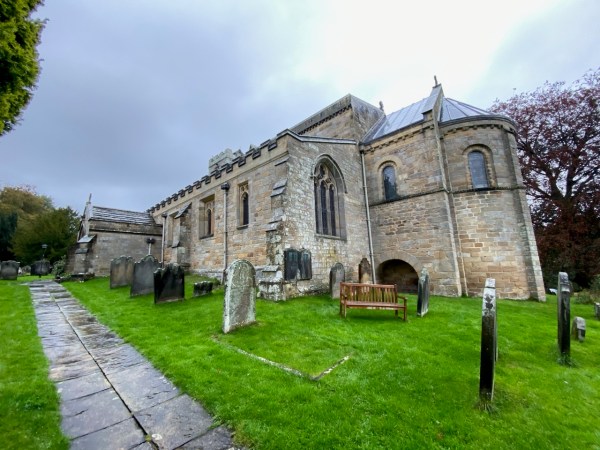
We have to wonder at the irony and sadness of this: first to lose (in the service of his king, Oswiu) the Celtic Christian tradition in which he had been raised since a boy; then to lose his life in one final visit to his beloved Lastingham.
Cedd was buried here, and the place of his burial in AD664 became the ground on which all the layers of the present church were constructed.
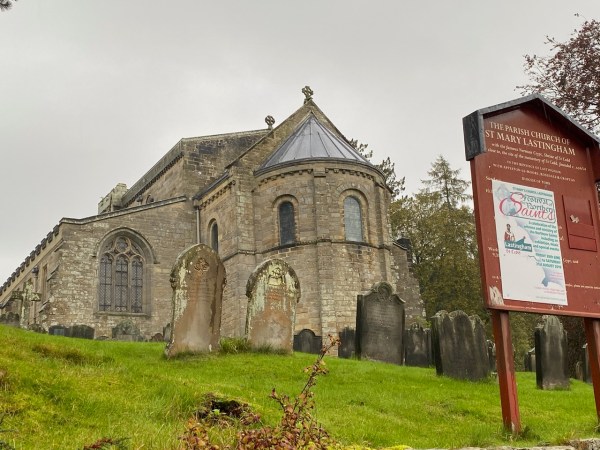
St Mary’s church attracts visitors from all over the world. Christian and non-Christian ‘pilgrims’ are welcomed here in a warm spirit of spiritual openness. Though not formally a Christian, I am entirely happy with the scriptural idea of Christ as the ideal and perfected ‘inner man’. I am at home in most temples of the spirit, but seldom have I felt the kind of harmonic energies that are present in St Mary’s.
There is, in the words of one of our companions of the weekend ‘Something very special here…’ And you can feel its presence in the air around you.
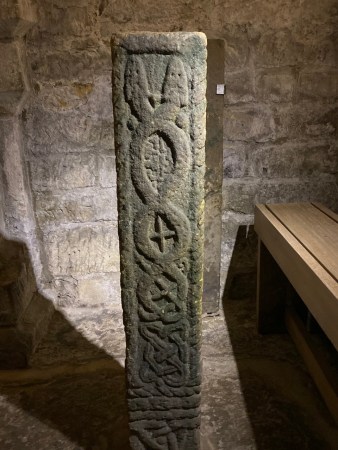
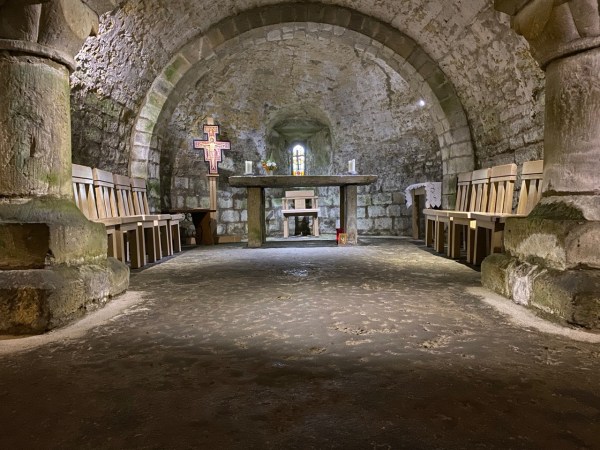
The original monastery was wooden, and nothing remains of it. But the present church of St Mary’s is built upon its site, and specifically, upon the original crypt that was constructed over the location of St Cedd’s grave two hundred years after his death. This region (of what was then Northumbria) was a wild place, and lawless – possibly one reason why Cedd devoted so much of his time establishing the original monastery as a spiritual refuge for the local people and their hard lives.
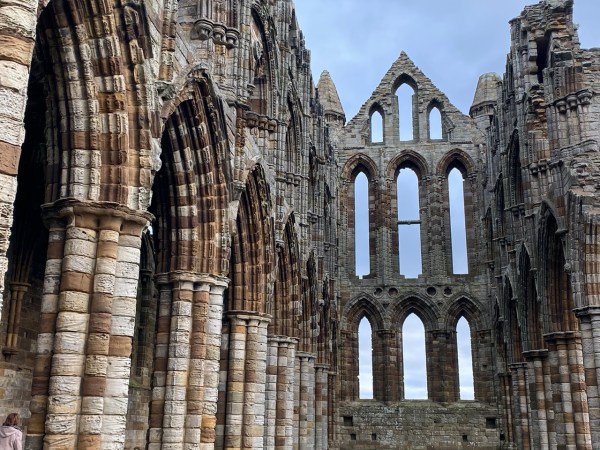
After the Synod of 664, the seat of religious power moved south from Lindisfarne to York, though Whitby survived for a while, in the form of the influential Abbey whose abbecy passed from Hild to Eanflæd, the wife of King Oswiu, upon his death. A royal princess and later queen to Oswiu, she brought grace and dedication to the abbey in the town that would later become Whitby.
But, the age of the Vikings was upon the land and the northern Saxon kingdoms were eventually overrun. Little is known of life here during that period and the former monastery was left to decay.
Over four hundred years later, in 1078, Stephen, abbot of the recently rebuilt monastery at Whitby, obtained permission from no less a person than William the Conqueror to take a team of skilled monks to restore the monastery at Lastingham as a Benedictine house.
Stephen designed the crypt we see today and built it over the place where Cedd had been buried. Above this crypt he began to build a new abbey church, but work was abandoned in 1088 when Stephen and his monks moved from Whitby to the all-powerful York; there to build St Mary’s Abbey… This may have been due to the increasing lawlessness of life within the hills making things impossible for the monks.
The Lastingham Crypt deserves a post in itself, but our story of the Keys of Heaven weekend (now ten posts) has to be brought to a close.
There was a communion service on that Sunday morning. We took care to arrive after it had finished, but I hoped we would be able to meet one or two of the local team. Historic places are fascinating, but the ‘now’ contains some miracles, too. As we pushed open the heavy oak door, one of the church wardens greeted us and we were welcomed into the ‘coffee area’ of the church and urged to join the larger than expected residual group of parishioners.
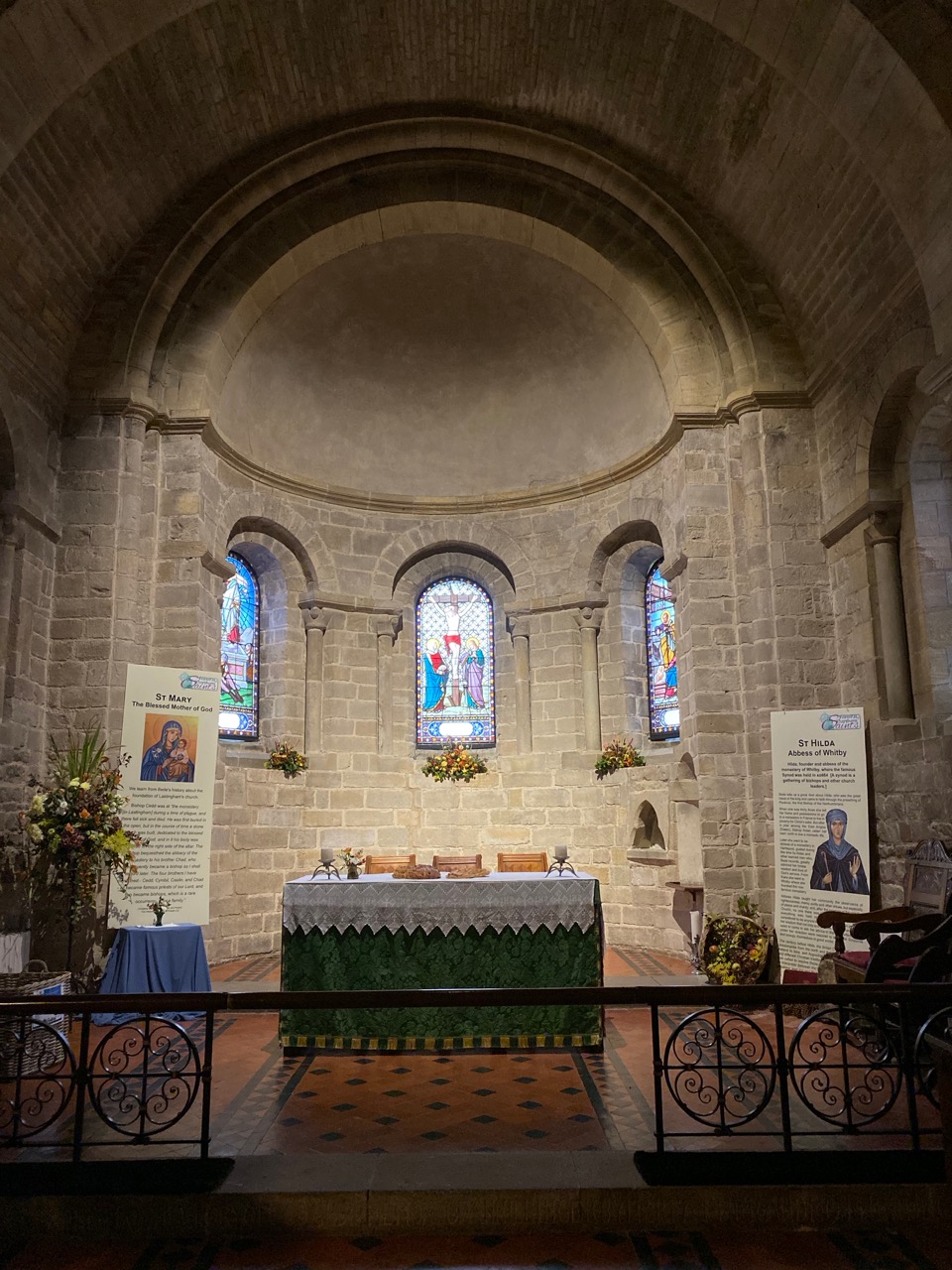
This was my third visit to St Mary’s. The main floor of the building is special in its own right, but I knew the ‘attracting power’ of what lay beneath. Most of our companions drank their coffees then melted quietly away down the stone staircase and into the crypt. But, by that time, as leader of our group, I had not only been given ample coffee and biscuits, but introduced to a cleric in a splendid set of robes… somewhat grander than I had expected for a small village.
Bishop Godfrey is well known throughout the North York area. He has served the Christian cause all his life and is now part-retired with a special attachment to Lastingham; a place in which he feels very much at home. He asked about our group and I was honest about our affiliations and goals. He seemed delighted with our attempts at local scholarship and offered to solve my one remaining problem of the weekend…
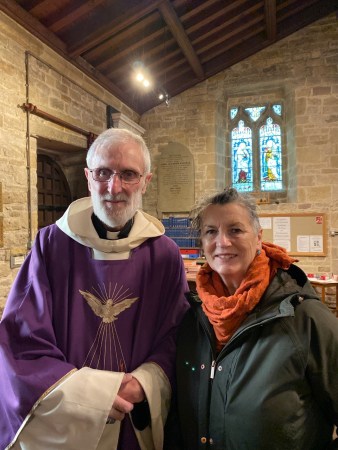
Ten minutes later, happy to pose for a photo as long as someone else was in it, Bishop Godfrey waved us with his blessing down into Lastingham’s very special crypt – the final resting place of St Cedd. As I walked down the stone steps I couldn’t help but feel just a little ‘blessed’ as we finally entered the place where the mortal remains of another very special bishop were interred.
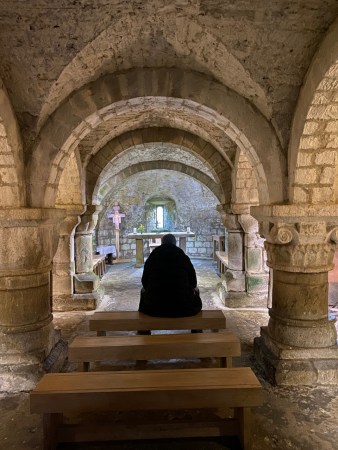
Most of the group had already found their bearings, and were quietly exploring the beautiful crypt. But, one figure sat in the middle of a stone pew locked in total inner and outer silence. His back was to us, and he later described how the crypt had both embraced and entranced him… exactly the effect it had always had on me.
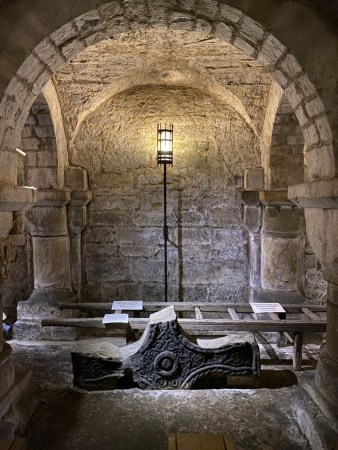
The meeting with Bishop Godfrey had made me late into the crypt and we had two important things to do. With an inner certainty, I knew that this visit was for my companions. I had done my part in bringing them here and the magical place was doing the rest. Snapping a few photographs to supplement the ones I had taken in October, I sat quietly, giving thanks that the weekend had gone well; and that we had largely achieved what we set out to do.

I could see that the group were tired and in need of some lunch. Across the road from the church is the Blacksmith’s Arms, a lovely and traditional Yorkshire pub with a fine Sunday lunch menu. There are no ‘facilities’ in St Mary’s church, but Bishop Godfrey and the landlord have reached an amicable agreement. The pub displays a sign saying that those attending or visiting the church may use the pub toilets but are asked to leave a donation towards the upkeep of the church. The bishop had smiled as he told us of the monthly cheque the landlord brought him…
The lunch was wonderful… An hour later, with the afternoon upon us and time running out, we set out on the last trek – a last walk around the village to visit Lastingham’s celebrated wells.
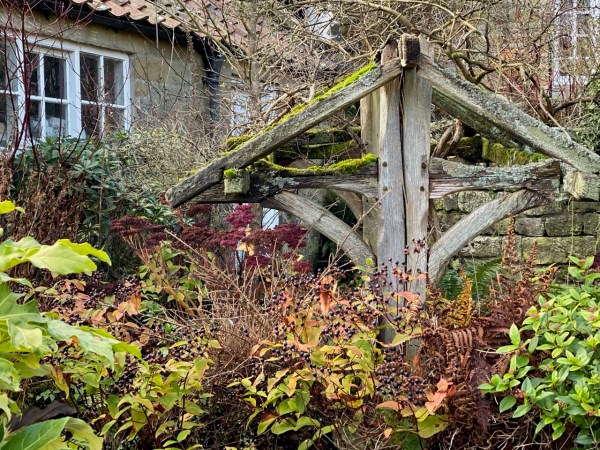
Space does not permit too much description, but, briefly, there are four of them. Two are set into the walls of local properties and one is in the garden of a private house near the church. None of these are currently flowing… but the fourth one – St Mary Magdelene’s well – is. The problem is that it’s well outside the village and very hard to locate. On our recce trip in October, Bernie and I had failed to discover its location, despite directions from the Blacksmith Pub’s landlord.
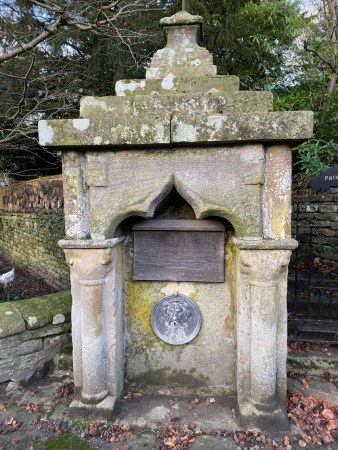
But now I was miraculously equipped with the more precise instructions from Bishop Godfrey and I could feel the ‘cogs of happenstance’ aligning.
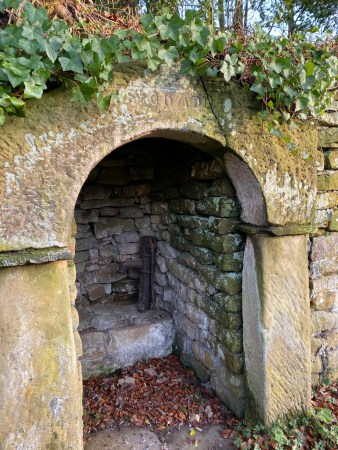
I explained to our companions that we had the chance to discover St Mary’s well in a very real way. We drove to a where the place where I had given up looking in October and I pointed out the sloping bank to which Bishop Godfrey had directed us.
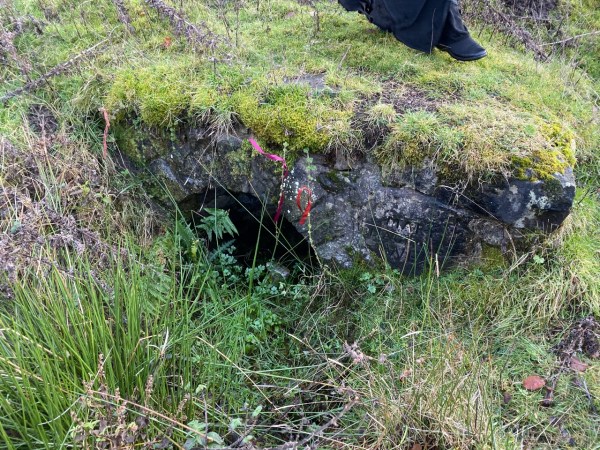
Within seconds, Gary – the figure in a peaceful trance in the crypt – had found it…
We stood around it in an arc and I explained the final purpose of the small empty jars given out to everyone on our opening trip to the beach, so long ago on the late Friday afternoon.
St Mary’s well is a small arch of stonework set into a stream-filled bank that leads down to the small river that flows through Lastingham. And now, as the only person with wellingtons, I needed to fill each of the jars. The only way to do it was to stretch my legs over the small valley of the spring and lean towards the stone arch, reaching down (thank you, Pilates) to fill each jar. I could hear the mental bets being taken that I would end up in the water, but reached the last jar still vertical, albeit locked into the muddy banks on either side…
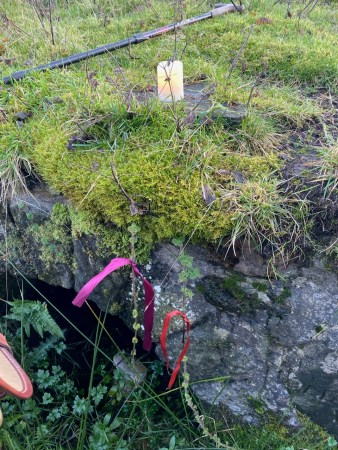
A set of friendly hands were outstretched in case I lost my footing, but, with one last push and the weekend’s second sound of a mired boot breaking free, I managed to reunite my legs and scramble away from the water and mud. Everyone now had a Christmas candle and a small jar of very rare St Mary’s well water to take away.
Moments later, with jars tucked safely into travel bags, we hugged and said our goodbyes. The Keys of Heaven workshop was over; and it had been a success. In silence, I drove back to Runswick Bay to collect Bernie for our promised beach walk for Tess and our extra night in the location to unwind.
Later, we would walk through the darkness to the Cod and Lobster and reflect on the weekend. But that is where our story began…
End of Series
Other parts in this series of posts: Part One Part Two Part Three Part Four Part Five Part Six Part Seven Part Eight Part Nine This is Part Ten, the final part.
©Stephen Tanham
Stephen Tanham is a Director of the Silent Eye School of Consciousness, a not-for-profit teaching school of modern mysticism that helps people find a personal path to a deeper place within their internal and external lives.
The Silent Eye provides home-based, practical courses which are low-cost and personally supervised. The course materials and corresponding supervision are provided month by month without further commitment.
Steve’s personal blog, Sun in Gemini, is at stevetanham.wordpress.com.
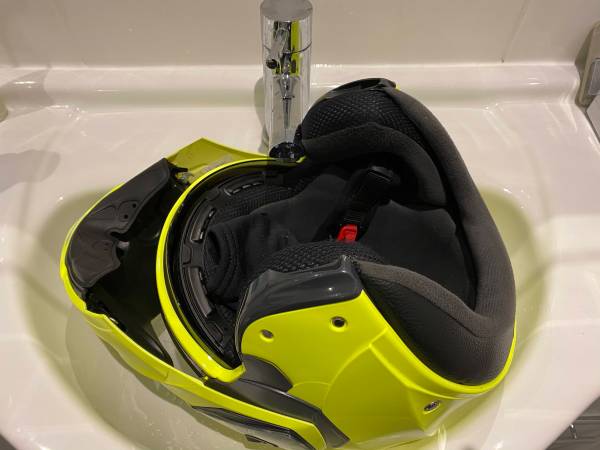
I could have shown you a picture of my motorbike lying on its side in the car park, but that might have been too brutal…
“It’s not for everyone, the Advanced Rider Course,” my examiner was saying as he helped me recover the Honda 750NT from its prone position in a corner of Morrisons’ huge car park on the outskirts of Kendal. “It’s rather demanding and does tend to shred the ego…”
He’s a very decent man (let’s call him Paul), this examiner of would-be graduates of the UK’s Institute of Advanced Motorists (and Riders). I had known him less than sixty seconds and could tell that he had both integrity and humour – but, as examiners must – a determined and steely nature.
I could see in his eyes a certain degree of concern that his latest charge had begun their examination with an early arrival (tick;) a pleasant and informed greeting (tick); and had then transformed their attempt to put the Honda onto its centre stand – for stability – (tick) into a bruised horizontal motorbike lying on the wet tarmac with a good number of Monday’s shoppers staring on in confusion…
“Let’s pretend it never happened,” Paul said, kindly. “You sure it’s okay for you to carry on?”
It was. There were two scrapes along the exhaust and the rear brake pedal had been adjusted inwards… but it still worked. The wind deflector on the right handlebar had been ripped at its main juncture with the handlebar. If one could be colder than I already was that was going to be my fate on this dark, January morning.
“Do you fancy going up Shap?” Paul asked reasonably, as though I had a choice in this matter. My face conspired to look enthused. Storm Brendan was arriving with a vengeance as we put in our earplugs, under-helmet balaclavas and thick winter gloves. Paul watched me mount my iron steed. I think he’d decided to wait before getting on his own bike… in case I dropped it, again.
Mercifully, I didn’t, and within minutes we were headed into Kendal’s infamous one-way system. Time for me to show off – sorry, demonstrate – my ‘filtering in traffic’ skills. There weren’t too many opportunities, but I managed to steal a march on a few cars and inserted myself in front of them with a peacemaking wave of the left glove.
But then came Shap… You may already know of the celebrated Shap ‘high road’ – otherwise know as the old A6 link to Scotland. It’s twenty miles of Cumbria’s most extreme and barren terrain and boasts the second highest road summit in England. Before the M6 motorway formed its wonderful link with Scotland, going over the ‘Shap Summit’ was the only way to get there – except the train. Winter saw heavy snowfalls and the winding beast of a road was populated with giant truckers’ cafes – several of which were used as temporary shelters in savage winters like that of 1963, when Shap was closed for days and sometimes weeks at a time.
I was winding up the A6, flowing to right and left, matching the changing visibility ahead with the contours of the road, watching as the speed limits changed up from thirty, to forty to sixty – the maximum for a ‘National Speed Limit’ road in the UK – unless it’s a dual carriageway. Sixty is not fast on a motorway, but on wet tarmac in a ‘switchback’ landscape, it’s very easy to overdo it and find yourself in danger.
But managing that had been what I had been taught for the six months of the course; as my two highly-skilled supervisors showed me a completely different way of being aware of the road ahead – and its opportunities and dangers…
Getting into that climbing ‘flow’ gave me time to think… about Jinxi. She’s my ‘spirit of 13’. You see, thirteen has always been my lucky number – really! Anything that comes up with a thirteen is grabbed by me, immediately. Jinxi is the mysterious ‘spirit’ that seems to engineer the benefits and their cost when I try to collect on my lucky thirteen. They usually materialise – but I also have to deal with something else, first.
Today was (and still is at the time of writing) the 13th January. It’s dark, cold and threatened by one of the worst storms in recent memory coming at us from the Atlantic. I’d like to blame the fallen Honda on the winds… but they were only just beginning.
No… the fallen Honda was Jinxi’s work.
Now, the air was getting colder and wilder and seemed to wrap itself around me, trying to breach the suddenly-inadequate textile riding suit and thermals. There’s an inner battle at these moments, when you’re cranked over at a steep angle at nearly sixty miles per hour and your life hangs on the acuity of those beautiful Michelin rubber things that are managing the tarmac for you.
I know the road well – having recently had a strong sense of intuition (Jinxi?) that it would be used by Paul in the real test. I knew he liked how it combined twisty mountain roads with sudden speed changes… and left you feeling very exposed and dependent on your own resources. It’s a tough and often brutal landscape, but, thankfully, this part of the test was only going to take an hour… a very long hour.
About fifty metres behind me, Paul was watching my every move, and checking I had understood the route.
The edge of Storm Brendan had definitely arrived by the time I pulled onto the M6 slip road to begin a short motorway section of the test. The bike started to shake in the side wind and I felt my arms go tense. This is a mistake, but it’s very hard to fight as you start rocking at the side of enormous wagons thundering down towards Tebay at the end of the descent from the Shap summit. And this rocking is now taking place at seventy miles per hour… with just two wheels and an engine underneath you and Storm Brendan behind.
Suddenly, the thought of Jinxi didn’t seem so funny.
Paul is, of course, far more experienced in these conditions than I am. If it’s windy I avoid motorways on the bike. On the test you have to take what comes. I was to pull off the motorway at the Tebay service for a review of progress so far. I could tell Peter was happier with my pace on the A6 than the motorway, but didn’t dwell on it. My last assignment at the motorway services was to perform a U-turn in a narrow width to simulate a road. I had practiced this the day before – ironically at the back of Morrisons’ supermarket – and so had little difficulty.
Then it was back on the motorway for a final, blowy, two miles before exiting at Tebay and joining the snaking Appleby road back towards Kendal. Like most keen bikers, Paul’s preference was for ‘the twisty stuff’, the secondary benefit of which was that the stone walls and hedgerows reduced the savage buffeting of the winds.
I knew that Paul – like all the IAM supervisors I’d met – liked to ‘make progress’. This is a euphemism for going as fast as is safe within the allowed speed limits. I knew I’d not done well on the motorway – I later confessed to him that I had actually been frightened by the wind’s intensity. I had to recover some points towards my total and the only way to do that was to ride like a thing possessed – but safely! Wasn’t that the essence of what I’d been taught for the past six months?
We arrived back at Morrisons, exhilarated and without incident. Peter got off his BMW smiling. “I enjoyed the pace of that” he said, giving me a look that had some hope in it.
A visit to the toilet was essential before we sat down with a hot drink in the cafeteria and reviewed the results of my ride. Motorcycle helmets are bulky things and supermarket toilets are tiny. The only place I could find to store mine was upside down in one of the sinks. As the opening photo shows, it was good fit and utilised one of the few contours that would hold the unwieldy yellow object. Satisfied that it wasn’t going to roll off anything, I turned to wash my hands in the second sink. The water flow was triggered by a sensor and I smiled at the effective automation.
Jinxi was smiling, too…
As I turned to the hand-drier, I could hear that my tap had failed to turn off. I looked again at the sink I had used. Nothing… But in the next sink along, the tap pointed down at my upturned helmet was busy filling the sink’s yellow occupant with tepid water.
There was no point rushing. I stood and marvelled at the deviousness of the familiar spirit of mischief. When it had finished its flood, I picked up the helmet and gently inverted it, emptying a substantial quantity of water into the sink.
Jinxi had enjoyed a busy day. I collected our drinks and returned to the table to see that Paul was halfway through filling out the form that would become my verdict…
Did I pass? Jinxi had done her work and I had paid my dues on this Monday the thirteenth. Later, standing at my now dirty and scraped bike, I swung the sodden helmet onto my head and, water tricking down my scalp and into my jacket, started the Honda.
In my waterproof pocket was tucked a small blue and white card.

©Stephen Tanham 2020
Stephen Tanham is a Director of the Silent Eye School of Consciousness, a not-for-profit teaching school of modern mysticism that helps people find a personal path to a deeper place within their internal and external lives.
The Silent Eye provides home-based, practical courses which are low-cost and personally supervised. The course materials and corresponding supervision are provided month by month without further commitment.
Steve’s personal blog, Sun in Gemini, is at stevetanham.wordpress.com.
Share this:


©Stephen Tanham
Share this:

+ #Silenti, Ancient Landscapes, Ancient Sacred Sites, Celtic Christianity, esoteric psychology, Photography, Spirituality
Keys of Heaven (9): blown down the mountain
by Steve Tanham
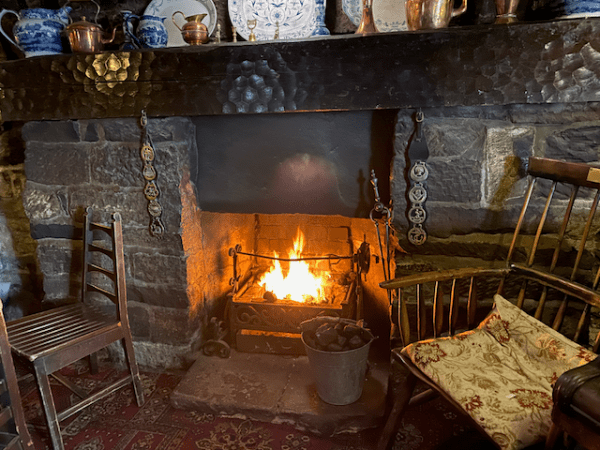
continued from Part 8
My companions of the Silent Eye’s ‘Keys of Heaven’ weekend were waiting when I arrived at the Lion Inn. We had coffee and biscuits and we discussed the options for our last day of the workshop. Everyone was looking forward to the visit to the celebrated St Mary’s church at Lastingham – the final resting place of St Cedd.
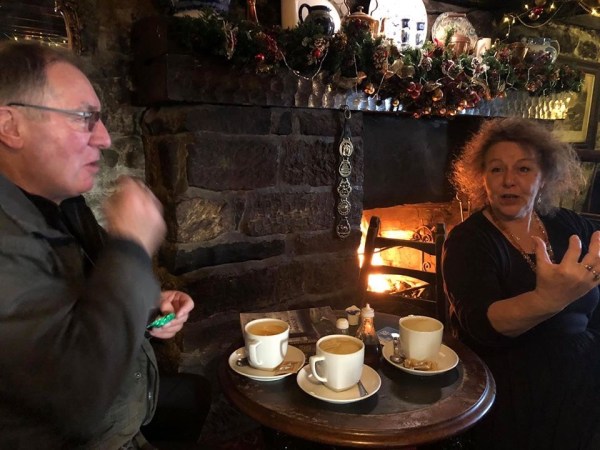
There was a group excitement; a buzz. Human nature responds to being ‘on top of things’ in both a physical and metaphorical sense. We had all managed to find the Lion Inn – it’s not trivial! We were at the highest point in the North York National Park, but we weren’t there just for coffee and the views. We planned to take advantage of the rich history to be found in the immediate area of the Inn, which, although completely isolated, has a site that has been occupied for hundreds of years; and contains archeology that is thousands of years old.

There are some very special pathways that cross these high moors. Some of them link ancient sacred sites, often marked by crosses that surprise with their age – over a thousand years old in some, cases… possibly a lot older in others.
Where they cross – or meet, might be a better word – they create a special place of exchange and, often, hospitality. Years pass, then hundred of years, and there becomes established a place of meeting. In a few rare cases the meeting point defies the often hostile elements by becoming a permanent building of refuge and hospitality.

The Lion Inn on the top of Blakey Ridge is one such. As high as you can be in the North York National Park (1,325 feet), it sits astride a crossing of ancient ways and alongside the more modern road linking Castleton to Hutton-le-Hole. The Inn has been run by the Crossland family since 1980. Being on the highest point, it offers breathtaking views down into the Rosedale and Farndale Valleys.
The story of the inn on Blakey Moor dates back to the 16th century. During the reign of King Edward III a house and ten acres of land on Farndale Moor were given to the Order of Crouched Friars, who had been unable to find a home in York.. It is thought that the friars founded the Inn around 1554 to lighten their poverty. Friar Inns are common enough in all parts of the country – Scarborough has two. Since that time there has always been an inn here.
We were fortunate that two of the most significant historic sites are adjacent to the inn. All we had to do was take the short walk from the Inn’s door.

The grave at Loose Howe (above) is a short scramble up a hillock to the east of the inn. It can be seen from the windows in the bar. Here, a Bronze Age chieftain was interred in a boat-like oak coffin: armed, clothed and equipped for his voyage.
Cockpit Howe is a Neolithic burial mound just behind the inn, facing the Ferndale valley, below.

The ancient Waymarks – standing stones and stone crosses – known as ‘Fat Betty’ and the Ralph Crosses (previous post) bear witness to the continuous tradition of passage over this pinnacle of the North York moors. The earliest history of these markers remains a mystery.

We had a plan. Our destinations were all within a few hundred metres of the Inn – two of them much closer. The above photos (taken during our recce trip in October) show how simple it should have been…
But…
What really happened, when we stepped out of the Lion Inn on that freezing December Sunday, was this:
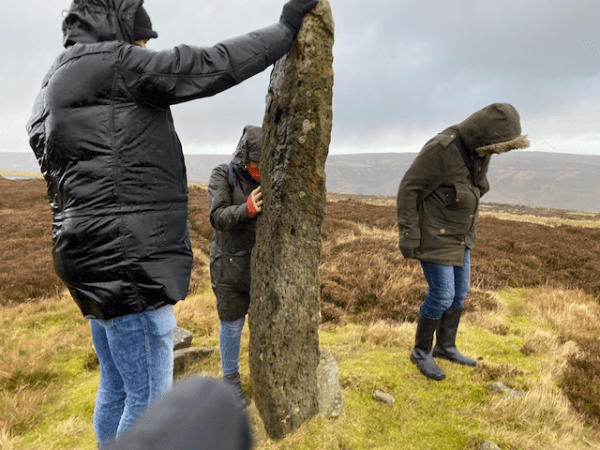
Loose Howe stands about twenty metres taller than the Lion Inn. By the time we had climbed half that height the winds were making it difficult to walk forward. By the time we reached the mound itself, we had to huddle or grasp the stone to stay upright.
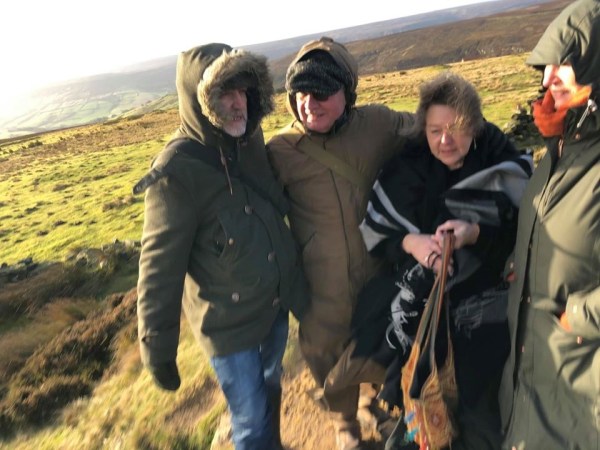
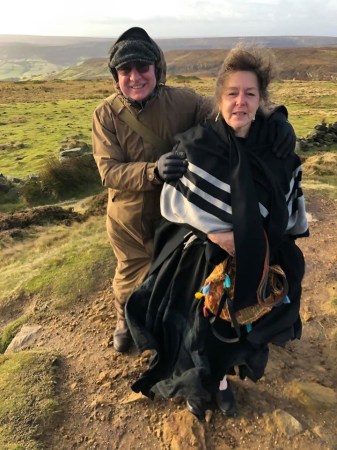
It was no better down behind the Inn at Cockpit Howe. If anything, it was worse. The wind was so strong that it was becoming dangerous.
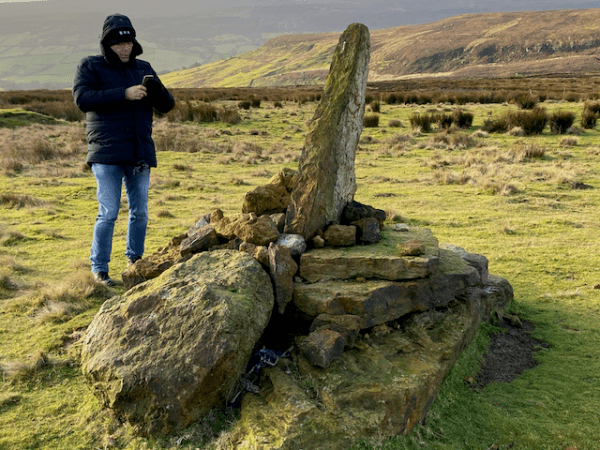
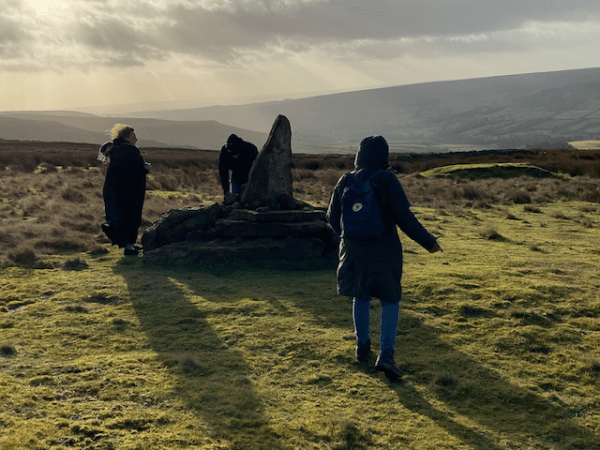
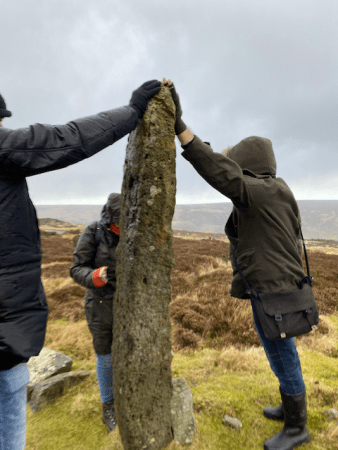
By the time we got to the third site, a marker stone a hundred metres down the Blakey Ridge road, only a handful of us were still able stand against the ferocious winds. We knew when to give up.
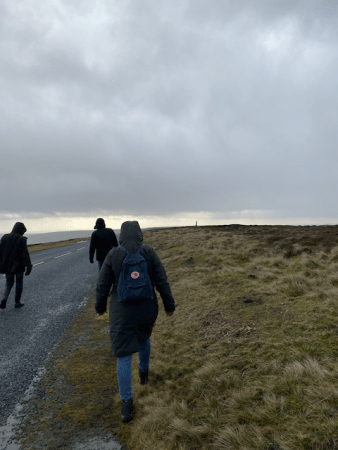
My success crossing the bog, earlier in the morning, seemed a long time ago…. The winter had won. Our only choice was to abandon the peak at Blakey Moor and escape down the mountain, earlier than planned… However, wildness has its attractions and no-one seemed unhappy with the experience!
But fate and circumstance have a habit of ringing the changes… and continuing to do so. We retreated to the safety of the cars and, once warm again, drove – slowly – down to Lastingham,
Where the magic was waiting…
To be continued…
Other parts in this series of posts: Part One Part Two Part Three Part Four Part Five Part Six Part Seven Part Eight This is Part Nine
©Stephen Tanham
Stephen Tanham is a Director of the Silent Eye School of Consciousness, a not-for-profit teaching school of modern mysticism that helps people find a personal path to a deeper place within their internal and external lives.
The Silent Eye provides home-based, practical courses which are low-cost and personally supervised. The course materials and corresponding supervision are provided month by month without further commitment.
Steve’s personal blog, Sun in Gemini, is at stevetanham.wordpress.com.


 Sun in Gemini
You must be logged in to post a comment.