
Sue narrates her journey to Burghead as part of the Silent Unicorn weekend in north-east Scotland…

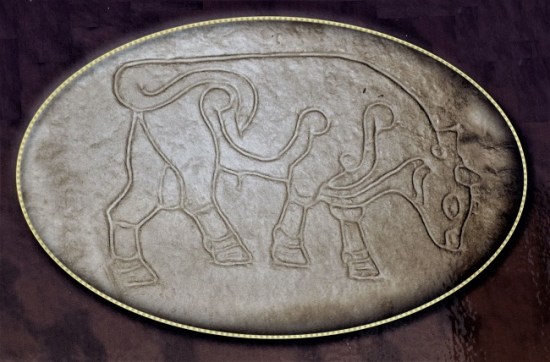
Sharp tang of woodsmoke, tall shadows climb stone walls, reflected flames dance in a black pool. Deep in the belly of earth, the symbols of the rite painted on pale skin, I wait as the torches come…
I could not say where or when the scene unfolded, nor what was the rite, only that to find yourself unexpectedly standing in a landscape familiar from an old, recurring dream is very strange. The soft echoes of the chamber brought back one missing detail.
“We need to chant…”
***
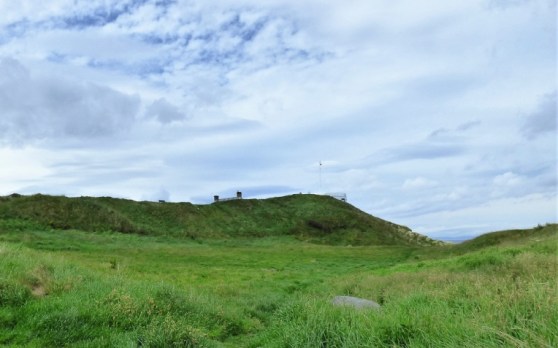
We had arrived in Burghead knowing that we would take a look at an ancient fort and a holy well. For once, that was about the limit of my knowledge. We had been given a detailed itinerary, but I had deliberately not researched any of the places on the list. As I was not one of those responsible for guiding the weekend, I…
View original post 1,119 more words
Share this:


+ #Silenti, Ancient Landscapes, Ancient Sacred Sites, Celtic Christianity, Christianity and modern mysticism, Consciousness, esoteric psychology, Highlands of Scotland, landscapes, Magic, Mindfulness, Mystery Schools, Mystical ritual drama, myths and spirituality, Neolithic, Pentagram, Scotland, Silent Eye School, Spirituality
Three Days of the Oyster-Catcher (Part 3) Headland of the Picts
by Steve Tanham
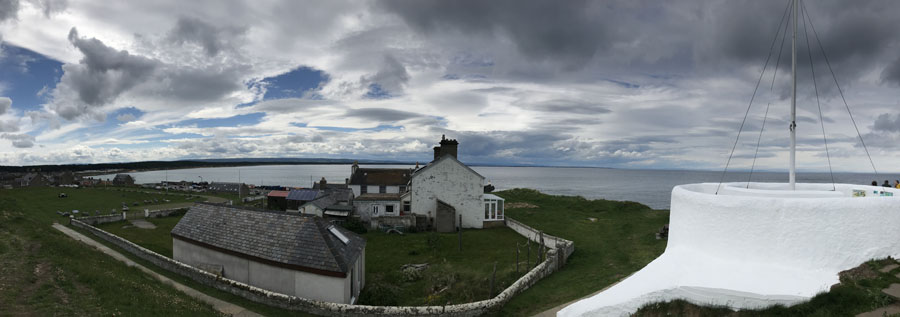
The Moray Firth is vast, wild and beautiful. Examined on a map it resembles a child’s geometry exercise in triangles, with the coast between its ‘origin’ at Inverness and far-away Fraserburgh being a virtually flat west-east baseline. From Fraserburgh the great inlet of the Moray Firth reaches northwards into the North Sea. The final line in the triangle, from Inverness moving north-east, ends at the tip of Scotland: John o’ Groats.
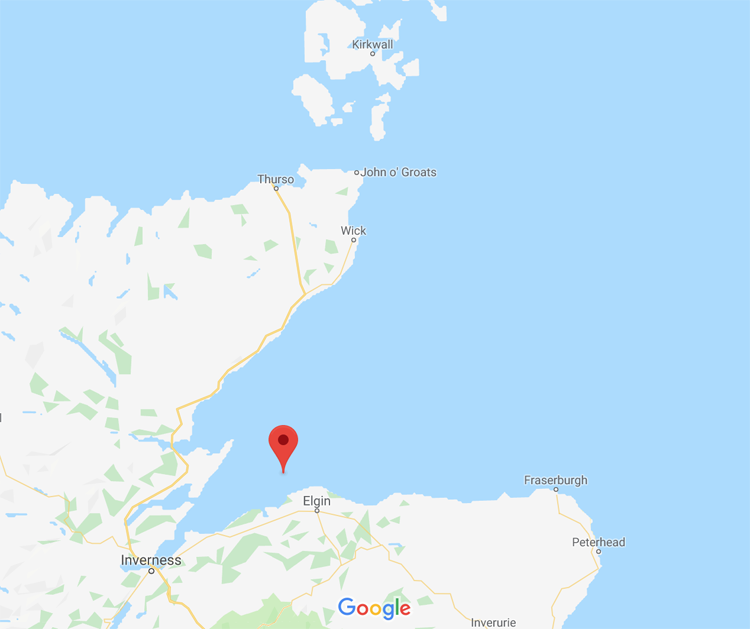
Our huge geographic triangle pivots around Inverness -which is also the place where Loch Ness meets the sea. What we know as Loch Ness today is the result of the shearing of two vast tectonic plates four-hundred million years ago. This geological event produced a ‘line’ of fracture that is now the line of Loch Ness but runs further across the entire width of Scotland and beyond. The east-west depression is known as the Great Glen.
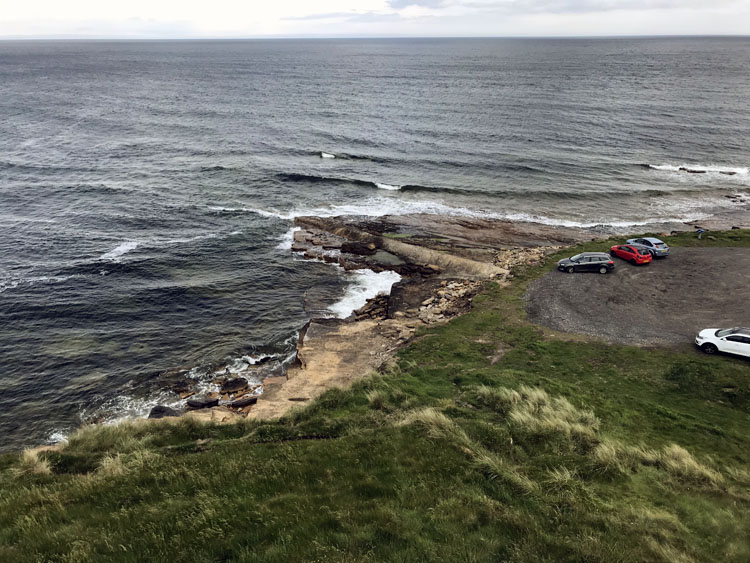
If you are sensitive to ancientness, when you stand on this, the south coast of the Moray Firth, you can feel the immense age of this beautiful place – and its importance in Scotland’s history.
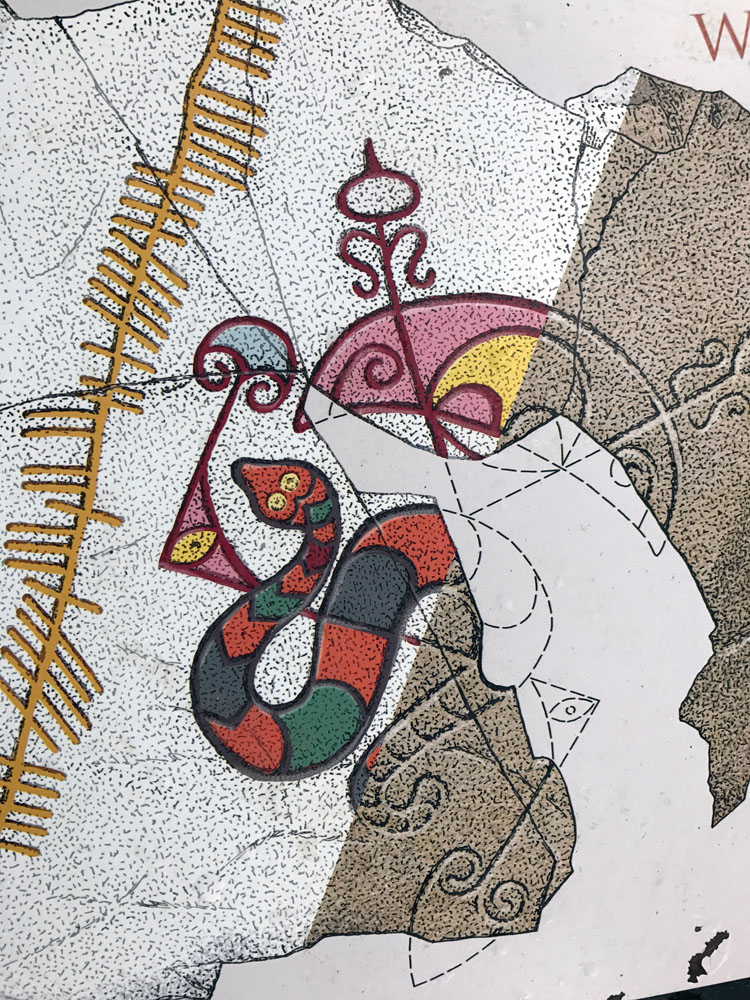
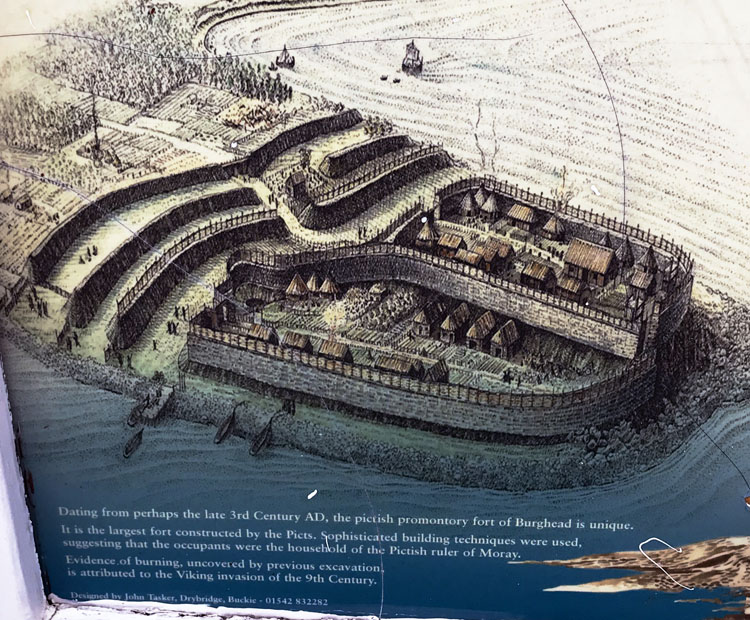
The mysterious race known as the Picts, did just that… and they built what would be in our terms a mighty city. Today, the small town that grew in its ruins is known as Burghead.
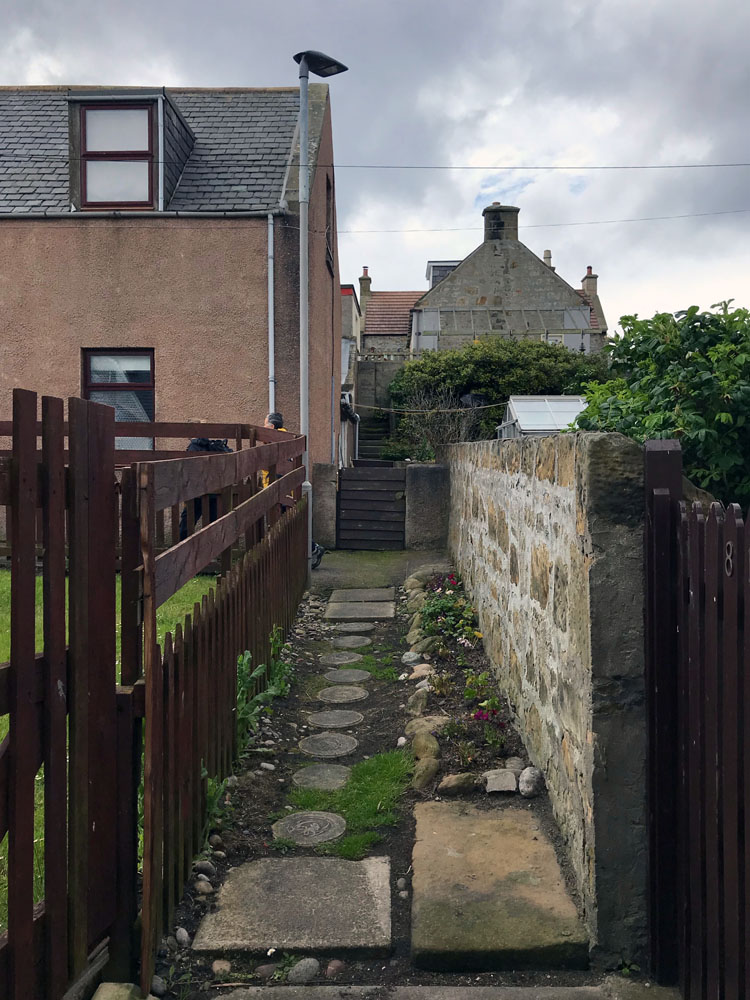
When we arrived we knew nothing of the above history. Dean (who had made a mysterious stop at one of the shops in the small high street) had arranged to take us through a warren of passageways to get to the famous and mysterious well.
Another turn and we approached our goal. It’s worth showing an edited copy of the Historic Scotland’s schematic. This pinpoints exactly where we now were in terms of the old fort…
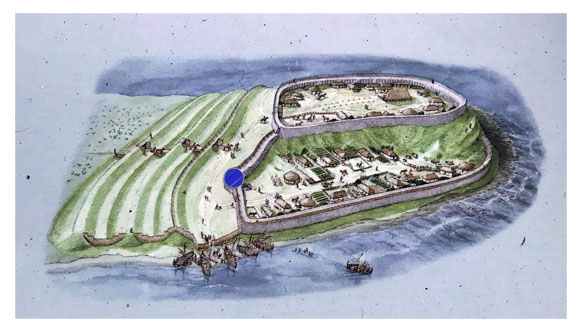
We stood before the wooden fence reading the Historic Scotland information boards. The Burghead Well is kept locked but Dean had collected the key from one of buildings in the main street. About to enter, we were surprised when a visiting family arrived and said they believed that he had the key! Graciously, we stood back while they added to their holiday enjoyment. They soon returned and we entered the strange space in what looked like a large garden with a depression in the middle…
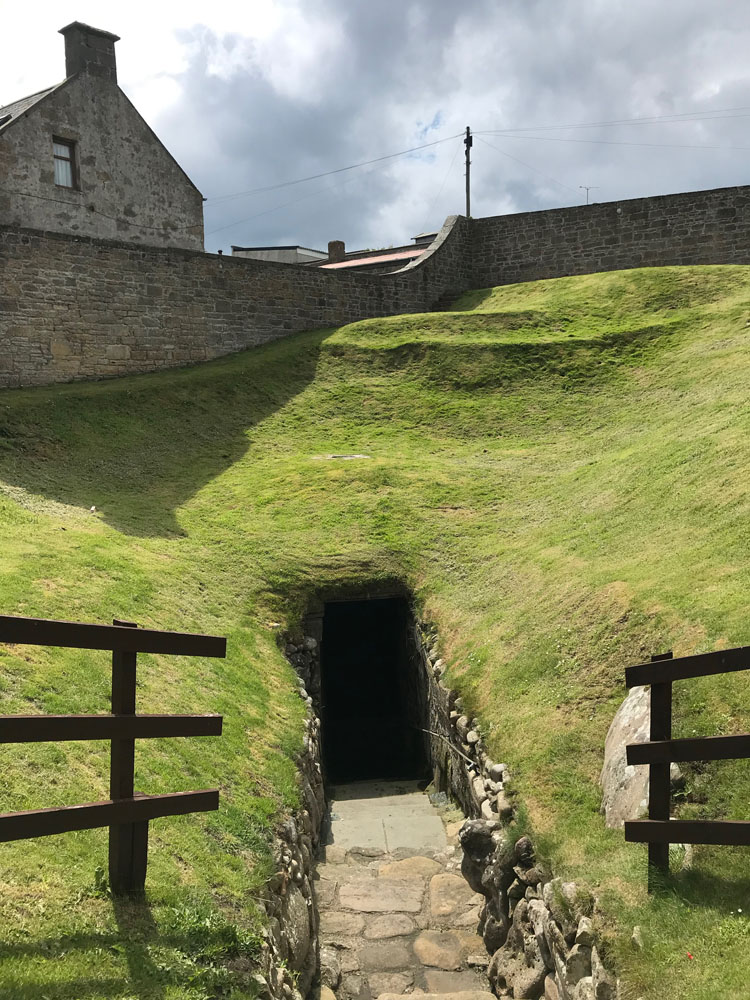
” An old man suggested that they should dig in a certain spot, where, according to immemorial tradition, a well would be found”
Gentlemen’s Magazine, 1828
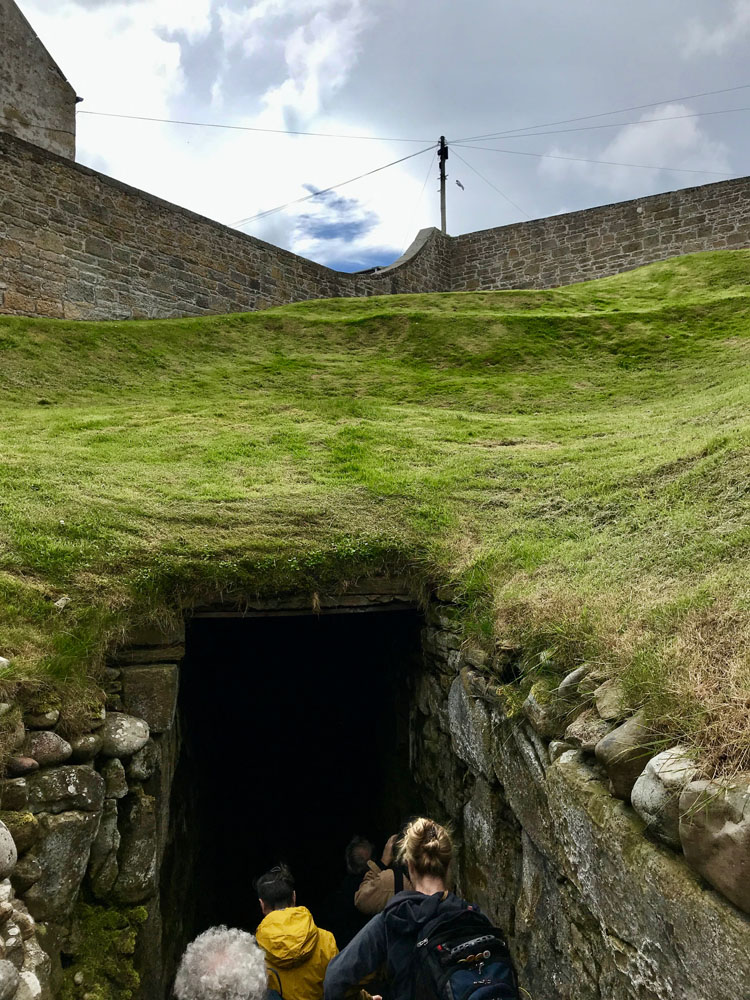
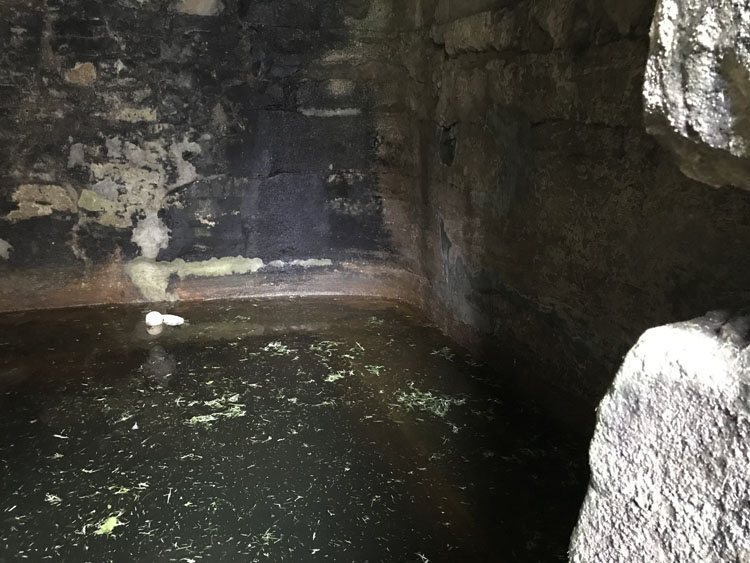
The well-chamber is accessed by a descent of twenty rock-cut steps. The entire structure was hewn out of the local rock. The chamber is square, with rounded corners; and measures 5m by 5m. In the centre of the chamber is a pool surrounded by a narrow ledge 0.9m wide. The well pool is 1.3m deep. It was once emptied for maintenance and took six days to refill.
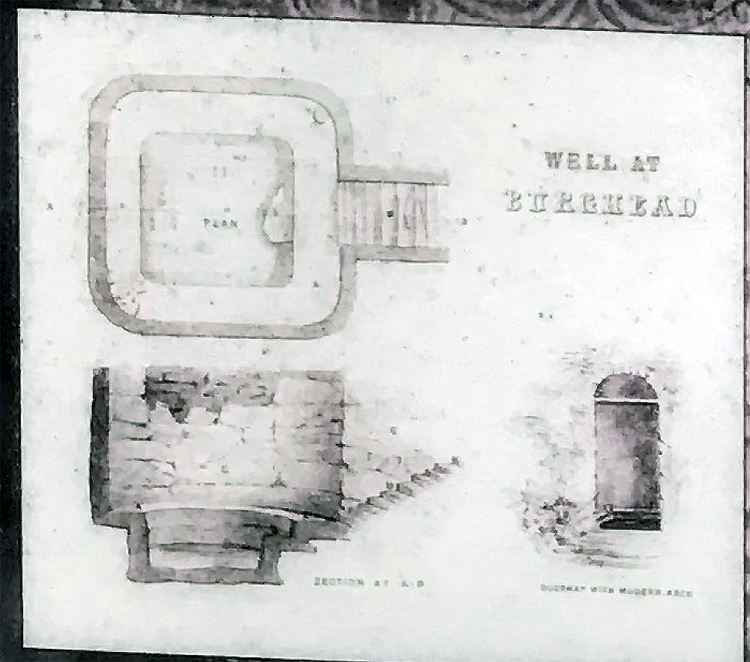
It is described as a ‘Pictish puzzle’
It is not known when Burghead Well was constructed, nor why. As we have seen from the schematic, it lies on the rampart line of the inner Pictish fort – built between the 4th and 6th centuries AD. The well may not have been part of the fort’s design. The well could have been added later or it could be even older than the ramparts themselves.
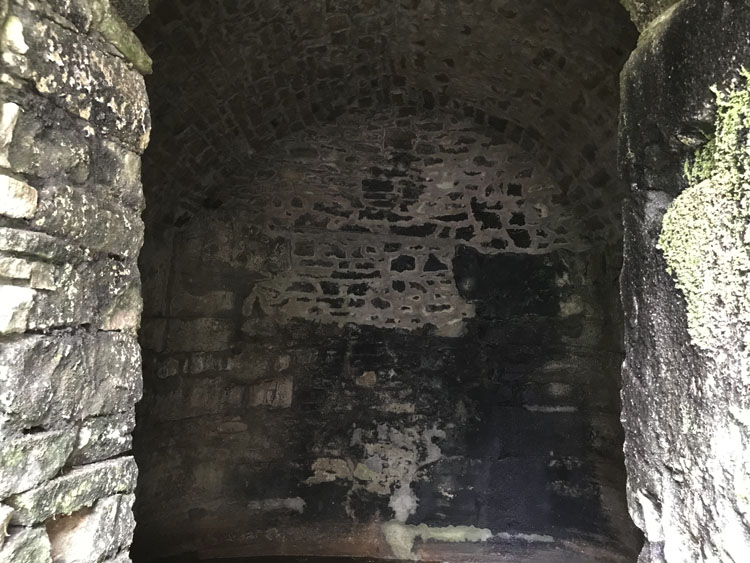
The well could be considered as a water supply for the Pictish fort, but a shaft would be of more practical use. The rock-cut chamber is 5m wide and contains a 1m deep pool which is fed by a spring.
The act of descending into the earth is likely to have had spiritual significance – as mirrored in the Greek myth of Persephone and Hecate.
Different explanations have been put forward. These include a ritual drowning pool, a shrine to Celtic water deities or perhaps an early Christian baptistery.
Then Sue suggested something profound….
After so much buildup, the actual water looked, for want of a better word, ‘sad’. Everyone spent a quiet moment taking in the age and cultural Pictish significance of this very special place. With a collective heavy heart, we began to move back up the rock steps… Then Sue stole the moment and suggested that we do some of our chants…
Music and chanting have been part of sacred practices for as long as man gazed in wonder at the stars and the sunrise. Over the years we have developed a set of chants that come under the general heading of ‘vowel sounds’. Stuart suggested a combination we had used before; one ending in the powerful ‘Aum’ sound.
Structures – particularly stone structures – have resonant frequencies. On a few notable occasions, such as when visiting the West Kennet barrow, just outside Avebury, we have been amazed and delighted when the artefact in which we were chanting ‘came alive’ and appeared to sing with us.
The Burghead Well did the same. In a second of incredible transformation the beautiful but neglected stone chamber began to ring with the human voice and to speak to us. It spoke of water, of the power of water, of the home of water. It spoke of the journey we were making from the element of earth to that of water, and everyone present left that beautiful and hallowed place in a state of deep reflection…
We may not have ‘connected’ with the ancient Picts, but we certain did so with what they left behind…
The morning was still not finished. Before we had our long-awaited lunch at the Findhorn Bakery, another laying-out of our water-oriented pentagrams was to be made on Findhorn Beach… or was it?
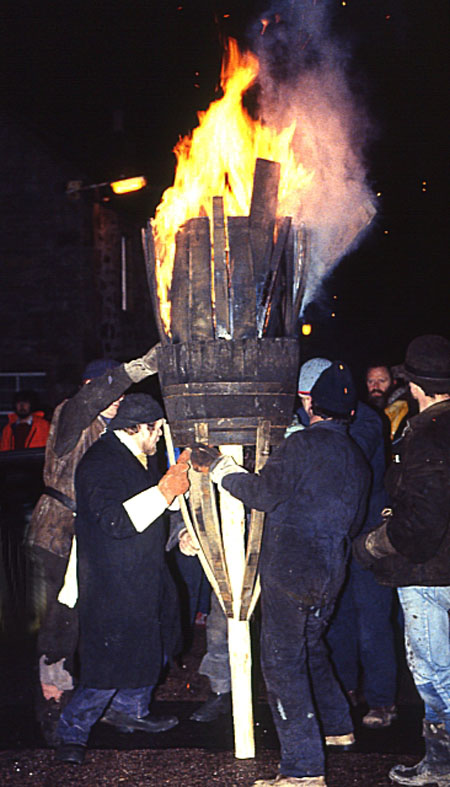
In passing, though not part of our agenda, it is worth noting that Burghead connects with its past in a very special way. It is the only Scottish town that still carries out the ceremony of the ‘Burning of the Clavie’ – the origins of which are lost in history. This takes place on the ‘old new year’ date of January 11th, unless that is a Sunday, in which case the 12th is used, instead.
CC BY-SA 2.0
https://en.wikipedia.org/wiki/Burning_of_the_Clavie
Elders of the town carry a flaming ‘Clavie’ – half of a cask filled with burning, inflammable materials and topped with tar – through the town. The procession ends at the ruins of an altar on the Pictish headland where the Clavie is made the centre of a ritual bonfire. When the originating Clavie finally falls apart, the people of the town rush forward to claim a piece of the still-burning material and take it back to ward evil from their homes…
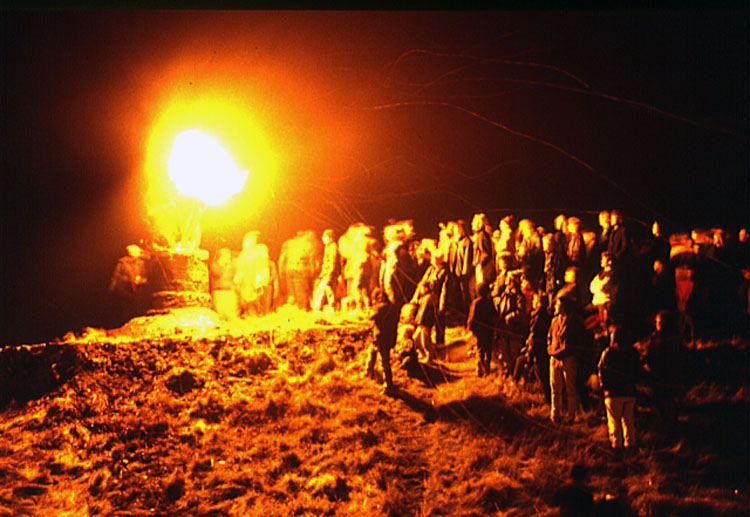
The burning of the Clavie
CC BY-SA 2.0
https://en.wikipedia.org/wiki/Burning_of_the_Clavie
To be continued….
Other parts in this series
Part One, Part Two, This is Part Three
©Copyright Stephen Tanham
Stephen Tanham is a Director of the Silent Eye School of Consciousness, a not-for-profit teaching school of modern mysticism that helps people find a personal path to a deeper place within their internal and external lives.
The Silent Eye provides home-based, practical courses which are low-cost and personally supervised. The course materials and corresponding supervision are provided month by month without further commitment.
Steve’s personal blog, Sun in Gemini, is at stevetanham.wordpress.com.
+ #Silenti, Ancient Landscapes, Ancient Sacred Sites, Celtic Christianity, Christianity and modern mysticism, Consciousness, esoteric psychology, Highlands of Scotland, landscapes, Magic, Mindfulness, Mystery Schools, Mystical ritual drama, myths and spirituality, Neolithic, Pentagram, Scotland, Silent Eye School, Spirituality
Three Days of the Oyster-Catcher (2) Coast and Castle
by Steve Tanham
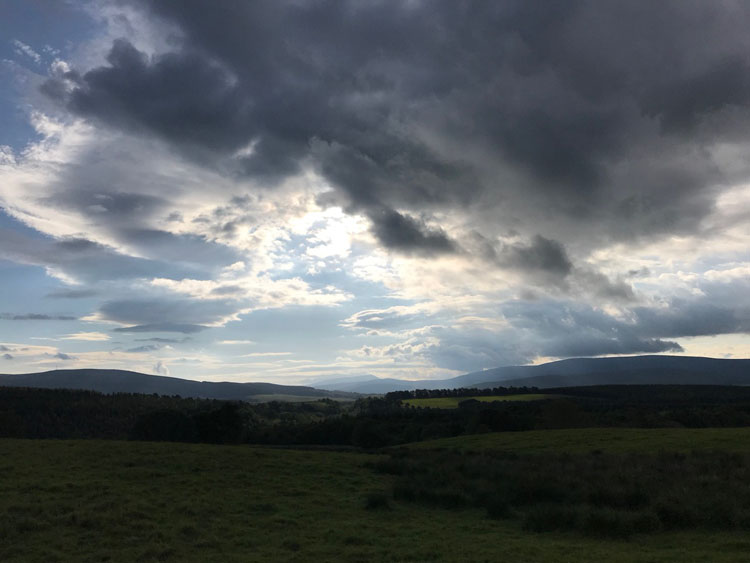
There has to be a dawn… I’m not being flippant. Our Silent Eye ‘spirituality in the landscape’ weekends always have at least one early morning event during which we gather somewhere beautiful and greet the dawn. It’s a joy and also a discipline: something that tells our inner self that ‘we mean it’. Sometimes we might read poetry or even enact something from esoteric literature. Sometimes we just gaze and drink it in…. Nature often responds… Once, in the Silent Eye’s ‘birth’ weekend we had a lamb follow us up the side of a field. Hard to better that one…
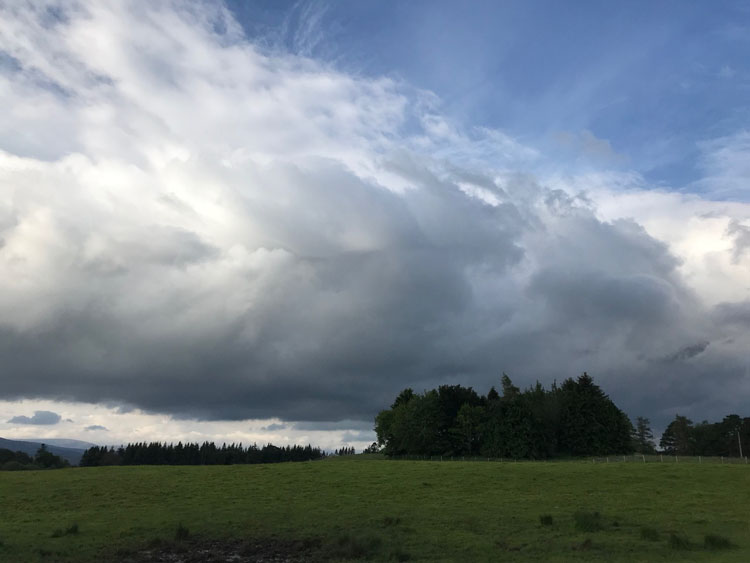
But, to do so in the locations around Grantown-on-Spey would have meant getting up at around three in the morning…. so we settled for a 7 am start, instead; to be followed by breakfast back at our ‘budget’ hotel.
Dean had picked us a beautiful location. The oyster-catchers thought so, too! Their beautiful calls rang out across the hilltop. Only a few minutes drive from our base town of Grantown, yet, with a short walk into a field, giving a view down the valley of the River Spey in all its beauty. The sun had long risen, but we took a few moments to greet it, and its life-sustaining power. Then it was down to work…
In the symbolic ‘pre-solstice dawn’ we were to consider the ‘element’ of Air, which is strongly associated with our mental aspects and thought. Aided by a reading of the Macbeth scene where Lady Macbeth tries to wash the imaginary blood of Duncan and Banquo’s murders off her skin, we took a moment to consider what our symbolic ‘Air’ meant to each of us. In my own case, I pondered the power and the weakness of ‘thinking’.
Thoughts are powerful tools: they empower ordinary ‘working-day’ consciousness. We may think about the spiritual, yet our experience of it lies beyond thoughts. From ancient times it has been taught that we must find the gap between our thoughts to seek the ‘opening’ the other world of our spiritual consciousness. Put like that, it’s not that complex – which further illustrates the power of thought to ‘inner chatter’ about the way… but only the theoretical way…
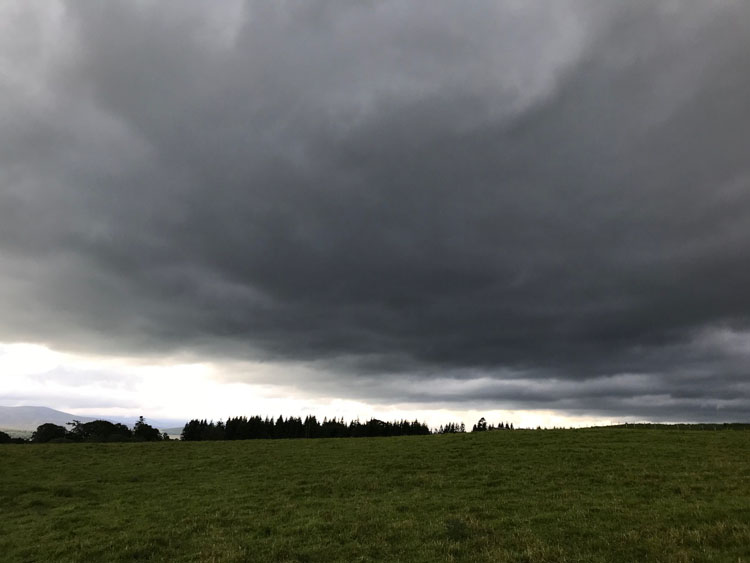
We scribbled in our notebooks and shared what we were comfortable with. Perhaps other thoughts had made us consider aspects of ‘Air’ at a deeper level… Eventually and in an unhurried manner – considering the darkening sky – we left to embark on the next stage of our Saturday adventure. Dean had fashioned a content-packed weekend.
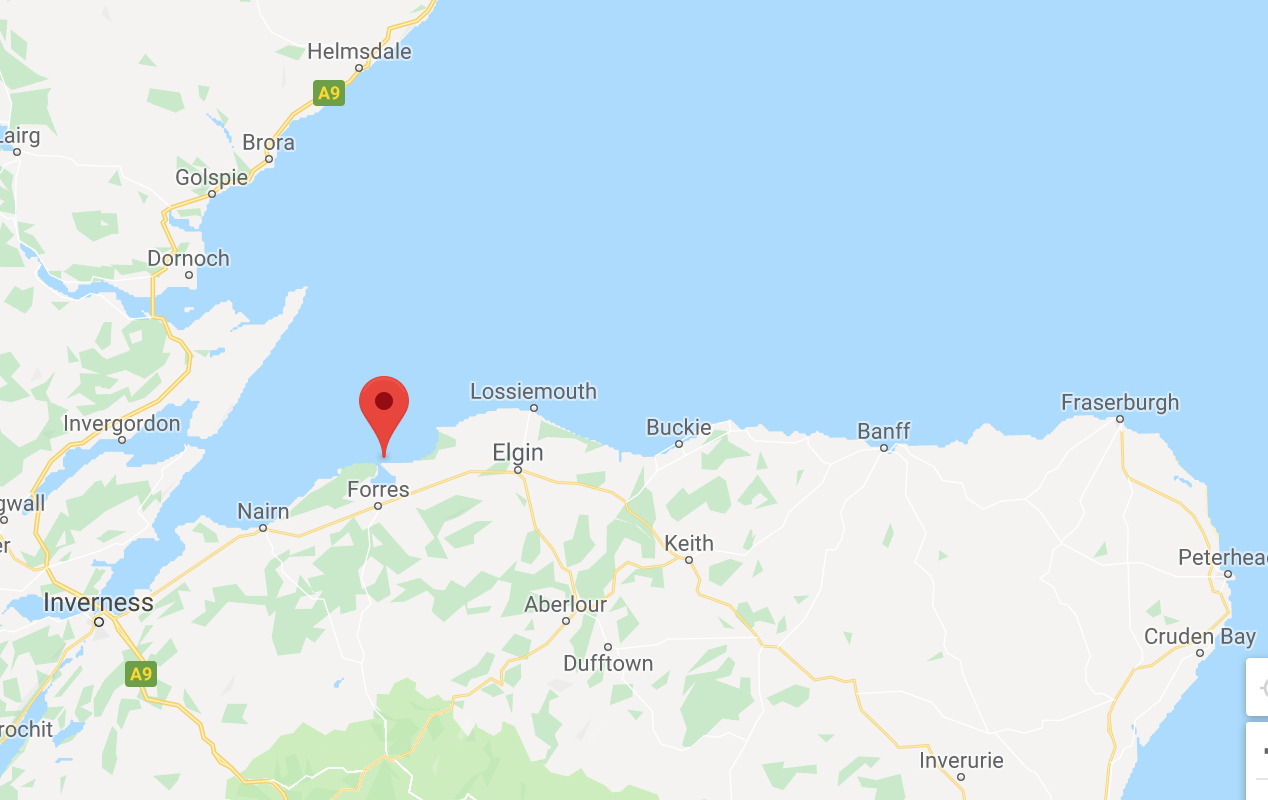
After a surprisingly good breakfast, we gathered again for our trip towards the north coast. The upper part of our ‘triangle’ was about to fill the rest of the day, with the Findhorn Coast and the largest Pictish standing stone in Scotland forming just part of the agenda.
But first we had the delight of Duffus Castle… a symbolic part of ‘Macbeth country’.
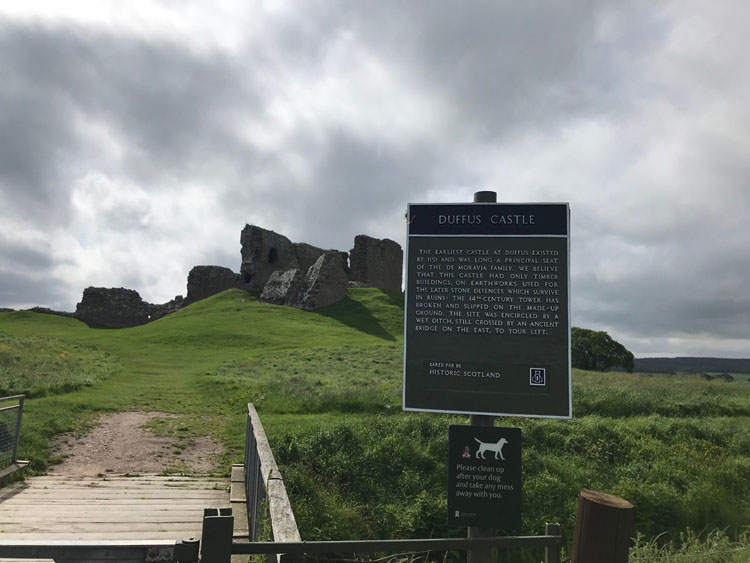
Duffus Castle was originally constructed in the twelfth century by a Flemish mercenary named Freskin. He was an ‘incomer’ who was granted Scottish land by King David I. The king was trying to reinforce his own authority by making land grants to those loyal to his military ambitions.
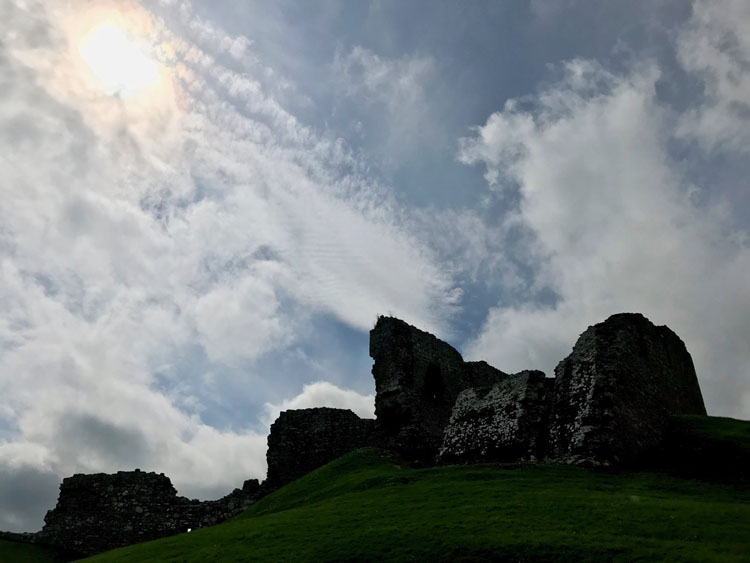
The original building was wooden and nothing survives except its site.
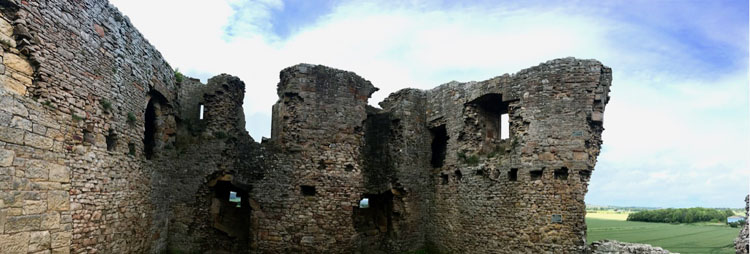
The present structure, though a ruin, is a classic example of a medieval motte and bailey castle – a raised mound with a less defended lower area; the latter designed to protect both supplies and craftsmen and (in much greater luxury) the owning gentry. The accompanying image, below, taken from the Historic Scotland notice board, illustrates this, showing the lord’s dwellings at the highest point.
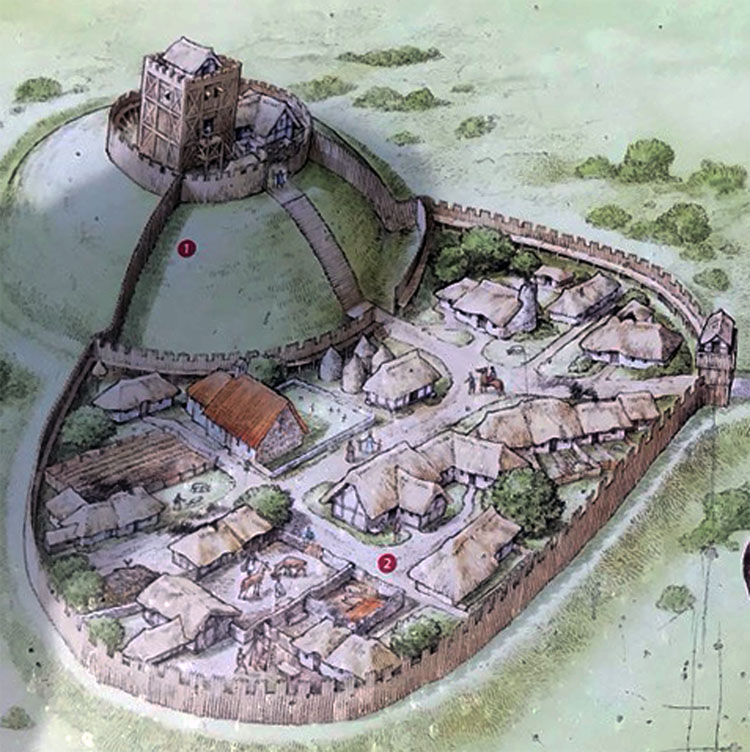
The rebuilding – in stone – was carried out around 1305 when Sir Reginald Cheyne was granted ‘200 oaks’ from the royal forests of Darnaway and Longmore to ‘rebuild his manor of Dufhous’. The wood would have used for flooring, roofing and scaffolding in the otherwise stone structure.
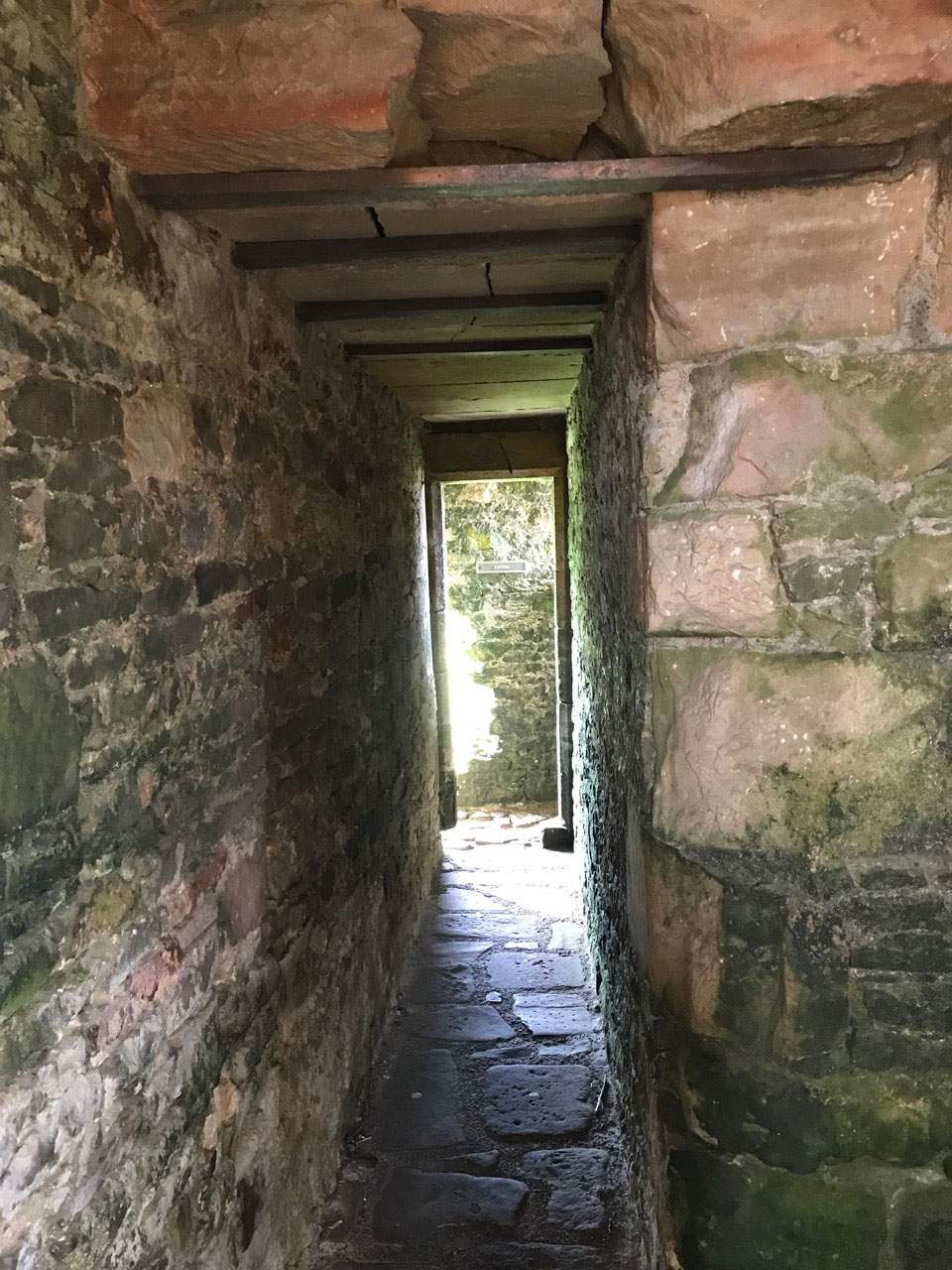
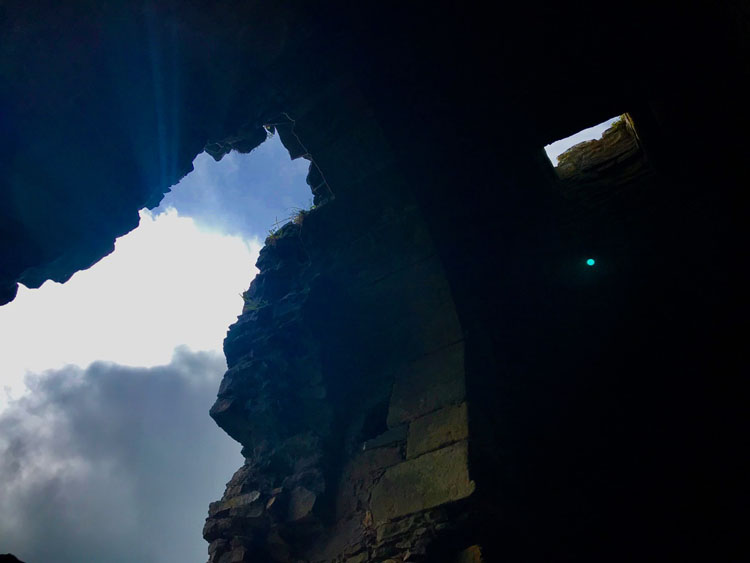
The main residence was the tower on the motte – the keep. The more comfortable rooms – hall, dining and bedrooms – were on the first floor; with shared accommodation for the household on the floor below. The windows were few and small, the only entrance was via an easily guarded portcullis.
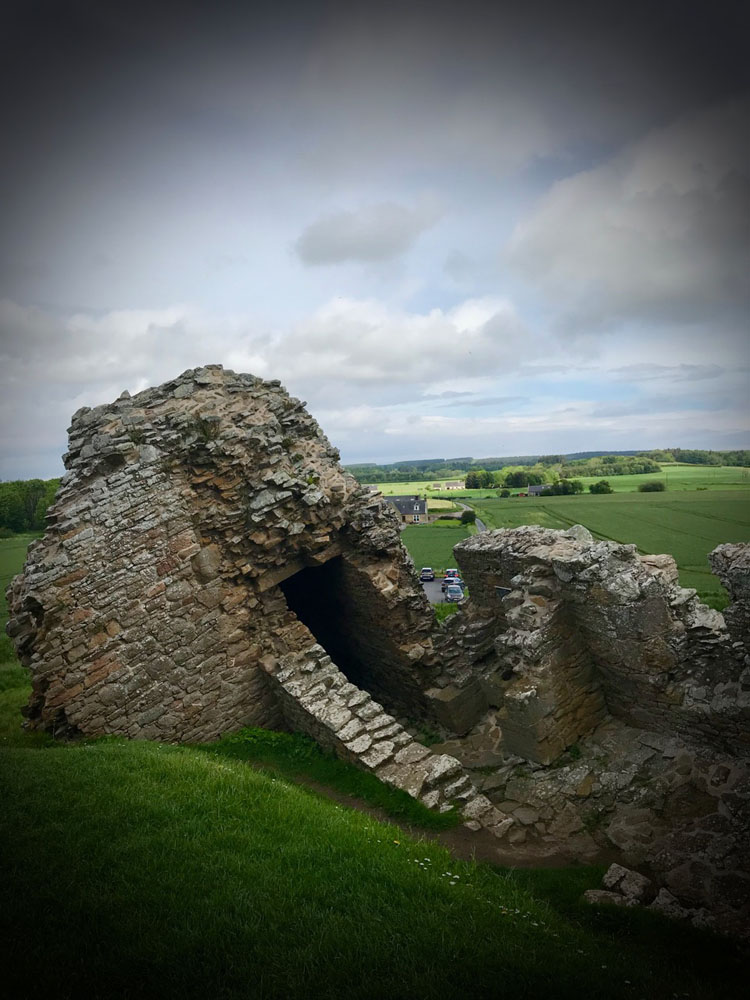
Sadly, the heavy castle was constructed directly on the ruins of the former structure. Eventually, the north wall of the tower slid down the hill. The lord had to move his quarters to the lower parts of his once-splendid castle.
It was time to make use of our Macbeth theme, again. This time Act III, Scene I, which begins with Banquo speaking his thoughts that the dreadful prophesy from the witches on the ‘blasted heath’ (which we were later to visit) had all come true… Macbeth was the Thane of Cawdor, Glamis and King. And Banquo had good reason to fear the newly-elevated tyrant… his former friend. There is much of great depth in such storytelling, and it fits well with a modern approach to the psychology of mankind.
“Thou hast it now, king. Cawdor, Glamis, all. As the weird women promised, and I fear thou play’dst most foully for’t…”
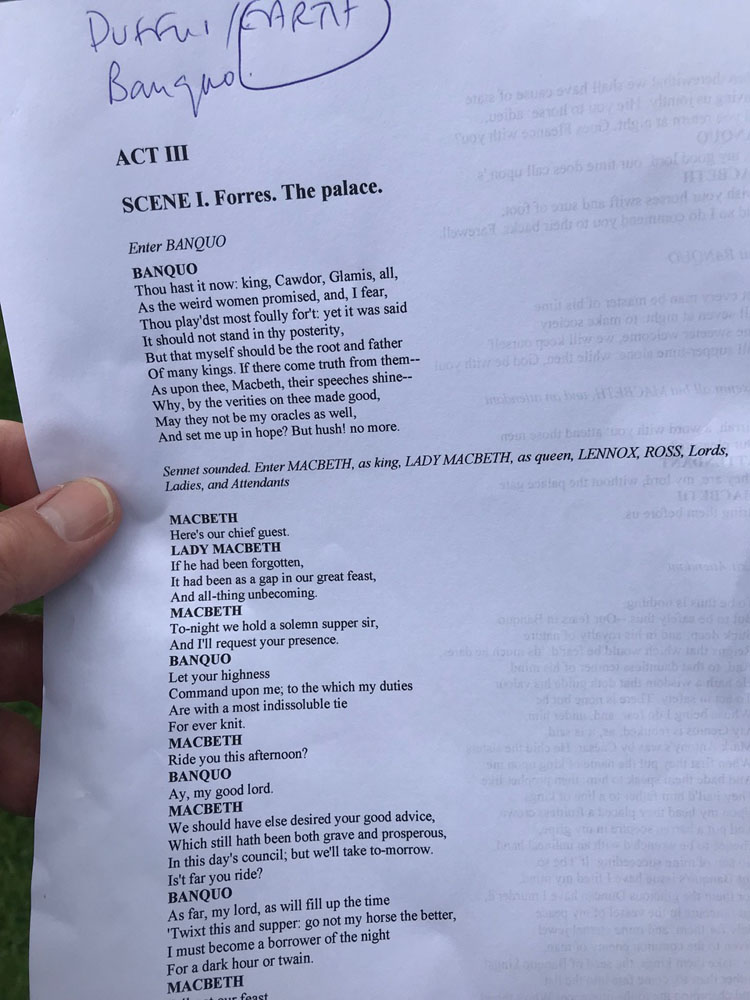
Our volunteer ‘actors’ were enthusiastic – we all took turns through the weekend. The group was at ease and good-natured. We smiled, yet considered the deeper side of Macbeth’s wilful ambition. How did it relate to us? Dean had selected Duffus castle to be the pentagram point of ‘Earth’. In his new system, this was the place of the Potential Self.
It was very suitable. Alchemical Earth is all the things that are foundational and basic – but essential. Without the earth in which organic things grow we would be nothing. We do not demean the earth symbol as being in any way lowly – in the same way that astrology does not – but it is the home of our bodies and of sex. Also the home of the lower emotions such as Macbeth’s twisted ambition….
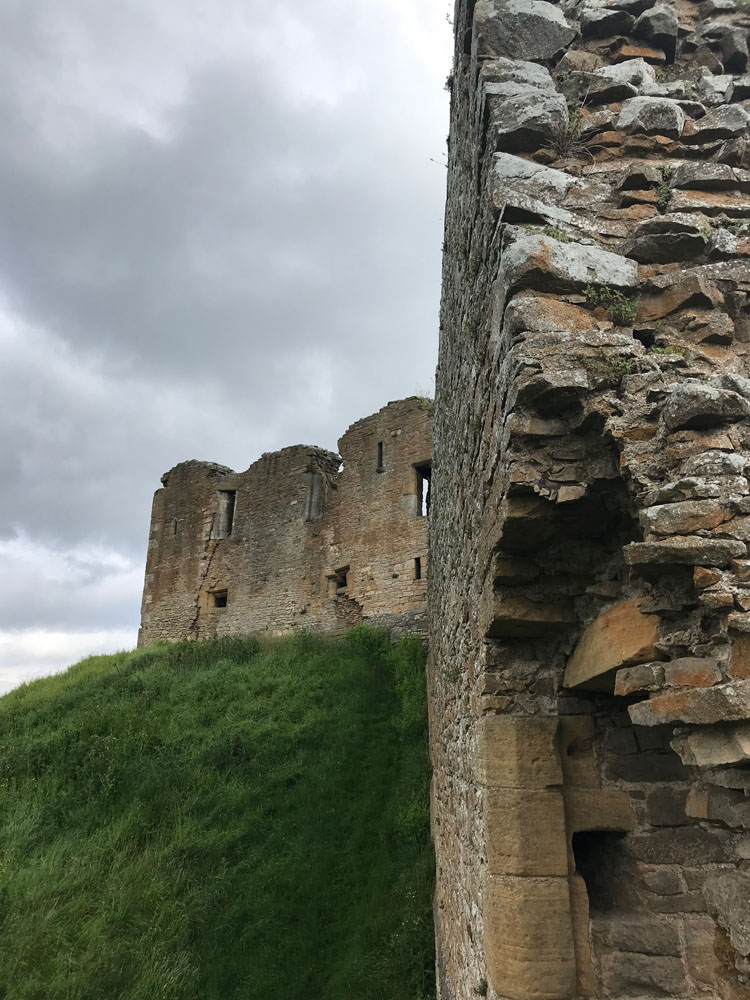
Duffus was a fitting symbol of Macbeth; a man who ‘o’er reached himself’. The castle, built on insecure foundations – like the Thane’s rise to kingship – fell into the mud, there to languish as a lasting symbol to us all… A sobering thought!
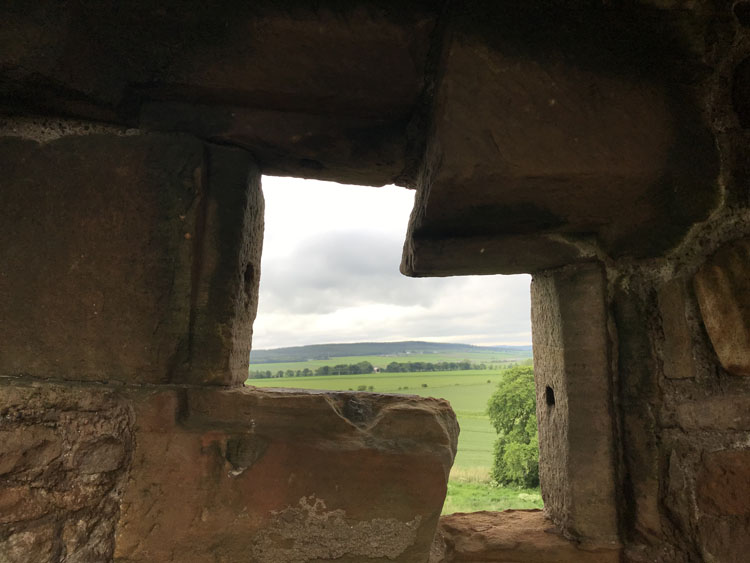
We were only part-way through the morning, yet felt like we’d had a day of activity. Walking out of the castle and past the long wall of Duffus, we listened to Dean’s description of our next place of inner and outer discovery – a holy well set deep in the ground of modern Burghead; a place with a rich and fascinating Pictish heritage. A place of sleeping water… and perfect acoustics.
To be continued….
Other parts in this series
Part One, This is Part Two
©Copyright Stephen Tanham
Stephen Tanham is a Director of the Silent Eye School of Consciousness, a not-for-profit teaching school of modern mysticism that helps people find a personal path to a deeper place within their internal and external lives.
The Silent Eye provides home-based, practical courses which are low-cost and personally supervised. The course materials and corresponding supervision are provided month by month without further commitment.
Steve’s personal blog, Sun in Gemini, is at stevetanham.wordpress.com.
Sue begins her narrative on the SilentUnicorn weekend
Share this:

+ #Poetry, #Silenti, Alchemical Poetry, Consciousness, Mystical poetry, Silent Eye School, spiritual turning around, Spirituality, Stone Circles
Harlequin Solstice
by Steve Tanham
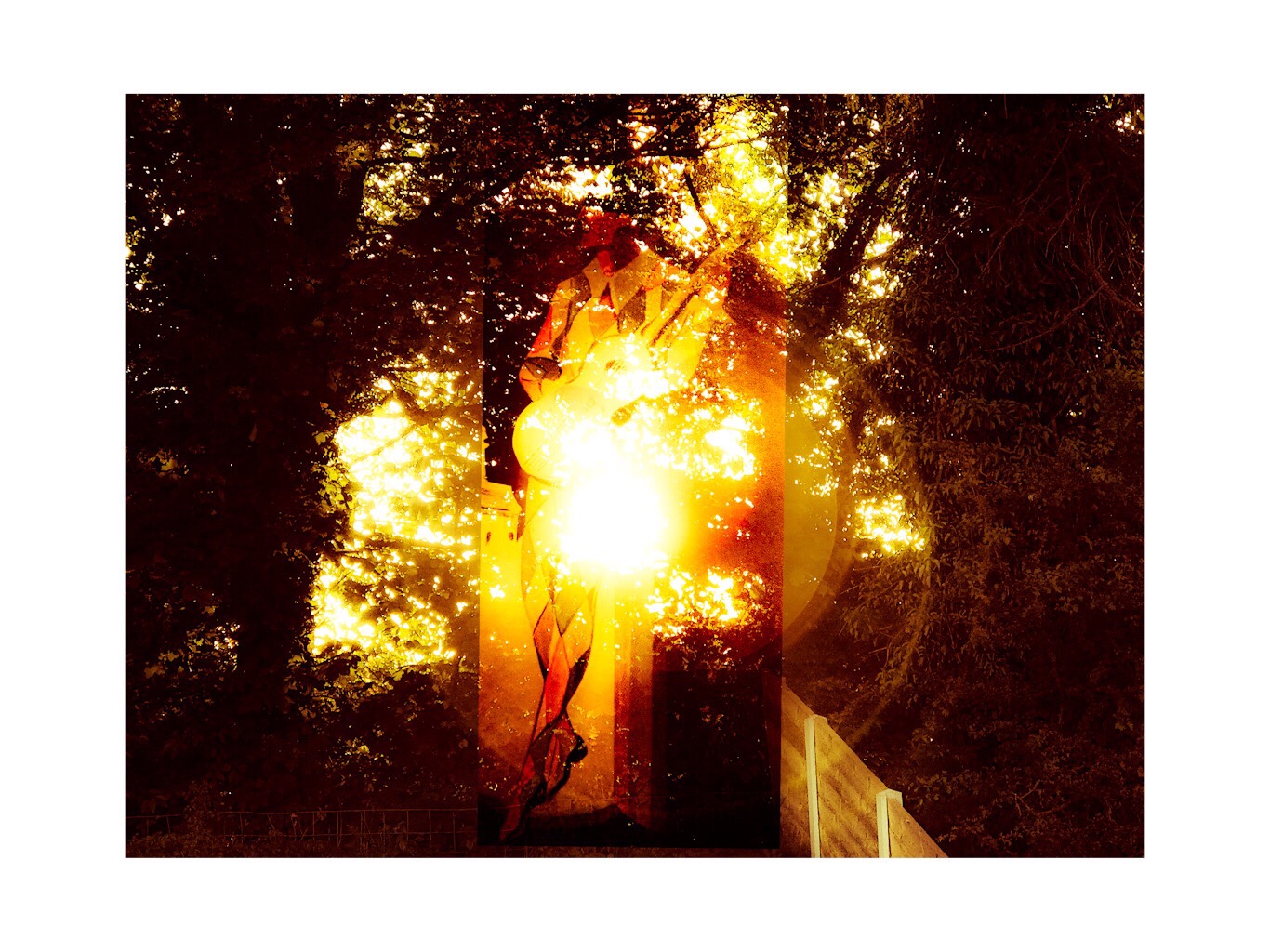
Harlequin solstice
St John Kin
A picture in the fading sun
A race of fingers, digits
Of solstice long earned
Short departed
➰
How little
How sadly
You are understood
Your music the struggle
Of madness
Made harmony
➰
Until this moment
When kings detach your strings
When single song
Descends
Towards the dark arms
But brighter eyes
Of St Stephen
➰
©Stephen Tanham
Share this:

+ #Silenti, Ancient Landscapes, Ancient Sacred Sites, Celtic Christianity, Christianity and modern mysticism, Consciousness, esoteric psychology, Highlands of Scotland, landscapes, Magic, Mindfulness, Mystery Schools, Mystical ritual drama, myths and spirituality, Neolithic, Pentagram, Scotland, Silent Eye School, Spirituality
Three Days of the Oyster-Catcher (1)
by Steve Tanham

We were standing close to the River Spey in the grounds of Strathallan church a few miles from the centre of Grantown-on-Spey: one of the gems of the north-eastern highlands of Scotland. The previous hour had seen us all meet at a tea room in the centre of the town. We discussed the plans for the weekend, drank tea and had cake…
Strathallan church is famous for its beautiful location by the river. But it is also the site of an ancient pictish stone; one that bears markings related to the mysterious number at the heart of the pentagram – Phi.

The call of the nearby oyster-catcher rose till it was overwhelming.
“A lone female,” the groundsman of the nearby church explained, as he prepared to wield his petrol strimmer against the long grass around the neighbouring gravestones. “Down to one surviving egg,” he shouted, lowering his ear mufflers. “Makes a terrible racket!”
Whatever else he was trying to convey to our suspicious-looking bunch of clipboard-wielding visitors was lost in the mayhem that followed. You have to wonder if the oyster-catcher was chuckling…
You get days like this in the pursuit of mystical experiences…
Luckily, our guide and teacher for the weekend, Dean Powell, was used to dealing with adversity. We have shared many an adventure, he and I. This, the Silent Unicorn weekend – a union of the Silent Eye and his Scottish Lodge – was to be one of the best.

We stuck the twin noises as long as possible, then moved to the edge of a high wall, near the river, against which we could begin our construction of ‘pentagrams from ribbons’. We had no plans to enact moonlit rituals! To start with, there’s precious little darkness this far into northern Scotland so close to the summer solstice. Darkness lasts a few hours at best, and the dawn is about 03:00.

The pentagrams were to be the basis of a psychological analysis of ourselves. Their five-pointed shapes would come to represent our journeys of self-enquiry as we let rationality slip away within the glorious green of the Spey valley, the Findhorn coastline, and the mysterious castles of Macbeth country…

The river Spey’s course is just over one hundred miles long and is the fastest flowing river in Scotland. Its beautiful landscapes are famous for salmon fishing and the production of Scotch whisky. It flows northwards, ending in the Moray Firth a few miles west of Buckie. We were to see many of its beautiful faces as the weekend progressed.

The groundsman’s strimmer fell silent. The oyster-catcher’s urgent protest stilled. We would be reunited soon enough.
Dean pointed to our first-attempt pentagrams and allocated names to the five points; later backed up by a comprehensive set of handouts.
The pentagram has long been a symbol of both the human and the place of the human in the scheme of creation. In other posts, I have detailed the unique geometric properties of its shape. The primary mystery of it lies in the embedded ‘magical’ number Phi. Phi allows the division of a ‘whole’ into two parts such that the child pieces retain their relationship with their dimension of origin. Phi is the ‘seen’ symmetry in plants and seashells, and can be found throughout nature. Famous artists, such as Leonardo Da Vinci, based much of their work on this mysterious number.
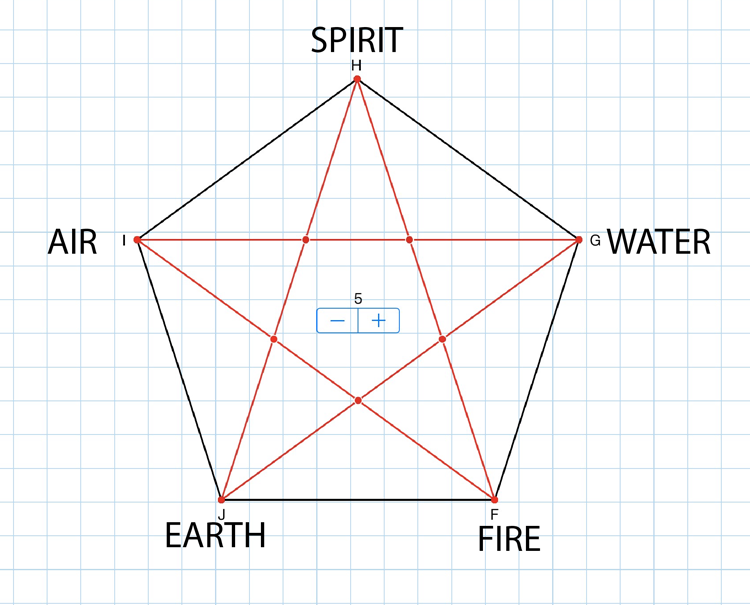
Dean’s use of the pentagram was as a map of the human self, using the headings of:
- Core
- Potential
- Limited
- Boundary
- Weak/Defect
- Shadow
The meanings of these would unfold within the beauty of the landscape. We were in for quite a weekend…
To be continued….
©Copyright Stephen Tanham
Stephen Tanham is a Director of the Silent Eye School of Consciousness, a not-for-profit teaching school of modern mysticism that helps people find a personal path to a deeper place within their internal and external lives.
The Silent Eye provides home-based, practical courses which are low-cost and personally supervised. The course materials and corresponding supervision are provided month by month without further commitment.
Steve’s personal blog, Sun in Gemini, is at stevetanham.wordpress.com.
Share this:

+ #Silenti, Ancient Landscapes, Ancient Sacred Sites, Astrology, Belief and Faith, Castles, Consciousness, English Lake District, guided mystical walks, Higher Mind, Lake District, Magic, meditation, Mindfulness, Spirituality
The way to dusty death?
by Steve Tanham

We were in Ulverston, Dean and I. We’d just climbed the famous ‘Hoad’ – a tall monument on the top of a tall hill that looks like a lighthouse… but isn’t. There’s some important symbology in that, but we’ll return to it later.

He was on his way back from Somerset to northern Scotland – the Glenlivet area of the North Cairngorms, where he and his loved ones have their home. Our house in Cumbria is en-route, so the door is always open to break his journey. After a night involving Bernie’s excellent cooking and a glass of red wine or two, we decided that a local (ish) walk would put some air into the bloodstream for his second leg and return to the far north.
Ulverston is one of our local favourites. It’s about a half-hour journey up the fast Barrow road. A coffee in Ford Park and then the short but taxing climb up ‘The Hoad’ to get to the famous lighthouse that isn’t. It can be seen all over the expanse of Morecambe Bay. It’s actually a monument to the famous engineer Sir John Barrow.
We’d got our breath back by the time we got to the monument. The Silent Eye had recently carried out the ‘Jewel in the Claw’ spring workshop at Great Hucklow – our annual biggie. We had used a Shakespearean theme, casting one of our Californian visitors as Queen Elizabeth – ruling over a giant chessboard which was the royal court; and upon which the players moved with great caution… under her watchful eye.
Dean and Alionora had played two of the central characters: Lord Mortido and Lady Libido – death and life in the fullest sense. They were superb. Leaving the tiny village Dean had reflected that there might be scope for doing something else ‘Shakespearean’, in the form of a journey around Macbeth Country, centred in Grantown-on-Spey, not far from where he and Gordon live.
Now, on top of the world and next to the faux lighthouse, we began to discuss it in earnest.

It would involve several kinds of journey. First, it was a long way to travel; but we had all driven down to Dorset the year before for the similar summer weekend, so we knew we’d get the support from our hardy regulars…

Second, there had to be a dual journey in terms of both spiritual discovery and visiting the landscape. The event was to take place in a triangle of land between Grantown, the Findhorn Coast and the Macbeth castles just south of Inverness. There would be no lack of scenery! Dean had already assembled a set of places with that ‘special feel’, including a mysterious old church and a stone circle. Within this combined landscape he proposed leading a journey of self-discovery using an ancient magical symbol. Macbeth’s ‘witches’ had to be honoured – they were a very real force in the time of James VI of Scotland – and subsequently the English king on the death of Elizabeth I. Dean has an intensely esoteric background and is a qualified NLP therapist and teacher as well as the local leader of Lodge Unicorn n’ha Alba. He has recently developed the idea of the ‘magical matrix’ and proposed to use this to accompany our journey in the highland landscape.
I hadn’t realised until he told me that the Unicorn is the national animal of Scotland. The event would mix his Scottish team and the Silent Eye, and we proposed it be called the Silent Unicorn.

Somewhat pleased with the plan, we took the long and winding path down from the Hoad to have a fruitful cafe lunch in Ulverston.

And now it is upon us. Like Macbeth we must earn our keep (sorry) and ‘strut and fret’ upon the magnificent stage of the highlands. Our weekend’s tower must be a true one and not false. Only with that intent – that something deeper is afoot, will we attract the intellectual and emotional harmony that so typifies these Silent Eye ‘landscape journeys’. By the time this is published, we will be leaving Cumbria, to join up with friends old and new from across the UK. We all face a long journey; but a very rewarding one.
For more information on joining us for one of the Silent Eye ‘discovery in the landscape’ weekends, click to see our forthcoming events, here.

©Copyright Stephen Tanham
Stephen Tanham is a Director of the Silent Eye School of Consciousness, a not-for-profit teaching school of modern mysticism that helps people find a personal path to a deeper place within their internal and external lives.
The Silent Eye provides home-based, practical courses which are low-cost and personally supervised. The course materials and corresponding supervision are provided month by month without further commitment.
Steve’s personal blog, Sun in Gemini, is at stevetanham.wordpress.com.
Share this:

Willow continues her recollection of the last stages of the Lord of the Deep workshop.

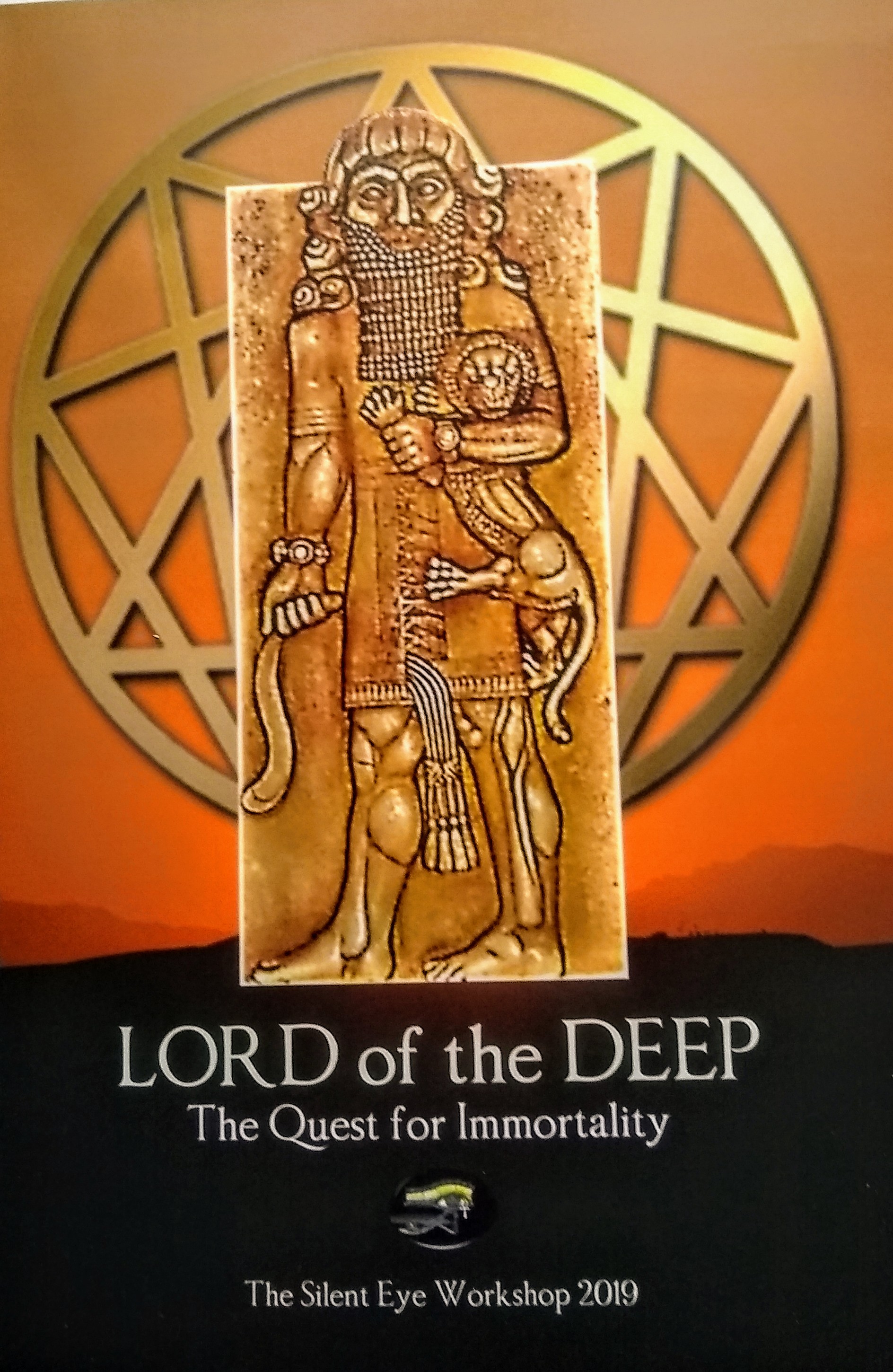
Urshanabi leads Gilgamesh to the Deep Underworld. And so for nine hours Gilgamesh has to out run the sun.
And he does out run the sun, though how I do not know.
Continued
After nine exhausting hours with the sun hot on his heels Gilgamesh emerges from the underworld into the garden of the Gods.
The garden is a place that even, the mighty King of Uruk has never seen the like of. He was dazzled by trees and plants that have flowers and blossom of precious and semi precious stones and gems. It was quite amazing.
Then Gilgamesh is confronted by an ordinary man, Utanpishtim. The king of Uruk is surprised he was expecting a God that he would have to fight.
Weaponless Gilgamesh has to talk to Utanpishtim who asks him why he looks so tired and wan. Gilgamesh tells him how he has spent his last nine…
View original post 424 more words
Share this:

From Sue…

‘Know thyself’… Pausanius tells us it was inscribed in the court before the temple of Apollo at Delphi. We are given to understand it is associated too with the Inner Temples in ancient Egypt. It is one of the first phrases we come across in esoteric studies and where else could we begin? It is not the easiest thing to look into the mirror of the soul and admit to oneself what one finds there. Even less to share that openly with others by dropping the social masks and simply being who we are.
I first learned the concept as a child from my grandfather, but it was one it took years to begin to truly understand and longer still to try and put into practice. As we grow through adolescence and youth our self-image constantly shifts, changing as it reflects the desire to become who we think we ought…
View original post 548 more words
Share this:

+ #Silenti, Ancient Sacred Sites, Astrology, Astrophysics, Consciousness, enneagram, esoteric psychology, Harmony, Higher Mind, Life-sciences, Magic, myths and spirituality, Pentagram, Photography, Sacred Geometry, secret language of mythology, Silent Eye School, Spirituality
The Golden Eye of Fiveness (3)
by Steve Tanham
“It is highly dishonourable for a Reasonable Soul to live in so Divinely built a Mansion as the Body she resides in, altogether unacquainted with the exquisite structure of it…”
Robert Boyle
In Part One, and Part Two we looked at a the emergence of a special number, Phi, that allowed the division of any ‘whole’ – like a figure in a painting or a building – into a series of proportions that divided it, but also retained its original relationship to the overall dimensions. the original ‘parent’. The number cannot be written, exactly, because it is ‘irrational’ – really an infinite relationship whose digits never recur. But the table below shows its emergence, to three decimal places, from the Fibonacci series. See Part One for the details.

This magical number, often called the Golden Mean or the Golden Section, was named Phi after the Greek artist and sculptor, Phidias, best known for his design of the statue of Athena within the Parthenon in Athens and the celebrated status of Zeus at Olympus. Both works were famous for their beauty… and also a sense of ‘specialness’. The reason for the latter is less well understood, yet central to our final consideration of this essence of ‘fiveness’.
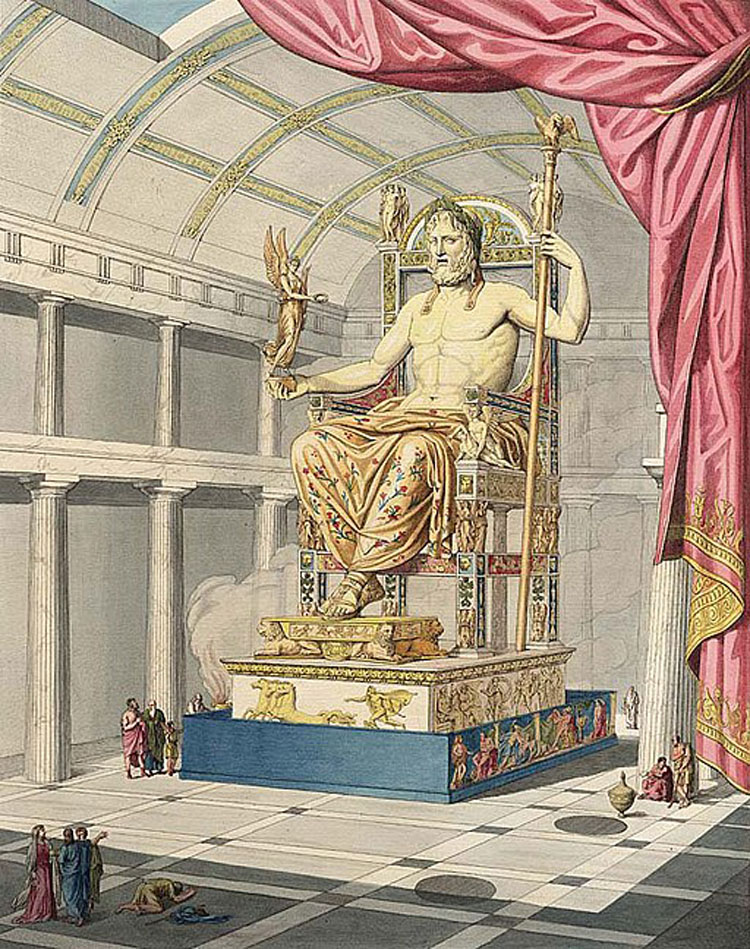
Phidias, or the school he belonged to, had discovered that the human body followed ‘divine proportions’ – all based on the magical number of Phi – approximated as 1.618.
In the human form, the primary unit of this ‘divided divinity’ was the vertical distance between the brow of the face (the top of the eye, as in ‘eyebrow’) and the tip of the nose. Taking this as a base, the the vertical distance from the brow to the crown of the head is Phi times the base unit -the brow to tip of nose.
Moving the other way, the Phi ratio applies between the nose tip to the base of the neck. Travelling down the body, the same ratio applies – but with increasing lengths – from the neck to the armpit, then the navel, to the reach of the fingertips, and, finally from the fingertips to the soles of the feet. Using this analysis, there are seven harmonic sections to the human body.
Phidias used these proportions to create his breathtaking art. His approach was copied by many throughout history, including Leonardo Da Vinci, who had also inherited a love of another symbol that encapsulated the uniqueness of this magical proportion – the pentagram.
The origin of the pentagram is lost in ancient history, but was known as an astronomical symbol around 6,000 years BC in the land that became Sumer – possibly to represent the visible planets: Jupiter, Mercury, Marks, Saturn and Venus.
Its rise in Western history is due to the adoption by the School of Pythagoras (approx 500 BC), who shaped so much of our philosophical thought. The Pythagoreans knew the mathematical properties of the Golden Ratio and its relationship to the pentagram. Pythagoras was said to keep his own small pentagram with him at all times.
To conclude this series of three posts. Let’s examine the pentagram in the light of what we have learned about the Golden Section –
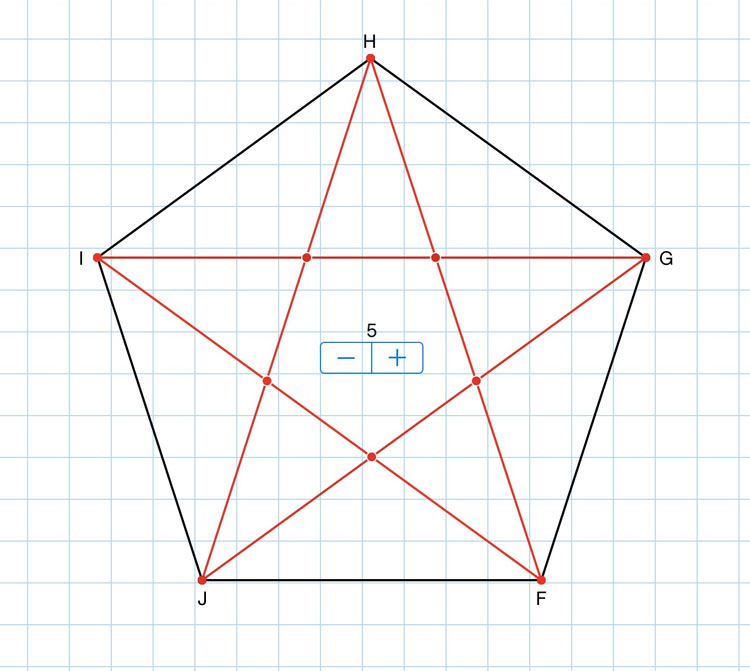
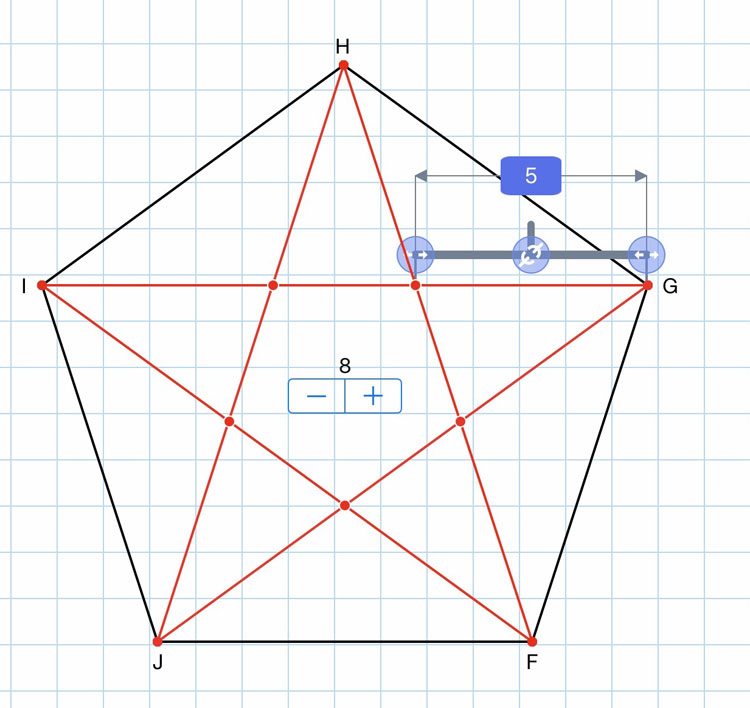
This five-sided ‘star’ can stand alone, or can sit within either a pentagon or a circle. The simple iPad geometry app I’ve used to create these diagrams (Geometry Pad) allowed only one measurement to be shown while the snapshots were being taken. We need to combine the measurements shown in Figure Four and Figure Five.
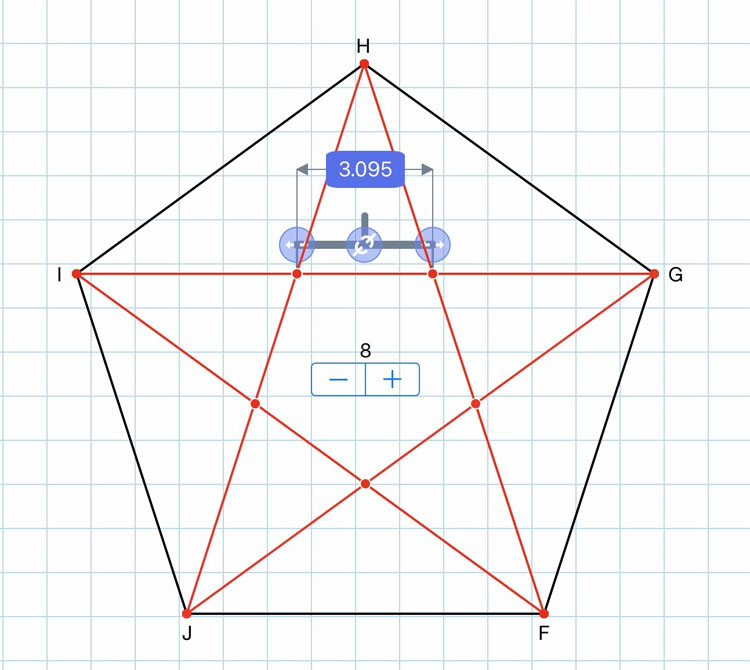
Look at the line running from G to I. It has three divisions caused by the intersections with the other vertices. From Figure Four we see that the distance from G to the first intersection is 5 units. Figure five shows us that the next section is of length 3.095 units. Allowing for the slight inaccuracy of the graphics we can divide the smaller by the larger and get 1.618, which is the value of Phi – the Golden Section.
This is only one instance. The pentagram is entirely constructed from Phi and Phi squared. As we have seen, it is truly the glyph of the human, and its Phi-based symmetry is too closely allied to our proportions to be considered an accidental result.
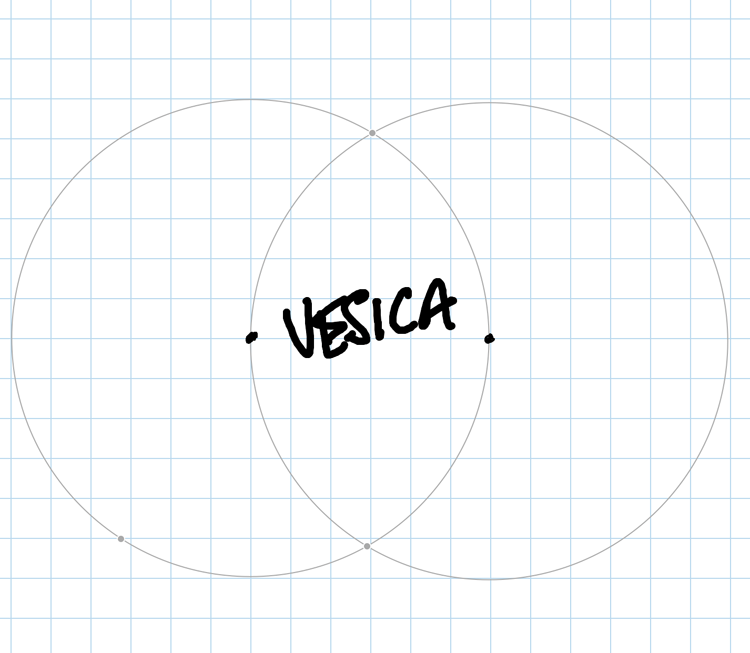
It is beyond the scope of this post but the pentagram first emerges – graphically – from the interaction of two circles, as above. First comes the point, then the line, then the triangle, then the square – then the pentagram. It occupies a very special place in Creation…
I believe we will go on discovering further depths to the pentagram in the years to come.
Other posts in this series:
©Copyright Stephen Tanham
Stephen Tanham is a Director of the Silent Eye School of Consciousness, a not-for-profit teaching school of modern mysticism that helps people find a personal path to a deeper place within their internal and external lives.
The Silent Eye provides home-based, practical courses which are low-cost and personally supervised. The course materials and corresponding supervision are provided month by month without further commitment.
Steve’s personal blog, Sun in Gemini, is at stevetanham.wordpress.com.
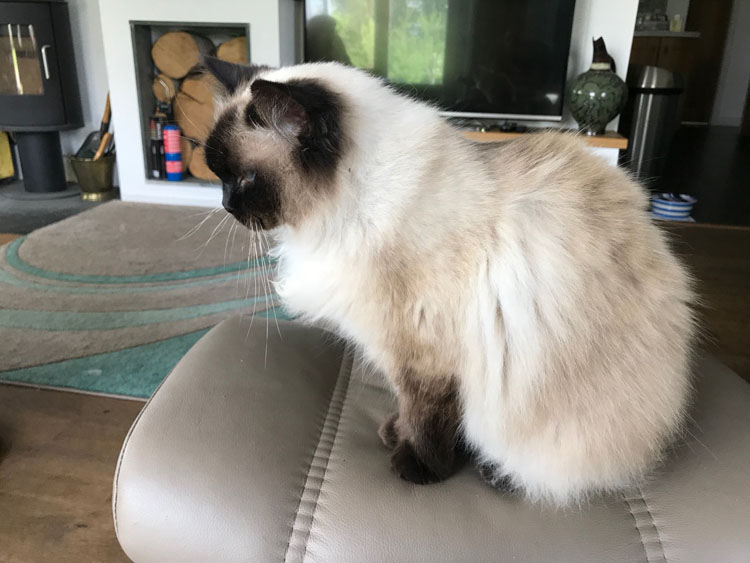
– Have you studied me recently?
That’s my footstool, you know
– I’m very beautiful…
But I’ve had a long day. I want my feet up!
– I’m still beautiful
©Stephen Tanham
From Stuart… and timely


 Sun in Gemini
You must be logged in to post a comment.