+ #Collie dogs, #Poetry, #Silenti, Consciousness, Mystical poetry, Seasons of the year, Seasons, Four Seasons, Spring, Summer, Autumn, Winter,
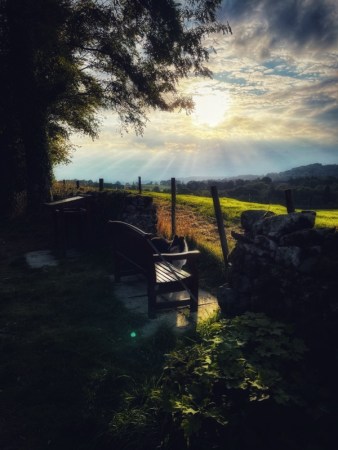
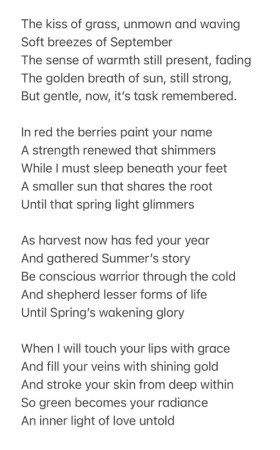
Into the Autumn
by Steve Tanham

©Stephen Tanham 2021
Stephen Tanham is a Director of the Silent Eye, a journey through the forest of personality to the dawn of Being.
http://www.thesilenteye.co.uk and http://www.suningemini.blog
Share this:

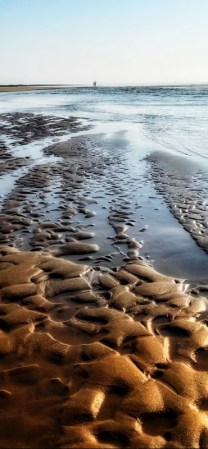
The man was speaking: “Let’s meet back here at the end of time… That’s what you said…”
It had seemed a fantasy; a delight; a thing that would never happen. Impossibly long ago, but meant – clear and sincere.
Yet, here they were, with separate lives behind them, trudging on old legs across the wet sand.
“I’m amazed you remembered the date… you seldom remember my birthday!” She said it with warmth and humour.
He frowned, acutely aware of his own mental limitations. He looked into her hazel eyes, still shining like stars after all these years.
“I have a good heart,” he said, softly.
“That you do,” she whispered. Leaning into his body and stealing a close hug at this special place: the end of the world, at the end of time…
©Stephen Tanham 2021
Stephen Tanham is a Director of the Silent Eye, a journey through the forest of personality to the dawn of Being.
http://www.thesilenteye.co.uk and http://www.suningemini.blog
Share this:


From Stuart. A profound love story…
* I saw a garden blossom in a valley. A man and woman stood there. Their love for each other was a service to the cosmos, and through it they …
‘Sympathy for the Devil’?…
Share this:

+ #Silenti, Consciousness, Healing, Mindfulness, Photographic techniques, Photography, Places and Prose
Childhood’s end?
by Steve Tanham
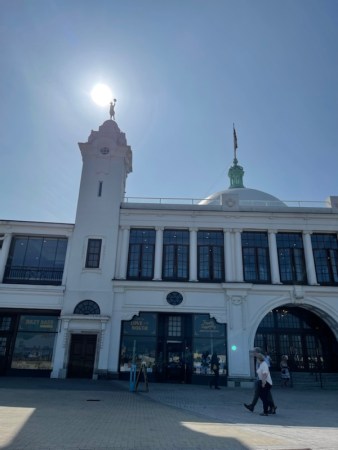
Some experiences are tiny and subtle; you don’t expect to remember them. But, days after, I was still thinking about that line of writing on the wall, in the last of the summer sunshine…
I’m a north-west lad; deeply Lancashire in my roots, though well-travelled from a business perspective. But one of my favourite parts of the UK is the North-East coast, from Whitby all the way up to Scotland, most of it in Northumberland.
This land of history and mystery used to be its own kingdom. To my mind, there is still a sense of the otherness in its hills and perfect beaches – and the people are friendly and usually welcoming.
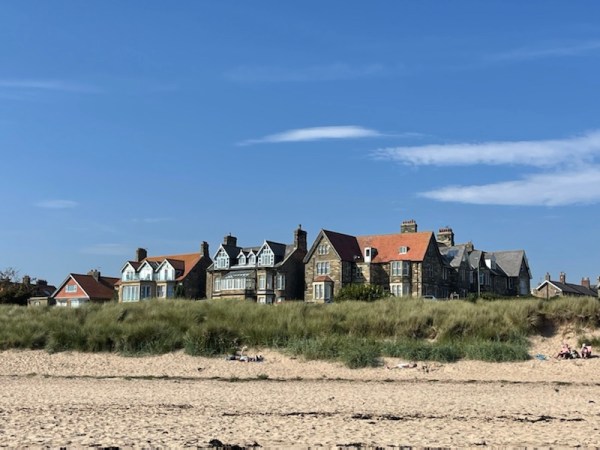
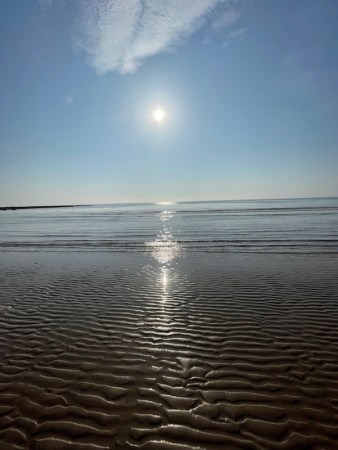
We were spending a few days in Almmouth, that harmonic delight of estuary village meeting sea; en-route to a reunion in Edinburgh.
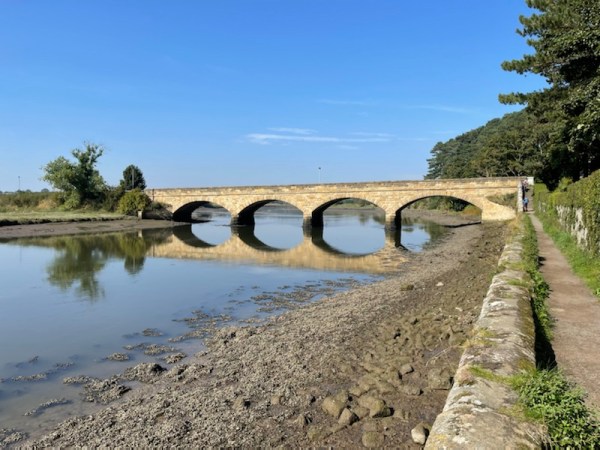
The oldest of the Alnmouth bridges crosses the River Aln to give the village its main access to the mainline East Coast railway station (Edinburgh in 60 mins), and the beautiful ancient town of Alnwick, ancestral home of the Percy family, who kept out the marauding Scots… Say it quietly, a good number of my cousins are Scottish.
As we often do on these trips, we were catching up with a diverse group of people, dotted along our route, including Cathy, a long-standing friend of my wife, Bernie, from the time they both worked in Bournemouth.
A few years ago, Cathy, now approaching retirement from the NHS, relocated to Whitley Bay, north of Newcastle. She had always wanted to live by the sea, and settled in Weymouth for a while, but found it too far from other places she needed to be.
Then she found her eldest son was planning to move in Teignmouth, just north of Newcastle, where he had been at university. Like his mum, he was attracted to that stretched of what was the Northumberland coast.
Cathy had a limited budget, but was delighted to discover that nearby Whitley Bay was not only affordable, but undergoing a resurgence and considerable ‘gentrification’. Formerly the haunt of the worst kind of drug dealers, facsimiles of whom seemed to feature in the ever-popular Vera detective series, it now teems with individual boutiques, quality cafes and restaurants, and coffee shops.
Locals say Whitley Bay is now safe and prosperous, yet hasn’t lost it’s common touch…
After refreshments in her sea-facing garden, Cathy took us on a guided tour of the promenade and resurgent town – the last stop on the northern leg of the Newcastle Metro line.
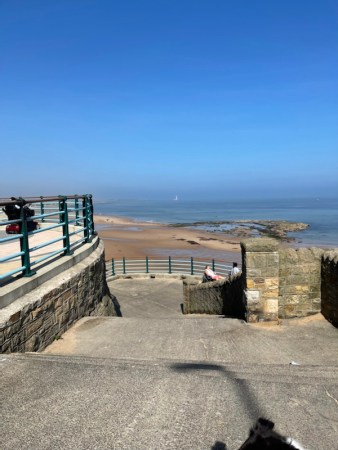
For a while we alternated descending and climbing back up the various sections of the expansive promenade. The sea is a long way below this section of coast road, and I wondered whether my iPhone camera would do anything useful at that distance?
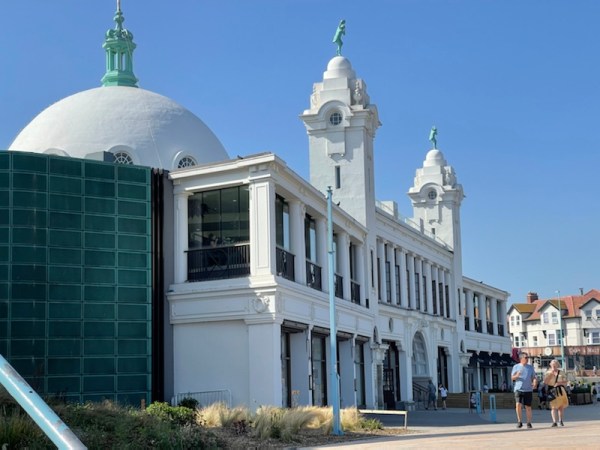
After about 30 mins of walking, it was obvious that we were approaching the centre of town. Two things were of immediate interest to my photographer’s eye: a giant white building looking like a Moorish palace; and a wonderful view down to the beach, framed by curving stone walls.
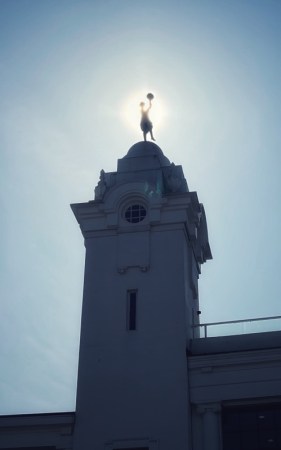
Spanish City – the large white ‘palace’ – used to be the main tourist attraction of Whitley Bay. It was built 108 years ago as a ‘resort within a resort’, and offered cafes, restaurants, entertainment and a set of rides for the young and the young in heart. For the sixteen years prior to 2018, it stood derelict, until being restored and refurbished.
In July, 2021, the listed ‘Dome’ was reborn and re-opened by the local council after a £10million restoration, which included contributions of £3.47m from the Heritage Lottery Fund and a £2.5m Coastal Communities grant. It’s never looked back.
Cathy announced it was time for an ice-cream. There was a chorus of approval, especially when she crossed the coast road at speed and installed herself at the back of a short queue outside the famous Di Meo ice cream parlour. When we caught up with her, she explained that the queue was normally fifteen people deep, and she’d rushed to take advantage of this astonishingly smaller one – give it was one of the finest days of the year.
While she was queueing, I strolled quickly back to try the possible photo I’d seen. Two women were talking across a gap on the edge of a set of steep downward steps. Beyond was a panoramic view across the beaches and sea towards the distant St Mary’s lighthouse. Even in the bright sunlight of a pristine September day, it didn’t look as emotionally warm as it felt; so I took the shot with a view to editing it in a new (free) App I’d been recommended called Snapseed, made by Google.
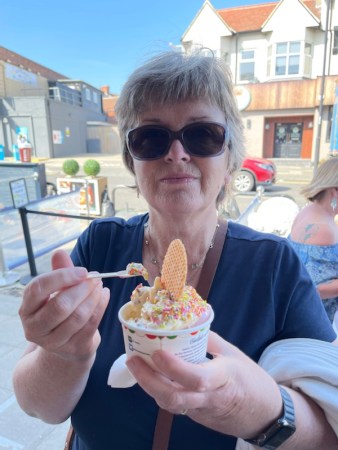
That done (which was the work of a minute only) I crossed back over the road, just in time to collect my ice cream. We meandered slowly back, with Cathy telling the story of how the original Spanish City was etched into the memories of generations of both locals and visitors. She said there had been a famous quote, but couldn’t remember it.
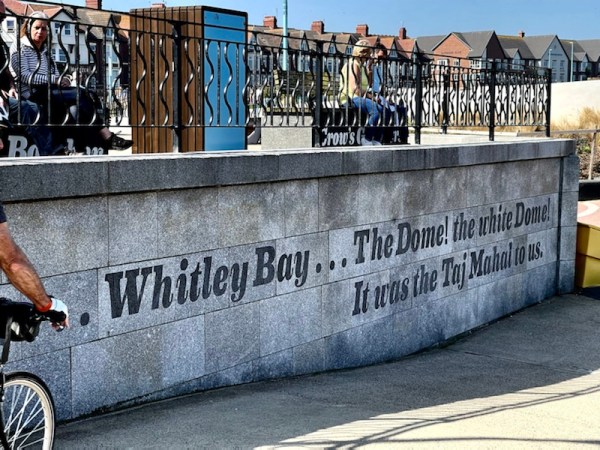
Later, I remembered that I had taken a few random shots of the promenade’s slope near the ‘Dome’. One of them had Cathy’s quote. It reads:
“Whitley Bay… The Dome! the white Dome. It was the Taj Mahal to us…”
Some would laugh at it, but I thought it was a beautiful sentiment. Bolton didn’t have much in the way of glamour. But I remember the sheer sense of sophistication going into Bolton’s Navada roller skating rink as a child. I was entering a new world; and what the people of the old Whitley Bay felt about their dome must have been the same.
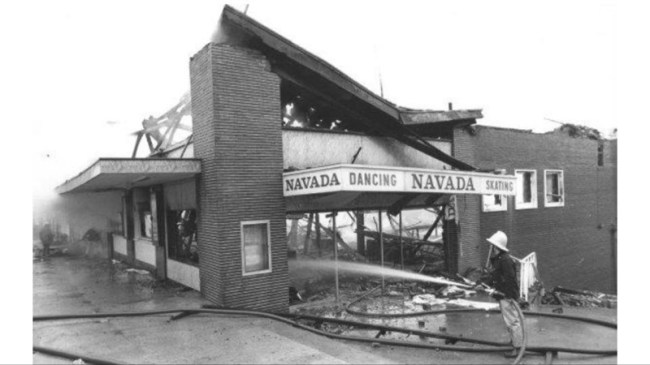
Now the people of Whitley Bay had their dome back, renewed and whole. It was a lesson in what we all experience – the familiarity of what we’ve grown used to versus the fading through time of what was once great. The ‘Spanish City’ had been wonderfully conceived, over a century ago, and its original vision had miraculously survived the inevitable physical decline.
The right energy and determination brought it back, justifying the sincere words on the curving wall.
My story ends there… apart from the editing I did that evening on the iPhone, using Snapseed to transform that view.
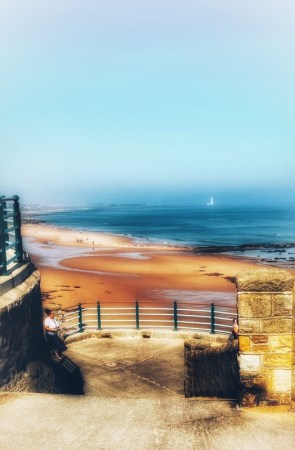
Above is the result: a picture more in tune with what I felt about the two women, the ornate steps, the sunny beach far below, filled with happy people in what was probably the last really hot day of 2021.
And in the distance the white St Mary’s lighthouse, surely one of the most beautiful symbols we have.
©Stephen Tanham 2021
Stephen Tanham is a Director of the Silent Eye, a journey through the forest of personality to the dawn of Being.
http://www.thesilenteye.co.uk and http://www.suningemini.blog
Share this:


From happier times. December 2019, Whitby.
Happy Birthday, Sue…
From everyone. ❤️
Share this:

We are lucky to live in an age where we have at our fingertips (phone or tablet) far more computing power than would have seemed possible on a powerful desktop machine a decade ago.
Applications like computer aided design (CAD) have traditionally demanded more and more power, as the ability to envisage what is in the mind is translated to 3D drawings…and even virtual reality videos.
Photography is one of the fields in which the full power of the technology is readily available to the non-specialist.
Those who follow my blogs – and thank you – will know that I take a lot of photographs. Recently, I discovered that my library on iCloud held 140,000 images! Most of them I’ll never see again, and it’s a pain to sort through even a fraction, so I’ve started being ruthless with how many I keep.
The problem is the supercomputer in my pocket pretending to be a camera. With a bit of human direction, it’s remarkably good at capturing what is around me. Because it’s my phone, diary, dictation machine, notebook and many other things, I’ve always got it with me.
The power of modern phone cameras raises a few questions, chief of which is whether we still photograph ‘the real’?
There is a big difference between the image capture stage and its subsequent processing. If I wish, I can set the camera part to ‘filter’ what is there as it takes the shot. The downside is that I’ve therefore lost a lot of what ‘could have been there’ by post-processing the image, later. For this reason, I normally let the camera take the shot, ‘as it sees it’, adjusting only the composition; and that usually means the range from ‘telephoto’ to ‘close up’.
Phone cameras are poor at zooming into scenes. It’s asking a lot from those tiny lenses – computer-backed or not! But there is a style of landscape that responds well to the limitations of the phone camera. Consider the example below:
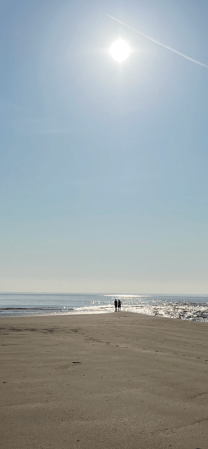
It’s a pleasing shot, and not posed. I simply kept my distance and let the camera reach into the lives of the two lovely people enjoying their moment; hopefully without intrusion. I have no idea who they were.
But what about this one:
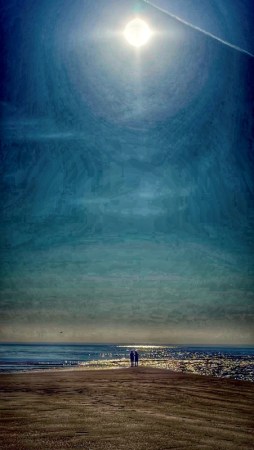
It’s the same photograph, but processed after the event – and on my iPhone. Here, I’ve deliberately modified the look and feel of the original to tell more of the story – the link between the sun in the sky and the ‘receiving’ humans on the shoreline.
You could say it’s slightly ‘alchemical’ in its symbolism; combining ‘Earth’ – the beach; ‘Air’ – the sky; Water – the ocean; and Fire – the sun, now sporting four ‘wings’. The imagery is clear: the humans, below, are recipients of one of the best things in life (Love) via the gift of the ‘elements’, led by the Sun.
What is really there and what’s not? It’s impossible to discuss without getting a bit philosophical. We all see the world slightly differently. My eldest son is slightly colour-blind. He can’t see certain greens. Is his reality less? No two people will actually see the same scene, anyway.
The difference is not limited to perception of colour. We all react to what we see by modifying it with how we feel. We can’t change how our eyes biochemically observe; but we can deliberately choose to see something in a landscape that’s not there. But it might be there inside our powerful imaginations.
If what I’m trying to capture is the ‘feel’ of the event; the mood, even, then what I want often lends itself to the palette of modern editing tools, many of which are immediately available after taking the original photo. A photographic purist would say that I’m altering things; I’m changing what’s there.
Talk to most photographers, and they will say that the suite of digital editing tools they possess is simply the updated ‘dark room’ of days gone by – that photographers have always had ways to enhance what the camera takes.
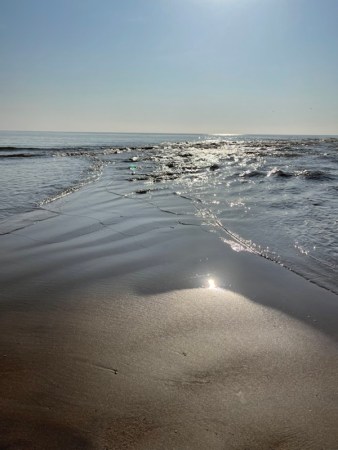
In the beach photo above, I’ve reproduced the shot the camera took. No editing, except cropping the image for my purposes. Everything else is unmodified – and I had no desire to impose my own view as to how it should be seen.
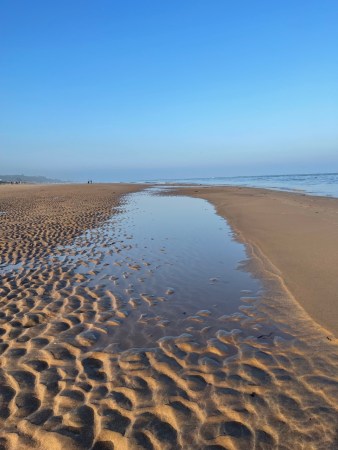
The final shot, above and below, is an example of deliberately going out to find an image that matches a desired state. I wanted to find something natural that would suggest the germination of an idea and its transformation in the mind to a solid and workable reality.
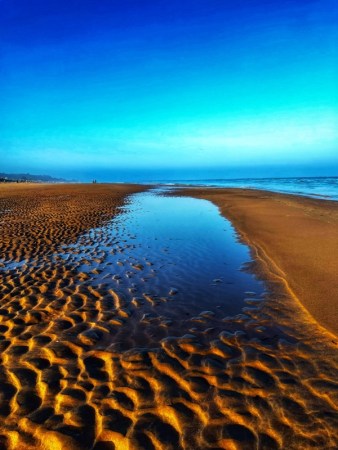
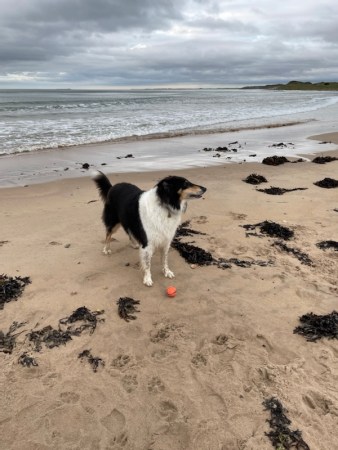
Walking Tess, our collie, along this Northumberland beach as the sun was setting, I glimpsed the scene above. The well-defined ripples led the eye to the water, whose eventually depth absorbed them. The downward gradient of the beach took away the resulting flow from the small pool and it joined the sea.
For me it was a perfect metaphor, but left in its natural state, might not have conveyed the purpose with enough impact. Experimenting with the depth of colour and object ‘definition’, I was able to create something with much more impact.
Real or right? Only the reader can decide in each situation… But the modern photographer now has the tools to be both picture-taker and illustrator; and that can only be a good thing.
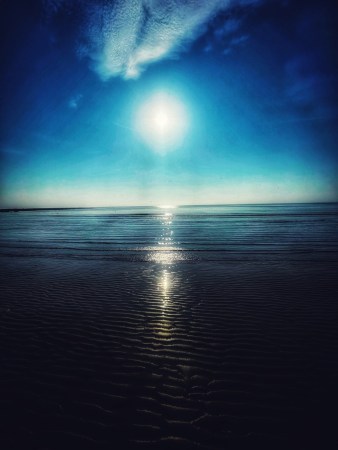
The final image, above, is an attempt to create a piece of art from a photograph. The original photo has been dramatically altered to create a ‘dreamy effect’. No ‘real’ photo would have these colours in it, but I wanted a ‘fantasy’ scene.
©Stephen Tanham 2021
Stephen Tanham is a Director of the Silent Eye, a journey through the forest of personality to the dawn of Being.
http://www.thesilenteye.co.uk and http://www.suningemini.blog
Share this:

+ #Silenti, Consciousness, esoteric psychology, landscapes, Photographic techniques, Photography, Travel and Photography
From above…
by Steve Tanham
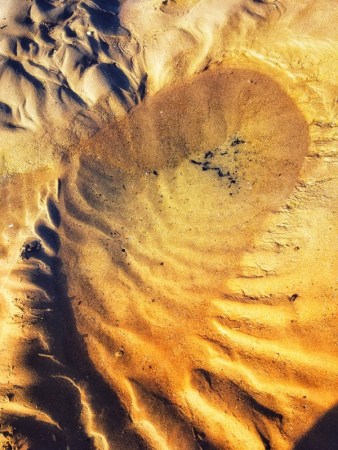
We often think that seeing something ‘from above’ will result in greater clarity.
It’s usually true in a situation where there is a holistic ‘big-picture’, and the real or metaphorical aerial view can make clear the relationships at work.
But sometimes being above things can conceal the truth about their essential states.
The above image turned into an accidental illustration of this.
We are actually looking down on a pool of water on a beach, where the retreating tide has left it briefly whole. I deepened the colour, in an attempt to bring out the water, but it didn’t work. Instead, there emerged this organic-looking structure that appears to owe more to cellular biology than beach forms…
The colour was rich and pleasing, so I thought I’d make a short blog of it. As with all such things, its existence was brief. But for the short duration of its life on that beach, it was very real indeed… and fascinatingly beautiful.
©Stephen Tanham 2021
Stephen Tanham is a Director of the Silent Eye, a journey through the forest of personality to the dawn of Being.
http://www.thesilenteye.co.uk and http://www.suningemini.blog
Share this:

Season Changing: Levens Park
http://thesilenteye.co.uk/2021/09/09/season-changing-levens-park/
— Read on thesilenteye.co.uk/2021/09/09/season-changing-levens-park/
Share this:


©Stephen Tanham 2021
Stephen Tanham is a Director of the Silent Eye, a journey through the forest of personality to the dawn of Being.
http://www.thesilenteye.co.uk and http://www.suningemini.blog
Share this:

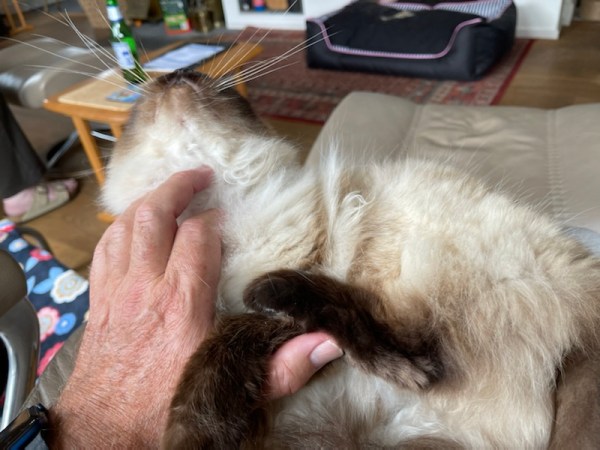
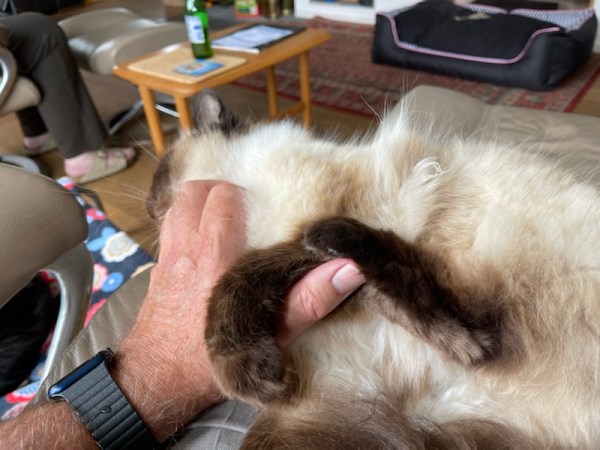
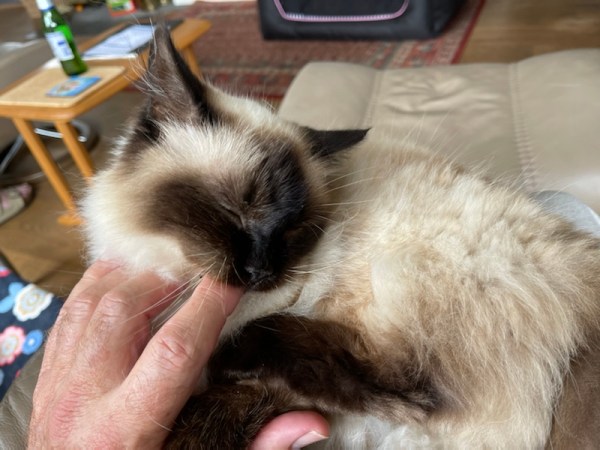
©Stephen Tanham 2021
Stephen Tanham is a Director of the Silent Eye, a journey through the forest of personality to the dawn of Being.
http://www.thesilenteye.co.uk and http://www.suningemini.blog
Share this:

+ #Silenti, Consciousness, esoteric psychology, Mindfulness, Mystery Schools, Silent Eye School, Silent Eye Workshops
Gnosis and the Spider
by Steve Tanham
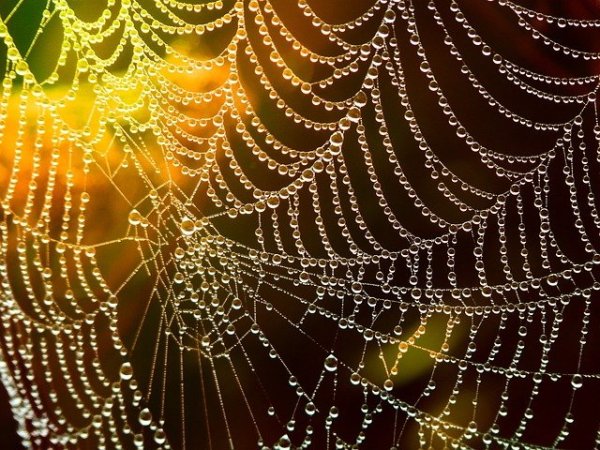
I realise that spiders might be a difficult subject, so, instead of the actual photo of the tiny spider, I’ve used this beautiful image of a web caught in the sunlight from Pixabay.
I was spraying wood preserver on our fence. Its a big fence, and cost us a lot of money. Every three years it needs a wood preserver spraying on its entire wooden surface. The other side is, of course, in the neighbour’s garden, so I’d asked them to move their car to remove any danger of the projected preservative droplets settling on the paintwork.
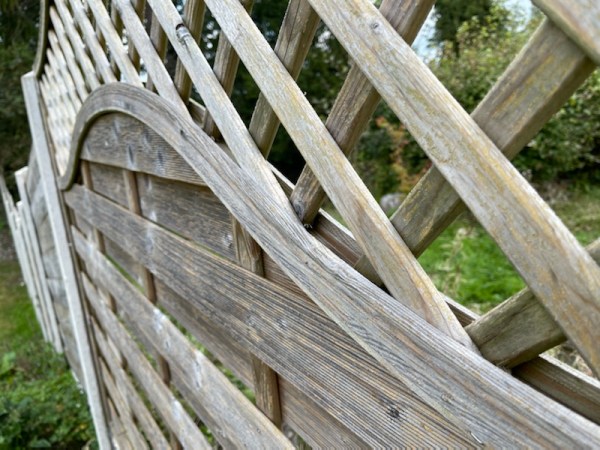
I had only ever used a large paintbrush in the past. But this time had invested in a hand-pumped power sprayer… and it worked – beautifully. I’d started with the neighbours’ side and worked my way around. By the time I got to what used to be the canal bed – the lower half of our reclaimed garden – I was a bit tired…
I topped up the sprayer with the last five litres of the wood treatment and pumped the device the requisite 25 times. The pressure release made a quick hiss, then stopped. I was good to go. I picked up the spray head and began a careful, horizontal pattern. Nearing the end of the first panel, I pulled my hand back, quickly and let the spray valve go. Then I looked at what had made me stop. Nestled in the 90 degree corner was a spider. The line of the spray had stopped less than a centimetre from it. As we gazed at each other, the spider made a wise decision and ran off – very much alive.
It was only later that I realised the little story had much to teach about intelligence – the planned subject of this blog.
There are many measures of intelligence. Over the years, I’ve used different models to illustrate it with a spiritual twist. My favourite is that intelligence in humans is best understood with what I’ve come to call the ‘preplay’. What’s a preplay? It’s the ability to look at a developing situation and visualise what different things might happen next. That might be hundred of things, so our minds have developed the ability to use probability to tell us what is the most likely outcome from all the things that might happen.
Once decided on, we can then make a plan to encourage or defend against it. Either way, we are preplaying the outcome. How we adjust it depends on the context. If I were a hunter in a tribal family, I might want to kill the beast in front of me so that my family could eat.
If I were a man spraying a fence, I might want to be careful not to kill spiders, knowing them to be smart creatures who do a good job of eating what I like even less. Apart from that, I might not like killing things at all. Some hunt and kill for fun, but I’m not one of them, and I view those that do as lacking in something essential to us as an evolved species.
The concept of time is a big part of intelligence looked at in this way. I have to understand how the object in question will ‘change its state’ in my immediate future. An arrow coming at me is changing its state very quickly. Its terminal state might be within my body if I don’t do something about it. Even better is to foresee the state of the hunter who doesn’t like my attitude on killing… and wants to kill me.
Not being there when he fires the arrow might be the smartest goal I can achieve. This multi-state prediction requires an extraordinary amount of brain power – and yet we do this kind of thing all the time when we, for example, drive a car. Cars plus drivers have an amazing statistical ability not to collide with each other.
The spider has a simple life compared to us driving a car. It spins a web and extends its hunting sensors into the strong fibres. The smallest disturbance will alert it. Its genetic history is full of instinctive intelligence that allows it to differentiate a breeze from the landing of a fly. But when the edge of a high speed spray comes towards it, spewing chemical death, it doesn’t stand much of a chance.
The simple spider caught in the chemical headlights represents instinctive intelligence, with no ability to do anything but run; and not fast enough in this case.
Then we have the human being who was tired and ready for that cup of tea. On full alert he might have used his predictive intelligence to visually comb the panels ahead, but he didn’t… This story is not about his intelligence.
There is another level of response available to the developing human – one in touch with their own true nature at a deeper level of consciousness. The ancients called it Gnosis. We retain the name to contrast it with ordinary knowing. Gnosis is the act of knowing something as though it were already a part of you and being ‘rediscovered’ in ‘real-time’ – or even faster. It is not adding something new to the mind. It bypasses reason. It is the solution to what is happening outside of time, and it is always optimal.
You don’t have to think about it, because, without this small example of it, I would have sprayed the little spider to its death in the next quarter second. But…my arm moved, safely and away; taking the spray head a short distance from the creature below. When I looked at where the spray should have been, I could see the spider. But only then.
I moved to the next fence panel, returning to the place of the spider’s survival a few minutes later. Happily, it had gone. I did not resist the smile. This happens rarely, but when it does, I know what it is…
©Stephen Tanham 2021
Stephen Tanham is a Director of the Silent Eye, a journey through the forest of personality to the dawn of Being.
http://www.thesilenteye.co.uk and http://www.suningemini.blog
Share this:

©Stephen Tanham 2021
Stephen Tanham is a Director of the Silent Eye, a journey through the forest of personality to the dawn of Being.
http://www.thesilenteye.co.uk and http://www.suningemini.blog


You must be logged in to post a comment.