

Misti: Morning, Tess!
Tess; Morning, Misti!

Misti: Fancy a groom?
Tess: It’s a fine day… why not!

Lick, lick, lick lick lick…

Lick, lick, lick lick lick….

Misti: Can’t beat it!
©Stephen Tanham 2020
Share this:


37
The Dao abides in non-action but there is nothing it does not do.
When the leaders abide,
The myriad of things transform by itself;
Transformed yet desire to act,
I lead the community by not naming the simplicity of things;
Without naming the simplicity of things, thus lead to no desire;
Without desire, with tranquility,
The world correct by itself.
——-
The above is chapter 37 of Lao Tzu’s Book of the Way (Dao Je Jing) quoted from the Wikipedia Opensource project Wikisource.org. Further extracts are quoted below from the same source.
In Part One and Part Two we set the scene for the Lao Tzu’s approach to life and how to live it using the Dao (The Way). It’s a method which seems alien to the west in our so-called modern age. Perhaps the great thoughts of the world simply cycle round from age to age? One of Lao Tzu’s principle tenets is the noble art of ‘not-doing’, a concept very difficult for the western mind to grasp.
It could be said that technology’s advancement merely gives us the idea of progress. Perhaps in the heart and mind of mankind there remains the same hunger for a different truth as when the New Testament quoted Jesus as saying people should ‘turn the other cheek’.
Resistance is something we live with daily. Something happens – arises in our lives, for it has no meaning unless it affects us – and we either like or dislike it. If I like something I will want more of it; I will want to be closer to the source of it.
If I dislike something, I will want to oppose it – to arrest its motion or progress. The spectrum of my response will vary all the way to outright hatred; something currently felt by millions of people with respect to the polarised state of world politics. Such polarisation is fed by a new generation of vastly wealthy ‘disruptors’, who have seen how easily the intelligence of the public can be misfed and misled, particularly with complex economic and social topics. Fear is a reliable ally for those who have the power to manipulate…
The Book of the Way does not advocate us being passive for its own sake. Nor does it really advocate doing nothing. But it does propose a response that seems utterly radical and revolutionary: It says we should be conscious of the whole and protect the whole, while not taking a side and injecting our energies; energies that may disrupt the whole, which knows how to change its shape with the changes – no matter how powerful the villains.

Consider Figure 2, above. It shows the origin of our world – really the origin of the consciousness of our world. If ‘I’ am not here then this world is not here, either. ‘A world’ may be present, but it is not the world I know, nor would I be part of it… The greater question might be: would there be an I without the world to externalise?
If ‘I’ have power to do, then I can push the pendulum towards what I consider to be evil or good. Usually, people believe they are doing good despite the opposite opinions of others. The creation is the whole cone within the diagram.
When I push the pendulum, part of the creation with a sense of ‘I’ (separateness) is altering the internal balance of the creation, but not altering the container of the whole creation. The part of the creation with a sense of ‘I’ may think it knows better than the whole of the creation, but its real duty is to be a fully conscious part of the whole – the Dao – the ‘flowing way of rightness’.
34
Implications of the Tao are broad and extensive. Ubiquitous!
Capable of contravening and swaying anything left or right.
The myriad things depend on it yet it never turns its back away,
Fulfilling without recognitions.
Submitting to the myriad things without assuming ownership,
Always undesirable,
Thus be called modest;
Submerged by the myriad things without accepting ownership,
Thus be called great.
Hence the master foregoes greatness,
Therefore is capable of accomplishing great deeds.
Lao Tzu says that there is a loving intelligence flowing in the world – in creation. This loving intelligence is always in contact with the whole of the creation. It is like saying that there is a flowing medium that is the substance of the world – a very alchemical notion – and our ‘right’ relationship to it will only be shown us when we learn to SEE it as it IS, not as an abstract and habitual picture to react to.
In the Wilhelm translation, the person who achieves that seeing is named ‘The Man/Woman of Calling”, who ‘never makes himself look great’ and thus achieves a noble goal by being in harmony with the Dao.
This philosophy has caused great confusion over the ages since it was written (six hundred years BCE). Comprehension of it is based upon an understanding that ‘not-doing’ is not doing nothing. Not-doing might be re-termed not-reacting; or waiting to see what the world does with it without our intervention – yet remaining fully aware and empathetic to what is happening.
As though we were an (as yet unconscious) intrinsic part of this intelligent and loving energy. Which just might be the truth…
There are no definitive opinions, here. We are all free to decide that the Book of the Way means for us. These are my personal views. Like the I Ching, the Book of the Way (Dao Je Jing) makes for a wonderful daily dose of radical wisdom in what seems to be a tired world… or is it?
In the next post, we will consider the nature of the I Ching and its remarkable powers of divination.
To be continued
13 May 2020
©Stephen Tanham 2020
Stephen Tanham is a Director of the Silent Eye School of Consciousness, a not-for-profit teaching school of modern mysticism that helps people find a personal path to a deeper place within their internal and external lives.
The Silent Eye provides home-based, practical courses which are low-cost and personally supervised. The course materials and corresponding supervision are provided month by month without further commitment.
Steve’s personal blog, Sun in Gemini, is at stevetanham.wordpress.com.
Share this:


I’m writing this on Sunday. The unexpected gale-force wind is battering the house. Temperatures have dropped thirteen degrees in the middle of the night – I know, because I woke up at four, fought wakefulness for half an hour (it may have been the bright moon), then gave in and let the collie out for a wee, to find I was too cold to photograph the startling moon without dashing back in to don a coat…
This in a spring so warm you could have gone out in beach shorts for most of the days and nights of the previous two weeks. Not the norm for Cumbria!

The beautiful spring moon is unrelated to the rest of this post, but why waste it!. There weren’t too many people out in their gardens at 04:30 pointing a camera at the night sky.
Our C-19 ‘lockdown’ has been made more tolerable by the weather and the proximity of some lovely walks. Living on the edge of the English Lake District, we are fortunate, indeed, to have so many of them. We try to use the car as little as possible, though it’s the only way to do weekly food shopping, as we live in a tiny village four miles from the nearest supermarket.

To keep car usage to a minimum, we regularly use four local walks. One of these winds up from the river Kent’s valley into Sizergh forest. It is part of a well-managed estate, which includes the ruins of the old gunpowder works. I am currently researching the history in order to complete a series of posts on the subject.
Industrial history can be far more complex than you envisaged…

The walk through the forest climbs up from the river before levelling off at a crossroads of paths. One of the way-markers (without which many walkers would be lost) is a large charcoal-kiln. I photographed it in April, just as the forest was ‘greening’.

On Saturday, we got to the crossroads to find a masked man in a green T-shirt working the kiln. I asked if I could take some photos, and he kindly stopped to chat to us, raising his mask. His name is Gareth (see the photo of his board), and he has the licence to carry out forest maintenance on behalf of the owners – The National Trust – as well as running his own charcoal production business and other forest-related activities.

Gareth reassured us that the process of charcoal production was a simple matter, but, in the manner of skills handed down through the generations, what he described seemed anything but simple.
He was standing in the middle of his kiln, blackened with the messy work; the mask now pulled up over his forehead in what looked like a rhino’s horn. For all the visual drama, he turned out to be a wonderfully friendly man.
Later, I realised that his demeanour and openness had a lot to do with his life in the open forest, and his closeness to its nature. Clearly, he loved his work, and its many faces.
Charcoal is prized because it burns at high temperatures without making smoke; hence its popularity with domestic summer barbecues. It is the ‘residue’ of a method of burning (typically) small logs of wood – ideally hardwood, such as oak or cherry. The production method is a slow pyrolysis: the heating of wood and, possibly, other organic materials, without allowing oxygen to enter the chemical reaction. The whole process is known as charcoal burning. The finished charcoal consists largely of carbon. It is a very pure substance, produced by an ancient recipe.
Seeing charcoal made so close to the old gunpowder works was ironic, because charcoal is an important ingredient of gunpowder – produced in large quantities a century ago in the nearby works. The Sizergh forest is no stranger to the production of charcoal…

Gareth paused his work and described the process of making charcoal for us. It takes four days to complete and begins where he stood, in the centre of the kiln. The relatively thin logs – recycled from his coppicing work – are laid out radially from the centre. They are set and ventilated so the fire in the lowest part of the kiln begins with a great intensity, sacrificing the lower level of wood but infusing the steel vessel with intense heat, but only burning the lower levels of the wood.
The kiln is ‘over-stuffed’ to begin the process, but, in the secondary stage of the burning, the heat and the weight of the lid seals the cylinder, itself, allowing only enough oxygen to enter to ensure the charcoal effect, rather than burning the wood to ash. All the timing is controlled by the initial stacking of the wood within the kiln, which, to me, sounded like a very skilled process, indeed.

Four days later, the charcoal has cooled and Gareth once again steps into his kiln to extract the charcoal by hand, dropping it into a metal and plastic ramp from which it is loaded into large carriers for subsequent domestic bagging in his workshop, near the river.

His busy time is usually the summer months, when people have barbecues. But the warm spring weather is enabling him to bring forward more charcoal production. During the winter, demand is minimal, so he supplements his income with forestry work, and also runs outdoor courses in making furniture from ‘green’ wood.

He took about twenty minutes from his busy schedule to explain things to us. We thanked him and moved on through the forest, only to meet him, later, loading his truck, when we returned from our walk to Low Sizergh Barn.
I have no commercial connection with Gareth. The above was our first meeting. I am keen to support these native crafts and small industries of our local woodlands. Gareth and Ro’s website is a mine of information.
If the above links don’t work, paste this into your browser and help support our native forest crafts: http://www.garethandro@woodmatters.org.uk

©Stephen Tanham 2020
Stephen Tanham is a Director of the Silent Eye School of Consciousness, a not-for-profit teaching school of modern mysticism that helps people find a personal path to a deeper place within their internal and external lives.
The Silent Eye provides home-based, practical courses which are low-cost and personally supervised. The course materials and corresponding supervision are provided month by month without further commitment.
Steve’s personal blog, Sun in Gemini, is at stevetanham.wordpress.com.
Share this:

+ #Cats, #Collie dogs, #FurryFives, #RagDollCats, #Silenti, Collie dogs, Spirituality, Your inner wolf
#Furry Fives : Cool Boot
by Steve Tanham

Human: We’re home now, shouldn’t you be facing the other way?
Tess: It’s cool in here…
Human: Aren’t you getting out?
Tess: It’s May. It’s 22 degrees. I’ve chased the ball for an hour… No.
Human: Fair point! Chicken?
©Stephen Tanham 2020
Share this:

The story of the Old One and the Gatekeeper told in Part One may be just that – a story. Or it may be the truth, turned into legend. Classical Chinese history places Lao Tzu as a 6th century BC contemporary of Confucius, and there are reliable records of their meetings. They were said to have great respect for each other’s work.
But, beyond his book, very little is known about the mysterious sage Lao Tzu, other than he was an imperial archivist in the outgoing Zhou dynasty in the 6th century BC.
In contrast, the story of Confucius is set (by himself) in a well-documented historical milieu. His heroes are the legendary figures of the past. In comparison with Lao Tzu who left no historical basis of his own existence, The Analects, compiled by Confucius’ disciples after his death, presents twenty volumes of work that weave their teacher’s life into China’s history.
Lao Tzu, the author of the Dao De Jing (Tao Te Ching) had no interest in such temporal things… he had other matters on his mind and in his heart. His quest was what we would now call a mystical one, and that is the reason I embarked on this difficult project – to put forward some hopefully helpful comparisons between the Book of the Way and modern mysticism. Lao Tzu is credited as being the father of Daoism, but scholars of philosophy find little similarity between his provocative and enigmatic writings and the animistic religion of present-day Daoism.
In terms of spirituality, Chinese antiquity focuses on the two great teachers Confucius and Lao Tzu. Our first posts will look at the work of the latter. Later, we will consider the part that the I Ching (Book of Changes) played and continues to play in the transmission of ancient oriental wisdom. Confucius did not create the I Ching, which was already an old and established system of divination when Lao Tzu wrote his book in the sixth century BC, but it was said he drew heavily on its for his own philosophy.
A detailed consideration of the life and work of Confucius is beyond the scope of this series of posts.
The two books: the Book of the Way and the older Book of Changes were not related and were different in their intentions. Confucius did not write the Book of Changes – I Ching – but it is considered to be far more Confucian than the Book of the Way written by Lao Tzu. There is a tendency in the west to consider the two traditions as related or even the same. But they are different.
However, the mixture of wisdom from the two sources informed Chinese thought and life for hundreds of years to such an extent that later extrapolations of meaning carry the flavour of both. The spirit of Confucianism was focussed on effective and moral behaviour, and good government. The spirit of Lao Tzu’s teachings was to step aside from traditional explanations of the world and look at it in an entirely different and radical way.
Lao Tzu was a spiritual revolutionary – though he sought no notoriety – and, in my opinion, was more similar to the much later mystical Sufis than any of his contemporaries. Tradition says he left China heading west, and is believed to have settled in India. There is no suggestion that he was instrumental in the establishment of Buddhism, which sprang from that region at the same time, but there are certain similarities of approach in how the two systems see our relationship with the world.
Nothing in Lao Tzu’s work suggests that he wanted himself to be remembered, but everything in his work is aimed at the retention of the thoughts, ideas and practices put forward in the 81 aphorisms of the Book of the Way – a set of wisdom texts that were to be consulted as such, and not used as the basis for divination in the way the I Ching was.
Richard Wilhelm, one of the most famous translators and interpreters of China’s ancient traditions, divides Lao Tzu’s translated work into three sections based on the the sage’s naming of the book, itself.
Dao De Jing translates, literally as Way-Life-Meaning
The three divisions are: The Way and The Life and then their combination, the Meaning. As a prelude we might consider two of the core considerations of the work: the nature of our relationship with the world; and, by inference, the nature of duality.

Lao Tzu’s work begins by instructing us in the nature of consciousness and the nature of its inherent duality. These are necessarily subjective, as we each gain insight from the aphorisms appropriate to our understanding at the time:
The universe is undivided.
Only our way of perceiving it is divided.
Such division is necessary for us to come into the world and see it because we are of the world.
We are the world seeing itself and are capable of gradually realising our true relationship with it.
The societies into which we are born may resist our attempts to do this; and insist that we adopt the ruling dogma. This can be the hardest of tasks.
The diagram – my own – illustrates these points in terms of the establishment of duality. The universe – the whole – establishes ‘existence’: a field within which there will first be chaos. There is a purpose in the manifestation of the universe and this is served by the establishment of order over chaos. Mankind’s intelligence is expected to play its part in this task. S/he has been given a brain in order to use it in service to the universal cause, this is the primary belonging that should be borne in mind.
Mankind has been given a heart so that sympathy will be felt and become a motivator to assist others
We belong to this quest, not to our self-aggrandisment.
The One therefore divides itself, as seen from below. To itself it is whole and undivided; but chaos must now be mastered with order, with symbolic ‘light’.
The children of the One exist at their own levels, but they are also of the One and seen from above are undivided; that is, they carry the seed of greatness within them, a seed designed to germinate in the spirit of service to the group quest.
A ‘child’ looking back up at the universe sees only duality: it and the world. To see beyond this requires the intervention of the spark of the One within the child. There are certain conditions under which this will be favourable.
To be continued…
6 May 2020
©Stephen Tanham 2020
Stephen Tanham is a Director of the Silent Eye School of Consciousness, a not-for-profit teaching school of modern mysticism that helps people find a personal path to a deeper place within their internal and external lives.
The Silent Eye provides home-based, practical courses which are low-cost and personally supervised. The course materials and corresponding supervision are provided month by month without further commitment.
Steve’s personal blog, Sun in Gemini, is at stevetanham.wordpress.com.
Share this:

+ #ShortWrytz, nature, Photographic techniques, Photography, Places and Prose, Seasons of the year, Silent Eye School, Solar Year, Spirituality
#ShortWrytz : The Time-Capsule
by Steve Tanham
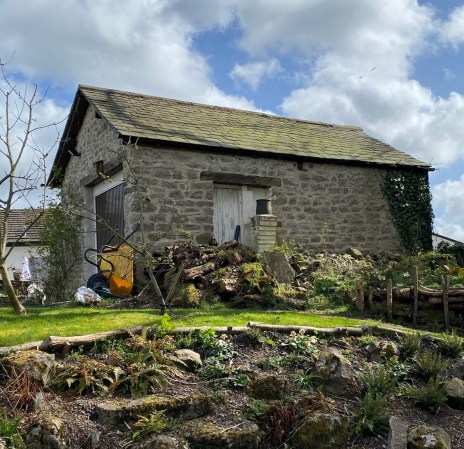
I’ve written about it, before. The Saltpetre is a gunpowder store that was used to house the produce of the local gunpowder factory by the river Kent. The ‘black powder’ as it used to be called, was brought up through the village, slowly, by horse and cart – the cart having dressed wheels to help prevent sparks. There were many deaths in the village from explosions, so everyone was deeply conscious of the danger.
Old (black) gunpowder was mixed in the following proportions (by weight): 75% potassium nitrate (saltpetre), 15% softwood charcoal, and 10% sulphur. Our quirky outbuilding was named after the component with the greater part by volume – 75%. We suspect that gunpowder was also generally known as ‘saltpeter’ in those days when the bargemen would collect it from the canal wharf that is now our garden and take it south.
The photo was taken from the lower part of the garden. It’s lower because it was the canal bed. The Saltpetre was constructed in about 1820, the year the local Quaker banker and gunpowder entrepreneur, the first John Wakefield, persuaded the canal trust to change their route and run as close to his works as possible.
The simple stone structure has been there ever since, enjoying many incarnations, but none as exciting as its original use. For the past decade, we have been filling it up with our ‘stuff’. It’s bigger than it looks and has taken a lot of filling! But, with the Covid-19 lockdown in place, it made sense to spend some of the time doing the long-promised clean out.
Right at the back were three shoe boxes, each one carefully taped closed so that not even dust could get in. I had packed them – several house-moves ago, but any knowledge of their contents had long vaporised.
Grubby from the day’s dusty excavations and disposal into a mountain of ‘black bags’, I reached for a my knife and sliced open the tape, feeling intrigued as to what was in there.
Much of it was instantly binable. But an inner ‘jiffy pack’ contained two items: a vintage pocket watch, bought on a business trip to The Hague, and a passport sized photo of me taken approximately 25 years ago. I had thought the watch was long lost, and was delighted to be reunited with an object I loved. It cost me the equivalent of £150 back then. Not a huge investment, but I found its slim and elegant lines very pleasing, and simply wanted to keep it.
The second item was more shocking. There’s nothing quite so sobering as seeing yourself as you were a quarter of a century ago… Ageing is inevitable, but such a brutal confrontation across the years requires a deep breath.
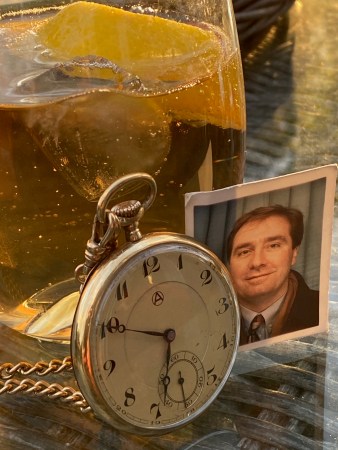
The day was ending in a lovely and still-warm sunset when, freshly showered, I brought the two objects to our patio table, where Bernie had made us each a long gin and tonic.
We sat in silence, gazing at the evening gold reflected in drink and watch, and laughing at the young man. Talk about a time capsule!
©Copyright Stephen Tanham
Stephen Tanham is a Director of the Silent Eye School of Consciousness, a not-for-profit teaching school of modern mysticism that helps people find a personal path to a deeper place within their internal and external lives.
The Silent Eye provides home-based, practical courses which are low-cost and personally supervised. The course materials and corresponding supervision are provided month by month without further commitment.
Steve’s personal blog, Sun in Gemini, is at stevetanham.wordpress.com.
Share this:


Misti: “Tess! Spines are funny things aren’t they?”
Tess: “Yes, Misti. But wonderful…”
Misti: “I’ve been watching yours for a long time.”
Tess: “Mmmm?”
Misti: “And every time I blow on it, it ripples!”
©Copyright 2020 Stephen Tanham.
Share this:

The Old One crested the rise in the road and turned to look back at the land he had loved. If all went to plan, it would be the last time he saw his home.
The breeze that should have been summer-warm was cold and frigid, yet carried the warm stink of corruption. He could no longer breathe its air. He had to leave; had to find a new home for the few years that remained. The low nature of man had triumphed. Now, only nature, herself, could return the rotted civilisation to the country’s soil and make it fit for fresh seeds.
Ahead of him the final barrier to his exile loomed in the near darkness. The old tower that guarded entry and exit along the western road spanned the track, its heavy wooden gate lowered to forbid the unbidden. High up in a recess in the black stone, a single light burned. Had he been seen? The skin on the back of his head began its familiar sensation of ripples in the sand, as though an incoming tide was patterning his mind, as in the paintings he had seen of beaches…
There was no escaping the onset; in the other world, he was being eaten by the way, the path, the track… In the other world; the one that flowed over and alongside this seemingly fixed and rigid one. The one that was more real than this land of rocks could ever be.
Ahead of me a lamp in one of the high windows burns. The thought would not leave, the rippling scalp remained. Its signature was on this moment. There would be no escape from the payment demanded.
Before he could cross the short distance to the gatekeeper’s door, the heavy portal opened and a kindly face – at least as old as his – peered out, straining to see in the half-light.
“Is it you?” the voice croaked at his approach.
The Old One was startled… and began to laugh at the sentiment. Is it me, indeed?, he mused, tripping over an unseen stone by the roadside and landing in the dust at the other’s feet.
“It would appear to be me… arrived in all my diminishing glory.”
The Gatekeeper smiled down at him, extending his hand to a man he did not know, but had wanted to all his life. The Old One took it, grateful, and they came face to face.
“I saw you once, passing through the royal courts. You’re the Royal Archivist, yes?”
“I was…” The Old One replied, returning the gentle fire in the other’s eyes. Glad to be with a man he hoped would not only understand but become a friend. “Now I am nothing… and hope to stay that way…”
The Gatekeeper nodded. “Many now leave the realm by this west gate. Have no fear. My respect for you is as great as my thirst for your knowledge of the Way.” He looked down, embarrassed at what he was about to say. But the old eyes blazed with fire and resolution.
“I will give you food and shelter and in return I ask that you teach me a little of that understanding.”
“You cannot teach understanding,” the Old One said. “But I will pass to you some knowledge and we will see if you can begin the Way… for those whose first steps are firm may find the Way teaches them.”
The Gatekeeper nodded and they climbed the wooden stairs together – slowly, for the four legs had seen younger days…
——-
The warm fire smouldered in the grate. The wooden bowls contained only crumbs – and few at that. Before them, the two wooden goblets of huangjiu, the local yellow wine, lay untouched; to be savoured during the discourse to come. The Gatekeeper’s eyes were fixed on the Old One, but he said nothing to his guest, who appeared to be sleeping in his chair.
“I am not asleep,” the Old One remarked, eventually. “I am listening to the Way, and how it will approach the task of leaving you something meaningful.”
The Gatekeeper bowed and remained silent.
“Do you remember how I fell over the rock in the road?” The Old One smiled at the memory.
The Gatekeeper shook with mirth. “Solid things, rocks…”
The Old One’s head nodded. “More sense to go around it, had I seen it at all!”
The Gatekeeper was seized with a sudden depth of understanding. “And you speak, not just of that rock, perhaps Lǎoshī!”
The teacher smiled at the use of the formal name. “Good. The Way is a flow, it does not resist, for to resist is to increase the ‘me and it’ : the opposition of the situation. Action belongs to The Way, and so, in any situation, it will seek the flow by which the resistance is made small…When we are aligned with The Way, then we become it, in action – which is its own fulfilment.”
The Gatekeeper bowed his head, again, understanding. He was silent for a while, while the Old One watched. Then he asked, “How do I come to know The Way, Lǎoshī?”
“You must talk with it, Gatekeeper.” said the Old One. “You must read its thoughts and let them guide the changes in your life.”
“And how will I read those thoughts, Lǎoshī?”
“You will consult a book of its wisdom, and in that way become a Man of Calling.”
“And where will I find this book, Lǎoshī?”
“When you wake in the morning, you will find it waiting for you… Now drink your yellow wine and sleep.”
“And what will you be doing, while I sleep, Lǎoshī?”
“I will be writing the book!” said the Old One, furrowing his brows in mock anger.
When he awoke in the morning, the Gatekeeper found the Dao Book of the Way (Dao De Jing) on his table. There was no sign of his guest, whose last action was inaction – leaving no trace. No-one ever recorded meeting with Lao Tzu, (literally, the ‘Old One’), again, though many, including Confucius, had known and respected him.
In the next few posts, we will explore Lao Tzu’s astonishing legacy, beginning with some of the fundamental principles that informed his view of life, the universe and the meaning of ‘meaning’.
We will also look at the second such ‘book’ of ancient Chinese wisdom, the more familiar ‘I Ching’ – Book of Changes, and consider the process and power of divination using such treasure-chests of wisdom.
We’re all going to need access to wisdom in the coming years of turmoil – much as Lao Tzu did in the face of a collapsing society whose values had become meaningless.
30 April 2020
©Stephen Tanham 2020
Stephen Tanham is a Director of the Silent Eye School of Consciousness, a not-for-profit teaching school of modern mysticism that helps people find a personal path to a deeper place within their internal and external lives.
The Silent Eye provides home-based, practical courses which are low-cost and personally supervised. The course materials and corresponding supervision are provided month by month without further commitment.
Steve’s personal blog, Sun in Gemini, is at stevetanham.wordpress.com.
Share this:


The last time it happened, I was in Mexico, in the Mayan temple of Chichen Itza. After a long coach journey, and a beautiful swim in cold but crystal clear cenote, we had arrived at the fabled temple complex; and were lucky enough to have one the best guides I have ever encountered.
He was of the native people and described – with great gentleness – how the spirit of what happened at the city-temple complex was gradually being lost. As we were guided around the different locations in the vast complex, the day grew hotter, but the warmth seemed to take on an aliveness which fed me, rather than drained.
Minutes later I had a vivid image of a jaguar leaping from the central pyramid at me… Later the guide told the group of the importance of the Jaguar to the ancient Mayan priests.
My good friends Allan and Ann Pringle assured me this was a Shamanistic experience…. and implied that I had better get used to them. Several more followed in the heat of that day. Throughout, I felt no fatigue, although those around me were becoming visibly tired by the day.
Allan is a trained Zuni Shaman. In the same year, I had a similar experience at Uluru Rock in central Australia, while visiting my eldest son and his family. Again, there was the sense of being nourished by the heat.
Today it was a simple fire that triggered it; that and a thought I considered to be of great importance for my forthcoming Tuesday blog on Sun in Gemini – still unwritten at that point.
We have had a hard-working day, mainly in the garden. There’s not a lot of choice of location in this Covid-19 lockdown period. So, jobs that have been put off for a while are brought to the fore, and Bernie and I find ourselves putting in a long day of quite intense physical work. Our lawn has suffered over the very wet Cumbrian winter. The moss has overtaken the grass in large parts of the garden. The only cure is to scarify the three separate lawns – made simpler by a petrol-driven machine we bought a few years ago; but still a five or six hour job. We had set aside the whole day to get it done.

Extraordinarily for an English April, the sun has been beating down for weeks. Monday dawned the same. By the start of the afternoon, it was obvious that cooler weather was not coming to our aid. We began the work. It was towards the end of this very physical period of over five hours that I decided we needed a small bonfire to get rid of some of our excess cardboard and help reduce a pile of old logs that have been accumulating as we demolished earlier attempts at landscaping.
I was lighting the fire when the thought that had been in the back of my mind came again. Since the start of the Covid-19 outbreak, I have been having vivid dreams. Some of them have seemed to contain a message that my sleeping mind has struggled to retain. Usually, during the course of the day, these are lost to waking consciousness, but today I awoke with a clear picture of what I wanted to set down.
Over the previous week, I had noticed that other bloggers were making reference to similarly intense dreams. I believe they are all connected.
Staring into the flames of the garden fire, I recovered the clarity of my own dream. Jung spoke of the ‘collective unconscious’ – a shared place of conscious awareness which speaks to us in dreams and symbols. Throughout mankind’s history, periods of turmoil and chaos have been interpreted as being of deeper importance than just the ‘physics’ of their happening. I’m not fanciful in these matters, but I believe that it is essential that we throw off old ways of thinking. We have many crises to solve, but the old and powerful controlling forces that hold the planet’s social and economic conventions intact are resistant to change – seemingly regardless of the cost to life on Earth.
I believe that the intense dreams many are having are the seeds of the new. These will need to germinate in the collective unconscious mind until they are strong enough to break free into the ‘day-world’ of our social, political and economic lives.

When I came back to ordinary consciousness, I was still staring at the fire. The sun was setting and some time had passed. I felt at peace that the earlier dream memory had been recovered.
Time will tell if the vision is accurate or even important, but I sense a period of great change – one brought about by the breaking down of the present order of things and the fragility of our ecosystems on this beautiful planet.

There will be no escaping Earth if we get it wrong. I find the idea repulsive that, having failed to be guardians to such a beautiful place, we could escape a dying Earth to seek other hospitable planets without fixing ourselves first. There will be no second chance. We must fix things here…
Still intensely moved by this, I walked around the garden in the sunset to take a few photos that I hope express this mood… and this feeling of hope and renewal. I hope you like them.

©Stephen Tanham 2020
Stephen Tanham is a Director of the Silent Eye School of Consciousness, a not-for-profit teaching school of modern mysticism that helps people find a personal path to a deeper place within their internal and external lives.
The Silent Eye provides home-based, practical courses which are low-cost and personally supervised. The course materials and corresponding supervision are provided month by month without further commitment.
Steve’s personal blog, Sun in Gemini, is at stevetanham.wordpress.com.
Share this:

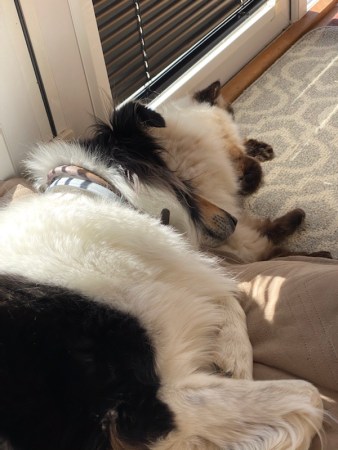
Tess: I just love these lazy afternoons, Misti, don’t you?
Misti: zzzzz.

Tess: Whassat?
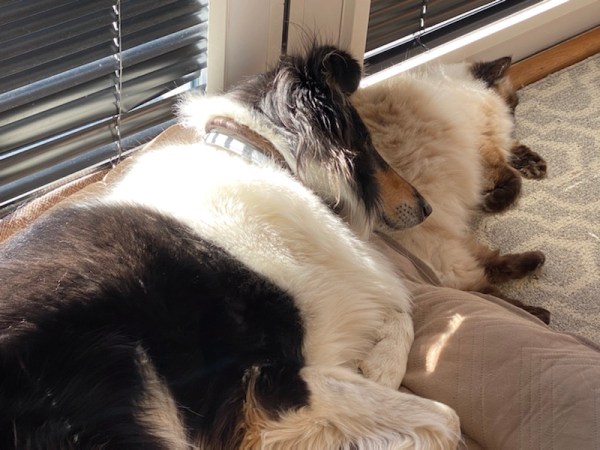
Misti: Food?
Tess: Nope..
©Copyright Stephen Tanham 2020
Share this:

From Sue…

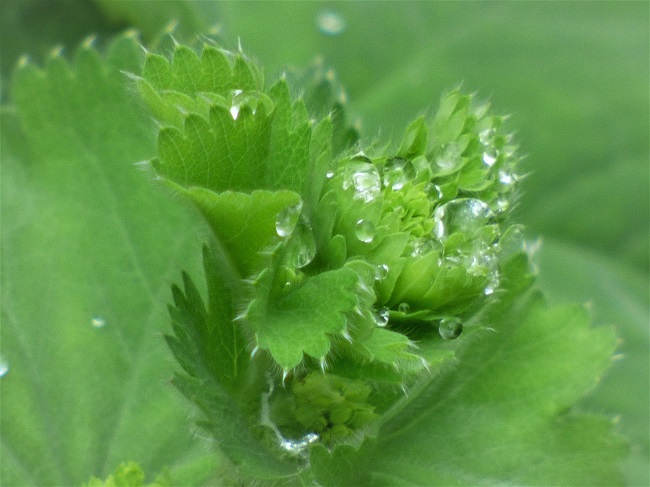
Shards of glass flew everywhere, surrounding my bare feet and covering the work surface with sparkling motes. The sun through the window lit the tiny fragments with incongruous rainbows. My hand, abused by a heavy day in my son’s garden, had refused to grip the slick surface. It was nothing much, a simple accident that would normally have passed by almost unremarked, save for the odd expletive. Instead, I could feel a knot tighten in my stomach, the pressure of tears demanding release behind my eyes as I ordered the dog to her bed to protect her paws. The mythical ‘stiff upper lip’ began to quiver and I felt about as steady on my feet as a jelly.
Even as the tears came, I could not help laughing at myself. It was ridiculous to get so upset over a broken glass.
As I started to clear up the mess, though…
View original post 616 more words
Share this:


Our garden is south-facing, which is lovely when the sun shines, as we benefit from its rays through most of the day.
I’ve begun to write about the history of our ‘gunpowder’ village of Sedgwick in other posts. The old (drained) canal bed that runs through our garden has been a challenge to incorporate into a coherent design, but, a decade on, we seem to have achieved it.
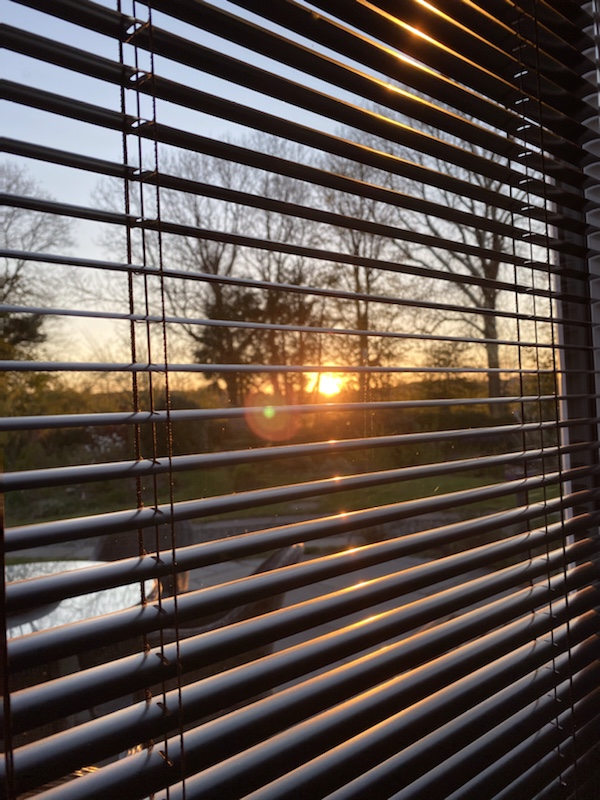
One benefit of the garden’s orientation is that the evening sun sets along a ridge about a mile away. In winter and early spring we have a clear view of this progression, as each day gives it a little more clockwise distance along the horizon line. As the foliage on the far side of the canal grows with the maturing summer, the ridge becomes more difficult to see, but is always there to our right – given that the sun is visible at all…
The approach to midsummer is, for me, the most emotionally powerful time of the year. As a mystically inclined person, I marvel each year at the level of sheer ‘aliveness’ that permeates the summer air, particularly as the sun is setting over that far ridge and filling the Cumbrian world with a last blaze of gold as it sinks between the distant trees.

I take a lot of photographs, as you may know from previous posts. One of the delights of the summer is to poke a long lens towards that sunset and let the blends and reflections create Their own work of art. It doesn’t matter if the photo is not technically good. What matters is to bathe in the beauty of the blazing reds and oranges as they project through the wooden branches of the near and far trees and shrubs.
Beginning in late March, if the day is clear, I will often be found nurturing a final cup of tea on our patio (occasionally, something stronger) and snapping dozens of shots of the moments just before, and just after, the sunset. I throw away most of these, but the odd few are worth keeping… and on a correspondingly dark day in winter, provide some fuel for the soul and a sense of ‘hang on in there’. Cumbria has long, dark and wet winters, which makes the spring and summer all that more precious. Summer, itself, is not guaranteed, though we always have the intense green and the knowledge of summer.

I’ve often tried to express that glorious feeling of the gentle months. It’s not just the obvious warmth, though that is pleasant. There is also a softness to the air, and the sense that it is filled with a kind of creative energy. There is the sense that you are being pulled out of the body and into a state of merged being… I suspect that we all, as children, do this naturally, and that is why kids go crazy with energy and fun when the sun shines.
Really, it’s a state of just being. As a verb it doesn’t need an object: In that golden state, I don’t need to be anything… It’s bigger than that and I will dilute it if I restrict it to a something. That golden feeling of summer captures this. Just to be is the most powerful thing possible. Throughout mystical history, people have sought to express and symbolise this in different ways. The Christian world, for example, names the longest day the Feast of St John. John is viewed as the most mysterious and the most mystical of the Christian fathers, and, for me, the attribution fits well.
This year, Bernie and I have decided to create a permanent marker in the garden to show the alignment with the solstice and the Sun’s final point of zenith on the horizon. One of my sons and his wife bought me, for my birthday last year, an armillary sphere, otherwise known as a spherical astrolabe. This is a model of objects in the sky, based on the the celestial sphere above us, rather than the celestial globe, which is a smooth sphere that maps the constellations.
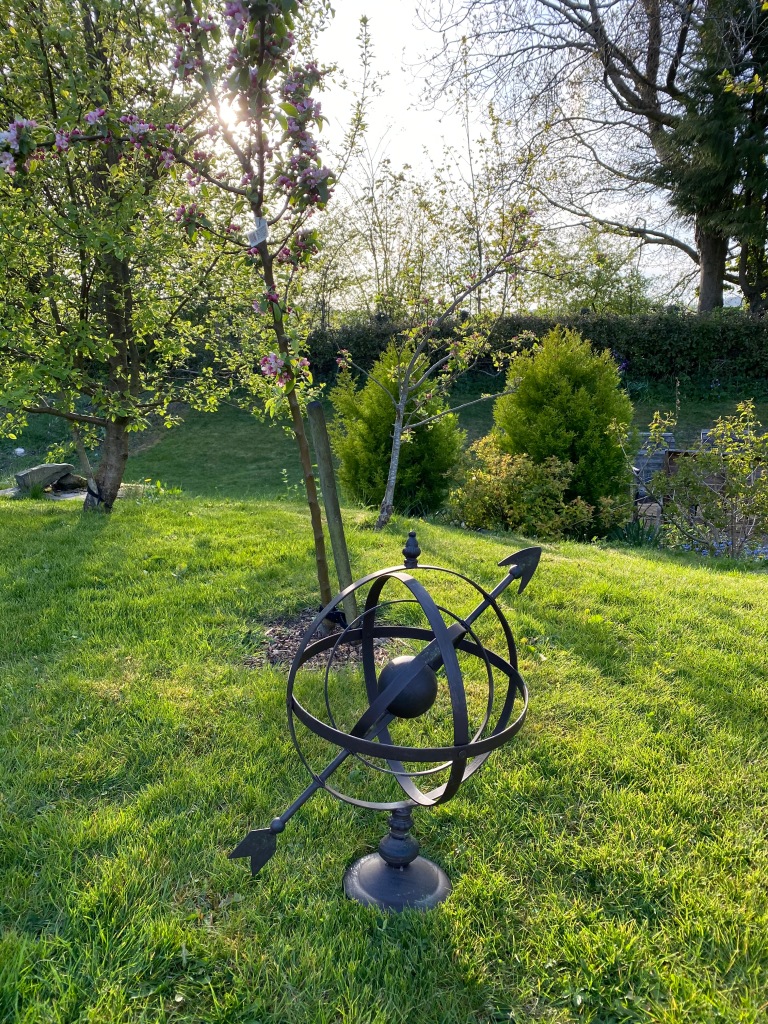
The armillary sphere consists of a spherical framework of rings, centred on the theoretical Earth or the Sun. It shows lines of longitude and latitude and other important features such as the ecliptic. Our intention is to design a setting for it whereby the arrow can point to the point of farthest progress of the Sun as it crosses the far ridge in its final moment of setting.
This marking of the horizon of the longest day is, of course, an ancient practice. The solstice has been associated with festivals of ‘full-nesss’ for as long as mankind has gazed at the heavens and given thanks for the energy than enables us to have food for our bodies. The harvest comes later. The energy of the Sun is, by then, embedded in what keeps our bodies alive.
We hope our marking of the horizon in this way will provide us a little ‘food for the soul’ as we inch towards the third week in June. This simple act of marking the horizon, will become very special in the weeks to follow.

©Copyright Stephen Tanham
Stephen Tanham is a Director of the Silent Eye School of Consciousness, a not-for-profit teaching school of modern mysticism that helps people find a personal path to a deeper place within their internal and external lives.
The Silent Eye provides home-based, practical courses which are low-cost and personally supervised. The course materials and corresponding supervision are provided month by month without further commitment.
Steve’s personal blog, Sun in Gemini, is at stevetanham.wordpress.com.


 Sun in Gemini
You must be logged in to post a comment.