+ #Silenti, Consciousness, esoteric psychology, People power, Politics and Power, Silent Eye School, Speaking truth to power, Spirituality
Tango in the key of sorry
by Steve Tanham

As the years pass, I continue to wonder at the marvel of human communication, and the sadness of how little we use its potential…
The world appears to be full of conflict and strife. But much of it is happening at the psychological level. The Trump era in America and the Brexit ‘civil war’ in the UK were both fuelled by similar (if not the same) media barons, but they continue to feed on two common elements of human nature – hatred and anxiety; in most cases related to things that were not present.
The power of fear plus the well-placed myth of taking back control are a potent brew… and a complete lie.
This lowest state, in which our desire for real interaction with those of other opinions drops to zero, is easily kindled in people who have limited awareness of the complexity and interaction of modern societies. The populist dictator always sows ‘his’ seeds among the weak-thinking, the people who believe in black and white solutions. But that state of mind is driven only by despair at their own situation.
A wise and enduring society ensures that, though there may be layers of prosperity, no-one is in that lowest position of helplessness.
For good or ill, our societies have evolved into enormous machines of interrelated complexity. All attempts to disengage with internationalism are doomed to the same sad death – costing the inhabitants of the country decades of repair in wealth and reputation. In many cases our societies may never enjoy the prestige they had, before.
But to blame the car which has just driven into a line of innocent people, where the bodies lie, broken across the pavements, is equally wrong. Complex machines require sophisticated pilots. There is no equivocation about a pilot’s science: the plane lands, successfully, or it crashes. There are no ‘alternative facts’ about whether it landed; just like there are no alternative facts about how a virus rips through an innocent and unguided population.
Populism dies in the face of such disasters… and for those who still persist with alternative facts there is, simply, no hope. They are to be shunned by the ‘healthy cells’ of the society to which they represent such a threat. The society – the ‘body’ – remembers health, and yearns to return to it. Only the routes back are seen differently.
In this deadly tango, which now embraces us all, are the seeds of despair and hope. The despair will take us all down – like the car without a driver, or a driver who chooses the fundamentalism of alternative facts over the power of the real and chooses to die in an orgy of ego.
Hope requires that, as individuals, we all take responsibility for listening to others’ point of view – no matter how antithetical they seem to our own minds. All counselling is based, first, upon listening.
There may be a ‘special place in Hell’ for those who engineered the chaos in which we find ourselves. But the greater power lies in the word ‘sorry’ – said from the heart opened with empathy.
It is the beginning of that special state that repairs a world.
©Stephen Tanham, 2020.
Stephen Tanham is a Director of the Silent Eye School of Consciousness, a ‘school of the soul’ that offers a three-year, mentored path to personal, spiritual growth, independent of religion.
Contact us at Rivingtide@gmail.com for more details.
Share this:


We start early the following day… There is that sense of being able to finish the whole project if we focus – and if we are prepared to be a bit brutal. There’s a certain recklessness about this attitude, but it’s born of an image of something to come that has great potency…
The first thing is to pick off the easy tasks, especially those that will make a big difference…
A couple of posts ago, I mentioned there were two USOs – Unidentified Structural Objects. The first we used as the basis for the ‘Detail Workbench’, photo below.
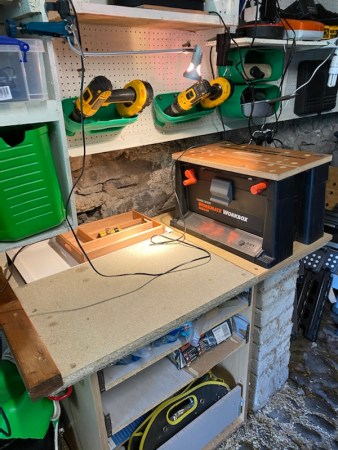

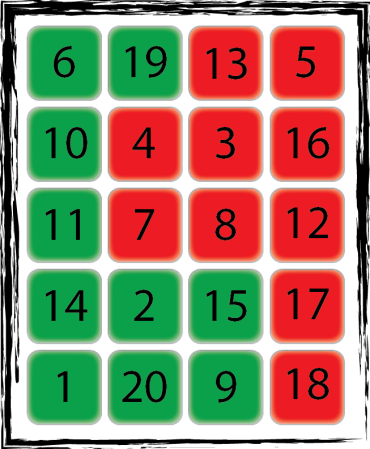
The second is a much bigger affair, stretching from the cobbled floor of Salty Pete to the base of the loft, ten feet or so above – square 19 in our Lucky Bag diagram, above.

The previous evening, I had spotted that the rectangular holes in the bricks exactly matched the cross-section of two lengths of old timber lying at the back of the wood store. The restored mitre saw makes short work of the lengths. A hand saw and the drills cut and fix the shelves in place. In less than thirty minutes we have an extremely solid wall unit that takes the main woodworking power tools: circular saw, electric plane, jigsaw and power sander… not forgetting the fearsome chainsaw lurking at the bottom!

Our success propels us forward. Moving across into the ‘red zone’:squares 13, 5 and 16, there is a partial solution waiting to be made whole…

In square 13 sits a rudimentary bench, knocked together one morning by the local contractor who restored the Saltpetre’s roof. It was the place he used to do detailed work. He’d spotted my father’s old bench vise, said it was a gem, and asked if he could incorporate it for the job. As far as I knew, it was broken, but I was happy for him to try to get it going, again.
The problem was that the ‘clutch’ that frees the main moving arm was broken, meaning the vise couldn’t be tightened. After an hour of trying, he had it working. I didn’t ask how. At the time I was just happy to have it back in good order.
After he had finished the roof, I asked the tradesman to leave the makeshift vise-bench in place. Now, checking if was still securely bolted into the wood, I foolishly flick the ‘clutch lever’. The vise ‘clunks’, ominiously, and refuses to tighten. The big lever just spins, uselessly!.
So much for our momentum… But the victory with the restored mitre saw has given me (probably unjustified) confidence. I dig out a socket set and ratchet loose the three large bolts securing the vise to the bench. It’s very heavy and, using two hands, I turn it over – gingerly. I can see the problem, straight away, a missing ‘stop’. But it would take a metal-worker to fix it… But then I realise that our roofer had been this way before me… and got it working. Using a large screwdriver to hold up what the clutch lever should be supporting, I manage to get the main screw to re-engage the vise’s sliding arm.
As long as I don’t touch the clutch lever, I’m confident it will continue to work.
No-one’s ever bettered these old bench vices, and I’m delighted to have Dad’s back working… “Just don’t touch that blasted lever.” I mutter to myself a dozen times as I tighten the now-working vise the slow way. The double victory – vise and mitre saw – brings a strong sense of Dad’s presence into this once-forlorn building… He came into here shortly before he died, in 2011. He patted me on the shoulder and muttered, “Lot of work…”.
Now, he’s willing us to that finish line… I can feel it.
With vise enabled, I turn and stare at the two remaining big problems. There are three objects in the otherwise-cleared centre of Salty Pete. One is an old and very ugly wooden table that has lived most of the past decade pushed up against the back wall. The other two are bright green: the Viking mower and the Viking scarifier. They are only used twice a year, but they are essential to the health of the lawn. The ‘scarifier day’ is a big and exhausting event with such a large area of lawn…
I really want them out of the way, but they are too heavy to store in the loft. I did consider buying and fitting a hobby hoist, but it’s overkill – a good boy’s toy, but over the top… and would cost money.
Instead, I want to think laterally and put them ‘up’; but not as ‘up’ as I plan for the bicycles… That will make sense, shortly.
Next to the roofer’s bench and vise are several bits of what was my ‘organic’ office desk – made for me by a friend who retired from IT and became a cabinet maker – a real woodworker! I cherished the desk, which comprised a long curve for my Macintosh computer, a bespoke set of drawers of variable height, and a small circular table – at which I would hold serious one-on-one meetings…


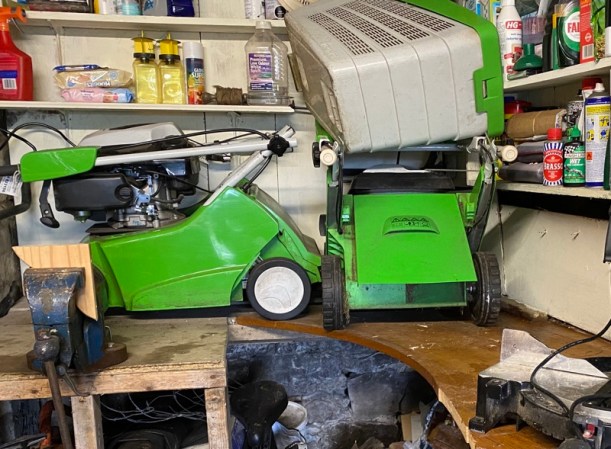
I loved the bespoke desk and re-used many of its parts in the new house, but the curved unit didn’t really fit and was too small for a main table in the study. So, here it is, in this far and dusty corner corner of Salty Pete, abandoned and out of place. I look at it and decide that some brutality would at least bring it back to usefulness. Measuring carefully and wincing, I slice it with the circular saw and jam the result into its new home. There will be no going back… It’s not at all pretty, but it will do the job and gives me somewhere ‘up’ to store the green machines.
Much sweating and cursing later, the two green machines are finally off the floor and housed somewhere better… The corner unit has enough space for vise, green machines, mitre saw and the second portable workbox.
Bernie appears from her gardening and asks if want a sandwich at the patio table or in here. She smiles when I opt for the latter – she knows me well and recognises my obsessive gene at work.
She brings a lot of kitchen roll, a bowl of hot, soapy water, the sandwich and a flask of coffee. She’s smiling, but says little… Hopefully, we’ll be celebrating with a G&T at the end of the day…
Fifteen minutes later, I’m back at work; the coffee is put to one side for real-time sips of inspiration.

The reason I’m so confident we can finish, today, is that half of the right hand side of Salty Pete is already done… At the start of the project, I moved a set of old wooden shelves from one of the dark corners to be centre-stage down the right-hand wall: Squares 16, 12, 17. There is a collection of objects waiting to go on them… which is the work of a matter of minutes.

One of the ‘fittings’ of the new shelves is an old wine rack, gifted to us by a friend when we spotted they were throwing it away. I’d already worked out that it could form a useful ‘pigeon-hole’ system for smaller tools: screwdrivers, pliers, that sort of thing. I just needed to work out how the tools were going to be ‘shuttled’ into place… and not fall through the gaps.
The answer came as I was washing out a plastic milk bottle. Examining it for size and shape, I ran out to Salty Pete. The fit was perfect. As you can see, we are building up our collection. It’s cheap and nasty, but free – and it works…
It’s a good feeling to have so much new and organised storage. But my excitement is not for this, it’s for what I can finally do with the middle of Salty Pete – something that I’ve been waiting to do for the past decade…
I’ve always wanted a woodworking bench. At school, I was good at woodwork, but was moved on by the teachers to concentrate on sciences. Now, finally, I had a chance to return to some of those basic skills and have fun developing them without time or career pressures.
I had two things with which to finish the whole project: the ugly but sturdy table that was now the only thing in the middle of Salty Pete’s floor, and the left-over planking from the new garden fence. The process was going to be crude and incomplete, but it would give me a dedicated, large bench to get things started. I could refine it, later. For now I wanted to reclaim the middle of this long-abused and ancient space.
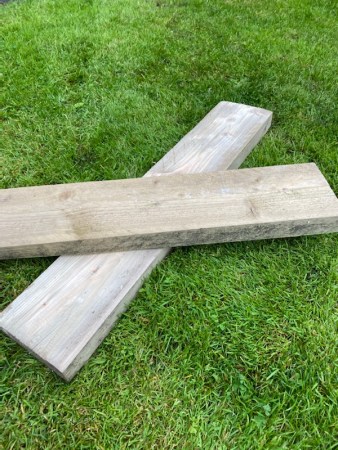
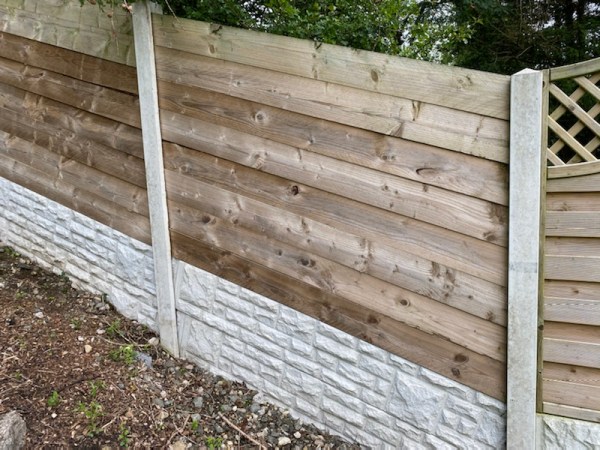
First I have to cut the sturdy planks to fit the width of the table’s top. The planks are long and unwieldy. They are also very heavy. I’m caught in a kind of Catch-22. I need to workbench to accurately cut the lengths, but the planks are too big to use the indoor table. Instead, I have to cut them outside, resting them on a trio of folding steps. The circular saw cuts well, but the planks are sliding around and the accuracy is poor. It’s better than nothing. There will be time for refinement, later, and, as a flexible concept, the planks are hard to beat.
I bring the trimmed planks into Salty Pete and assemble them for fit. Months ago, we bought an inexpensive table saw from the local Aldi. I’ve never used it because it needs to rest securely within some kind of ‘cradle’. I don’t want to take any risks with that naked spinning blade…

I drill and screw the first plank onto the edge of the old table top, then sit the table saw behind it, fitting another plank behind that. The gap created is larger than two planks, but not by much. I can leave two planks loose to fill the gap for now. For most jobs, it won’t matter. I continue until I’ve covered the table with the sturdy planking. I’ve been saving the sawn-off top of an old bookshelf (the rest sits under my desk in the study) for the final part, which, as the photo above shows, forms a kind of sliding ‘jig’ on which I can keep the tools in current use.
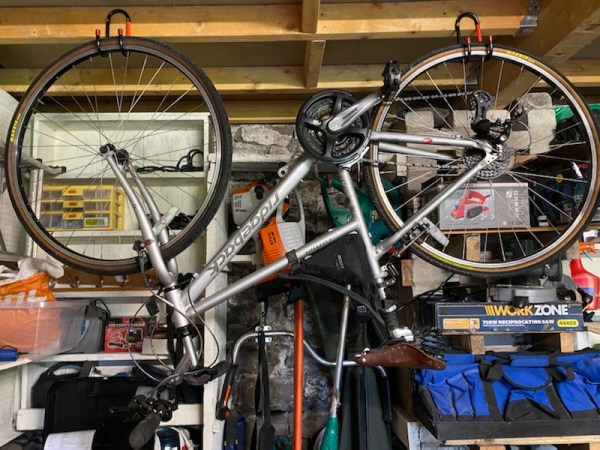
The project is nearly complete. The final action is to fix four sets of hooks to the rafters of the loft. These take the bikes, hung, upside down from their wheels. They can be detached in seconds and rolled out of the shed. You can’t win them all… At least they aren’t taking up floor space.
It’s finished. That’s the story of how the Saltpetre – Salty Pete to the project team – became a proper man cave. I can’t say I enjoyed every minute, but I enjoyed most of it. I’ve never seen Roddy the rat since that first sighting. Maybe he’s still around sniggering at me.

I’ve had some lovely comments and enjoyed your company along the way. Thanks for being part of the journey… And the final cost? Why, nothing but time and energy! Not a single penny was spent doing it; and that brings a smile.
Now, where’s that G&T?
The End…
Other parts of the Locked Down and Armed series:
Part One, Part Two, Part Three, Part Four, Part Five, Part Six, Part Seven, this is Part Eight, the final instalment.
©Copyright Stephen Tanham
©Stephen Tanham 2020
Stephen Tanham is a Director of the Silent Eye School of Consciousness, a not-for-profit teaching school of modern mysticism that helps people find a personal path to a deeper place within their internal and external lives.
The Silent Eye provides home-based, practical courses which are low-cost and personally supervised. The course materials and corresponding supervision are provided month by month without further commitment.
Steve’s personal blog, Sun in Gemini, is at stevetanham.wordpress.com.
Share this:


Human: Hello, Misti, what you up to?
Misti: I’m doing, Zen… flowing into the shape of this pot…
Human: Impressive! Anything else?
Misti: Unfathomable peace…

Human: Nothing to do with the bee under there, then…
©Stephen Tanham, 2020
Share this:

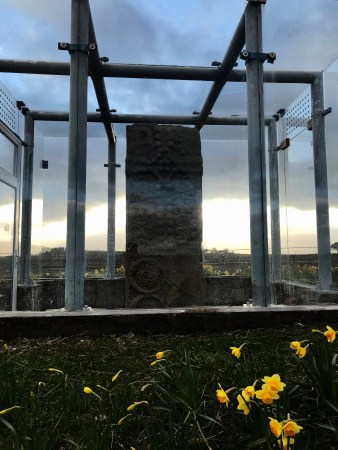
With many of the restrictions on Scottish travel and locations being lightened, it has become possible for the Silent Eye to resume its celebrated ‘landscape’ weekends.
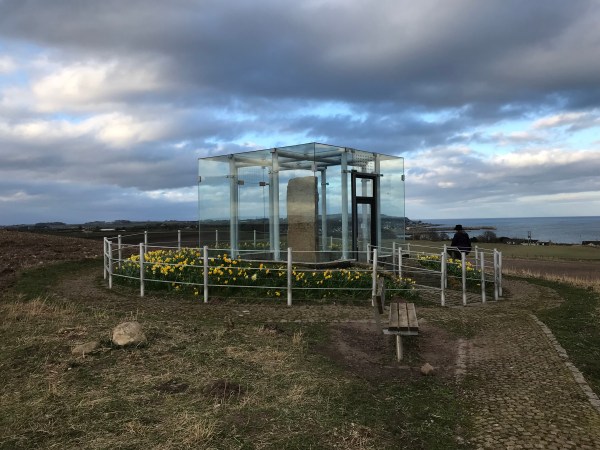
Come and join us in September for a beautiful journey along the Easter Ross coastline to trace the artistic and long-lasting people we call the Picts. A race of artist-warriors who kept the Romans at bay, yet revelled in peace and connection to the cosmos.
Three days in September: 11-17th. Full details here.
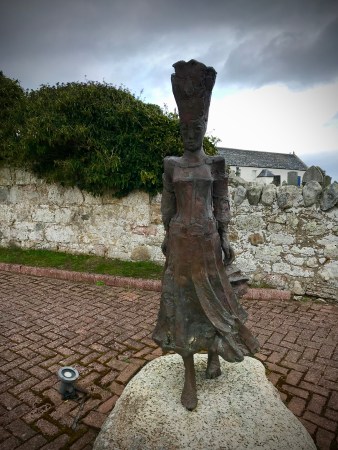
There is an option to join a smaller group travelling on to Orkney. See the above link for details.
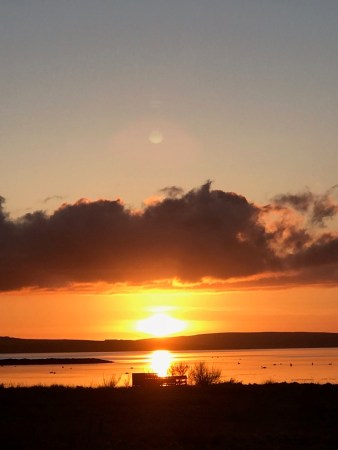
©Copyright Stephen Tanham
Stephen Tanham is a Director of the Silent Eye School of Consciousness, a not-for-profit teaching school of modern mysticism that helps people find a personal path to a deeper place within their internal and external lives.
The Silent Eye provides home-based, practical courses which are low-cost and personally supervised. The course materials and corresponding supervision are provided month by month without further commitment.
Steve’s personal blog, Sun in Gemini, is at stevetanham.wordpress.com.
Share this:

It’s an important day… definitely make or break. You arrive early and we have a toasted sandwich washed down with tea. The sun is climbing over the trees, but it’s cool in Salty Pete, and we sense that this will be a very positive period of reconstruction.
We need something upbeat to get us started, so here’s a bit of Abba to set the tone…
We have a big challenge today: to end the constant movement of shed-stuff out from Salty Pete at the start of the day and returning it from the lawn at the end of the day. Despite the recycling corner now containing seventeen large black bags of rubbish, we are still spending at least thirty minutes at the start and end of each day getting enough space to work in.
Our ‘Lucky Bag’ map of the interior is beginning to look very different, though… We are making real progress, and it’s lifting our spirits. The completion of the left wall (squares 1-6) has provided a drill station, the new illuminated workbench for detailed things and given us storage for a host of mid-sized objects like folding chairs and a portable workbench on which I can now cut logs for next winter’s wood for the log-burner. The garden tools storage is mainly complete. I’d say we were about 60% of the way through the whole project.
The big problem we have is the amount of shed-stuff we need to store – even after sorting it. We’ve discussed this and come up with a plan. Salty Pete is a tall structure and it’s high time we used some of the ‘up’.
Its obvious, really… But I don’t know about you, I usually feel decidedly unsafe at the top of a ladder…
The other issue is the bicycles. There are six of them. Two are folding Bromptons, and easy to store. The other four are full-size and take up a lot of room. Finding a solution for them is not going to be trivial. Once again, I looked up for inspiration…
There is a substantial loft space in Salty Pete. We had it built along with the new roof. It’s badly in need of a sort-out, but was constructed to take a lot of weight and, for now, we can make more space up there to solve our problem down here.
The issue is accessing it, safely. At present it needs the skills of a mountaineer to shimmy up the thin steel ladder that came with the property. The ladder – we inherited it – is ugly, thin and bright pink… I’ve never understood why. Bernie hates it with a passion, but it’s strong and doesn’t get in the way… and I have a certain respect for it.
Only part of our problem is up in the air; the other half is how you fix a ladder to a cobbled floor. It could slide away at any moment, or it might jam itself in a gap so that nothing can move it… But we don’t want to gamble on the latter…. And falling onto that stone wouldn’t be trivial.
If we are to stay true to our resolve to spend zero money on the project, we need something that has a miraculous fit to the pink steel ladder. Something that will allow itself to be anchored in a safe part of the ‘up there’.
When we bought The Wharf, I went looking for an unusual chair to complete the fittings in the study. There is a furniture shop in Lytham, (on the Lancashire coast) that specialises in ’used but unusual’ pieces. We often looked in the window. Just before we moved into the new home, we had a run out to walk Tess on the seashore and have a pub lunch. Passing the shop window, I spotted an oversized, overstuffed, American style armchair. It was a wine red and I liked it. I walked around it for a while, then made an emotional decision and bought it.
It looked terrible when we got it home… and wasn’t comfortable, either. Fast forward several years and I managed to get it down and into a skip. As I was manhandling it, one of the steel feet came loose. The feet, themselves, were sturdy (see pic) and I decided to unscrew all four and keep them for possible use. At the time, I had a nagging feeling that I’d just end up throwing them away at the next major sort-out.
But no… The elusive god of ‘told you that would come in handy’ was on my side, for once…

Now, I had an idea that would vindicate their retention…
The problem with using the loft space was safe access. It wasn’t the difficulty of getting shed-stuff up the ladder. The minimalist pink ladder had smooth sides, and it was quite easy to push an object ahead of you, as long as it wasn’t too heavy. If the plan worked, a single session of moving things up there would eliminate the recurring problem… at least for now.
My idea lacked engineering finesse. It was a ‘shoe-in’, but I knew it would work. I would need to locate the fittings carefully, and I would need both drills, working together… I would also need your help in holding the pink ladder very steady while I worked…because it wouldn’t be safe until the end.
The giant timber cross-member, to which I had attached the strip light, is about save the day, again. We move all the shed-stuff in the central squares of 7, 8, 2 and 15 out onto the lawn for what would hopefully be the last return trip. We stand the pink ladder in a variety of locations so that its top rests on the wooden beam. Eventually, two positions stand out as the least likely to obstruct the flow of likely movement: squares 2 and 15.
Fastening my leather tool-belt in place, and sliding the twin drills into their holsters, I climb slowly, skywards… Woof!
You pass me the first of the steel feet from the scrapped chair. They are pre-drilled – to fit the chair, and the holes can be re-used for our project – something critical, given they’re the kind of high tensile steel we’d find difficult to drill through. From my belt I take a pencil and mark the line of the pink ladder’s highest rung. Clinging with one hand, I switch between the two drills to pilot the holes, then secure the re-purposed chair foot so that the ladder top will rest in its ‘U’ shape, keeping me safe up there…
It’s hot work, hanging from a ladder and drilling like that… But, minutes later, I descend and we re-fit the pink ladder into its new (working) home. It rests well. I twist it, savagely – I’d rather find out now that it’s not fit for purpose than when I’m hanging on for dear life, pushing a heavy box upwards. It doesn’t budge. I’m looking smug, again…

Three mugs of steaming tea arrive… with some biscuits. Bernie’s been gardening, and is just as tired as we are. But she’s pleased. She’s impressed with the ‘up there’ approach and agrees to pardon the pink ladder… Result!
After tea, the whole operation with the ladder brackets is repeated on the left side. That goes smoothly and I realise how much this has just solved. For the next half hour, we bring in all the shed-stuff that was on the lawn. This time, anything not needed for our project can go up and stay up there... We will need a second stage of the project to clear out the loft, but that can wait for next year.
Looking upwards at the ladder supports, I smile. Generally, we think in terms of supporting a ladder at the base. But, in terms of it slipping, the top is much more secure – if you have the opportunity. The spirit of spending zero money has driven us to create a solution that is now going to save us an hour each working day.
There’s a lot you can do with an hour…
I remove the pardoned pink ladder to check that it can be put away along the left wall when not needed. It fits. It can.
Our day has gone well. It’s late and you need to head home. I continue for a while to complete an easy stage of the previous day’s work.
In square 19, there is a happy accident waiting to be finished…

The ‘long power tools’ – strimmers, hedge trimmers and various others, are of a length that rests nicely along the vertical face of what was one of Peter’s radio shacks. It feels like a long time ago that we took that sledgehammer to them…
For several years, I’ve been collecting ‘hooks’. The label on the large, plastic box says so. In my system, ‘hooks’ are anything from which other things can be hung, once they are fitted to something solid. Hooks come in many forms. The strongest are capable of holding the weight of a bicycle or greater.
I’ve already attached several such bicycle hooks to the top shelf from the old radio shack in square 19. With the exception of the most powerful tool – the Stihl strimmer – they hang beautifully, still allowing the storage shelves behind to be used for related items, such as two-stroke oil in its measuring bottles.
The Stihl strimmer is heavy; but luckily its ‘handlebar’ will rest on the remains of a lower batten – as long as the heavy bit – the engine – is secured above – by its shaft. It’s a curvy item, and tapered, and won’t fit flush to the shelf… but the curve only wants to take it out an inch or so. Thinking laterally, I saw out an enclosure and use a chisel to remove the waste block. I use another, smaller piece of waste, plus a screw, to create a hinged closure for the lateral ingress. The Stihl strimmer slides into place as though made for it. It’s a good feeling.
A quick slap of North Californian Shabby Chic emulsion on the new bits and it’s a tidy job…

Walking back towards Salty Pete’s door, I realise I am still wearing the holster and the two drills, plus bits. In the far corner, by the door, is a part-assembled shoe rack storage system. The cubes in this plastic and metal unit link together to form large pigeon-holes in which anything that fits and is not too heavy can be stored.

We’ve used so many in the house, I could assemble them in my sleep. It’s the work of a few minutes to complete the array – a unit I know will fit into the now-white carcass of the largest of Peter’s radio shacks and rest on the base shelf. What I need to do is to figure out how to lock what is a rather fragile unit into place. Reluctantly, I conclude that long screws and a degree of butchering are the only way.

The drills are ready, I’m fired up from the success of the day. Soon, the shoe-racks are in place, and held as best they can be. I’m down five long screws, but the unit is secure and complete… as is the whole wall.. I place the drills into their new working ‘pods’ made from the halved green petrol cans.
It’s a good feeling. The wall is complete. We can step back and look at the full length.

The left wall now comprises: garden tools, large and small; liquid storage; vertical storage cubes; detail workbench, floor storage for folding chairs and ladder; drill station and vertical storage for long gardening power tools.

Looking along the walls length and smiling, I note that there is still a lot of ‘up’ we’ve not exploited. Hmm…
To be continued…
Other parts of the Locked Down and Armed series:
Part One, Part Two, Part Three, Part Four, Part Five, Part Six, This is Part Seven
©Copyright Stephen Tanham
©Stephen Tanham 2020
Stephen Tanham is a Director of the Silent Eye School of Consciousness, a not-for-profit teaching school of modern mysticism that helps people find a personal path to a deeper place within their internal and external lives.
The Silent Eye provides home-based, practical courses which are low-cost and personally supervised. The course materials and corresponding supervision are provided month by month without further commitment.
Steve’s personal blog, Sun in Gemini, is at stevetanham.wordpress.com.
Share this:


Human: You’ve stolen that lady’s ball?
Tess: Haven’t!
Human: It’s in your mouth.
Human (louder): She’s looking for it behind you!
Tess: Snigger… I know…
©Stephen Tanham 2020
Share this:

+ landscapes, Life and Death, nature, Photographic techniques, Photography, Spirituality, Travel and people, Travel and Photography
Dr Joy’s Garden
by Steve Tanham

A poignant return visit to Alnmouth, a beautiful coastal town in Northumberland. A memorial garden dedicated to a very special woman…
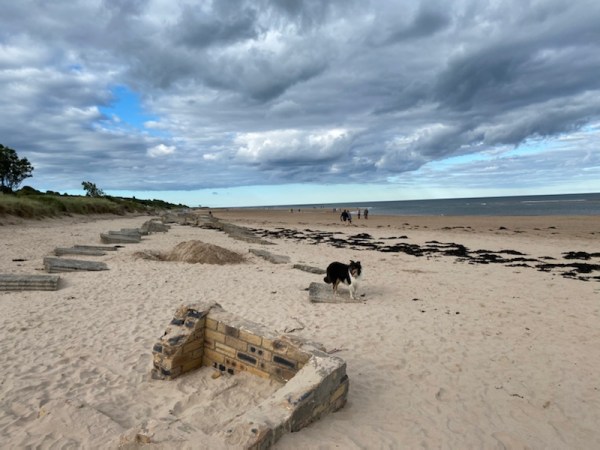
Share this:

So, now we’ve got to move swiftly!
I see you’re willing and able, You have your faded work- jeans on and you can borrow my older safety helmet. It’s a bit squeaky, but perfectly functional. We have two hours to paint Salty Pete between squares 1 and 19. See the ‘Lucky Bag’ diagram, below .
During the last hour before you arrived, I’ve been stirring this huge pot of white emulsion paint – essentially, bringing it back to life from ten years ago. I’m as surprised as you are that it worked… and it’s free, of course. If we use it up – which is unlikely – there’s another, identical tub sitting in the darkness close to where the rat was last seen…
‘Roddy’ – Salty Pete’s newly-named resident rat – has not been seen since our fateful meeting in the dark and dingy recess under the old vice. I have to say, we must have been feeding him well because his coat and eyes gleamed with health. I’m not entirely happy with his (or her?) presence. How do you ‘sex’ a rat? Very carefully, I imagine, especially a wild one, living in your future man-cave.
I decant the first measure of thick, white paint into two old mugs and hand you a medium sized brush. We set to… The brief is to paint everything above waist level that is wood and connected to the old stone – with the exception of the now-completed garden tools racks, made from the old pallets. The contrast of aged wood and white will look good.
I’m after a cheap effect; what Bernie and I once named ‘North California Shabby Chic’. In the 1990s we spent many weekends motoring along the Pacific Coast Highway (also known as PCH and Highway 1) and further north, following the roads as far as the stunning Oregon coast. The computer-based world we worked in was centred on technology from one of the Silicon Valley companies, and we took every opportunity to tag a few days’ adventure onto each of our quarterly business trips.
North of San Francisco, it’s quite sparsely populated. You can drive for hours before finding that much-desired cafe, tucked away down a backroad. When you do, there’s a good chance that the decor will be ‘North California Shabby Chic’. This consists of rapidly-applied rough strokes of thick, white emulsion, resulting in a rich coat of white, underpinned by occasional glimpses of the wood beneath. It doesn’t come into its own until you put colourful things on it, of course…
It’s easy, error-proof and fast. It doesn’t matter what else you paint in the process because it can all go in the mix. We’re talking casual painting – a style to go with the organic nature of our restoration of Salty Pete… It’s also fun, and we’ll end up spattered with white. But your old jeans and my old jeans have seen it all before.
Music… we’ll need music. So here is one of my favourite Jackson Browne tracks to keep us rhythmic and motivated.
Off we go…
Two hours later, singing and, occasionally, giggling, we have finished. Our arms ache with the constant brush strokes, and we’re a bit of a mess… But it’s been fun. Salty Pete – at least the wall between squares 1 and 19 – has been completely transformed.

One of the long sections of pegboard still has shelf supports fixed in place. They’re drilled into a batten that’s is fixed into the stone at the back, so they’re very solid. Not waiting for the paint to dry, I reach for the step ladders and try them for size. They hang, perfectly, leaving ample space, below, for other fittings to be attached. Doing this gives me an idea about the many bicycles…. but more on this, later.
“Suddenly, it’s bright!’ says Bernie, arriving with three mugs of steaming tea – we’ll have to be careful not to confuse the various mugs, going forward…
She examines what we’ve done… “North California Shabby Chic!” She says it with a chuckle. It’s all the approbation we could wish… The day has begun well, and it’s about to get better.

There’s one shelf I’m in a hurry to see dry. It’s right in the middle of the main section and I want it to be the home of a bluetooth-based portable speaker to which I can ‘beam’ music while we’re working in here. Having quality sound is a key step. I place an old tile beneath the speaker to protect it from the drying paint, and connect it up to the phone. The well-constructed cabinet space – a survivor from one of Peter’s radio shacks – makes its sound rich and resonant.
Above it are two more shelves. I put the large, outdoor extension leads into these, and the whole arrangement seems to snap into life. Directly above this are the twin feeds from the dual power sockets on the main beam, so we’ve aligned form with function.
Let’s bring it to life… Here’s an appropriate song from John Miles:

USOs… it’s not a typo. Unidentified Structural Objects… There are two of them; the smaller one, here, Square 11 – beneath the music and power shelf, and a bigger floor to ceiling one on the back wall, Square 19.

The smaller one, beneath the music shelf, is about the depth and height of a kitchen unit, which is why we placed a broken and surplus kitchen unit next to it, years ago. We had a vague plan to make it useful in the future and it currently houses chisels and an old jigsaw. The USO is made of pale brick and serves no visible purpose. Perhaps it supported something vital in Peter’s day?
Whatever it was, it’s about to become something new, for I can’t make progress along this most important of walls without resolving its use. It is too big and intrusive to ignore, and I’d just fall over if it stayed unchanged. So I have to make it part of something functional.
Thinking furiously, I assemble some bits… which turn out to be an inspired collection…

There’s a Black and Decker ‘workmate workbox’, a plastic tray, a pen and pencil drawer insert, two pieces of MDF – one raw, the other covered, a scrap halogen light fitting from my old office desk, and, finally, a small ‘modeller’s’ vice.
I push the old (and door-less) kitchen unit up snug to the USO. A short stride to the newly commissioned Drill Cabinet sees me equipped with two ready-charged drills – pilot drill and power screwdriver locked and loaded. Five minutes later, I’ve drilled the two pieces of MDF into place. In the process, the kitchen unit has been secured into the whole. I’m looking smug…
By some miracle of good fortune the white plastic tray fits snugly behind the MDF, tidying the gap to the wall. I place the pencil tray into its white brother and rotate the ‘workmate workbox’ into one of two orientations it will have, long-term.

Things are looking good. But this workplace will be used for detailed things, and I need the footless halogen light resolving…
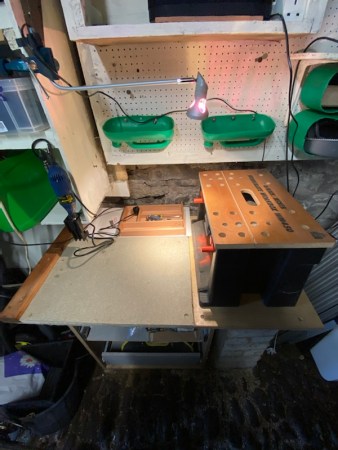
The small vice comes into play: it fixes (at a right-angle to the usual orientation) to the music shelf, above. The arm of the broken halogen lamp is fastened, horizontally, so that the head can be rotated to the workbench, below, or just about anywhere else for contributory illumination.
Our working day is ending. I have one final thing to do. We have a plethora of old, plastic, petrol cans, and I suspect they’ll make useful storage – sawn in half. The first one is in the above photo, mounted on the pegboard. We’ll look at what it does, in the next post.
The left wall is looking purposeful. But behind me the central part of the floor is still chaotic. I will need a bold move for the next step, if I am not to continue to spend the start and end of each day carrying things out to the lawn and back again.
I stare up into the dusty heavens and wonder… dare we?
To be continued…
Other parts of the Locked Down and Armed series:
Part One, Part Two, Part Three, Part Four, Part Five this is Part Six
©Copyright Stephen Tanham
Stephen Tanham is a Director of the Silent Eye School of Consciousness, a not-for-profit teaching school of modern mysticism that helps people find a personal path to a deeper place within their internal and external lives.
The Silent Eye provides home-based, practical courses which are low-cost and personally supervised. The course materials and corresponding supervision are provided month by month without further commitment.
Steve’s personal blog, Sun in Gemini, is at stevetanham.wordpress.com.
Share this:

Will I layer my data, uniform,
Till that obedient plateau
Where the arranged and ruling desktop
stamps me ‘passed’, no threat
Or
Shine and gripe, outrageously
Refuse to corner, close or fit
Until a newborn’s bloody fingers
Stain the pallettes
Of billionaires’ mahogany
©Stephen Tanham, 2020
Share this:

+ #Silenti, Child of Light, Consciousness, esoteric psychology, Lake District, Photography, Silent Eye School, Soul, Spirituality, The Beloved
The Summer Within
by Steve Tanham

When I was a young boy, a favourite uncle, who was quite old, said to me, “You always feel young, inside, you know…”
It’s a sentiment I’ve heard many times. I knew it to be true – from the look in the eyes of those who said it, despite the lines of time on their faces. But now, to experience it in my sixties, is sobering and refreshing at the same time.
In the Silent Eye, we put forward a method – really a journey – which takes each person on an individual path towards what we might call ‘a place of summer’ within themselves. The journey concentrates, initially, on what life and our choices have made of us. We look, with honesty… and sometimes grit, at what we have become. The desire for this may take place later in our lives, when the energy of youthful excess has had its hour upon our stage, but it doesn’t need to: it is appropriate at any time of life.
As children and then young people, we do not consider that the inner and outer ‘selves’ have different lives. If we are healthy, the energies flowing in the inner and outer seem to have the same exuberance. It is only as the decades pass, and aches, pains and stiffness sometimes penetrate our daily consciousness, that we begin to notice there is a two-state existence to our lives; that the inner, though often clouded by it, is not experiencing the limitations of the body in the way that the outer is…
There comes a point – somewhere in the middle of our lives, where health and flexibility can no longer be taken for granted; when deliberate, rather than spontaneous exercise needs to be done with discipline if we are to retain some degree of that youthful flexibility that makes ‘life worth living’.
This is when many become conscious of the inner life in a renewed way. In moments of deep sleep or other relaxation, they may touch on a glowing sense of presence within. This usually happens when the physical self is at rest, and the mental self is psychologically peaceful. The degree of outer and inner ‘quietness’ is important, for this feeling has a refined ‘glow’ of existence that is hard to define in words.
In these moments, we are experiencing our own soul; and the enormity and significance of this cannot be overstated. The sense of depth and calmness may be touched upon by poets, but is seldom described in ordinary writing – because it is so little known What we experience, here, lies beneath – and has always done so. Yet, it is not inferior, as ‘beneath’ usually denotes. This is beneath ‘as foundation’. Its power and lovingness exist in a deeply peaceful place, where it has been all our lives. This inner state is known in childhood, when the world seems ‘brighter’, but our rightful fascination with the outer is paramount to the consciousness that wants to ‘taste the world’, and the innate knowledge of the inner fades…
Touching this state, again, triggers certain responses. We don’t want to lose it, yet ordinary attempts to hold onto it will fail. To hold the contact with that presence that is so deeply ‘us’ – requires that we learn why we lost touch with it in the first place…
It is constantly changing, and, unless we understand the subtle currents that drive its changes, it will appear to float off on an inner, summer breeze.
Part of what the Silent Eye teaches is to understand, in a self-demonstrable way, what the soul is. In the simplest terms, it is our truth: absolute and unchallengeable once experienced. It came into this world, into our lives, before we – the personality of self – existed. Our personality has grown, in all its strengths and weaknesses, around the soul, like a suit of heavy armour around warm and beautiful flesh. This necessary journey was chosen by the soul for its development. When we die, the harvest of the life adds to the soul, and the armour returns ‘to the earth’.
The soul is made of something special. It is not subject to the ordinary laws that govern our lives. It is not subject to them because its existence pre-dates them. It is ‘bigger’ and more fundamental than those restrictions.
We don’t ordinarily ‘see’ the soul because it is closer to us than anything else. All our experiences are actually experienced in its substance, but our reactions to those experiences are of our ordinary, waking self. The inner peace, spoken of through mystical history, is the non-reactive response of the soul to life’s experiences, as it delights in oneness in the fullness of inner and outer life, combined.
The soul tries to speak to us every day, every minute and second of our waking and dreaming lives. But the noise of the world and our habitual turning away mean that it cannot be heard. Life is a ‘noisy’ place, and most of the noise is our reactive self.
The journey into that place of peaceful love and purpose belongs to us all. There doesn’t have to be a map – some people take it by storm. But a map helps on the journey. Few of us can find that beautiful home on our own simply because we’ve got used to not being there. Those who teach it are paying forward the love of they who taught them.
Like the flowers on the front of the bicycle in the opening image, we carry the soul within us always. It is us rather than we are it. This perspective is crucial…
We’ve just forgotten that the summer is always there… right in front of us.
©Stephen Tanham 2020
Stephen Tanham is a Director of the Silent Eye School of Consciousness, a not-for-profit teaching school of modern mysticism that helps people find a personal path to a deeper place within their internal and external lives.
The Silent Eye provides home-based, practical courses which are low-cost and personally supervised. The course materials and corresponding supervision are provided month by month without further commitment.
Steve’s personal blog, Sun in Gemini, is at stevetanham.wordpress.com.
Share this:

I didn’t explain about the three drills…
I’ve written about the new one – a slinky DeWALT with a noise that makes you shiver with DIYlight. The other two are older versions by the same maker.
Buying the new one was prompted by the failure of both my re-chargeable batteries, when I tried to use the drill after a year of idleness… So, technically, I had a spare drill – but I had purchased only one battery with the new device… Two drills, one battery…hmm.
Prior to the destruction of Salty Pete’s old interior (the ‘radio shacks’), I stored my personal protective gear – safety helmet, armoured gloves, eye-protectors, long waders for the pond, etc – in a large plastic box that was loosely jammed on to the main cross-member that supports the upper part of the building. The middle of the former Saltpetre was so cluttered that I needed somewhere with easy access to my most precious life-protecting gear. Being high above, I only had to arrange the pink ladder (more on this later) to access my essential gear.
Before I swung the sledgehammer at the entire left side of the interior, I shimmied up the ladder to retrieve the box before the start of armageddon. The box contained a surprise: all my expected stuff and, underneath, another drill case. It was old and dirty, but inside was a drill and two batteries… presumable dead ones.
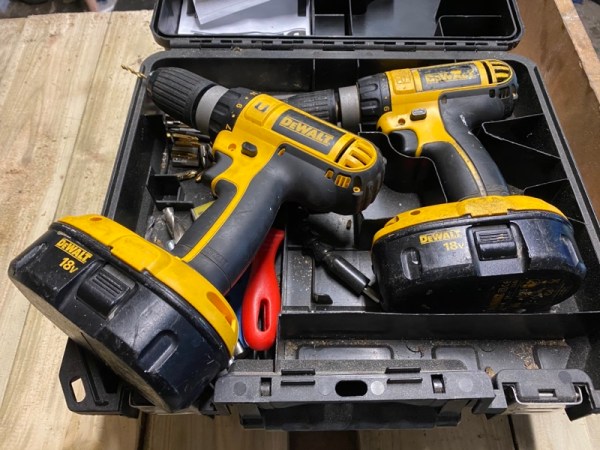
In a state of disbelief, I did a quiet calculation on my fingers and realised I now had – at least potentially – three drills and three batteries – assuming the older ones worked.
It was too good to be true. Hardly daring to hope, I stretched a power line up to the only socket in the place and used a multi-plug to connect the two chargers. There was a satisfying clunk as the batteries dropped into the charger’s housing… and then both red lights began to blink, indicating they were charging. Disbelief… and a silent thank you to the fates.
Within a meagre half an hour, they were fully charged, tested and ready for action. Two of the drills were mine; the other was a mystery. Five years ago, we had some structural work done to create an interior loft within the Saltpetre; but no-one had contacted us about a lost drill case and contents.
I made a phone call to check. Nope… said the roofer and builder of lofts. The drill kit was not his…. A mystery; but in these circumstances, a delightful one. If anyone else who’d worked here came to mind, I’d come clean.
If not, I had three drills…each with a battery.
A drill saves hours of work, but what slows you down is having to change the ‘bit’ from, say, a thin pilot drill – used to make sure the final screw doesn’t split the wood, to a bit that functions as a powerful screwdriver – driving a long, high-tensile screw home in a few seconds, where it would have taken long minutes by hand. The small, dedicated ones are useful in a house, but, for serious stuff, get an adaptor for your drill…heaven!
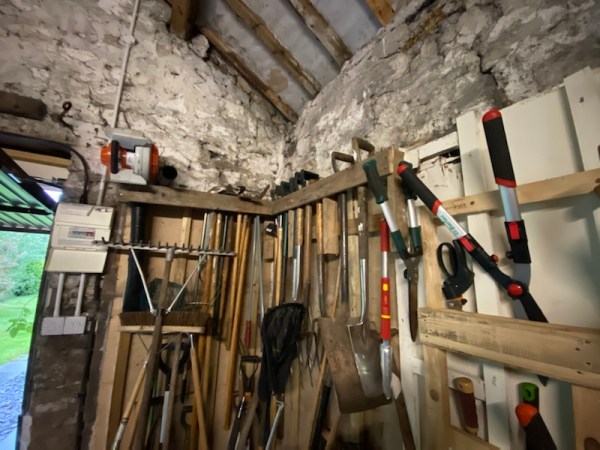
The only reason the ‘long-handled garden tools rack’ had been finished in the short time available was the double-act of two drills, functioning as described, above.
The main problem when working on Salty Pete’s interior was the low level of light- there are no windows. When we bought The Wharf, ten years ago, there was no electric to the ‘shed’. While having the contours of the future garden carved out of the muddy building site, we had an armoured cable routed under what would become the main lawn. For the first few years, we survived off this, and the single plug near the door, barely visiting Salty Pete during the dark months. Eventually, we had a overhead set of sockets and a strip light put in, but the light was in the wrong place – on the side of the lintel and not its lower face, where it would light up the intended (future) workbench, below.
I was going to need a lot of light for some of the work I had planned, so I disconnected the fuse, then the light-fitting, before stretching the existing cable to allow for it to be mounted directly over the central part of the building. The spring days were bright, but that little extra from the overhead helped a lot.
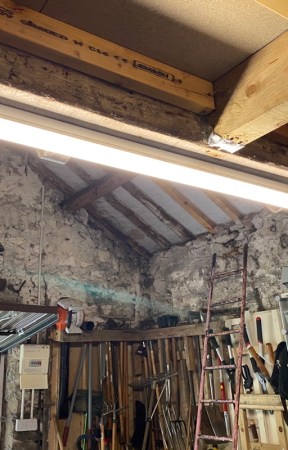
Having relocated the main light, I took stock of what the rest of the day might contain. There was another ‘easy win’ for Square 14: an object that would add both hand-tools and liquid storage beneath the long-handled tools rack. For years it had served as a shelving unit in the larder of our former house. It was made wholly of plastic and I hated it… But it was free.
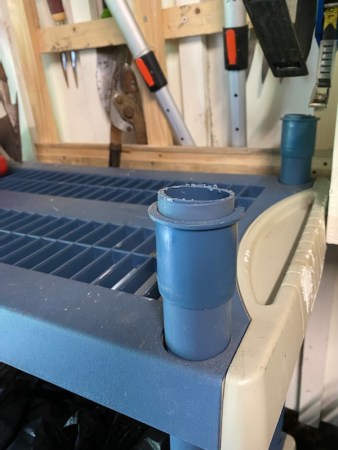
The plastic shelf was too tall. The top of this unit had to be level with the base of the tools above it. A hand saw made short work of the adjustment in height. Minutes later, minus its top shelf, it was functioning as a container for the petrol, two-stroke, white spirit, turps and various other liquids that normally take up flow-through space on a garage floor.
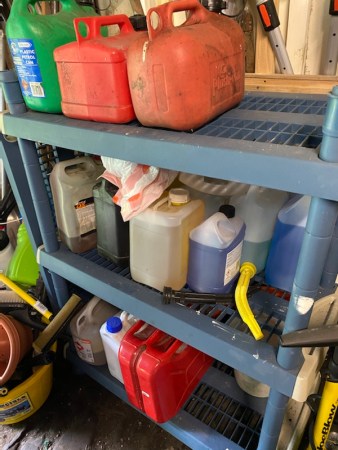
The new structure was beginning to emerge within the dusty cube of the Saltpetre. Its functions and forms were nascent in what was included and excluded so far. This wall was to be dedicated to garden tools and liquids at one end; and ‘tall power tools’ at the other, with drills taking a central place in the middle. The ‘tall power tools’ had no common home at present and were a damned nuisance. Incorporating them into the wall would free up much of the floor and provide a wonderful feeling of walkable space.
I was starting to realise that this was not just a physical journey, but a psychological one, as well. Much of my personal past was being confronted, here… Contradictions have a habit of being exposed in such a process.
Enter contradiction…
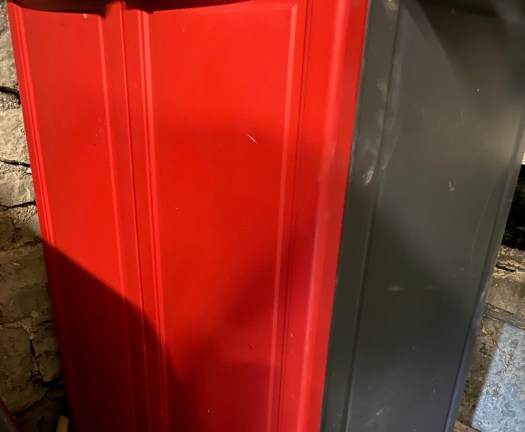
It’s about four feet tall, garish red with grey trim, and had large castor wheels. It’s all plastic, and often bends in all the wrong places. It’s useless and Bernie couldn’t wait to get rid of it!
It’s a tool chest – but was never strong enough to do its job. I used it for years in my office–but not for anything heavy. Since then, it had mouldered at the back of Salty Pete, buried under a mountain of other, unlikely-to-be-reused stuff.
But my ‘gift from above’ drills were sitting, quite nicely, on it. Moreover, it could be rotated into the corner of Square 6, where it would take up the minimum room and not block access to the ‘long power tools’ that had to live on the adjacent and recessed Square 19. Reluctantly, I could see the potential for it to be dedicated solely to the drill-related part of my hardware. And I had just redeemed and re-used Bernie’s nasty plastic shelves. According to the verdict accompanying the last mug of tea, she was ‘well pleased!’
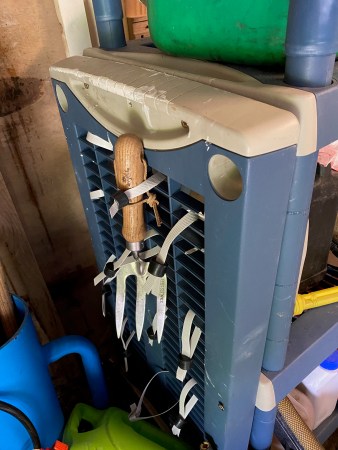
There was a trade, here… And I knew just how to sweeten the deal. On her last mercy mission with the tea, Bernie had remarked that it was a pity that we couldn’t re-use the severed top of the plastic shelves. Two drills at the ready, and armed with my large plastic jar of may-come-in-handy bits, I fixed the old top, vertically to the side of the renewed liquids rack and, using long screws, locked it tightly in six places against the verticals of the shelving. The hard ‘webbed’ surface was perfect for the use of plastic ties. A short time later, we had a place where shorter garden tools could be slipped into strong plastic loops and tightened… all made from scrap pieces of plastic and large-packet Amazon wrapping.
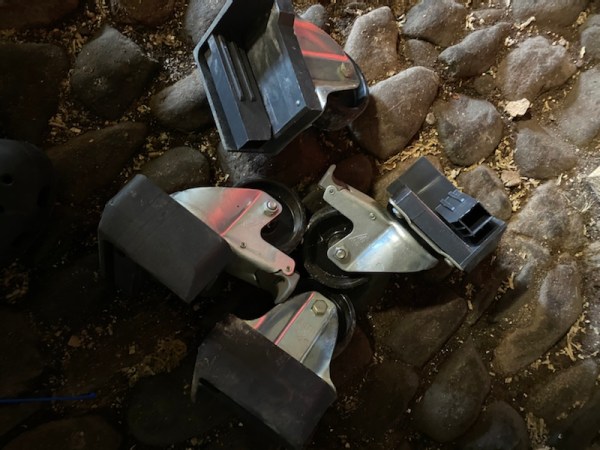
Returning to the other side of the left wall, there was a problem with the tool cabinet’s feet – four large castor wheels, allowing it to be pushed around on a hard level floor. But on cobbles from 1820! Even Hercules would shudder… Removing the wheels was a matter of sliding the casings out of the ‘loose from new’ plastic housings. I put the heavy castors to one side. They were the best made part of the cabinet and would possibly come in handy within the house. Wheel-less, it stood more firmly on the ever-present, ever uneven cobbles.
“If it were snowing, we could tow it away on a sleigh,” I heard myself mutter. And then thought about what I’d said. Flat runners would at least average out the effects of the cobbles. I scrambled to retrieve two lengths of scrap wood and one of Peter’s old jam jars in which he had stored a selection of basic washers. The cabinet’s plastic was flimsy, but I suspected that the right fat-screw and washer combination would fix it to anything below. I could drill through the cabinet anywhere I liked, there was no strength in any of it…
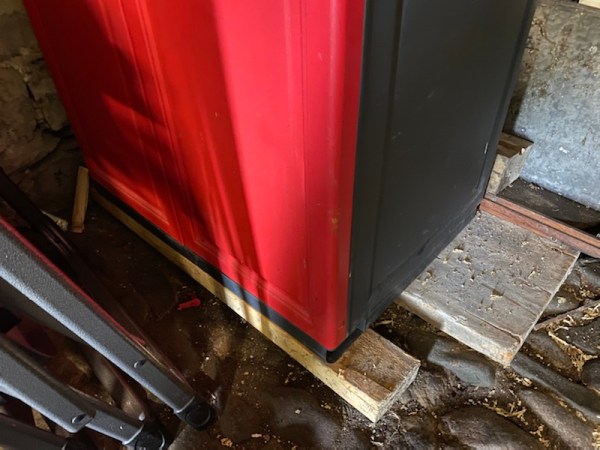
I examined the interior of the cabinet to check where the structure was weakest. Pulling my head back to the daylight, I noticed that two of the older timber battens ran down the wall at the back.
Thirty minutes later, the ugly red box was not only secure, it was drilled and screwed so tightly into what was around it that it had become an integral part of Salty Pete’s structure. I grunted in triumph. I wasn’t just remodelling the interior, I was building a Favela!
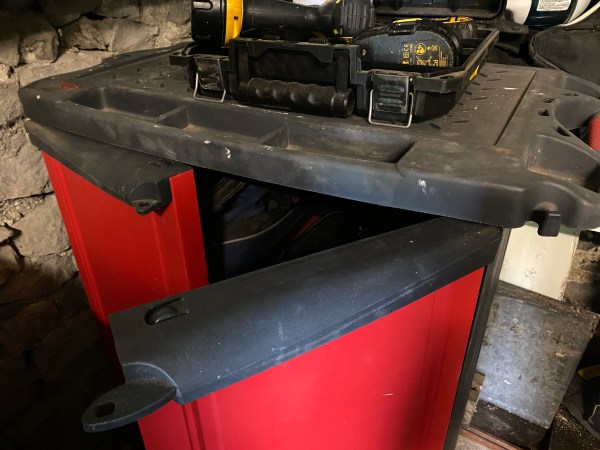
Keen to keep the momentum going, I located everything I could find related to my drills: bits galore (thank you, Dad), plastic plugs of all sizes, the lot. I stuffed them all into their new home, with the twin drills on top and… and stood back; looking from garden tools, across the expanse of the left wall to the new, bright red, ‘drill station’.
It felt really good, until I focussed on the actual wall between these twin triumphs. Before me was a patchwork of ancient red pegboard, slotted-in timbers for support, and a wealth of old MDF pieces to fill the gaps. Each was a different colour. The effect wasn’t vital, it was ‘dead’ and old… Whatever happened next with that important central section, I didn’t want it backed by such a sad base…
We needed a break from the past, and colour was the most powerful technique I knew. But the spirit of the project was to do it by re-use and upcycling–spending no additional money in the process.
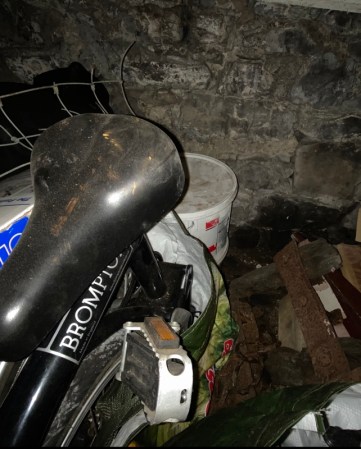
I knew that, in the back of one of the nastiest corners of the building, (Square 5 on our map) buried beneath a pile of other things – including our ‘bagged’ Brompton folding cycles, were two ten litre plastic drums of white emulsion paint. They had been left over from decorating the house when it was finally complete, back in 2012. I doubted they would still be usable… But they were the best chance I had of changing the ‘feel’ of Salty Pete… without spending a penny!
But, first, I had to dig my way to them…
Twenty minutes later, sweating profusely with the effort of shifting enough stuff to get in there, I located them in the near darkness. They were as far back as they could be, and against the old stone of the back wall. As I inched towards them, I looked sideways, for motivation, at the shining red side of my new ‘Drill Station’…. and saw the remarkable blue eyes of a large rat looking back at me…
To be continued…
Other parts of the Locked Down and Armed series:
Part One, Part Two, Part Three, Part Four, this is Part Five
©Copyright Stephen Tanham
Stephen Tanham is a Director of the Silent Eye School of Consciousness, a not-for-profit teaching school of modern mysticism that helps people find a personal path to a deeper place within their internal and external lives.
The Silent Eye provides home-based, practical courses which are low-cost and personally supervised. The course materials and corresponding supervision are provided month by month without further commitment.
Steve’s personal blog, Sun in Gemini, is at stevetanham.wordpress.com.
Share this:

+ #Cats, #Collie dogs, #FurryFives, #InnerCatPeace, #RagDollCats, #Silenti, Cats, Collie dogs, Rag Doll Cats, Spirituality, Yoga
#FurryFives : possession
by Steve Tanham
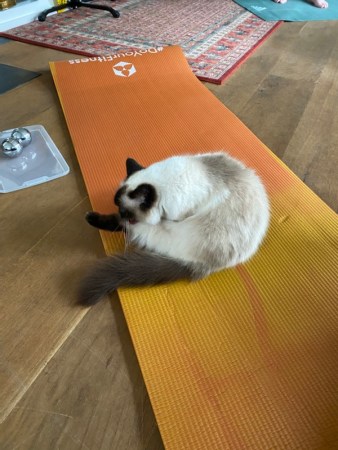
Human: That’s my Yoga mat!
Misti: She who has possession!
Human: But I need to begin my online class!
Misti: I’d concentrate on kissing your shin, like this, if I were you..
Human: I’m taking you back to Bolton and dumping you back in that bush!
Misti: Bet you don’t…
©Copyright Stephen Tanham, 2020


 Sun in Gemini
You must be logged in to post a comment.