
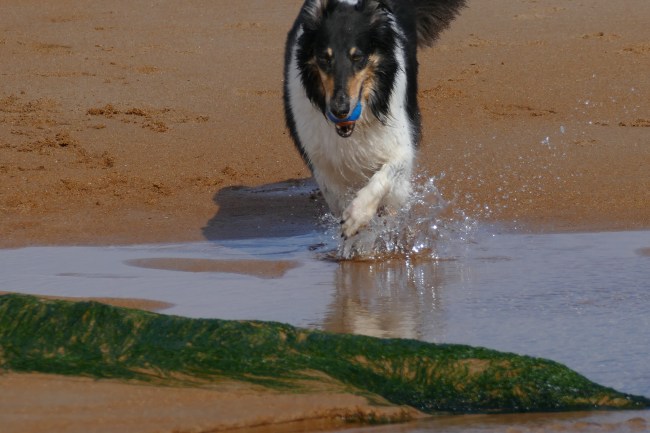
Sphere or disc, it matters little
What your complex words cry
Into the wind – the only thing that separates us
Not distance, not when:
Your smallest sigh,
Your first breathed sound,
The movement, even, of your lips,
Stirs my heart to action
⦿
And, pumping blood,
In ancient ways you could not grasp
I change before your eyes into arrowed fur and claw
Head stretched on neck reaching into time
Purposeful and sleek beyond your unformed dreams of dog
And watching full of awe as wolf emerged
To hold you, hazel-spelled, with her softened eyes.
Intelligent, now, they guide the ‘snook’
The word you gave the tip of this living arrow
That now, like a lightning strike
Steals the ball from the air before it lands
A second time… waiting…
⦿
To hear, from far behind my vortex tail
Your howl of delight
A noise I taught you, long ago
When puppy legs were shaped like ‘A’
And we began…
⦿
Your she-wolf
Run me well. man-friend
as I curl my warm life
Around yours
In complex, harmonic motion
⦿
Stephen Tanham
20April20
©Stephen Tanham 2020
Stephen Tanham is a Director of the Silent Eye School of Consciousness, a not-for-profit teaching school of modern mysticism that helps people find a personal path to a deeper place within their internal and external lives.
The Silent Eye provides home-based, practical courses which are low-cost and personally supervised. The course materials and corresponding supervision are provided month by month without further commitment.
Steve’s personal blog, Sun in Gemini, is at stevetanham.wordpress.com.
Share this:

Misti: Wasssat!

Misti: Tess! It’s a wasp!

Tess (sleepy): It’s a bee, Misti…

Misti: You don’t know everything, you know!

Misti (looks at camera): And neither do you!
©Stephen Tanham 2020
Share this:


From a photographic perspective, we live in a wonderful age. Even the most humble of today’s mobile phones boasts a decent camera. Used within their limitations, we can achieve an amazing record of our days – even locally to our homes – with the use of a few simple techniques.
My wife and I, plus our cat and dog, are lucky to live in the countryside, just south of Kendal, in Cumbria. Like everyone else we are ‘locked down’ except for buying food and exercising our Collie dog. The emergence of the spring has been a welcome respite, and has enabled a wider choice of photographic opportunities.
In my experience, taking photographs is a deeply therapeutic activity. It gets you out of the house, and makes you focus on something very positive. For the shots I’ve used in this blog my criteria were:
1. To walk only a short distance from home. A typical morning dog walk takes us about two hours and sees us less than two miles away, as we meander and the collie gets lots of ball-chucking.
2. To photograph only objects that are commonplace. The essence of this kind of challenge is to find something special in the ordinary.
3. To use only my mobile phone to take the shots, leaving cameras with more sophisticated lenses at home. Generally this means that the emphasis will be on the close-up shot, but, as we shall see, there can be exceptions.
The opening shot, above, is at the farthest point of our walk. The path along the old canal bank takes a sharp left and dives down into a field with sheep. This removes the middle ground and opens up the perspective available. A few seconds spent exploring the composition through the viewfinder can reveal a pleasing mix of foreground and distant background – in this case, a faded view of the Lakeland hills to the north-west, contrasting with the old limestone and aged wood of the fence.

The second image, above, is of Sedgwick House, in the middle of the village. Once the palatial home of a local gunpowder magnate, the gothic-style mansion has seen many roles; including army base and children’s home. Following a recent building conversion, Sedgwick House is now divided into luxury apartments.
I’ve photographed it many times, but today was the first time I’ve seen the light so perfectly balanced between the dappled area beneath the trees and the brighter approach to the building. The two tall trees should have interfered with the shot but, due to their helping frame the light effects, they have actually enhanced it.

The third shot is of the ‘skewed’ aquaduct in the centre of Sedgwick. What is now known as the ‘Lancaster’ canal once ran all the way into Kendal. The canal-carrying bridge was built using advanced stonemason techniques that allowed the shape to be bent. This avoided having to reshape the road into a ‘z’ bend. The photo deliberately emphasises the skewed right arm of the structure, thereby demonstrating its length. The tiny view into the continuing main street is a visual surprise in something so massive and dense.

The final photo is simply a tree bursting with the unique green hue of the spring. It’s impossible not to feel joy in its presence – especially after such a long and muddy winter. Always look for the dappled light at the base of the tree – it’s a joyous as the green on a lovely day like this.
Four simple techniques and sample shots. Anyone can take such photos, and come back home feeling something deliberate and mindful was achieved in the daily exercise walk. In addition, the air is clear and beautiful, given that there is so little traffic on the roads. Get your camera out and take advantage while it lasts… It will give you a record to discuss with your grandchildren, if nothing else!
©Stephen Tanham 2020
Stephen Tanham is a Director of the Silent Eye School of Consciousness, a not-for-profit teaching school of modern mysticism that helps people find a personal path to a deeper place within their internal and external lives.
The Silent Eye provides home-based, practical courses which are low-cost and personally supervised. The course materials and corresponding supervision are provided month by month without further commitment.
Steve’s personal blog, Sun in Gemini, is at stevetanham.wordpress.com.
Share this:

Continued from Part One…
(Note: republished from my Mac laptop as the latest version of WP on the iPhone 11 Pro has crashed itself, repeatedly, and appears to have taken the original post with it… I’ve had to recreate this from a (mercifully) still open window that allowed a cut and past of the whole thing… Apologies to those whose links arrived at nothing!)
We have a somewhat unique connection to the history of our tiny village of Sedgwick, near Kendal and on the edge of the English Lake District. The village of only 350 residents has neither shop, nor pub nor church. But its location, four miles south of Kendal is an ideal basis for Lakeland life and also gives easy access to the M6 motorway – a mere fifteen minutes away.
The village has no shop, no pub, no church and about 350 residents. But it’s a gently attractive place to live…
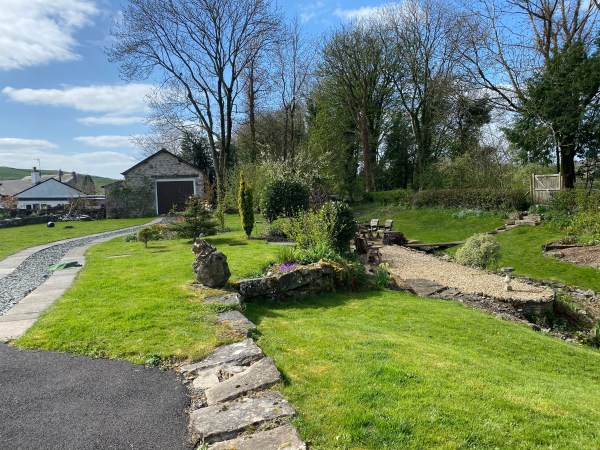
Our home is one of the few properties which still bear the imprint of the old canal which ran from Preston to Kendal in the early years of the 19th century. Our neighbour, Richard – who has lived here all his life – remembers being allowed to stand on the deck of the maintenance barge as the water was finally drained from this stretch of the canal in 1958. The maintenance boat is buried on our side of the property, some ten feet below the lawn (see photo above) that now abuts the large stones that were the original wharf – the ‘dock’ – for Sedgwick’s interaction with the canal… and the canal, or rather, the reason the canal came here, is what created Sedgwick.
In the sixty years from 1770 to 1830 canals were the height of innovation. They helped fuel the industrial revolution. Each one required an act of parliament for its creation. They, plus the long barges that floated on them, were very important forms of transport, known as ‘navigations’, which gave the name ‘navvies’ to the labourers who dug them out by hand from Britain’s rugged landscapes.
Their reign was brief. Britain’s growing network of railways meant that the slow transport by inland boat was made obsolete within thirty years of the canal’s height of success.
Sedgwick has few claims to fame. One is the former canal; but a far more important reason is how and why the canal ever ran through this tiny place at all…
Let’s tell it as a bit of a mystery – by way of a walking tour and easy reading.
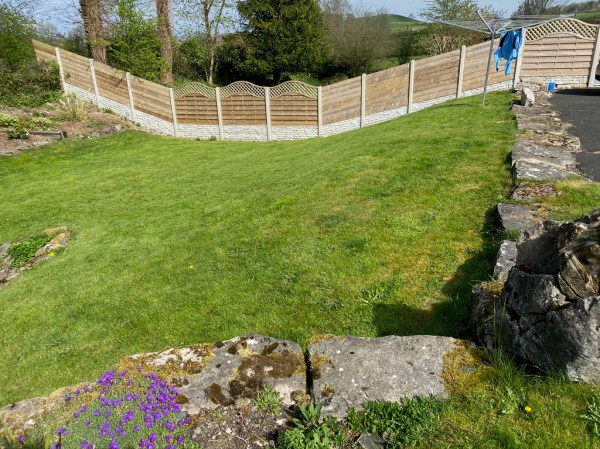
We have a large garden. It’s taken us ten years to transform it from the run-down wilderness we inherited when we decided to blow most of our savings designing and having built a home on the edge of the Lake District.

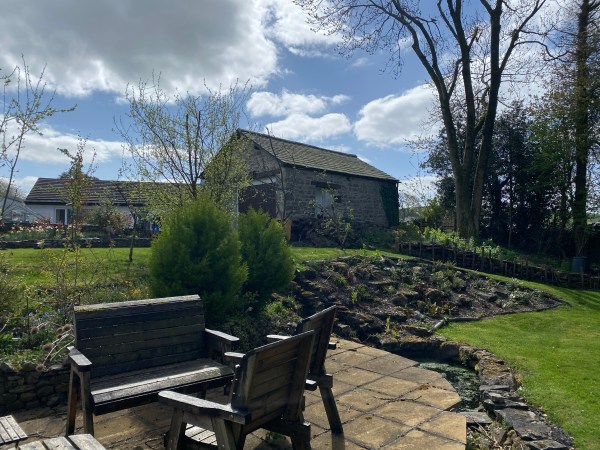
At the end of garden, on the south side, is a stone outbuilding known locally as the ‘Saltpetre’. It’s quite well known in the village and forms a key part of the industrial history of the place. A sign on the canal path about a hundred metres away describes it. It was built in 1830!
Historic gunpowder (also known as ‘black powder’ to distinguish it from modern smokeless powder) is the earliest known means of creating a chemical explosion. We associate gunpowder with war and aggression, but far more of it is used in mining, quarrying and other peaceful endeavours. The canals, themselves, were created by the use of gunpowder to blast away rocks that would have prevented the straight lines necessary to create the economic route.
Gunpowder was made from a mixture of sulphur, charcoal and potassium nitrate. The latter was known as saltpetre – pronounced ‘salt-peter’. The sulphur and charcoal are fuels for the core ‘burning’ reaction, while the saltpetre injects a literally explosive reaction of rapidly expanding oxygen, catalysing the ordinary burning into something entirely different…
No saltpetre, no bang…
Saltpetre is known, historically, as the ‘white mother of gunpowder’. We will explore its relationship to Sedgwick and the strange naming of our outbuilding in the next post.

The interior of our Saltpetre building is still floored in the original limestone ‘cobbles’ once used throughout Cumbria.
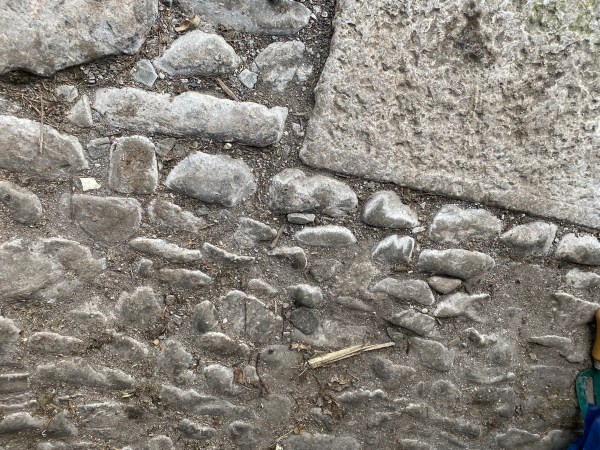
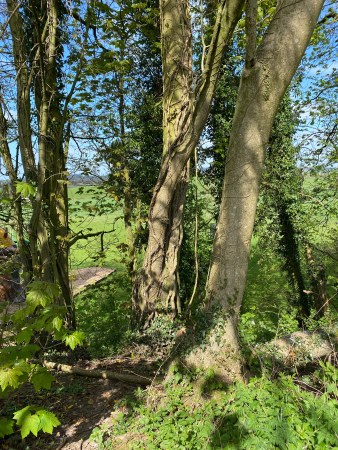
For now, let’s climb out of the old canal bed, through the gate and up onto the original canal path – still in use as a footpath and right of way. The immediate area is heavy with trees which follow the steep bank down to the adjoining farmland.
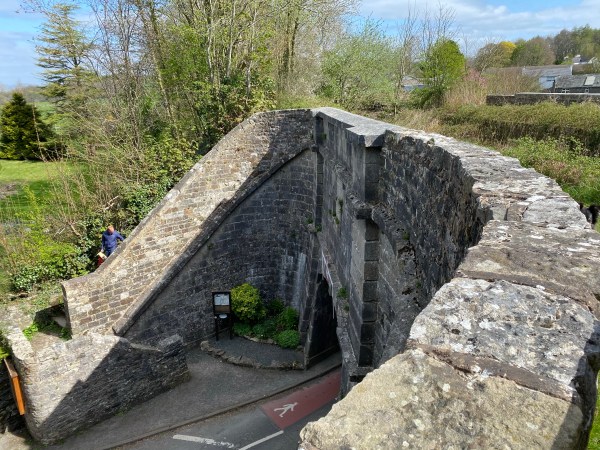
About a hundred metres along the canal path we get to the old bridge that is the centre of Sedgwick. The bridge is an aqueduct – designed to carry water over a roadway. Its strength is demonstrated by the fact that it’s still here, and still carries the bed of the long-drained canal through the centre of the village. A special national authority still exists to protect and maintain such structures.
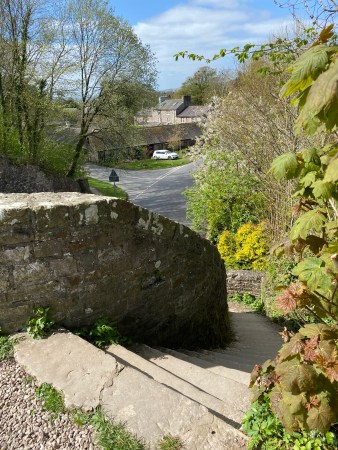
The bridge is of the ‘skewed’ type. This allowed the existing track or roadway to operate directly beneath the ‘bending’ stone bridge. Without this design, the road would have needed alteration to become a ‘z’ shape.
The other side of the skewed bridge allows descent via a pedestrian slope. The village hall is directly ahead at the base of this pedestrian slope.
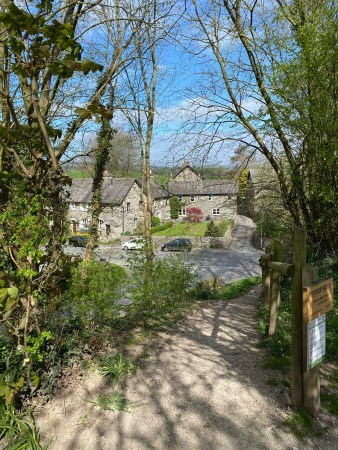
From here, continuing on the canal path, we walk southwards for a few hundred metres until we come to the edge of the village.
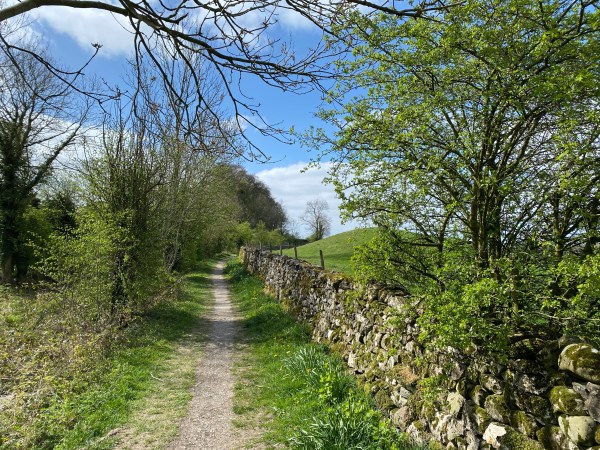
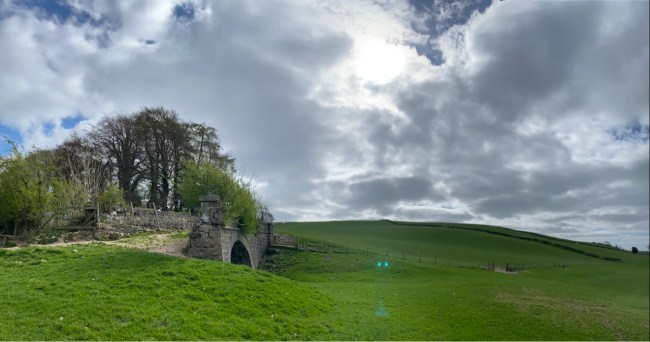
Eventually, after another five minutes’ walking, we come to one of our most iconic and mysterious structures: a ‘bridge to nowhere’ that crosses a canal that is no longer there. In this view you can see what happened to the canal along most of its length; it was sold off and filled in to create agricultural fields – as it was with the piece that is now our garden.
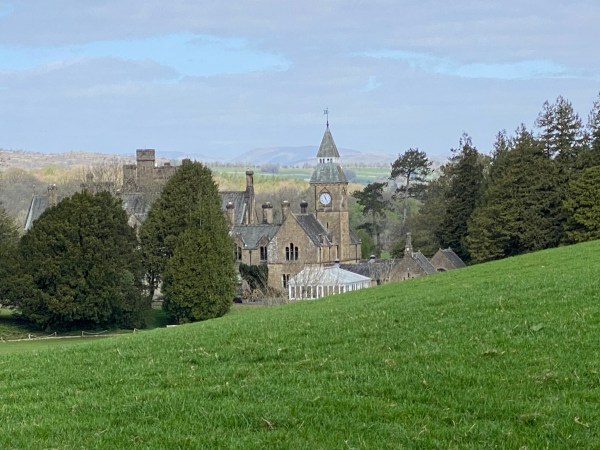
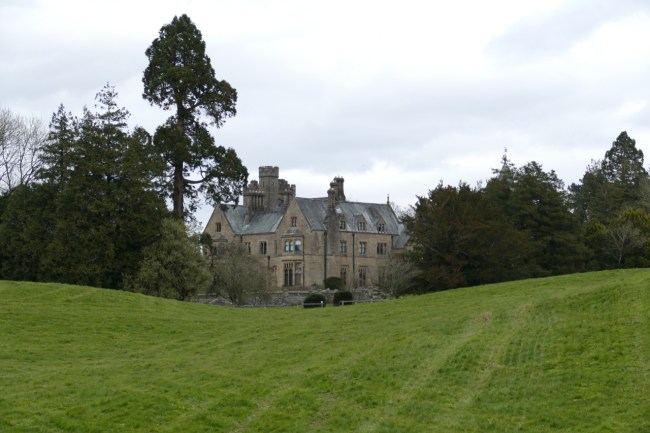
At this point, we can look down the slope to see a very different face of Sedgwick. There, set in its own grounds, is the largest building for miles around. Its present name is Sedgwick House, but originally it was named Wakefield House. ‘Wakefield’ was the family name of a man whose industry was to transform the landscape of Sedgwick; and connect it with the beating heart of the rest of industrial Britain.
(To be continued… )
©Stephen Tanham 2020
Stephen Tanham is a Director of the Silent Eye School of Consciousness, a not-for-profit teaching school of modern mysticism that helps people find a personal path to a deeper place within their internal and external lives.
The Silent Eye provides home-based, practical courses which are low-cost and personally supervised. The course materials and corresponding supervision are provided month by month without further commitment.
Steve’s personal blog, Sun in Gemini, is at stevetanham.wordpress.com.
Share this:

+ Celtic Christianity, Christianity and modern mysticism, Consciousness, Egyptian Myth, Goddess Isis, Osiris, Spirituality
The Sacrificed King
by Steve Tanham
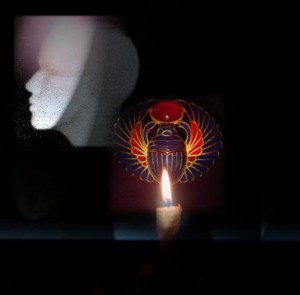
Easter is symbolically the time of the celebration of the death and resurrection of Christ. This thread of story and principle runs through our civilisation very deeply; and Easter Sunday is the most important day in the Christian calendar.
Jesus (the) Christ did not proclaim himself king, despite being labelled ‘King of the Jews’ – quite the opposite. He said he came ‘from the Father,’ not from some royal and kingly forebear. The lineage he claimed was of a deeper and less material nature – one that would only manifest itself in right actions and the generation of goodwill through a deeper understanding.
In so doing, Christianity is more explicit in the nature of the change to human nature represented by the older and more ‘pagan’ stories of the Sacrificed King. The common elements are worthy of exploration.
Would we expect any ‘king’ to be the subject of sacrifice? Killed by his enemy, perhaps, as in the case of the Egyptian king Osiris – cut into pieces by his brother, Set. But would we expect sacrifice as part of a process of psychological or spiritual transformation? Surely the state of kingship represents the pinnacle of temporal existence?
The King does, indeed, represent the ‘fullness’ of mundane existence, and it is precisely this quality of achievement that brings on a ripeness for a transition to a higher order (or plane) of consciousness. To continue the metaphor of ripeness, the King becomes the self-sown seed for what is to come. King in this sense may, of course, be male or female, though our patriarchal history more frequently assigns the male.
The Kingly achievements become the soil in which the seed of the sacrifice is sown, the fuel for the journey. The parallel stories of alchemy teach that, once begun, the transformation will continue as a ‘descending fire’ until the earthly nature is symbolically burned away, and the new and reborn spiritual nature shines for the first time in this world, potent and filled with the innocence of a consciousness that has no past.
The Sacrificed King has much to teach us. The force behind this transformation is particularly strong at this time of year, as the long winter gives way to the spirit of the spring – the astrological year, renewed…
A deeper understanding of this process will reprise the story of Osiris. The many parts into which he is cut are lovingly re-assembled – minus his penis – by Isis, who searches his ‘kingdom’ tirelessly. Eventually, he comes to rule a different land – the Egyptian underworld, the place of the ‘Gods’.
This year, surrounded by the horrors and frustrations of the Covid-19 situation, we have much to consider about life and death. The Sacrificed King stories refer to a symbolic rather than a literal death – but one which carries just as much potency… some would say, more.
We wish you healthy, happy and reflective Easter.
©Stephen Tanham 2020
Stephen Tanham is a Director of the Silent Eye School of Consciousness, a not-for-profit teaching school of modern mysticism that helps people find a personal path to a deeper place within their internal and external lives.
The Silent Eye provides home-based, practical courses which are low-cost and personally supervised. The course materials and corresponding supervision are provided month by month without further commitment.
Steve’s personal blog, Sun in Gemini, is at stevetanham.wordpress.com.
Share this:


Our neighbour and I were speaking, quietly, looking through the spring buds at the rising of the full moon last night.
“I’ll be glad when this is over,” he mused.
I nodded my agreement, but privately held other thoughts…
What exactly is ‘this’ I wondered? Have we really thought through what we are all going through?
Many things have come to a ‘harvest’ over the past few years, among them are:
The state of world politics has grown bleak. Particularly in the USA and the UK – which, not surprisingly, seem to be linked by far more than a common language and historic genes. So much that we took for granted as ‘the normal state of civilisation’ has been swept aside by the force, abuse of information and the power of the super-rich. We all seemed to take a breath and wait for the natural intervention of hidden guardians who would keep the faith with kindness and the kind of liberal values many of us thought were the established bedrock of our societies.
But that didn’t happen. Instead, that ‘old order’ seemed weak at the level of power. Stronger, perhaps in the home and communities that watched with horror as so much that had been hard-won was torn apart, as a wild dog might destroy a fine meal.
The general concern about ecology and looking after the Earth seemed subsumed by the single focus on a gas – carbon dioxide – now generally dubbed ‘evil’ despite being an utterly essential molecule of life. The complex relationships being modelled as ‘climate change’ are now so polarised that no alternative viewpoints are possible without being pilloried. I’m content to let the experts agree that their simulations, plus ‘much faster than ever before’ warming is taking place. But I’m not going to declare war on a gas that, until the start of the industrial revolution (1760 – 1840) had declined to such an extent that oxygen-breathing life on Earth was about to be threatened with extinction. Global warming may well be happening, but our concern for the planet should be on a wider front…
Ironically, this is happening despite politics. Electricity generated from renewables (especially wind power) has now developed – despite politics – to such an extent that nuclear power is generally reckoned to have no future at all. I can only see this as an example of a much more potent ‘will of the people’ than the manipulation of political opinion during a once-in-five-years election that supposedly represents democracy. The alternatives to democracy are terrible, but are we really sure we have democracy in the first place?
And, now we have Covid-19. It’s a deadly ‘novel’ virus believed to emanate from bats via pigs in the ‘wet-markets’ of China. It has cut through the world’s societies without regard to any kind of status, wealth or privilege. As I write this, the British Prime Minister is in intensive care in one of London’s top NHS hospitals, suffering from the deadly virus… in a country which has yet to begin to face the difficulties of ‘Brexit’ that lie ahead in our severed world.
And, it was this more that any other thing that has happened that made me think of a different level of meaning to what is changing all our lives.
My neighbour was staring at a beautiful full moon that had just emerged from behind the trees. It was so clear you could see its features with the naked eye. Quietly, he said, “It’s like someone has drawn a line across the moon… no-one can take their mind off it.”
In that moment, I saw a new meaning to the Covid virus and its world-wide epidemic of misery and death. It was forcing us all, young and old, rich and poor, to think differently and as a single life-form.
The most potent part of this new thinking is the fragility of our world; not ‘world’ in the sense of nature – that will go on regardless of man’s waste, greed and folly – but ‘world’ as the way we live our daily lives.
The shock we are all feeling is a result of our previous way of life coming to an end, and of all of us staring into this face of the unknown ‘land’ where almost everything we took as inviolate is gone or dramatically changed… No longer will any British politician – regardless of ‘left’ or ‘right’ affiliation – be able to say that state money on a vast scale should not be spent from the country’s reserves to help people in need. That is already happening under the Conservative government’s own plan; recognising that those needy people are the very molecules of the economic system, itself – its life-blood.
All it took was a threat bigger than politics and more immediate than ‘climate change’.
That state of ‘gone’ may be temporary…or it may not. For the first time, nature has looked us in the face and dared us to survive. The scientific bits of how this happened are not irrelevant. I’m not looking for some action of ‘God’ in this catastrophe. But, collectively, we are awakening in a world changed beyond belief in the shortest of time. The power of this change makes politics look irrelevant. But perhaps the politics that replaces the stagnation of our present systems of government will find its birth in what the philosopher Gurdjieff would have called a ‘necessary shock’ to the system of regular rotation of events.
The archetypal ‘bully’ is on the floor, struck by a chance blow as we fell. But we are first on our feet, and a changed and dramatic future may await those who can ride this energy of the new as the spectre of the world-virus fades from sight…but not from memory.
A ‘line across the moon’ indeed. Here’s to the sunrise…
©Stephen Tanham 2020
Stephen Tanham is a Director of the Silent Eye School of Consciousness, a not-for-profit teaching school of modern mysticism that helps people find a personal path to a deeper place within their internal and external lives.
The Silent Eye provides home-based, practical courses which are low-cost and personally supervised. The course materials and corresponding supervision are provided month by month without further commitment.
Steve’s personal blog, Sun in Gemini, is at stevetanham.wordpress.com.
Share this:

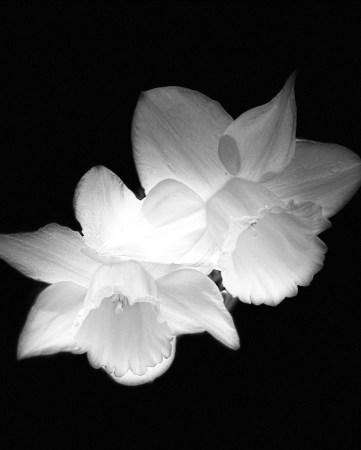
I will not tread upon your words
Whose worth is in these hills and lakes
Where golden flowers charmed the breeze
That carried you to greatness
➰
But armed with eyes of fingered glass
Which sense and frame intensity
I reach into the now of gold
To capture black’s propensity
➰
To frame in light what lies beyond
And host a soul that only
Reveals, concealed, the single light
Of daffodil that conquers lonely
➰
©Stephen Tanham
©Stephen Tanham 2020
Stephen Tanham is a Director of the Silent Eye School of Consciousness, a not-for-profit teaching school of modern mysticism that helps people find a personal path to a deeper place within their internal and external lives.
The Silent Eye provides home-based, practical courses which are low-cost and personally supervised. The course materials and corresponding supervision are provided month by month without further commitment.
Steve’s personal blog, Sun in Gemini, is at stevetanham.wordpress.com.
Share this:


Human: Good grief! I heard a terrible thump…are you okay? What happened?
Misti <muted>: Crashed…
Human: Crashed! How did it happen?
Misti <muted>: Brakes…
Human: Brakes! Are you okay?
Misti: Never better…
©Stephen Tanham 2020
Stephen Tanham is a Director of the Silent Eye School of Consciousness, a not-for-profit teaching school of modern mysticism that helps people find a personal path to a deeper place within their internal and external lives.
The Silent Eye provides home-based, practical courses which are low-cost and personally supervised. The course materials and corresponding supervision are provided month by month without further commitment.
Steve’s personal blog, Sun in Gemini, is at stevetanham.wordpress.com.
Share this:


Caroline Ormrod is one of the Companions of the Silent Eye working through the first year of the three-year journey towards the real nature of the individual Soul. I am delighted to be her supervisor for this process. Her brief and light-hearted bio is appended to this post. Recently, along with her weekly email ‘journal’ of progress and experiences, she sent me a short article she had written inspired by the upside of what we are all going through with the Covid-19 virus and its imposed social isolation.

In this, she used the words ‘I-soul-ation’ (to replace isolation), and ‘In-soul-ation’ (to replace insulation). I asked if she would consider contributing it to our weekly cycle of posts here on the Silent Eye. She did this with gusto, and also provided the photographs and quotations used here.
I hope this gives the reader as much inspiration as it did me. Our thanks to Caroline for this important contribution to the Silent Eye’s Work.
Here is her article…
The Gifts of I-soul-ation and In-soul-ation
During this time of global uncertainty, we are being gifted a brief glimpse into possibilities and the wonder of the Universe. Many of us are in isolation, insulating ourselves from the daily habits and interactions to which we have become accustomed. Now, we are being required to slow down and reassess, to connect with and re-experience our Selves; to take into account the words of Ralph Waldo Emmerson who warns ‘But your isolation must not be mechanical, but spiritual, that is, must be elevation’. (see Ref 1, below).

The act of isolation is becoming one of i-soul-ation in which ‘I’ gets to tear off the mask of our habitual being and dive down deep into that which makes the ‘I’ unique – the purpose and goal of your Essence. Isolation is alternatively, ‘the condition of being alone, especially when this makes you feel unhappy’ and ‘the fact that something is separate and not connected to other things’. (Ref 2)

However, neither of these definitions is ever true. Although we may physically be separated (and, therefore, the ‘other’ may not even exist), we are intimately connected, not only to each other, but also to the whole world and Universe, as the spread of the C-19 virus demonstrates. Just as we cannot see the threads that connect us to each other – or even, really, see each other at all – in times of isolation, the threads are present and gifted to us, just as they are present in our connection with our Soul. This gift of i-soul-ating is donating time, space and direction to our ultimate goal of soul-connection.

We have been offered a choice here – we can buy into the propaganda which declares that isolation is horrific and we should be struggling and unhappy with the situation or we can be proactive and productive and buck that perspective by utilising this time offered to refine and condense our Selves into ourselves.

Similarly, the act of insulation, in-soul-ation, asks that ‘I’ find that which warms and comforts the Soul; in reality, that ‘I’ who finds warmth and comfort from the Soul like a big thick blanket and a cup of hot chocolate on a cold winter’s day. Insulation is ‘the act of covering something to stop heat, sound, or electricity from escaping or entering, or the fact that something is covered in this way’. (Ref 3) These aspects that we are stopping are our energies, our life resources that, although they may be invisible (like the threads joining us all), are vital to our survival, not only physically, but our whole being on all levels, especially those that access hope, faith, joy and love. By in-soul-ating, we invite our Soul to join us in our daily physical lives, to merge with the already-well-practiced physical being who feels disconnected and alone.

(Above: Figure 5 Photo courtesy of Kristie Virgoe)
We are back-end co-ordinators – and, if you are reading this, then you are too, whether you recognise it immediately or not – and we are being called to our Work at this time. We are being offered an opportunity, not only to i-soul-ate and in-soul-ate personally and individually, but also to support the whole population of the Earth, all her beings and the larger, wonderfully expansive and giving Universe of which we are a part. In i-soul-ation, we move inside to explore our gorgeous inner Soul; in in-soul-ation, we encompass that energy and allow it to expand into the farthest reaches of our Cosmos, insulating all. We are being summoned by the words of George Bernard Shaw who said ‘I am of the opinion that my life belongs to the whole community and as long as I live, it is my privilege to do for it whatever I can’. (Ref 4)
It is time for us to practice our own privilege.

(Above: Figure 6 Photo courtesy of Ramona Thiessen)
Author’s Bio:
Caroline Ormrod is an eternal student, questioning and exploring all aspects of this marvellous universe in which we live. She is proud to be a Companion in The Silent Eye School of Consciousness, having graduated from, among other things, the Servants of the Light New Main Course and achieving a Masters’ in Cultural Astronomy and Astrology from the Sophia Centre at the University of Wales Trinity Saint David. Mother of four home-schooled young adults, Caroline enjoys spending time with her family, writing and editing and contemplating the mysteries of the Universe. During this time of i-soul-ation and i-soul-ation, Caroline is reviving her love of yoga and keeping the candle industry strong and vibrant!
Caroline lives in Canada and is currently anchoring an etheric ‘Indigo Energy Tsunami’ at 1:00 p.m. E.S.T. to in-soul-ate the world. All are welcome to take a seat, light a candle and send prayers, love, grace and gratitude to all the beings of our planet, to our beloved Mother Earth and out into the magnificent Cosmos.
References:
[Ref 1] Ralph Waldo Emerson, Self-Reliance, Essays: First Series (1841), [accessed March 30, 2020] https://emersoncentral.com/ebook/Self-Reliance.pdf p. 16. [1] (Cambridge Dictionary Online, https://dictionary.cambridge.org/dictionary/english/isolation, accessed March 25, 2020).
(Ref 2) (Cambridge Dictionary Online, https://dictionary.cambridge.org/dictionary/english/isolation, accessed March 25, 2020).
[Ref 3] (Cambridge Dictionary online https://dictionary.cambridge.org/dictionary/english/insulation accessed March 25, 2020).
[Ref 4] George Bernard Shaw, As referenced to a private conversation with Professor Henderson and quoted in Edwin Björkman, ‘The Serious Bernard Shaw’, The American Review of Reviews (1911), 43: 425 [accessed March 30, 2020] https://todayinsci.com/S/Shaw_GeorgeBernard/ShawGeorgeBernard-Quotations.htm
©Stephen Tanham 2020
Stephen Tanham is a Director of the Silent Eye School of Consciousness, a not-for-profit teaching school of modern mysticism that helps people find a personal path to a deeper place within their internal and external lives.
The Silent Eye provides home-based, practical courses which are low-cost and personally supervised. The course materials and corresponding supervision are provided month by month without further commitment.
Steve’s personal blog, Sun in Gemini, is at stevetanham.wordpress.com.
Share this:

+ #Silenti, Collie dogs, Dementia, humour, Lake District, landscapes, Photography, Silent Eye School, Spirituality
Circles around Sedgwick (1)
by Steve Tanham
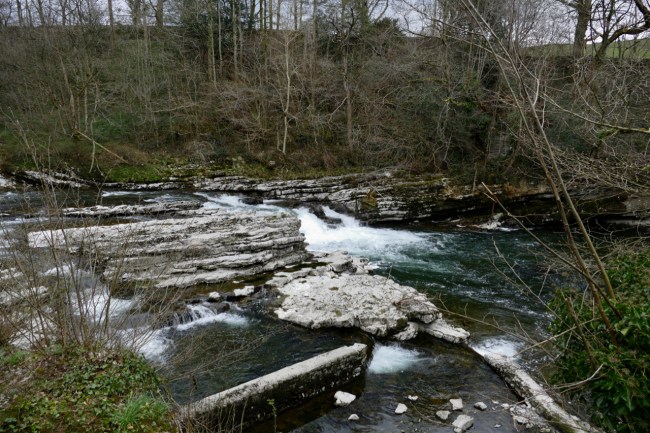
It’s a Viking word, Sedgwick. It dates from the time when the Lake District was part of the Danelaw, the half of England under the rule of the Norsemen, and means ‘place by the river’. The river in question is the Kent, which flows from Kentmere lake through Kendal on its way to the estuary at nearby Arnside, then out as a major channel into the expanse of Morecambe Bay.
Sedgwick, our home village, lies on the edge of the Lake District. For now, due to the Covid19 crisis, we are, like millions of others, confined to our homes – apart from essential trips out for food, medicines, or to help vulnerable people. Our incarceration is compounded by our choosing to bring my mother – who is ninety and has (moderate) vascular dementia – to live with us for the duration of the ‘lockdown’ period, rather than leaving her alone in the family home town of Bolton, Lancashire.
Three people, two dogs (we have a five-year old Collie and my mother has her aged Pomeranian with her) and an exotic looking cat… It’s a challenging mix.
So… how to (a) stay sane, and, (b) make best use of this enforced grounding?
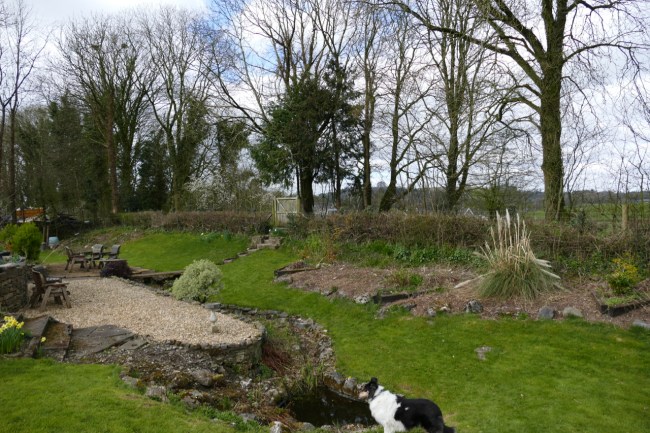
Doing the garden is one possibility. We have a large and challenging garden due to half of it being a residual hollow resembling the bed of a canal… which is just what it is. The celebrated Lancaster canal, which connects Preston and Tewitfield, used to extend all the way to Kendal, ferrying coal from the south and gunpowder (amongst other things) back to Preston, and via the docks there, out to sea and the world… Our house is directly on the line of that route and the (long gone) wharf here played an important part in the history of the village.
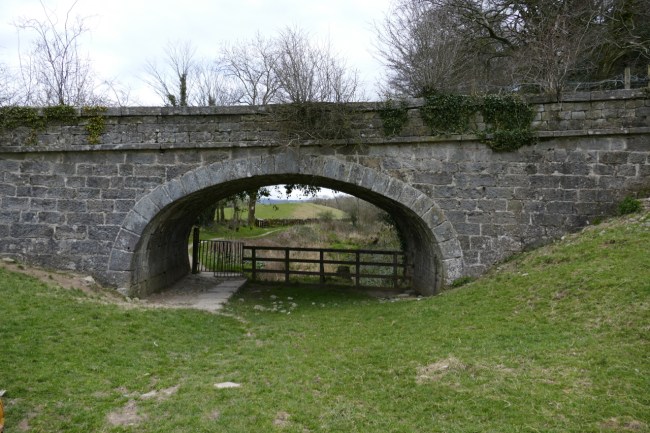
More on that, later… Sedgwick is only famous for two things, so it’s nice to be connected with one of them… (and, obliquely, both!)
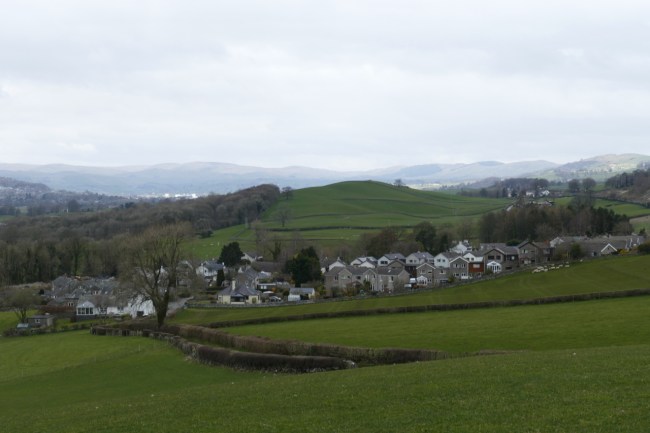
The canal north of Tewitfield was drained of water in the 1950s and our garden is one of many plots that were sold off to the owners of adjacent land. We moved here in 2010 and inherited a sunken wilderness which has taken many years to bring into harmony with the rest of the plot. The far side of the garden rises to the level of the old canal path, which, although our land, is still a public right of way and footpath. When we’re gardening – which is often in the warmer months – we often get walkers stopping to chat. We spent most of our savings transforming the decaying 1960s property and are happy to suspend the garden work and take a few minutes to chat to those passing.
Cumbria is next to Scotland so the weather is similarly chilly and wet. But the verdant green countryside is the result. Currently, the unseasonal north wind is trying to exterminate us with arctic conditions, and mum can only take so much of the cold, though she hates being ‘cooped up in the house’, so gardening is only a partial solution. We used to take her out for drives, but non-essential motoring is now out of the question, so… it’s walking. Despite her age, she still walks a few miles every day at home. It makes sense to carry that on, keeping her healthy and exercising the dogs at the same time.
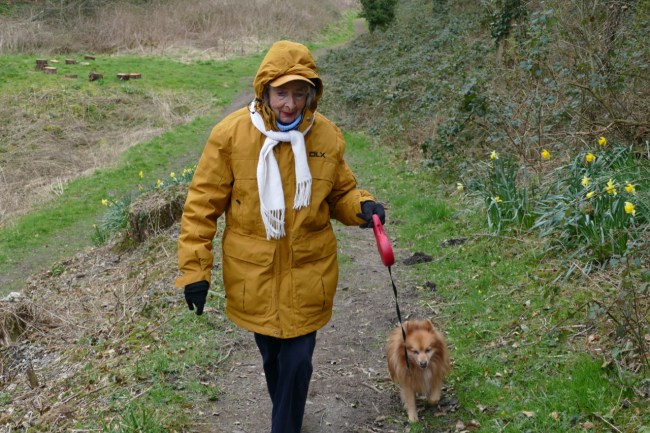
If you’ve read my blog before, you’ll know I take a lot of photographs. Many of them find their way here, when they are appropriate to the writing. In this time of reduced mobility, I thought it might be fun to describe and illustrate some of the local walks we take.
I’ve called this series ‘Circles around Sedgwick‘ because that’s just what they will be: circular walks from our home that last, typically, 3-4 hours. We take along a flask of tea and a biscuit or two. The cafes are all closed, of course, and those with outdoor tables seem to have stored them away. I can understand the logic (reduced social meetings) but the result is that we usually end up – at the farthest point of the walk – huddled against some stone wall, hiding from the wind and sipping tea.
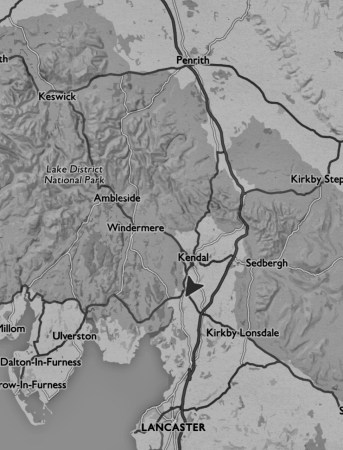
Where is Sedgwick? It’s a small village a twenty minute drive due south of Kendal. Kendal is the major gateway town to the Lake District, though the fast A590/591 dual carriageway re-routed the majority of the traffic past the town and on to Windermere or along the coast to Ulverston and Barrow in Furness. If you were visiting the northern lakes of Ullswater or the popular twin-laked town of Keswick, you’d stay on the northern M6 motorway and exit at the Penrith junction.
We are therefore in what is known as the ‘South Lakes’, and that is what you’ll see on the sign at Junction 36 as you leave the M6. At the moment, you’ll find the A590 looks, unusually, like this:
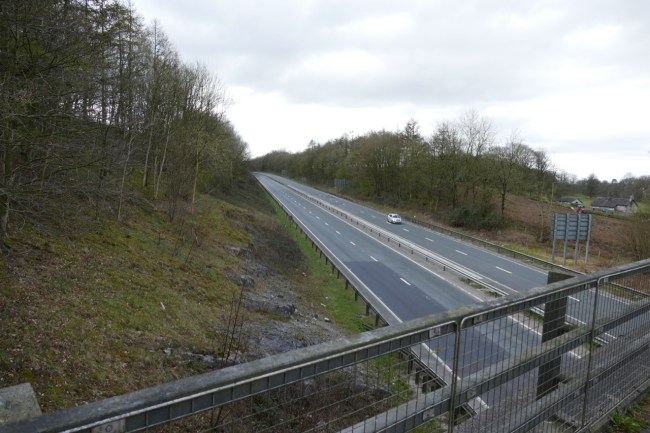
Sedgwick is a small village. It has a farm shop, no pubs (the nearest is a thirty-minute walk away), and no cafes. It does have an excellent cricket club, which will serve you a pint on a Friday night, if you’re a member. The nearest church is a twenty-minute walk over the hill to the even smaller hamlet of Crosscrake.
The old canal – what’s left of it – will form the starting point to many of these local walks. We’ll encounter some of its history, and the reason for the presence of the largest house for miles around…
©Stephen Tanham 2020
Stephen Tanham is a Director of the Silent Eye School of Consciousness, a not-for-profit teaching school of modern mysticism that helps people find a personal path to a deeper place within their internal and external lives.
The Silent Eye provides home-based, practical courses which are low-cost and personally supervised. The course materials and corresponding supervision are provided month by month without further commitment.
Steve’s personal blog, Sun in Gemini, is at stevetanham.wordpress.com.
Share this:


Man: Those are your mother’s gardening shoes!
Tess: They are lovely…
Man: She’s been out there all day in the sun!
Tess: You don’t understand.
Man: Obviously not!
©Stephen Tanham 2020
Share this:


“Grandad,” said Jessica. “Can we have the Hoovid story, again?”
Her hazel eyes, wise beyond their five years, twinkled at him. He put down the book of the forest, with its fold-out leaves and simulated bark, and smiled at her.
“Okay,” he said. “Of course we can…ready?” He bounced her up and down on his knee: their chosen method for settling in for a story. She squealed. Her curls shook as she shouted,“ Story…story…stor–“
“Once,” Grandad said, capturing the silence. “there was a good bacteria named Hoovid.”
“Are all bacteria good, Grandad?” The earnest young voice asked.
“Well, no… lots of them are bad, but only to us humans. The bad ones can be very good for other forms of life… but Hoovid was good… and very special.”
“Why was he special?”
“Because he had been born very small, and he could see the nasty ghost organisms that were too tiny for even the good bacteria to worry about.”
“Were they ghosts because they were tiny bacteria?” Jessica asked. Then added, “And you could hardly see them?”
“No,” said Grandad. “They were ghosts because they weren’t actually a creature at all, but a chemical that was clever, and could invade the bodies of other creatures and take them over, turning them into bad ghosts, too!”
“Did Hoovid save the world?” asked Jessica, remembering.
“He saved a lot of the world, yes.”
“How did he do it, Grandad?”
“One very special day,” he said, “Hoovid was hungry and he came upon a group of ghost chemicals that were called viruses.
“Are there any good viruses, Grandad?”
“All things have their place and purpose, Jessica, or they wouldn’t be here on the Earth.” He paused, remembering. His eyes turned misty – something he didn’t want Jessica to see – so he pretended to cough.
“Did Hoovid do something else?”Jessica asked. Filling the silence.
Grandad cleared his throat and continued. “He ate the bad viruses…”
“All of them?” asked Jessica, bouncing, again, and swinging her arms.
“All of them,” said Grandad, emphatically.
“All of them in the world?” Jessica said, her tone rising in wonder.
“No… just the ones he’d found… but then, something remarkable happened!”
Jessica’s joy could barely fit on his knee…
Grandad continued. “The good bacteria can do a wonderful thing.”
Jessica had stopped all movement; she knew how important the next bit was.
“When they have learned something, the tiny coils of who they are can adapt to hold that learning… and automatically share it with all their relatives.”
“So all the other bacteria could eat the nasty viruses, too?” she shouted in wonder and excitement.
“Yes… and they did.”
“All of them?”
“All of them!”
A few minutes later he was tucking her into bed.
“Grandad, was Grandma a microbogist?”
“A microbiologist, darling, yes she was. She was the one that discovered and encouraged Hoovid, but not in time to save herself…”
Can I be a micro…biol…gist, Grandad.”
“That would have been your Grandma’s deepest wish, Jessica,” he said, turning out the light. “Sweet dreams.”
As he walked across the landing, he heard the little voice whisper into the gentle darkness. “Night, grandma…”
©Stephen Tanham 2020
Stephen Tanham is a Director of the Silent Eye School of Consciousness, a not-for-profit teaching school of modern mysticism that helps people find a personal path to a deeper place within their internal and external lives.
The Silent Eye provides home-based, practical courses which are low-cost and personally supervised. The course materials and corresponding supervision are provided month by month without further commitment.
Steve’s personal blog, Sun in Gemini, is at stevetanham.wordpress.com.


 Sun in Gemini
You must be logged in to post a comment.