

It’s rained all night – for most of August, to be honest. Our weekly Pilates class has been beset by bridge failures for the past two months.
So.. equipped with our own tea, we’re here early… 18 minutes early, to be exact, and sitting, with kind permission, in the closed bar of Kendal Rugby Club, the place where the classes are held.
Funny how the table number is chuckling at me…
©Stephen Tanham
Share this:

+ #Silenti, Consciousness, enneagram, esoteric psychology, Fear, Higher Mind, Life and Death, Love, meditation, Metanoia, Mindfulness, Mystery Schools, Photography, Politics, Powers of the Mind, Silent Eye School, Speaking truth to power, Spirituality, Travel and Photography
Vexed by the Tribe (part two) – the fabrication of complexity
by Steve Tanham

We’re visiting relatives. It’s friendly. We have a light meal and some cake to follow. But then someone mentions Brexit and a cold frost descends on the room…
My wife and I bite our tongues, knowing our hosts are firm believers that Britain’s post-colonial destiny lies in a renewed ‘Little England’ reborn from some poster of decades ago. Until my wife’s uncle says, “Besides, the EU isn’t democratic..”
If you know her, you can hear something snap. She leans forward to take another piece of cake and refreshes her tea from the beautiful Royal Albert tea service. “Who is your MEP (Member of European Parliament), Uncle Norman?” she asks.
“Well, I’m not sure… I don’t bother with that sort of thing,” he says, wrong-footed by the lack of the simplest fact. But the question was designed to show that the EU is as democratic as it’s possible to be… It ‘s just that Uncle Norman can’t be bothered to invest even that much effort in what it’s trying to do – what it has done, very successfully, since Europe emerged from the ashes of World War II.
But none of that matters. Nor does the fact that Vote Leave – the organisation behind Brexit, has just been fined the maximum possible for electoral over-expenditure. The mere twenty thousand pounds is a tiny expense to the billionaires who want to jerk Britain out of Europe so they can make even more money in a less regulated world.
The exchange is typical of a vicious polarity that has divided Britain down the middle (52% to 48%, plus or minus the fraud). Towns, counties and families find themselves on one side or the other of the great divide. Everyone knows something vast is happening.
Some people find it exciting… ‘It’s time for a change..’
Other people understand history… and manipulation… and don’t.
But all the above is just me expressing, as honestly as I can, one side of that polarity.
Someone on the ‘excited’ side of the equation will tell you that Britain has been ‘shackled’ by the EU (our main trading partner, and supporter of our poorest regions) for decades and that vast, new trade deals will be available to a plucky and rejuvenated England.. sorry, Britain… Donald Trump is excited about Brexit. He’s publicly stated that he has his eyes on our National Health Service…
It’s too late to change what Brexit has done to Britain. But it’s not too late to examine the fault-lines that led nation, industry and families to be ripped apart. In my opinion, this is critical, since we are being manipulated on a scale never seen before – and the Tribe is at the centre of it all.
In Part One, we looked at how an approach like that of the famous psychologist Maslow, could be used to explain ‘Tribal’ influences being preyed upon by political strategists seeking to implement radical changes in our political systems – leading to increasingly authoritarian governments within the western world.

Maslow’s Hierarchy of Needs is reproduced above with an explanation in Part One. The pyramid diagram below is my own attempt to create a schematic for what I see in Britain, and also what seems to be happening in the USA. See Part One for the details.

Western civilisation has taken a long curve to get to where it is today. Its ideal, at least until recently, has been freedom for the individual. The freedom to live a life as we each choose, supported by a state which offers a balance between individual effort and financial return, is central to this ethic. But, when 80% of the wealth belongs to 20% of the people, something’s going to break.
The old industrial regions of the north and midlands of England and the American ‘rust belt’ have a lot in common. They are both examples of peoples with strong backgrounds – and self-belief. Their identity is related to the landscape in which they live, the hard jobs they have traditionally done and the family values they inherited. Such people (and I am from the north of England, so this is not said negatively) have a strong ‘Tribal’ presence, in the way I described it in Part One.
Their anger seeks expression. They are fed up of buying into an economic system that has left them behind; fed up of political rhetoric that forgets its promises the minute the elections are done – because it never had any intention of honouring them, once it had won the vote.
Success, measured by the human heart, is hard and never quick. It takes a long, considered view and cares.. Anything less is someone else’s agenda for more power.
But people believe in instant fixes – given the right hero. So, when there comes an opportunity to give the system a kick in the teeth, they take it…
I cannot speak for the USA, but it is certainly true in Britain. The ‘will of the people’ (one of the new hypnosis words) arose and kicked out the villains… or perhaps not. What did happen is the ‘will of the people’ was cleverly manufactured by people who understood that the world had changed, but not that much; who understood that the twin powers of social media and good old-fashioned hatred of ‘them’ could be harnessed beneath a flag that promised ‘freedom’.
Tribes have flags. What could be easier in a complex world?
Even before Britain reaches the ‘final, final’ departure date from the EU (the last day of October, 2019), Britain’s car industry is in crisis… Companies like Nissan, General Motors and Honda, who had made huge investments in Britain on the basis that it was a civilised and educated ‘gateway’ into Europe have done or are in the process of doing what any business would do. There is no longer anything ‘too big’ to fail in the world of global business.

Which brings us face to face with the behaviour of the Tribe. I am born into a Tribe. Our individual, ‘private self’ goal is to break through this, taking what is good from our Tribe, but claiming our freedom to follow our own path… a path that may see us diverge from that taken by the unquestioning Tribe. This is the core dichotomy of the world to come: can we mature beyond the Tribe to real and powerful individuality?
That may be the most important question of our age.
The bullies – the aggressive ones with guns or equivalent, discard the facade of democracy and proclaim the time-consuming processes of real consent as ‘weak.’ All authoritarian regimes reject the individual quest. This should be sacrificed, they say, for the collective.
This is the cross of Socialism, whose fundamental lack of fit with ‘today’s’ world is individual, not collective, intelligence, despite its admirable and caring values. But political identities are constantly evolving…
I know the world of ‘Tech’ well. It used to be called either computing or technology. I have spent most of my adult life in this sea. Tech has become a force of power in politics because in allows massive reinforcement of what the Tribal values are at any time.
The most potent power in the Tech world is the ‘Like‘ button. I don’t need to worry too much about the working out of something if I like its colour. I don’t need to worry about the truth of what someone said if it is associated with an advert for my football team. If my favourite things weren’t there, it would be a harder medium to be in. And so, those of great intelligence have placed before me what I may easily like. In so doing, I can be linked to those of like mind… and lied to. I will not question it, because my friends are there…
All of these ‘Tech’ processes were used in both Brexit and America’s presidential elections. Cambridge Analytica, a UK company, pioneered the use of ‘extracted’ social media data to achieve the results their customers wanted. The results are history…. and our present.
In sport, when someone cheats, their gold medal is taken away. In politics we shoot the drug that gave them the advantage and leave intact the sport’s result.
All of this is summarised in the diagram below. Which show how our real maturity is an aspirational force pushing up our pyramid of self, Complexity is easily manipulated to exclude the ‘common man’.

Modern complexity is being fabricated. Education could be used to illustrate the lies. The effect of complexity is a negative one and drives people back into a tribal mode of behaviour. I believe this to be happening across western societies, today, and it partly accounts for the rise of both nationalism and populism, and the seeming ignorance of the historic basis for the repeated rise of fascism in our histories.
We still have the choice as to what we belong. We can belong to the values of our Tribe and be safe: “Well, we all did that…” Or we can belong to the truth, and seek it out with all our being. It is real, it has power, but it must be embraced, loved and understood – in a way that makes modern politics its opponent. But politics is just the will of the people, and, ultimately, though it may take a long time, that will not be fooled.
In Part Three, the conclusion of this series, we will look at the dynamics of polarity, and how opinion is not so black and white as we may think.
© Stephen Tanham
Stephen Tanham is a Director of the Silent Eye School of Consciousness, a not-for-profit teaching school of modern mysticism that helps people find a personal path to a deeper place within their internal and external lives.
The Silent Eye provides home-based, practical courses which are low-cost and personally supervised. The course materials and corresponding supervision are provided month by month without further commitment.
Steve’s personal blog, Sun in Gemini, is at stevetanham.wordpress.com.
+ Ancient Landscapes, Collie dogs, Consciousness, English Lake District, Lake District, landscapes, nature, Photography, Places and Prose, Silent Eye School, Silent Eye Workshops, Travel and people, Travel and Photography, Your inner wolf
Above the Lion and the Lamb (part three)
by Steve Tanham
It was past four in the afternoon. We had been walking for over five hours. Despite our best smiles – and Joh’s chocolate – we were tired, very tired.
We were desperately looking for something – a path that should have been climbing up towards us from the steep lower slopes of the glacial corrie below. But paths – this far into a landscape – can be tenuous things, and all we could see, below and west, was the course of a stream, cascading down the valley.

Jon was pointing along the line of our high path, towards what I took to be a tarn, set high against the corrie wall. I had a mental picture of Jon’s map and knew that the far glacial wall was too high to intersect our present course.

“No,” he said, immediately understanding my glum expression, and pointing to a gap in the near ridge just left of my line of sight. “There!”

I looked… there. A small gulley acted as a cut-away to reveal what I had thought was the far side of the valley. But my perspective had been wrong. Revealed in the ‘V’ was a thin strip of path… climbing to meet the track we were on.
With something approaching joy, we powered up our weary feet and walked forward. In the end, we need not have worried; the two paths intersected not far from the corrie wall – which still towered high above us. We had no desire to sample the – undoubtedly stunning – views from its northern edge.
We joined the downward path – just a smattering of stones at this height – and began our longed-for descent.

The descending path was steep. Even worse, the path and the stream crossed each other all the time, meaning we had to pick our way across the larger boulders to traverse.

In places, the stream would suddenly drop ten, or even twenty feet, turning the way ahead into a partial waterfall. We knew that most walking accidents occurred on the way back from the heart of the walk: when the legs are at their most tired. There was still another four miles of the descent before we reached the level ground at the outskirts of Grasmere…

This is the kind of landscape that will constantly surprise you. When the main section of the descent was done, we sat by the stream – now a river – and had the last of the chocolate and the final sips of water. For some reason, our thoughts turned to the idea of a long, cold beer, reminiscent of the John Mills film ‘Ice cold in Alex’. The idea was potent and spurred us on.

Jon pointed to the top of the ridge, which was now above us and to the left. He thought that there may be a figure standing where we had rested so many hours before, looking down, ruefully, at the bridge… and choosing the long walk.

I raised the telephoto lens of the camera and and zoomed in…

To keep our spirits up, we chatted about our favourite sights of the day. Mine had been seeing the Lion and Lamb Rocks from above:

Bernie’s had been the hundreds of butterflies flying around a large but solitary thistle bush, close to Gibson Knot:

Kathy remarked that discovering that there actually was a path back along the valley had “been pretty special”.

Jon remarked that his was yet to come, but he could bear that cold beer calling from Grasmere…
We walked on, knowing that another hour would see us back at our start point in Grasmere.
Around the next bend, a familiar friend awaited us: the bridge we had last seen from nearly 500 metres above our present location.

To show her pleasure, the tireless Tess dashed across it and back to collect us.

We emerged from the glacial Easedale valley and into the farmland around the town. Another half hour to go. But then Bernie looked at her watch and realised we had only fifteen minutes left on the parking ticket.
We reassured her that, at this late hour, we were unlikely to get a fine, but she trotted off, surprising the three of us with her reservoir of energy.
‘Ice Cold in Alex’. The moment will live in our taste buds for ever….


Bernie arrived back with the car at the same moment the beer was delivered to our table. It was the best beer I’ve ever had…
It was 18:38. We had been walking for nearly eight hours – far longer than we had planned. We had covered eleven very difficult miles. But, we had done three of Wainwright’s peaks and made it home in relatively good shape.
What a day!
©Copyright Stephen Tanham
Stephen Tanham is a Director of the Silent Eye School of Consciousness, a not-for-profit teaching school of modern mysticism that helps people find a personal path to a deeper place within their internal and external lives.
The Silent Eye provides home-based, practical courses which are low-cost and personally supervised. The course materials and corresponding supervision are provided month by month without further commitment.
Steve’s personal blog, Sun in Gemini, is at stevetanham.wordpress.com.

I snapped this while walking the collie along Morecambe’s seafront in a strong wind, earlier today.
And then I was reading about WordPress’ new iOS ‘share’ extension for Apple iPad and iPhone, which can instantly convert online content (eg pictures or a block of text) into a there-and-then post.
It seemed the perfect test! However, I was expecting a ‘preview’ dialogue, but apparently not..
But what it does is good, if a little trigger happy! So, rather than shoot it, I’ll leave it there…
And later I added this:
‘The Midland’ is Morecambe’s iconic Art Deco hotel, whose beautiful renovation by Urban Splash became a key event in Victorian seaside town’s regeneration.
The Eden Project’s directors have recently confirmed that they are to site the new Eden North campus next to the Midland Hotel, on a part of the seafront that used to be home to the famous ‘Super Swimming Stadium’ – the TV home of the Miss Great Britain contest that ran from the 1950s to the 80s.
Times have, thankfully, moved on, and the eco focus of Eden North will have a dramatic effect on the town’s fortunes.
We are due to attend an Eden North event in November. I hope to do a detailed blog, then.
Hope you enjoy the pic!
Steve 😎
Share this:

Stunning image and beautiful thoughts from Solitaire

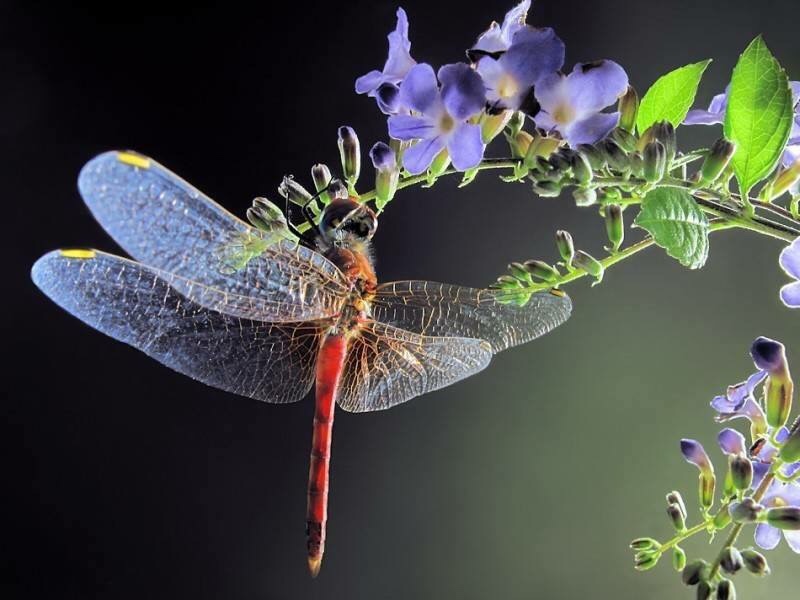
Your flashing wings suddenly appear on a warm spring day;
Wings quick, turning, zigzagging to catch a micro insect in the warm air.
Then, your brilliant colors flashing wings, delicately enjoying the last days of summer before you disappear.
Share this:

+ #Cats, #Collie dogs, #FurryFives, #InnerCatPeace, #RagDollCats, #Silenti, Cats, Collie dogs, humour, Pet Heaven, Rag Doll Cats, Silent Eye School, The Inner Cat, Your inner wolf
#FurryFives – Passenger
by Steve Tanham
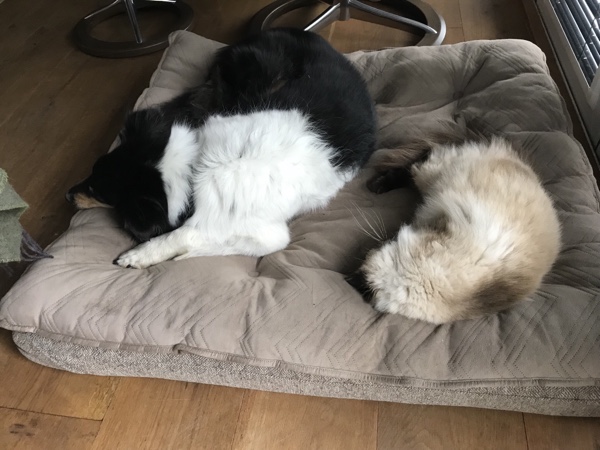
– Tess, I’m not criticising your driving
Sniff
– I just think….
Sniff, sniff
– I just think we took that corner a bit too fast!
©Stephen Tanham
Share this:

Sue and Stuart’s enormous journey crosses back into England…
Share this:

+ #Silenti, Consciousness, enneagram, esoteric psychology, Fear, Higher Mind, Life and Death, Love, meditation, Metanoia, Mindfulness, Mystery Schools, Photography, Politics, Powers of the Mind, Silent Eye School, Speaking truth to power, Spirituality, Travel and Photography
Vexed by the Tribe (part one)
by Steve Tanham
I am vexed…
It’s a word you don’t hear much, now. Old English, I believe. It describes an agitated state of mind – and possibly body – when something nagging can’t be solved.
What I’m vexed about is the entrenchment of nationalistic opinion across the world, in the face of much more important issues – like the world’s climate problems and the undermining of democracy as a new type of war carried out by authoritarian regimes.
I’m vexed because I think I’ve seen beneath this to the psychological mechanics of something that has the potential to kill the world.
In Britain, with Brexit, we are marching, like lemmings, towards a clifftop that will bring chaos and self-inflicted harm to not only this generation of voters, but our children and their children. They will look back at the devastation and ask why somebody didn’t do something to avert it.
Friends in the USA describe a similar situation, there. My intention with this blog is not to discuss politics, but to examine the entrenchment of views that underlies these vast shifts in ‘normality’ This is closely linked to the use of ‘fake news’ as a defence against the truth…
The psychologist Maslow did some ground-breaking work on developmental psychology, particularly human motivation, back in the 1940s. His celebrated diagram of the “Hierarchy of Needs” is reproduced below:
Maslow’s idea was that the lower needs in the pyramid had to be satisfied before the higher and more creative functions would manifest. It has been modified since the 1940s but remains a popular and intelligent way to understand some of the ways individuals evolve – or devolve.
In Maslow’s scheme, the ultimate state of the human in a society is one of ‘Self-Actualisation’ – the top of the pyramid. This is built on ‘Esteem’, which grows in the soil of ‘Love’. Only below this level do the ‘fear-factors’ come into play.
There is an upward current which is enabling. But any downward movement in the lower levels is capable of de-stabilising the whole thing. It would be difficult to put a complex political situation like Brexit into the above pyramid, since this is based upon a society’s condition rather than that of an individual. But we can identify ‘what’ happens in such upheavals, and that may serve to illustrate the societal forces at work.
If a majority of people vote for something, then we in the West believe they have ‘spoken’ and we honour the result – unless there has been electoral fraud or other fundamental abuses. Sadly, with every new generation of abuse the perpetrators show they are cleverer than the regulators.
Western Government is still based on the principles of democracy. So the motivation behind how people vote is a vital thing to understand – and it may help us to come to terms with the often self-destructive basis of such individual decisions. This is where it could be illuminating to consider a scheme similar to Maslow’s at work at the heart of how countries evolve their governance.
We are all born into a family of some sort. We know nothing of the society in which that family exists. If we are lucky, the family will be loving and caring. In honouring that we will wish to reflect the inherent but often unstated values that the family subscribes to. These are powerful things, and much more akin to how tribes used to, and still do, work. The Tribe will have a relationship to the geography in which it exists. This may be cooperative or antagonistic.
The route of the person from birth, through the values of the tribe and to real individuality may not happen at all. True individuality requires knowledge, judgement and a high degree of self-reliance. We all know Tribes in which such a rise to the ‘freedom’ of individuality would be frowned upon – to say the least.
Despite this, the wisest of individuals have, throughout history, risen to think for themselves and brought great change to the society in which they lived. Their upward journeys have been struggles of courage against both circumstance and prejudice.
I believe we now face new forces which are abusing and mis-shaping our countries. They are driven by the relatively small number of people who understand the ‘Complexity’ of our worlds. Our societies have changed beyond recognition in the past fifty years, largely driven by technology. Tech can be and is an enabler, but it is also a generator of fear for those left behind as powerful entities dominate the way in which such Tech is used…
Tech is also an ideal basis for placating the masses. Television soap operas and dating shows, for example. Thinking is hard, that is the simple truth. Thinking for yourself is very hard…
The above diagram illustrates the idea that, while maturity is an aspirational force pushing up our pyramid of self, Complexity is a negative one and drives people back into a tribal mode of behaviour. I believe this to be happening across western societies, today, and it partly accounts for the rise of nationalism and the seeming ignorance of the historic basis for the repeated rise of fascism in our histories.
So, what can we do about what is happening in Western democracies? We may be unable to do anything. There are tectonic forces at work, both economic and political, which are de-stabilising things for their own advantage. We can at least be aware that this is taking place and consider how Tribes are ‘played’ by such forces.
A Tribe will serve its society if it has expectations that its brightest individuals will ‘see farther’ and thereby educate the Tribe, itself. If this is not present, and any alternate thinking is given the ‘fake news’ treatment, then the element of ‘belonging’ will be invoked near the base of the pyramid and we will be collectively dragged back to the vexed lower land of our birth and not the potential of our individualities.
© Stephen Tanham
Stephen Tanham is a Director of the Silent Eye School of Consciousness, a not-for-profit teaching school of modern mysticism that helps people find a personal path to a deeper place within their internal and external lives.
The Silent Eye provides home-based, practical courses which are low-cost and personally supervised. The course materials and corresponding supervision are provided month by month without further commitment.
Steve’s personal blog, Sun in Gemini, is at stevetanham.wordpress.com.
Let us tell you a story… Sue’s post


“Tell me a story…”
My granddaughters and I were sitting on the floor of their pink-painted cabin at the bottom of the garden. I had evicted yet another invading spider and, while the youngest sat on my knee, her almost-five year old big sister was sprawling in the pink armchair.
The three of us had been playing. I had pushed little Imogen on her swing until she giggled with joy and had chased Hollie around the garden, swinging her up onto my shoulders and teaching her to stand on her head in a fairly unorthodox manner. Somehow, small children make you forget the aches and pains… at least until next morning when you try to move again.
By this point though, we had settled down in the playhouse and eaten a meal of chocolate-dipped worms and green slimegrobbels with custard… a menu chosen by Hollie and lovingly prepared by the…
View original post 974 more words
Share this:

+ Ancient Landscapes, Collie dogs, Consciousness, English Lake District, Lake District, landscapes, nature, Photography, Places and Prose, Silent Eye School, Silent Eye Workshops, Travel and people, Travel and Photography, Your inner wolf
Above the Lion and the Lamb (Part Two)
by Steve Tanham
We were on the Helm Crag plateau, about to climb up and beyond the Lion and the Lamb rocks to reach the start of the ridge. When you’ve just done a steep climb, it’s natural to feel that you’re ‘at the top’. In our case, this assumption was to prove expensive…
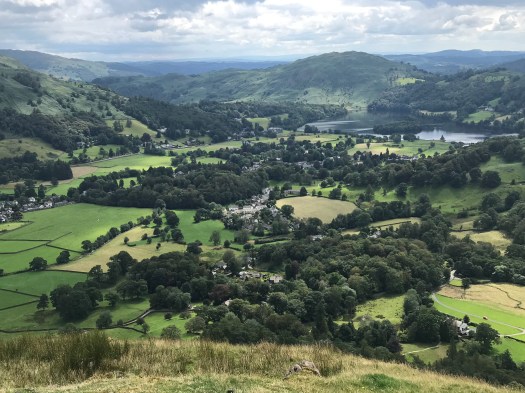
It was time to say goodbye to the glorious views of Grasmere – though we were to get one last unexpected view later in the walk.
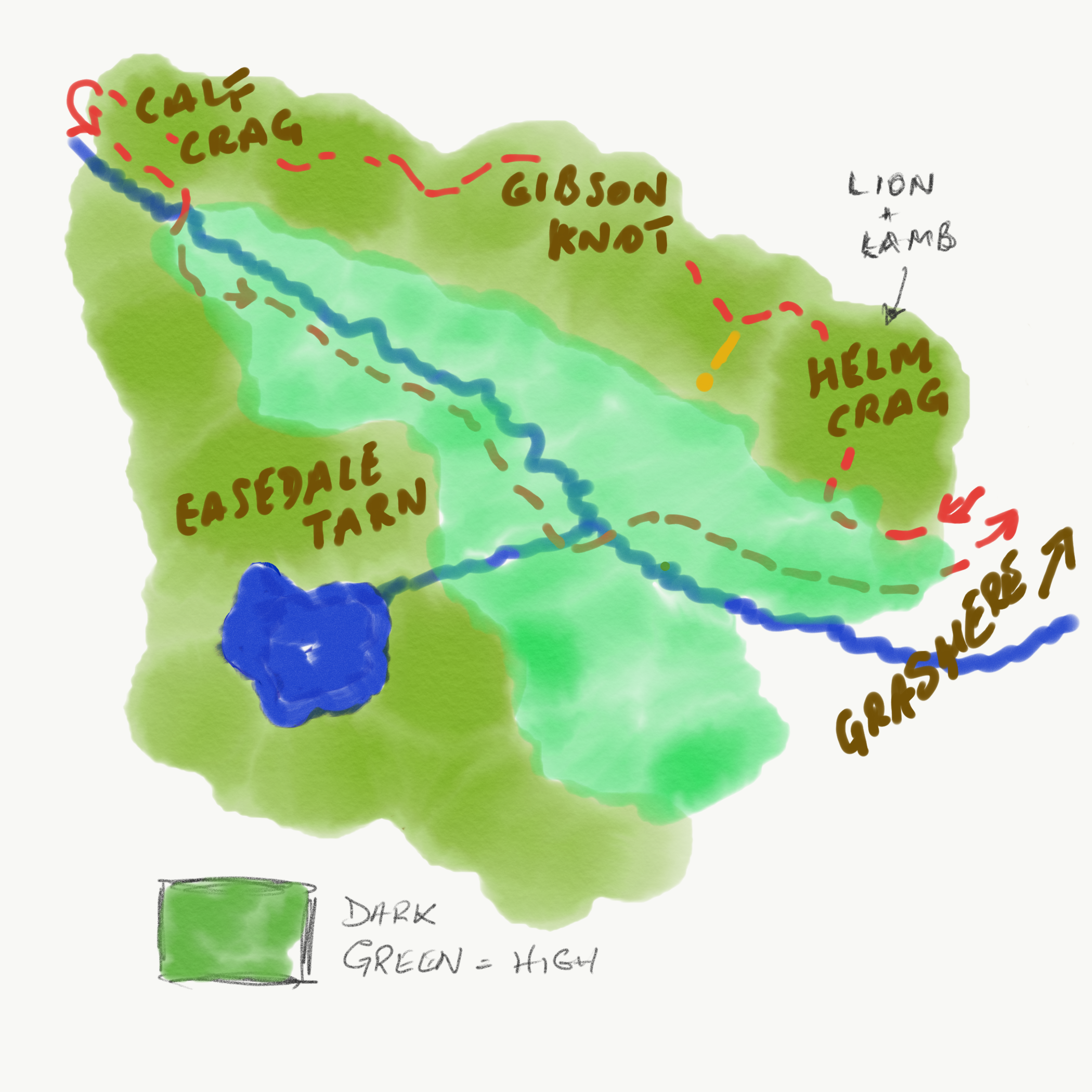
Helm Crag lies at the southern end of a long ridge. My simple picture, above, shows its location. Helm Crag is the point at which the photograph below, was taken. Our Collie dog, Tess, is looking at the start of the path which climbs up and along the ridge.
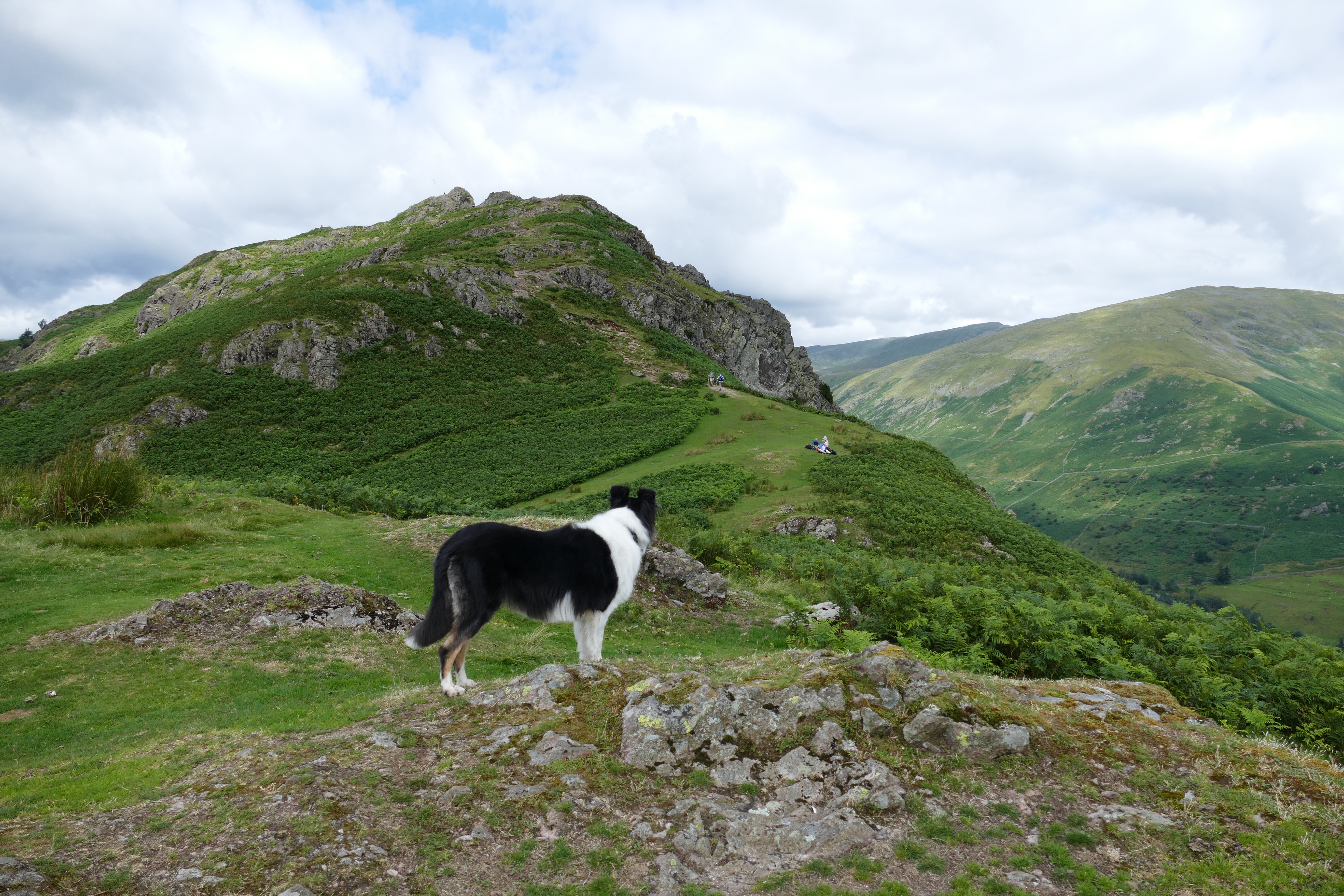
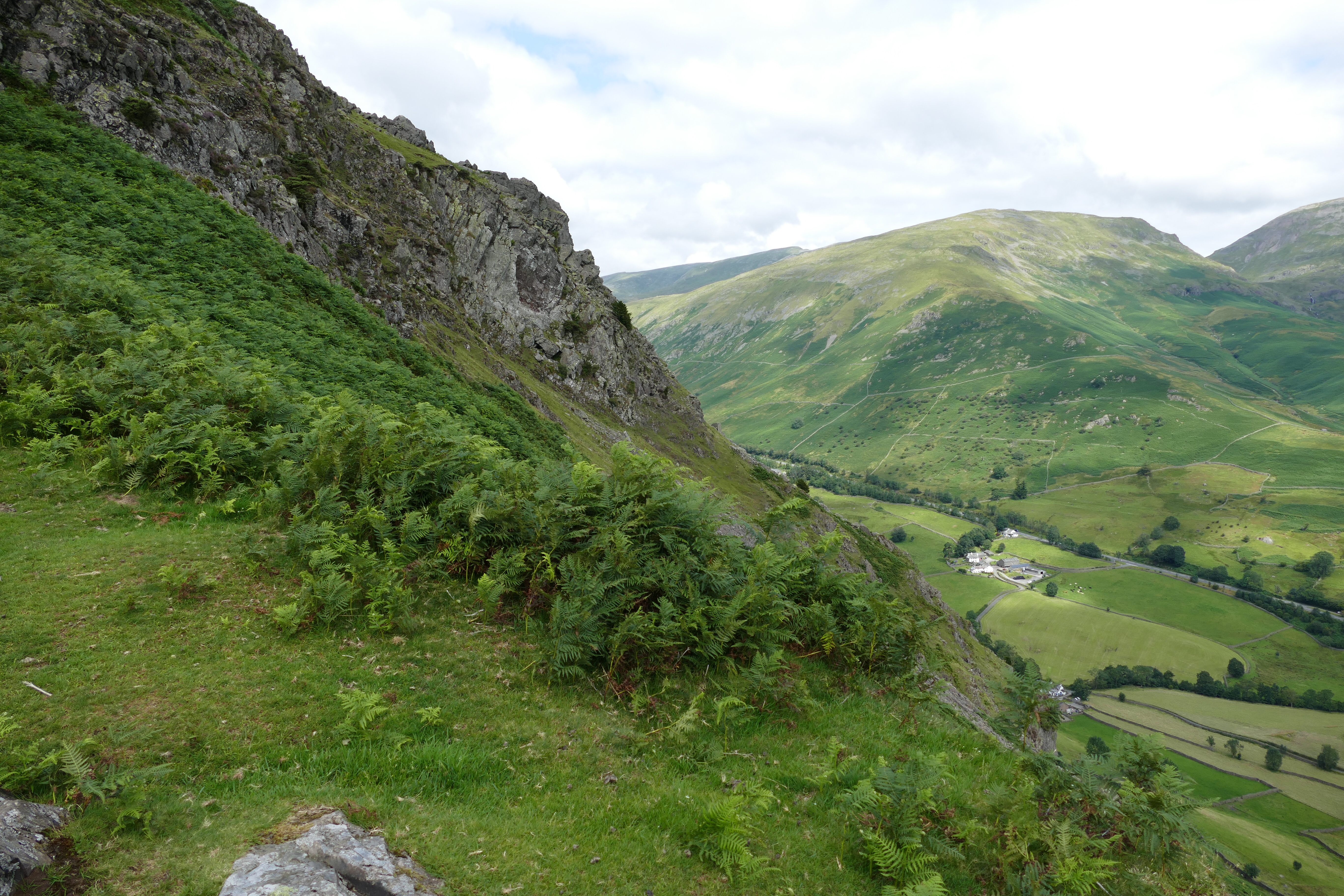
The path up to the ridge is quite a scramble – and very steep. One of its pleasures is a view of the A591 – the main road between Windermere and Keswick. Once at the top, the landscape changes dramatically. Gone is the gentle basin filled with the bright green of a grassy plateau, to be replaced with the undulating and rocky surface of a different world.
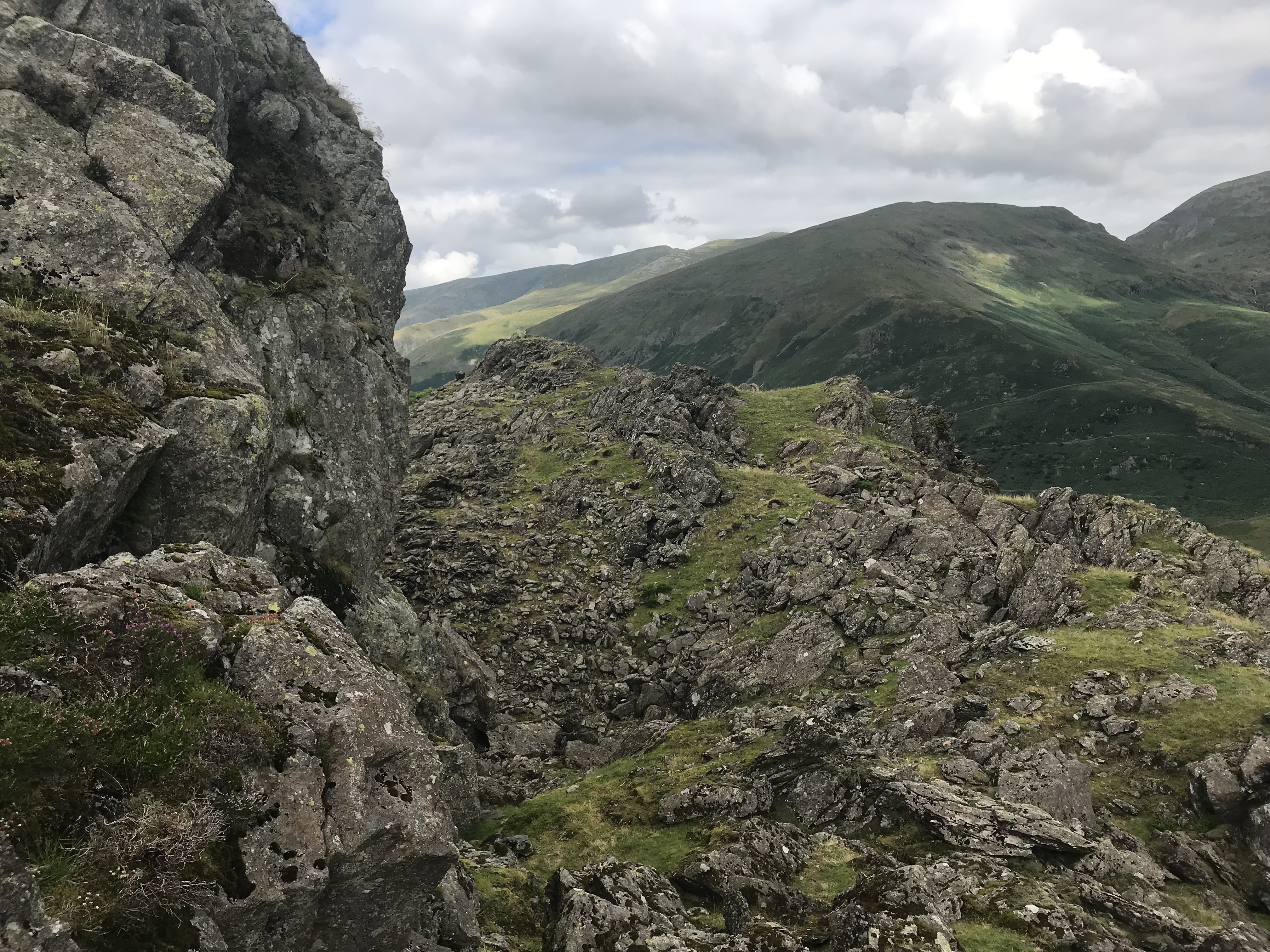
Once we had reached the ridge at Helm Crag peak, we faced a stark choice: we could take the footpath to the left (orange on the drawing) and make the quick descent to the bridge over Easedale Beck – shown below at the end of a long lens – or we could carry on along the top of the ridge, taking in another two of the famous ‘Wainrights’ peaks – a term that refers to a set of hand-drawn and hand-illustrated guides to hundred of walks in the Lake District.
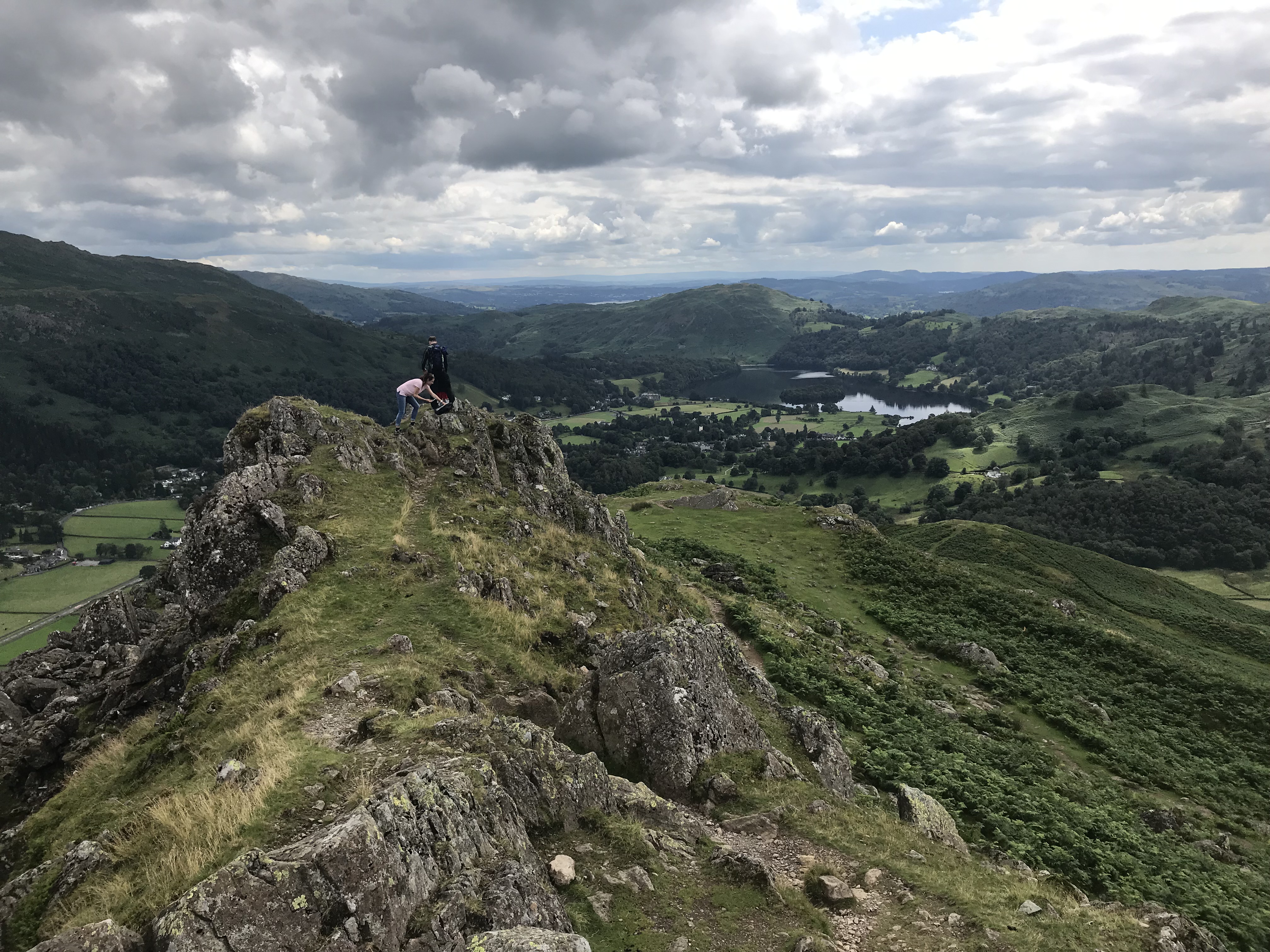
We choose to risk the ridge, knowing that it would take us longer than leaving the high-ground at Helm Crag and descending to the bridge below. What we didn’t know was how much longer the ridge walk was going to take…
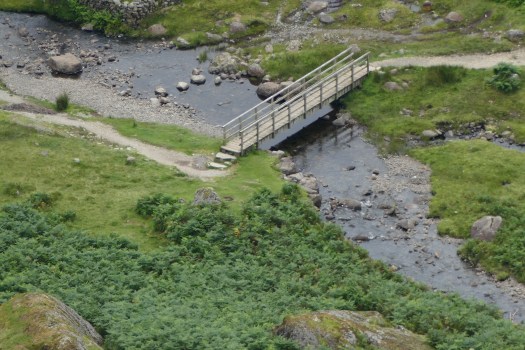
I pointed the camera at the vital bridge hundreds of feet below. The long lens made it look much closer than it was. But it was to be a lot more distant before we had the chance to change direction, again….
The Lion and the Lamb Rocks are visible from below, but it is only from above that you get the sheer scale of this famous landmark.
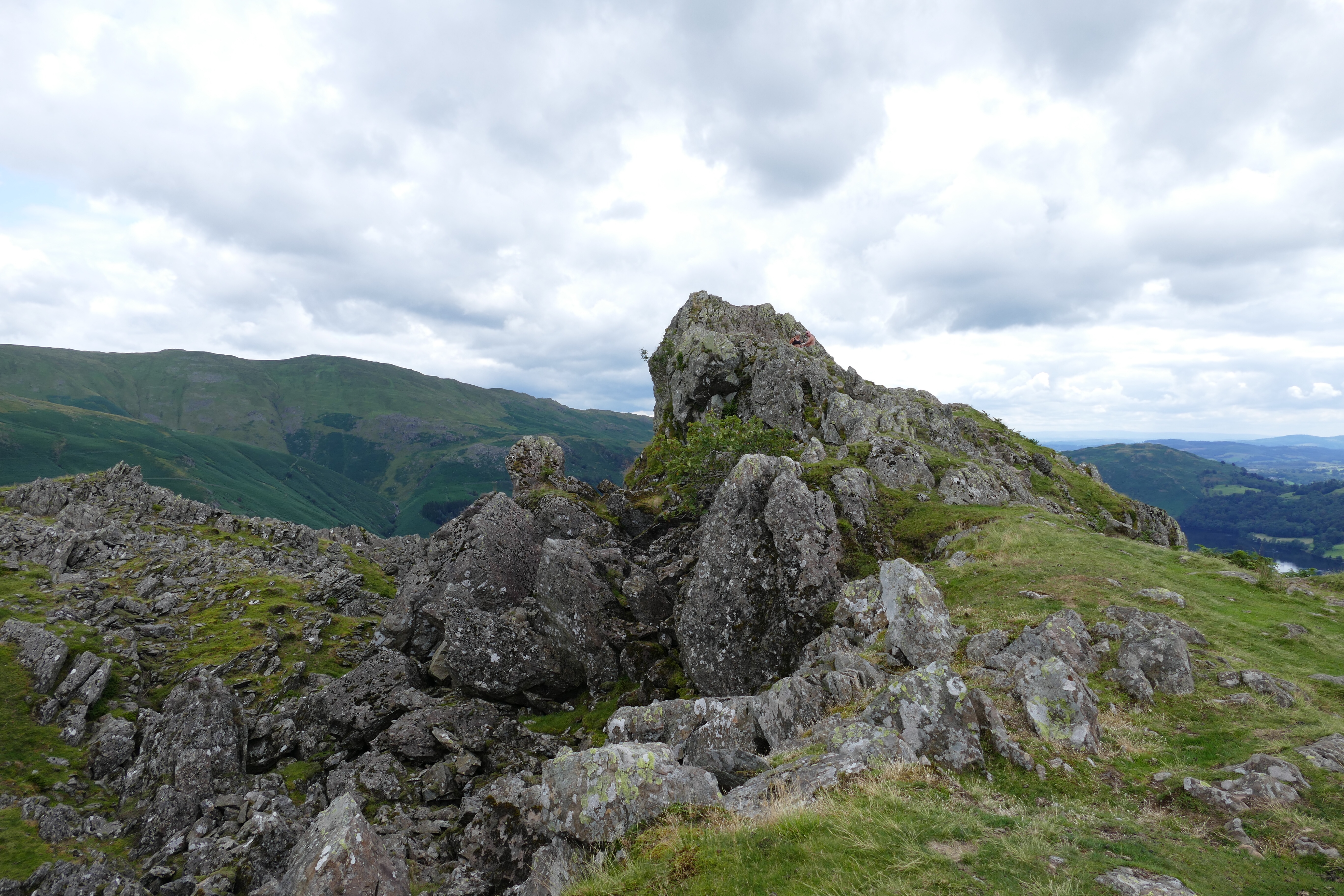
We had made our decision and now time was passing – and we had a long way to go. We estimated that the walk along the ridge, alone, would be at least five miles. Walking at an average speed of between two and three miles an hour, we reckoned that it would take us at least two hours to pass Gibson’s Knot and reach the junction of paths at the head of the valley below us and to the left.
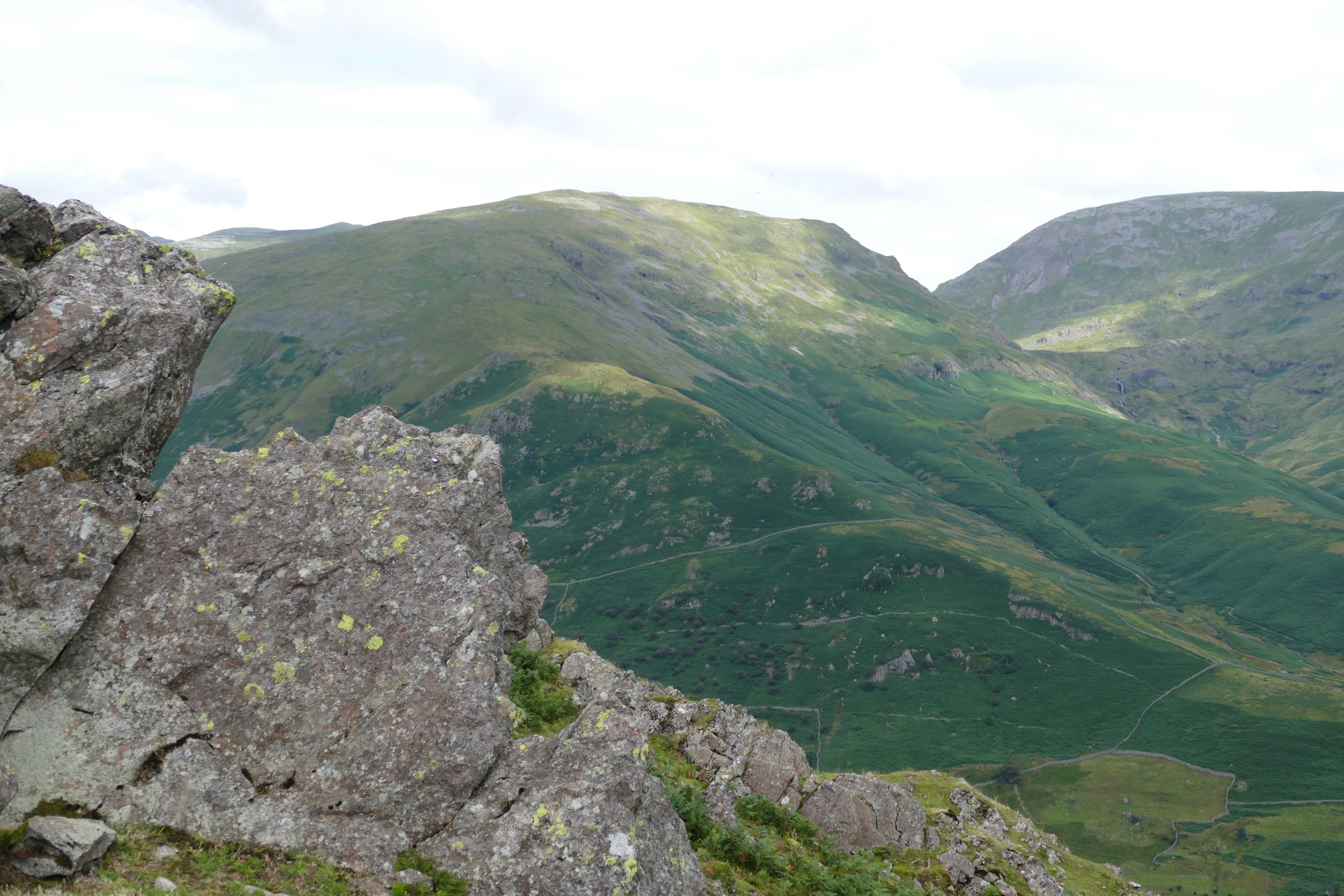
Our first surprise was that we had to climb, again, to follow the ridge-path. Not only that, but the path that had been smooth and stepped on the lower slopes now became rough and rocky. Walking became a process of carefully placing each footfall… and was consequently very slow.
I didn’t help much, either. The trip was the first outing for my new camera. The telephoto lens was wonderful at reaching into the far distance and I ended up taking over a hundred shots… stopping each time to compose and frame them. The photo below illustrates what happens when you do this and look up to see where your friends are!
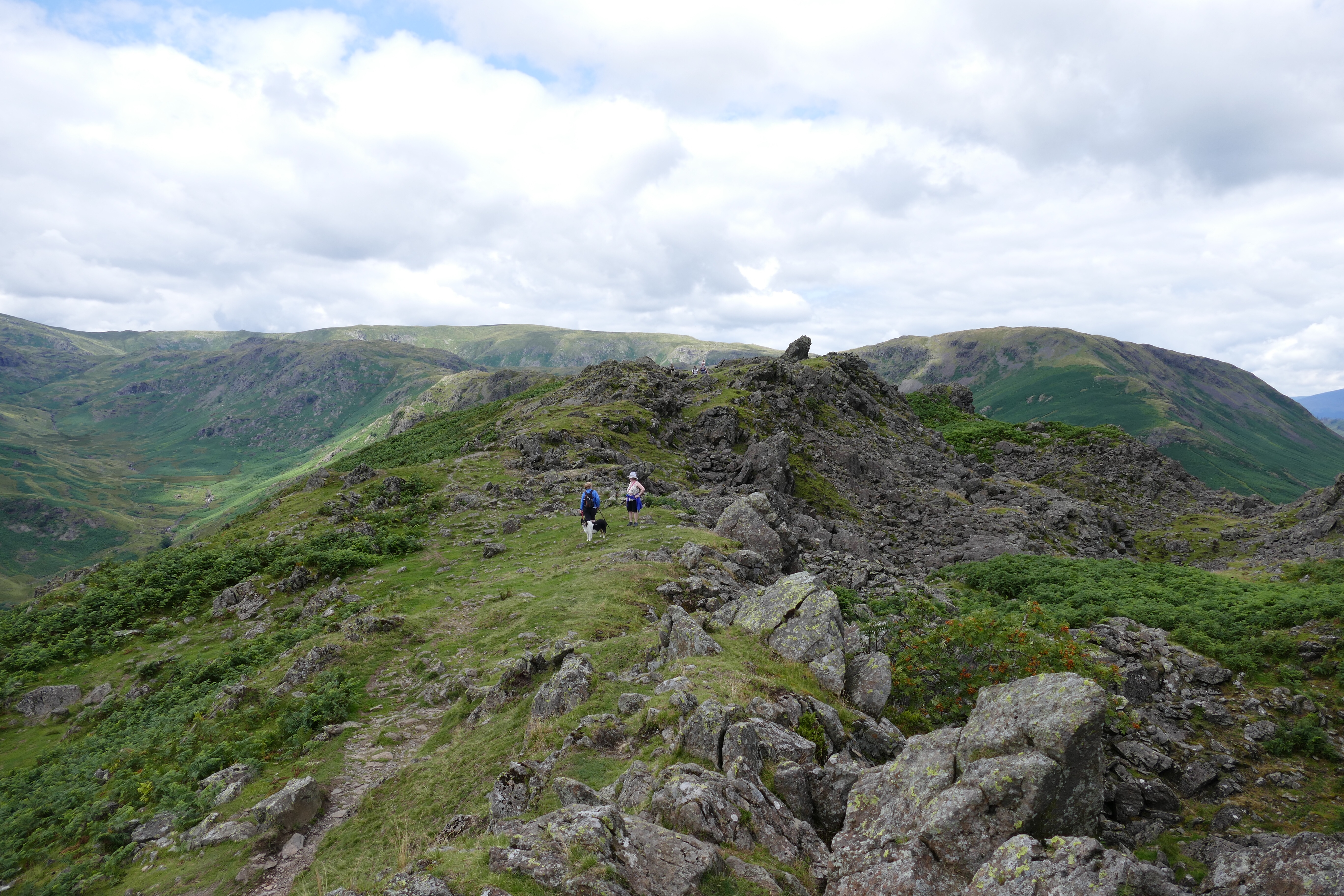
To our right (the east) the outline of the vast edge of the Fairfield Ring was becoming clear. The Fairfield Ring marks the high glacial bowl (Corrie) from which one of the largest glaciers carved out the northern basin of Lake Windermere – England’s largest lake.
From this perspective (below), you can only see the rim of Fairfield. The full walk around it, beginning at Ambleside, takes six to eight hours! These are not trivial landscapes!
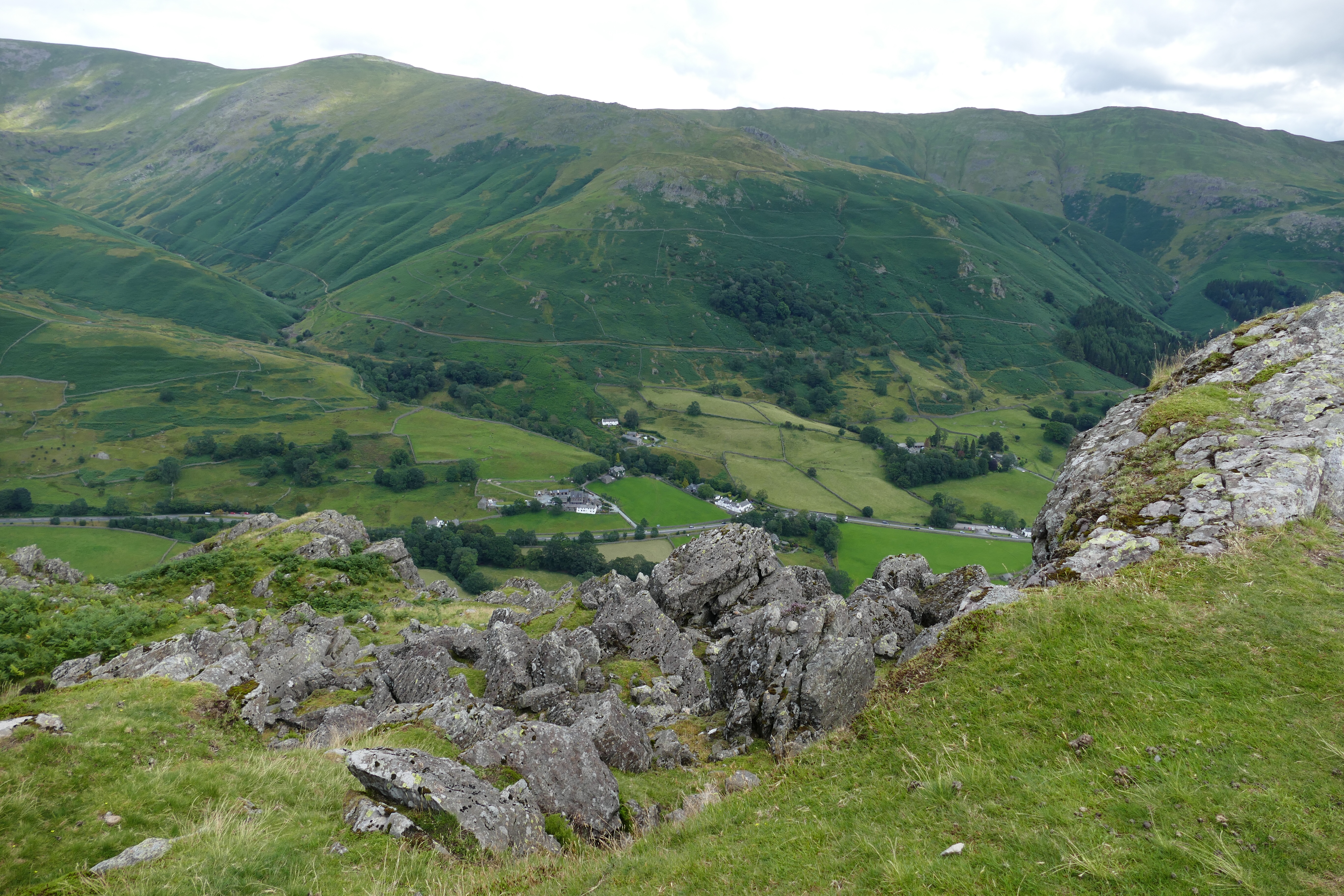
To our left, the steep sides of the fell showed evidence of less and less habitation, as the ground gave way to the rocky floor of one half of the Easedale valley – known at this point as ‘Far Easedale Gill’
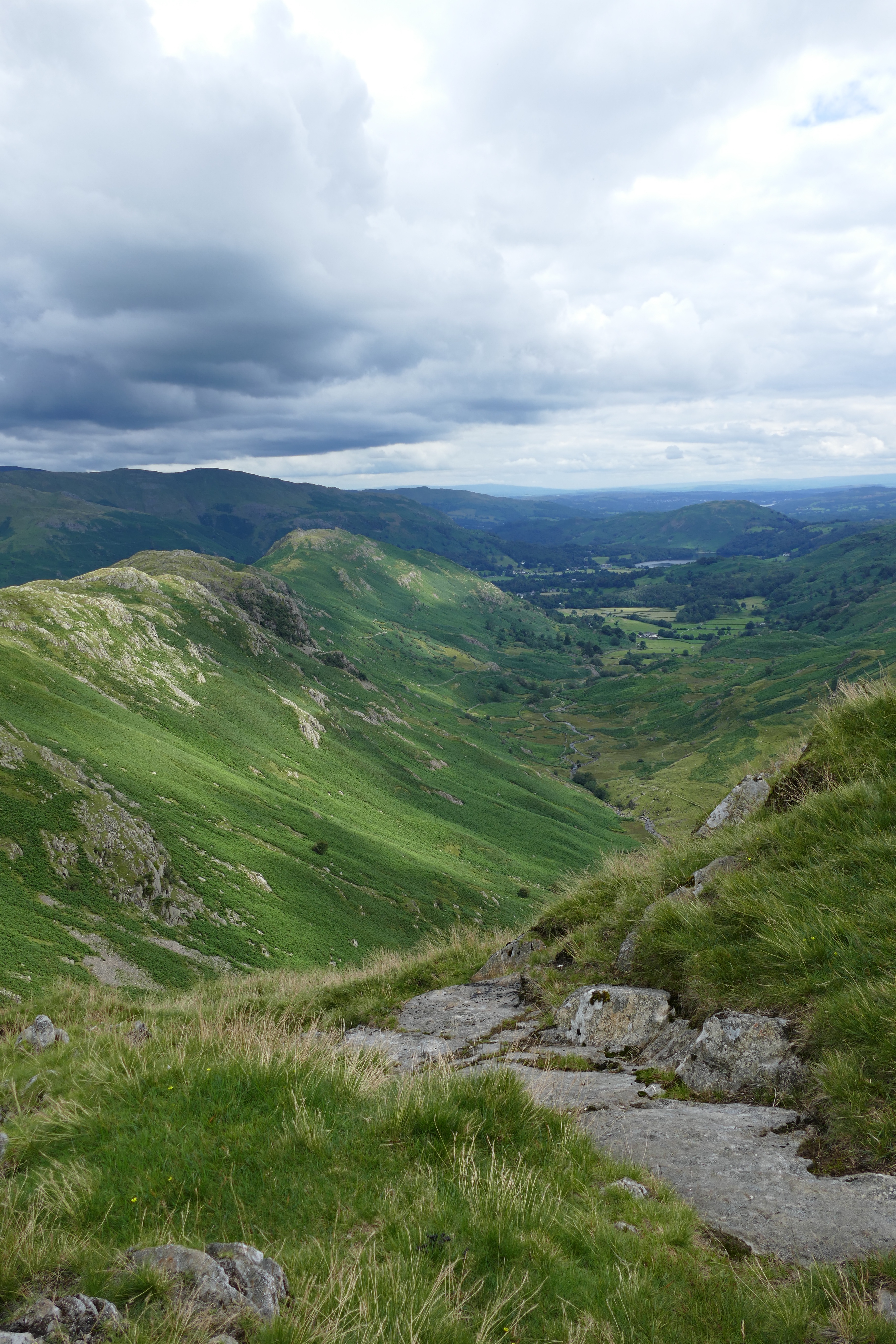
Above: Flashing forward in time… The ridge and valley: the two halves of our eventual walk. The photo was taken when we had finally ended our walk along the ridge – but still had to walk back to Grasmere along the valley floor.
The above photo shows the hidden difficulty we faced: each section along the ridge was a serious further climb; a fact that we hadn’t realised when we left Helm Crag. Locate the second ‘hump’ on the ridge. This is the point we had reached in the narrative…
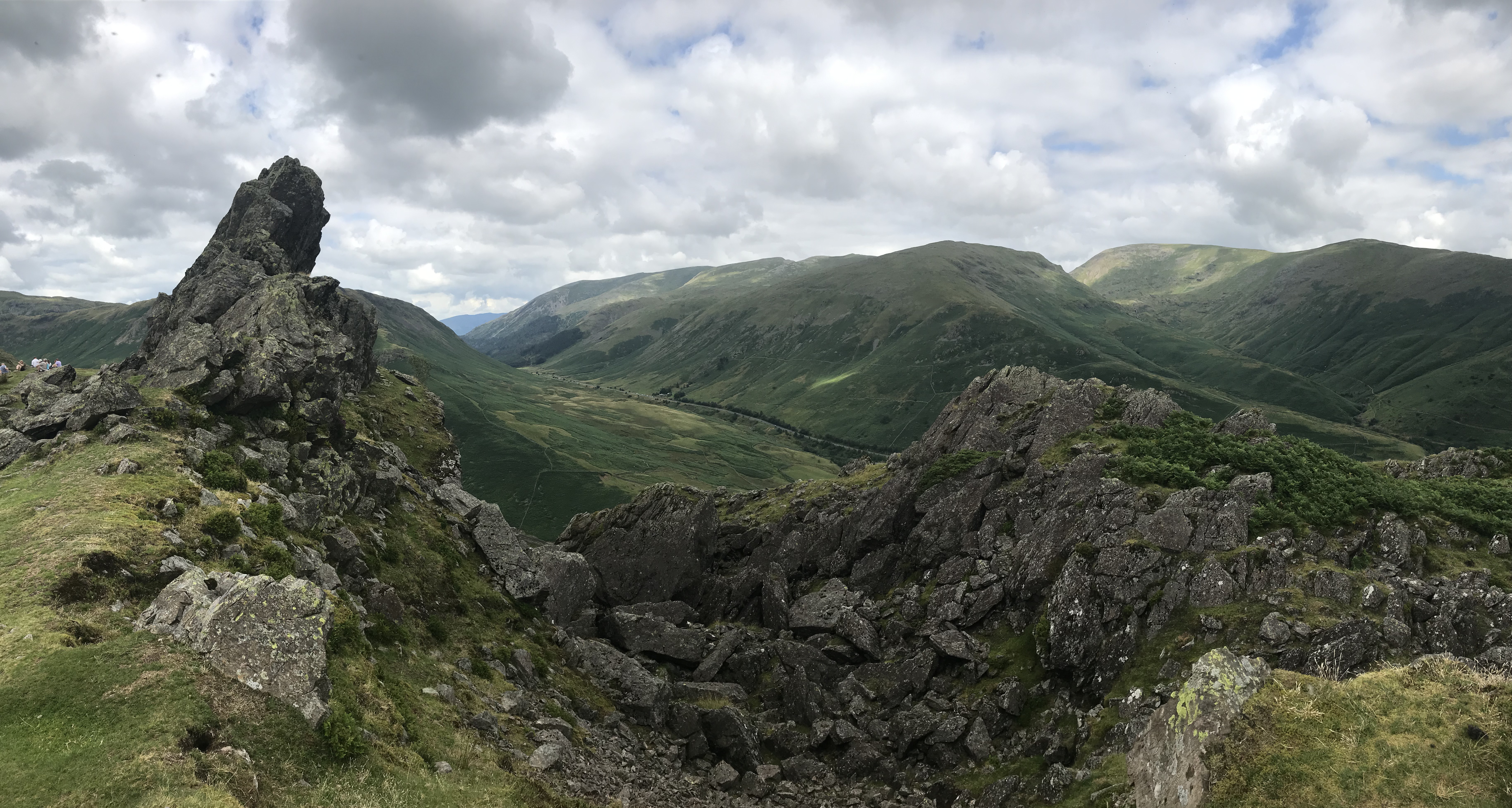
We had developed a method of making as much progress as our diminishing strength would allow. We would walk for an hour, solid, then stop to sit on a pile of friendly rocks and share water and some fruit chocolate that Jon had resourcefully brought with him. It was only later, looking back, that we realised how much we were climbing in each leg.
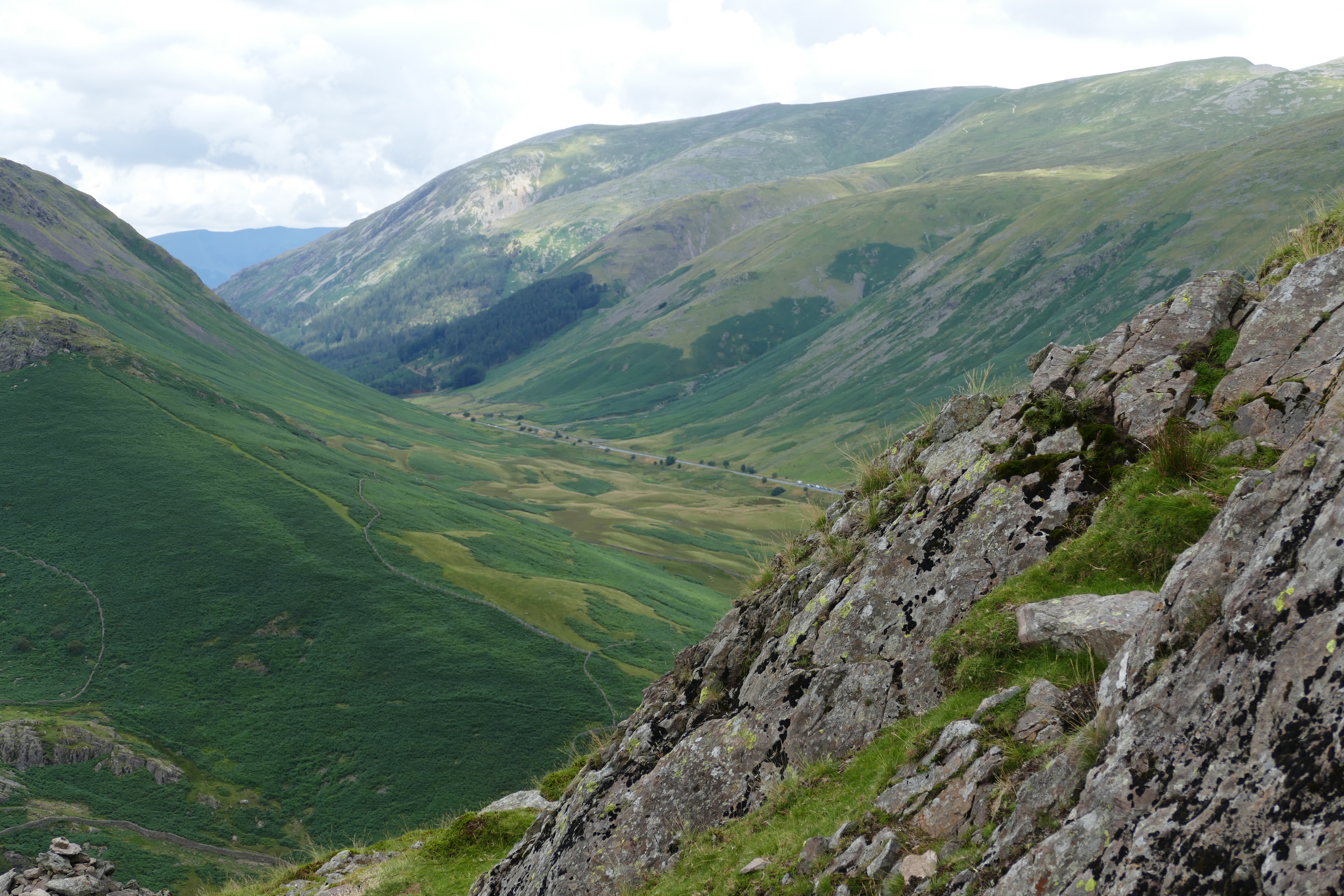
The ridge was narrow, and each twist of the path revealed new vistas on the right and left. We were ascending, of course, and could see more of the surrounding landscape from each intermediate peak.
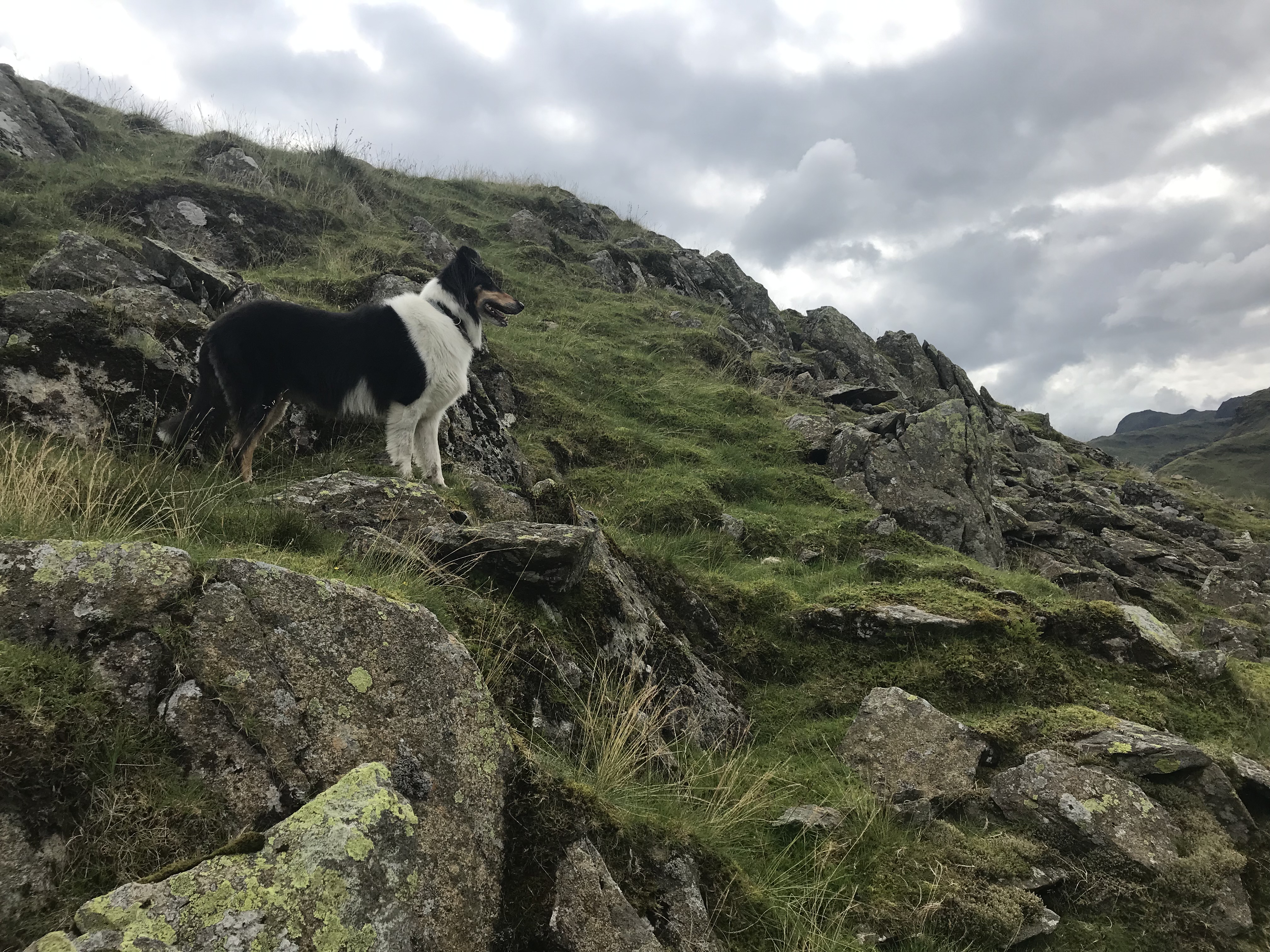
It was only when we realised that we had passed Gibson’s Knot (see schematic) without noticing that we became aware of how fatigued we were becoming. Our tireless Collie, Tess, was doing her best to help us – continually running from the back of her ‘pack’ to the front to keep the herd motivated to maintain their progress to market… a true ‘drover’. The photographer was often guilty of being some way behind the other three!
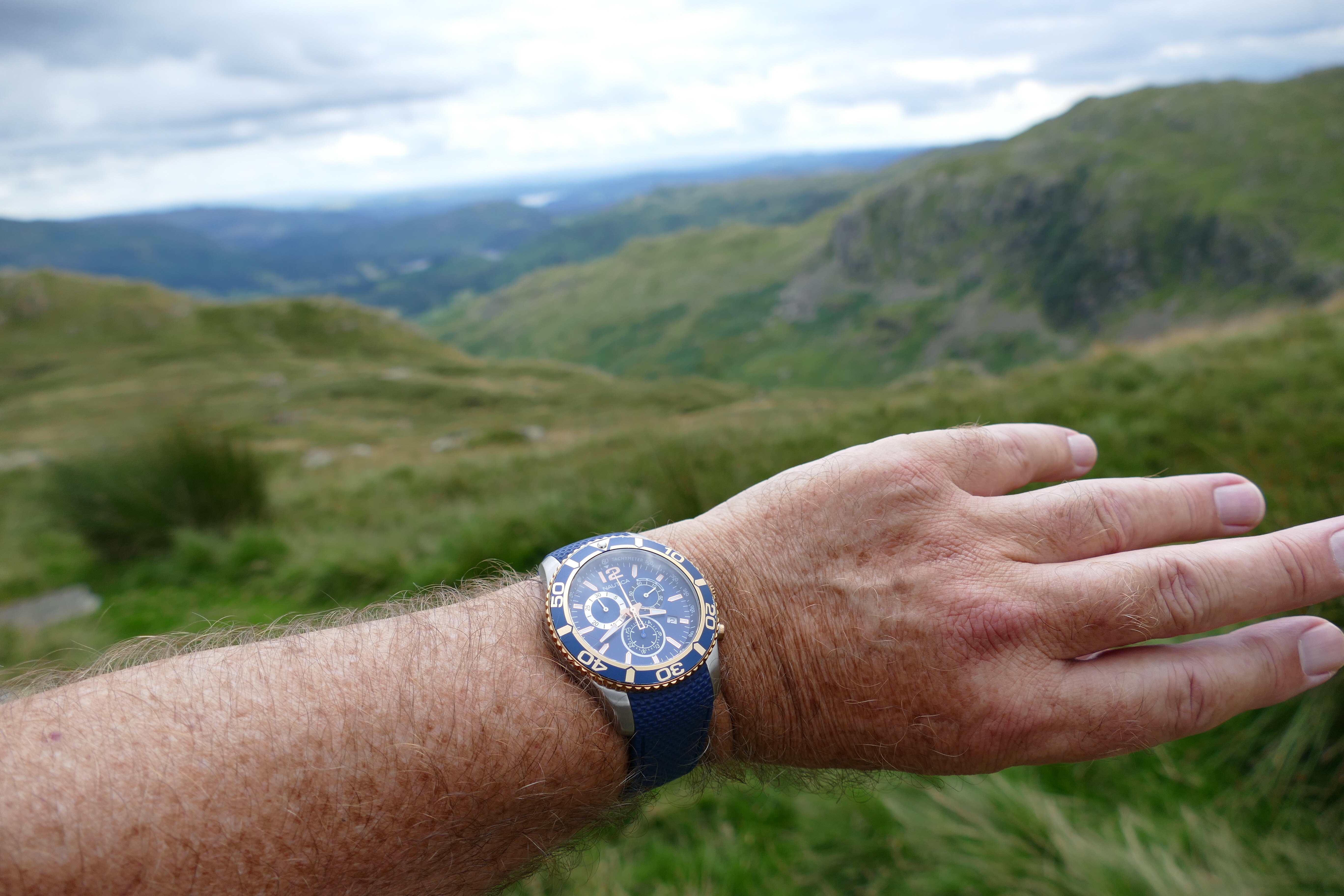
We took another break and reflected… It was 15:41. We had been walking since mid-morning. We had no choices left. Our only hope was to continue along the ridge. We looked at the diminishing water supplies and watched Jon search his backpack for more chocolate… worst of all, we were still at least an hour from the most northerly point of the valley; in other words, we were still walking away from Grasmere, the point where we started!
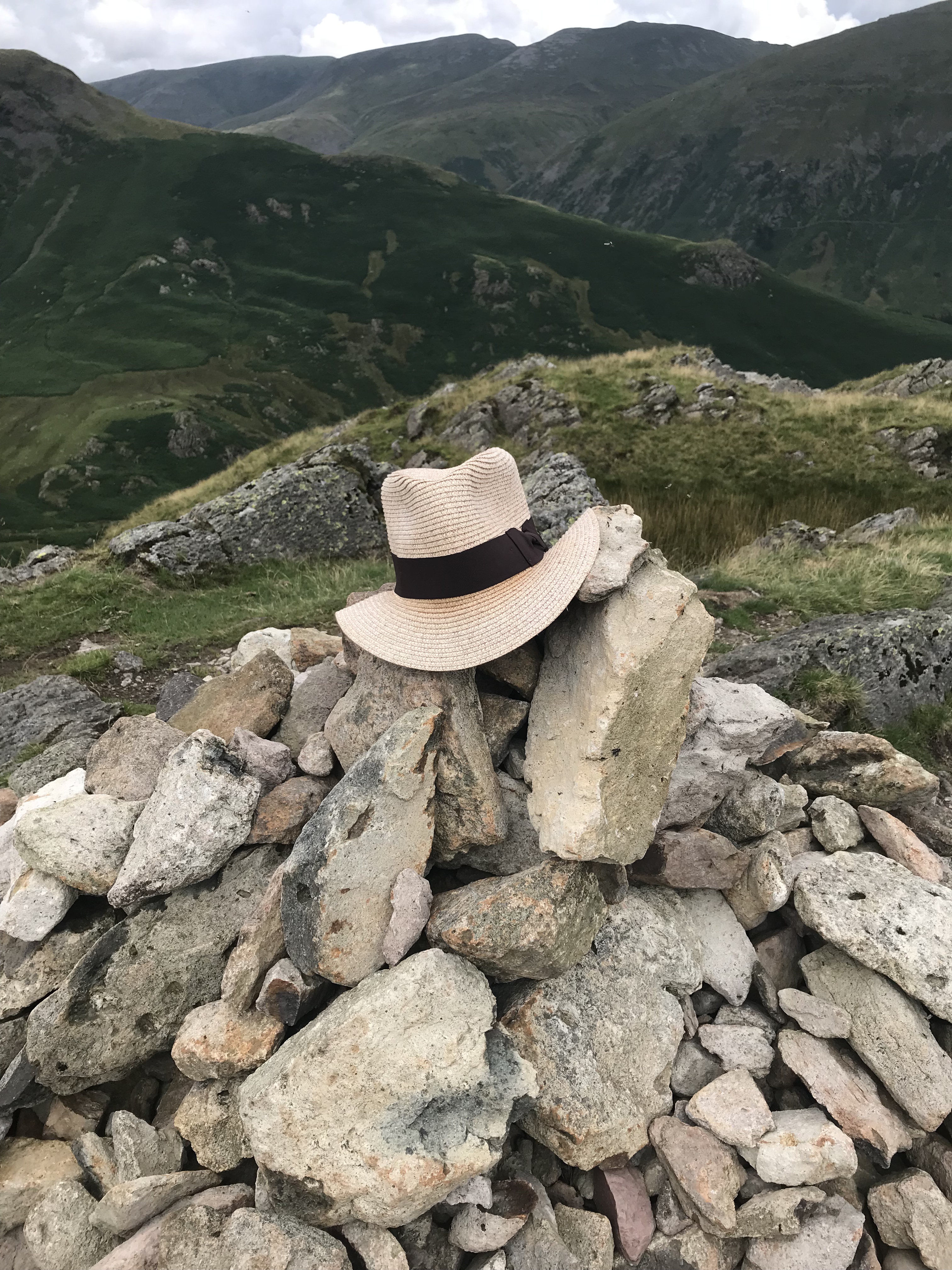
A slight panic tends to set in at such times. It pays to think laterally if only to clear the head. I found myself wondering if we could cross the high wall of the glacial Corrie to our north and hitch a lift from a passing 555 Bus, which would take us back to Grasmere… clearly ludicrous, as there were no paths marked on the map.
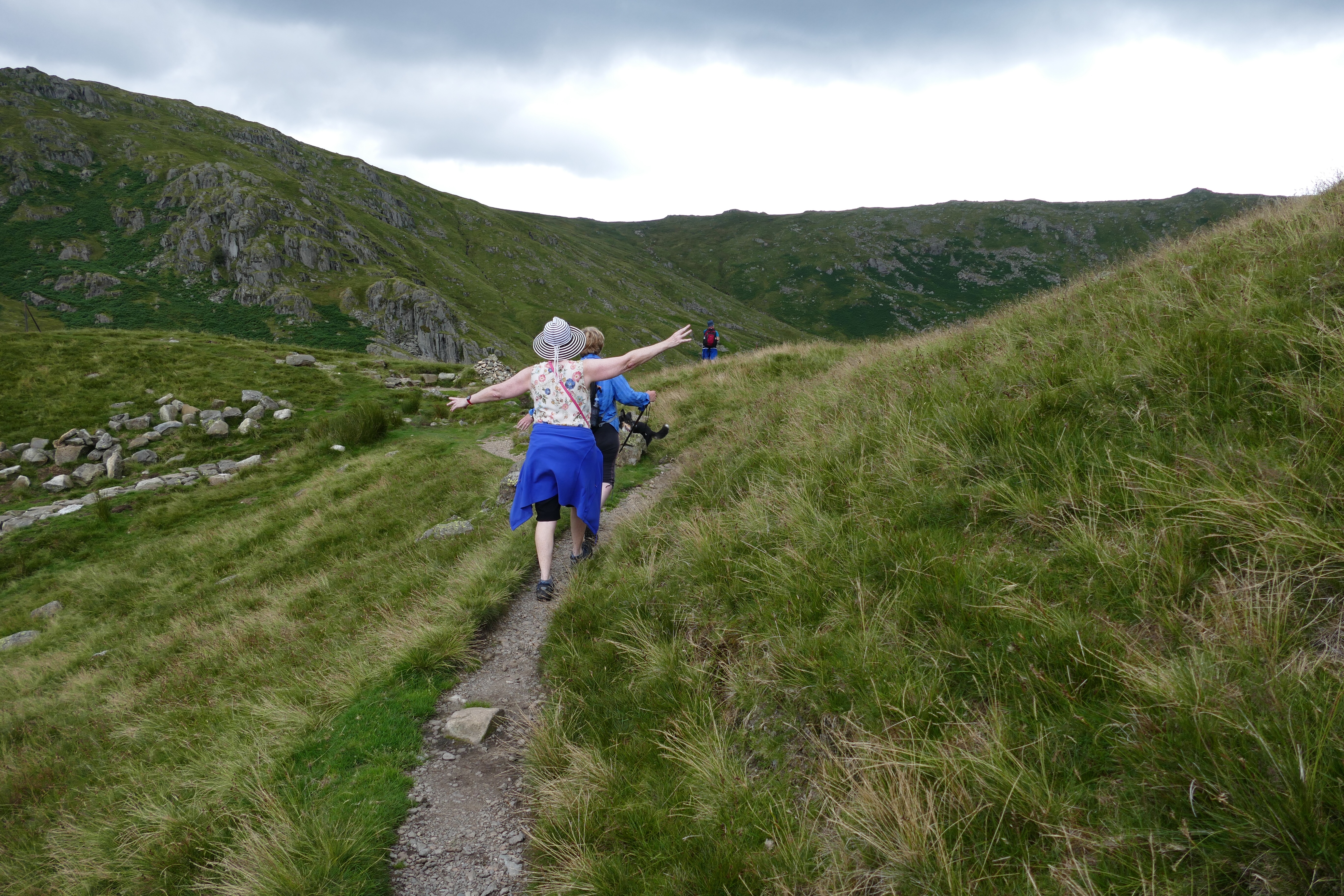
Then, ahead of me, I saw Kathy turn herself into an aeroplane and try to fly… so I wasn’t alone. Could we camp out on the mountain, Bernie might have been thinking. I could tell by her knitted brows she was worried…
Only Jon seemed calm. And he was studying his map, intently. He looked up and smiled.
“I think I’ve got some good news,” he said. We moved closer, following his pointing finger…
To be concluded in Part Three
Other parts in this series:
Part One, This is Part Two
©Copyright Stephen Tanham
Stephen Tanham is a Director of the Silent Eye School of Consciousness, a not-for-profit teaching school of modern mysticism that helps people find a personal path to a deeper place within their internal and external lives.
The Silent Eye provides home-based, practical courses which are low-cost and personally supervised. The course materials and corresponding supervision are provided month by month without further commitment.
Steve’s personal blog, Sun in Gemini, is at stevetanham.wordpress.com.
+ #Cats, #Collie dogs, #FurryFives, #InnerCatPeace, #RagDollCats, #Silenti, Collie dogs, humour, Pet Heaven, Rag Doll Cats, The Inner Cat
#FurryFives – Fallen
by Steve Tanham

-Tess?
Yes, Misti
– I think we need to practice
Practice what, Misti?
– That piggy-back trick!
©Stephen Tanham
Share this:

+ #Silenti, Biology and mysticism, Child of Light, Consciousness, enneagram, esoteric psychology, Fear, Higher Mind, Life and Death, Life-sciences, Love, meditation, Metanoia, Mindfulness, Mystery Schools, Photography, Poetry, Powers of the Mind, Sexual Force, Silent Eye School, soul in body, Speaking truth to power, Spirituality, Travel and Photography
Primal screen
by Steve Tanham

Somewhere in the frontal cortex of our brains there’s a very special junction – a place where we learned to do something truly different with our minds… Let’s call it the Primal Screen…
Our spines can be considered the highway of our historical evolution: the inherited paths of form and energy that developed from single cells in oceans, through fish, lizards and apes. At the apex of this human ‘flower’ is the brain; in which the higher concepts, such as ‘self’ and moral values reside.
Those, like me, who felt uncomfortable with science’s cold and clinical view of life as a series of accidents aimed only at the mating chamber, can now take heart that the biological sciences, themselves, have, for the past twenty years, led the way in redefining the benign complexity of life and breaking us away from the genetic ‘evolution as everything’ model that dominated the life-sciences in the past.
The modern view of the human is a very complex thing, indeed – but wonderfully so. The innate complexity of sub-atomic matter is now matched with a new science – appropriately named ‘complexity theory’ – which studies and tries to understand how ‘dumb’ matter organises itself into increasingly complex forms, as though the whole of Life is experimenting with different ways to something mysterious.
Philosophers, long ago, named this ‘Teleological’; meaning it had a purpose. The modern picture is even more complex – or beautiful, depending on your perspective. Genes do work with survival and species as in the Darwinian model; but that’s not all they do. The new science of Epigenetics shows how genes also ‘express’ their complex proteins within a lifetime to alter the human: they are a living rather than a dead code…
The understand of consciousness has played a part in the cultures of our species for thousands of years, but the division of consciousness into reliable ‘organs’ is a success story of the last century, in the form of psychology.
We can argue that this ignores mystical philosophy, yoga, and Buddhism, each of which have been around for hundreds and, in some cases, thousands of years… But the successes of psychology are real and provide a common basis for us to discuss the concept of ‘self’.
The breaking open of the greater life-sciences has changed everything, and there will come a time when all these journeys of the ‘self’ will be united with an advanced form of today’s biology; but possibly under a new and common language.
So, to return to our opening statement. What was this juncture in our evolution of ‘self’? The philosopher Gurdjieff made it one of the central tenets of his successful system of self-work. He called it Identification. It was the stage in our group evolution when we looked ‘out’ from our presumed separate bubble of ‘me’ and saw high-intensity things that were so interesting we decided they should be an extension of our selves.
Children do do this automatically. Their imagination is so vivid that the pile of rocks on that hill becomes a castle – and can stay so for many years until the maturing adult looks back one day and smiles at how he and his companions brought it to life as Castle Hilltop…
Imagination is not the only component of this extension of self. Identification involves emotions, too. That castle belonged to the boys and girls of the Hilltop Gang – and they defended it, fiercely… It not only belonged to them, it was them.
As we grow into adulthood, the identifications become stronger. Our job – that important place in society, is considered vital. Alternatively, we may develop a skill or craft that becomes our defining set of actions – an artist who locks herself away for weeks while a fine work is created is a positive example. The career-minded politician whose only goal is power, regardless of the cost is a more negative one. That shiny BMW in the top salesman’s drive might be considered a good example of the power that this kind of defining attraction holds.
Identification can be more complex and subtle, too. We can become identified with negative things, like our illnesses or states of depression; allowing them to define who we are. I am not trivialising the difficulty of working with these conditions, just pointing to the mechanism which has such a ‘locking’ power.
The core of what Gurdjieff said – and a big part of the Silent Eye’s first year course work – is to stand back from these ‘suits of armour’ and realise that we are not them. The ‘younger self’ beneath the defences and attachments is where we really live, but it takes a brave soul to begin that journey. Having begun, it actually gets easier, not harder. Each identified state has locked up a lot of the creative energy of our lives. Seeing them for what they are, with exercises to soothe the way, releases that energy… and gives it back to us as a gentle, creative warmth, which pools with its kin to empower a change in the whole being – in a remarkably short time.
Society and civilisation has its Primal Screens, too. We are in a period of global history where these are now threatening our future. As an older society we may see in others’ flag-waving an immature identification–but not be so good at acknowledging our own.
Beneath all of this is our true Self – and that kind, warm and sharing place has never changed, just been papered over like the interior of an old house. All mankind shares this house, and only a recognition of what we share, rather than our projected view of what we don’t, will enable us to free the collective healing energies to work with this beautiful planet.
At that wonderful stage in our collective lives, we may discover far more about ourselves than we thought possible. We might even discover an entirely new concept of purpose…
© Stephen Tanham
Stephen Tanham is a Director of the Silent Eye School of Consciousness, a not-for-profit teaching school of modern mysticism that helps people find a personal path to a deeper place within their internal and external lives.
The Silent Eye provides home-based, practical courses which are low-cost and personally supervised. The course materials and corresponding supervision are provided month by month without further commitment.
Steve’s personal blog, Sun in Gemini, is at stevetanham.wordpress.com.


You must be logged in to post a comment.